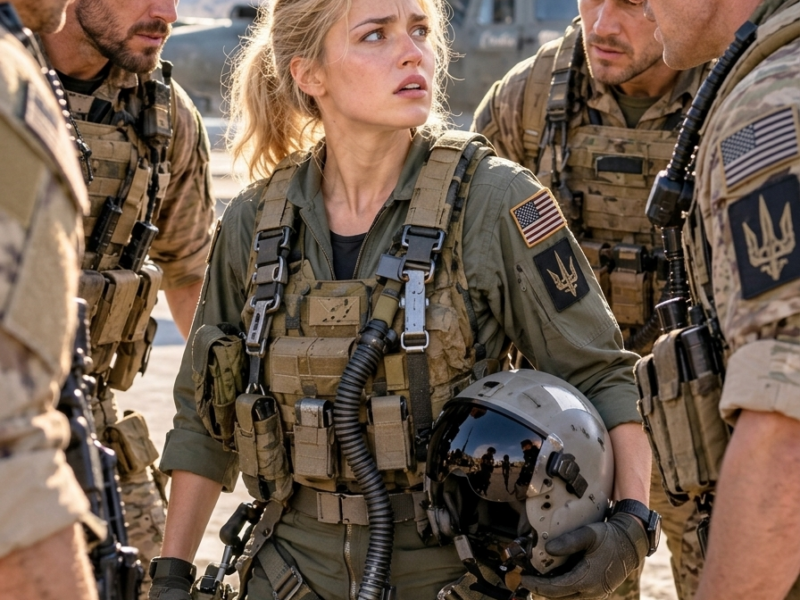
“You’re just secondary support, ma’am, so stay out of my operation,” the Navy SEAL commander sneered in front of his entire team
The air in the joint operations center at Virginia Beach was thick with the scent of stale coffee, copper from overheated server racks, and the cold, invisible weight of unearned authority. Commander Jack Reeves stood under the glow of three eighty-inch tactical monitors, his tactical vest spotless and his spine rigid with the posturing of a man who had climbed the ranks by surviving administrative audits rather than real fire.
He held my mission folder—a forty-page comprehensive analysis of the Target Compound in Al-Badiyah—and tossed it onto the steel briefing table like a deck of worthless cards.
“You’re just secondary support, ma’am, so stay out of my operation,” Reeves sneered, his voice loud enough to carry across the polished concrete floor where twelve men of SEAL Team Seven were making final gear adjustments.
I stood beside the high-resolution satellite array, my hands clasped loosely behind my back, my posture deliberately neutral. “I strongly recommend delaying the insertion, Commander,” I said, keeping my tone level. “The eastern approach is far too clean. No secondary patrols, no improvised barriers. Moreover, the long-wave thermal scans show a distinct heat signature forty feet beneath the abandoned warehouse floor.”
Reeves smirked, looking back at his master chief, who offered a dutiful, quiet chuckle. “Are you here to analyze photographs or lead an operation, Captain Vance?”
“To keep your men alive,” I replied.
A few of the younger operators paused, their hands freezing over weapon magazines and night-vision mounts. They knew the look of a veteran who didn’t raise her voice; they had seen it in their instructors. But Reeves only saw a civilian-clothed intelligence specialist disrupting his tactical authority.
Reeves closed the distance between us, stepping so close I could smell the sharp peppermint on his breath, lowering his voice just enough to make the insult feel intimate and cutting. “Your assignment is communications support and radio routing. Let the professionals do the heavy lifting.”
I closed my folder with a quiet snap. “Yes, Commander.”
I had learned long ago that arguing with arrogant officers in front of their men rarely altered their course; it only forced them to defend their ego at the expense of their personnel.
What Jack Reeves did not know—what his level-three security clearance would never allow him to see—was that six years ago, I didn’t sit behind a desk routing radio frequencies. I had commanded Task Force Blackout, a black-budget special operations unit whose official record was a blank row of zeros in the Pentagon’s archive. My operational call sign was Ghost Six.
For seven years, I operated in deep-denial zones across East Africa, Northern Iraq, and Central Asia—places where support did not exist, where extraction meant walking forty miles through hostile terrain, and where a single dropped signal meant complete erasure. I was the person military intelligence called when conventional forces were already declared dead or captured.
Then came Operation Obsidian Ridge in Syria.
Six of us entered a fortified bunker near the Turkish border to retrieve a compromised hard drive. We were set up. A high-level mole inside our own chain of command had sold our precise entry vector and radio encryption keys to a foreign mercenary company called the Iron Veil.
Five of my operators were executed in the dark. I survived only because my primary radio operator shoved me down an unmapped ventilation shaft as the room was swept with heavy machine-gun fire. I clawed my way out through three miles of irrigation pipe, bleeding from two shrapnel wounds, carrying the drive between my teeth.
The military court cleared me of all operational negligence, but innocence is a cold comfort when you know the names and faces of five families whose sons never came home. I handed in my active badge, stepped down from field command, and accepted a quiet, invisible desk role coordinating communications routes for naval operations. I told myself my war was over.
At 02:17 local time, Reeves’s team executed their high-altitude jump into the Syrian desert and moved on foot toward the compound.
For the first ten minutes, the tactical audio was textbooks and murmurs.
“Vanguard Lead, set on perimeter.”
“Vanguard Two, breaching North entry.”
Then, the world tore apart through the tactical speakers.
A sudden, deafening cascade of automatic weapons fire rattled the overhead monitors, followed by the sharp, metallic concussions of flashbangs and heavy grenades.
“Contact East! Contact East!” a voice screamed through static.
“Multiple shooters on the catwalks! They were waiting for us!”
“Command, we’re taking heavy fire from inside the sub-structure!”
I stepped smoothly toward the primary communications console, my eyes locked on the digital telemetry map. The red and green position icons representing the SEALs were scattering erratically across the layout.
A second later, the entire eastern frequency band went pitch black, replaced by a flat, white hiss.
“Reestablish the primary link!” Reeves yelled, rushing to the main console and grabbing the operator’s shoulder. “Switch to secondary frequency Bravo!”
The young technician’s fingers flew across the mechanical keyboard, his face slick with panic. “I can’t, sir! Someone is jamming the primary, secondary, and satellite relay bands simultaneously! They’re using a sweeping military-grade noise generator!”
I leaned over the signal map, tracking the localized power density of the radio interference. “The jammer isn’t stationary,” I said softly, my voice cutting through the rising panic in the room. “The interference vector is tracking directly with your point element. It’s moving as they move.”
Reeves turned toward me, his face flush with anger. “What did you say?”
“The enemy isn’t reacting to your team’s tactical maneuvers, Commander,” I said, looking him dead in the eye. “They are anticipating them. They are reading your localized telemetry feeds.”
Before Reeves could process the statement, a secondary low-frequency transmission crackled through the emergency backup audio channel.
“Commander… this is Vanguard Three…” heavy, ragged breathing filled the briefing room. “We have two men down… Chief Miller is unconscious… we are pinned in the inner courtyard… the eastern exit is completely blocked by reinforced steel shutters…”
Reeves grabbed the desk microphone, his knuckles turning white. “Vanguard, hold your position! I am requesting immediate close-air support and emergency extraction from Task Force Air!”
He hit the direct hotline to Regional Air Command. “Control, this is Commander Reeves. I need an immediate strike package on target Al-Badiyah and an extraction bird on the LZ!”
The response from Regional Command came back through the main speaker—cold, detached, and absolute.
“Request denied, Commander Reeves. Target area has been designated an active radar-engagement zone. Unidentified surface-to-air missile systems have just brought up active tracking radars in your sector. No air assets will enter that airspace under current parameters. You are on your own.”
The room went deathly still. The SEAL operators standing near the armory rack stared at the radio console in disbelief.
Over the open channel, the sound of heavy boots crunching on broken glass drifted through the speaker, followed by the sharp, rhythmic thud-thud-thud of armor-piercing rounds striking concrete pillars.
“Sir…” the operator whispered, his voice trembling with an emotion no SEAL ever wants to acknowledge. “They’re moving through the interior corridors… they’re surrounding us.”
I recognized that exact tone of voice. I had heard it six years ago in a basement in Syria. It was the sound of brave men realizing that the structure above them was built on lies and that no one was coming to save them.
I didn’t ask Reeves for permission. I reached across his console, grabbed the interactive satellite display, and zoomed past the surface layout directly into the structural infrared layer. I traced a thin, dark blue line running forty feet beneath the western perimeter wall.
“There,” I said, pointing to a subtle thermal gradient. “An old Ottoman-era drainage shaft connects to an unpaved service road half a mile behind the compound.”
Reeves didn’t even look at where my finger was pointing. “We cleared the western quadrant prior to entry. That sector is dead.”
“You cleared the surface entrance, Commander,” I said, my voice dropping into an icy command tone. “You failed to check the subterranean infrastructure.”
He turned on me, his teeth clenched. “You’re guessing, Captain! You’re staring at outdated thermal maps and guessing with my men’s lives!”
“I’m not guessing,” I said, leaning in until I was inches from his face. “I’m remembering. I was in this exact valley eight years ago.”
Before Reeves could respond, the communications console emitted three sharp, rhythmic electronic tones—a triple-flash priority override code that instantly froze every screen in the center.
The primary audio channel cleared, and a high-ranking voice from the National Military Command Center in Washington came through the secure line, distorted by heavy quantum encryption.
“Joint Ops Virginia Beach, this is Director Vance at NMCC. Who is currently directing tactical communications for Operation Vanguard?”
Reeves straightened his shoulders and leaned into the mic. “This is Commander Jack Reeves, sir. I am the operational commander.”
A two-second silence stretched across the satellite link.
“That is not what I asked, Commander Reeves,” the Director’s voice was sharp enough to slice glass. “Is Ghost Six in the room?”
Every head in the room snapped toward me. The operators, the technicians, and the intelligence analysts all stared at me as if I had suddenly transformed into a stranger.
Reeves’s face drained of color. His jaw loosened slightly, his hand slipping off the console desk. He looked at me not as a subordinate intelligence officer he could insult, but as a ghost rising out of a classified grave.
I stepped forward, pulled the main headset off the console stand, and slipped it over my ears.
“This is Ghost Six,” I said into the microphone.
Director Vance exhaled deeply over the secure line. “Ghost Six… you need to pay very close attention to what I am about to tell you. The hostile force inside that compound isn’t just ambushing a SEAL team. They know your identity. They knew you were on duty at the comms station tonight.”
A cold wave swept down my spine. “Explain.”
A top-secret file package automatically populated my central monitor. It displayed high-altitude drone footage of the compound, real-time vital signs of the trapped team, and a high-resolution mugshot of a man with a jagged scar across his throat—a man I had personally watched fall into a burning fuel depot six years ago.
Major Viktor Volkov. The former Spetsnaz officer who had accepted three million dollars to betray Task Force Blackout in Syria.
Director Vance’s final sentence hit my ears like a physical bullet.
“Ghost Six… Volkov is inside that building right now with your people. And he brought the original encryption keys.”
I stared at the screen, my heart hammering against my ribs, as Reeves slowly reached down toward his tactical holster.
Before he could touch the weapon, the trapped SEAL operator’s voice crackled through the speaker one last time, ragged and desperate.
“Ghost Six… if you can hear this… don’t trust the tactical feed! There’s something you need to know about the woman who authorized our deployment…”
The audio line snapped off into static.
The silence in the control room was deafening, broken only by the low electronic hum of the servers and the frantic clicking of cooling fans.
I didn’t turn my head, but my peripheral vision was locked on Commander Reeves’s right hand, which was resting unsteadily on the retention strap of his sidearm. The twelve operators standing near the back of the room were looking between Reeves and me, their instincts telling them that the war had suddenly shifted from a desert compound three thousand miles away into the very room they stood in.
“Step away from the console, Commander,” I said softly, my eyes never leaving the central display.
“Captain Vance—or whoever you are,” Reeves stammered, his voice lacking every drop of its previous bravado. “You are not in the chain of command. You have no authority to take control of a naval operation.”
“Director Vance,” I spoke clearly into the headset. “Initiate Command Protocol Zero-Black. Suspend Commander Jack Reeves’s operational security clearance immediately.”
“Protocol Zero-Black confirmed,” the Director’s voice boomed over the room’s master speakers. “Commander Reeves, you are hereby relieved of command. Captain Vance has full tactical authority over Task Force Vanguard. Any interference will be treated as treason under wartime directives.”
Reeves froze. His hand slowly slipped away from his holster, his face pale, sweat glistening on his forehead.
“Master Chief,” I called out, turning my gaze to the senior non-commissioned officer standing among the operators. “Isolate Commander Reeves in the side office. Secure his personal phone, his tablet, and his flash drives.”
The Master Chief didn’t hesitate. He had heard the fear in his men’s voices over the radio; he knew that whoever Ghost Six was, she was their only chance of coming back alive. He stepped forward, grabbed Reeves by the upper arm with an iron grip, and led him into the glass partition room, locking the door behind him.
I sat down in the main pilot chair at the tactical desk, pulling the master headset over my ears and adjusting the boom mic. The grief, the guilt, and the six years of self-imposed isolation evaporated, replaced by the razor-sharp, lethal clarity that had kept me alive in the darkest corners of the world.
“Listen up!” I barked to the remaining technicians. “I want raw wide-band spectrum analysis of the target zone on Screen One. I want the secondary infrared feed from the orbital satellite on Screen Two. And get me a direct, unrouted signal bridge to the local tactical net!”
“Ma’am, the local net is jammed!” the chief technician yelled, his hands flying across his keyboard. “The high-power frequency sweep is blocking every attempt to lock a carrier wave!”
“They’re using a directional phase-array jammer operating on a repeating pseudo-random sequence,” I said, typing a long string of manual override code into the terminal—a code I had memorized six years ago in the Syrian desert. “The sequence repeats every 4.2 seconds to allow their own operators to transmit encrypted burst-data. Time your handshake request to the 4.2-second pulse window!”
The technician stared at me for a split second in awe, then slammed the enter key.
BEEP-CLICK.
The red warning light on the console turned a solid, steady amber. A clear audio stream opened, carrying the distant, heavy thud of automatic weapons fire and the rapid, shallow breathing of the trapped SEALs.
“Vanguard Lead, this is Ghost Six,” I said, my voice steady, slow, and commanding. “Do you copy?”
A beat of heavy static, then a voice broke through—it was Lieutenant Miller, the second-in-command on the ground. “Ghost Six! We copy! We are pinned in the sub-basement courtyard! Chief Henderson is down with a thigh wound, and Lieutenant Vance—I mean, Lieutenant Miller—is holding the stairwell! We’re running low on ammunition!”
“Listen to me very carefully, Miller,” I instructed, pulling up the structural wireframe of the building. “The force attacking you is not a local insurgent cell. They are professional military contractors using heavy electronic warfare assets. They know your standard extraction protocols. If you try to break toward the eastern gate, you walk straight into a crossfire.”
“What are our orders, ma’am?” Miller asked, the raw panic in his voice beginning to stabilize under the weight of my calm instructions.
“Look at the western wall of the sub-basement,” I commanded. “There is a corrugated iron ventilation plate behind the old generator unit. Kick it out. It leads directly into an Ottoman-era stone drainage conduit. Move your wounded through that conduit now!”
“Ma’am! That conduit isn’t on our target map!”
“It’s on mine,” I said grimly. “Execute!”
On the satellite infrared display, I watched five glowing heat signatures shift position, moving away from the main doorway where heavy enemy fire was concentrated and converging on the hidden western wall. A moment later, the icons slid one by one into the cool blue shadow of the subterranean tunnel, vanishing from the enemy’s surface radar scope.
“Ghost Six, this is NMCC,” Director Vance’s voice cut back into my earpiece. “We have isolated the signal origin of the leak that compromised Vanguard’s entry vector. The transmission was sent from inside Virginia Beach forty minutes prior to launch.”
My hands tightened on the edge of the desk. “Who sent it?”
“The authorization credentials belonged to an administrative account assigned to the Fleet Intelligence Directorate,” Vance revealed. “Specifically, the personal terminal of Captain Sarah Vance—your desk, Sarah.”
My blood ran cold. The mole hadn’t just compromised the operation; they had used my own administrative credentials to frame me for the breach, creating a perfect paper trail that would brand me a traitor the moment Vanguard Team was wiped out.
“It’s a mirror-routing script,” I whispered, the tactical puzzle pieces slamming together in my mind with terrifying speed. “Whoever accessed my computer didn’t do it from my office. They used an active remote-access bridge through the local tactical server. That’s why Reeves was so eager to push me out of the room—he was the physical gateway.”
I turned my head to look through the glass partition into the side office. Commander Reeves was sitting at the wooden desk, but he wasn’t looking at the floor or wringing his hands in distress.
He was staring directly at me through the glass, a cold, unnatural smile slowly spreading across his face as he held up a tiny, dark blue USB transmitter hidden between his fingers.
Before I could spring out of my chair, the glass partition room erupted in a blinding flash of white light and a muffled concussion.
Reeves had activated a localized thermite charge built directly into his secure tablet, scorching the metal desk, melting his phone, and shattering the reinforced glass into a shower of harmless fragments. The room filled with thick, gray chemical smoke.
“Security!” I shouted, drawing my sidearm from the hidden compartment beneath the main console.
The Master Chief smashed open the door, his weapon raised, but Reeves was already down on his knees, his hands locked behind his head, laughing quietly through the haze of smoke.
“It’s too late, Sarah,” Reeves wheezed, his eyes red from the fumes. “The package was delivered twenty minutes ago. Volkov has the raw telemetry, the live biometric feeds, and the active extraction coordinates. Your little ghost hunt ends tonight.”
I stepped into the smoky room, the barrel of my weapon pointed directly at his chest, my finger taking up the slack on the trigger. “Why, Reeves? You were a commissioned officer. You took an oath.”
“An oath to what?” Reeves spat, looking up at me with pure venom. “To a military that buries its best operators in windowless offices while bureaucrats trade defense contracts? Volkov paid ten million dollars for the Task Force Blackout archive. He didn’t just want the operational records, Sarah—he wanted you. He knew that if he put a SEAL team in a meat grinder, Ghost Six would be forced back onto the net.”
I realized the horror of the situation in an instant.
The entire operation—the deployment of SEAL Team Seven, the false intelligence about an insurgent high-value target in Syria, the deliberate jamming—was a massive, elaborate trap designed to lure me into taking active command of a tactical communications frequency, allowing Volkov’s cyber-warfare suite to lock onto my unique encryption signature and reverse-engineer my identity.
“Master Chief,” I commanded, my voice dropping an octave. “Zip-tie him to the steel pillar. If he moves a finger, shoot him.”
“Understood, Captain,” the Master Chief growled, slamming Reeves down onto the concrete floor.
I rushed back to the master console. On the primary tactical display, the five blue icons representing the surviving SEALs were moving slowly through the dark blue line of the underground drainage conduit. But behind them, three large red icons—heavy armored enemy units—had just entered the western access hatch and were moving rapidly into the tunnel system to intercept them.
“Vanguard Lead!” I called into the mic. “You have pursuers entering the drainage tunnel behind you! Three hostile elements, heavily armed, moving fast! You have less than two minutes before they close the distance!”
“Ghost Six!” Miller’s voice came back, heavily distorted by the stone walls of the tunnel. “Chief Henderson can’t run! His leg is shredded! We can’t outrun them in this narrow pipe!”
“Listen to me, Miller,” I said, pulling up the structural blueprint of the Ottoman conduit. “Three hundred meters ahead of your current position, the tunnel intersects an old iron water sluice gate. There is a manual override lever on the north wall. Do you see it?”
A pause, followed by the sound of boots splashing through shallow water. “I see it! It’s rusted shut!”
“Use a breaching charge on the iron hinges!” I ordered. “Drop the gate behind you! It will seal the tunnel and flood the lower section with three feet of stagnant water, blocking their line of sight!”
“Copy that! Setting charge now!”
On the screen, I watched the blue icons pause at the junction point. A deep, muffled rumble vibrated through the audio net as the explosive detonated, followed by the heavy, metallic screech of tons of iron sliding down into concrete tracks.
The red icons pursuing them slammed into the dropped gate, their forward momentum halted completely.
“Gate is down!” Miller yelled. “Pursuers blocked! We are emerging into the open desert half a mile west of the compound!”
“Good work, Vanguard,” I breathed, relief washing through me for a fleeting second. “Now get your men into defensive positions behind the stone ruins at grid zero-four-nine. I am routing an automated extraction drone to your location.”
“Ghost Six…” Miller’s voice suddenly grew solemn, the excitement of their escape vanishing. “There’s something else. Before we broke out of the sub-basement, we found a secondary server room… it was running a live video feed directed at Virginia Beach.”
My hand froze over the console keys. “What kind of video feed?”
“It was a message, Captain,” Miller whispered. “A recorded video file addressed directly to Ghost Six. The man in the video… he said he knew you were listening. He said he was holding the original flight manifest from Operation Obsidian Ridge.”
My breath caught in my throat. Operation Obsidian Ridge was the mission where my five operators had died six years ago. The official report stated that our extraction helicopter had been shot down by an RPG while attempting to land. But I had never seen the physical air manifest or the wreckage with my own eyes.
“What did he say, Miller?” I asked, my voice barely above a whisper.
“He said…” Miller hesitated, taking a deep breath. “He said your team didn’t die in that bunker, Captain. He said they were taken alive… and one of them is still inside that compound.”
The words echoed through the headset like an icy wind, freezing the blood in my veins.
Taken alive.
For six agonizing years, I had carried the crushing weight of survivor’s guilt, believing that my tactical miscalculation had caused the immediate deaths of five extraordinary operators—my friends, my family, the people who had trusted me with their lives in the darkest corners of the earth. I had spent six years staring at five names etched into a private memorial stone, convincing myself that their sacrifice was swift.
To learn that they might have been captured—that one of them might still be breathing inside an enemy containment cell three thousand miles away—was a revelation so devastating it nearly brought me to my knees.
“Director Vance,” I said into the primary NMCC channel, my voice trembling with suppressed rage and raw focus. “Did you copy Vanguard’s last transmission?”
“I heard it, Ghost Six,” Vance replied, his voice heavy with grave concern. “We are analyzing the tactical server logs from the compound now. Sarah… you cannot allow this information to compromise your tactical judgment. Volkov is a master of psychological warfare. He knows your history. He is using your past to draw you into a personal mistake.”
“He doesn’t need to draw me in, Director,” I said, reaching down to my utility belt and retrieving a classified satellite access card—an old Task Force Blackout emergency override module I had kept in my pocket for six years. “He’s already inside my operational area. And I am going to finish this.”
I slammed the access card into the console’s master slot.
The main tactical map flared bright blue as a high-altitude, low-observable stealth drone—a Ghost Hawk asset orbiting at sixty thousand feet above the Syrian desert—was immediately commandeered by my terminal. The drone’s primary weapon system, a pair of precision-guided kinetic penetrator missiles, loaded into the active targeting array.
“Vanguard Lead,” I called out to Lieutenant Miller. “Is your team clear of the compound perimeter?”
“We are set up in the stone ruins, ma’am,” Miller answered. “We have a clear line of sight to the western wall. But Ghost Six… if you’re planning a strike, you need to know that the heavy structure over the main bunker is reinforced concrete. Standard ordinance won’t penetrate to the lower cells.”
“I’m not aiming for the main bunker, Miller,” I said, my fingers flying across the targeting screen, locking the drone’s optical tracker onto a tiny, unarmored air intake shaft situated on the roof of the northern wing—the exact ventilation shaft I had crawled through six years ago to escape the compound. “I’m aiming for their primary power grid.”
I looked down at the infrared telemetry. Volkov’s heavy jamming equipment and high-intensity electronic warfare suite required massive amounts of electrical power, which was being drawn from two heavy diesel generators located directly beneath that air intake.
If I destroyed the generators, their electronic shield would collapse, their secure data servers would initiate an emergency lock down, and their internal communications would be completely severed, leaving Volkov’s team blind in the dark.
“Target locked,” I announced. “Firing Weapon One!”
A high-velocity kinetic missile detached from the stealth drone, screaming down through the upper atmosphere at Mach 4.
On the satellite camera, a tiny white streak descended from the sky, striking the air intake shaft with mathematical precision. A second later, a brilliant shockwave of orange flame and black smoke erupted from the northern roof as the diesel generators exploded in a catastrophic secondary detonation.
BOOM!
The localized tactical map flared red, then instantly cleared.
The heavy white noise jamming that had suffocated the sector for two hours vanished completely. The primary, secondary, and satellite radio channels flooded back to life with crisp, clean audio signals.
“Direct hit!” Miller cheered over the radio. “Target power grid is completely neutralized! Their exterior searchlights are dark!”
“Director Vance,” I spoke into the NMCC line. “The jammer is destroyed. You now have clean airspace. Send in Task Force Air for Vanguard’s extraction immediately.”
“Extraction package is inbound, ETA four minutes,” Vance confirmed. “Great work, Ghost Six. Now bring your team home and step down.”
“Negative, Director,” I said, standing up from the pilot chair and pulling a tactical radio transponder from my desk drawer. “Vanguard is clear, but the operation isn’t over.”
I turned to the Master Chief, who was standing beside the bound Commander Reeves. “Master Chief, you have tactical control of this console. Maintain Vanguard’s defensive perimeter until the extraction helicopters arrive.”
“Captain,” the Master Chief looked at me with deep concern. “Where are you going?”
“I’m stepping out of this control room,” I said, sliding the transponder into my vest. “Director Vance, patch my headset into a direct tactical satellite channel. I’m going to speak to Major Volkov personally.”
A three-second pause, then a secure audio line clicked open, linking my headset directly to an unencrypted tactical radio sitting on the desk inside the burning, darkened compound in Syria.
A low, raspy laugh answered through the speaker—a voice ruined by fire and time.
“I knew you couldn’t resist, Ghost Six,” Major Volkov said, his breathing heavy against the microphone. “You always were too noble for your own good.”
“The game is over, Volkov,” I said, my voice cold as ice. “Your power is gone, your jamming is dead, and a full squadron of AH-64 Apache gunships is four minutes away from leveling that compound to the ground. You have nowhere to run.”
“I don’t need to run, Sarah,” Volkov chuckled darkly. “I achieved my objective the moment you used your personal encryption card to fire that drone missile. Your location, your active biometric profile, and your Task Force Blackout credentials have just been uploaded to an anonymous offshore server.”
“And what good does that do a dead man?” I countered.
“It proves that Task Force Blackout never ended,” Volkov whispered sneeringly. “It proves that the United States government maintained a black-budget assassination unit in violation of international law. Tomorrow morning, those records will be broadcast to every news network on the planet.”
“Unless I execute Command Delete,” I said quietly.
The laughter on the other end of the line abruptly stopped.
The silence on the direct satellite line was heavy, broken only by the crackle of distant fires burning inside the Syrian compound.
“Command Delete,” Volkov repeated, his voice losing its mocking edge, replaced by a sudden, sharp tension. “You don’t have the master authorization key. That key was destroyed when your team died in Syria.”
“The key wasn’t destroyed, Volkov,” I said, holding up a small, worn silver dog tag that hung around my neck beneath my shirt—the tag belonging to my primary radio operator, the man who had thrown me down the ventilation shaft to save my life. “My operator didn’t just save me that night. He transferred the master wipe protocol into my personal transponder before the room was breached.”
For six years, I had worn that tag as a reminder of my failure. I had never realized that inside the tiny, high-density storage chip embedded within the metal lay the ultimate fail-safe—a complete, nuclear-option cyber-erase command capable of purging every piece of Task Force Blackout data from every server in the world, including the offshore drive Volkov had just uploaded.
“You execute that command, Sarah,” Volkov warned, his tone dropping into a dangerous growl, “and every record of your team’s existence is erased forever. No official records, no honors, no legacy. They will truly become ghosts.”
“They were never defined by your servers, Volkov,” I said, my voice steady and filled with absolute peace. “They were defined by the lives they saved.”
I inserted the silver tag into the console’s master terminal and typed the final six-digit execution code.
“This is Ghost Six,” I said into the mic. “To all units, stand by for complete data purge.”
“Sarah, wait!” Volkov shouted over the line. “The man in the lower cell—he’s still alive! If you execute the wipe, the automated security doors in the sub-basement will seal permanently! He will be trapped inside!”
My fingers hovered over the enter key. My heart pounded against my ribs like a trapped bird. It was the ultimate psychological test—a choice between saving the ghost of my past or protecting the future of every operative currently serving in the field.
Then, a weak, heavily static-laden voice broke through a tertiary emergency channel—a voice that was faint, raspy, but unmistakable.
“Ghost Six… this is… Vanguard Five…”
It was Chief Henderson, the wounded SEAL sitting in the stone ruins with Lieutenant Miller.
“Captain Vance… don’t listen to him…” Henderson wheezed through his oxygen mask. “We swept the lower cell before we blew the sluice gate… the cell was empty, ma’am. It was a projection… a pre-recorded loop designed to hold you hostage.”
A cold, beautiful clarity washed over me. Volkov had never held any survivors. He had constructed a brilliant, cruel illusion using six-year-old audio files to keep me from pressing that key.
I looked through the glass window of the Virginia Beach control room out toward the horizon, where the first pale light of dawn was beginning to break over the Atlantic Ocean.
“Thank you, Vanguard,” I whispered.
I turned back to the console and slammed my hand down onto the master enter key.
EXECUTE COMMAND DELETE.
On the main display, tens of thousands of complex data streams began to collapse into rows of zeros. In offshore servers in Switzerland, in cloud storage arrays in Eastern Europe, and on the hard drives sitting inside the burning Syrian compound, every file, every telemetry log, every photo, and every record associated with Task Force Blackout and Ghost Six was systematically overwritten with random noise and erased permanently from human history.
Inside the Syrian compound, a sudden cascade of electrical short-circuits detonated the server racks, sparking an immediate fire that consumed the entire tactical room.
Over the radio, I heard Volkov scream as his primary terminals went pitch dark, followed by the deafening, majestic roar of two AH-64 Apache gunships arriving over the target compound.
“Command,” the lead Apache pilot radioed in. “Hostile compound is neutralized. Target structure is down. Extraction helicopters are picking up Vanguard Team now. All five operators are accounted for and secure.”
The control room in Virginia Beach erupted into wild cheers and applause. Technicians were hugging each other, operators were slapping the Master Chief on the back, and Director Vance was exhaling a long, relieved sigh over the NMCC hotline.
I slowly removed my headset, setting it down gently on the console desk.
Commander Reeves was led away by two military police officers, his career ended, his face dark with shame as he was taken into federal custody.
I walked out of the Ops center, stepping through the heavy steel doors out onto the high balcony overlooking the airfield. The morning wind was cool and fresh, blowing away the stale scent of ozone and smoke.
Director Vance stepped out onto the balcony a few minutes later, holding two hot cups of coffee. He handed one to me, looking out at the rising sun.
“Every record is gone, Sarah,” Vance said quietly. “As far as the official military record is concerned, Task Force Blackout never existed. And Ghost Six is a myth.”
“Good,” I said, taking a sip of the warm coffee. “That’s how it was supposed to be.”
“What will you do now, Captain?” Vance asked. “You proved today that you belong in tactical command. I can have a full strike wing assigned to you by Monday.”
I looked down at my hands—hands that no longer shook with the guilt of the past, hands that had brought five brave men home from an impossible situation.
“I spent six years hiding from the sky because I was afraid of the ghosts,” I said, looking up at the bright blue horizon where two F-35 fighters were roaring into the morning clouds. “I think it’s time I stepped back into the light.”
I pulled the empty silver casing of the access card from my pocket and tossed it into the recycling bin near the door.
I was no longer a ghost hiding in the shadows of Syria. I was a commander, a protector, and a guardian of the men and women who risked everything in the dark.
And as long as there were lives to save, I would be waiting at the console.
The end









