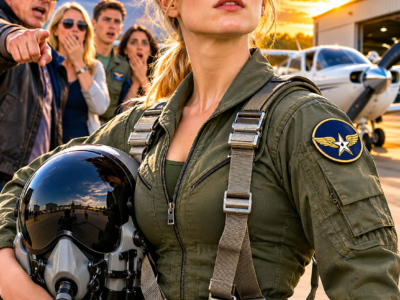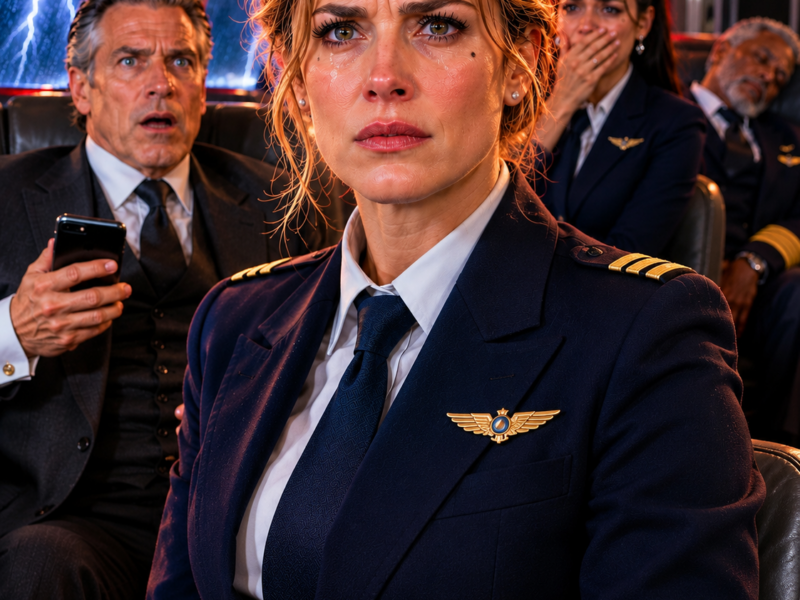
“I was serving champagne to an arrogant billionaire in first class when he deliberately spilled an entire glass down my uniform and promised to have me fired before we landed
The first thing I heard after identifying myself was the controller asking me to repeat my last transmission.
Not because he hadn’t understood me.
Because he couldn’t believe me.
“Flight 728, confirm your identity. Are you a current commercial pilot?”
I tightened my grip on the controls.
“Negative. I am a former United States Navy pilot. I have logged over two thousand flight hours, including carrier operations. I am currently a senior flight attendant aboard this aircraft.”
There was a pause.
Then the controller’s voice returned, sharper now.
“Flight 728, do you understand the aircraft you are operating?”
“I understand enough to know I need help.”
That was the truth.
I knew how to fly. I knew how to read instruments, manage speed, and respond to changing conditions. But I had never flown this particular aircraft. I had never been responsible for more than a crew and a handful of people in a training environment.
Now there were 186 passengers behind me.
And two pilots unconscious on the floor.
“Understood,” the controller said. “We are declaring an emergency and connecting you with our airline operations center. Keep the aircraft on autopilot. Do not make any unnecessary control inputs.”
“I won’t.”
I glanced at the captain.
Walker was still breathing, but his face had gone pale. Dan lay beside him, one arm twisted awkwardly beneath his body.
I had checked their pulses twice.
They were alive.
That was all I could promise myself for now.
“Flight 728,” the controller continued, “what is your current altitude?”
I read the instruments aloud.
He asked for our heading, speed, fuel, and the status of the autopilot. I answered as accurately as I could, fighting the urge to look at the cockpit door.
I knew what was waiting outside.
Fear.
Confusion.
And Richard Whitmore.
The man who had spent the flight making sure everyone knew how important he was.
Now he was going to discover how little his money could do.
“Claire?”
Megan’s voice came through the cockpit doorway.
I turned.
She stood there with one hand gripping the frame, her face drained of color.
“What’s happening?”
“Both pilots are incapacitated. I’m in control.”
Her eyes moved from me to the men on the floor.
For a moment, she looked as if she might faint.
Then she swallowed.
“What do you need?”
That question nearly broke me.
Not because it was complicated.
Because she hadn’t asked whether I could do it.
She had asked how she could help.
“I need you to keep everyone calm. Tell them we’re dealing with a medical emergency and that air traffic control is assisting us. Don’t tell them we’re without pilots unless you absolutely have to.”
“Okay.”
“And Megan?”
She stopped.
“Keep people away from the cockpit. Especially anyone who thinks they can help by coming in here.”
She nodded.
“I’ll handle it.”
Before she left, I caught her wrist.
“Are you scared?”
Her eyes filled.
“Terrified.”
“Me too.”
She gave me the smallest nod.
Then she walked back into the cabin.
The controller returned with another voice on the frequency.
“Flight 728, this is Captain Lewis with your airline’s flight operations team. I’ve been briefed on your situation. We’re going to work through this together.”
I closed my eyes for half a second.
A familiar voice.
Calm.
Professional.
No judgment.
“Captain Lewis, I need you to understand that I haven’t flown in nine years. I have military experience, but I am not qualified on this aircraft.”
“We understand. Our immediate priority is keeping the airplane stable. The autopilot is doing that now. We will guide you through everything else.”
I looked at the instrument panel.
Nine years.
Nine years since I had sat in a cockpit and trusted myself to bring an aircraft safely through the sky.
Nine years since the last flight of my career.
Nine years since I had watched a fellow pilot disappear into a wall of smoke and fire.
I pushed the memory away.
Not now.
“Understood,” I said.
“First, we need to know whether the pilots are receiving medical attention.”
“They’re breathing. I have basic medical supplies, but I need someone qualified to assess them.”
“Is there a doctor aboard?”
“I don’t know.”
“Have your cabin crew make an announcement.”
I pressed the interphone.
“Megan, can you ask whether there’s a medical professional on board?”
“Already doing it.”
Her voice sounded steadier now.
A few seconds later, she came back.
“We have a physician in economy. A woman named Dr. Patel. She’s coming forward.”
“Bring her in.”
I turned back toward the instruments.
The aircraft was steady, but the weather ahead was getting worse. A broad band of storms stretched across our route, and the radar showed a cluster of intense cells directly in front of us.
“Captain Lewis,” I said, “we’re approaching weather.”
“I see it. We are going to request a diversion around the strongest cells. Do not attempt to change course until we coordinate it.”
“Copy.”
The cockpit door opened again.
A woman in her fifties stepped inside carrying a small medical bag.
“I’m Dr. Patel.”
“Thank you for coming.”
She knelt beside Captain Walker, checked his airway, then moved to Dan.
“Are they breathing?” I asked.
“Yes. Both have pulses. I need more room.”
I moved as far as I could without disturbing the controls.
Dr. Patel worked quickly, checking their pupils and blood pressure. Her expression tightened.
“Something happened to them very suddenly,” she said. “This isn’t ordinary fainting.”
“Can you tell what?”
“Not yet. They need hospital care.”
I felt my stomach drop.
“Can they wake up?”
“I can’t promise that.”
For a moment, the cockpit seemed to tilt.
Then the radio crackled.
“Flight 728, we have a route update. We are clearing you to turn left ten degrees to avoid the storm cell. Confirm when established.”
I looked at the instruments.
Ten degrees.
I could do that.
“Flight 728 turning left ten degrees.”
I made the adjustment carefully, watching the heading change.
The aircraft responded smoothly.
I exhaled.
It was a tiny thing.
A routine correction.
But it was the first time in nine years that I had moved an aircraft and watched it obey.
And for the first time, I believed I might actually bring us through this.
Then a voice came from behind me.
“Are you seriously letting a flight attendant fly this plane?”
Richard.
Of course.
I turned my head.
He stood in the cockpit doorway, holding his phone.
Megan was behind him, trying to keep him back.
“Mr. Whitmore, you need to return to your seat,” she said.
“This is insane. I want to speak to the airline’s management.”
“You can speak to them after we land.”
“I am not sitting back there while someone who serves drinks plays pilot.”
I stared at him.
“Mr. Whitmore, unless you have flight training, you need to leave this cockpit.”
His mouth tightened.
“I have more experience managing people than you have doing anything.”
“Then you should understand what an emergency is.”
His face flushed.
“I know exactly what this is. It’s a liability disaster. If this plane crashes, I want it on record that I objected.”
Dr. Patel looked up from the captain.
“Sir, two people are unconscious. Please stop making this harder.”
Richard opened his mouth.
Then he noticed the captain’s condition.
For the first time all flight, he had nothing to say.
Megan stepped forward.
“Mr. Whitmore, now.”
He backed away, muttering something about lawyers.
I returned my attention to the instruments.
But my hands were shaking.
Not from his words.
From the memory of another man telling me I wasn’t ready.
A man who had once stood beside me in a hangar and promised that we would always fly together.
I heard his voice in my head.
You can’t save everyone, Claire.
I swallowed.
Not everyone.
But I could try to save these people.
The controller came back.
“Flight 728, we have an update. We are arranging a diversion to Denver International Airport. Weather conditions are favorable there, and emergency medical services are standing by.”
Denver.
I knew the airport. I had landed there before, years ago, during a Navy training exercise.
“Copy. Denver.”
“Your estimated arrival is approximately fifty minutes. We will provide vectors and support throughout the approach.”
Fifty minutes.
I could hold steady for fifty minutes.
I repeated the words silently.
Hold steady.
Stay ahead of the aircraft.
Don’t rush.
The storm moved around us, and the turbulence grew stronger. The cabin shook hard enough that I heard a crash somewhere behind the cockpit.
Megan’s voice came over the interphone.
“Claire, we’ve got a passenger injured in the middle cabin. A woman hit her arm against an armrest.”
“Is she conscious?”
“Yes. Dr. Patel’s assistant is with her.”
“Keep everyone seated and secured.”
“Understood.”
Then Megan added, quietly, “People are asking if we’re going to be okay.”
I looked at the instruments.
I wanted to tell her yes.
I wanted to promise every person on that plane that nothing bad would happen.
But I couldn’t.
“Tell them we’re doing everything possible to get them safely on the ground.”
“Okay.”
I heard her take a breath.
“And Claire?”
“Yes?”
“I’m proud of you.”
The words landed harder than I expected.
I blinked quickly.
“Thank you.”
The next thirty minutes passed in a blur of instructions.
The airline’s operations captain talked me through the aircraft systems. Air traffic control cleared the route. I monitored the autopilot, checked the readings, and reported every change.
I did not pretend to know what I didn’t know.
When I was uncertain, I asked.
When I needed confirmation, I waited.
And when the aircraft shook, I kept my hands steady.
Then, just as the storm began to fade behind us, Captain Walker moved.
Dr. Patel leaned over him.
“Captain? Can you hear me?”
His eyelids fluttered.
“Captain Walker,” I said, “it’s Claire. We’re diverting to Denver.”
He tried to speak, but only a faint sound came out.
Dr. Patel checked him again.
“Don’t try to move. Just stay still.”
His eyes shifted toward me.
For one brief second, I saw recognition.
Then he looked at the controls.
His lips moved.
I leaned closer.
“What?”
He swallowed.
“Don’t…”
“Don’t what?”
His eyes closed again.
Dr. Patel looked at me.
“Give him time.”
I turned back to the instruments.
But his unfinished sentence stayed with me.
Don’t.
Don’t what?
Don’t descend?
Don’t trust the autopilot?
Don’t fly?
The radio crackled.
“Flight 728, prepare for initial descent. We will begin guiding you toward the airport.”
I focused on the instructions.
There would be time to wonder later.
If there was a later.
When we began our descent, I felt the weight of the passengers behind me more heavily than before.
Every seat held a life.
Every family waiting at the destination.
Every person who had boarded that plane expecting nothing more dramatic than a meal, a movie, and a safe arrival.
I thought about Margaret, the older woman in first class.
She had been traveling to see her daughter.
She had shown me a photograph of her granddaughter earlier in the flight.
A little girl with two missing front teeth and a pink ribbon in her hair.
“She’s waiting for me,” Margaret had said.
I wondered whether she was still looking at that photograph.
I wondered whether she knew how close we were to losing everything.
Then I remembered the last words she had said to me before the turbulence.
“Don’t let anyone make you feel small, dear. People who need to humiliate others are usually trying to hide something.”
I almost smiled.
Even now, her kindness was with me.
“Flight 728,” the controller said, “we are preparing you for the approach. You will be landing on runway 34R. Winds are light and visibility is good.”
I repeated the information.
Captain Lewis came back on the airline channel.
“Claire, we’re approaching the most demanding part of this operation. I want you to listen carefully. We’ll take this one step at a time.”
“I am listening.”
“You have done well so far. Don’t let the pressure make you rush.”
“I won’t.”
“Do you understand the landing configuration?”
I looked at the panel.
“I understand the basics. I need you to guide me through the aircraft-specific procedures.”
“We will.”
I glanced at the captain on the floor.
He was still unconscious.
Dr. Patel was monitoring him and Dan.
There was no one else who could take the controls.
It was me.
I had spent nine years believing that my past was something I had to bury.
Now it was the only reason I could help.
The descent continued.
The runway was still invisible, hidden beyond the clouds and the distant lights of Denver.
The controller gave us another heading.
I adjusted carefully.
Then another instruction.
I followed it.
My breathing grew shallow.
I forced it slower.
In.
Out.
In.
Out.
“Flight 728, you are cleared for approach.”
I repeated the clearance.
The cabin interphone buzzed.
Megan.
“Claire, I need to tell you something.”
“Go ahead.”
“Mr. Whitmore has been asking for you.”
“I’m busy.”
“He says it’s urgent.”
I almost laughed.
Of all the things that could be urgent right now, Richard Whitmore wanting my attention was not one of them.
“Tell him he can wait.”
“He says he wants to apologize.”
I looked at the instrument panel.
“Tell him he can apologize after we land.”
There was a pause.
“Understood.”
A moment later, Megan spoke again.
“He’s crying.”
I didn’t answer.
I wasn’t interested in whether Richard was crying.
Not yet.
The aircraft continued its approach.
Then the controller’s voice changed.
“Flight 728, we have a developing issue. Wind conditions are shifting near the runway. We are checking an alternate runway.”
My stomach tightened.
“What does that mean?”
“Stand by.”
Captain Lewis came onto the airline channel.
“Claire, we’re reviewing the latest weather. The wind shift may require a different runway. Do not change anything until you receive the updated instructions.”
I watched the numbers.
The aircraft was stable.
But the weather ahead was changing.
The controller returned.
“Flight 728, runway 34R is temporarily unavailable due to a ground emergency. We are assigning runway 26.”
I looked at the heading.
A new approach.
A new set of instructions.
“Copy. Runway 26.”
“Be advised, emergency vehicles are positioned near the runway.”
I swallowed.
“Understood.”
Then the cockpit radio crackled again.
It was Captain Walker.
His voice was weak, barely audible.
“Claire…”
I turned.
“Captain?”
His eyes were open now.
Dr. Patel leaned closer.
“Don’t try to speak. Save your strength.”
But he kept looking at me.
“Claire… the…”
He struggled for breath.
“The fuel…”
My heart stopped.
“What about the fuel?”
He tried again.
“Check…”
His head fell back.
Dr. Patel checked his pulse.
“He’s fading again.”
I looked at the fuel indicators.
The readings appeared normal.
I checked them twice.
Then I noticed something.
The fuel balance was not what I expected.
One side was showing a different quantity from the other.
Not dangerously low.
But unusual.
“Captain Lewis,” I said, “I need you to review the fuel readings. Captain Walker tried to warn me about them.”
There was a pause.
“Send me the numbers.”
I read them out.
The response came quickly.
“Claire, we’re checking. It may be a sensor discrepancy. Keep the aircraft stable.”
I stared at the instruments.
A sensor discrepancy.
That was possible.
But something about the captain’s warning bothered me.
He hadn’t said sensor.
He had said fuel.
“Can we verify the actual fuel balance?”
“We’re working on it.”
The controller interrupted.
“Flight 728, you are cleared to continue toward runway 26. Maintain your assigned heading.”
I acknowledged.
Then the airline captain returned.
“Claire, we have identified a possible fuel transfer issue. We need you to follow the next instructions carefully.”
My throat tightened.
“Is it serious?”
“We don’t know yet.”
I looked at the panel again.
The fuel numbers had changed.
Not dramatically.
But enough.
I remembered a lesson from my Navy days.
Never trust a single indication when something feels wrong.
Cross-check.
Confirm.
Then act.
I asked Captain Lewis to walk me through the relevant readings.
He did.
And the more we checked, the more certain I became.
This wasn’t just a sensor problem.
Something was wrong with the fuel system.
“Captain Lewis,” I said, “I believe we’re losing usable fuel on the left side.”
“Stand by.”
I heard voices in the background.
A few seconds later, he returned.
“We see the same indication. The aircraft’s systems are showing an abnormal transfer. We need to determine whether the fuel is feeding correctly.”
“Can we still make Denver?”
“We believe so, but the margin is narrowing.”
I looked at the distance.
The runway was closer now.
But the aircraft was still several minutes from landing.
Several minutes that suddenly felt impossibly long.
“Can we request priority?”
“Already done. Denver has cleared the runway and emergency services are standing by.”
I pressed the interphone.
“Megan, I need you to prepare the cabin for landing. Make sure everyone is seated, seat belts fastened, and all loose items secured.”
“Understood.”
“And Megan?”
“Yes?”
“Tell them we’re landing in Denver. Don’t mention the fuel issue.”
“I won’t.”
I took one breath.
Then another.
The aircraft was still flying.
I had to keep it that way.
Captain Lewis continued guiding me through the approach.
The controller gave us a revised heading.
I followed it.
Then the warning appeared.
A sharp tone cut through the cockpit.
A red indicator flashed.
I stared at it.
“Captain Lewis, I’m getting a fuel warning.”
“I see it.”
“Is it critical?”
“Not yet. We need to keep the aircraft stable and continue the approach.”
The warning disappeared.
Then returned.
My palms were damp.
The cockpit seemed smaller than it had a few minutes earlier.
I could hear the sound of my own breathing.
And then, from somewhere behind me, I heard a voice.
“Claire!”
It was Richard.
He had come forward again.
Megan was trying to stop him, but he pushed past her.
“Get away from the controls,” he shouted. “You’re going to kill us!”
“Mr. Whitmore, get back!”
“I have a right to know what’s happening!”
I looked at him.
“Then listen carefully. You are going to return to your seat, fasten your seat belt, and stay there until we land.”
“You can’t order me around.”
“I can when your actions put everyone in danger.”
He looked at the red warning light.
His face changed.
“What is that?”
“A problem we’re handling.”
“That’s not an answer.”
“It’s the only one you’re getting.”
For a moment, he stood frozen.
Then Megan grabbed his arm.
“Come with me.”
He didn’t resist this time.
As she led him away, I heard him say something I never expected.
“Please…”
It was barely audible.
“Please get us down.”
I turned back to the instruments.
“I intend to.”
The controller came through.
“Flight 728, you are three miles from the runway. Continue approach.”
Three miles.
The runway lights appeared in the distance.
A long line of white and amber against the darkening sky.
I had imagined this moment a thousand different ways over the years.
But never like this.
Never with two unconscious pilots behind me.
Never with a cabin full of frightened people.
Never with the weight of an entire aircraft resting on my decisions.
“Claire,” Captain Lewis said, “you are doing well. Keep your attention on the approach. We will talk you through the remaining steps.”
I nodded, though he couldn’t see me.
“Understood.”
The aircraft began to descend.
The runway grew larger.
The lights became clearer.
I could make out the markings.
Then the wind shifted again.
The aircraft moved slightly off the intended path.
I corrected carefully, following the guidance from the operations captain.
“Good,” he said. “Hold that.”
I did.
The runway was closer now.
One mile.
Then less.
My entire world narrowed to the instruments, the runway lights, and the voices guiding me.
I thought of the people behind me.
Megan.
Margaret.
Dr. Patel.
The little girl waiting in California.
Even Richard.
I thought of all the people who had never asked to be part of this story.
And I thought of the man I had lost nine years earlier.
For a brief moment, I heard his voice again.
You can’t save everyone, Claire.
I swallowed.
No.
But I could bring them home.
The aircraft descended.
The runway filled the windshield.
“Flight 728, continue.”
I held steady.
“Continue.”
I did.
“Now.”
I followed the instruction.
The wheels touched the runway.
A hard jolt ran through the aircraft.
Then another.
The plane bounced slightly, and my heart leaped into my throat.
“Keep it straight,” Captain Lewis said.
I tightened my grip.
The aircraft settled.
The tires screamed against the pavement.
The runway lights rushed past.
I kept the nose aligned.
The aircraft slowed.
The warning tone continued.
Then the speed dropped.
And dropped.
Until the airplane finally came to a stop.
For one second, nobody spoke.
I stared straight ahead.
The aircraft was on the ground.
We were alive.
Then the cabin erupted.
People were crying.
Some were cheering.
Someone shouted, “Thank God!”
I heard Megan laughing and sobbing at the same time.
I lowered my head.
My hands were shaking so badly I could barely release the controls.
“Flight 728,” the controller said, “confirm you are stopped and secure.”
I pressed the transmit button.
“Flight 728 is stopped. We are on the ground.”
“Understood. Emergency vehicles are approaching.”
I closed my eyes.
I had done it.
I had brought them home.
Dr. Patel was already checking the pilots.
“Claire, we need medical help immediately.”
“I’ll get it.”
I reached for the interphone.
But before I could speak, the cockpit door opened.
Megan stood there.
Her face was wet with tears.
“We’re down,” she whispered.
I nodded.
“We’re down.”
She rushed forward and wrapped her arms around me.
For the first time since the pilots collapsed, I allowed myself to cry.
Not loudly.
Not dramatically.
Just a quiet, helpless release of everything I had been holding inside.
Megan held on.
“You did it,” she whispered.
I shook my head.
“We did it.”
Outside, emergency vehicles surrounded the aircraft.
Paramedics boarded and took over care of Captain Walker and Dan. Both were alive and transported to a hospital for further examination.
The passengers remained seated until the medical teams confirmed it was safe to disembark.
Then the cabin door opened.
Cold Denver air rushed inside.
People began stepping onto the stairs.
Some cried.
Some prayed.
Some simply stood on the tarmac and looked up at the aircraft as if they couldn’t believe it had brought them down safely.
Margaret was among the last to leave.
She stopped beside me.
Her hands were trembling, and she held the photograph of her granddaughter against her chest.
“I’m going to see her,” she said.
I smiled through my tears.
“Yes, you are.”
She reached for my hand.
“You gave me that chance.”
I couldn’t answer.
She squeezed my fingers.
“Never let anyone make you feel small again.”
Then she stepped down the stairs.
I watched her go until I could no longer see her.
Behind me, someone cleared his throat.
Richard Whitmore.
His suit was wrinkled. His hair was disheveled. His expensive phone was hanging loosely in his hand.
He looked smaller than he had in New York.
For a long moment, he said nothing.
Then he lowered his eyes.
“I owe you an apology.”
I didn’t respond.
He continued.
“I was cruel to you. I humiliated you in front of everyone. I recorded you and made you look like you were the problem.”
“Yes,” I said.
His face tightened.
“I thought I could treat people however I wanted because I had money and influence.”
I looked at him.
“You didn’t just treat me badly, Mr. Whitmore. You treated everyone around you as if their lives mattered less than your comfort.”
He nodded slowly.
“I know.”
“No. I don’t think you do.”
He looked up.
I continued.
“When you spilled your coffee on me, I was doing my job. When you threatened my career, I was doing my job. When you mocked me, I was still doing my job.”
My voice shook, but I kept going.
“And when those pilots collapsed, I did more than my job. I put my life on the line for every person on this aircraft. Including you.”
He looked away.
“I know.”
“Do you?”
He took a long breath.
“I don’t know how to make this right.”
“You can’t undo what you did.”
“I can tell the truth.”
I studied him.
He held up his phone.
“I posted the video. I made it look like you were incompetent. I can post another one. I can explain what really happened.”
“You should.”
“I will.”
He paused.
“And I’ll make sure the airline knows what you did.”
I almost laughed.
“The airline already knows.”
For the first time, his expression changed into something that looked like shame.
“I hope you can forgive me someday.”
I looked at him.
“Maybe. But forgiveness isn’t something you get to demand because you’re finally afraid of losing something.”
He nodded.
“I understand.”
I wasn’t sure he did.
But for once, he didn’t argue.
The next hours were a blur of medical checks, statements, and questions.
The airline’s safety team arrived. Investigators began reviewing the cockpit data and the aircraft’s maintenance records.
I was asked to describe every decision I had made.
I answered honestly.
I told them when I had been uncertain.
I told them which instructions had come from Captain Lewis.
I told them how I had relied on the autopilot and air traffic control.
I did not pretend I had done everything alone.
Because I hadn’t.
I had been the person in the cockpit.
But there had been a whole network of people helping me.
The controller.
The operations captain.
Megan.
Dr. Patel.
The emergency teams waiting on the runway.
And the passengers who had stayed calm when it mattered.
Later that evening, I sat alone in a quiet room at the airport.
My uniform was still stained with coffee.
My hands had stopped shaking, but my body felt as if it had aged ten years in a single afternoon.
A representative from the airline came in.
“Claire Bennett?”
I stood.
“Yes.”
“My name is Laura Mitchell. I’m with flight operations.”
She offered her hand.
“First, I want to thank you for helping bring Flight 728 down safely.”
“Thank you.”
“We’ve reviewed the initial information. Your military experience was critical. But we also understand the situation was far beyond what any cabin crew member should have had to manage.”
I nodded.
She continued.
“We will be conducting a full investigation into the medical emergency involving the pilots and the aircraft’s fuel system.”
“Do you know what happened?”
“Not yet. The medical team believes the pilots may have been exposed to something that affected them both. The fuel issue also needs to be examined.”
I thought about Captain Walker’s warning.
The fuel.
“Please let me know what you find.”
“We will.”
She placed a folder on the table.
“There is something else. The airline has received hundreds of messages from passengers. Many are asking that you be recognized for what you did.”
I stared at the folder.
“I wasn’t looking for recognition.”
“I know.”
She paused.
“But you deserve it.”
After she left, I sat quietly for a long time.
Then my phone buzzed.
A message from an unknown number.
I opened it.
It was a link to Richard’s new post.
The video showed him sitting in the airport lounge, his face pale and his eyes red.
He spoke directly to the camera.
“Earlier today, I posted a video humiliating a flight attendant named Claire Bennett. I presented her as rude and incompetent. That was dishonest. I left out what I had done to her, and I made her look bad because I wanted attention.”
He paused.
“Today, that same woman took control of our aircraft after both pilots became incapacitated. She worked with air traffic control and airline operations to bring 186 people safely to the ground. She saved my life, too.”
His voice broke.
“I was wrong. I was arrogant. And I hope she never has to hear another word from me.”
I watched it once.
Then I put my phone down.
It didn’t erase the humiliation.
It didn’t undo the way he had treated me.
But at least, for once, the truth was being told.
The following morning, I visited the hospital.
Captain Walker was awake.
Dan was awake, too.
Both had undergone extensive tests. Doctors believed they had suffered a sudden medical reaction, possibly linked to a contaminated drink in the cockpit.
Investigators were still working to confirm the cause.
When I entered Captain Walker’s room, he looked at me for a long moment.
Then he smiled weakly.
“Claire Bennett.”
“Captain.”
“I hear you stole my airplane.”
I laughed.
“I borrowed it.”
He chuckled, then winced.
“Fair enough.”
I pulled a chair beside his bed.
“How are you feeling?”
“Like I got hit by a truck.”
“I’m glad you’re awake.”
His expression softened.
“I owe you more than I can say.”
“You don’t owe me anything.”
“I do.”
He looked toward the window.
“When I came around for a moment, I saw you in the cockpit. I wanted to tell you something about the fuel system. I couldn’t get the words out.”
“I figured.”
“I should have said more.”
“You were barely conscious.”
He looked back at me.
“You kept that aircraft steady. You asked for help. You didn’t pretend to know everything. That’s what a good pilot does.”
I lowered my eyes.
“Thank you.”
He hesitated.
“Can I ask you something?”
“Of course.”
“Why did you leave flying?”
The room became very quiet.
I had avoided that question for nine years.
But I was tired of carrying the answer alone.
“My last Navy flight ended in an accident.”
Captain Walker listened without interrupting.
“My closest friend was flying beside me. His name was Daniel Hayes. We were on a training mission when an equipment failure caused his aircraft to go down.”
I paused.
“I survived. He didn’t.”
Captain Walker’s expression changed.
“I’m sorry.”
“I was cleared after the investigation. They found no evidence that I had caused the accident. But I kept thinking there had been something I could have done differently.”
I stared at my hands.
“I left the Navy. I couldn’t stand being near a cockpit. I told myself I was done.”
“And today?”
“Today I didn’t have time to be afraid.”
He nodded slowly.
“Sometimes that’s when we discover what we’re still capable of.”
I looked at him.
“I don’t know if I can fly again.”
“You don’t have to decide today.”
That was the first time someone had said it without trying to persuade me.
And it meant more than he knew.
Before I left, Captain Walker reached for my hand.
“Claire?”
“Yes?”
“Thank you for bringing us home.”
I squeezed his fingers.
“Get well, Captain.”
When I stepped into the hospital corridor, I found Dan sitting in a wheelchair near the nurses’ station.
He looked tired but alert.
“Hey, Captain,” he said.
I smiled.
“Don’t call me that.”
“Why not? You had the hardest landing of your life.”
I laughed.
He became serious.
“I remember falling. Then I remember waking up in the ambulance. Someone told me you were in the cockpit.”
“I was.”
He shook his head.
“That’s incredible.”
“It was a team effort.”
“Still. You did something most people couldn’t.”
I didn’t know what to say.
So I simply nodded.
Two weeks later, the investigation released its preliminary findings.
The pilots’ medical emergency had been caused by a contaminated beverage container delivered during a catering transfer. The substance had been introduced before the flight, and investigators were examining how it happened.
The aircraft’s fuel imbalance had been caused by a malfunctioning transfer valve. It had not caused the pilots’ collapse, but it had reduced the available margin during the emergency.
The two problems had occurred at the worst possible time.
The airline grounded several aircraft for additional inspections and changed its catering security procedures.
There were no fatalities.
All 186 passengers and crew survived.
The airline held a small ceremony for the people who had helped bring Flight 728 home.
Megan stood beside me.
Dr. Patel came with her husband.
The air traffic controller who had guided us to Denver attended through a video call.
Captain Walker and Dan were there, both still recovering.
And Margaret arrived carrying a photograph.
Her granddaughter.
The little girl with the pink ribbon.
“She met me at the airport,” Margaret said, smiling. “She wouldn’t let go of my hand for twenty minutes.”
I smiled.
“I’m glad you made it.”
She hugged me.
Then the airline’s chief executive stepped onto the stage.
He spoke about courage, teamwork, and the responsibility people carried when they worked in aviation.
Then he called my name.
I walked forward.
There was applause.
A certificate was placed in my hands.
A few people stood.
I looked at the crowd and felt something strange.
For nine years, I had believed the cockpit was a place I no longer belonged.
But that day, I understood something.
The cockpit hadn’t taken my friend from me.
The accident hadn’t erased the years I had spent learning to fly.
And fear didn’t have to decide what I was allowed to become.
After the ceremony, Laura Mitchell approached me.
“We’d like to talk about your future with the airline.”
I looked at her.
“What do you mean?”
“We’ve reviewed your military record and the events of Flight 728. If you’re interested, we’d like to support you through the process of qualifying for commercial flight training.”
I didn’t answer immediately.
She continued.
“There would be medical assessments, simulator work, and a long certification process. No one is asking you to make a decision today.”
I looked down at the certificate in my hands.
For nine years, I had refused to imagine that future.
Now someone was offering me the chance to consider it.
“I need time,” I said.
“Take all the time you need.”
That evening, I went home and opened the old box I had kept in the back of my closet.
Inside were my Navy wings, a photograph of Daniel, and a folded letter he had written to me before our final training mission.
I had read it so many times that the paper was soft at the edges.
I unfolded it.
Claire,
If there’s one thing I’ve learned flying with you, it’s that you never stop looking for a way through.
Even when the weather gets ugly.
Even when the instruments don’t make sense.
Even when everyone else thinks it’s time to turn back.
You keep looking.
That’s what makes you a good pilot.
Don’t ever let anyone convince you that courage means never being afraid.
It means doing what matters even when you are.
I sat on the floor and cried.
Not because I missed him less.
I never would.
But because, for the first time in nine years, I could remember him without feeling that I had to punish myself for surviving.
A month later, I returned to the airport.
Not in my flight attendant uniform.
Not as a passenger.
I stood outside a training center, looking through the glass at a simulator cockpit.
A familiar shape.
A familiar world.
My hands were cold.
My heart was racing.
I almost turned around.
Then my phone buzzed.
A message from Megan.
You don’t have to prove anything to anyone. But if you want to fly, I hope you give yourself the chance.
I smiled.
I put the phone away.
Then I walked inside.
The first simulator session was humbling.
The aircraft systems were different from anything I had flown in the Navy. The procedures were detailed. The workload was demanding. My instructor corrected me more than once.
But I listened.
I learned.
I made mistakes.
And I came back the next day.
Months passed.
I completed the required assessments and began the formal training pathway. I did not rush. I did not try to turn one emergency landing into proof that I was ready for everything.
I respected the work.
I respected the aircraft.
And I respected the people who would one day trust me with their lives.
Richard Whitmore kept his promise, too.
His apology video remained online. He publicly corrected the story he had first posted, and he reached out privately through the airline to apologize again.
I never became his friend.
I never needed to.
But I did accept that he had taken responsibility in the only way that mattered: by telling the truth when he could no longer benefit from the lie.
One afternoon, nearly a year after Flight 728, I received an invitation to attend a small event honoring the cabin crew and emergency responders who had helped during the incident.
Megan was there.
Margaret was there.
Captain Walker had returned to flying.
Dan had returned to work as well.
And I arrived wearing a new uniform.
Not a flight attendant uniform.
A pilot’s uniform.
My wings were pinned neatly above my name.
Claire Bennett.
First Officer.
I stood quietly near the back of the room, still getting used to seeing those words together.
Megan spotted me.
She covered her mouth.
Then she rushed across the room and hugged me.
“You did it!”
I laughed.
“I’m still learning.”
“That’s not what I said.”
Captain Walker approached and shook my hand.
“Welcome back to the sky.”
I looked at him.
“Thank you for helping me find my way back.”
He nodded toward the people gathered around us.
“You did that yourself.”
Later, as the event ended, Margaret came over with her granddaughter.
The little girl looked up at my uniform.
“Are you a real pilot?”
I crouched to her level.
“I am.”
“Did you fly the big airplane?”
I smiled.
“I helped bring one down safely.”
She thought about that.
Then she reached into her pocket and pulled out a small pink ribbon.
“My grandma said you were brave. This is for you.”
I took it carefully.
“Thank you. I’ll keep it safe.”
She grinned and ran back to her grandmother.
I pinned the ribbon inside my jacket.
Not as a medal.
Not as a reminder of what I had done.
As a reminder of who I had helped bring home.
That evening, I stood alone near the terminal windows.
Aircraft moved across the runway under the golden lights.
For years, I had watched them take off and land while telling myself that my place was no longer up there.
Now I knew better.
I wasn’t the woman Richard Whitmore had tried to humiliate.
I wasn’t the pilot who had failed to save her friend.
I wasn’t even the flight attendant who had been forced into an impossible situation.
I was all of those things.
And I was still becoming someone new.
I thought about the first moment I had stepped into that cockpit.
My hands shaking.
My voice uncertain.
My past pressing against me.
I had been terrified.
But I had asked for help.
I had listened.
I had trusted what I knew.
And I had refused to let fear make the decision for me.
Sometimes courage doesn’t look like confidence.
Sometimes it looks like a frightened woman standing in a cockpit, knowing she isn’t alone.
I looked out at the runway one last time.
Then I turned toward the training center.
There was another flight waiting for me.
And this time, I was choosing to take it.
The End.