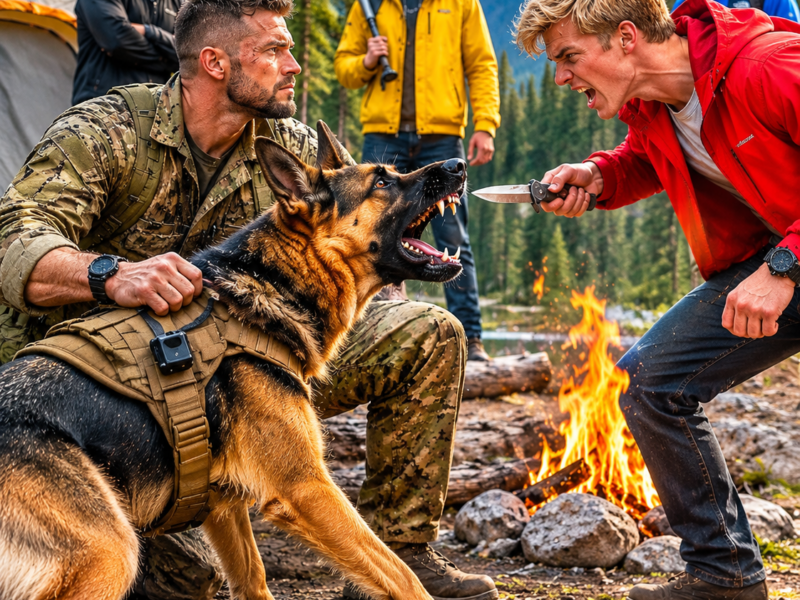
“I was drinking coffee beside my campfire in Idaho when four rich young men surrounded me with a baseball bat, a knife, and a steel flashlight
The sheriff slowly looked at Logan.
Then he reached for his radio.
“Dispatch, Unit 12. Nobody releases anyone or turns over evidence based on a telephone demand. I want that call logged, including the caller’s exact words and the time it came in.”
A brief hiss answered him.
“Copy, Unit 12.”
Logan took a step forward.
“That’s my dad. You need to call him back.”
Sheriff Brooks didn’t look away from his radio.
“I heard you the first time.”
“My father owns half the businesses in this county.”
“Then I’m sure he can afford a lawyer.”
Seth glanced at Logan, then at the knife lying in the dirt.
“Logan, maybe we should just explain—”
“Shut up,” Logan snapped.
That was the first time any of his friends looked at him with something other than admiration.
Sheriff Brooks noticed it, too.
He pointed toward the ATVs.
“Nobody touches those vehicles. Nobody touches the weapons. You four stay where I can see you.”
Then he turned to me.
“Mr. Cooper, do you have identification and your camping permit?”
I reached slowly into my jacket and handed them over.
He checked my driver’s license, then examined the permit.
“Everything appears to be in order.”
“It is.”
He glanced toward Bishop.
“That camera yours?”
“Mine. I use it to document his training and keep a record of our hikes.”
Brooks nodded.
“Good thing you had it running.”
I looked at the little device in his hand.
“Good thing it was pointed in the right direction.”
The sheriff didn’t smile, but the corner of his mouth moved.
He returned to his truck and called dispatch again.
This time, he requested another unit, an evidence technician, and a supervisor.
Logan’s confidence began to drain away.
“You’re seriously calling backup over a misunderstanding?”
Brooks turned around.
“A misunderstanding is when somebody takes the wrong trail. This is four armed men confronting a camper, damaging his property, and then giving me a story that doesn’t match the recording.”
“We didn’t attack him,” Logan said.
“Then the video should help you.”
Evan had been silent since the knife was taken from him.
He stood with his hands clasped in front of him, staring at the ground.
Finally, he spoke.
“Can I tell you something?”
Logan spun toward him.
“Don’t.”
Sheriff Brooks raised one hand.
“Let him speak.”
Evan swallowed.
“We didn’t come out here by accident.”
The forest seemed to grow quieter around us.
Logan’s face hardened.
“Evan, stop talking.”
Brooks stepped closer to the young man.
“Why don’t you tell me what you mean?”
Evan looked at me, then at Bishop.
“We were told there might be somebody camping on this ridge. Logan said we needed to make him leave.”
“Who told you that?”
“My dad works for King’s Partners. He said the company was trying to get access to this area.”
Logan shook his head.
“That’s not what happened.”
Evan’s voice dropped.
“You said the guy wouldn’t have a choice.”
I looked toward the ridge beyond the creek.
The land around us was public forest, and I knew the rules well enough to understand that a private company couldn’t simply announce ownership and start ordering people away.
But I hadn’t expected this to be part of something larger.
Sheriff Brooks studied Evan.
“Did your father tell you to bring weapons?”
“No. Logan brought those.”
“Why?”
Evan didn’t answer.
Zachary shifted his weight.
“He said it was just to scare the guy.”
Logan’s jaw tightened.
“You’re both making this worse.”
Brooks looked at him.
“You’ve been doing that yourself since I arrived.”
The second patrol truck appeared about fifteen minutes later.
A deputy named Maria Ellis stepped out, followed by a county investigator carrying an evidence case.
Brooks briefed them quietly.
Deputy Ellis photographed the scattered dog food, the damaged backpack, the coffee mug, and the three weapons.
The investigator collected the bat, flashlight, and knife separately.
He photographed each item before placing it into an evidence bag.
I watched him work.
It was a familiar process, and I was grateful to see it handled carefully.
Logan wasn’t grateful.
“You’re treating us like criminals.”
Deputy Ellis looked up from her notes.
“Right now, we’re treating this as an investigation. Your cooperation will help determine what happened.”
“My dad is going to have your badge.”
She returned to her photographs.
“Then he can discuss that with the sheriff.”
I crouched beside Bishop and checked his paws.
He had stepped through some spilled dog food and broken twigs, but he wasn’t injured.
I brushed the debris from his fur.
“You’re all right, buddy.”
He leaned against my shoulder.
For the first time since the ATVs arrived, I felt the tension leave his body.
Sheriff Brooks approached with my camera.
“We need to preserve this properly. Can you tell me how the recording works?”
I explained that it captured continuously while powered on and stored the footage on a removable memory card.
He asked whether the original file had been edited.
“No.”
“Can you demonstrate that?”
“I can show you the device settings. I’d rather have your investigator handle the card.”
Brooks nodded.
“That’s the right answer.”
He asked me to provide a written statement.
I described the encounter in order, from the arrival of the ATVs to Logan’s call to dispatch.
I didn’t exaggerate.
I didn’t add what I thought the young men deserved.
I simply described what I had seen and heard.
When I finished, Brooks read the statement carefully.
“Anything you want to add?”
“Yes. I want the false report documented. And I want the weapons handled as evidence.”
“That’s already being addressed.”
“I don’t want special treatment. I want the same process you’d follow if I were anyone else.”
He held my gaze for a moment.
“That’s what we’re doing.”
Logan gave a short, disbelieving laugh.
“You’re acting like he’s some kind of victim.”
Brooks turned toward him.
“His campsite was peaceful until you arrived. That’s not in dispute anymore.”
The investigator finished documenting the scene and asked me to review the camera’s date and time settings.
They were correct.
He sealed the memory card in an evidence envelope and gave me a receipt.
I watched him write the case number across the front.
It was a small thing, but it mattered.
The footage wasn’t just something I could wave around to win an argument.
It was evidence now, and it would have to stand on its own.
Before long, the four young men were separated so their accounts could be taken individually.
Seth was the first to change his story.
He admitted that Logan had told them to drive to the ridge and make me leave.
He also admitted that the knife had belonged to Evan, though Logan had encouraged them to bring anything that might intimidate me.
Zachary confirmed that Logan had kicked my belongings.
Evan gave the most complete statement.
He said Logan had been angry because his father had recently been told that the company could not treat the ridge as private property.
The company had been exploring a possible development and access arrangement.
Some of the land was privately held.
The forest around my campsite was not.
The distinction had apparently become inconvenient.
“Why didn’t you tell me that earlier?” Logan demanded when Evan finished.
Evan stared at him.
“Because you told us nobody would believe a camper over your family.”
For a moment, Logan had nothing to say.
Then a black SUV appeared on the forest road.
It moved slowly, its tires crunching over the gravel.
A tall man in a charcoal coat stepped out before the vehicle had fully stopped.
He looked to be in his early sixties, with silver hair and the kind of expensive clothing that seemed out of place among the pine trees.
Logan’s face changed immediately.
“Dad.”
The man ignored the deputy and walked straight toward Sheriff Brooks.
“Ronald. What is this?”
Brooks didn’t move.
“Good morning, Mr. Turner.”
“I received a call saying you were detaining my son.”
“I’m investigating an incident.”
“Then investigate it and send them home.”
Brooks pointed toward the evidence bags.
“Your son and three companions entered a public campsite, threatened the occupant, damaged his property, and made statements that conflict with recorded evidence.”
The older man glanced at the camera receipt in the investigator’s hand.
“Recorded by what?”
“A camera attached to the camper’s dog’s harness.”
The man looked at me for the first time.
His eyes moved over my jacket, boots, and face.
“You’re Nathan Cooper?”
“Yes.”
He paused.
“Do you know who I am?”
“I know you’re Logan’s father.”
The answer seemed to irritate him more than an insult would have.
He lowered his voice.
“Whatever happened here, I’m prepared to make it right. We can pay for the damaged equipment and compensate you for your trouble.”
I looked at the scattered dog food.
Then I looked at the dent in my backpack where Logan had kicked it.
“You’re welcome to replace anything your son damaged. That doesn’t change what happened.”
His expression tightened.
“You’re making a simple situation complicated.”
“No. The recording made it simple.”
He glanced at Sheriff Brooks.
“Ronald, let’s talk privately.”
“We can talk here.”
“That’s not necessary.”
“It is if you’re discussing an active investigation.”
For the first time, the older man seemed to notice Deputy Ellis standing nearby with her notebook.
He looked back at his son.
“Logan, tell me exactly what happened.”
Logan’s eyes flickered.
“They attacked us. The video doesn’t show everything.”
“Then explain what it doesn’t show.”
Logan looked toward his friends.
None of them helped him.
His father took a slow breath.
“Son?”
Logan finally said, “We wanted him to leave.”
“Why?”
“Because the ridge is part of the property we’re acquiring.”
His father closed his eyes briefly.
When he opened them, his voice was quiet.
“That isn’t how this works.”
Logan looked confused.
“You said we had to protect the access route.”
“I said we needed to document the situation. I did not tell you to threaten anybody.”
“You said the camper would be a problem.”
“I said unauthorized activity could complicate negotiations.”
Logan shook his head.
“That’s the same thing.”
“No, it isn’t.”
Sheriff Brooks listened without interrupting.
I couldn’t tell whether the older man was genuinely shocked or simply angry that the conversation was happening in front of witnesses.
Then he made a mistake.
He turned toward the investigator and said, “You don’t need to take that camera. I’ll have our attorneys arrange for a copy.”
The investigator answered calmly.
“Sir, the memory card is already secured as evidence.”
“I represent the company involved in the land acquisition.”
“That doesn’t give you control over county evidence.”
The older man’s mouth tightened.
He looked at Sheriff Brooks.
“You’re going to regret handling this so aggressively.”
Brooks took out his notebook.
“Is that a threat?”
“It’s advice.”
“Then I’ll record it as a statement made during the investigation.”
For several seconds, nobody moved.
Then the older man stepped away.
He called someone on his phone and walked toward the SUV.
Logan watched him go.
“Dad!”
The older man didn’t turn around.
That was the moment Logan finally looked frightened.
Not because he was facing an arrest.
Because his father had stopped protecting him.
The sheriff ordered the young men to remain while he completed the initial investigation.
After consulting with his supervisor and reviewing the evidence available at the scene, he told them they would be taken to the county station for further questioning and processing.
Logan protested.
“You can’t do this. My dad will fix it.”
Brooks replied, “Your father isn’t the one deciding what happened here.”
The deputies handled the weapons and property evidence.
They also documented the damage to my equipment and took photographs of the campsite.
I gave them permission to copy the relevant camera footage through the proper process.
Before leaving, Deputy Ellis approached me.
“Mr. Cooper, are you sure you’re all right?”
“I’m fine.”
She glanced at Bishop.
“And him?”
“He’s fine, too.”
She smiled faintly.
“Good. He did a better job keeping his head than most people would.”
I rubbed Bishop’s ears.
“He had a good teacher.”
After the patrol vehicles left, I stood alone beside the creek.
The campfire had gone out.
The coffee was cold.
My journal lay open on the log, one corner stained with mud.
I sat down and read the sentence I’d written before the engines arrived.
Peace isn’t the absence of noise. Sometimes it’s the ability to remain yourself when the noise begins.
I closed the journal.
Then I began cleaning the campsite.
It took nearly an hour to gather the scattered food, replace the damaged items, and straighten the tent.
Bishop followed me from one task to the next.
Every few minutes, he looked toward the road.
I knew the feeling.
The incident wasn’t over simply because the patrol trucks had disappeared.
There would be reports, interviews, lawyers, and questions.
I had no idea how much of my remaining leave would be consumed by it.
But I also knew I wasn’t going to let four strangers decide whether I could enjoy the forest.
That evening, I received a call from the county investigator.
He confirmed that the original footage had been copied and preserved.
He also told me that the prosecutor’s office would review the case.
I thanked him and ended the call.
Then I sat beside the tent while the last light faded behind the mountains.
Bishop rested his head on my knee.
“Looks like we’re staying another night,” I told him.
His tail thumped once.
The following weeks were less dramatic than the morning in the forest, but considerably more complicated.
I returned to duty when my leave ended.
The investigation continued without me at the center of it.
I answered questions when asked, provided the original permit information, and submitted receipts for the damaged equipment.
I didn’t call the sheriff every day.
I didn’t contact Logan’s father.
I didn’t post the recording online.
The investigator had asked me not to distribute it while the case was being reviewed, and I saw no reason to turn a legal matter into entertainment.
A few weeks later, I learned that all four young men had been charged with offenses related to the incident.
The exact charges differed according to each person’s actions and the evidence against him.
Logan faced the most serious allegations, including making a false report and offenses connected to the threats and property damage.
The others faced charges based on their participation and possession or use of the weapons.
The prosecutor also reviewed the statements made about the land.
That inquiry led to a separate examination of the company’s development plans and the way its representatives had described public access.
I wasn’t a party to those business dealings, and I didn’t pretend to know what had happened inside the company.
But I did know that the forest wasn’t something a person could claim just because his father had money.
The court proceedings took months.
I attended when I was required and kept my answers limited to what I personally knew.
The defense attorneys asked about my military background.
They asked whether I had training in hand-to-hand combat.
They asked whether I could have avoided the confrontation.
I answered honestly.
“I asked them to leave. I told them to pick up the property they had damaged. I didn’t pursue them.”
One attorney asked whether I had used more force than necessary.
“I used enough to stop the immediate threat.”
“You’re trained to hurt people, aren’t you?”
“I’m trained to stop threats.”
The attorney looked down at his notes.
The video was played in court.
The room was quiet as the recording showed the ATVs arriving, the demands to leave, the kicked bowl, and the weapons.
It showed me giving Bishop a command and keeping him beside me.
It showed the young men approaching with their weapons.
It also showed the moment Logan called dispatch and described a completely different encounter.
I watched without looking at him.
I had already seen the footage enough times.
What stayed with me wasn’t the fight.
It was the sound of Bishop’s bowl hitting the ground.
That small metallic crash had marked the end of a peaceful morning.
The judge and attorneys reviewed the evidence and testimony.
The case eventually resulted in convictions and other legal consequences for the young men, though their outcomes differed according to their individual conduct and the agreements reached in court.
Logan received the harshest consequences.
He was ordered to pay restitution for the damaged property, received probation with strict conditions, and was required to complete community service.
He also lost access to the company’s vehicles and was removed from a position he had been promised within his father’s business.
The other three received lesser penalties based on their involvement.
Evan’s early cooperation was considered during his case.
The false report was formally addressed, and the court made clear that calling law enforcement with a fabricated accusation was not a harmless way to win an argument.
The separate land-access inquiry also forced King’s Partners to clarify its plans.
The company could pursue lawful negotiations for private parcels, but it could not claim authority over public forest land.
For a while, I thought that would be the end of it.
Then, several months after the incident, I received a letter.
It came to my home address with no return address, only my name written in careful block letters.
Inside was a single sheet of paper.
The message was short.
Mr. Cooper,
I was wrong about what happened in the forest. I was angry, embarrassed, and too afraid to admit that I’d followed someone else’s expectations without questioning them.
I don’t expect you to forgive me. I only wanted to say that I’m sorry.
Evan.
I read it twice.
There was no request for help.
No excuse about his friends.
No mention of his father.
Just an apology.
I placed the letter in a drawer.
I didn’t know whether I would answer.
A week later, I received another envelope.
This one came from a local animal shelter.
Inside was a receipt showing a donation made in Bishop’s name.
The amount wasn’t large.
The note attached said the money came from Evan’s community service earnings.
I looked at the receipt for a long time.
Then I placed it beside his letter.
I still didn’t know whether his apology was enough to change anything.
But I respected the fact that he had chosen to do something without asking for recognition.
By the time my next block of leave arrived, the mountains were calling again.
I drove back to the Sawtooths with Bishop riding in the passenger seat.
The road was familiar.
The creek was still there.
The pine trees had grown no less indifferent to human arguments.
I found a campsite a short distance from the original one.
The weather was warmer, and the evening sun fell across the water in long golden strips.
I unloaded the truck, pitched the tent, and set a small fire.
Then I placed Bishop’s food bowl beside the log.
It was a new bowl.
The old one had been too badly dented to sit flat.
Bishop sniffed it, looked at me, and wagged his tail.
“Better than the last one, huh?”
He lowered his head and began eating.
I poured myself a cup of coffee.
For a while, I listened to the creek.
I thought about the four young men, about the sheriff, and about the older man who had arrived believing money could make a problem disappear.
I thought about Evan’s letter.
I didn’t feel triumph.
I didn’t feel the need to prove anything.
I was simply grateful that the truth had been preserved and that nobody had been seriously hurt.
Bishop finished eating and came to sit beside me.
I rested a hand on his broad head.
The forest was quiet again.
And this time, when the wind moved through the pines, I didn’t hear engines behind it.
I heard only the creek, the fire, and the steady breathing of the partner who had never needed to tell me he was loyal.
I had come to Idaho looking for fifteen days of peace.
In the end, I learned that peace wasn’t something a wealthy man could take away—or something a sheriff could hand back.
It was something I had to choose to protect, one quiet morning at a time.
THE END.