“I watched a retired Navy dog growl at every person who approached his kennel, but when a blind veteran sat down beside him, the dog did something that made our director cover her mouth
I still hadn’t told him the one detail in that report that changed everything.
Garrett stood beside his truck, one hand gripping the open window, waiting for me to speak.
The evening wind moved through the tall yellow grass behind the barn.
Somewhere down the kennel aisle, a dog barked twice and fell silent.
“What does page four say, Mara?” Garrett asked.
I looked down at the folder in my hands.
“Garrett, I think you should sit down.”
“I’ve been sitting down most of my life since I lost my sight. Just read it.”
His voice wasn’t angry anymore.
That somehow made it harder.
I opened the folder.
The incident report was seven years old, printed on yellowed paper with several handwritten notes along the margins.
I found the section he wanted.
“Convoy operation in eastern Afghanistan. Roadside explosive device detected by Navy working dog Magnus. Handler identified as Petty Officer Dale Whitaker.”
Garrett’s fingers tightened around the truck door.
“Keep going.”
“Explosion occurred during evacuation. Handler sustained fatal injuries. Senior Chief Garrett Maddox suffered severe injuries, including permanent loss of vision.”
He lowered his head.
I continued.
“Working dog sustained facial and nasal injuries. Following the explosion, the animal remained positioned across the wounded senior chief’s legs and refused to leave.”
Garrett’s breathing changed.
I paused.
“Medics attempted to approach the wounded soldier. Dog displayed defensive aggression toward anyone attempting to remove him. One medic sustained a bite injury.”
“Go on,” he whispered.
I read the final lines.
“Animal was eventually restrained and removed by force using a chain. Transfer recommended due to repeated defensive biting and inability to tolerate physical handling.”
I closed the folder.
Garrett didn’t move.
After several seconds, he asked, “Did they say anything about the dog after that?”
“Only that he survived.”
He turned his face toward the kennel building.
“I thought he was dead.”
His voice broke on the last word.
For seven years, Garrett had carried a memory he had never been able to put into words.
He remembered the explosion.
He remembered the darkness.
He remembered the smell of burned metal and the sound of men shouting.
But most of all, he remembered the weight across his legs.
Something warm and breathing had stayed with him while the world fell apart.
He had believed it was the last thing he would ever feel.
“I heard that clicking sound when I was lying on the road,” he said. “Every breath. I thought it was coming from somewhere near my head.”
He rubbed his thumb across the handle of his cane.
“I remember reaching down and finding fur. Thick fur. I couldn’t see anything, but I knew somebody was there.”
I sat on the edge of the truck’s open tailgate.
“Garrett…”
“He stayed with me.”
It wasn’t a question.
I nodded.
“Yes.”
“And they pulled him away.”
I couldn’t answer.
He swallowed.
“Did he fight them?”
“According to the report, yes.”
Garrett let out a bitter laugh.
“I would have fought them too.”
For a while, neither of us spoke.
Then he asked the question I had been dreading.
“Why didn’t you tell me before I came?”
I looked at him.
“I was afraid you wouldn’t come.”
“So you decided I didn’t deserve to know?”
“No. I thought you deserved the chance to meet him before you knew what he meant to you.”
He shook his head.
“You made that decision for me.”
“I know.”
“You used the fact that I was blind and couldn’t recognize him.”
The words landed harder than any accusation I’d heard in my career.
“I was trying to save him.”
“And what if seeing him again was something I wasn’t ready for?”
I lowered my eyes.
He folded his cane.
“I need to go home.”
“Garrett, please.”
“Don’t call me tonight, Mara.”
He walked toward the gate.
I watched until his sister’s pickup arrived.
He didn’t turn around.
Inside Kennel 9, Magnus stood at the gate.
For the first time since arriving at Second Watch, he began to whine.
It was a small, rough sound.
The kind a dog makes when he is waiting for someone who has already left.
The following morning, Magnus refused breakfast.
I tried his usual food.
Then chicken.
Then warm broth.
Nothing.
He stood in the corner with his head lowered, looking toward the aisle.
At noon, I sat outside his kennel with my back against the wire.
“Come on, buddy,” I whispered. “You can’t give up now.”
He didn’t look at me.
Across the county, Garrett was sitting at his sister Renee’s kitchen table.
His coffee had gone cold.
A piece of cornbread sat untouched beside his plate.
Renee had known him long enough to recognize when he was trying to disappear into his own thoughts.
“You haven’t said anything since breakfast,” she said.
“I’m eating.”
“You’re pushing cornbread around a plate.”
He set down his fork.
She pulled out the chair across from him.
“Tell me.”
He told her everything.
The dog.
The clicking sound.
The report.
The fact that he had been lying on that road seven years earlier with a young Navy handler named Dale Whitaker and his dog protecting him.
When he finished, Renee was quiet.
“So you think Magnus is the dog?”
“I don’t know.”
“But you think he is.”
Garrett rubbed his forehead.
“I want him to be.”
Renee reached across the table.
“Then why aren’t you going back?”
He turned his face toward her.
“Because I don’t know what he’ll do when I touch him. I don’t know if he’ll remember me. And I don’t know what happens if I try to help him and he bites me.”
“You’re afraid.”
“Of course I’m afraid.”
“That’s not the same as being unable.”
He pushed his chair back.
“You weren’t there, Renee.”
“No, I wasn’t. But I know you.”
She waited until he faced her again.
“You’ve spent seven years believing you were the one who needed saving that day. Maybe you’ve never considered that the dog needed somebody too.”
Garrett’s jaw tightened.
“He stayed with me.”
“And maybe he has been waiting for you to come back.”
Garrett didn’t answer.
That afternoon, I received a phone call from Texas.
The woman introduced herself as Tessa Whitaker.
“My husband was Dale Whitaker,” she said.
I recognized the name immediately.
“Of course. I’m so sorry for your loss.”
“Thank you. Mara, I heard you found his dog.”
I sat down.
“Yes. Magnus is here.”
There was a long silence.
“Is he really alive?”
“He’s alive.”
A quiet sob came through the phone.
I waited.
“Dale used to talk about him all the time,” she said. “He’d bring home pictures and show me every little scratch on that dog’s face. He used to say Magnus had the stubbornest heart of any creature he’d ever known.”
I smiled sadly.
“That sounds about right.”
“Did you know Dale had a saying?”
“No.”
“He used it at the end of every search. He’d tap Magnus twice on the shoulder and say, ‘Easy, off the clock.'”
I looked toward Kennel 9.
“What did it mean?”
“It meant the job was done. No more searching. No more danger. He was telling Magnus that he could stop watching everyone and just be a dog.”
I felt something tighten in my chest.
“Did he ever use it outside work?”
“All the time. If I was upset, he’d tap my shoulder twice and say it. It was his way of telling me everything was going to be okay.”
I thanked her and hung up.
Then I called Garrett.
He answered after the third ring.
“Mara?”
“I know something about Magnus that you need to hear.”
He didn’t speak.
I explained what Tessa had told me.
When I finished, I heard him exhale slowly.
“That’s it.”
“What?”
“The two taps.”
He paused.
“I remember Dale doing that every morning. He’d finish a search, tap Magnus twice, and say those words.”
His voice became quieter.
“That wasn’t just a command. It was a promise.”
I looked through the office window at the dog standing in his kennel.
“Garrett, what are you going to do?”
For a moment, all I heard was the faint hum of his radio in the background.
Then he said, “Tell Renee to get the truck ready.”
Friday morning arrived under a heavy gray sky.
Garrett came through the gate at 6:30.
He was carrying his white cane in one hand and a small canvas bag in the other.
I met him halfway across the gravel.
“You’re early.”
“I didn’t sleep.”
“I’m glad you came.”
“I’m still angry with you.”
“I understand.”
He nodded.
“But I’m here for him.”
We walked toward Kennel 9.
Magnus was standing in his usual corner.
When he heard Garrett’s cane tapping against the concrete, his ears lifted.
He took one step forward.
Then another.
Garrett stopped outside the gate.
“Easy, big man.”
The dog’s tail moved once.
I opened the gate.
Garrett entered and lowered himself against the wall.
Magnus approached slowly.
He sniffed Garrett’s jacket, then his hands, then the side of his face.
Garrett remained still.
“I know,” he whispered. “I should have come sooner.”
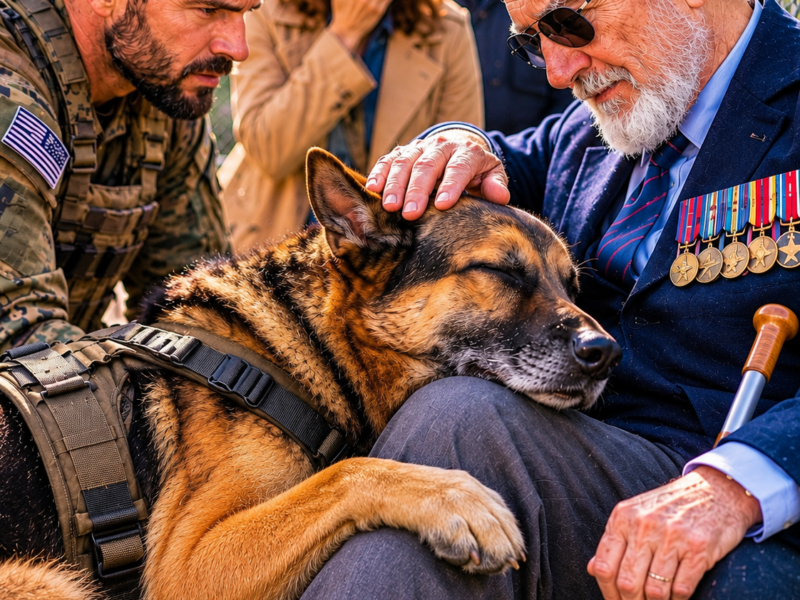
The dog rested his head against Garrett’s knee.
Garrett waited until the breathing became slower.
Then he lifted his right hand.
I felt my stomach tighten.
He moved carefully, giving Magnus time to withdraw.
His fingers found the dog’s shoulder.
Tap.
Tap.
“Easy, Magnus.”
His voice trembled.
“Off the clock.”
The dog went completely still.
For a second, I thought we had made a terrible mistake.
Then his shoulders dropped.
His ears relaxed.
He released a long breath, the faint click sounding at the end.
And he leaned his entire body against Garrett.
Garrett bowed his head.
“Oh, Dale,” he whispered. “You taught him well.”
I knelt beside them.
“Can I try?”
Garrett nodded.
“Keep your hand low. Shoulder, not head.”
I moved slowly.
Magnus watched my hand.
His lips tightened slightly.
I stopped.
Garrett spoke softly.
“Easy. He’s all right.”
I waited.
Then I placed two fingers against the dog’s shoulder.
Tap.
Tap.
“Off the clock, Magnus.”
He didn’t growl.
He didn’t pull away.
Instead, he leaned into my hand.
I had trained hundreds of dogs.
I had seen frightened animals recover.
But I had never witnessed anything quite like that.
It wasn’t a miracle.
It was trust, built slowly over seven years of fear, pain, and misunderstanding.
At two o’clock, Dr. Walter Lennox arrived.
He carried a leather veterinary bag and a clipboard.
He was a careful man who never rushed an examination.
He had also been bitten twice in his career, so he took Magnus’s history seriously.
“Where is he?”
I pointed toward Kennel 9.
“With Garrett.”
The doctor looked at the veteran.
“Mr. Maddox, I appreciate your willingness to help, but I need to conduct an independent evaluation.”
“Of course.”
Garrett stood.
Magnus immediately followed, pressing against his leg.
Dr. Lennox opened his bag.
The metal clasp made a small snapping sound.
Magnus reacted instantly.
His head shot up.
His teeth showed.
A deep growl rolled through the kennel.
The doctor stepped backward.
“Nobody move.”
I reached for the gate.
Garrett spoke before I could do anything.
“Magnus.”
The dog didn’t look at him.
His attention remained fixed on the bag.
Garrett lowered himself to one knee.
“Easy, big man.”
He placed two fingers against the dog’s shoulder.
Tap.
Tap.
“Off the clock.”
Magnus’s growl faded.
His breathing remained quick, but he turned away from the bag and pressed his side against Garrett.
Dr. Lennox watched for several seconds.
Then he slowly closed his bag.
“Let’s try something different.”
He asked me to stand beside him.
Garrett remained seated with Magnus.
I approached from the side, keeping my hands visible and low.
The dog watched.
I stopped several feet away.
Dr. Lennox gave me a quiet instruction.
“Offer your hand. Don’t reach over him.”
I extended my fingers.
Magnus sniffed them.
His ears flicked backward.
Then he looked toward Garrett.
Garrett spoke softly.
“You’re all right, buddy.”
The dog remained still.
Dr. Lennox moved one step closer.
He waited.
Then he gently touched Magnus’s shoulder.
No growl.
No lunge.
No attempt to bite.
The examination lasted nearly twenty minutes.
When it was over, the doctor returned to his clipboard.
He read through the old recommendation.
Then he drew a line through the words humane euthanasia.
I watched his pen move.
“What’s the decision?” I asked.
He adjusted his glasses.
“I’m changing my recommendation.”
Garrett’s hand remained on Magnus’s shoulder.
Dr. Lennox continued.
“The dog needs dental and nasal surgery to address the old injury. He also needs a structured behavioral rehabilitation plan and a home with an experienced handler.”
He looked at Garrett.
“That doesn’t mean the risk disappears. He’ll need supervision, consistent handling, and time.”
Garrett nodded.
“Understood.”
The doctor looked back at me.
“If those conditions can be met, I see no reason to end his life today.”
For several seconds, nobody spoke.
Then Magnus lowered his head onto Garrett’s knee.
The veteran’s face crumpled.
He rubbed the dog’s shoulder.
“I told Mara I couldn’t take him home,” he said.
I sat beside him.
“You did.”
“I can’t see when he’s hurt. I can’t tell if he’s limping.”
“Then we’ll work around that. I’ll help you learn his signals. We’ll arrange regular veterinary visits and make sure you have support.”
Garrett shook his head.
“I don’t want him to spend the rest of his life in another place where someone has to decide whether he’s worth the trouble.”
“Then don’t let him.”
He looked toward the dog.
Magnus’s nose rested against his jacket.
After a long silence, Garrett said, “All right.”
He took a breath.
“Let’s go home, big man.”
The weeks that followed were not as easy as either of us had hoped.
Magnus had surgery the following Tuesday.
The damage inside his nose was worse than the original examination had suggested.
The veterinarian removed damaged tissue and treated an infection that had probably been causing him discomfort for years.
For several days, Magnus was tired and irritable.
Garrett slept on a mattress beside his recovery bed.
He learned the sound of the dog’s footsteps.
He learned the difference between a relaxed sigh and the short breath that meant discomfort.
Renee helped with meals and medication.
I visited every other day.
We made the farmhouse safer by removing clutter, placing nonslip mats along the hallway, and keeping the furniture in consistent positions.
Garrett learned to use a simple routine of verbal cues.
“Door.”
“Step.”
“Water.”
“Easy.”
Magnus learned that Garrett never reached for him without warning.
And Garrett learned that the dog didn’t need him to see everything.
He needed him to listen.
One afternoon, I found Garrett sitting on the porch with Magnus lying beside his chair.
The dog had gained weight.
His coat was cleaner, and his breathing was quieter.
Garrett was holding a brush.
“How’s he doing?”
“He’s decided the porch is his office.”
I laughed.
“Sounds like a promotion.”
Garrett ran the brush along the dog’s back.
“He doesn’t like the vacuum cleaner.”
“Most dogs don’t.”
“He also hates the sound of the kitchen timer.”
“That’s useful information.”
He smiled.
Then his expression changed.
“Mara, can I ask you something?”
“Sure.”
“Do you think he remembers Dale?”
I looked at Magnus.
The old dog had his eyes closed, his chin resting on his paws.
“I don’t know if he remembers him the way we remember people.”
Garrett nodded.
“But I think he remembers being safe with him.”
He rubbed the dog’s shoulder twice.
“Maybe that’s enough.”
Three months after the day we first met, I received another phone call.
It was Tessa Whitaker.
She wanted to know if she could visit.
I told her she was welcome anytime.
She drove from Texas on a cold March morning.
When she arrived at Garrett’s farmhouse, she stayed beside her car for several minutes.
She was wearing a faded navy sweatshirt.
Garrett later told me it had belonged to Dale.
He came out onto the porch with Magnus beside him.
“Tessa?”
She turned toward his voice.
“Garrett.”
They shook hands.
For a moment, neither knew what to say.
Then Tessa looked down at the dog.
“Is that him?”
Garrett smiled.
“He’s right here.”
She lowered herself carefully onto the gravel.
Her hands trembled as she held one palm out.
Magnus looked toward Garrett.
“Go ahead, buddy,” he said.
The dog approached.
He sniffed her fingers.
Then he placed his head in her lap.
Tessa bent forward and began to cry.
“Oh, sweetheart.”
She ran her hand gently along his neck.
“I’ve wondered where you were for seven years.”
Magnus remained still.
Then he released a long breath.
A faint clicking sound came at the end.
Tessa laughed through her tears.
“That sound.”
She looked up.
“Dale used to say he sounded like an old typewriter.”
Garrett smiled.
“He still does.”
Tessa found the dog’s shoulder.
She touched it twice.
“Easy, Magnus.”
Her voice shook.
“Off the clock.”
The dog closed his eyes.
For a long time, the three of us stayed there in the gravel.
Nobody rushed him.
Nobody asked him to perform.
Nobody tried to make him prove he was safe.
Eventually, Tessa stood and walked with Garrett toward the porch.
She told him stories about Dale.
How he burned pancakes every Sunday.
How he sang terribly in the shower.
How he once drove forty miles to rescue a stray kitten and then pretended it had simply followed him home.
Garrett listened.
Sometimes he laughed.
Sometimes he sat quietly.
At one point, Tessa touched his arm.
“I’ve wanted to meet you for years.”
Garrett turned toward her.
“Why?”
“Dale talked about you after that mission. He said you were stubborn, but he trusted you.”
Garrett smiled faintly.
“I was stubborn.”
“He also said you were the reason he wanted to make it home.”
Garrett lowered his head.
“I wish he had.”
“So do I.”
They sat together until the afternoon light began to fade.
Before Tessa left, she knelt beside Magnus one more time.
She rested her forehead against his.
“Thank you for staying with him,” she whispered.
Garrett stood beside her.
“He stayed with both of us.”
That evening, I watched from the driveway as the two of them went inside.
The radio was playing softly in the kitchen.
Magnus settled across Garrett’s feet.
The veteran reached down and placed his hand on the dog’s shoulder.
Two gentle taps.
“Easy, big man.”
Magnus sighed.
“Off the clock.”
I had spent 26 years believing that my job was to teach difficult dogs how to trust people again.
But Magnus taught me something I hadn’t understood before.
Sometimes the most frightened animal in the room isn’t looking for someone to control him.
He’s looking for someone who won’t leave when the fear comes back.
Garrett had lost his sight on a road in Afghanistan.
Magnus had lost the only person who knew how to tell him the danger was over.
For seven years, they had both carried that day in different ways.
And somehow, on a quiet Friday in Kentucky, they found their way back to each other.
The last time I visited, Garrett was sitting on the porch with a cup of coffee.
Magnus lay beside him, his gray muzzle resting on the man’s boot.
The radio hummed through the open kitchen window.
Garrett reached down without hesitation.
Two taps on the shoulder.
A familiar promise.
And for the first time in a very long time, neither of them was waiting for the next explosion.
The watch was over.
The dog was home.
The End.