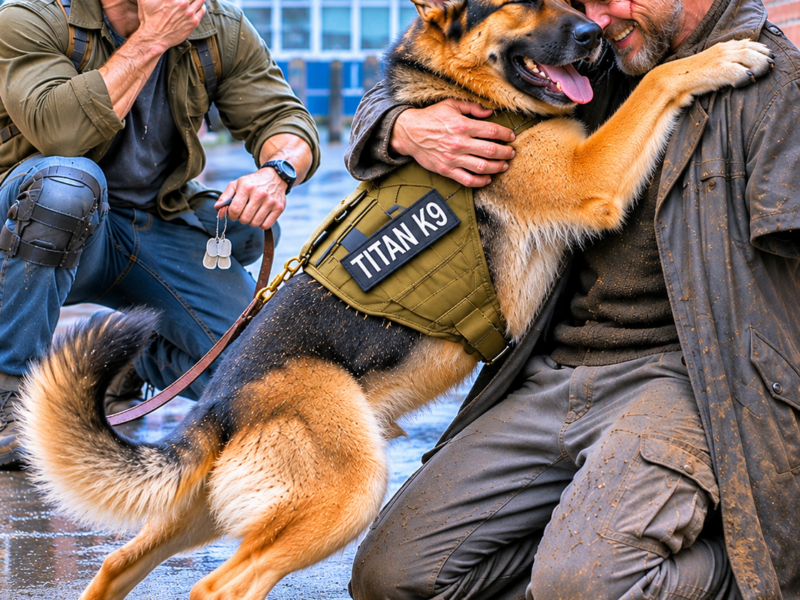
“I was standing in a rain-soaked alley in Atoria, Oregon, pointing my Glock at a man officially declared dead six years earlier
I stared at the dog tags in Donovan’s hand.
My name was stamped into the metal, just as it had been on the tags I’d worn throughout my military service.
But the handwriting scratched into the back was unmistakable.
Five words.
YOU WERE NEVER THE TARGET, WYATT.
I looked up at Donovan.
“What does that mean?”
He glanced toward the street, where the black SUVs were beginning to move.
“It means the ambush wasn’t supposed to kill you.”
“Then who was it supposed to kill?”
“You.”
I shook my head.
“That doesn’t make sense. You just said they wanted me dead too.”
“They wanted you alive long enough to make sure I was gone.”
He took a shaky breath.
“Wyatt, you were the only person who could identify the men who arranged the weapons shipments. You’d been assigned to the logistics security detail two weeks before the patrol. You knew the routes, the serial numbers, and the people who signed the transfer documents.”
I remembered those two weeks.
I’d spent most of my time checking convoy manifests and escort assignments. It had been boring work, the kind of assignment I barely remembered.
Donovan continued.
“I found out that your name was on a list of people scheduled for reassignment. The ambush was supposed to eliminate me, capture you, and make it look like the entire operation had been destroyed by insurgents.”
My mouth went dry.
“Why would they need me alive?”
“Because they wanted to know exactly what you had seen. They thought you’d memorized the shipment records.”
I looked at the tags again.
“How did you get these?”
Donovan hesitated.
“They belonged to a man who wore your uniform that day.”
Before I could ask another question, Titan lifted his head and growled.
The sound came from deep in his chest.
The two SUVs had stopped at the entrance to the alley.
A man stepped out of the passenger side.
He wasn’t wearing tactical gear.
He wore a charcoal overcoat, polished black shoes, and a white shirt that looked completely out of place in the freezing rain.
He held a small black umbrella.
Then he called my name.
“Sergeant Hayes.”
I hadn’t heard anyone use that title in years.
Donovan grabbed my sleeve.
“Don’t answer him.”
The man smiled.
“Mr. Miller. It’s been a long time.”
Donovan’s face tightened.
“Agent Mercer.”
The name meant nothing to me.
But the way Donovan said it made me understand that he knew this man very well.
Mercer took another step into the alley.
“I see you’ve reunited with your old friend. That’s touching.”
I raised my Glock.
“Stay where you are.”
Mercer looked at the weapon as if I’d shown him an inconvenient parking ticket.
“Wyatt, I’m not here to hurt you.”
“Then turn around and leave.”
He sighed.
“You’ve always been stubborn. Even in Afghanistan.”
I felt my stomach tighten.
He knew me.
Not from photographs or military records.
He knew something about my past.
“How do you know me?”
“Because I was there when your convoy was assigned to Corenal Valley.”
Donovan moved closer to me.
“He’s lying.”
Mercer ignored him.
“There’s a great deal you don’t understand, Sergeant. Your friend has spent six years making terrible decisions. I’d hate for you to make the same mistakes.”
He reached inside his coat.
I tightened my grip.
But instead of a weapon, he produced a folded photograph.
He held it between two fingers.
“Do you remember this?”
He tossed it onto the wet pavement.
I didn’t want to look.
Something inside me already knew I would regret it.
The photograph showed our convoy in Afghanistan.
Three military vehicles lined up beside a concrete wall.
I was standing near the second vehicle.
Donovan was beside me.
But someone else stood behind us.
A tall man in sunglasses.
I recognized the face immediately.
Captain Richard Hale.
Our commanding officer.
The man who had personally informed me that Donovan had died.
The man who had attended his memorial service.
The man who’d placed a hand on my shoulder and told me that sometimes soldiers had to learn to live with the things they couldn’t save.
“Why are you showing me this?” I asked.
Mercer smiled.
“Because Captain Hale sends his regards.”
A gunshot cracked through the rain.
The brick wall beside my head exploded into dust.
Titan lunged, pulling Donovan down behind the dumpster.
I fired once toward the mouth of the alley, then grabbed Donovan’s coat.
“Move!”
We ran toward the waterfront.
My left leg was screaming, and every step sent pain through the metal rod buried in my thigh.
Titan stayed ahead of us, moving between dumpsters and abandoned delivery trucks.
Behind us, men shouted.
A second shot struck the metal door of a seafood restaurant.
“Where are we going?” Donovan gasped.
“Pier 39.”
“That’s abandoned.”
“Exactly.”
I had spent the last three years repairing a small fishing skiff beneath the old cannery.
The building belonged to Sullivan, the owner of the hardware store. He’d given me permission to store some equipment there after I’d helped him repair his roof.
It also had something more useful.
An independent maritime radio system.
If Donovan’s evidence was genuine, I needed a way to get it beyond Vanguard’s reach.
We reached the cannery as the black SUV crashed through the chain-link fence behind us.
I shoved Donovan through the rusted doors.
Titan slipped inside.
I slammed the doors shut and dropped the heavy iron crossbar into place.
A moment later, something struck the other side.
Then came another impact.
Donovan leaned against a support beam, breathing hard.
“You still limp when you run,” he said.
I almost laughed.
“You still talk too much.”
For one brief second, I saw the old Donovan.
The young man who used to steal my coffee, make terrible jokes, and insist that he could identify every country in the world by its military ration packaging.
Then his expression changed.
He looked down at his empty sleeve.
“I thought I’d never see this place again.”
I didn’t know what to say.
So I handed him my canteen.
“Drink.”
He accepted it.
We climbed the metal stairs to the old foreman’s office.
Inside, dusty radio equipment covered two long tables. A weather monitor flickered in the corner, and a battered maritime transmission terminal sat beside an old laptop.
I locked the door behind us.
“Show me what you brought.”
Donovan placed the waterproof drive on the desk.
“I’ve got the shipment records, financial transfers, operation orders, and personnel files.”
I connected it to the terminal.
A directory appeared.
Hundreds of encrypted files.
Some were labeled with dates.
Others contained military unit numbers and contractor identification codes.
One folder had a name that made me stop.
CORONEL — OPERATION NIGHTFALL.
I opened it.
A list appeared on the screen.
Names.
Dates.
Coordinates.
And a document titled FINAL FIELD AUTHORIZATION.
My hands became cold.
The authorization had been signed six years earlier.
At the bottom were three names.
Captain Richard Hale.
Director Thomas Mercer.
And General Edward Whitaker.
I knew all three.
Hale had commanded our unit.
Mercer was standing outside.
Whitaker had appeared on television several times after the war, praising American soldiers and promising greater accountability in military operations.
I scrolled further.
A second document appeared.
It contained the names of the soldiers assigned to the convoy.
Beside most names were simple status codes.
But beside mine was something different.
ASSET 07 — RECOVERY REQUIRED.
Beside Donovan’s name was another designation.
ASSET 08 — PERMANENT DISPOSITION.
I stared at the screen.
“They weren’t just planning to kill you.”
Donovan shook his head.
“No.”
“They were planning to take me.”
“Yes.”
“Why?”
He looked at me for a long moment.
“Because you were the one who signed the discrepancy report.”
I turned toward him.
“What report?”
“Wyatt, you found missing weapons shipments before the ambush. You reported them to Captain Hale.”
I remembered.
A discrepancy in several weapons manifests had bothered me.
The serial numbers didn’t match the equipment loaded onto our vehicles.
I’d filed a report and handed it directly to Hale.
Two days later, he told me the issue had been resolved.
I’d forgotten about it.
Or perhaps I’d simply trusted him enough not to question it again.
Donovan pointed at the screen.
“They thought you kept a copy.”
“I didn’t.”
“I know that now.”
He looked down at the dog tags.
“But they didn’t.”
A loud metallic bang echoed from below.
Someone had forced the cannery doors.
Titan moved toward the office entrance, his ears forward.
I checked my pistol.
“How many?”
Donovan glanced through the broken window.
“At least four.”
I looked at the terminal.
The evidence was too important to lose.
I opened the transmission software.
The maritime emergency relay could send compressed files through a series of coastal repeaters.
It wasn’t designed for this kind of data transfer, but I knew enough about radio systems to make it work.
I selected the most important documents and entered several news organizations’ public investigative submission addresses.
Then I added a secure copy to a federal oversight office.
The progress bar appeared.
2% — TRANSMISSION STARTED.
Donovan watched the screen.
“How long?”
“Depends on the interference.”
A burst of gunfire shattered the silence below.
The office window trembled.
Titan barked once.
“Stay here,” I told Donovan.
He grabbed my arm.
“No.”
“Donovan, you can barely stand.”
“I spent six years being told to stay where they put me.”
His voice was quiet, but there was something in it that made me release his arm.
He reached for a metal flashlight and moved toward the doorway.
I nodded.
“Then stay behind me.”
We descended the stairs.
The cannery floor was a maze of rusted machinery, broken conveyor belts, and stacked wooden crates.
Two men were moving between the machines.
One carried a rifle.
The other had a flashlight.
Titan moved first.
He slipped behind a row of old barrels and approached from their blind side.
When the first man turned, Titan struck his weapon arm and forced him against the machinery.
The rifle hit the floor.
I shouted for the man to stop moving.
The second operative raised his weapon.
Donovan threw the flashlight.
It struck the man’s face, distracting him long enough for me to force him behind a conveyor belt.
A shot went into the ceiling.
Dust fell around us.
I managed to knock the weapon away and pin the man against the floor.
“Who sent you?”
He said nothing.
I tightened my grip.
“Was it Hale?”
The man’s eyes shifted.
That was enough.
A voice suddenly came through a loudspeaker near the entrance.
“Wyatt.”
I recognized it immediately.
Captain Richard Hale.
“Put down your weapon. We can talk.”
Donovan looked at me.
“Don’t listen.”
Hale continued.
“I know you’re angry. I know you have questions. But this is bigger than you and Miller.”
I stepped toward the open floor.
“Then explain the recovery authorization.”
Silence.
For several seconds, I heard only the rain hitting the roof.
Then Hale spoke again.
“You don’t understand what that document means.”
“Then tell me.”
“Your convoy was transporting weapons that weren’t supposed to exist on any official inventory. If those shipments had been discovered, the entire operation would have collapsed.”
“And Donovan?”
“Your friend made a mistake.”
Donovan stepped forward.
“I found your records, Hale.”
The speaker crackled.
“You should have stayed dead, Miller.”
I looked at Donovan.
His jaw tightened.
Hale continued.
“Six years ago, I gave you an opportunity to disappear. You refused. You forced my hand.”
“You took my arm.”
“I kept you alive.”
Donovan’s voice shook.
“You tortured me.”
“Because you wouldn’t cooperate.”
I felt something twist inside my chest.
For six years, I’d imagined Donovan’s final moments.
I’d pictured the explosion.
I’d pictured him trying to reach me.
I’d wondered whether he’d called my name.
Now I was hearing the man responsible for his disappearance describe it as an administrative decision.
I stepped toward the loudspeaker.
“Why did you tell me he was dead?”
“Because you were becoming a problem.”
The answer came too easily.
Too calmly.
I looked at the radio terminal upstairs.
The transmission was at 38%.
We needed more time.
Then Hale said something that made my hands tighten around the pistol.
“Wyatt, I know what you did after you came home.”
I said nothing.
“I know about the drinking. The hospital visits. The nightmares. I know you nearly lost your leg because you refused to leave that patrol.”
Donovan looked at me.
Hale continued.
“You’ve already paid enough for that day. Walk away. Let Miller give us the drive. You can go home and forget all of this.”
I almost believed him.
Not because I trusted him.
Because I was exhausted.
For six years, I’d tried to forget the valley.
I’d tried to become a normal man with a normal job and a dog who slept beside his bed.
But forgetting had never worked.
I looked at Donovan.
He wasn’t asking me to save him.
He was simply standing there, waiting for me to decide what kind of man I wanted to be.
I raised my voice.
“You’re right about one thing, Hale.”
The loudspeaker crackled.
“What’s that?”
“I’ve spent six years trying to forget that day.”
I looked at the blood on Donovan’s coat.
“But I won’t spend another six pretending it didn’t happen.”
A burst of gunfire erupted from the entrance.
Hale’s men were moving inside.
I pushed Donovan behind the machinery.
“Back upstairs!”
We ran toward the metal stairs.
Titan followed, barking sharply as a bullet struck the railing above his head.
When we reached the office, the transmission had reached 61%.
The terminal was still working.
But a warning flashed across the screen.
EXTERNAL INTERFERENCE DETECTED.
“They’re jamming the signal,” I said.
Donovan looked at the monitor.
“Can you bypass it?”
“Not from here.”
I checked the equipment.
The old maritime antenna was connected to a backup cable running through the roof.
If I could switch to the secondary transmitter, we might be able to finish the upload.
But the switch was located on the exterior maintenance platform.
Outside.
In the storm.
With armed men inside the building.
I looked at Donovan.
“Can you keep the transmission running?”
He nodded.
“Go.”
I grabbed my jacket and climbed through the broken window.
The rain hit my face immediately.
The maintenance platform was narrow, slippery, and suspended above the black river.
I moved carefully toward the antenna housing.
My left leg trembled.
Below me, I could see flashlights moving across the cannery floor.
A voice shouted.
“He’s outside!”
A shot struck the railing.
I dropped behind the metal housing.
My hands searched for the emergency switch.
The cable was damaged.
I could see where someone had cut through the insulation.
I pulled a small repair tool from my pocket and began reconnecting the wires.
Inside the office, Donovan shouted.
“Wyatt! We have a problem!”
I looked through the broken window.
A man had entered the office.
He was holding Donovan at gunpoint.
Hale’s voice came through the radio.
“Step away from the terminal, Miller.”
Donovan didn’t move.
The operative struck him across the face.
He fell against the desk.
Titan lunged, but the man kicked him away.
“Stop!” Donovan shouted.
The dog recovered and circled the room, searching for an opening.
The transmission was at 74%.
I finished connecting the wire.
The signal indicator flickered.
Then it turned green.
I flipped the switch.
The terminal inside the office flashed.
SECONDARY RELAY CONNECTED.
The progress bar jumped to 79%.
I climbed back through the window.
The operative turned toward me.
“Don’t move.”
I raised my hands.
“Easy.”
He pointed his weapon at my chest.
Then Donovan did something I hadn’t expected.
He stood up.
His face was bleeding, and his remaining hand was shaking.
But he walked directly toward the man.
“Remember me?” Donovan asked.
The operative glanced at him.
That tiny distraction was enough.
Titan struck from the side, forcing the man’s weapon away from Donovan.
I moved in and knocked the rifle from his hands.
The man fell hard against the desk.
I secured his wrists with a cable tie.
Donovan sat down, breathing heavily.
Titan pressed his nose against Donovan’s knee.
“You okay?” I asked.
Donovan wiped blood from his lip.
“I’ve had worse.”
I looked at the monitor.
91%.
The radio crackled again.
Hale’s voice returned.
“Wyatt, this is your last chance.”
I walked toward the microphone.
“Then make it count.”
For the first time, I heard uncertainty in his voice.
“You don’t know what you’ve started.”
“No,” I replied. “But I know what you’re afraid of.”
The transmission reached 100%.
A green notification appeared.
UPLOAD COMPLETE — 14 RECIPIENTS CONFIRMED.
For a moment, nobody spoke.
Then Donovan lowered his head.
Six years of captivity, pain, and silence had finally been answered by something other than another locked door.
He covered his face with his remaining hand.
I sat beside him.
“We got it out.”
He nodded, but he couldn’t speak.
Then the office loudspeaker crackled.
Hale’s voice sounded different now.
He was no longer calm.
“Destroy the terminal.”
A distant siren answered him.
Then another.
And another.
The men downstairs began shouting.
Someone yelled that federal agents were approaching from the harbor road.
The surviving operatives abandoned their positions.
A few seconds later, I heard footsteps running down the metal stairs.
I kept my weapon trained on the doorway.
But nobody came.
Instead, a voice called from below.
“Federal agents! Weapons down! Hands where we can see them!”
I didn’t immediately lower my gun.
Donovan looked at me.
“Wyatt.”
I turned.
He nodded toward the doorway.
“It’s over.”
I wanted to believe him.
I really did.
But after six years of lies, belief wasn’t something I could simply switch back on.
I waited until I saw the first federal agent enter the office.
A woman in a dark rain jacket approached slowly, her badge visible.
“I’m Special Agent Elena Brooks, FBI. Are either of you injured?”
“Minor injuries,” I answered.
She looked at Donovan.
“Mr. Miller?”
He nodded.
She glanced at the computer screen.
“Did the transmission complete?”
“Yes.”
Her expression changed.
“Then we need to get you somewhere secure. There are people who will want to speak with you.”
Donovan gave a tired laugh.
“People wanting to speak with me is how this started.”
Brooks didn’t smile.
“I understand.”
She ordered medical assistance and secured the evidence.
As the paramedics arrived, I noticed something on the floor beside the desk.
The photograph Mercer had thrown into the alley had somehow ended up inside Donovan’s coat.
I picked it up.
The picture showed our convoy.
But now that I looked more closely, I noticed something I hadn’t seen before.
On the far right side of the image, partially hidden behind a military vehicle, was another man.
He was holding a clipboard.
I recognized him.
General Edward Whitaker.
He had been there too.
The man who had spent years publicly honoring fallen soldiers had personally supervised the operation that had made Donovan disappear.
I handed the photograph to Agent Brooks.
“Make sure this goes into the evidence file.”
She studied it carefully.
“It will.”
Then she looked at me.
“There’s something else you should know.”
I waited.
“Captain Hale has been arrested.”
I nodded slowly.
“What about Mercer?”
“He’s in custody. We found him attempting to leave the state.”
“And General Whitaker?”
Her expression became serious.
“We’re working on the warrants.”
I looked toward the window.
Outside, the rain was beginning to ease.
For the first time that evening, the river seemed quiet.
But the story wasn’t finished yet.
Not for Donovan.
Not for me.
And certainly not for the families who had spent years believing that their loved ones had died in accidents that never happened.
Three weeks later, I sat in a small federal courtroom in Portland.
Donovan was beside me in a wheelchair.
His injuries had been treated, though the damage from six years of captivity would take much longer to heal.
His left arm was gone.
The scars across his face would remain.
And sometimes, when someone dropped a metal tray in the hospital cafeteria, he still flinched before he could stop himself.
I understood.
Some sounds don’t disappear just because the shooting stops.
The investigation had uncovered more than either of us expected.
Vanguard wasn’t simply a private military company making illegal weapons deals.
It had been operating through a network of shell companies, corrupt officials, and unauthorized military contracts.
Several officers had accepted payments.
Weapons had been diverted to conflict zones where the company later received lucrative security contracts.
And soldiers who discovered the operation had been silenced.
Some had been killed.
Others had been threatened into cooperation.
Donovan’s testimony became central to the prosecution.
The hard drive contained enough evidence to trigger investigations across several federal agencies.
General Whitaker was arrested two months later.
Captain Hale eventually pleaded guilty to conspiracy, kidnapping, obstruction of justice, and several related charges.
Mercer was charged with coordinating the abduction and unlawful detention of military personnel.
The government also reopened several cases involving missing service members.
For the first time in six years, Donovan’s family received an official account of what had happened.
His mother wasn’t alive to hear it.
But his younger sister, Emily, was.
She arrived at the hospital one afternoon carrying a photograph album.
Donovan was sitting beside the window, trying to drink coffee with his remaining hand.
When he saw her, the cup slipped.
“Emily?”
She stopped in the doorway.
For several seconds, neither of them moved.
Then she crossed the room and wrapped her arms around him.
He began crying.
Not quietly.
Not politely.
He cried like a man who had been holding six years of grief inside his chest and had finally run out of strength to contain it.
“I’m sorry,” he whispered.
Emily shook her head against his shoulder.
“Don’t.”
“I should have come home.”
“You didn’t have a choice.”
“I should have found a way.”
She pulled back and held his face between her hands.
“You’re here now.”
I stood near the doorway, giving them space.
Emily noticed me.
She came over and hugged me too.
“Thank you for bringing him home.”
I looked down.
“I didn’t do it alone.”
She smiled through her tears.
“I know.”
Then she reached into her bag and pulled out an old photograph.
It showed Donovan and me standing beside Titan in Afghanistan.
Titan was younger, his coat almost entirely black, his ears pointed straight up.
Donovan had one arm around my shoulders.
I was holding a cup of terrible military coffee.
We were both laughing.
I hadn’t seen that picture in years.
Emily handed it to her brother.
“He kept this in his room,” she said. “Even after the military told us he was gone.”
Donovan stared at the photograph.
“I thought I’d never see you again,” he whispered.
Emily took his hand.
“Neither did I.”
I looked away toward the window.
The afternoon sunlight was falling across the hospital floor.
For once, the light didn’t remind me of the desert.
It just looked like sunlight.
The following spring, I drove Donovan to Atoria.
He had spent months in rehabilitation.
Learning to walk without losing his balance.
Learning to dress himself with one hand.
Learning that accepting help wasn’t the same thing as surrendering independence.
Some days were good.
Some were not.
There were mornings when he refused to leave his room.
There were nights when he woke from nightmares and couldn’t remember where he was.
I never pushed him to explain.
I knew that sometimes the best thing a person could do was sit nearby and let the silence remain.
Titan had become particularly attached to him.
The dog would sleep beside Donovan’s wheelchair and follow him from room to room.
If Donovan went outside, Titan went too.
If Donovan sat on the porch, Titan settled at his feet.
One afternoon, I found them watching the river.
Donovan was holding the old photograph from Afghanistan.
“Remember that day?” he asked.
I sat beside him.
“Which one?”
“The day Titan stole your sandwich.”
I laughed.
“He stole yours.”
“You accused me of eating yours.”
“Because you ate mine.”
Donovan smiled.
For a moment, the years disappeared.
Then he looked down at his empty sleeve.
“I don’t know who I am anymore, Wyatt.”
I leaned back in my chair.
“You’re Donovan Miller.”
“That’s what the paperwork says.”
“Forget the paperwork.”
He looked at me.
“Then what am I?”
I thought about the young soldier I’d met in training.
The man who had once carried me through a minefield.
The friend who had risked everything because he couldn’t live with knowing the truth and doing nothing.
“You’re the guy who owes me six years of coffee.”
He laughed.
It wasn’t a big laugh.
It wasn’t the same laugh I’d heard in Afghanistan.
But it was real.
And that was enough for that afternoon.
Later that summer, I visited the military cemetery in Ohio.
The same cemetery where an empty coffin had been buried six years earlier.
I stood beside Donovan’s memorial marker.
The military had agreed to correct the official record after the investigation established that his death had been falsified.
His name would remain on the memorial.
But the record now reflected the truth.
He had survived.
I placed a small American flag beside the stone.
Titan sat quietly at my side.
I looked at the marker for a long time.
For years, I’d come here carrying guilt.
I had believed that I should have done something differently.
That I should have found Donovan.
That I should have known he was alive.
That somehow, his suffering had been my responsibility.
But standing there, I finally understood something.
I hadn’t abandoned him.
I had been lied to.
And there was a difference.
I rested my hand on Titan’s head.
“Come on, buddy.”
The dog stood.
We walked slowly back toward the parking lot.
A few weeks later, Donovan moved into the cabin beside mine.
It wasn’t a grand arrangement.
Two small houses, a shared gravel driveway, and a porch overlooking the trees.
He insisted on paying rent.
I told him he could pay by fixing the coffee machine.
He said that was an unreasonable demand.
We argued about it for nearly twenty minutes.
It felt strangely familiar.
On the first cold evening of November, we sat outside watching the rain move across the river.
Titan lay between our chairs, his gray muzzle resting on his paws.
Donovan held a cup of coffee in his remaining hand.
He looked toward the dark water.
“Do you ever think about going back?”
“To Afghanistan?”
He nodded.
“Sometimes.”
“Why?”
He considered the question.
“Part of me wants to remember the good days without thinking about what happened afterward.”
I understood.
The war had taken things from both of us.
But it hadn’t taken everything.
I looked down at Titan.
“Maybe we don’t have to go back to find those parts.”
Donovan smiled faintly.
Then he reached down and scratched Titan behind the ears.
The dog opened one eye, recognized the familiar hand, and moved closer.
The rain continued falling.
But this time, I didn’t need it to drown out the memories.
I could hear the water against the roof.
I could hear Donovan breathing beside me.
And I could hear Titan’s slow, peaceful breathing at our feet.
Six years earlier, I’d watched an empty coffin disappear beneath the dirt and believed I’d lost my brother forever.
Now he was sitting beside me, alive, imperfect, and finally free.
For the first time in a very long time, the silence between us didn’t feel like grief.
It felt like home.
The End.