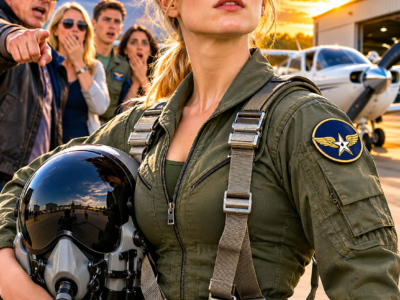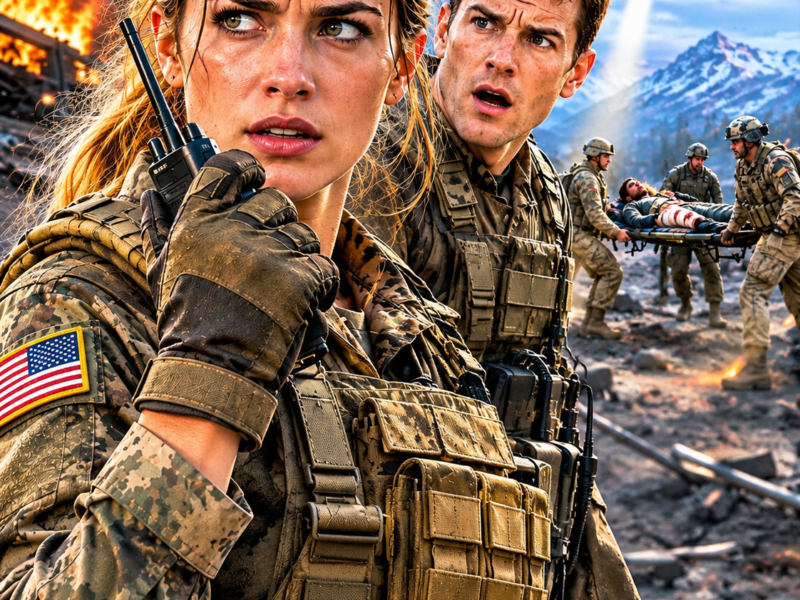
“I stood in front of fourteen soldiers as Captain Reed called me the weakest member of his unit, but when the flash flood swallowed our evacuation route
The crack above us sounded like a gunshot.
I looked toward the mountainside and saw rocks tumbling through the trees.
“Everybody move!” I shouted. “Get away from the slope!”
Captain Reed was still struggling to stand.
I grabbed his arm and pulled him toward the ridge.
“Sergeant, the others—”
“They’re moving, sir. Keep your feet under you!”
A section of the hillside collapsed behind us, sending mud and broken branches across the road.
The force knocked me onto one knee.
For a moment, all I could hear was rushing water and the sound of rocks hitting metal.
Then Brooks appeared through the rain.
“Sergeant Carter! We’ve got everyone except Miller. He’s with David!”
“Where are they?”
“Near the upper trail!”
I looked toward the ridge.
The route was steep, narrow, and barely visible through the rain.
But it was higher than the canyon floor.
“Take the others up there. Stay together. Nobody runs ahead.”
Brooks nodded.
“What about you?”
“I’m bringing the captain.”
Reed tried to pull his arm away.
“I can walk.”
“Then prove it, sir.”
He gave me a tired look but followed.
We reached the others several minutes later.
David had Miller sitting against a large boulder, his injured leg stretched out in front of him.
Emily’s medical training wasn’t part of the original exercise, but I’d spent enough time working alongside combat medics to know what needed attention.
I knelt beside Miller.
“Can you move your toes?”
He nodded.
“Good. Keep your leg still. We’re getting you out.”
David looked toward the canyon.
“Sergeant, the water’s covering the entire road.”
I followed his gaze.
The vehicles were almost completely submerged.
The equipment we had left behind was gone.
So was the route we’d been ordered to follow.
Captain Reed stared at the water for a long moment.
Then he turned toward me.
“What’s the plan?”
It was the first time he’d asked me that question.
I studied the ridge.
There was an old maintenance trail running along the eastern slope, but it wasn’t marked on our current field map.
I remembered seeing something similar during an assignment years earlier.
Beyond that trail was an abandoned mountain service station.
If it was still standing, it could provide shelter.
“There’s a maintenance route east of here,” I said. “It should lead to an old emergency shelter.”
Reed frowned.
“That route isn’t on our map.”
“Neither is the flood, sir.”
Brooks almost smiled.
The captain didn’t.
“How do you know it exists?”
I hesitated.
“Because I’ve been there.”
He studied my face.
Before he could ask anything else, another wave crashed against the rocks below us.
“Fine,” he said. “You’re leading.”
I turned toward the unit.
“Listen carefully. We’re moving in pairs. The person behind you stays within arm’s reach. If someone slips, you stop and help them. Nobody gets left behind.”
Fourteen soldiers adjusted their packs.
I counted them twice.
Then I started up the ridge.
The rain had become colder.
Water ran down the back of my jacket, and mud clung to the soles of my boots.
Miller needed help walking, so David and Brooks supported him between them.
Captain Reed stayed close to the rear.
Every few minutes, I looked back to make sure the formation was intact.
We had covered less than half a mile when Private Harris slipped.
His boot slid across a wet rock, and he dropped hard against the slope.
“Hold!” I shouted.
I turned and moved toward him.
“I’m okay,” he said, trying to stand.
“Don’t rush.”
I checked his ankle.
He could put some weight on it, but not enough to move quickly.
“We’ll adjust the pace.”
Captain Reed approached.
“At this speed, we’ll lose daylight.”
I looked at him.
“Then we’ll move in the daylight we have.”
He opened his mouth, then stopped.
For the first time, he didn’t argue.
We continued.
As we climbed, the noise of the flood became quieter.
But the mountain was still moving.
Small streams of mud crossed the trail, and several sections had been washed away.
At one point, I found a narrow passage between two rock formations.
The trail beyond it was barely wide enough for one person.
I tested the ground with my boot.
It held.
“One at a time,” I ordered.
Brooks crossed first, followed by David and Miller.
The others followed carefully.
When Reed reached the passage, he stopped beside me.
“Sergeant.”
“Yes, sir?”
“About what I said earlier…”
I knew exactly what he meant.
He had called me the weakest soldier he’d ever commanded.
I looked at the soldiers crossing the narrow trail.
“Sir, you can apologize when everyone is safe.”
He nodded slowly.
“Fair enough.”
We reached the eastern ridge shortly before noon.
The old service shelter was still visible in the distance.
It was a squat concrete structure built into the mountain, with a metal door and a weather station attached to its roof.
I felt some relief.
Then I noticed something.
The antenna was bent.
The windows were dark.
And the door appeared to be slightly open.
“Is that the shelter?” Brooks asked.
“Yes.”
“Please tell me it has power.”
“Let’s get inside first.”
We approached cautiously.
I pushed the door.
It didn’t move.
A heavy locking mechanism had engaged from the inside.
Captain Reed stepped forward.
“Can we force it?”
“Not without damaging the frame.”
I examined the control panel beside the entrance.
It was an older emergency access system.
Most people wouldn’t recognize it.
I did.
I removed my gloves and wiped the rain from the small display.
The panel had power, but the keypad was unresponsive.
“Where did you learn to operate that?” Reed asked.
I didn’t answer immediately.
I opened the small maintenance compartment beneath the panel.
Inside was an old mechanical override.
The system looked almost exactly like the ones I’d worked with years before.
“Sergeant?”
I turned.
“An old assignment, sir.”
He looked at me as if he wanted to ask more.
Instead, he stepped back.
I worked the manual release.
A small indicator light blinked.
Then the locking mechanism clicked.
The door opened several inches.
Brooks let out a breath.
“You’re officially my favorite person today.”
I gave him a tired smile.
“Get Miller inside.”
We moved everyone into the shelter.
The interior smelled of dust, wet concrete, and old electrical equipment.
There were emergency blankets, a first-aid cabinet, water storage containers, and a small communications station.
It wasn’t comfortable.
But it was dry.
And most importantly, it was above the flood line.
“Sound off!” Reed called.
One by one, the soldiers responded.
“Present.”
“Here.”
“Accounted for.”
I counted again.
Fourteen.
Every single one.
Reed removed his soaked jacket and looked around the room.
“How long can we stay here?”
“Long enough to stabilize Miller and restore communications, if the equipment works.”
I opened the medical cabinet and checked the supplies.
Some were outdated, but the emergency radio batteries were still sealed.
Brooks helped Miller onto a bench while David examined his leg.
I went to the communications station.
The main radio was damaged.
The backup unit had power, but no signal.
I adjusted the antenna connection and tried again.
Static.
Nothing.
“Command, this is Sergeant Carter. Do you copy?”
Only static answered.
I tried another frequency.
Still nothing.
The canyon walls were blocking our transmission.
Captain Reed came to stand beside me.
“How did you know about this place?”
I continued checking the radio.
“I told you. I worked on a similar system during an old assignment.”
“That doesn’t explain why you knew this shelter was here.”
I looked at him.
“Because I helped build part of the emergency network in this area.”
His eyebrows drew together.
“You’re a field sergeant.”
“Now, sir.”
He waited.
I wasn’t ready to explain everything.
Not yet.
The radio suddenly crackled.
A faint voice came through.
“—any station receiving, this is Mountain Rescue Command. Identify your position.”
I grabbed the microphone.
“Mountain Rescue Command, this is Sergeant Emily Carter, unit fourteen. We have fourteen soldiers at the eastern emergency shelter. One casualty with a leg injury. We require evacuation assistance.”
The response was faint but clear.
“Sergeant Carter, repeat your name.”
I repeated it.
There was a pause.
Then the voice returned.
“Emily Carter? Is that really you?”
I looked at the radio.
“Affirmative. Who is this?”
“Stand by.”
The channel went silent.
Reed stepped closer.
“Do you know that person?”
“Not yet.”
A few seconds later, another voice came through.
It was older, deeper, and unmistakably surprised.
“Sergeant Carter, this is Colonel James Morgan. Are you receiving?”
I straightened.
“Yes, sir.”
“Are you the same Emily Carter who served with the mountain emergency response team five years ago?”
The room became quiet.
I looked down at my hands.
“Yes, sir.”
Reed slowly turned toward me.
Colonel Morgan continued.
“We’ve been trying to locate your unit. The main access road has collapsed, and our rescue teams are approaching from the northern side. Your shelter is our only confirmed contact point.”
“Understood, sir.”
“Emily, we have a question about the evacuation route.”
I glanced at the map on the wall.
“Go ahead.”
“Do you remember the old western service trail?”
“Yes, sir.”
“Is it still passable?”
I studied the markings.
“Partially. The lower bridge may be damaged, but there’s another crossing farther north.”
“Can you identify it?”
I took a marker and began tracing the route.
“There’s a drainage channel here. The old maintenance bridge runs above it. If it’s intact, we can reach the northern clearing.”
Colonel Morgan paused.
“That bridge was removed from the current maps.”
“I know, sir. I was part of the team that documented it.”
Reed was watching me now.
Not with irritation.
With something closer to disbelief.
Colonel Morgan’s voice returned.
“Emily, your previous assessment during the Silver Ridge evacuation was the reason we developed the current mountain rescue protocols.”
I closed my eyes briefly.
I hadn’t heard that operation mentioned in years.
Five years earlier, I had been assigned to a specialized mountain emergency response team.
We were responsible for coordinating rescue routes, evaluating unstable terrain, and evacuating personnel during severe weather.
During one operation, a sudden storm had trapped twenty-three people in an isolated maintenance station.
I had identified an alternative route that wasn’t included in the official maps.
We brought all twenty-three people out alive.
But the operation ended badly for me in another way.
My commanding officer had taken credit for the successful route assessment.
When I questioned the report, I was told that arguing about recognition would damage my career.
I could have filed a formal complaint.
Instead, I requested a transfer.
I returned to ordinary field service.
I never told my new unit what had happened.
I hadn’t wanted to spend the rest of my career explaining a story nobody seemed interested in hearing.
Now, five years later, the same judgment was needed again.
Colonel Morgan spoke once more.
“Emily, your experience is why we selected you for this unit’s emergency readiness program. Your assignment record was reviewed before the deployment.”
I looked toward Reed.
He seemed unable to find words.
I answered carefully.
“Sir, I never asked to be selected for anything.”
“I know. But you were selected because of what you did.”
I lowered the microphone.
For a moment, the only sound in the shelter was the rain hitting the roof.
Then Reed spoke.
“Sergeant Carter.”
I turned.
“Sir?”
“I called you weak.”
Nobody moved.
He looked around at the soldiers.
“I told this entire unit you weren’t capable of making decisions.”
His voice was quieter than I’d ever heard it.
“I was wrong.”
I didn’t smile.
I didn’t tell him it was all right.
I simply said, “Then don’t make that mistake with another soldier, sir.”
He nodded.
“I won’t.”
Before either of us could say anything else, the radio crackled again.
“Sergeant Carter, we need your assistance. The northern rescue route has been compromised. We have several personnel stranded near the clearing.”
I reached for the microphone.
“How many?”
“Nine rescue workers and five additional soldiers. Their access bridge has sustained damage.”
I looked at the map.
The northern clearing was our only realistic evacuation point.
If the bridge had failed, we would need another way to reach them.
“Can you send an aerial assessment?” I asked.
“Negative. Visibility is too poor.”
I studied the old maintenance drawings.
There was another crossing.
It was longer, narrower, and required a steep climb.
But it might still be usable.
I pointed to the map.
“Sir, I believe we can reach them through this ridge.”
Reed came closer.
“That’s a difficult route.”
“Yes, sir.”
“How certain are you?”
I looked at the soldiers.
Fourteen people who had already survived one flood.
One of them could barely walk.
The others were exhausted.
I knew the route would be dangerous.
But leaving those people stranded wasn’t an option.
“Certain enough to attempt it with the proper precautions.”
Reed studied the map.
Then he turned toward the radio.
“Command, this is Captain Reed. Sergeant Carter’s assessment has my approval. She will lead the evacuation.”
I looked at him.
He handed me the map.
“Your call, Sergeant.”
I took it.
“Understood, sir.”
I gathered the unit.
“We’re moving again. This time, we’re not following the original route. We’re taking the northern ridge.”
Brooks adjusted his pack.
“Are we going to find more trouble?”
“Probably.”
He sighed.
“Good. I was worried the day might get boring.”
A few soldiers laughed.
It was the first time anyone had laughed since the flood began.
I gave them a moment.
Then I pointed toward the door.
“Let’s bring everyone home.”
The northern ridge was worse than the map suggested.
Several sections had been washed out, and the trail was covered in loose gravel.
The wind pushed against us as we climbed.
Miller’s leg was still painful, so David and Brooks took turns supporting him.
Every twenty minutes, I checked our position.
Captain Reed stayed near me.
He didn’t try to take control.
He listened.
When I asked him to check the rear formation, he did it without complaint.
At one point, we reached a narrow bridge crossing a fast-moving drainage channel.
The water below was not as high as the main flood, but it was moving quickly.
I stepped onto the bridge and tested the first section.
It creaked.
I stepped back.
“Nobody crosses yet.”
Reed looked at the structure.
“Can we reinforce it?”
“Not safely.”
“Then what’s the alternative?”
I looked downstream.
A large fallen tree had lodged between two rock formations.
It formed a rough natural crossing, but the surface was slick.
I examined the distance.
“We can use a safety line. One at a time.”
Reed nodded.
“Do it.”
We secured the rescue cord to a stable anchor point.
Brooks crossed first.
Then David.
Then the soldiers carrying the medical supplies.
I stayed near the center, helping each person maintain balance.
When Miller reached the crossing, his injured leg gave way.
David caught him.
“I’ve got you!”
The current splashed against the rocks below.
“Don’t look down,” I told Miller. “Look at me.”
He swallowed.
“Yes, Sergeant.”
“One step.”
He moved.
“Another.”
He reached the other side.
When everyone was across, I checked the formation.
Fourteen.
Still fourteen.
We continued toward the clearing.
The rescue team was closer than expected.
We could hear distant shouting through the trees.
I raised my hand.
“Hold.”
Everyone stopped.
A red emergency flare rose above the ridge.
Then another.
“They’re signaling from the clearing,” Brooks said.
I looked toward the sound.
“We’re almost there.”
But the final section of the route was blocked by a deep stream.
The water was moving faster than the earlier crossing.
On the opposite bank, I could see several people waving.
A rescue worker was holding an injured man upright.
The rest were gathered beneath a rock overhang.
Captain Reed approached.
“Can we cross?”
I studied the current.
“Not there.”
“We’re losing daylight.”
“I know.”
I followed the stream upstream.
There was a narrower section farther north, but reaching it would require another steep climb.
The soldiers were exhausted.
Miller could barely stand.
I knew what I was asking of them.
“Sergeant,” Reed said quietly, “we can wait for another rescue team.”
I looked toward the stranded people.
One of them had begun waving both arms.
The injured man was losing his balance.
“How long?”
Reed checked his watch.
“At least two hours.”
I shook my head.
“We don’t have two hours.”
I turned to Brooks.
“Help me find a secure anchor point.”
He nodded.
We located a thick tree rooted into the rock.
I secured the rope around its base and tested the knot.
Then I crossed the narrowest section first, moving carefully through the water.
The current pushed against my legs.
For several seconds, I could barely keep my footing.
On the opposite bank, a rescue worker reached toward me.
“Grab my arm!”
I made it across.
Then we secured the line on the other side.
The crossing wasn’t easy, but it was possible.
One by one, the soldiers followed.
Reed was among the last.
When he reached the middle, the current suddenly strengthened.
A wave struck his legs.
His footing slipped.
“Captain!” Brooks shouted.
Reed grabbed the rope.
I moved toward him from the bank.
“Keep holding!”
He struggled to regain his balance.
I reached out and caught his wrist.
For a moment, the same scene from the command vehicle flashed through my mind.
Another man.
Another rushing current.
Another person who needed someone to reach back.
“Sir, I’ve got you.”
He looked at me.
Then he found his footing.
We pulled him onto the bank.
He sat on the rocks, breathing hard.
I crouched beside him.
“Are you injured?”
He shook his head.
“No.”
I offered him a hand.
He took it.
“Thank you.”
I nodded.
“Let’s get the others.”
We reached the clearing shortly before sunset.
Nine rescue workers and five soldiers were waiting beneath the rock overhang.
One of the rescue workers ran toward us.
“Thank God. We thought nobody was coming.”
I immediately checked the injured man.
His leg was badly swollen, and he was showing signs of exhaustion.
David opened the medical kit.
“We need to stabilize him before moving.”
I looked around.
There were fourteen people in my unit and fourteen people waiting in the clearing.
Twenty-eight people in total.
I counted them carefully.
No one was missing.
The rescue workers helped us prepare the return journey.
But the northern route was now becoming unstable.
A large section of the stream bank had collapsed, and the bridge we had crossed earlier was no longer safe.
We needed to reach a nearby open area where aircraft could potentially spot us.
I contacted Command.
“Mountain Rescue, this is Carter. We have twenty-eight personnel at the northern clearing. Two injured. We require extraction.”
The radio crackled.
“Understood. Weather conditions are improving. An extraction team is being dispatched.”
I looked toward the sky.
The clouds were beginning to separate.
For the first time that day, I could see a faint strip of blue.
Then another problem appeared.
A rescue worker pointed toward the western side of the clearing.
“There’s another trail over there.”
I followed his finger.
The path descended toward a narrow valley.
It wasn’t on my map.
“Where does it go?” I asked.
“An old forestry access road. It might connect to the lower highway.”
I examined the terrain.
The road could be useful.
But the valley was still carrying runoff.
“Nobody moves until we’ve assessed it.”
Captain Reed came beside me.
“Agreed.”
He looked at the rescue worker.
“Can you show us where the road begins?”
The man nodded.
We followed him a short distance.
The trail was steep, but the ground appeared stable.
I found an old marker partially buried beneath the mud.
The lettering was almost gone.
But I recognized the symbol.
It was part of the original mountain emergency network.
I knelt and brushed away the dirt.
The marker indicated a secondary access route to the same shelter system.
I turned to Reed.
“This could lead to the southern service road.”
He examined the marker.
“Can we use it?”
“Possibly. But we’ll need to move carefully.”
He looked at me.
“Your assessment.”
I considered the options.
Waiting for aircraft extraction was safer if the weather remained clear.
But if the clouds closed again, the aircraft might not reach us.
The forestry road offered another option.
It was longer, but it could connect us to ground rescue teams.
I contacted Command.
“Requesting confirmation of the southern service road status.”
The reply came after a brief delay.
“Road is unverified. No current access report.”
I looked at the terrain.
“Understood.”
Reed waited.
I could feel the responsibility of the decision settling over me.
Twenty-eight people.
Two injured.
A route nobody had confirmed.
And a weather system that had already proven how quickly the mountains could change.
I finally spoke.
“We stay here until the extraction team confirms its position. If the aircraft cannot reach us, we’ll take the southern road in daylight.”
Reed nodded.
“That’s the right call.”
We established a temporary perimeter and organized the injured personnel.
Brooks distributed water.
David checked the medical supplies.
The rescue workers helped secure the shelter area.
For the first time since the flood began, everyone had a chance to sit down.
I leaned against a rock and removed my gloves.
My hands were trembling slightly.
I hadn’t noticed until then.
Brooks sat beside me.
“Sergeant?”
“Yeah?”
“Can I ask you something?”
“Go ahead.”
“Why didn’t you ever tell us about that old rescue?”
I looked toward the distant mountains.
“Because it happened a long time ago.”
“That’s not an answer.”
I smiled faintly.
He was right.
I picked up a small stone and turned it between my fingers.
“After that rescue, my commanding officer received the recognition. The report made it sound like he had identified the route and coordinated the evacuation.”
Brooks listened without interrupting.
“I was told not to challenge it. I was young, and I thought speaking up would make me look difficult. So I transferred.”
“Didn’t you want people to know what you did?”
“At the time, yes.”
I watched David help Miller adjust his leg.
“Eventually, I realized I didn’t need everyone to know. I just needed to know I had done the right thing.”
Brooks looked at me.
“Still, it wasn’t fair.”
“No. It wasn’t.”
He nodded.
Then he looked toward Captain Reed.
“He’s different now.”
I followed his gaze.
Reed was helping one of the rescue workers organize supplies.
“People can change,” I said.
“Do you believe that?”
I considered the question.
“I believe they can choose to.”
A few minutes later, Reed approached.
“Sergeant Carter, can I speak with you?”
I stood.
“Yes, sir.”
He walked a short distance away from the group.
For a moment, he seemed unsure how to begin.
Then he took a breath.
“I’ve been reviewing the way I’ve treated you since you joined this unit.”
I waited.
“I made assumptions based on your rank and the way you approached decisions. I thought caution meant hesitation.”
He looked down at the mud on his boots.
“I was wrong.”
I didn’t interrupt.
“I should never have called you weak. Not in front of the unit. Not anywhere.”
The apology was quieter than I expected.
It wasn’t dramatic.
He wasn’t asking me to tell him he was a good man.
He was simply admitting what he had done.
“Thank you for saying that, sir,” I replied.
He nodded.
“I don’t expect you to forget it.”
“I won’t.”
He accepted that.
Then he looked toward the soldiers.
“But I hope you’ll let me earn back your trust.”
I looked at him for a moment.
“Trust isn’t something you get because you apologize, sir.”
“I know.”
“It’s something you build through what you do next.”
He gave a small nod.
“Then I’ll start there.”
The sound of helicopter blades reached us shortly after sunset.
Everyone stood.
A rescue aircraft appeared beyond the ridge, its lights cutting through the fading rain.
One of the rescue workers raised an emergency flare.
The helicopter circled once.
Then the radio crackled.
“Clearing team, this is Mountain Rescue. We have visual confirmation. Prepare for extraction.”
I looked around.
“Organize the injured first. Nobody approaches the aircraft until the crew gives instructions.”
The extraction took time.
The injured personnel were secured and transferred first.
Then the remaining soldiers and rescue workers followed.
I stayed until everyone else was accounted for.
Captain Reed approached the aircraft last.
“Sergeant, you’re coming.”
“After you, sir.”
He shook his head.
“That’s an order.”
I almost smiled.
“Understood.”
We boarded.
As the helicopter lifted away, I looked down at the valley.
The road that had seemed so ordinary that morning was now buried beneath mud and water.
The vehicles were gone.
The training equipment was gone.
But every person from our unit had survived.
I rested my head against the seat.
For the first time all day, I allowed myself to close my eyes.
The following morning, we returned to Fort Carson.
The medical team examined everyone.
Miller needed surgery for his leg, but doctors expected him to recover.
Harris had a badly sprained ankle.
The rest of the unit had minor injuries and exhaustion.
I spent most of the morning completing reports.
I wasn’t thinking about recognition.
I was thinking about the people who had made it home.
Around noon, Captain Reed entered the briefing room.
“Sergeant Carter, Command wants to see you.”
I stood.
“Now, sir?”
“Now.”
We walked to the administration building.
Colonel Morgan was waiting inside.
He stood beside a large table covered with rescue reports and photographs from the operation.
“Emily,” he said, “it’s good to see you again.”
“Good to see you too, sir.”
He gestured toward a chair.
“Please sit.”
I remained standing.
“Thank you, sir. I’d prefer to stand.”
He smiled slightly.
“Still the same.”
Captain Reed stood near the door.
Colonel Morgan opened the first report.
“Fourteen soldiers evacuated from the canyon. Fourteen additional personnel recovered from the northern clearing. Twenty-eight people brought to safety.”
He looked up.
“Your decisions prevented a much larger casualty event.”
I lowered my eyes.
“The entire unit contributed, sir.”
“I know. That’s why the report names everyone who participated.”
He turned a page.
“However, your leadership deserves particular recognition.”
I didn’t know what to say.
Colonel Morgan placed another document on the table.
“There’s something else.”
I stepped closer.
It was an official personnel recommendation.
My name appeared near the top.
I read the first few lines.
Then I looked up.
“Sir, what is this?”
“Your new assignment has been approved.”
I read the designation again.
It was a position within the Army’s emergency operations and rescue coordination program.
A role that would allow me to train other soldiers in terrain assessment, evacuation planning, and disaster response.
I looked at Colonel Morgan.
“I didn’t apply for this.”
“No. We recommended you.”
He tapped the report.
“Your experience, your judgment, and your ability to lead under pressure are exactly what this program needs.”
I felt a strange tightness in my throat.
Five years earlier, I had left that kind of work believing the door had closed behind me.
Now it was opening again.
“Sir, I appreciate the recommendation, but I need to think about it.”
“Of course.”
He slid the document toward me.
“Take the time you need.”
Captain Reed stepped forward.
“There’s something I want to add.”
I turned.
He looked uncomfortable, but he didn’t look away.
“During the operation, I made the mistake of treating your judgment as a threat to my authority.”
He paused.
“I thought being a strong commander meant having the final answer.”
He glanced at the report.
“Instead, you reminded me that leadership sometimes means recognizing who has the knowledge you don’t.”
I listened.
“I would like to formally recommend you for the position.”
I looked at him.
“Thank you, sir.”
He nodded.
Then he said something I hadn’t expected.
“And I would like the unit to hear the truth about what happened five years ago.”
I stared at him.
“What do you mean?”
“Your old rescue operation. The report. The credit you never received.”
Colonel Morgan folded his hands.
“We reviewed the original records after your name came up during the radio transmission. There is enough documentation to correct the historical report.”
I felt my fingers tighten around the edge of the table.
For years, I had told myself that the past didn’t matter.
That the work was what mattered.
That recognition was unnecessary.
But seeing the report in front of me brought back memories I had carefully put away.
“I don’t want anyone punished just to make a point,” I said.
Colonel Morgan nodded.
“That’s not the purpose. The record should simply be accurate.”
I looked at Captain Reed.
He gave a small nod.
I finally sat down.
“Then I’d like the record corrected.”
Colonel Morgan smiled.
“That’s all we needed to hear.”
Three days later, the unit gathered in the main assembly hall.
I stood near the back, still uncomfortable with the attention.
The soldiers from our rescue operation were there.
Brooks was standing beside David.
Miller had arrived on crutches, determined not to miss the ceremony.
Captain Reed stood at the front.
Colonel Morgan stepped up to the microphone.
“Today, we are recognizing a team that faced an unexpected natural disaster and brought every member home.”
The room became quiet.
He described the flood, the collapsed road, the emergency shelter, and the difficult evacuation through the northern ridge.
Then he mentioned the twenty-eight people who had been brought to safety.
He thanked the soldiers and rescue workers who had helped.
Finally, he looked toward me.
“One soldier’s judgment and experience played a central role in the rescue.”
I felt Brooks nudge David.
Colonel Morgan continued.
“Sergeant Emily Carter demonstrated that leadership is not measured by how loudly someone gives an order, how many people stand at attention, or how much authority appears on a uniform.”
He paused.
“It is measured by the responsibility a person accepts when others are depending on them.”
The room remained silent.
“Five years ago, Sergeant Carter helped coordinate the Silver Ridge evacuation, bringing twenty-three people out of a dangerous mountain area. Her assessment and rescue planning later influenced our emergency response procedures.”
I heard someone whisper behind me.
I had never told the unit about those twenty-three people.
Colonel Morgan continued.
“Today, she did it again.”
He called me forward.
I walked to the front.
The applause began before I reached the podium.
I shook Colonel Morgan’s hand.
He presented me with a commendation.
Then Captain Reed stepped toward the microphone.
He looked at the unit.
“I owe Sergeant Carter an apology.”
The room became completely quiet.
“When she joined my unit, I judged her before I understood her experience. I called her weak because she questioned a route I had approved.”
He paused.
“That decision could have cost every one of us our lives.”
He turned toward me.
“She saved my life when she could have left me behind. She brought our unit to safety when my orders were no longer enough.”
His voice softened.
“Sergeant Carter, I was wrong. And I am sorry.”
I looked at him.
There was no perfect response.
No sentence could erase those weeks of being dismissed.
But I could see that he meant what he said.
“Thank you, sir,” I replied.
Then I added, quietly but clearly, “I hope you remember this the next time another soldier questions something you believe is certain.”
He nodded.
“I will.”
After the ceremony, Brooks found me near the exit.
“Well, Sergeant, I guess you’re famous now.”
I laughed.
“Don’t start.”
“I’m serious. Twenty-three lives five years ago, twenty-eight this time. That’s fifty-one people.”
“That’s fifty-one people who had other people helping them.”
He shook his head.
“You really can’t accept a compliment, can you?”
“I can.”
“All right. You’re an excellent leader.”
I smiled.
“Thank you.”
He looked surprised.
“That actually worked?”
“Don’t get used to it.”
We both laughed.
A few days later, I visited Miller in the hospital.
He was sitting beside the window with his leg supported by pillows.
A television played quietly in the background.
“Sergeant Carter,” he said when I entered.
“How’s the leg?”
“Better. The doctor says I’ll be walking normally again.”
“Good.”
He pointed toward the chair.
“Sit down. I wanted to ask you something.”
I sat.
“Go ahead.”
“Why did you come back for the captain?”
I looked at him.
“What do you mean?”
“During the flood. You could have stayed with the rest of us. You went back toward the vehicle when everyone was moving away.”
I considered the question.
“Because he was still one of ours.”
Miller looked down at his hands.
“Even after the way he treated you?”
“Especially then.”
He frowned.
“I don’t think I could have done that.”
“Maybe you won’t have to find out.”
He nodded slowly.
Then he smiled.
“Brooks says you’re getting a new assignment.”
“That’s what they’re offering.”
“Are you taking it?”
I looked out the hospital window.
A group of soldiers crossed the parking lot, laughing about something.
“I think I am.”
Miller smiled.
“Good. You’re going to be missed.”
“I’ll still be around.”
Before I left, he reached out and shook my hand.
“Thank you for bringing us home.”
I squeezed his hand.
“Get better, Miller.”
Two weeks later, I signed the acceptance papers.
My new assignment would begin the following month.
I would be responsible for helping train soldiers in emergency leadership and mountain rescue planning.
It wasn’t a promotion I had ever imagined.
But it was work I understood.
On my final afternoon with the unit, Captain Reed asked me to attend one last briefing.
I entered the room and noticed a familiar map on the table.
It was the same canyon where the flood had happened.
Reed stood beside it.
“Before we begin, I want to make one thing clear.”
He looked around at the soldiers.
“Sergeant Carter is here to review the terrain assessment. I expect everyone to listen, especially me.”
Brooks grinned.
“Understood, sir.”
A few soldiers laughed.
I stepped toward the map.
“All right. Let’s start with the rainfall markers.”
I pointed to the canyon entrance.
“This section looks safe under normal conditions. But after sustained rainfall, runoff from the upper slope can reach the road much faster than expected.”
Reed nodded.
“Which means?”
“We don’t treat an approved route as a permanent guarantee of safety.”
He looked at the soldiers.
“Write that down.”
I smiled faintly.
We spent the next hour reviewing alternative routes, emergency communication points, and evacuation procedures.
Nobody interrupted when I raised a concern.
Nobody called caution weakness.
At the end of the briefing, Reed walked me outside.
The afternoon sun was shining across the base.
“Sergeant, I wanted to thank you again.”
“You already did, sir.”
“I know. But I don’t think I said enough.”
He looked toward the mountains in the distance.
“When I first took command, I believed authority meant never showing uncertainty. I thought if I admitted someone else knew more than I did, the unit would lose confidence in me.”
He shook his head.
“Now I understand that refusing to listen is what makes people lose confidence.”
I considered his words.
“That’s a difficult thing to learn.”
“Yes.”
He looked at me.
“I hope the next unit you train has better weather.”
I laughed.
“So do I.”
We stood there for a moment.
Then he extended his hand.
I shook it.
Not because everything that happened had been forgotten.
Not because an apology erased the past.
But because I believed people deserved the chance to do better when they were willing to change.
As I walked toward the administration building, I passed the fourteen soldiers who had stood in formation on the morning of the flood.
Brooks raised his hand.
“Sergeant Carter!”
I turned.
“Yes?”
He pointed toward the mountains.
“Ready for another long day?”
I looked at the team.
The same people.
The same mountains.
But something between us had changed.
I adjusted the strap on my shoulder.
“Ready.”
And as I walked away, I remembered the words I had spoken during the flood.
Nobody gets left behind.
I had always believed that meant refusing to abandon someone in danger.
Now I understood something else.
It also meant refusing to abandon the person you could become just because someone else had failed to recognize your strength.
The mountains were still there.
The storms would come again.
But this time, the soldiers standing beside me knew that the strongest leader in the room wasn’t necessarily the one giving the loudest orders.
Sometimes, it was the one quietly checking the weather, noticing what everyone else had missed, and making sure there was a way home for every single person.
The End.