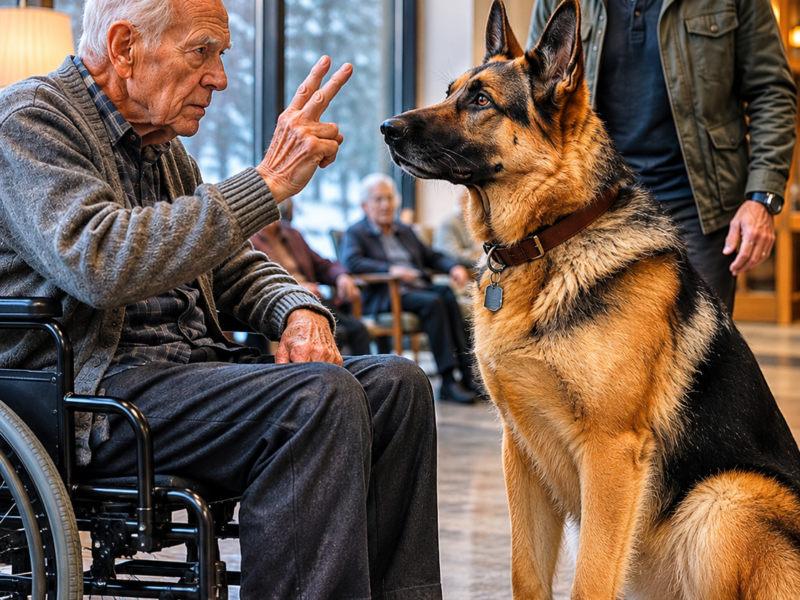
“At Northstar Veterans Residence in Wisconsin, I watched my retired German Shepherd step between an elderly veteran and a doorway after the man whispered two words I had never taught him
The date on the photograph was almost twenty years earlier than Bishop’s official military records.
I stared at it, turning the picture slightly toward the light.
The numbers were faint, written in blue ink along the bottom corner. The photograph showed a younger Bishop standing beside a man in uniform, his ears alert and his body angled toward the camera. Caleb. I had heard Walter say the name more than once, always with the same distant certainty, as if the man were still somewhere nearby.
But the date made no sense.
Bishop had been born nine years ago. His military records were clear. His service history was clear. There was no way he could have been standing beside Caleb twenty years earlier.
Unless the photograph wasn’t what I thought it was.
I looked again at the dog in the picture. The shape of his head. The dark markings around his eyes. The white patch beneath his chin.
It was Bishop.
Or a dog so much like him that the resemblance was unsettling.
“Something wrong?” Celia asked.
I handed her the photograph.
“Do you know when this was taken?”
She studied the date, then shook her head. “I’ve seen the picture before. Dad kept it in his desk for years. I never paid much attention to the date.”
“Bishop wasn’t born then.”
“Maybe it was another dog.”
“Maybe.”
But I didn’t believe that.
Celia turned the photograph over. There was nothing on the back except a small handwritten sentence.
Don’t let him learn the wrong lesson.
I had seen those words before. They had bothered me the first time, and they bothered me more now.
“Who wrote this?” I asked.
“I don’t know,” Celia said. “My father never explained it.”
I returned the photograph to the table.
For the first time since arriving at Northstar, I had the feeling that Walter’s memories were not simply slipping away. Some of them were connected to something he had never finished saying.
And I was beginning to understand that Bishop might be part of that unfinished story.
That evening, I called Ronan Pike.
He answered on the fourth ring.
“Pike.”
“It’s Elias Voss. We met years ago at the training facility.”
There was a pause.
“Eli Voss,” he said. “I remember. How’s that old dog?”
“Still stubborn.”
“Then he’s doing well.”
I almost smiled.
“I have a question about a photograph.”
I described it: a German Shepherd beside a uniformed man, a date written in the corner, and a note on the back.
Ronan didn’t answer immediately.
“Where did you get it?”
“From Walter Keane. He’s at Northstar Veterans Residence.”
Another pause.
“Walter Keane,” he repeated.
“You know him?”
“I knew of him. He worked with Caleb.”
“Caleb who?”
“I don’t know his last name. Not for certain. But I remember the story.”
I leaned back in my chair.
“What story?”
Ronan exhaled slowly.
“Before your time, there was a handler who worked with a German Shepherd named Noble. The dog was exceptional. Quiet, steady, and very good at reading people. The handler was a man named Caleb. They were assigned together for years.”
“And the photograph?”
“Could be them. But Noble wasn’t Bishop.”
“I know.”
“Do you?”
I looked through the window. Bishop was lying near the radiator, his paws crossed, watching the snow gather against the glass.
“What are you saying?”
“Dogs can resemble one another. Especially within the same working lines. But that name, Noble, means something. It wasn’t just a nickname.”
“Walter calls Bishop that.”
“I figured he might.”
Ronan went quiet again.
“Eli, I need you to understand something. Caleb and Noble had a difficult ending. The kind of ending people don’t talk about because they don’t know how to explain it.”
“What happened?”
“I don’t know everything. I heard Caleb left the service after an incident. Noble was retired, too. Walter stayed in touch with him for a while. Then something happened between them.”
“An argument?”
“Maybe. Or maybe something worse.”
I rubbed a hand across my face.
“Do you know where Caleb is?”
“I knew where he was years ago. I don’t know now.”
“Walter has been asking for his address.”
That seemed to change something in Ronan’s voice.
“Has he?”
“Art Leland told me Walter has asked more than once.”
“Then he probably still has it.”
“Who?”
“Walter. He may have kept the old correspondence. If he hasn’t thrown it away.”
I looked down at the photograph again.
“Ronan, why would Walter write, ‘Don’t let him learn the wrong lesson’?”
“Because he was afraid someone would.”
“Someone like who?”
“Maybe Caleb. Maybe himself.”
The call ended without giving me the answer I wanted.
For a while, I sat in the quiet.
I had spent years believing that the hardest part of leaving the service would be learning to live without a mission. I had been wrong. The hardest part was learning that not every problem could be solved by finding the right person, giving the right command, and holding the line until the danger passed.
Some things stayed unresolved because people were afraid to face them.
I knew something about that.
I had spent nine years telling myself that Bishop needed structure. That he needed a purpose. That without a job, he would lose the part of himself that made him valuable.
But perhaps I had been confusing his purpose with mine.
The next morning, Walter was sitting in the common room with a cup of tea cooling between his hands. He wore a gray cardigan and the same expression he had worn when he first saw Bishop.
The dog was beside my chair.
“Walter,” I said.
He looked up.
“Good morning, son.”
I pulled a chair across from him.
“I found something in the photograph.”
His eyes moved toward me.
“The date?”
I nodded.
He looked down at his tea.
“It’s not Bishop.”
“I thought you might say that.”
“It was another dog. His name was Noble.”
I glanced at Bishop.
“Why do you call him that?”
Walter reached out and rubbed Bishop’s shoulder.
“Because he reminds me of him.”
“Did Noble belong to Caleb?”
Walter’s fingers stopped.
For a moment, the room seemed to become very quiet.
“Yes.”
“What happened to them?”
Walter looked toward the window. Outside, a maintenance worker was clearing snow from the walkway.
“Caleb was a good man,” he said. “A difficult man, sometimes. But good.”
I waited.
“He believed that if you stayed beside someone long enough, you could keep them from falling apart.”
Walter smiled faintly.
“He was wrong about that.”
“Did you tell him?”
“I should have.”
His eyes returned to the dog.
“Noble was trained to protect Caleb. Not just from strangers. From doors, roads, crowds, anything Caleb might walk into without thinking. He was very good at it.”
“Like Bishop.”
“Exactly like Bishop.”
Walter took a slow breath.
“Caleb used to say Noble understood him better than any person ever had. I thought it was sentimental nonsense. Then I saw the dog work.”
He looked at me.
“Have you ever seen a dog stand between a man and a mistake?”
I thought of Bishop at the lakeside gate.
“Yes.”
“Then you know.”
Walter’s hand rested on the dog’s back.
“One winter, Caleb started having trouble. He forgot things. Got confused. Sometimes he couldn’t tell where he was. He hated it. He hated being watched. Hated being helped.”
“Was he injured?”
“Not in the way people could see.”
Walter lowered his voice.
“He had memories that wouldn’t leave him alone. Some days he was fine. Other days, a sound or a smell would take him somewhere else.”
I remembered the generator at the lake.
“Did Noble help him?”
“More than anyone.”
Walter paused.
“But we made a mistake.”
“What mistake?”
“We thought because Noble could keep Caleb safe, we didn’t have to teach Caleb how to accept help from people.”
He looked down at his hands.
“We let the dog do all the talking.”
I didn’t answer.
“Caleb began relying on him for everything. Then one day, he refused to leave his room without Noble. He stopped going to appointments. Stopped visiting people. He said the dog was the only one who understood.”
Walter swallowed.
“I told him he was making Noble carry too much.”
“Did he listen?”
“No.”
Walter gave a small, humorless laugh.
“Neither did I.”
“What happened?”
“One afternoon, Caleb went outside during a storm. He thought he was going to the old training grounds. He wasn’t. He was confused. Noble kept him away from the road, but Caleb fought him. He pulled against the leash. Shouted. Told the dog to get away from him.”
Walter’s eyes became wet, though his voice stayed steady.
“Noble obeyed. For the first time, he stepped back when Caleb needed him to stay.”
I felt my chest tighten.
“Was Caleb hurt?”
“He fell. Broke his hip. It was a long recovery. After that, he couldn’t work with Noble anymore.”
“And the dog?”
“Retired. He went to a good home.”
Walter looked at Bishop.
“But Caleb never forgave himself. He believed Noble had abandoned him. He believed the dog had failed him.”
“Was that true?”
“No.”
The answer came sharply.
“No, son. It wasn’t true. Noble did exactly what he had been trained to do. Caleb gave a command, and the dog obeyed. The failure was ours.”
I looked at the photograph again.
“Who wrote the note?”
“I did.”
The words settled between us.
“Why?”
Walter stared at the table.
“Because I was afraid Caleb would teach the next dog the same thing. That love meant never stepping away. That loyalty meant staying even when staying was hurting you.”
He reached for his tea but didn’t drink.
“I wanted Noble to have a life after Caleb. I wanted him to know he wasn’t a failure. I wanted the people around him to understand that a dog could be loyal without carrying every burden a person refused to share.”
I looked at Bishop.
The dog had been watching Walter the entire time.
“Why did you call him Noble?”
“Because I missed the first one.”
Walter’s voice cracked slightly.
“And because I wanted to believe I could get it right the second time.”
I sat back.
“Walter, Bishop isn’t Noble.”
“I know.”
“He has his own history.”
“I know that, too.”
“And he doesn’t need to become someone else’s answer.”
Walter nodded slowly.
“No. He doesn’t.”
For a while, neither of us spoke.
Then he said something I hadn’t expected.
“I have Caleb’s address.”
I leaned forward.
“Where?”
“In a box at home. Letters, photographs, old papers. I kept telling myself I’d visit him when I had more time.”
“Do you still want to?”
Walter looked at the window again.
“I don’t know if I can.”
“Would you like help?”
He looked at me for a long moment.
“Not from the dog.”
I understood.
“All right.”
“From you, perhaps.”
I nodded.
“Then we’ll see what we can arrange.”
He gave a small smile.
“Thank you.”
When I stood, Bishop rose with me.
Walter reached down and touched the dog’s head.
“Goodbye, Noble.”
Bishop leaned into his hand.
But Walter corrected himself.
“Bishop,” he whispered. “Your name is Bishop.”
I watched the dog return to my side.
It was a small thing. A correction of one name.
But it felt like the beginning of something.
That afternoon, I found Celia in the reception area. She was holding a folder against her chest and speaking quietly with Naomi.
When she saw me, she stepped away from the desk.
“Did Dad tell you about Caleb?”
“He did.”
She looked relieved, then uncertain.
“I found the box he mentioned.”
“Where?”
“At his house. I went there this morning to collect some clothes. It was in the back of his study, under a stack of old newspapers.”
“Did you find the address?”
“I found letters. A lot of them.”
She opened the folder and showed me a few envelopes. The handwriting was old and uneven. Some were addressed to Walter. Others were addressed to Caleb.
“He never sent these,” she said.
I looked at the dates.
The letters had been written over several years.
“Have you read them?”
“Some.”
She looked down.
“He wrote about visiting Caleb. About apologizing. About how he should have said something before Noble was retired. Then he wrote about how he didn’t know what to say anymore.”
“Did he ever explain why he stopped?”
“No.”
She pressed the folder against herself.
“I think he was ashamed.”
“Of what?”
“Of not being there when Caleb needed him. Of telling himself he was helping when he was really avoiding the difficult part.”
I thought of the way Walter had described it.
“He may have been afraid of making things worse.”
“That’s what I used to tell myself about Dad. He was practical. He fixed things. He drove me to appointments, repaired my car, brought groceries when I was sick. But whenever I wanted to talk about something that hurt, he would find a task to do.”
She gave a small, sad smile.
“I used to think he didn’t care.”
“Maybe he didn’t know how to show it.”
“Maybe.”
She glanced toward the common room.
“Is he going to see Caleb?”
“He said he doesn’t know if he can.”
Celia nodded.
“I found one letter that might help.”
She handed it to me.
The paper was folded into thirds. The ink had faded, but the words were still readable.
Caleb,
I keep thinking that if I had said the right thing, you would have understood. But maybe there was no right thing. Maybe I was afraid that if I admitted how much I had failed you, I would have to admit how much I had failed myself.
I should have come sooner.
I should have asked what you needed instead of deciding what would be best.
I don’t know if you will ever forgive me. I don’t know if I deserve it.
But I want you to know Noble did not abandon you. He stayed as long as he could. The day he stepped away, he was obeying you. He loved you enough to listen, even when you were hurting.
I wish I had been as good a friend to you as he was.
Walter
I read the letter twice.
Then I handed it back.
“Does he know you found this?”
“Not yet.”
“Maybe you should ask him if he wants to send it.”
She looked at me.
“What if he says no?”
“Then he says no.”
“And if he says he wants to visit?”
“Then we’ll help him get there.”
Celia nodded slowly.
“I don’t want to force him.”
“Neither do I.”
She glanced at Bishop.
“Dad keeps calling him Noble.”
“He knows the difference.”
“I think he does now.”
That evening, I walked Bishop along the corridor outside the recreation room. The snow had stopped, and the windows reflected the warm lights inside.
He moved at an easy pace, stopping occasionally to sniff the baseboards or look toward a passing resident.
There was no harness.
No command.
No task.
Just a dog walking beside me.
I had spent so long thinking that retirement meant losing something that I had failed to notice what it could give back.
A slower walk.
A quiet room.
A choice.
I stopped near the window.
Bishop stopped, too.
“Come on, old man,” I said.
He looked at me, then turned toward the garden doors.
I followed him.
Outside, the snow had settled in smooth layers across the courtyard. The lamps cast pale circles over the path. Bishop walked a few feet ahead, then turned his head to check that I was still there.
I didn’t call him back.
I didn’t tell him where to go.
I let him choose the direction.
The following morning, Walter asked me to sit with him after breakfast.
Celia was there, holding the letter.
“I found something,” she said.
Walter looked at the paper.
For a moment, his expression tightened.
“Where did you get that?”
“Your study.”
He looked down at the letter.
“I thought I had thrown it away.”
“You kept it.”
“I suppose I did.”
Celia sat beside him.
“Would you like me to mail it?”
Walter shook his head.
“No.”
She lowered her eyes.
“All right.”
“I’d rather take it myself.”
Celia looked up.
“You want to visit Caleb?”
Walter nodded, though uncertainty remained in his face.
“If he’s still there.”
“We can find out.”
He held the letter with both hands.
“I don’t know what he’ll say.”
“He doesn’t have to say anything,” I told him.
Walter looked at me.
“That’s easy for you to say.”
“Yes,” I admitted. “It is.”
He considered that, then nodded.
“I suppose it is.”
Celia put a hand over his.
“Dad, we can go together.”
Walter stared at their joined hands.
“I don’t want you to feel responsible for me.”
“I don’t.”
“You have your own life.”
“I do.”
“And you shouldn’t have to spend it taking care of an old man.”
Celia’s eyes filled.
“I’m not doing it because I have to.”
Walter looked at her.
“I’m doing it because I want to know you,” she said. “Not just the things you can fix.”
He looked away.
For several seconds, he seemed unable to find a response.
Then he nodded.
“I’d like that.”
It was not a dramatic reconciliation. No one embraced. No one made a speech. Walter folded the letter carefully and placed it inside his cardigan pocket.
But when Celia stood to leave, he reached for her hand.
She stayed.
Two days later, Ronan called me back.
“I found something,” he said.
I was in the parking lot, brushing snow off the windshield.
“What?”
“Caleb’s last known address. I also spoke with someone who knew him. He’s still alive.”
I stopped brushing.
“Where is he?”
“An assisted living community outside Green Bay. His memory isn’t what it used to be, but he’s doing reasonably well.”
“Does he know Walter might visit?”
“Not yet. I didn’t want to say anything without checking with you.”
“Thank you.”
Ronan paused.
“Eli, one more thing.”
“What?”
“I looked into Bishop’s records after our last conversation. His working line goes back to the same breeding program that produced Noble.”
I looked through the windshield at the snow.
“So they’re related?”
“Possibly. The records aren’t complete enough to say how closely. But the resemblance may not be a coincidence.”
I let that settle.
“Walter might find that comforting.”
“Maybe. But don’t let him turn Bishop into a replacement.”
“I won’t.”
“Good. And don’t turn him into one yourself.”
I smiled faintly.
“I’m working on that.”
After I hung up, I stayed in the car for a while.
The old photograph made more sense now. It wasn’t proof that Bishop had lived another life. It was proof that some stories continued through people and animals who never knew they were carrying them.
But Bishop wasn’t a second Noble.
He wasn’t Walter’s chance to repair the past.
He wasn’t my excuse to keep living like every day needed a mission.
He was simply Bishop.
And I needed to let that be enough.
The visit was arranged for the following week.
The drive to Green Bay took a little over two hours. Celia sat in the front passenger seat. Walter sat in the back with his coat buttoned to the neck, the letter resting in his lap.
Bishop rode in the rear cargo area, lying on his blanket.
I had considered leaving him at Northstar.
Walter had insisted he come.
“Not as Noble,” he had said. “As Bishop.”
So Bishop came.
The road was quiet. Snow-covered trees lined the highway, and the sky was the flat gray of a winter morning.
Walter spoke very little.
Once, about forty minutes into the drive, he asked how long remained.
“About an hour,” I said.
He nodded.
A few minutes later, he asked again.
I gave him the same answer.
Celia reached back and rested her hand on his knee.
“There’s no rush, Dad.”
Walter looked at her.
“I know.”
But his fingers kept moving over the folded letter.
When we arrived, a staff member met us in the entrance. She led us through a bright hallway to a small sitting room.
Caleb was waiting by the window.
He was older than Walter, thinner than the man in the photograph, and his hair had gone almost entirely white. His hands rested on the arms of his chair.
When he saw Walter, he didn’t stand.
For a long moment, neither man spoke.
Then Caleb said, “You took your time.”
Walter let out a breath that might have been a laugh.
“I did.”
Caleb looked at the letter in his hand.
“What’s that?”
“Something I should have sent years ago.”
“You could have called.”
“I could have.”
“Could have visited.”
“I could have.”
Caleb looked out the window.
“You always were good at knowing what you should have done.”
Walter lowered himself into the chair across from him.
“I was better at knowing than doing.”
Celia sat beside Walter. I remained near the door with Bishop.
Caleb noticed the dog.
His expression changed.
“That’s a Shepherd.”
“Yes,” I said. “His name is Bishop.”
Caleb leaned forward slightly.
“What’s his other name?”
Walter looked at him.
“Sometimes I call him Noble.”
Caleb’s eyes moved back to the dog.
For a moment, something seemed to pass through his face.
“Noble,” he whispered.
“He isn’t Noble,” Walter said gently. “He’s Bishop.”
Caleb nodded.
“Of course.”
Bishop stood quietly beside me.
Caleb watched him for a long time.
“Good-looking dog.”
“He is,” I said.
“Does he work?”
“Not anymore.”
Caleb seemed to understand that answer better than I expected.
“Retired?”
“Yes.”
“Good.”
He looked toward Walter.
“Dogs should get to retire.”
Walter nodded.
“They should.”
The room became quiet again.
Then Walter held out the letter.
“I wrote this a long time ago.”
Caleb took it.
His hands trembled as he unfolded the paper. He read slowly, pausing over certain lines. When he reached the end, he folded it again.
“I don’t remember all of it,” he said.
Walter’s face fell slightly.
Caleb looked up.
“But I remember Noble.”
Walter nodded.
“He was a good dog.”
“The best.”
“He didn’t abandon you.”
Caleb’s eyes moved toward the window.
“I know that now.”
Walter’s voice became unsteady.
“I should have told you.”
“Yes.”
“I should have come.”
“Yes.”
“I was afraid.”
Caleb looked at him.
“So was I.”
Those four words seemed to remove something from the room.
Not the years. Not the hurt. But perhaps the need to pretend the hurt had belonged to only one of them.
Walter rubbed his hands together.
“I thought staying away was easier than making things worse.”
Caleb gave a small shake of his head.
“You always did think you could fix things by waiting.”
Walter smiled sadly.
“I know.”
“Waiting doesn’t fix much.”
“No.”
Caleb glanced at the letter.
“But you came.”
Walter nodded.
“I did.”
They sat quietly.
No grand forgiveness followed. No promise that everything would return to how it had been. They spoke about the old training grounds, the people they had lost touch with, and the dogs they remembered.
At one point, Caleb asked Walter if he still kept photographs.
“Too many,” Walter said.
Caleb smiled.
“Then you haven’t changed.”
Before we left, Caleb asked if he could meet Bishop.
I looked at Walter.
He nodded.
I walked Bishop closer, keeping the leash loose.
Caleb held out his hand.
Bishop sniffed it, then rested his chin against the old man’s knee.
Caleb closed his eyes.
“Hello, Noble,” he whispered.
Walter gently corrected him.
“Bishop.”
Caleb opened his eyes and looked at the dog.
“Right. Bishop.”
He stroked the dog’s head.
“Sorry about that.”
Bishop leaned into his hand.
It was only a few seconds, but I watched Walter’s expression change. He looked sad, yes, but there was relief there, too.
He was no longer asking Bishop to bring back a dog who was gone.
He was allowing himself to remember.
On the drive back, Walter fell asleep.
Celia watched him for a while, then turned toward me.
“Thank you for bringing him.”
“He wanted to go.”
“I know.”
She looked down at her hands.
“I used to think he didn’t know how to love people.”
I kept my eyes on the road.
“Maybe he didn’t know how to show it.”
“He showed it today.”
“Yes.”
She was quiet for a moment.
“Do you think people can change that late in life?”
I thought about Walter holding the letter. About Caleb saying he had been afraid, too. About Bishop resting his chin on a stranger’s knee without being asked.
“I think people can choose what they do with the time they have left.”
Celia nodded.
Behind us, Walter shifted in his seat but didn’t wake.
When we reached Northstar, the afternoon light was already fading.
I helped Walter out of the car.
He stood for a moment, looking at the building.
“Feels different,” he said.
“What does?”
“Coming back.”
“Different how?”
He considered the question.
“Like I left something behind that I didn’t know I was carrying.”
I nodded.
“That’s not a bad feeling.”
“No,” he said. “I suppose it isn’t.”
He glanced at Bishop.
“Come on, Bishop.”
The dog moved beside him.
Not in front.
Not between him and the door.
Beside him.
The days that followed were quieter.
Walter and Celia began having lunch together twice a week. Sometimes they talked. Sometimes they sat in comfortable silence. She stopped trying to make every visit productive, and he stopped pretending he needed a reason to ask her to stay.
He still forgot things.
He still had difficult mornings.
There were days when a noise in the hallway made him tense, and days when he asked where Caleb was even though he had visited him only the week before.
But now, when the memories came, he was less likely to push everyone away.
He began keeping the letter in the top drawer of his bedside table.
Sometimes he read it.
Sometimes he didn’t.
Bishop remained a familiar presence in the residence, but I stopped letting people call him Noble without correcting them. Not because the name was wrong, but because it belonged to another dog, another time, another life.
Walter understood.
He began greeting Bishop by his real name.
“Morning, Bishop.”
“Good night, Bishop.”
“Take care of yourself, old fellow.”
And Bishop seemed perfectly content with that.
As for me, I started making changes of my own.
I put away the old working harness.
I didn’t throw it out. I wasn’t ready for that. But I cleaned it, folded it, and placed it in the storage cabinet instead of keeping it beside the door.
I stopped giving Bishop commands during every walk.
I stopped looking for things he could guard.
At first, the silence made me uncomfortable. My body still expected the old rhythm. My eyes still checked exits. My mind still turned ordinary moments into problems that needed solving.
But Bishop didn’t seem troubled by the change.
He slept more.
He sniffed longer.
He took his time.
Sometimes he ignored me when I called him from the other side of the courtyard, not because he couldn’t hear me, but because he was busy investigating something beneath a tree.
I learned to wait.
One afternoon, Ronan called again.
“How’s retirement?”
“Boring.”
He laughed.
“Good. That’s what it’s supposed to be.”
“I’m still getting used to it.”
“You will.”
I looked at Bishop, who was lying in a patch of sunlight.
“Do you ever miss the work?”
“Of course.”
“Then how do you know when it’s time to stop?”
Ronan was quiet for a moment.
“When the work starts becoming an excuse not to live.”
I looked at the dog again.
“That sounds familiar.”
“Then maybe you’re ready to hear it.”
We ended the call.
That evening, I found Walter sitting outside near the courtyard. He had a blanket over his knees and a cup of tea on the table beside him.
The snow was melting along the edges of the path.
Bishop walked over and settled near his feet.
Walter smiled.
“Hello, Bishop.”
The dog lifted his head.
I took the chair beside Walter.
For several minutes, we watched the last light settle over the trees.
“Caleb called yesterday,” Walter said.
I turned toward him.
“He did?”
“Celia helped him use the phone. We spoke for ten minutes.”
“How was it?”
“Awkward.”
I smiled.
“That’s a start.”
Walter nodded.
“He asked about the dog.”
“Bishop?”
“He asked if I still had him.”
“What did you say?”
“I told him no. I told him Bishop belonged to someone else.”
Walter looked down at the dog.
“And then I told him I was glad.”
“Glad?”
“That I had met him. That I had been reminded of Noble. But that he wasn’t there to replace him.”
I felt a quiet warmth in my chest.
“What did Caleb say?”
Walter smiled.
“He said that sounded right.”
He reached down and scratched Bishop gently behind the ear.
“Funny thing,” he continued. “For years, I thought loyalty meant never leaving someone alone.”
“And now?”
“Now I think sometimes loyalty means letting someone stand on their own.”
He looked at me.
“Even when you want to hold on.”
I nodded.
I knew what he meant.
I had held on to Bishop’s old purpose because I was afraid of what would remain without it. I had told myself I was protecting him, but I was also protecting myself from the question I didn’t want to answer.
Who was I when no one needed me to lead?
Who was I when there was no mission, no operation, no one waiting for an order?
The answer hadn’t arrived all at once.
It came in small things.
In the quiet walk after breakfast.
In a cup of coffee that didn’t need to be finished quickly.
In the sound of Bishop breathing beside my chair.
In Walter asking Celia to stay for dinner without pretending he needed help with something.
I was beginning to understand that being useful and being worthy were not the same thing.
The next morning, I took Bishop out before sunrise.
The air was cold, but the sky had begun to lighten. Snow covered the grass, and a narrow path had been cleared along the edge of the property.
I clipped on his ordinary walking leash.
No harness.
No equipment.
No command.
We reached the fork in the path.
The left trail went toward the parking lot. The right one curved around the garden and disappeared behind a row of pine trees.
I stopped.
For years, I would have chosen the route.
I would have checked the ground, assessed the surroundings, and moved with a purpose.
Instead, I loosened my grip.
“Your call, Bishop.”
He stood for a moment, looking down both paths.
Then he turned right.
I followed.
We walked slowly beneath the pines. Bishop stopped to sniff a patch of snow, then continued. A bird moved somewhere above us. The branches shifted in the breeze.
Nothing happened.
No emergency.
No danger.
No one needed saving.
And for once, I didn’t feel the need to invent a reason to be ready.
At the end of the path, Bishop stopped and looked back at me.
His ears lifted.
His tail moved once.
I smiled.
“I’m here, old man.”
He came back to my side.
We walked toward the residence together.
I used to think the hardest thing a soldier could do was hold the line.
I had learned that sometimes the harder thing was knowing when to lower your weapon, loosen your grip, and let the people you loved find their own footing.
Bishop had spent years learning how to stand between danger and the people who needed him.
Now he was learning how to rest.
And I was learning with him.
Walter had not repaired every broken part of his past. Caleb had not forgotten everything. Celia and her father still had conversations they had postponed for too long.
But they had stopped waiting for a perfect moment.
They had begun with the time they had.
I looked down at Bishop as we reached the doors.
His muzzle was gray around the edges. His steps were slower than they used to be. He was no longer the dog who moved at the first signal, who searched every room, who waited for the next command.
He was older.
He was tired.
He was free.
And he was still enough.
I opened the door and let him walk through first.
For once, I didn’t need him to hold the line.
I only needed him to walk beside me.
The end.