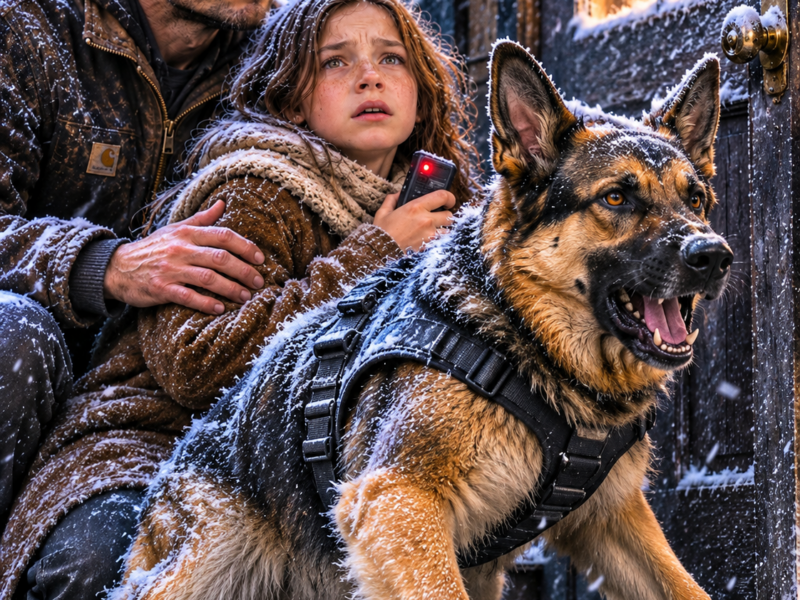
“I stood barefoot on the frozen porch while my stepmother watched through the locked glass door, calmly telling my father I had chosen to leave the house myself
My father stared at the little silver recorder in his hand.
For several seconds, nobody moved.
Denise set her mug on the porch railing.
“Patrick, please. She’s been having a difficult time since her mother died. You know how she gets when she’s upset.”
My father looked at me.
“Emma, did you turn this on tonight?”
“Yes.”
“Why?”
I pulled his jacket tighter around my shoulders.
“Because I knew you wouldn’t be here, and I wanted someone to know what happened.”
His face tightened.
Ethan stood beside Ranger, keeping a respectful distance.
“There’s a responding officer on the way,” he said. “I’d suggest we let him hear the recording before anyone makes assumptions.”
Denise gave a short laugh.
“You’re making this into something it isn’t.”
Ethan looked at the porch door.
“Then the recording should clear that up.”
My father pressed PLAY.
At first, there was only the sound of the wind and my shoes scraping against the porch.
Then Denise’s voice came through the tiny speaker.
“Where are my mom’s pictures?”
My father looked up.
The recording continued.
“Those were my mom’s pictures.”
“They’re safe, Emma. But this is our home, and homes get updated.”
“It’s my mom’s home.”
“Your father needs a life that isn’t a museum.”
Then came the sound of the door closing.
A few seconds later, my voice.
“Can you please open it?”
Denise’s answer was quiet and unmistakable.
“I’m not doing this with you today.”
My father stopped the recording.
He looked at Denise.
“Did you lock the door?”
“I didn’t lock it.”
“Emma says she couldn’t get inside.”
“She was upset. She probably didn’t know how to turn the handle properly.”
Ethan spoke without changing his tone.
“She tried it several times while I was here.”
Denise crossed her arms.
“You’re a stranger. You have no idea what goes on in this house.”
“That’s true,” Ethan replied. “I know what I saw tonight.”
The police officer arrived a few minutes later.
He spoke to everyone separately, photographed the porch, checked the door, and took down the time Ethan had arrived.
He also asked me whether I wanted to speak somewhere warmer.
I said yes.
My father carried me inside.
The hallway was dark.
I looked toward the empty spaces where Mom’s photographs used to hang.
Even after everything, that was what I noticed first.
The pictures were still missing.
And Denise was still standing in the kitchen as if the evening had been an inconvenience rather than something that had happened to me.
The officer eventually asked my father to take me to the living room.
Before I left, I heard Denise say, “Patrick, you need to understand that Emma has been increasingly difficult.”
My father answered quietly.
“She’s ten, Denise.”
“She’s manipulating you.”
I turned around.
“I didn’t manipulate anyone.”
Denise looked at me.
For once, she didn’t have an immediate answer.
The officer asked me to sit down.
He didn’t make me feel like I was in trouble.
He asked what time I had gone outside, whether I had been given permission to leave, and whether anyone had told me when I could come back inside.
I answered as carefully as I could.
Then he asked about the recorder.
“I recorded the conversation because I didn’t want anyone to say I made it up.”
He nodded.
“That’s something we can preserve and review properly.”
My father sat beside me, his hands clasped together.
I could tell he wanted to ask a hundred questions.
He only asked one.
“Why didn’t you call me?”
I stared at the carpet.
“My phone was inside.”
“I mean before tonight. When things happened with Denise.”
I didn’t answer immediately.
Because there were too many examples.
And because I had already tried telling him.
Twice.
Maybe three times.
I wasn’t sure anymore.
“I did.”
His eyes dropped.
“I told you about the pictures.”
“I know.”
“And the coffee mug.”
He swallowed.
“And when she put Mom’s blanket in the garage.”
My father rubbed his forehead.
“I thought she was trying to help us move forward.”
“I know.”
That answer seemed to hurt him more than if I had shouted.
The officer finished his notes and explained that he would document the incident and forward the relevant information for follow-up.
Ethan gave his contact details and waited until the officer had finished.
Before leaving, he crouched beside Ranger.
“Come on, buddy.”
Ranger didn’t move.
He looked at me.
“Can he stay?” I asked.
Ethan glanced at my father.
“That depends on your dad.”
My father nodded.
“If Emma wants him here for a while, that’s fine.”
Ethan smiled slightly.
“I’ll come back tomorrow to check on him. And on you, if your dad says that’s okay.”
I looked at Ranger.
“Will he remember me?”
“Absolutely,” Ethan said. “He’s better at remembering people than most of us.”
That was the first time I laughed that evening.
It wasn’t much.
But my father heard it.
And he looked as though he hadn’t heard that sound in a very long time.
The next morning, I woke up on the living room couch.
Dad had fallen asleep in the armchair beside me.
His work clothes were still on.
A blanket covered his legs, and his phone lay on the floor.
I sat up carefully.
He opened his eyes.
“Morning, sweetheart.”
“Did you sleep here?”
“Apparently.”
“You have a bed.”
“I’ve heard.”
I almost smiled.
Then I remembered something.
“Where are the pictures?”
Dad sat up.
“I don’t know yet.”
“They were in the hallway.”
“I’ll find them.”
“Denise said they’re safe.”
He looked toward the kitchen.
“Then we’ll find them.”
Denise wasn’t there.
Her overnight bag was gone from the guest room, and there was a note on the counter.
She had gone to stay with a friend.
Dad read it twice before putting it down.
He didn’t say anything about her.
Instead, he made scrambled eggs.
He burned the first batch.
Mom used to burn pancakes, and Dad had always joked that it was the only thing she couldn’t cook.
I watched him scrape the eggs into the trash.
“Mom would’ve laughed at that.”
He stopped.
Then he smiled.
“She would have said I was making them too complicated.”
“She said that about everything.”
“She wasn’t wrong.”
For a few minutes, the kitchen felt familiar again.
But the familiar feeling didn’t last.
At breakfast, Dad asked me something I hadn’t expected.
“Emma, how long has Denise been doing things like this?”
I put down my fork.
“Which things?”
“Making you feel like you can’t talk about your mother. Moving her things. Telling you to stay out of certain rooms.”
I thought about it.
“Since August.”
He looked up.
“August?”
“That’s when she started putting things in boxes.”
“Why didn’t you tell me then?”
“I did.”
He closed his eyes.
I could see the answer forming in his face before he said it.
“I thought she was organizing the house.”
“She said you wanted it.”
Dad looked at me for a long time.
“Emma, I need you to tell me something. Have you ever tried contacting me when I was at work?”
I nodded.
“Lots of times.”
“How?”
“My tablet.”
He frowned.
“Your tablet?”
“Denise said she set it up so I could message you.”
My father reached for his phone.
“What do you mean?”
“I used the family messaging app. I sent you messages when she said things I didn’t understand.”
He looked at me carefully.
“Did I answer?”
“No.”
He opened the messaging application.
I watched his expression change as he searched through the settings.
Then he called his phone provider.
The conversation lasted nearly twenty minutes.
When he hung up, he didn’t immediately speak.
“What?” I asked.
He turned the phone toward me.
“Your account was connected to my work profile. Denise changed the permissions last spring.”
“Why?”
“She said she was organizing my notifications.”
He scrolled through the settings.
Messages from my tablet had been filtered into a separate folder.
Some had been automatically archived.
Others had been marked as muted.
Dad opened the folder.
There were dozens of entries.
He read the first one.
Then another.
Then another.
His hand began shaking.
“Emma…”
I looked at the screen.
The first message was from March.
Dad, when you get a chance, can we talk? Something happened today and I think you should know.
The next was from April.
I don’t want to make Denise mad, but I miss Mom’s things.
Then May.
Can you come home early? I don’t feel comfortable being alone with her.
I had sent sixty-one messages.
My father had received none of the notifications.
He sat down slowly.
“Sixty-one.”
I looked at him.
“I thought you were busy.”
He pressed his palms against his eyes.
“I thought you were doing okay.”
I didn’t know what to say.
He kept scrolling.
“Why didn’t I check this?”
I shrugged.
“Denise said you were tired of getting messages about the same things.”
He put the phone down.
“I let her explain you to me.”
His voice broke slightly.
“And I never checked whether she was telling me the truth.”
I looked at the breakfast plate.
“I thought maybe you didn’t want to hear it.”
He moved closer.
“That was never true.”
“But you didn’t.”
He nodded.
It was the first time he didn’t try to defend himself.
“You’re right. I didn’t.”
For a while, we sat in silence.
Then he asked whether I wanted to talk to someone outside the family.
A counselor.
Someone who wouldn’t take sides.
I said yes.
Not because I thought I was broken.
Because I was tired of carrying everything around in my head.
Over the next few days, things became complicated.
Denise hired an attorney.
A woman from the county called to arrange a child welfare assessment.
Dad was advised not to contact Denise directly while the investigation was being reviewed.
The photographs were eventually found in cardboard boxes in the garage.
They were wrapped in old newspaper.
One frame had cracked glass.
Another had a small dent in the corner.
The photograph of Mom with the golden retriever was missing.
I searched the boxes twice.
Then a third time.
I found the empty frame beneath a pile of holiday decorations.
But the picture itself wasn’t there.
“Maybe it’s somewhere else,” Dad said.
“She wouldn’t throw it away, would she?”
He didn’t answer.
That evening, Ethan came by with Ranger.
He brought a bag of dog food and a small blanket.
Ranger ran straight to me.
I knelt down and buried my face in his fur.
“Hey, you.”
Ethan smiled.
“Looks like somebody remembered you.”
Dad thanked him for what he had done.
Then he asked how Ethan had known to stop that night.
Ethan explained that he had been driving home from a training exercise when Ranger started barking.
He had initially thought the dog had noticed an animal near the driveway.
But Ranger kept looking toward the porch.
“He doesn’t usually do that,” Ethan said.
“He’s trained for search and rescue. Sometimes he notices things before I do.”
“Search and rescue?” Dad asked.
Ethan nodded.
“I work with a volunteer team in the county.”
He looked at me.
“Ranger is still in training.”
I scratched the dog’s ears.
“He’s good.”
“He’s getting there.”
Before Ethan left, I asked him something.
“Did you know my mom?”
His smile faded into a thoughtful expression.
“Rachel?”
I nodded.
He looked toward my father.
“Yes. I knew your mother.”
Dad stared at him.
“How?”
Ethan took a breath.
“She ran a support program for veterans returning home. I was in it for a while.”
My father seemed surprised.
“She never told me much about that.”
“She didn’t talk about people without their permission.”
Ethan glanced at me.
“Your mother helped me through a difficult period after I left the Navy.”
I looked at Ranger.
“She liked dogs.”
Ethan smiled.
“She did.”
“She wanted one.”
“I remember.”
I sat back.
“She died before we got one.”
Ethan was quiet for a moment.
“She would have liked Ranger.”
“How do you know?”
“She told me once that she wanted a dog who knew when someone needed company before they asked.”
I looked at the golden retriever.
He was resting his head on my shoe.
That sounded exactly like something Mom would have said.
Over the following weeks, Dad began to change.
Not all at once.
He started coming home earlier when he could.
He attended my counseling appointments.
He asked questions and waited for answers instead of deciding what I meant.
Sometimes he got things wrong.
Sometimes I got angry.
But he stopped telling me I was overreacting.
One evening, I found him sitting on the floor in the garage.
He had opened another box of Mom’s belongings.
He was holding her old blue sweater.
“Remember this?” he asked.
I nodded.
“She wore it when we went to the lake.”
He smiled faintly.
“She complained that I packed too much food.”
“You did.”
“I was prepared.”
“You brought three bags of sandwiches.”
He laughed.
Then his expression changed.
“I miss her.”
I sat beside him.
“Me too.”
He held the sweater for a while.
“I think I spent so much time trying to make the house feel normal again that I forgot you needed to remember her.”
I leaned against his shoulder.
“You don’t have to make everything normal.”
He nodded.
“Maybe we can figure out what normal looks like now.”
The legal process took months.
Denise eventually challenged the findings.
Her attorney argued that I had misunderstood the situation and that Ethan had interfered in a private family matter.
They also questioned the recording.
They said it was incomplete.
They said I was grieving.
They said I had a history of emotional outbursts.
They even brought up the time I had slammed my bedroom door after Denise moved Mom’s belongings.
I remembered that day.
I had been eight years old.
I had asked her not to put Mom’s things in the garage.
She told me I needed to stop acting like a baby.
I had slammed the door.
For weeks afterward, she used that incident as proof that I was difficult.
Now it was being presented in a legal document.
Dad read the papers at the kitchen table.
His face was pale.
“They’re trying to make you sound like the problem.”
I looked at him.
“Maybe they think I am.”
He put the papers down.
“I don’t.”
The hearing was scheduled for the following month.
The court wanted to hear from me.
My counselor explained what that would involve.
I could speak in a separate room.
I could have an advocate present.
I didn’t have to answer questions I didn’t understand.
But I wanted to be there.
“I want them to hear it from me,” I told Dad.
He looked worried.
“Emma, you don’t have to prove anything to anyone.”
“I know.”
“You’re ten.”
“I know how old I am.”
He smiled sadly.
“You’ve had to be older than that for a while.”
I looked down at my hands.
“I don’t want to keep being the person who has to explain what happened. But if I don’t say it, Denise gets to explain it for me again.”
Dad didn’t argue.
He simply nodded.
The morning of the hearing, I wore the blue sweater Mom had left behind.
It was too big for me, but I liked the way the sleeves covered my wrists.
Ethan came with us.
He wasn’t there as a witness to the family history.
He was there because the court had asked him to describe what he had seen on the porch.
He sat quietly near the back.
Ranger stayed with a friend from the search-and-rescue team.
I missed him.
The hearing room smelled like paper and old coffee.
Denise sat beside her attorney.
She wore a gray jacket and had her hair pulled back.
When she saw me, she gave me a small, sad smile.
I didn’t return it.
The judge asked me to tell the truth.
I did.
I explained the photographs.
The messages.
The boxes.
The porch.
The recorder.
I didn’t exaggerate.
I didn’t leave out the fact that I had been angry sometimes.
I explained that I had slammed my bedroom door once.
I explained why.
Then Denise’s attorney stood.
He approached the table with a folder.
“Emma, you’ve said that Mrs. Holloway locked you outside. Are you certain the door was locked?”
“Yes.”
“Could it have been stuck because of the cold?”
“No.”
“How do you know?”
“Because I tried the handle several times. It didn’t move.”
“Did you know that old houses sometimes have doors that stick in cold weather?”
“Yes.”
“So it’s possible you misunderstood what happened?”
I looked at him.
“A stuck door moves the handle but doesn’t open. A locked door doesn’t move at all.”
He paused.
“Have you ever been angry with Mrs. Holloway?”
“Yes.”
“Have you ever wanted her to leave your home?”
I thought about it.
“I wanted her to stop making me feel like I wasn’t allowed to have a mother.”
The room became quiet.
He looked down at his notes.
“Isn’t it possible that you wanted your father to choose you over his wife?”
I felt my hands tighten.
“No.”
“Then what did you want?”
I looked toward Dad.
He was sitting with his hands folded, listening.
“I wanted my mother to still have a place in our house. I wanted my dad to read my messages. I wanted to come inside when it was cold.”
The attorney closed his folder.
He had no further questions.
The judge later issued a temporary protective order.
Denise was prohibited from contacting me or coming within the specified distance of our home while the matter was being reviewed.
The endangerment finding was upheld.
The written report stated that my account had been consistent, detailed, and supported by the recording and the witness testimony.
Outside the courtroom, Dad put his arms around me.
“I’m sorry.”
I leaned against him.
“I know.”
He pulled back.
“No, Emma. I need you to understand something. I was supposed to notice.”
I looked at his face.
He had tears in his eyes.
“I was supposed to be the person you could tell anything to. You sent me sixty-one messages, and I didn’t see a single one.”
He swallowed.
“I can’t change what happened. But I can change what happens next.”
I nodded.
“I believe you.”
He held me again.
Ethan waited until we had finished.
Then he walked over.
“How about some fresh air?”
I smiled.
“Can Ranger come?”
“He’s been waiting for you.”
That afternoon, Ranger climbed into the back of Ethan’s truck and rested his head on my lap.
For the first time in months, I didn’t feel like I was waiting for someone to come back.
I was going somewhere.
And there was a difference.
The months that followed were not perfect.
Dad had difficult days.
I had difficult days.
Sometimes I woke up from dreams about the porch and had to check that the front door was unlocked.
Sometimes I still felt guilty when I laughed.
My counselor told me that grief didn’t disappear just because good things happened.
I was beginning to understand that.
One Saturday, Dad and I went through another of Mom’s boxes.
We found old notebooks, photographs, letters, and a folder marked “Outdoor Access Project.”
I opened it.
Inside were pages of handwritten notes.
My mother had been working on a proposal to create outdoor recreation programs for children with mobility disabilities and veterans recovering from injuries.
She wanted to build accessible trails.
Not just paved paths beside ordinary trails.
Real outdoor experiences where children using wheelchairs could explore forests, lakes, and open spaces without feeling like visitors.
I read the first page twice.
“She was going to build this?”
Dad sat beside me.
“She wanted to.”
“Why didn’t she finish?”
“She got sick before she could.”
I turned another page.
There were sketches of trails, accessible observation decks, picnic areas, and a small building for group activities.
One sentence had been underlined.
The goal is not to make these spaces accessible as an accommodation. The goal is to make them accessible as a baseline, so that no child arrives already understanding themselves as an exception.
I ran my finger beneath the words.
“She wrote this?”
Dad nodded.
“Sounds like her.”
I looked at the plans again.
“Can we finish it?”
He didn’t answer immediately.
“We’d need help.”
“Ethan knows about outdoor programs.”
Dad smiled.
“You’re already thinking about him.”
“He knows how to train Ranger. And he knows veterans.”
“All right. Let’s ask him.”
We called Ethan that afternoon.
He came over the next day.
He spent nearly an hour reading the proposal.
Then he sat back in his chair.
“Your mother had a good idea.”
“Can we do it?” I asked.
“Possibly.”
“That’s not a yes.”
“It’s an honest answer.”
I liked that.
He explained that a project like this would need land, funding, accessibility assessments, trained staff, and partnerships with veteran organizations.
Dad could help with the budget and operations.
Ethan could help design the outdoor program.
We would need people who understood mobility access.
And we would need a location.
“How much land?” Dad asked.
Ethan looked through the drawings.
“Enough to create several routes with different difficulty levels. A central building. Accessible bathrooms. A training area.”
I opened the folder again.
“There’s a place north of town.”
Both men looked at me.
“Forty acres,” I continued. “The middle is flat, and it borders the national forest.”
Ethan raised an eyebrow.
“How do you know that?”
“I’ve been looking at maps.”
Dad laughed.
“Of course you have.”
The parcel had been listed for sale for months.
The access road needed repairs, which made the price lower than nearby properties.
Ethan agreed to visit.
The following Saturday, the three of us drove out to see it.
The ground was covered with dry grass.
A narrow road led toward a stand of pine trees.
I sat quietly while Dad and Ethan walked the boundaries.
I imagined children arriving there.
Children who had spent years being told that certain places weren’t made for them.
I imagined them rolling along a trail without anyone having to explain why they belonged.
When Dad returned, he had a thoughtful expression.
“It’s possible.”
Ethan nodded.
“The terrain is better than I expected.”
I looked at them.
“Then we should do it.”
Dad smiled.
“We’ll see what we can arrange.”
It took three weeks of phone calls before things began to move.
A regional veterans organization expressed interest.
A rehabilitation specialist in Missoula offered to help assess the land.
A grant attorney confirmed that the project could qualify for federal funding if the application met the requirements.
An older rancher named Gus, who owned property nearby, offered to help repair the access road with his tractor.
He met me at the gate one Saturday.
“You’re the one who wants to build a trail?”
I nodded.
“Accessible trails.”
He looked toward the land.
“That’s a big job.”
“I know.”
He scratched his chin.
“Good thing I’ve got a tractor.”
I smiled.
“We might need it.”
He laughed.
“Then you’ve got yourself a deal.”
The grant application took six weeks.
Dad handled the budget and administrative details.
Ethan wrote the veteran rehabilitation and outdoor training sections.
I wrote the participant statement.
Two pages.
I wrote about what it felt like to grow up in a world where people assumed you couldn’t do something before asking whether you wanted to try.
I wrote about the importance of having a place where children didn’t have to explain themselves.
At the end, I included a sentence from Mom’s notebook.
Belonging should never be something a child has to earn.
When I finished, Dad read it at the kitchen table.
He didn’t speak for a while.
Then he folded the pages carefully.
“Your mother would have loved this.”
I looked at the photographs hanging on the wall behind him.
We had restored the frames and put all three pictures back in the hallway.
The photograph of Mom with the golden retriever had finally been found inside an old holiday box.
Its corners were bent, but the image was intact.
“She would have wanted us to build it,” I said.
Dad nodded.
“Then let’s try.”
The funding decision arrived in late summer.
We received enough money to begin the first two years of construction and program development, with a renewal review scheduled later.
Dad read the email twice.
Ethan read it once.
I asked them both the same question.
“Does this mean we’re really doing it?”
Dad turned his laptop toward me.
“Yes, Emma.”
I stared at the screen.
Then I started laughing.
Not because anything was funny.
Because something my mother had imagined was finally going to exist.
The environmental assessment began the following month.
Construction took longer than expected.
The access road needed more work.
A section of the eastern trail had to be redesigned after the assessment identified drainage problems.
There were meetings, paperwork, inspections, and more than one disagreement about the location of the central building.
But the project kept moving.
Ranger became part of the program.
Ethan continued his search-and-rescue work while developing a training program for veteran volunteers.
He also helped establish a dog-assisted outdoor activity area.
I visited the land almost every weekend.
Sometimes I helped mark routes.
Sometimes I sat with Dad and watched the workers.
Sometimes I just listened to the wind in the trees.
On my eleventh birthday, Dad took me to a trail two hours south of town.
It was a beautiful day.
The sun came through the trees in long golden strips, and the air smelled like pine needles and wet earth.
We stopped at a wooden bench overlooking a small lake.
Dad sat beside me.
“Your mom would have liked this place.”
I smiled.
“She would have complained about the bench.”
He laughed.
“She absolutely would have.”
“She said benches were designed by people who only sat on them for thirty seconds.”
Dad shook his head.
“She once spent an entire afternoon arguing with a park manager about the height of a picnic table.”
I laughed.
Then I looked at the water.
“Do you think she’d be proud?”
Dad didn’t answer right away.
“I think she’d be proud of the project. But I think she’d be even prouder that you didn’t let what happened in our house decide what kind of person you became.”
I leaned against his arm.
“I was angry for a long time.”
“You had every reason to be.”
“I still get angry sometimes.”
“So do I.”
I looked at him.
“Are you still angry at yourself?”
He nodded.
“Some days.”
“Mom wouldn’t want you to stay angry forever.”
He looked toward the trees.
“Your mother was very good at reminding people that they were allowed to come back from their mistakes.”
I thought about that.
Then I said something I had been wanting to tell him for months.
“I forgive you.”
His eyes filled.
“Emma…”
“But don’t make it weird.”
He laughed through his tears.
“I’ll try.”
“And don’t start crying.”
“I’m not.”
“You are.”
He wiped his face.
“You’re very observant.”
“Mom said that too.”
He looked at me.
For a moment, we were both quiet.
Then he kissed the top of my head.
“I’ll keep listening,” he said.
“Even when it’s uncomfortable.”
I nodded.
“Especially then.”
The center opened on the first Saturday of December.
The morning was cold, but the sky was clear.
The building stood near the edge of the forest.
Wide doors opened onto a spacious common room.
The bathrooms were designed for people with different mobility needs.
The central path had a firm, even surface that connected to several outdoor routes.
There were raised garden beds, accessible picnic tables, and a covered area where families could gather.
The first visitors arrived shortly after ten.
Veterans came with their families.
Children came with parents and siblings.
Some used wheelchairs.
Some walked with braces or crutches.
Others had injuries that weren’t immediately visible.
I stood near the entrance with Dad.
Ethan was checking the training area.
Ranger was lying beside the welcome desk.
“Don’t rush them,” Ethan reminded the volunteers. “Let people decide when they’re ready.”
I nodded.
He looked at me.
“You’re leading the first orientation.”
“I know.”
“You nervous?”
“A little.”
“That’s fine.”
The first family approached.
A woman stepped forward with a boy about my age.
He used a wheelchair.
He looked at the trail map, then at the gravel outside.
“Will my wheels get stuck?”
I smiled.
“We tested the surface. It’s designed to stay firm under wheelchair wheels.”
He looked doubtful.
“I asked the same question before we built it.”
He glanced at me.
“Really?”
“Really.”
I showed him the route we had tested.
He looked toward his mother.
“Can I try it?”
She nodded.
We rolled outside together.
The first few feet were easy.
Then he reached a slight curve and stopped.
He looked down at his wheels.
“Is it okay if I go slowly?”
“That’s what the trail is for.”
He smiled.
We continued.
When we reached the first overlook, he looked toward the trees.
“I’ve never been this far into a trail before.”
I looked at the forest.
“Neither had I, when we first started.”
He turned toward me.
“Can I come back next week?”
I smiled.
“Of course.”
His mother thanked me.
I wasn’t sure what to say.
So I just nodded.
Later that afternoon, I found Dad standing beneath the entrance sign.
It carried the name we had chosen from one of Mom’s notebooks: Rachel’s Open Trail Center.
He was looking at the dedication plaque.
Under her name was a short line.
For every person who deserves to belong outdoors.
I stood beside him.
“Do you think she would’ve liked the name?”
He smiled.
“She would have suggested three alternatives and then told us this one was fine.”
I laughed.
Ranger walked over and sat between us.
Dad scratched his ears.
“Your mother would have loved this dog.”
I looked at the photograph we had brought for the welcome room.
Mom was smiling beside the golden retriever from the charity event.
For a long time, I had thought keeping her memory meant keeping everything exactly where it had always been.
The empty hallway had felt like losing her all over again.
But standing there, watching children discover a place that had been built because of her ideas, I understood something I hadn’t understood on that frozen porch.
Remembering someone didn’t mean refusing to move forward.
It meant carrying the best parts of them into places they never got to see.
A few months later, Dad and I were walking through the hallway at home.
The three photographs still hung on the wall.
The frames matched now, but not because Denise had chosen them.
We had restored the originals.
Dad stopped beneath Mom’s birthday photograph.
“I never asked you something,” he said.
“What?”
“That night on the porch. When Ethan found you, why did you stay so calm?”
I thought about the cold.
The locked door.
The recorder.
The sound of Ranger barking.
“I wasn’t calm.”
“You looked calm.”
“I was counting.”
“Counting?”
“Every few minutes. I thought if I counted, I would know how long it had been. And if I knew how long it had been, maybe I wouldn’t feel so scared.”
Dad looked at the photograph.
“I’m sorry you had to do that.”
I slipped my hand into his.
“Next time, I’ll just call you.”
He nodded.
“And I’ll answer.”
I believed him.
Not because he promised everything would be perfect.
Because I had watched him learn how to listen, even when the truth hurt.
That evening, we sat at the kitchen table with Ranger asleep beneath our feet.
Dad made pancakes.
He burned the first one.
I laughed so hard that I nearly spilled my milk.
And for the first time in a long while, the sound of laughter in our house didn’t feel like something we had to earn.
It simply belonged there.
The End.