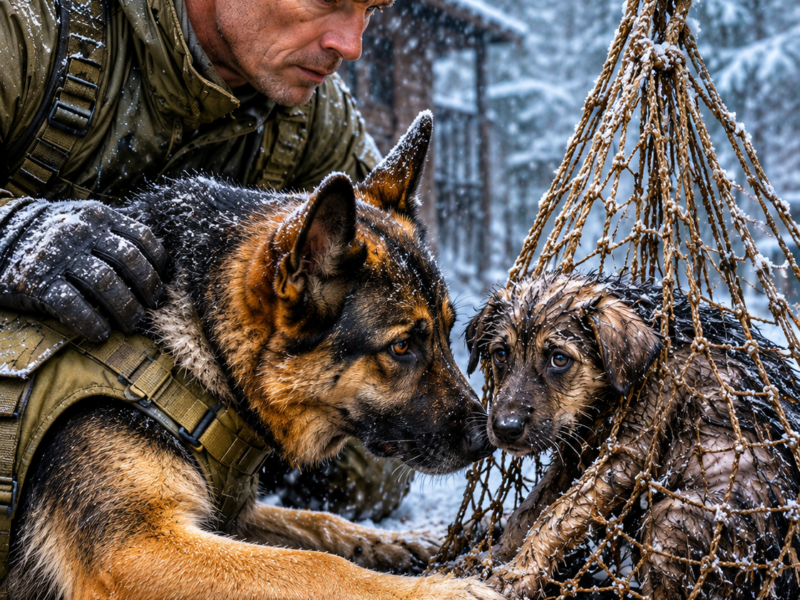
The puppy had been home for three weeks when Rhett Callaway realized he might be making the same mistake as the woman who had lost her.
The next morning, Rhett woke to the sound of something scratching against the kitchen door.
For several seconds, he lay still, listening.
The cabin was quiet except for the old refrigerator and the occasional pop from the woodstove. Kestrel was asleep on her mat, but Juniper was standing near the back door, her nose pressed against the narrow gap beneath it.
Rhett pulled on his jeans and crossed the room.
“What did you find?”
Juniper stepped backward.
He opened the door.
Cold air swept into the kitchen, carrying the smell of pine and fresh snow.
Nothing stood outside.
But there were tracks on the small wooden porch.
Not dog tracks.
Boot prints.
Rhett crouched to examine them. The snow had begun filling the impressions, but he could still make out the pattern of a heavy work boot.
Someone had been standing outside his door.
Someone had left something beside the steps.
A small brown envelope.
His name was written across the front in black marker.
RHEtt CALLAWAY.
The uneven lettering suggested someone had written it in a hurry.
He picked it up and turned it over.
No return address.
No stamp.
Just a strip of clear tape holding the flap shut.
Behind him, Kestrel appeared in the doorway.
Her ears lifted slightly.
Rhett looked toward the tree line.
Nothing moved.
He brought the envelope inside and placed it on the kitchen table.
Juniper stayed close to Kestrel.
He opened it carefully.
Inside was a photograph.
It showed the old hunting camp where he had found Juniper.
The picture had been taken from the service road, probably within the last few days.
The rusted pulley was visible in the background.
So was the fallen counterweight.
But something else caught Rhett’s attention.
A man stood beside the tree.
His face was partly hidden by a hood, but one hand rested on the cable.
On the back of the photograph, someone had written a sentence.
YOU WEREN’T THE FIRST PERSON TO FIND HER.
Rhett read it twice.
Then he picked up his phone and called Nolan Price.
The county ranger answered while he was driving.
“Morning, Callaway.”
“Did you return to the hunting camp yesterday?”
“No. Why?”
“Someone left a photograph of the site at my cabin.”
There was a pause.
“Don’t touch anything else. I’m coming over.”
Rhett glanced at the envelope.
“Do you recognize the handwriting?”
“I haven’t seen it.”
“Someone was standing beside the net.”
Nolan’s voice became more serious.
“Send me the photograph. I’ll check the case notes.”
Rhett did.
Then he called Gray Ansley.
Gray had worked in the county’s animal services department for nearly twenty years. He was a broad, soft-spoken man who remembered every stray dog he had ever helped and most of the people who had abandoned them.
When Rhett explained what had happened, Gray went quiet.
“Rhett, I need to ask you something.”
“Go ahead.”
“Did you notice anything attached to Juniper’s collar?”
“She didn’t have one.”
“Are you sure?”
“I checked her twice.”
Gray exhaled.
“Then someone may have removed it.”
“Why would that matter?”
“Because we received a report about a missing dog three weeks ago.”
Rhett looked at Juniper.
“What kind of dog?”
“A young female. Tan coat. One folded ear. The description was incomplete, but the owner claimed she had been taken from a property outside Silver Basin.”
“Did you investigate?”
“We tried. The address was a rental cabin, and the person who filed the report stopped answering calls.”
“Name?”
“I’m looking at it now.”
Rhett waited.
“Daniel Mercer.”
The name meant nothing to him.
“Do you have a photograph?”
“Yes. I’ll send it.”
A moment later, Rhett’s phone vibrated.
The picture showed a young woman standing beside a wooden fence.
A small tan puppy sat at her feet.
The puppy had one upright ear and one folded ear.
Juniper.
Rhett enlarged the photograph.
There was something else.
The woman had a thin scar running from the corner of her mouth toward her chin.
He had seen that scar before.
Not in person.
In the photograph on the envelope.
The hooded figure beside the hunting net had turned just enough for the same mark to be visible.
Rhett stared at the two pictures.
“Gray?”
“Yes?”
“Who is the woman in the photograph?”
“Her name is Mara Mercer. Daniel’s daughter.”
“Why did she report the dog missing?”
“I don’t know. The report says the puppy disappeared from her father’s property.”
Rhett looked at Juniper again.
The little dog had moved closer to Kestrel.
Her nose was tucked beneath the older dog’s neck.
“Something isn’t right,” he said.
“I was hoping you wouldn’t say that.”
Nolan arrived twenty minutes later.
He wore his ranger uniform beneath a heavy winter jacket and carried a folder under one arm.
Rhett showed him the photograph.
Nolan studied it for a long time.
“That’s not the angle I photographed the site from.”
“You went back?”
“Yesterday morning. I needed pictures of the cable mechanism before the snow got worse.”
Rhett pointed to the figure beside the tree.
“Did you see anyone?”
“No.”
“Could they have been there before you?”
“Possibly.”
Nolan placed the photograph on the table.
“There’s another thing. The hunting camp property was transferred last month.”
“To whom?”
“A holding company registered in Anchorage. But the paperwork lists Daniel Mercer as the local representative.”
Rhett leaned back.
“Why would someone buy abandoned hunting property?”
“That’s what I’m trying to establish.”
Nolan opened his folder.
“There’s an active investigation involving unauthorized trapping equipment in this area. Several reports over the past year. Most were dismissed because the devices were old or damaged.”
He tapped the photograph.
“This one wasn’t simply abandoned. The cable was maintained.”
Rhett remembered the tension in the rope.
The counterweight had been heavy enough to hold a small animal above the ground.
“Someone knew it was there,” he said.
“That’s my concern.”
Kestrel stood and walked toward the back door.
She stopped halfway and looked toward the table.
Nolan followed her gaze.
“She’s getting protective.”
“She has always watched people carefully.”
“More than usual?”
Rhett looked at the older dog.
“Since Juniper came home.”
Nolan closed the folder.
“I’m going to ask you to keep both dogs inside for a few days. Don’t return to the camp alone.”
Rhett nodded.
It was reasonable advice.
He disliked how much he wanted to ignore it.
After Nolan left, Rhett called Simone.
He explained the photograph, the missing-dog report, and the name Daniel Mercer.
Simone listened without interrupting.
When he finished, she asked, “How is Juniper eating?”
“Better.”
“Sleeping?”
“Mostly beside Kestrel.”
“And Kestrel?”
“She’s been following the puppy around.”
Simone was quiet for a moment.
“Rhett, I want to see Juniper again tomorrow. There’s something I didn’t notice during the first examination.”
“What?”
“I’d rather not guess over the phone.”
The following morning, Rhett carried Juniper into the clinic.
Kestrel came with them.
Simone examined the puppy’s ears, paws, teeth, and the healing marks around her chest.
Then she used a small scanner along the back of Juniper’s neck.
The machine beeped.
Simone frowned.
“That’s interesting.”
“What?”
“There’s a microchip.”
Rhett looked at her.
“You said she didn’t have a collar.”
“She doesn’t need one. The chip is beneath the skin.”
Simone entered the number into the registry.
A few seconds later, a record appeared.
She read it once.
Then she turned the screen toward Rhett.
The registered owner was listed as Mara Mercer.
But the contact information had been changed.
The original registration date was nearly five months old.
The new contact information had been entered eleven days before Juniper was found.
Rhett stared at the screen.
“Who changed it?”
“An authorized account associated with the registration.”
“Daniel?”
“Possibly.”
Simone opened the ownership history.
There was a second record.
A transfer request had been submitted six days earlier.
The request was incomplete.
The listed recipient was a commercial animal transport company.
Rhett felt his jaw tighten.
“Why would anyone transfer a five-month-old puppy to a transport company?”
Simone didn’t answer immediately.
Instead, she opened the medical notes attached to the registry.
One entry had been added by another veterinarian two months earlier.
The note was short.
Puppy presented for repeated restraint injuries. Owner advised to remove access to metal enclosures and tethering equipment.
There was no follow-up.
Rhett read it again.
“Repeated injuries?”
“That’s what the record says.”
“Was the owner questioned?”
“I can’t see that information.”
Simone closed the screen.
“I’ll contact the original clinic. But I want to be careful. A medical record isn’t proof of abuse by itself.”
“I understand.”
“Do you?”
Rhett looked at her.
She lowered her voice.
“You’re already angry. I can see it in your face. Don’t let that make you careless.”
He looked away.
She was right.
He had spent years learning that anger could make a person move faster than their judgment.
It was one reason he had become good at emergency work.
It was also one reason he had walked away from several situations he should have handled differently.
Juniper sat on the examination table, leaning against his hand.
He scratched gently behind her folded ear.
“I won’t be careless.”
Simone watched him for another moment.
“Good. Because this puppy needs stability more than she needs another person fighting on her behalf.”
The words followed him home.
That afternoon, Gray called.
He had located Mara Mercer.
She was staying with a friend in a small rental house near the southern edge of town.
“She asked about Juniper three times,” Gray said.
“Did she know the puppy was found?”
“Not yet. I wanted to speak with you first.”
“Why?”
“Because when I mentioned the hunting camp, she started crying.”
Rhett sat down.
“What did she say?”
“She asked whether the dog was alive.”
He closed his eyes briefly.
“Then she knows something.”
“She says her father told her Juniper was dead.”
The room seemed to grow smaller.
“When?”
“Two weeks ago.”
Rhett looked toward the dog bed.
Juniper was asleep with one paw resting across Kestrel’s front leg.
“Put me in touch with her.”
Gray hesitated.
“There’s something else. Mara says her father told her that the puppy had been taken away for medical treatment.”
Rhett felt the photograph in his pocket.
“Was that true?”
“No.”
The silence between them lasted several seconds.
Then Gray gave him the address.
Mara opened the door wearing a faded sweatshirt and jeans.
She looked younger than Rhett expected.
Maybe twenty-six.
Her dark hair was tied loosely behind her head, and the scar near her mouth was more visible in the daylight.
Her eyes went immediately to Juniper.
For a moment, she didn’t move.
Then she crouched.
“Oh, sweetheart.”
Juniper stepped behind Rhett’s leg.
Mara stopped.
Her hand remained extended, but she didn’t try to reach farther.
“It’s okay,” she whispered. “I won’t touch you.”
Rhett watched her face.
There was no anger in it.
Only the expression of someone who had spent too long preparing herself for bad news.
“I’m Rhett,” he said.
“I know. Gray told me.”
“Mara?”
She nodded.
“Is she really mine?”
Rhett considered the question.
“She has a registered microchip with your name on it.”
Mara swallowed.
“Then yes.”
She sat back on her heels.
“Her name is Poppy.”
Rhett glanced down.
“Juniper?”
“That’s what you called her?”
“I didn’t know her name.”
Mara gave a small, broken smile.
“Poppy was the name I gave her when I brought her home.”
Rhett nodded.
“I won’t argue with the person who knew her first.”
Mara looked at the puppy.
“Poppy.”
Juniper lifted her head.
The response was small, almost accidental.
But Mara heard it.
She covered her mouth.
“I thought I’d never see her again.”
Rhett stepped aside.
Mara remained on the porch.
“Can I ask you something?”
“Of course.”
“Did you find her in the old hunting camp?”
“Yes.”
Her face changed.
“Then he didn’t take her somewhere safe.”
“Who?”
“My father.”
She stood slowly.
“Daniel Mercer is my father.”
Rhett waited.
Mara looked beyond him toward the road.
“He told me Poppy had escaped. Then he said someone had found her. Later, he said she was dead.”
“Why would he tell you that?”
“Because I was asking too many questions.”
She rubbed her thumb against the scar near her mouth.
Rhett noticed the movement.
“Did he hurt you?”
Mara looked down.
“Not the way you’re thinking.”
“Then tell me the way I should be thinking.”
She took a breath.
“My mother died when I was nineteen. After that, Dad became very protective. At first, I thought it was because he was afraid of losing someone else.”
Her voice grew quieter.
“Then he started deciding where I could go, who I could talk to, and which jobs I was allowed to take.”
Rhett said nothing.
“He owned the property where I worked. He paid my rent. He said it was easier than letting me struggle.”
“And Poppy?”
“I found her behind an equipment shed. She was tiny. I took her to the vet and registered her under my name.”
Mara glanced at Juniper.
“My father didn’t want her in the house.”
“Why?”
“He said dogs were dirty. Then he said she would become expensive. Then he said she was distracting me.”
She gave a humorless laugh.
“He had a different reason every week.”
Rhett looked at the puppy’s uneven ear.
“Did you ever see the hunting equipment?”
Mara nodded.
“My father called it old property inventory. He said the cables were used to lift equipment and supplies.”
“Did you know animals were getting caught?”
“No.”
She looked directly at him.
“Not until I found a fox one morning.”
Rhett waited.
“It was alive. Its leg was caught in one of the old traps. I called my father, and he told me to leave it alone.”
“What did you do?”
“I cut it free.”
Her eyes filled.
“He was furious.”
“Did you report it?”
“I tried.”
She looked down at her hands.
“But the property belonged to him. He told everyone I was unstable after my mother’s death. I was afraid they would believe him.”
Rhett understood then why the report about Juniper had gone nowhere.
Not because the truth was impossible to find.
Because the person who needed help had been made to doubt whether anyone would believe her.
“Why didn’t you tell Gray all this?”
“I was going to.”
“What stopped you?”
Mara looked toward the street again.
“He called me yesterday.”
“Your father?”
She nodded.
“He said someone had found Poppy. He told me to come home and stop making trouble.”
Rhett’s expression hardened.
“Did he say where she was?”
“No.”
“Did he threaten you?”
Mara hesitated.
“He said he had something important to show me.”
Rhett looked at her carefully.
“What?”
“He wouldn’t say.”
A vehicle passed slowly at the end of the street.
Mara stepped back toward the door.
“I’m sorry. I shouldn’t have involved you.”
“You didn’t.”
She looked at Juniper.
“Can I see her again?”
Rhett nodded.
“Of course.”
For the next few days, Mara visited the cabin.
At first, she stayed near the kitchen table.
Juniper watched her from beside Kestrel.
The second day, she approached far enough to sniff Mara’s shoe.
On the third, she accepted a piece of boiled chicken from her hand.
Mara cried quietly when Juniper rested her chin on her knee.
Kestrel watched from her mat.
She seemed to understand that this was a difficult kind of reunion, one that required patience from everyone involved.
Rhett began to notice something else.
Juniper was more comfortable when Mara spoke softly.
The puppy recognized her voice.
But whenever Mara raised her hand too quickly, Juniper ducked.
It was a small movement.
Almost invisible.
Rhett saw it every time.
Meanwhile, Nolan continued investigating the hunting camp.
The holding company had acquired the property through a private sale.
Daniel Mercer had signed the documents.
But the company had also paid for several shipments of trapping equipment under a different business name.
Nolan found invoices for cables, pulleys, steel mesh, and animal transport crates.
Some shipments had been delivered to the camp.
Others had gone to a storage building near the old service road.
The county had no record of any authorized wildlife operation.
On the fifth day after finding Juniper, Nolan called Rhett.
“I need you to come down to the station.”
“What happened?”
“We found something at the storage building.”
Rhett looked at Kestrel.
She was sleeping beside the woodstove.
“I’ll be there in twenty minutes.”
At the station, Nolan showed him photographs of the building.
Inside were several cages.
Some were empty.
Others contained blankets, food bowls, and old identification tags.
One wall held a clipboard with handwritten dates and animal descriptions.
Rhett studied the photographs.
The dates went back nearly a year.
“Were there animals inside?”
“Not when we arrived.”
“Where did they go?”
“We’re checking transport records.”
Nolan pointed to one photograph.
A steel crate sat near the rear wall.
Its door was open.
A piece of faded orange cord had been tied around the handle.
Rhett leaned closer.
He knew that color.
It was the same color as the paracord bracelet he had used to secure the hunting net.
But this cord had a small knot at the end.
A knot he recognized.
It was the kind his former military teammate, Cole Mercer, had taught him years earlier.
Rhett stared at it.
“Who took this picture?”
“Deputy Harris.”
“Did you move the cord?”
“No.”
Rhett looked at Nolan.
“Daniel has been using this building for more than animal storage.”
“What makes you say that?”
“Someone who knows that knot left it there.”
Nolan studied him.
“You know someone connected to the Mercers?”
“Maybe.”
Rhett left the station and called an old number he hadn’t used in years.
Cole answered on the second ring.
“Callaway.”
The familiar voice carried the same rough warmth it always had.
“Cole.”
A pause.
“Well, I’ll be damned. I thought you’d changed your number.”
“I need to ask you something.”
“Go ahead.”
“Have you worked in Alaska recently?”
Cole laughed.
“That’s a broad question.”
“Near a coastal facility. Animal transport, storage, or private security.”
The laughter stopped.
“Why?”
Rhett looked at the photograph again.
“Because I found a cable restraint in Silver Basin, and someone left your knot on a crate.”
There was a long silence.
Then Cole said, “Don’t go back to that property.”
“Why?”
“Because I know the man who owns it.”
“Daniel Mercer?”
Cole exhaled.
“Yeah.”
Rhett gripped the phone.
“How?”
“I worked for his company last winter.”
“What kind of work?”
“Transport security.”
“For animals?”
“For equipment. At least that’s what the contract said.”
“And what did you actually transport?”
Cole didn’t answer.
“Cole.”
“I need to see you.”
“When?”
“Tomorrow. And don’t bring the dogs.”
Rhett looked toward the cabin.
“I’m not leaving them alone.”
“Then bring someone you trust.”
The call ended.
The next morning, Cole arrived at the cabin in a dusty pickup.
He was sixty-one, with a thick gray beard and a weathered face. His left knee had been damaged during a training exercise years earlier, leaving him with a slight limp.
He stepped inside and looked at Kestrel.
“Well, there’s my favorite old soldier.”
Kestrel lifted her head.
Cole knelt and held out his hand.
She sniffed his fingers.
Then she leaned forward.
Cole smiled.
“Still remembers me.”
Rhett offered him coffee.
Cole sat at the kitchen table.
He looked at Juniper for a long moment.
“Is that the dog?”
“Yes.”
Cole rubbed his forehead.
“I wish I could tell you this was a misunderstanding.”
“Then don’t.”
Cole opened a worn canvas bag and removed a folder.
Inside were copies of transport schedules, invoices, and several handwritten notes.
“I worked for Mercer Security for four months,” he said. “They hired me to supervise shipments to a private coastal facility in Alaska.”
Rhett looked at the paperwork.
The company name matched the one on the property documents.
“What were you transporting?”
“Equipment at first. Then animal crates.”
“Wildlife?”
“That’s what they told us.”
Cole turned a page.
“Some were rescued animals. Some were supposedly being relocated. But the paperwork never matched the shipments.”
“What do you mean?”
“Different numbers. Different species. Some crates listed as empty even though we could hear movement inside.”
Rhett looked up.
“Did you report it?”
“I tried.”
“What happened?”
Cole’s mouth tightened.
“Mercer told me the animals were part of a private rehabilitation project. He said I didn’t understand the permits. Then he showed me documents with government-looking stamps.”
“Were they real?”
“I don’t know.”
“Why did you leave?”
Cole looked at the floor.
“Because one night I opened a crate.”
Rhett waited.
“There was a young wolf inside. Its leg was badly injured. It had been kept in a space too small for it to stand properly.”
Cole’s voice lowered.
“I asked the transport manager where it was going. He told me not to worry about it.”
“And?”
“I refused to move the crate.”
Cole leaned back.
“Two days later, someone came to my apartment and told me I had violated my contract. They knew where my daughter worked. They knew her schedule.”
Rhett’s jaw tightened.
“So you left.”
“I thought I was protecting her.”
“Did you keep copies?”
Cole tapped the folder.
“Enough to show that something wasn’t right.”
“Why didn’t you report it?”
“I did. To the state wildlife office. They said they would investigate.”
“And?”
“Nothing happened.”
Rhett looked at the documents.
A shipment had been scheduled for the following week.
The destination was the same coastal facility listed in his Alaska contract.
He read the address again.
Then he looked at Cole.
“That’s where I was supposed to work.”
Cole nodded.
“I know.”
Rhett felt the weight of the unanswered offer settle over him.
The job had not simply appeared out of nowhere.
Someone had selected him.
Someone who knew his experience, his background, and his ability to handle difficult situations.
“Why me?”
Cole looked uncomfortable.
“Because Mercer asked about you.”
“Why?”
“He knew you had served with Kestrel’s former handler unit. He knew you had experience with animal detection and field operations.”
Rhett stared at him.
“He wanted me to supervise security.”
“That’s what I assumed.”
“And you didn’t tell me?”
“I didn’t know you were considering the contract until last week.”
Rhett stood and walked to the window.
Outside, Kestrel had moved into the sunlight.
Juniper was following her across the porch, staying close enough that their shoulders occasionally touched.
He had thought the Alaska offer was an opportunity to escape the uncertainty of staying.
Now he wondered whether it had been designed to bring him into something he would never have agreed to knowingly.
His phone rang.
Nolan.
“Rhett, where are you?”
“At home.”
“I need you at the station. We have a warrant.”
“For the storage building?”
“For Mercer’s property.”
“What happened?”
“We found the transport records. Several shipments were misclassified. We’re also looking at possible illegal trapping and animal cruelty.”
Rhett glanced at Cole.
“Is Daniel there?”
“Not yet.”
“Where is he?”
“We don’t know.”
The call ended.
Cole stood.
“I’m coming with you.”
Rhett shook his head.
“You’ve already given me enough.”
“I was part of this, whether I wanted to be or not.”
Rhett studied him.
Then he nodded.
At the station, Nolan was waiting with two deputies.
A second folder lay open on his desk.
Inside were photographs of several animals, transport manifests, and a list of names.
One name appeared repeatedly.
Daniel Mercer.
Another appeared beside several shipment approvals.
Mara Mercer.
Rhett looked at Nolan.
“Why is Mara’s name on these?”
“Because the company listed her as an operations assistant.”
“She didn’t work for him.”
Nolan turned the page.
“She did, apparently. At least on paper.”
Rhett called Mara.
She answered immediately.
“Rhett?”
“I need you to come to the station.”
“Why?”
“Your name is on some transport documents.”
There was silence.
Then she said, “I never signed anything.”
“Can you come?”
“Yes.”
When Mara arrived, she looked pale.
Nolan placed the documents in front of her.
She studied them carefully.
Then she shook her head.
“These aren’t mine.”
“Your name is here,” Nolan said.
“I know my name.”
“Did you authorize any shipments?”
“No.”
“Did you work for your father’s company?”
“I helped with bookkeeping for a few months. He said it was temporary.”
“Did you sign any forms?”
“Some routine paperwork. But not these.”
Nolan showed her the signatures.
Mara stared.
The signatures looked almost identical to hers.
Almost.
But the capital M was too rounded.
The final stroke in her surname was too short.
She looked up.
“He copied my signature.”
Nolan nodded.
“We’ll need a handwriting sample.”
Mara sat back.
“I told him I wouldn’t help with the transport business.”
“Why?”
“Because I found the cages.”
Her voice shook.
“I found a dog in one of them. It had been there for days. I gave it water and tried to open the door.”
Rhett leaned forward.
“What happened?”
“My father caught me.”
She pressed her hands together.
“He told me the dog was being held temporarily. Then he said I was interfering with a licensed operation.”
“Did you believe him?”
“For a while.”
Her eyes moved toward Juniper, who had come with Rhett and was resting beside Kestrel.
“Then I found the veterinary notes.”
Simone’s examination records came back to Rhett’s mind.
Repeated restraint injuries.
Mara looked at him.
“Poppy had been taken to the same clinic twice before I brought her home. I didn’t know why. My father said the dog had fallen.”
“Was that true?”
“No.”
She swallowed.
“He told me Poppy was a problem. That she was destroying equipment and causing trouble around the property.”
Rhett said nothing.
Mara continued.
“I found the old hunting net. I found the transport crates. I found the records. I tried to photograph everything.”
“Did you?”
She nodded.
“I kept the pictures on an old phone.”
Nolan sat forward.
“Where is it?”
“At my father’s house.”
“Can you retrieve it?”
Mara looked frightened.
“I don’t know.”
Rhett noticed her fingers trembling.
“You don’t have to go there alone.”
Nolan shook his head.
“We won’t send you back. We’ll get a warrant for the residence.”
Mara nodded.
Then she looked at Rhett.
“There’s something else.”
“What?”
“The night Poppy disappeared, I heard my father talking to someone on the phone.”
“Who?”
“I don’t know. But he said, ‘The older dog has started noticing the noise.’”
Rhett looked at Kestrel.
Mara continued.
“He said they needed to move the equipment before anyone else came up the road.”
The room went quiet.
Rhett remembered Kestrel stopping at the edge of the trail.
The tracks.
The wire vibrating.
The puppy suspended above the snow.
Kestrel had heard something before he did.
Perhaps she had heard more than one thing.
Perhaps she had been trying to lead him somewhere.
Nolan wrote down the statement.
“Did he mention a date?”
“Two days before Poppy disappeared.”
Rhett leaned back.
He thought about the Alaska offer.
The timing.
The sudden need for an experienced security supervisor.
The company that had bought the hunting camp.
And the dog who had been left in a net.
For the first time, the pieces began forming a picture.
Daniel Mercer had been moving animals through an unauthorized network.
The old hunting camp was one part of the operation.
The coastal facility was another.
And Rhett had been offered a job that would place him inside the system.
But one question remained.
Why had Daniel wanted Juniper gone?
Mara answered it before he asked.
“Poppy was the only one who had been inside the storage building with me.”
She looked down.
“When I was trying to free the dog, I took her with me. She was small enough to get under the shelves.”
Rhett listened carefully.
“She found something. A little metal case behind a stack of crates.”
“What was inside?”
“An old phone. A key. And a memory card.”
“Where is it?”
Mara shook her head.
“My father took it from me.”
“Did you see what was on the memory card?”
“No. But I remember the first video file.”
“What was it?”
She looked at Juniper.
“Poppy was barking at a man in the storage building. My father told me to delete the recording.”
Rhett glanced at Nolan.
“Do you know who the man was?”
Mara shook her head.
“I never saw his face.”
Nolan stood.
“Then we need that phone.”
Two days later, the warrant was executed.
Daniel Mercer was found at the hunting property.
He did not resist.
He stood beside his truck in a clean work jacket, watching the deputies approach as though he had been expecting them.
When Nolan asked him about the transport records, Daniel smiled.
“Those are business documents. You need a warrant to inspect them.”
“We have one.”
Daniel’s expression changed only slightly.
He looked past Nolan and saw Rhett standing near the road.
“You.”
Rhett said nothing.
Daniel studied him.
“You should have taken the Alaska job.”
“I decided not to.”
“That’s unfortunate.”
“Why?”
Daniel adjusted his jacket.
“Because it would have been good for you.”
Rhett looked toward the storage building.
“Good for whom?”
Daniel’s smile disappeared.
Nolan instructed the deputies to secure the property.
Inside the house, they found the old phone.
The memory card was still in it.
They also found handwritten records, veterinary invoices, and a second set of transport manifests.
The documents showed that several animals had been moved through the property without the required permits.
Some had been transferred to licensed rehabilitation facilities.
Others had been sent to private buyers.
The distinction mattered.
It also made the investigation more complicated.
Daniel was charged with multiple offenses related to illegal trapping, animal cruelty, falsified records, and unauthorized wildlife transport.
He denied knowing anything about the condition of the animals.
He claimed the employees had acted without his approval.
But the documents told a different story.
His signature appeared on several shipment authorizations.
The memory card contained videos showing him entering the storage building and directing workers to move cages.
One recording showed him ordering someone to remove the tracking collar from a small tan puppy.
The date matched the week Juniper disappeared.
Mara watched the footage in Nolan’s office.
She did not cry.
She simply sat with her hands folded in her lap.
When the recording ended, she whispered, “He told me she was dead.”
Rhett sat beside her.
“He wanted you to stop looking.”
Mara nodded.
“I know.”
She looked at the screen.
“I spent so long believing I was the problem.”
Rhett had no easy answer.
He had known people who could make another person question their own memory.
He had also known people who stayed silent because speaking seemed more dangerous than enduring.
Sometimes the hardest part of leaving was accepting that the person you were leaving had never intended to let you go.
The investigation continued for months.
Cole provided his records and testified about the transport operation.
He also gave the investigators the names of two former employees who had witnessed animals being moved without proper documentation.
Mara provided the old phone’s contents and a detailed statement.
Nolan worked with state authorities to trace the remaining shipments.
Several animals were recovered.
Others had been transferred through legal channels, though their records had been manipulated.
Not every animal could be found.
That fact stayed with Rhett.
Justice did not always return what had been lost.
Sometimes it only stopped the loss from continuing.
During those months, Juniper became more confident.
She learned to climb the two steps leading to the porch.
She discovered that the kitchen floor was warmer near the stove.
She began carrying a small red ball from room to room, although she rarely brought it to anyone.
Kestrel tolerated the puppy’s enthusiasm with the patience of an older dog who had seen many things and no longer needed to prove anything.
Some afternoons, Juniper slept with her head resting on Kestrel’s back.
Other times, she followed the older dog into the yard and tried to imitate her careful way of walking.
Rhett watched them often.
He noticed that Kestrel had begun sleeping more deeply.
Her hearing continued to decline.
Her hind legs sometimes trembled when she stood.
Simone adjusted her medication and recommended shorter walks.
Rhett followed the instructions.
He also stopped pretending he didn’t notice when Kestrel needed help getting onto the porch.
One evening, he sat on the floor beside her mat.
Juniper was chewing her red ball near the fireplace.
Kestrel rested her head against his knee.
Rhett ran his fingers through the thick fur behind her ear.
“You know,” he said quietly, “I almost left.”
Kestrel blinked.
“I had a job waiting. Two years. Six weeks away at a time.”
He looked at the gray patch on her harness.
RETired CANINE.
“I kept telling myself it was the sensible thing.”
Juniper dropped the ball.
It rolled against his boot.
Rhett picked it up and placed it beside her.
“I thought I was making sure you had everything you needed.”
He looked down at Kestrel.
“But I was really trying to make sure I didn’t have to think about what happened when you couldn’t come with me.”
Kestrel shifted closer.
Rhett rested his forehead against hers.
“I don’t know how much time we have left.”
The words came out more quietly than he intended.
“But I’m not spending it somewhere else.”
He accepted a local consulting position a few weeks later.
The work involved training search teams and helping county emergency services improve their animal rescue procedures.
It paid less than the Alaska contract.
It also allowed him to sleep in his own bed.
He did not consider that a sacrifice.
For the first time in years, he began making plans that extended beyond the next assignment.
He repaired the porch railing.
He replaced the loose boards near the kitchen door.
He bought a second orthopedic mat.
And he stopped keeping a suitcase packed beside the bedroom closet.
Mara eventually found a small apartment near the northern edge of town.
She started working at a veterinary clinic three days a week and enrolled in a certification program for animal care.
The first time she told Rhett about her new job, she sounded almost embarrassed.
“I know it’s not much.”
Rhett looked up from repairing Kestrel’s harness.
“Does it matter to you?”
“Yes.”
“Then it matters.”
She smiled.
Juniper began spending more time with Mara.
They developed a routine.
On Wednesdays, Mara visited after work and brought small pieces of chicken.
On Sundays, she took Juniper for a short walk around the meadow.
Rhett never insisted that Juniper return to her original name.
At home, he still called her Juniper.
Mara called her Poppy.
Eventually, the puppy responded to both.
One afternoon, Mara brought a small wooden frame to the cabin.
Inside was the first photograph of Poppy.
The puppy was sitting beside the fence, her ears uneven and her paws too large for her body.
Mara placed it on the shelf near the kitchen.
“I thought you should have this.”
Rhett looked at the photograph.
“Thank you.”
Mara hesitated.
“Do you think she remembers?”
He glanced toward the living room.
Juniper was asleep beside Kestrel.
“Maybe not the way we do.”
Mara nodded.
“I hope she remembers enough to know she was loved.”
Rhett looked at the picture again.
“I think she knows that now.”
Winter slowly gave way to spring.
The snow melted along the service road, revealing dark soil, broken branches, and the old scars left by machinery.
Nolan told Rhett that the hunting camp would remain closed until the investigation was complete.
The storage building had been cleared.
The traps were removed.
The property was placed under legal restriction.
The county also began reviewing reports of abandoned trapping equipment across the surrounding area.
It was not enough to undo what had happened.
But the clearing where Juniper had been found was no longer being used.
One morning in April, Rhett took Kestrel and Juniper to the meadow.
The sun was low, and the grass still held beads of water from the night before.
Kestrel walked slowly.
Juniper ran a few feet ahead, stopped, then returned when she noticed the older dog had fallen behind.
Rhett smiled.
“She’s learning from you.”
Kestrel sniffed the grass.
A breeze moved through the pines.
For a moment, Rhett remembered the morning he had found the puppy suspended in the net.
He remembered the cable groaning.
The cold against his bare hands.
The way Juniper had looked toward Kestrel before trusting him.
And he remembered the suitcase.
The job.
The easy path toward another departure.
He had spent years believing that staying meant giving something up.
He had never considered that leaving could mean losing something he would never get back.
That afternoon, Kestrel struggled to rise from her mat.
Rhett was beside her immediately.
He helped her stand, supporting her chest while she found her footing.
Juniper watched.
Then she approached and gently touched her nose to Kestrel’s shoulder.
Kestrel turned her head.
For several seconds, the two dogs stood together.
Then Kestrel took a step toward the kitchen.
Juniper followed.
Rhett watched them move through the doorway.
He knew Kestrel would not always be able to make that walk.
He knew there would be appointments, difficult decisions, and mornings when the house would feel too quiet.
He could not change any of that.
But he could be there.
Months later, when the first snow returned to Silver Basin, Rhett found the old orange paracord bracelet in the drawer beside his keys.
He had kept it after the rescue.
The fibers were frayed, and one end had been cut unevenly.
He held it for a moment, then tied it around the handle of Juniper’s walking harness.
Not as a restraint.
Not as a reminder of the net.
Just as a small piece of the morning that had brought them together.
Kestrel lay beside the door, her silver muzzle resting on her paws.
Juniper stood beside her, waiting.
Rhett picked up his jacket.
“Ready?”
Kestrel looked up.
Juniper wagged her tail.
He opened the door.
Cold air entered the cabin, carrying the familiar scent of pine and snow.
For years, Rhett had thought home was simply the place he returned to between assignments.
Now he understood it differently.
Home was the place where someone noticed when he was gone.
And sometimes, the greatest thing a person could do for the ones who depended on him was not to find another road out.
It was to stay long enough for them to stop waiting.
The end.