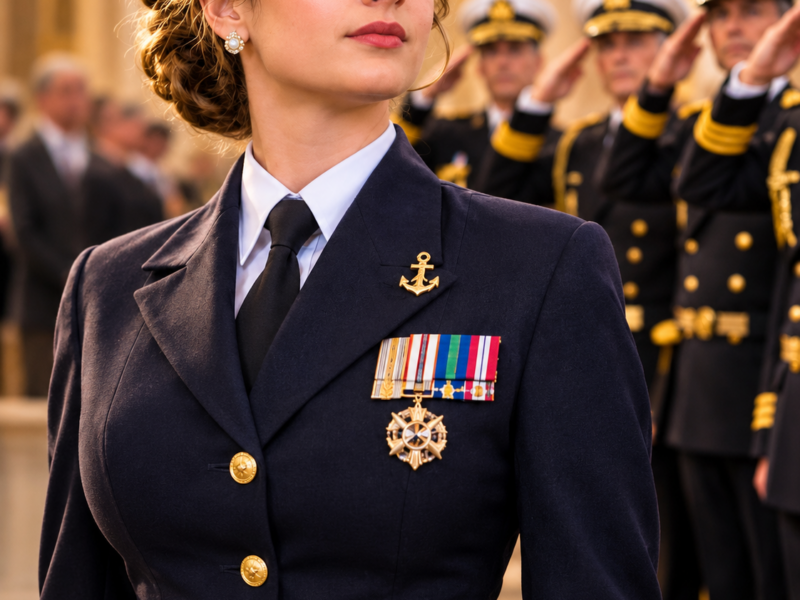
“I was publicly told I didn’t belong at a naval recognition ball in front of 200 officers, and the event coordinator actually asked security to remove me
The screen behind the registration desk flickered as Dorian Voss hesitated.
For the first time since I had arrived, he looked less like a man in control of the room and more like someone desperately searching for an exit.
“I’m not sure that information is relevant to tonight’s event,” he said.
Admiral Thomas Dain didn’t raise his voice.
“Then you won’t mind showing it to us.”
The room had grown so quiet that I could hear the soft clink of glassware from the ballroom beyond the doors. Nearly two hundred officers, spouses, civilian officials, and invited guests were watching the registration desk. Some had turned away from their conversations. Others had taken out their phones.
Dorian glanced at Celeste Mar.
She didn’t look back.
“Open the amendment history,” Admiral Mara Quill instructed.
Dorian tapped the keyboard.
A moment later, a list appeared on the monitor.
My name was there.
AMARA DAY — INVITATION CONFIRMED.
Below it was a timestamp from eleven days earlier.
Then another line.
GUEST STATUS: REMOVED.
The authorization field displayed the name of the person who had submitted the change.
CELESTE MAR.
Nobody moved.
Celeste’s expression tightened, but she recovered quickly.
“That was an administrative correction,” she said. “The original list contained outdated information. We had to prioritize the available space.”
Admiral Samuel Vale stepped closer to the screen.
“An administrative correction?”
“Yes, Admiral.”
“You removed a retired flag officer who had received a formal invitation from the Office of Maritime Ceremonial Affairs.”
“I was working from the approved guest allocation.”
“Who approved the removal?”
Celeste lifted her chin.
“I did.”
Admiral Vale looked at her for several seconds.
“Then you should be prepared to explain it.”
Celeste folded her hands in front of her.
“I don’t believe every retired officer needs to attend every recognition event. This evening is about current service, active leadership, and the people shaping the future of the fleet.”
It was a polished answer.
The kind of answer people give when they believe the right words can make an ugly decision sound reasonable.
I had heard versions of it before.
For thirty-four years, I had sat in rooms where people tried to dress personal ambition as institutional policy. I had learned that the most dangerous decisions were often made quietly, with a signature at the bottom of a form.
But I had not expected to find one waiting for me at a celebration.
Admiral Idris Bellan turned toward Celeste.
“That’s interesting. Because the invitation was issued specifically for a recognition connected to the Marrow incident.”
Celeste’s eyes flickered.
Only for a moment.
But I saw it.
So did Admiral Quill.
“You knew,” Quill said.
Celeste swallowed.
“I knew the event included a historical remembrance.”
“Did you know Admiral Day was the operational coordinator during Marrow?”
“I knew she had served in the Northern Maritime Command.”
“That wasn’t my question.”
Celeste said nothing.
Admiral Dain leaned toward the monitor.
“There’s another entry.”
He pointed to a second line beneath the removal authorization.
REASON: HISTORICAL DISPUTE — SUBJECT NOT SUITABLE FOR PUBLIC RECOGNITION.
My stomach tightened.
I had not seen those words in thirty-one years.
Historical dispute.
That was how the incident had been described in the first internal review after Marrow.
Not the storm.
Not the failed communications network.
Not the three vessels stranded beyond the Northern Navigation Corridor.
A dispute.
A neat, bloodless word for a night when hundreds of people had wondered whether their families would ever come home.
“Who entered that reason?” Quill asked.
Dorian looked at the screen.
“The entry was submitted under the committee chair’s credentials.”
Every face turned toward Celeste.
She took a breath.
“I was following the historical committee’s guidance.”
“Which committee?” Dain asked.
“The advisory group.”
“Name the person who gave you that guidance.”
Celeste’s lips parted, then closed.
I watched her carefully.
Something about her expression had changed. The confidence was still there, but beneath it was something older and more complicated than simple embarrassment.
“I was told there were concerns about Admiral Day’s account of the Marrow operation,” she finally said.
“My account?” I asked.
She looked at me.
“Yes.”
“What concerns?”
“That you received too much credit for what happened.”
The words landed harder than I expected.
Not because they were new.
Because I recognized them.
Thirty-one years earlier, a senior officer named Commodore Elias Mar had been responsible for coordinating the initial response to the Marrow emergency. His navigation instruction had sent a rescue vessel toward a restricted passage during a violent storm.
I had been a young commander at the communications station when I realized the coordinates were wrong.
I had challenged the instruction.
Then I had used the remaining operational stations to rebuild a communication route between the three damaged vessels and the rescue team.
We brought every crew member home.
No vessel was lost.
But the operation had left a permanent mark on the service.
The internal investigation found that the original navigation instruction had been issued without proper verification. It also found that the communications recovery plan I had implemented prevented the rescue from becoming a second disaster.
Commodore Mar had been relieved of his command.
I had never asked for his punishment.
I had never asked for a medal.
I had simply reported what happened.
And now I understood why Celeste had looked so uncomfortable when Admiral Quill mentioned the incident.
“Elias Mar was your father,” I said.
The room seemed to shrink around us.
Celeste’s face went pale.
“Yes.”
For a moment, nobody spoke.
I remembered the day I had testified before the inquiry board. I remembered the old commodore sitting at the far end of the table, his uniform immaculate, his hands clasped tightly together.
He had looked at me only once.
There had been anger in his eyes.
But there had also been shame.
Afterward, I had written a private letter to the review board recommending that the service recognize his decades of earlier contributions separately from the failure at Marrow. A mistake should not erase an entire career, I had argued.
I never knew whether he had received a copy.
I never knew whether it had mattered.
Celeste’s voice was suddenly sharper.
“You humiliated my father.”
“I testified about an operational decision,” I said. “I did not humiliate him.”
“You stood there and told a room full of senior officers that his judgment had put lives at risk.”
“Because it had.”
Her eyes glistened, but her jaw remained rigid.
“He never recovered from that.”
I felt something heavy settle inside my chest.
“I am sorry he suffered,” I said. “I truly am. But I cannot change what happened to make it easier for anyone to remember.”
“He died believing the service had made him a disgrace.”
Admiral Dain lowered his eyes.
Admiral Quill’s expression softened, but her voice stayed firm.
“Your father’s career was reviewed by a formal board. Admiral Day did not control the findings.”
“She was the witness everyone believed.”
“I was the witness who was there,” I said quietly.
Celeste turned toward me.
“You could have protected him.”
That was the moment I understood.
She had not removed me because she believed I was irrelevant.
She had removed me because she believed my presence would reopen a wound she had spent her entire life trying to close.
And because she had been given a position of authority, she had mistaken that authority for permission to rewrite the past.
I took a breath.
“Celeste, I did try to protect your father.”
She looked at me with open disbelief.
“Don’t.”
“I wrote to the review board after the inquiry. I asked them to recognize his previous service and to make sure the record reflected that one failure did not erase thirty years of duty.”
“That isn’t true.”
“It is.”
Admiral Dain was already looking through the records on his tablet.
“Wait.”
He tapped the screen twice.
Then he looked up.
“There’s a supplementary letter in the archived Marrow inquiry file. Signed by Commander Amara Day. Submitted three days after the final report.”
Celeste stared at him.
Admiral Dain continued.
“It specifically recommends that Commodore Mar’s previous service be preserved in the official record.”
He turned the tablet so she could see.
“I can have the original document brought up.”
Celeste didn’t take it.
Her face had lost its color.
“I never saw that.”
“I believe you,” I said.
And I did.
For the first time that evening, I felt sorry for her in a way that had nothing to do with the humiliation she had caused me.
She had spent years carrying a version of the story that had been handed down inside her family. In that version, I was the officer who had destroyed her father’s career.
She had never thought to ask whether the story was complete.
But understanding her did not mean excusing her.
Admiral Vale turned back to the registration screen.
“Dorian, preserve this record. Do not alter or delete anything.”
“Yes, Admiral.”
“Send the amendment history to the Office of Maritime Ceremonial Affairs and the service ethics directorate.”
Dorian nodded quickly.
Admiral Quill faced Celeste.
“You were entrusted with an official event. You used that authority to remove a legitimate invitee because of a personal grievance.”
Celeste’s voice trembled.
“I thought I was protecting my father’s memory.”
“You were protecting your version of it,” Quill replied.
That sentence seemed to take the last of the strength out of her.
She looked down.
I could have left then.
I could have turned away, walked through the doors, and let the admirals handle the rest.
But there was something I needed to say.
Not for the room.
Not for the cameras.
For the young woman standing in front of me who had made a terrible decision because she believed grief gave her the right.
“Your father was not a monster,” I said.
Celeste looked up.
“He made a serious mistake. It cost him his command. It could have cost people their lives. Both things can be true.”
Her eyes filled.
“He loved the service.”
“I know.”
“He wanted to be remembered for something good.”
“I know that, too.”
I paused.
“That’s why I wrote the letter.”
For several seconds, she didn’t speak.
Then her shoulders began to shake.
It was not a dramatic collapse. She did not fall into a chair or cover her face.
She simply stood there, struggling to hold herself together while the room watched.
“I thought you wanted him erased,” she whispered.
“No,” I said. “I wanted the truth remembered. All of it.”
Admiral Bellan stepped forward.
“Admiral Day, the recognition committee has already approved a formal acknowledgment of the Marrow operation. Your attendance tonight was requested because of your role in coordinating the rescue.”
I nodded.
“I understand.”
“And because of the people who served under you,” he added. “They deserve to see that work recognized.”
That meant more to me than the invitation itself.
I had not spent thirty-four years in uniform for a name on a program.
I had spent those years with sailors who worked through exhaustion, officers who made impossible decisions, and young people who sometimes had to be braver than they believed they could be.
I had seen people lose sleep over mistakes that could not be undone.
I had also seen them return to duty the next morning and do better.
If the Marrow story was going to be told, I wanted those people remembered.
Not just me.
“Then I would like the recognition to include the communications teams and rescue crews,” I said. “Their names belong beside mine.”
Admiral Vale smiled faintly.
“That is already in the program.”
He turned to Dorian.
“Bring up the original seating and recognition schedule.”
Dorian moved quickly.
The screen changed.
There was my name again.
This time it appeared in a section marked SPECIAL HONOREE.
Below it were the names of the three vessel commanders, the rescue crew leader, and several communications officers who had served during the emergency.
I recognized some of them immediately.
One name belonged to a young communications technician who had stayed at his console for nearly fourteen hours while the backup network kept failing.
Another belonged to a rescue officer who had personally refused to abandon a damaged vessel until every sailor had been accounted for.
I had not seen their names together in years.
My throat tightened.
“They’re coming tonight?” I asked.
Admiral Quill nodded.
“Several are already inside. Two traveled from overseas.”
I looked through the ballroom doors.
Suddenly, the evening seemed worth attending.
Not because I wanted to be celebrated.
Because the people who had carried that night with me were finally going to stand together again.
Admiral Vale turned to Dorian.
“Restore Admiral Day’s access immediately.”
“Yes, Admiral.”
“And make sure the original invitation is honored exactly as issued.”
Dorian entered the correction.
A printer behind the desk started humming.
A moment later, a new access pass slid into the tray.
Dorian picked it up with both hands.
“Admiral Day,” he said, his voice much quieter now. “I’m sorry for how I handled this.”
I accepted the pass.
“Thank you.”
He looked as if he expected me to say more.
I didn’t.
An apology does not always need a speech in response. Sometimes it needs to be followed by a change in behavior.
Admiral Quill then turned to Celeste.
“You will step away from event operations while this is reviewed.”
Celeste nodded slowly.
“I understand.”
“Your access to the registration system will be suspended pending the review.”
“I understand.”
“And you will provide a written account of the removal, including any outside communication you received about Admiral Day.”
Celeste glanced at me.
For a second, I thought she might argue again.
Instead, she nodded.
“I will.”
A member of the ceremonial staff approached and escorted her away from the registration desk.
I watched her disappear into the corridor.
There was no satisfaction in it.
I had imagined, during the long years after retirement, what it might feel like to have the truth finally acknowledged.
I had never imagined it would happen in front of a ballroom full of strangers, with a grieving daughter standing at the center of it.
Admiral Dain handed me the printed access pass.
“Would you like us to have the historical file available tonight?”
I shook my head.
“Not unless the families ask for it.”
He nodded.
“That is fair.”
The doors opened.
Music drifted into the entrance hall, and the guests slowly began to return to their conversations.
But the atmosphere had changed.
People were no longer whispering about the woman who had been denied entry.
They were whispering about the Marrow operation.
About the names on the screen.
About the fact that an officer who had been removed from the guest list had been invited for a reason none of them had known.
Admiral Vale offered his arm.
“Shall we?”
I looked down at my pass.
AMARA DAY.
RETIRED REAR ADMIRAL.
SPECIAL HONOREE.
It was a small piece of card.
But after thirty-one years, it felt heavier than any medal I had ever worn.
I straightened my jacket.
“Let’s go.”
The four admirals walked beside me through the doors.
The room rose almost immediately.
Not all at once.
First, the officers closest to the entrance stood.
Then the tables near the stage.
Then the entire ballroom, until nearly two hundred people were on their feet.
I had not expected that.
I stopped just inside the doorway.
The applause began.
It grew from scattered claps into a deep, steady sound that filled the hall.
I saw a few familiar faces.
Then I saw him.
Captain Jonah Mercer, one of the rescue officers from Marrow, stood near the second table. His hair was almost completely white now. His posture was still straight, though his shoulders had grown narrower.
Beside him stood Lieutenant Commander Elise Rowan, the communications technician who had stayed at her console through the night.
She was holding a glass in one hand.
When she saw me, she lowered it.
For a moment, neither of us moved.
Then she smiled.
I walked toward them.
“Commander Rowan,” I said.
“Admiral.”
She shook her head.
“Retired Admiral, I suppose.”
“Only when someone insists.”
She laughed, and the sound brought back a night of static, alarms, and desperate voices.
Captain Mercer stepped forward and shook my hand.
“It’s been a long time.”
“Too long.”
He glanced toward the stage.
“I heard what happened at the entrance.”
“I imagine the news traveled quickly.”
He gave a small smile.
“Apparently, someone thought the woman who kept us from getting lost wasn’t on the list.”
I laughed despite myself.
“Someone made a mistake.”
“That’s one way to put it.”
Elise Rowan looked at the recognition program.
“I didn’t know they were going to include the whole communications team.”
“They should have done it years ago.”
She shook her head.
“We didn’t do it for recognition.”
“I know.”
“Neither did you.”
“No,” I said. “But it’s nice when someone remembers.”
She nodded.
The master of ceremonies approached the stage.
Admiral Vale leaned toward me.
“They’re ready.”
I looked at the assembled guests.
For one brief moment, I was back at the communications station on the night of Marrow.
I could hear the wind pressing against the building.
I could hear the broken radio signals.
I could hear the voice of a young sailor asking whether the rescue vessel would find them.
I remembered telling him to stay on the line.
I remembered the silence afterward.
And then I remembered the first signal that came through clearly.
Three vessels accounted for.
All crews safe.
I stepped onto the stage.
The applause returned.
The master of ceremonies waited until it faded.
“Tonight, the Maritime Service recognizes an operation that demonstrated extraordinary judgment, courage, and cooperation under the most difficult conditions.”
He looked toward me.
“Thirty-one years ago, during the Marrow incident, three vessels lost reliable communications in severe weather beyond the Northern Navigation Corridor. The rescue operation was complicated by inaccurate navigation information and a rapidly deteriorating environment.”
The screen behind him displayed an old photograph of the communications station.
I recognized the room immediately.
The battered console.
The backup equipment.
The narrow window that had rattled every time the wind struck the building.
“Commander Amara Day coordinated the restoration of communications between the affected vessels and the rescue team, identified a dangerous navigation error, and helped redirect the rescue operation before another vessel entered restricted waters.”
The screen changed.
A photograph showed three ships returning to port.
“All crews were recovered. No vessel was lost.”
The audience applauded again.
But the master of ceremonies raised a hand.
“Admiral Day has requested that this recognition be shared with the people who served alongside her.”
He read the names of the vessel commanders, rescue personnel, and communications officers.
One by one, they were invited to the stage.
Some walked slowly.
Some looked overwhelmed.
One former sailor wiped his eyes before stepping into the light.
When everyone had gathered, Admiral Vale presented the recognition plaque.
It was not enormous or elaborate.
A simple dark wooden frame held a silver plate.
The words were engraved clearly:
FOR COURAGE, JUDGMENT, AND SERVICE DURING THE MARROW RESCUE OPERATION.
I held one side while Captain Mercer held the other.
For a moment, we stood together in front of the room.
I looked at the faces below us.
Some were young officers who had not yet been born when Marrow happened.
Others were veterans who understood exactly what it meant to bring every person home.
I stepped toward the microphone.
“I want to thank the service for remembering this operation,” I began.
My voice sounded steadier than I felt.
“But I want to be clear about something. No one person saved those crews.”
I looked toward Elise Rowan.
“The communications team kept the lines alive when every backup seemed to fail.”
I looked at Captain Mercer.
“The rescue crews entered dangerous waters because they trusted the information coming from those stations.”
Then I looked at the younger officers in the audience.
“And every sailor aboard those vessels did their part by staying disciplined when the situation became frightening.”
I paused.
“Marrow taught me that leadership is not about being the loudest person in a room. It is about making sure the right information reaches the right people in time. It is about being willing to challenge an instruction when the facts tell you it is wrong. And it is about remembering that every decision has human beings on the other end of it.”
The ballroom was silent.
“I also want to say something about mistakes. A mistake should be investigated honestly. Responsibility should be assigned fairly. But a person’s entire life should not be reduced to the worst decision they ever made.”
I thought of Celeste.
I thought of her father sitting before the inquiry board.
I thought of the letter I had written afterward.
“Service is complicated. People can do good things and make serious mistakes. We honor the truth by remembering both.”
I stepped away from the microphone.
For a moment, nobody moved.
Then the applause began again.
This time, it felt different.
It wasn’t applause for a decorated officer.
It was applause for a group of people who had done their jobs when everything was falling apart.
And that was enough.
After the ceremony, guests approached us with questions and stories.
A young lieutenant asked how we had managed to restore the communications network.
A retired engineer wanted to know whether the old equipment was still in the archives.
A woman whose father had served aboard one of the rescued vessels told me he had never spoken much about the storm, but he had kept the rescue team’s names in a notebook for decades.
I listened to every story.
I signed programs.
I shook hands.
I laughed more than I had expected.
Near the end of the evening, I stepped away from the crowd and found a quiet corridor overlooking the harbor.
The water was dark beneath the lights.
I could see the outline of the old breakwater in the distance.
A few minutes later, I heard footsteps.
Celeste stood several feet away.
She was no longer wearing her committee badge.
Her hands were clasped in front of her.
“May I speak with you?”
I nodded.
She came closer, but stopped at a respectful distance.
“I read the letter,” she said.
I turned toward her.
“Which letter?”
“The one you wrote about my father. Admiral Dain arranged for me to see a copy.”
I waited.
She looked down at her hands.
“I didn’t know.”
“I understand.”
“I spent years thinking you had taken everything from him.”
Her voice broke slightly.
“I thought if I could keep your name out of tonight’s program, then maybe people would stop repeating the story.”
I looked out toward the harbor.
“Did it help?”
She shook her head.
“No.”
“That’s usually the problem with trying to erase something. It doesn’t disappear. It just leaves a hole where the truth should be.”
She wiped her cheek.
“I was wrong.”
“Yes.”
“I know an apology doesn’t fix what I did.”
“No, it doesn’t.”
She nodded, accepting the answer.
“I will cooperate with the review. I won’t ask for the removal to be treated as a misunderstanding.”
“That is the right thing to do.”
She took a breath.
“Do you think my father would have wanted me to do this?”
I considered the question.
I remembered Commodore Mar’s face during the inquiry. I remembered the way he had sat alone after the proceedings, staring at the documents in front of him.
“I can’t speak for your father,” I said. “But I can tell you what I believe. Most people who truly love the service want it to be better than they found it. That means telling the truth, even when the truth is painful.”
Celeste nodded.
“I wish I had asked you before.”
“So do I.”
She looked at me.
“I’m sorry, Admiral Day. Not just for removing your invitation. For what I said at the entrance. For making you stand there while people watched.”
I studied her face.
“I accept your apology.”
Her shoulders lowered slightly.
“But I hope you understand that accepting it doesn’t mean pretending it didn’t happen.”
“I do.”
“Then learn from it.”
She nodded.
“I will.”
She turned to leave, then stopped.
“Could I ask you one more thing?”
“Of course.”
“Would you still have written that letter if you had known his daughter would one day treat you this way?”
I looked at the harbor lights.
“Yes.”
She seemed surprised.
“Why?”
“Because I wrote it for the truth, not for what I might receive in return.”
She stood silently for a moment.
Then she nodded and walked away.
I stayed by the window until the music from the ballroom changed to a slower song.
Admiral Quill found me there.
“Everything all right?”
“Yes.”
She looked toward the corridor where Celeste had disappeared.
“She has a difficult review ahead.”
“She should.”
Quill gave a small nod.
“The service will examine the unauthorized removal, the use of committee credentials, and the language entered into the historical record. There may be consequences.”
“I understand.”
“And your invitation?”
I glanced down at the pass still tucked into my jacket.
“I think I’ve had enough excitement over that for one evening.”
She smiled.
“Fair enough.”
We stood together for a moment.
Then she said, “You know, when I saw M-07 on your invitation, I recognized it immediately. I was hoping the evening would be about honoring the operation, not explaining why you weren’t allowed through the door.”
“So was I.”
“I’m sorry it happened.”
“Thank you.”
She looked toward the ballroom.
“Come back inside. There are people who have been waiting thirty-one years to tell you what that night meant to them.”
I followed her.
At the far end of the room, Captain Mercer was speaking with a group of younger officers.
When he saw me, he raised his glass.
Elise Rowan stood beside him.
I joined them.
For the next hour, we talked about the people we remembered, the equipment we had used, and the small decisions that had changed the course of that stormy night.
We talked about the ones who were no longer with us.
We laughed about the things that had seemed impossible at the time.
And we remembered the three crews who had made it home.
By the time I left the hall, the rain had stopped.
The pavement outside reflected the lights of the entrance, and the night air smelled of salt and wet stone.
I paused at the top of the steps.
My invitation was still in my hand.
The corner bearing the M-07 reference had become slightly bent.
I ran my thumb over it.
For years, I had believed that the most important part of Marrow was the moment we brought everyone home.
That would always be true.
But tonight had reminded me of something else.
History is not protected by keeping difficult names off a guest list.
It is protected by telling the truth, even when the truth makes powerful people uncomfortable.
I had walked into the Helian Naval Heritage Hall expecting an ordinary evening among old colleagues.
I had been stopped at the door, questioned, and publicly told I did not belong.
But I had not needed to demand my place.
The truth had been waiting inside.
And when it finally entered the room, it brought every person who had stood with me through the storm.
I folded the invitation carefully and slipped it into my jacket.
Then I walked down the steps toward the waiting car.
Behind me, the ballroom lights glowed against the night.
For the first time in thirty-one years, Marrow no longer felt like an unfinished story.
It felt remembered.
The End.