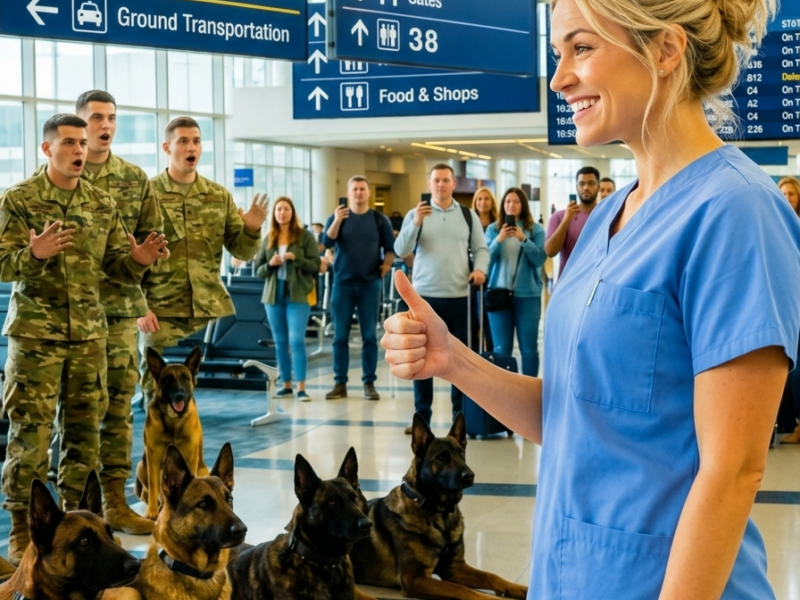
“You’re just a nurse,” the lieutenant sneered as he ordered seven military K9s to ignore me, but every dog suddenly turned toward my voice and dropped to the floor at once
The morning sun over Fort Liberty was merciless, baking the hard-packed gravel of the training yard until the air itself seemed to ripple with heat. I stood at the edge of the perimeter, my faded blue medical scrubs a sharp contrast to the sea of olive drab and camouflage that surrounded me. I was just a nurse. That was what the brass told me. That was what my personnel file stated. That was the lie I had lived for six years.
The yard was packed with soldiers. Morning drills had just concluded, and the atmosphere was thick with the smell of sweat, canvas, and gun oil. Every eye followed me as I walked across the open space. I did not belong out here. My domain was the sterile, quiet halls of the base infirmary, patching up twisted ankles and administering vaccinations. But today, something had drawn me out into the blinding light.
Lieutenant Carter stood directly in my path. He was a tall man, his uniform pressed to a razor-sharp edge, his face set in a permanent sneer of unearned authority. He had transferred to Fort Liberty three months ago, and since the day he arrived, he had made it his personal mission to remind the support staff of their place.
“Stay in the infirmary, Nurse,” Carter said, his voice loud enough to carry across the yard.
A few soldiers leaning against the chain-link fence laughed. The sound was sharp and grating in the dry air. I did not look at them. I kept walking, my eyes fixed straight ahead.
Then Carter shifted his stance and pointed toward the far end of the yard. Lined up beside the heavy steel fence were seven military K9s. They were magnificent, terrifying creatures. Belgian Malinois and German Shepherds, muscles coiled tight beneath their coats, their eyes sharp and intelligent. They were currently ignoring their new handlers, pacing restlessly, pulling against their heavy nylon leads.
“Since you know so much about them, make them obey,” Carter challenged, his tone dripping with condescension.
I stopped. I looked at the dogs.
Slowly, as if guided by an invisible tether, all seven dogs stopped their pacing. They turned their heads. They looked back at me.
Something inside my chest tightened, a cold vice gripping my ribs. My breath caught in my throat. I had not seen these specific dogs since a dust-choked night in Afghanistan. They were older now, their muzzles dusted with gray, their coats bearing the faint, hairless scars of old shrapnel wounds. Carter did not know that. Nobody on this base did. As far as the military was concerned, my record began the day I woke up in a military hospital in Germany with a traumatic brain injury and missing memories.
Carter folded his arms across his chest. He turned to the handlers. “Give the command.”
“Down,” a handler barked.
The dogs remained standing. They did not even twitch their ears toward the handlers. Their eyes remained locked on me.
The handler shouted it again, louder this time, yanking on the lead. “Down!”
Nothing. The dogs were statues.
Carter smiled cruelly, turning his attention back to me. “Your turn, Nurse. Show us your medical magic.”
I swallowed hard. The air in my lungs felt like broken glass. For six years, I had promised myself I would never speak of that night. I had buried the trauma, the blood, and the ghosts deep within my mind, accepting the clean, quiet life of a base nurse.
But then I saw him. The largest of the group, a massive black-and-tan German Shepherd named Ghost. He took a half-step forward, straining against his collar. He was trembling. A low, desperate whine vibrated in his throat. It was the sound of a soldier recognizing a comrade across a battlefield.
I took a step forward. The gravel crunched beneath my shoes.
“Seven-One,” I said. My voice was not loud, but in the sudden, eerie silence of the yard, it carried like a gunshot.
Every soldier stopped moving. The handlers froze.
Ghost’s ears snapped forward. His dark eyes widened, locking onto mine with an intensity that made the hair on my arms stand up. The other six dogs instantly mirrored his posture, their bodies rigid, waiting.
I took a deep breath, tasting the dust in the air, and whispered the words that had been carved into my subconscious.
“Black rain.”
The reaction was instantaneous. All seven dogs dropped simultaneously. Their bellies hit the hot gravel with a synchronized thud, their paws extended in front of them, their heads bowed in absolute, unquestioning submission.
Carter’s smile vanished. The color drained from his face, leaving him looking sickly and pale beneath his tan. He took a step toward me, his hands dropping to his sides.
“What did you just say?” he demanded, his voice stripped of its previous arrogance.
I ignored him. I was staring at Ghost. The dog was looking at me the way wounded soldiers look at a medic who knows exactly where it hurts. It was a look of pure, agonizing relief.
“That’s not a command in your manual,” Carter said, his voice rising, tinged with a sudden, unexplainable panic.
“No,” I answered, my eyes never leaving the dog. “It isn’t.”
These dogs had belonged to a classified Tier One combat unit. A unit that officially did not exist. Six years ago, they had disappeared during a black-ops mission overseas. The heavily redacted report stated that their handler, a man who treated these animals like his own children, was killed in action. The dogs were officially listed as damaged equipment, scheduled to be quietly euthanized before someone intervened and lost them in the bureaucratic maze of military transfers.
But I knew the truth. I had been the medic attached to that nameless unit. I had carried Ghost through a storm of enemy gunfire after his handler bled out in the sand, protecting me with his final breath. The other six dogs had followed us into the blazing heat of the evacuation zone.
Then came the radio order over the encrypted channel. An order nobody was supposed to hear, and nobody was supposed to remember.
Leave them.
We refused. We loaded them onto the chopper anyway. When we landed, I was drugged, hospitalized, and relocated. Someone made sure the official record said the dogs were left behind, and that I was just a civilian contractor who suffered collateral trauma.
Carter stepped closer, invading my personal space. His eyes were wide, frantic. “Who taught you that command?”
I finally looked away from the dogs and met his gaze. “Your predecessor.”
His face changed. The anger morphed into something much darker. Pure fear.
Before Carter could open his mouth to speak, Ghost broke formation. He ignored his handler’s frantic shouts, snapping his heavy leather leash with a violent jerk of his neck. He sprinted away from us, his paws kicking up clouds of dust, tearing across the yard toward a dilapidated, rusted storage building at the far edge of the perimeter.
The other six dogs immediately broke free and followed him. Their deep, frantic barking echoed across the base, a chorus of alarm that sent soldiers scrambling.
I knew exactly what they had found. They were scent-trained for something very specific.
A young corporal ran after them, disappearing behind the old storage unit. Minutes later, he jogged back, his face pale. In his hands, he carried a heavy, rusted metal case. He approached Carter, hesitant, but I stepped forward and took it from his hands.
My hands started shaking uncontrollably. Stenciled on the top of the rusted lid, barely visible beneath years of grime, was my name.
The latch was broken. I pushed the lid open. Inside, resting on a bed of dry, rotted canvas, was a single, physical photograph from that night in the desert.
I stared at it. Seven dogs. Eight soldiers in desert camouflage. And me, kneeling in the center, my hands resting on Ghost’s head.
But there was one detail in the background that made the blood in my veins turn to ice. Standing in the shadows behind our unit, partially obscured by the tailplate of a transport truck, was a younger Lieutenant Carter.
He had been there. He had been on the ground that night. And according to every official document, every congressional report, and every lie I had been fed, Carter had never been deployed to that theater.
I slowly raised my head and looked up at him.
He was staring at the photograph in my hands, a muscle feathering in his jaw.
Ghost, who had returned to my side, let out a low, menacing growl. The sound vibrated against my legs.
Carter leaned in close, his voice dropping to a harsh, ragged whisper. “You were never supposed to remember.”
And suddenly, the fragmented pieces of my broken mind slammed together. I understood why seven highly trained military dogs had obeyed my secret command. They were not just responding to my voice. They were responding to the only person left alive who knew what really happened in the dark that night.
Carter’s hand drifted slowly, deliberately, toward the sidearm holstered at his hip.
The air in the training yard went completely still. The soldiers surrounding us had frozen, sensing the sudden, lethal shift in the atmosphere, even if they did not understand it. Carter’s fingers brushed the hard plastic grip of his sidearm. It was a subtle movement, but to Ghost, it was a siren. The massive German Shepherd stepped directly between me and the Lieutenant, baring teeth that could crush bone. The other six dogs instantly flanked me, forming an impenetrable, growling semicircle of muscle and fury.
Carter froze, his hand hovering over his weapon. He knew better than to draw. Against seven combat-trained K9s, he would be torn apart before he could clear leather.
“Call them off, Nurse,” Carter hissed, a bead of sweat tracing the line of his jaw.
“I didn’t give them an order,” I said, my voice eerily calm despite the thunderous pounding of my heart. “They’re acting on instinct.”
As I stared into Carter’s panicked eyes, the metal walls of the military base around me began to dissolve. The blinding sunlight of Fort Liberty was swallowed by the suffocating, pitch-black darkness of the Afghan desert. The memories I had fought so hard to keep buried were tearing their way to the surface, unspooling in my mind with violent clarity.
I was back in the dust. The heat was unbearable, sticking to my skin, heavy with the metallic stench of copper and burnt cordite. We had been pinned down in a rocky ravine for three hours. The mission was supposed to be a simple extraction of a high-value asset, but we had walked straight into a kill box.
I remembered the deafening roar of automatic gunfire echoing off the canyon walls. I remembered the red tracer rounds slicing through the night sky like angry hornets. And I remembered Miller.
Sergeant Thomas Miller. The handler. He was a giant of a man with a booming laugh and hands gentle enough to calm a terrified, trembling pup. In the memory, he was pinned behind a shattered boulder, bleeding heavily from a wound in his shoulder. Ghost was pressed flat against his chest, whining, licking the blood from Miller’s tactical vest.
“Doc!” Miller had screamed over the gunfire, waving me forward. “You gotta get the dogs out of here! They’re zeroing in on our position!”
I remembered crawling through the dirt, the jagged rocks tearing at my uniform, my medical bag dragging heavily behind me. When I reached him, I pressed a massive dressing to his shoulder, my hands slick with his blood.
“We all leave together, Tommy,” I had told him, my voice shaking.
Miller shook his head, his face pale and shining with sweat. He reached into his vest and pulled out a heavy titanium flash drive, pressing it violently into my blood-soaked hands.
“They sold us out, Elara,” he gasped, coughing up dust. “Command knew this was a trap. They’re tying up loose ends. Take the drive. Take the dogs. You run for the extraction point. I’ll hold them here.”
“No!” I had screamed, but Miller had already turned away. He gave a sharp, complex hand signal to the dogs. It was a transfer of command. He was giving them to me.
Ghost refused to leave. He clamped his jaws onto Miller’s webbing, trying to drag the massive soldier backward. Miller had to physically pry the dog’s jaws open, tears cutting tracks through the grime on his face.
“Go with the medic, Ghost. Protect her. That’s an order.”
The memory shifted, blurring with motion and terror. I was running through the dark, the heavy flash drive burning a hole in my pocket, seven dogs running silently at my heels. Behind me, the night erupted in a blinding flash of white light and a concussive boom that threw me to the ground. Miller’s position had been hit by a mortar.
I remembered screaming his name. I remembered Ghost howling, a sound of such profound grief that it haunted my nightmares for years.
We made it to the extraction zone. The heavy rotors of the Black Hawk beat the sand into a blinding sandstorm. As I dragged myself up the ramp, exhausted, bleeding, and surrounded by the traumatized animals, a figure stepped out of the shadows of the aircraft’s interior.
It was a young officer. He wore no insignia, no nametape. His face was half-hidden in the dim red light of the cabin, but I saw his cold, dead eyes.
I remembered him looking at the dogs with disgust. I remembered him keying his radio.
“Asset secured. Dump the animals. We don’t have weight for damaged goods.”
“No!” I had screamed, drawing my sidearm and aiming it directly at the officer’s chest. “They come with us, or I put a bullet in your radio and we all stay here.”
The officer had smiled—a cold, cruel smile. He had stepped back, allowing the dogs on board. But as I collapsed into the webbing, a medic I didn’t recognize approached me. I felt the sharp prick of a needle in my neck.
“Just something for the pain, Nurse,” the officer’s voice whispered in my ear as the darkness took me. “You won’t remember any of this.”
The memory shattered like glass, snapping me back to the blinding sunlight of Fort Liberty.
I blinked, gasping for air as if I had been holding my breath for six years. I looked at the photograph in my hand. The officer in the shadows of the chopper. The man who had left Miller to die. The man who had ordered the dogs abandoned. The man who had drugged me to erase the evidence.
It was Carter.
My eyes snapped up to meet his. He saw the recognition in my face. He saw the ghost of the Afghan desert looking back at him.
“You remember,” Carter whispered. It wasn’t a question.
“You killed Tommy,” I said, my voice barely audible over the low growling of the dogs. “You set up the ambush. You wiped my memory to cover your tracks.”
Carter’s expression hardened into a mask of pure malice. He took a slow step backward, creating distance between himself and the dogs. He reached up and keyed the heavy radio clipped to his shoulder.
“Base command, this is Lieutenant Carter,” he spoke rapidly, his voice projecting authority. “We have a Code Red in the training yard. The base nurse has suffered a psychotic break. She has weaponized the K9 unit and is holding personnel hostage. I need armed military police on site, lethal force authorized. Lock down the perimeter.”
A collective gasp rippled through the crowd of soldiers. They looked at me, confusion and fear warring in their faces. They didn’t know who to believe, but Carter wore the bars on his collar.
The base alarms began to blare, a deafening, rhythmic siren that tore through the morning air. Heavy steel blast doors on the surrounding buildings began to slide shut.
I looked down at the rusted box in my hands. The photograph was just the beginning. The box was heavy. It was a dead drop. Someone had buried it here for me to find, knowing the dogs would eventually be brought to this yard. Someone knew the truth.
“You’re a dead woman,” Carter sneered, backing away as the sound of approaching sirens wailed in the distance.
I looked at Ghost. The dog looked at me, his muscles tensed, waiting for my word. We had survived the desert. We would survive this.
“Move,” I whispered.
With the dogs forming a protective wedge around me, I turned and sprinted toward the narrow alleyway between the barracks, plunging into the labyrinth of Fort Liberty as the hunt began.
The sirens screamed across Fort Liberty, a mechanical wail that vibrated in my teeth. I ran hard, the heavy rusted box clutched tightly against my chest, my medical scrubs flapping in the hot wind. Around me, the seven dogs moved in perfect, silent harmony. They did not bark. They did not scatter. They moved like a liquid shadow, a tactical unit falling back into the training that had been beaten into their bones.
Ghost took point, his heavy paws barely making a sound on the concrete. He checked every corner, pausing for a fraction of a second to scent the air before pushing forward. He was navigating the base not by sight, but by threat assessment.
“Stay close,” I hissed to the others as we darted behind a row of heavy transport trucks.
Shouts echoed from the training yard behind us. I could hear the heavy boots of Military Police hitting the pavement, the metallic clack of rifles being charged. Carter had labeled me a rogue asset, a psychotic threat. On a military base, that meant I was a target. They wouldn’t shoot to wound; they would shoot to neutralize.
I needed to get off the grid. The base was locked down, the perimeter gates sealed. The only way to survive was to disappear into the architecture.
Six years working in the infirmary had given me one distinct advantage: I knew the hidden arteries of Fort Liberty. I knew the old maintenance corridors, the steam tunnels, and the forgotten subterranean medical bunkers that hadn’t been used since the Cold War.
“This way,” I whispered, changing direction and breaking into a sprint toward the old boiler facility at the north end of the motor pool.
We rounded a corner and nearly collided with two armed MPs. They were young, their eyes wide with adrenaline, their rifles raised.
“Halt! Drop the box and get on the ground!” the lead MP screamed, his finger hovering dangerously close to the trigger.
Before I could even process the command, Ghost launched himself into the air. He didn’t go for the man’s throat; he went for the weapon. His massive jaws clamped down on the barrel of the M4 rifle, using his momentum to wrench it violently downward. The rifle fired into the dirt, a deafening crack that echoed off the brick walls.
At the same moment, two of the Malinois hit the second MP, knocking him flat on his back. They stood over him, pinning his arms to the ground, snarling viciously inches from his face, but they did not bite. They were disabling the threat, perfectly executing non-lethal suppression.
“Leave them!” I commanded, not breaking my stride.
The dogs instantly disengaged, abandoning the terrified soldiers and falling right back into formation behind me. We hit the rusted metal door of the boiler facility. It was locked.
I didn’t have a key, but I knew the building’s weakness. I stepped back, picked up a heavy steel wrench abandoned near a toolkit, and smashed it into the glass panel of the fire alarm override box on the wall. I yanked the red lever down. The magnetic locks on the heavy door clicked and disengaged.
I hauled the door open and shoved myself inside, the dogs pouring in after me. I slammed the door shut and threw the manual deadbolt just as I heard boots rounding the corner outside.
We were in total darkness. The air in the facility was thick, suffocatingly hot, and smelled of rust and stagnant water. I leaned back against the cold steel of the door, gasping for breath. My hands were shaking so violently I nearly dropped the rusted box.
Outside, a heavy fist pounded on the door.
“They’re inside! Get a breaching team down here now!” a voice yelled through the metal.
I turned on the small penlight clipped to my scrub top. The narrow beam cut through the darkness, illuminating a labyrinth of heavy iron pipes and massive industrial boilers.
“Come on,” I whispered to Ghost.
We moved deeper into the facility, descending a narrow metal staircase that led into the subterranean maintenance tunnels. These tunnels connected the old boiler room to the foundation of the base hospital. If I could reach the hospital sub-basement, I could access the unmonitored communication lines and maybe, just maybe, get a signal out to the Inspector General’s office.
The dogs trotted silently beside me in the dark. I could feel the heat radiating off their bodies. They were calm. This was what they were bred for. The chaos, the darkness, the hunt. It was all familiar territory to them.
We reached a heavy steel grate covering the entrance to the hospital tunnel. I set the rusted box down and gripped the iron bars, pulling with all my strength. It wouldn’t budge. Decades of rust had fused it shut.
Panic flared in my chest. I pulled harder, my boots slipping on the damp concrete. Behind me, echoing down the metal stairwell, I heard the heavy, metallic thud of a breaching charge blowing the exterior door off its hinges.
“Clear!” a voice echoed from above.
They were inside the building.
I scrambled to the rusted box. If I was going to die down here, I needed to know what else was inside it. I needed to know why Miller died, and why Carter was so desperate to erase me.
I flicked the latch open and shone my penlight inside. I had already seen the photograph. But beneath the rotted canvas was something else. A small, black leather journal, its pages warped by moisture, and a heavy titanium flash drive—the exact same drive Miller had pressed into my bloody hands in Afghanistan before he died.
I grabbed the journal and flipped it open. The handwriting was messy, hurried. It was Miller’s handwriting.
August 12. Carter is running a ghost operation. The weapons we’re securing aren’t going to the armory. They’re being diverted. He’s selling them to the local warlords. I found the ledger. He knows I found it. The extraction point tomorrow is a setup. If I don’t make it, the proof is on the drive. Tell Elara to run.
A cold tear slipped down my cheek, cutting through the grime on my face. Miller knew he was going to die. He had gone into that canyon knowing it was a trap, just to buy me time to get the dogs out.
Suddenly, Ghost’s ears snapped back. He whipped his head around, staring into the pitch-black tunnel on the other side of the rusted grate. He let out a low, rumbling growl.
Someone was standing in the dark on the other side of the bars.
I froze, killing my penlight. I held my breath, plunging us into total blackness.
Footsteps approached from the tunnel. Slow. Deliberate.
“Elara,” a deep, gravelly voice whispered from the darkness.
I stumbled backward, my heart hammering against my ribs. I knew that voice. But it was impossible.
A match flared on the other side of the grate, casting a flickering, orange glow. Standing there, holding a lantern, was a man with a heavily scarred face, wearing a faded tactical jacket.
It was Sergeant Hayes. Miller’s second-in-command. The man I had watched take a bullet to the chest in the canyon six years ago.
He looked at me, then looked down at Ghost. A sad smile crossed his face.
“Hello, girl,” Hayes said softly. He reached out and pulled a hidden lever on the wall. The rusted grate, which had refused to budge for me, swung open silently on hidden hinges. “You better get in here before Carter’s kill squad finds you.”
I stood paralyzed, staring at the face illuminated by the flickering lantern light. Sergeant Hayes had been dead for six years. I had seen the blood. I had checked his pulse myself in the dirt of that canyon. But here he was, flesh and blood, standing in the forgotten bowels of Fort Liberty.
Ghost didn’t hesitate. The massive dog pushed past me, squeezing through the open grate, and buried his head into Hayes’s waist, letting out a high-pitched whine of recognition. The other dogs swarmed him, their tails wagging furiously in the dark.
“Come on, Elara. We don’t have time,” Hayes urged, his eyes darting toward the stairwell behind me. The heavy, rhythmic thud of combat boots was getting louder. Flashlight beams were beginning to cut through the darkness of the upper levels.
I grabbed the metal box, clutching the journal and the titanium drive, and scrambled through the grate. Hayes pulled the heavy iron door shut behind us, locking it with a heavy steel deadbolt.
“Follow me. Keep quiet,” he ordered, turning and leading us deeper into the tunnel.
We moved quickly through the subterranean labyrinth. The air grew colder, the walls shifting from concrete to old, reinforced brick. Hayes navigated the darkness with the ease of someone who had lived in it for a long time.
“You’re dead,” I whispered, my voice trembling as we walked. “I checked your vitals. You were gone.”
Hayes didn’t stop walking. “I was close to it. Carter’s men left me for dead in the dirt. But a local village healer found me after the choppers left. It took me a year to walk again. Another two years to get back stateside without pinging Carter’s radar.”
“Why didn’t you contact me?” I asked, anger flaring through my confusion. “I’ve been living a lie for six years!”
Hayes stopped and turned to face me. The lantern light threw harsh shadows across his scarred face. “Because you were compromised, Elara. Carter’s medical team scrambled your brain with chemical suppressants. If I had approached you, and you didn’t remember me, you would have reported me. Carter would have known I survived, and he would have killed us both.”
He pointed to the rusted box in my hands. “I had to wait until the suppressants wore off. I needed a trigger. That box, the photo, the dogs… I arranged for them to be transferred here. I buried that box three months ago. I needed you to wake up on your own.”
My mind spun. The grand design of the conspiracy was almost too massive to comprehend. “The dogs,” I murmured, looking down at the seven loyal animals shadowing our every move. “Carter ordered them left behind because they witnessed the ambush. They knew his scent.”
“Exactly,” Hayes said grimly. “Dogs don’t forget. And they don’t take bribes. Carter couldn’t risk them reacting to him or his men on a base. He branded them damaged and tried to have them put down. When that failed, he tried to lose them in the system. But I found them.”
We reached the end of the tunnel. It opened into a massive, cavernous room—an abandoned Cold War-era command bunker buried directly beneath the base hospital. Dusty computer terminals sat dead on metal desks, and faded maps of a bygone era clung to the concrete walls.
“This is my dead-drop,” Hayes said, walking over to a heavy metal desk and firing up a portable generator. A string of overhead lights hummed to life, casting a harsh, fluorescent glare over the room. On the desk sat a ruggedized military laptop.
“Hand me the drive,” Hayes ordered.
I pulled the titanium flash drive from my pocket and handed it over. My hands were still shaking. Hayes plugged it into the laptop. His fingers flew across the keyboard, bypassing security protocols with practiced speed.
“Miller sacrificed himself to get this data out,” Hayes muttered, his eyes glued to the screen. “Carter has been running an illegal arms pipeline for a decade. He orchestrates ambushes on his own units, reports the weapons destroyed or captured, and then sells them on the black market. He’s made millions in blood money.”
The screen flashed green, and files began to cascade down the monitor. Bank transfers, shipping manifests, encrypted communications with known terrorist cells. The evidence was irrefutable. It was a death sentence for a traitor.
“We have it,” I breathed. “We can send this to the Pentagon. To the Inspector General.”
“I’m establishing an encrypted uplink now,” Hayes said, typing frantically. “It’s going to take exactly four minutes to upload the files to a secure server at the Pentagon.”
Suddenly, the laptop emitted a sharp, high-pitched beep. A red warning window flashed across the screen.
PROXIMITY ALERT. UNAUTHORIZED SIGNAL DETECTED.
Hayes froze. The color drained from his scarred face. He looked at the laptop, then slowly turned his head to look at the rusted metal box I had set on the floor.
“Elara,” he said slowly. “Did you empty the box completely?”
I frowned. “Yes. The photo, the journal, the drive.”
Hayes grabbed the box, flipped it over, and dug his knife into the rotted canvas lining at the bottom. He tore it away. Nestled beneath the false bottom was a tiny, blinking red LED light attached to a high-frequency military GPS tracker.
My stomach plummeted.
“It’s a trap,” Hayes whispered, horror dawning in his eyes. “Carter didn’t lose track of the box. He left it there on purpose. He’s been waiting for whoever buried it to dig it up.”
Before I could speak, a massive explosion rocked the bunker. Dust and debris rained down from the ceiling as the heavy steel doors at the far end of the room buckled inward. The deafening sound of a breaching charge echoed through the cavernous space.
Ghost barked viciously, the sound echoing like a cannon blast, as he and the other six dogs formed a defensive line between us and the buckling doors.
“Upload progress: 12%,” the laptop chimed in an automated voice.
“They’re here,” Hayes yelled, drawing his sidearm and kicking over a heavy metal desk for cover. “Get down, Elara! We have to hold them off until the upload completes!”
The heavy steel doors blew inward with a final, screeching groan of tearing metal, and the dark silhouettes of Carter’s heavily armed black-ops team poured into the bunker. We were trapped.
The bunker erupted into a storm of violence. Red laser sights cut through the dusty air, sweeping across the concrete walls like predatory insects. The crack of suppressed rifle fire was deafening, the bullets striking the heavy metal desk Hayes and I hid behind, showering us with sparks and fragmented steel.
“Upload progress: 34%,” the laptop announced, its synthetic voice eerily calm beneath the roar of the gunfight.
Hayes returned fire, his sidearm barking as he leaned around the edge of the desk. He clipped one of the mercenaries in the shoulder, sending the man stumbling backward into the shadows. But there were too many of them. At least a dozen men, clad in unmarked tactical gear, moving with ruthless, practiced precision.
And standing at the rear, safe behind his wall of guns, was Lieutenant Carter.
“Give it up, Hayes!” Carter’s voice boomed over the gunfire, amplified by the bunker’s acoustics. “I knew you were alive. You always were a stubborn son of a bitch. Hand over the drive, and I’ll make it quick.”
“Go to hell, Carter!” Hayes roared back, firing blindly over the desk.
I crouched low, pressing my hands over my ears. I wasn’t a soldier. I didn’t have a weapon. I was a nurse. My instinct was to save lives, not take them. But as I looked at the seven dogs holding the line, their teeth bared, ready to die for a cause they couldn’t understand, the fear inside me solidified into cold, hard resolve.
I looked around the dusty floor. Behind me, leaning against a rusted support pillar, were several old, heavy metal canisters painted bright yellow. Medical oxygen. They had been left behind when the hospital above was renovated decades ago.
I crawled backward, keeping my head low as bullets whizzed overhead. I reached the canisters. They were heavy, covered in decades of grime. I grabbed a rusted metal pry bar from the floor and looked at Hayes.
“Hayes!” I screamed over the noise. “Give me cover fire! Shoot the lights!”
Hayes didn’t ask questions. He popped up, unloading his magazine toward the ceiling. The fluorescent tubes shattered in a shower of sparks and glass, plunging the bunker into near-total darkness, save for the strobing flash of muzzle fire.
“Upload progress: 68%.”
I dragged the oxygen canister out from behind the pillar, aimed it toward the center of the room where Carter’s men were advancing, and raised the pry bar. With all my strength, I brought the heavy steel down onto the canister’s brass valve, snapping it clean off.
Highly pressurized oxygen screamed out of the broken valve with a deafening hiss. I kicked the canister hard. It skittered across the concrete floor, spinning wildly, spraying a massive, invisible cloud of pure, concentrated oxygen directly into the path of the advancing mercenaries.
“Now!” I screamed to Hayes. “Spark it!”
Hayes dropped his empty magazine, slammed a fresh one home, and fired a single round directly into the sparks raining down from a shattered light fixture above the oxygen cloud.
The air itself caught fire.
A massive, concussive wave of heat and blinding orange light exploded in the center of the bunker. The flash-fire wasn’t lethal, but it was blinding and terrifying. It sucked the air out of the room, throwing Carter’s men to the ground in a panic, their tactical gear singed, their night-vision goggles permanently fried by the flash.
The chaos was total. And for the dogs, chaos was a hunting ground.
“Black rain! Execute!” I screamed into the darkness.
The seven dogs moved as one. They didn’t attack to kill; they attacked to dismantle. Ghost launched himself through the smoke, colliding with a heavy-gunner, sinking his teeth into the man’s tactical vest and violently dragging him to the floor. The Malinois moved like ghosts in the dark, disarming soldiers, clamping onto wrists and ankles, turning a disciplined kill squad into a screaming, flailing mess of terrified men.
Carter panicked. He broke away from his men, retreating toward the blown-out doors.
“Upload progress: 95%.”
I wasn’t going to let him run. Not again.
I sprinted through the smoke, dodging the grappling bodies on the floor. Carter was struggling to climb over the wreckage of the steel doors. I grabbed the back of his tactical vest and yanked him backward.
He fell heavily onto the concrete but instantly rolled, bringing his sidearm up to aim directly at my chest.
“You should have stayed asleep, Nurse,” he hissed, his finger tightening on the trigger.
A black blur hit him from the side.
Ghost struck Carter with the force of a freight train. The gun flew from Carter’s hand, clattering away into the dark. The massive German Shepherd pinned the Lieutenant to the floor, his heavy paws planted squarely on Carter’s chest, his jaws clamped down tightly over Carter’s throat.
Ghost didn’t bite down. He just held him there, a millimeter of pressure away from ending the man’s life. The dog looked up at me, his eyes burning with intelligence, waiting for my command.
Carter lay perfectly still, his eyes wide with absolute, paralyzing terror. He couldn’t even swallow without scraping his throat against the dog’s fangs.
“Call him off,” Carter whimpered, tears of fear finally breaking in his eyes.
I stood over him, breathing heavily, looking down at the man who had stolen six years of my life and murdered my friend.
“Upload complete. Files transmitted successfully,” the laptop chirped in the background.
The sound of heavy sirens bled through the ceiling from the base above. Real military police, responding to the explosion, were swarming the hospital.
I looked at Carter, then down at Ghost. I reached out and gently placed my hand on the top of the dog’s head.
“Good boy,” I whispered. “Hold him.”
Twenty minutes later, the bunker was flooded with heavily armed CID agents and Federal Police. Carter was dragged away in handcuffs, screaming for a lawyer, his empire of blood money shattered by a ghost from his past. His men were rounded up, stripped of their gear, and marched out under heavy guard.
Hayes stood by the computer desk, speaking quietly with a commanding officer. He looked over at me and gave a small, weary nod. It was over. We had won.
The paramedics checked me over, but I refused transport to the hospital. I walked out of the bunker and up into the cool night air of Fort Liberty. The stars were bright, unclouded by the dust of the desert.
I sat down on the edge of an ambulance bumper. A warm, heavy weight pressed against my leg. Ghost sat down beside me, leaning his head against my knee. Within seconds, the other six dogs materialized from the shadows, sitting in a quiet, protective circle around us.
They were no longer damaged goods. They were heroes. And they were finally coming home.
I rested my hand on Ghost’s neck, feeling the steady, rhythmic beat of his heart. For the first time in six years, my memory was clear. The ghosts were quiet. And as I looked up at the stars, I knew Tommy Miller was smiling down on us.
The end.









