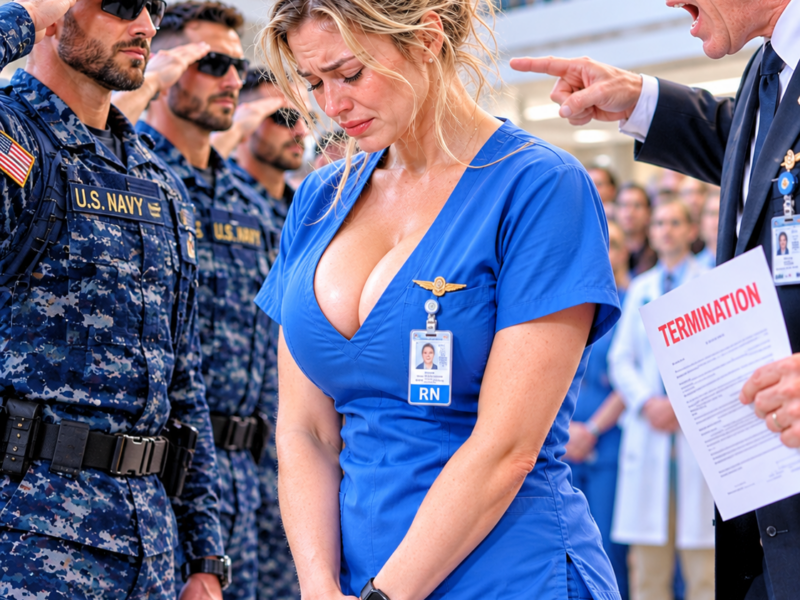
“‘You’re fired,’ the hospital director announced in front of the entire emergency department,
The hospital director’s office door opened before I could reach the nurses’ station.
Richard Lawson stepped into the hallway with his phone still pressed against his ear.
His face had lost its color.
“Emily,” he said.
I stopped.
A moment earlier, he had ordered security to remove me. Now he sounded as though he was afraid I might walk away.
“Come into my office.”
I looked at Dr. Reed.
“Why?”
Lawson glanced at the two security officers standing nearby.
“Because we need to clarify a misunderstanding.”
I almost laughed.
“You fired me in front of the entire emergency department. What exactly is there to clarify?”
He lowered his voice.
“Please.”
That one word told me more than his earlier shouting had.
I followed Dr. Reed into the office.
Lawson closed the door behind us and returned to his desk.
His phone was still connected.
“General, she’s here,” he said.
A deep voice came through the speaker.
“Put the phone on the desk, Director Lawson.”
Lawson obeyed.
Then the voice spoke again.
“Emily Carter, can you hear me?”
“Yes, General.”
“This is Lieutenant General Robert Whitaker, Deputy Commander of Army Medical Command.”
I straightened instinctively.
“Good morning, sir.”
“It’s been a long time, Captain Carter.”
I hadn’t heard anyone call me that in nearly three years.
“Good morning, General.”
He paused.
“I wish we were speaking under better circumstances.”
Lawson looked between the phone and me.
“General, I believe there has been some confusion. Ms. Carter was dismissed because she interfered with a physician’s treatment decision.”
The general’s response was immediate.
“Did you review the medication discrepancy before dismissing her?”
“I was informed that she had delayed treatment.”
“That’s not what I asked.”
Lawson shifted in his chair.
“No, sir. I had not completed my review.”
“Then you dismissed a nurse before establishing whether she had prevented a potentially dangerous medication error.”
Lawson opened his mouth.
The general continued.
“Let me make something clear. Sergeant Tyler Brooks is not an ordinary patient transfer. His condition and the records accompanying him are part of an active military investigation.”
I looked at Dr. Reed.
He was listening carefully.
“What investigation?” Lawson asked.
“That’s not information you are authorized to receive through this call.”
Lawson’s jaw tightened.
“But this is my hospital.”
“And Sergeant Brooks is a patient whose medical care is subject to applicable law, professional standards, and the authority of the treating team. Your position does not give you permission to override those obligations.”
There was silence.
Then General Whitaker addressed me again.
“Emily, are you still in possession of the original transfer documents?”
“No, sir. Director Lawson took the chart from the counter.”
Lawson immediately placed it on the desk.
“I have it right here.”
“Do not alter it,” the general said. “Do not remove anything. The original record must be preserved.”
“I wouldn’t do that,” Lawson replied.
“Good. Because investigators are already on their way.”
Lawson went completely still.
I looked at the clock.
Four minutes had passed since his phone rang.
Now I understood why he had stopped smiling.
The general asked me one more question.
“Emily, do you remember the evacuation incident at Forward Operating Base Sentinel three years ago?”
My throat tightened.
“Yes, sir.”
“Then you understand why we’re taking this seriously.”
I looked down at my hands.
I remembered that night.
The dust storm.
The overcrowded treatment station.
The young soldier whose medical record had been altered before he arrived.
And the officer who had ordered me to follow instructions even after I knew something was wrong.
I had never told anyone at St. Mary’s the full story.
I had hoped I would never need to.
General Whitaker continued.
“I’m asking you to remain available for an interview. You are not being ordered to resume employment, and this call does not change your employment status.”
“Understood, sir.”
“Thank you, Captain.”
The call ended.
Lawson sat back slowly.
For several seconds, nobody spoke.
Then he cleared his throat.
“Emily, I think we should reconsider the termination.”
I looked at him.
“You think?”
He gave a strained smile.
“Obviously, the situation has changed.”
“No. The situation was the same when you fired me. You simply didn’t know who might call.”
Dr. Reed looked down, hiding what might have been a smile.
Lawson’s expression hardened.
“Let’s not make this personal.”
“You made it personal when you dismissed me in front of my colleagues without investigating the concern I raised.”
He rubbed his forehead.
“I was under pressure.”
“So was I. There was a young man on that bed whose blood pressure was dropping.”
Before he could respond, someone knocked.
A hospital administrator opened the door.
“Mr. Lawson, two investigators are here. They have requested the original transfer paperwork and the medication access logs.”
Lawson stood.
“Already?”
“They said the request was coordinated with Army Medical Command.”
He looked at me.
“Stay here.”
I shook my head.
“I’ll cooperate with the investigators, but I’m not taking instructions from you about where I can stand.”
Dr. Reed opened the door.
“Let’s go.”
The investigators introduced themselves as Special Agent Karen Mills and Special Agent David Foster.
They were civilian investigators assigned to a joint inquiry involving military medical supply records.
They carried identification, document preservation notices, and a list of records they needed.
Agent Mills spoke first.
“We understand there was a discrepancy involving Sergeant Brooks’ medication order.”
Dr. Reed nodded.
“I identified an inconsistency between the ambulance record and the hospital transfer paperwork.”
“And Nurse Carter placed a temporary hold?”
“Yes. She brought the discrepancy to my attention. I agreed with the hold.”
Agent Foster looked at Lawson.
“Were you aware of that?”
“I was informed that treatment had been delayed.”
“Did you review the actual order?”
Lawson hesitated.
“No.”
Agent Mills wrote something in her notebook.
“Did you terminate Ms. Carter’s employment before reviewing the medical record?”
“I made an administrative decision based on the information available.”
“Did you know she had raised a patient safety concern?”
“Yes.”
“Did you ask her to explain it?”
Lawson looked toward me.
“I asked her to follow procedure.”
“That wasn’t the question.”
He didn’t answer.
The agents requested the original chart.
They also asked for the hospital’s electronic access logs, medication dispensing records, and the security footage from the emergency department.
Lawson handed over the chart.
Agent Mills examined the signature at the bottom of the disputed order.
“Dr. Aaron Whitmore,” she read aloud. “Was he working that morning?”
Dr. Reed shook his head.
“Dr. Whitmore is on approved leave. He hasn’t been inside this hospital for twelve days.”
“Could he have authorized the order remotely?”
“Not through the system shown here. His account was marked inactive for clinical orders during his leave.”
Agent Foster looked up.
“Then how did his name appear?”
Dr. Reed pointed to the electronic timestamp.
“That is what we need to establish.”
I stepped closer.
“There’s another issue.”
Agent Mills turned toward me.
“What is it?”
“The order appears to have been entered before the ambulance left the military facility. The time on the transfer paperwork doesn’t match the medication administration time.”
She checked the page.
“Can you explain?”
“The medication was documented as administered at 08:42. The ambulance departure time was 08:51. But the original hospital intake record shows the order was entered at 08:24.”
Agent Foster looked at the paperwork.
“So the order existed before the patient arrived here.”
“Yes.”
“Who had access to the record at that time?”
“I don’t know. But the access log should show it.”
The agent nodded.
“That’s exactly what we’ll request.”
Lawson stood near his desk, growing increasingly uncomfortable.
“I want to emphasize that the hospital has always cooperated with military transfers.”
Agent Mills closed the folder.
“Then preserving these records should be straightforward.”
She looked at him.
“Please don’t access the electronic system until our technical team has completed its preservation process.”
Lawson’s face tightened.
“Are you restricting my access to my own hospital?”
“We’re preserving evidence. Any necessary restrictions will be coordinated through the hospital’s legal department.”
For the first time, I saw him understand that the office he controlled was no longer entirely under his control.
But the biggest surprise came twenty minutes later.
A black government vehicle pulled up outside the emergency department.
Three officers entered the hospital.
The first was a colonel from Army Medical Command.
The second carried a sealed document case.
The third was a woman in civilian clothes with a military identification badge.
When she saw me, she stopped.
“Captain Carter?”
I recognized her immediately.
“Major Lewis?”
She smiled faintly.
“It’s Colonel Lewis now.”
Her name was Rebecca Lewis.
Three years earlier, she had been a major assigned to the medical evacuation unit at Forward Operating Base Sentinel.
She had been one of the few people who knew what happened during the incident that led to my departure from active service.
I hadn’t seen her since my final military medical review.
She approached and shook my hand.
“It’s good to see you.”
“You too. What’s going on?”
She glanced toward the investigators.
“We need to speak privately.”
I looked at Dr. Reed.
“Can you stay with Sergeant Brooks?”
“Of course.”
I followed Colonel Lewis into a small conference room.
She placed a folder on the table.
“Before I explain, I need to ask whether you remember Sergeant Tyler Brooks from the records at Sentinel.”
I shook my head.
“I’ve never met him before today.”
“That’s what I expected.”
She opened the folder.
Inside were several photographs of medical supply containers, transport manifests, and a handwritten list of serial numbers.
“Three years ago, you reported missing trauma supplies after an evacuation exercise. You also reported that a medication shipment had been diverted from the field clinic.”
I remembered.
“Yes.”
“Your report was initially classified as an inventory discrepancy.”
“It wasn’t an inventory discrepancy. We had patients who needed those supplies.”
“I know.”
She placed another document on the table.
“You were asked to sign a revised report stating that the missing equipment had been damaged during transport.”
“I refused.”
“And you were correct to refuse.”
I looked at her.
“Why are we discussing this now?”
“Because the same supply network appears in the records connected to Sergeant Brooks.”
I stared at the photographs.
“Are you saying the missing supplies from Sentinel were part of the same operation?”
“We believe so.”
She explained that an investigation had uncovered a pattern of medical supplies being redirected through a group of contractors.
Some of the supplies were listed as damaged, others as expired, and others as delivered to units that had never received them.
The paperwork made the shipments appear legitimate.
But the supplies were being sold through unauthorized channels.
The operation had continued for years because the records were deliberately complicated and the people responsible had access to both military and civilian systems.
“Why was Brooks involved?” I asked.
“He worked in logistics support. He noticed that a recent shipment of emergency medications had been marked as delivered to a medical unit that never received it.”
“And he reported it?”
“He copied the original manifest before the records were changed.”
I remembered the memory card tucked inside the transfer paperwork.
“Does he still have the evidence?”
“The investigators are securing it now.”
“Then why was he given the wrong medication?”
Colonel Lewis looked at me.
“We don’t know whether it was intended to harm him. But the order was not legitimate, and someone appears to have tried to make it look like an authorized treatment decision.”
I leaned back.
“Who?”
“That’s what we’re trying to establish.”
She turned another page.
“There’s something else, Emily.”
I waited.
“Your report from Sentinel was never closed properly.”
I frowned.
“I was told the review had been completed.”
“It was marked complete administratively. The original complaint was never resolved.”
“Why?”
“Because the officer who approved the revised report was later assigned to oversee the contractor relationship.”
I looked at the name.
My stomach tightened.
Richard Lawson.
Before becoming hospital director, he had worked as a regional administrator for a private medical logistics contractor.
He had left that position before joining St. Mary’s.
I stared at the page.
“Lawson worked for the contractor?”
“Yes. The company handled several medical supply agreements connected to the investigation.”
“Does he still have a relationship with them?”
“We’re checking that.”
I remembered how quickly he had tried to dismiss the medication discrepancy.
How he had taken the chart from the counter.
How he had ordered security to remove me before asking a single question.
“Did he know who I was?”
Colonel Lewis hesitated.
“His employment file indicates he reviewed your résumé before hiring you.”
That surprised me.
“He knew about my military service?”
“Yes.”
“Then why did he act as though I was just an inexperienced nurse?”
“Perhaps he believed you wouldn’t recognize the pattern.”
I looked at the folder again.
For three years, I had tried to put the incident at Sentinel behind me.
Now the same people might have followed the records into the hospital where I had started over.
“Is Sergeant Brooks safe?”
“He’s under protection. The hospital is cooperating with the investigation.”
I stood.
“Then I want to speak to him.”
Colonel Lewis nodded.
“Let’s go.”
When we returned to the emergency department, Dr. Reed was standing beside Tyler’s bed.
The young sergeant was awake.
His breathing was still shallow, but his vital signs had improved.
I approached slowly.
“Sergeant Brooks?”
He turned his head.
“Yes, ma’am?”
“My name is Emily Carter. I helped review your medication record.”
He looked at my face.
“Are you the nurse they fired?”
I gave him a small smile.
“Apparently.”
He looked uncomfortable.
“I’m sorry.”
“You don’t have anything to apologize for.”
He swallowed.
“Did they find it?”
“Find what?”
“The original record.”
I glanced at Colonel Lewis.
“We’re working on it.”
Brooks looked toward the doorway.
“I didn’t know who to trust.”
I pulled a chair closer.
“Can you tell me what happened before the accident?”
He took a slow breath.
“I was assigned to check incoming medical shipments. We had a delivery that didn’t match the manifest. The paperwork said twenty-four emergency medication kits had arrived, but there were only eight.”
“Did you report it?”
“Yes. My supervisor told me the remaining kits had been sent to another unit.”
“Did you verify that?”
“I called the unit. They hadn’t received anything.”
He paused.
“Then the record changed.”
“Who changed it?”
“I don’t know. But when I tried to print the original manifest, my access was revoked.”
“Did you save a copy?”
He nodded weakly.
“On a small storage card. I put it in my wallet.”
I glanced at Colonel Lewis.
“Did anyone know you had it?”
“My supervisor saw me copying the files. He told me to delete them.”
“What happened after that?”
“I was assigned to a training exercise. Before we left, someone told me I had a medication order waiting. I thought it was part of the routine pre-exercise check.”
His eyes filled with fear.
“Then I started feeling dizzy. My vision blurred. I remember telling someone I didn’t feel right.”
He stopped to catch his breath.
I waited.
“After that, I woke up in the ambulance.”
I looked at Dr. Reed.
“Do we know what he received?”
“Preliminary testing suggests the drug was not appropriate for his condition. We’re waiting on the full toxicology results.”
Brooks looked at me.
“Did I do something wrong?”
“No.”
I answered without hesitation.
“You noticed something that didn’t make sense. You tried to report it. That’s not wrong.”
He looked down.
“My daughter is four. I promised her I’d be home this weekend.”
The room grew quiet.
I remembered the small photograph tucked into the back of his wallet.
A little girl with dark curls, smiling at the camera.
“You’ll have a chance to see her again,” I said. “Right now, let us take care of you.”
He nodded.
Colonel Lewis stepped closer.
“Sergeant, we’re going to ask you some questions when you’re stronger. Nobody is going to force you to do that today.”
Brooks looked relieved.
I returned to the nurses’ station.
Dr. Reed was waiting.
“Emily, I owe you an apology.”
I looked at him.
“For what?”
“For not challenging Lawson more forcefully when he fired you.”
“You challenged him in the trauma bay.”
“Not enough.”
He looked toward Tyler’s room.
“I’ve worked here for eleven years. I’ve watched him intimidate people who questioned his decisions. I kept telling myself it was easier to work around him.”
I understood that feeling.
Sometimes people stayed silent because they were tired.
Sometimes because they feared losing their jobs.
And sometimes because they believed someone else would eventually speak up.
“Just make sure the next nurse who raises a concern gets heard,” I said.
He nodded.
“I will.”
The next several hours were a blur of interviews, records requests, and medical updates.
The investigators secured the medication logs and identified the computer terminal used to enter the disputed order.
The terminal was located in an administrative office.
Its access history showed that the order had been entered using credentials assigned to a physician who was on leave.
But the system also recorded the badge number used to enter the office.
It belonged to a senior hospital administrator.
That administrator denied entering the order.
Then investigators discovered that the same badge number had been used to access a restricted file containing Tyler’s transfer details.
The records suggested that someone had known the patient was carrying evidence.
But there was still no proof that Lawson had personally entered the medication order.
At 2:15 p.m., General Whitaker arrived.
He was taller than I remembered, with silver hair and a steady expression.
The hospital staff seemed to sense his presence before he even reached the emergency department.
He walked directly toward me.
“Captain Carter.”
“General.”
He offered his hand.
“Thank you for staying.”
“I wanted to make sure Sergeant Brooks was safe.”
He nodded.
“That’s why we needed you.”
I looked at him.
“Sir, I need to understand something. Why did you call the hospital director instead of simply asking the investigators to secure the records?”
“Because we had reason to believe someone inside the hospital might attempt to interfere with the investigation.”
“Lawson?”
“We suspected a connection. We didn’t have enough evidence to make an accusation.”
“So you wanted to see how he reacted.”
General Whitaker gave a small nod.
“We needed to establish whether he would preserve the records or try to control the situation.”
I thought about the way Lawson had taken the chart.
The way he had fired me.
The way his tone changed when he heard the general’s voice.
“Did he know about the investigation before today?”
“We’re still determining that.”
The general glanced toward Tyler’s room.
“How is the sergeant?”
“Stable, but he needs continued monitoring.”
“Good.”
Then he looked back at me.
“There’s a reason I asked for you by name.”
I waited.
“Three years ago, your report at Sentinel was one of the first credible warnings about the missing medical supplies. You refused to sign a false statement even when senior officers pressured you.”
I looked away.
“I was doing my job.”
“You were doing more than that.”
He continued.
“Your refusal forced an internal review. That review was delayed and eventually buried, but it preserved the original record.”
“Why didn’t anyone tell me?”
“Because the investigation became compromised. We couldn’t be certain who was receiving information.”
I felt anger rise.
“So I spent three years believing I had failed to make a difference.”
General Whitaker’s expression softened.
“You didn’t fail, Emily. The system failed to act on what you reported.”
For a moment, I couldn’t speak.
Then I asked the question that had been sitting in my mind since the phone call.
“Sir, why did you call me Captain?”
He smiled slightly.
“Because that was your rank when you left active service. You earned it, and nothing that happened afterward changes that.”
I looked toward the emergency department.
I had left the Army because I was exhausted.
I had wanted a life where my job was simply to care for people without worrying about orders, politics, or missing supplies.
But somehow, the past had followed me into the hospital.
General Whitaker continued.
“We have an offer to make, but it can wait until this matter is resolved.”
“What kind of offer?”
“A role helping review medical safety and logistics procedures across our military treatment network.”
I stared at him.
“Sir, I left active service.”
“I know. I’m not asking you to return to active duty. This would be a civilian advisory position.”
I looked at the floor.
“I need time to think about it.”
“Of course.”
He gave me a respectful nod and walked toward the investigators.
I didn’t know whether I wanted to go anywhere near military medicine again.
For now, I wanted to know what had happened to Tyler Brooks.
And I wanted the truth about the people who had put him in danger.
At 4:40 p.m., Agent Mills returned with an update.
The investigators had obtained records showing that Lawson had received several payments from a consulting company connected to the medical supply contractor.
The payments had been made through an outside business account.
Lawson had not disclosed the financial relationship when he joined St. Mary’s.
More importantly, an email recovered from his former work account showed that he had been warned about the missing supply reports at Sentinel.
The email had been sent shortly before my complaint was revised.
It included a sentence that made my stomach turn.
“Carter is unlikely to continue raising the issue if the report is closed and her assignment is changed.”
I read it twice.
“He knew I had refused to sign.”
Agent Mills nodded.
“He knew.”
“Did he arrange my transfer?”
“We’re still establishing who made that decision. But he was involved in the discussions.”
I looked at her.
“And today?”
“We have evidence that he attempted to prevent the original hospital record from being preserved. We also have evidence that he knew about the contractor’s connection to the military supply investigation.”
“Is that enough?”
“It’s enough for a formal investigation. The next step will depend on what the remaining records show.”
I nodded.
I wasn’t looking for revenge.
I wanted Tyler to recover.
I wanted the hospital to stop punishing employees for speaking up.
And I wanted the people responsible to answer for what they had done.
By evening, Lawson had been placed on administrative leave.
He was escorted from the hospital after a meeting with the board’s legal counsel.
As he passed the nurses’ station, he saw me.
He stopped.
For a moment, I thought he might apologize.
Instead, he said, “You should be careful about what you say to investigators.”
I looked at him.
“Why?”
“People don’t always understand the consequences of making accusations.”
Agent Foster stepped forward.
“Director Lawson, you have been advised not to contact potential witnesses about their statements.”
Lawson looked at him.
“I was just offering advice.”
“Then offer it through your attorney.”
He continued walking.
I watched until the elevator doors closed.
Dr. Reed came to stand beside me.
“Are you all right?”
I nodded.
“I think so.”
“You know you can take the rest of the week off.”
“I might take tomorrow.”
He smiled.
“That’s a start.”
Three days later, Tyler Brooks was transferred to a military medical facility for continued recovery.
Before he left, he asked to see me.
I entered his room carrying the photograph of his daughter that had been returned with his belongings.
He smiled when he saw it.
“Did you keep it safe?”
“I did.”
I placed it on the bedside table.
He picked it up carefully.
“Her name is Lily.”
“That’s a beautiful name.”
“She thinks I’m coming home with a surprise.”
“What kind of surprise?”
He smiled weakly.
“I promised her a puppy. My wife says I shouldn’t have made that promise.”
I laughed.
“Then you’d better recover quickly enough to negotiate.”
He looked at the photograph again.
“Thank you for not letting them move me.”
I shook my head.
“Dr. Reed made the treatment decision. I just made sure the right questions were asked.”
“Still.”
He looked at me.
“When I woke up, I heard someone telling them not to let me go.”
I felt my throat tighten.
“I was worried about you.”
He reached for my hand.
“I hope I can be that kind of person for someone else someday.”
“You already are.”
He frowned.
“How?”
“You noticed something was wrong and tried to protect people who might never know your name.”
He looked down at the photograph.
For the first time, he seemed to believe that what he had done mattered.
The investigation continued for several months.
The contractor’s medical supply agreement was suspended.
Several military personnel and civilian administrators were investigated.
The hospital board commissioned an independent review of its emergency medication procedures.
The review found serious weaknesses in how transfer records were verified and how employees could report concerns without fear of retaliation.
Lawson was eventually dismissed from his position.
The financial investigation uncovered additional payments, and prosecutors pursued charges connected to the falsification of records and the improper handling of medical supplies.
The investigation into the medication order remained separate, because proving who intended what required more evidence than the initial records provided.
I never learned every detail.
But I learned enough to know that Tyler’s warning had helped uncover a much larger problem.
St. Mary’s offered to reinstate me with back pay and a formal apology.
I accepted the apology.
I did not return to my old position.
Instead, I accepted a role as a patient safety coordinator.
Dr. Reed became the medical director of the emergency department, and one of his first decisions was to introduce a rule requiring independent verification whenever a medication order conflicted with a patient’s documented allergies.
He also created a protected reporting process for nurses and paramedics.
No one would be disciplined simply for raising a good-faith safety concern.
A few months later, General Whitaker contacted me again.
He repeated his offer to work with Army Medical Command as a civilian medical safety adviser.
This time, I accepted.
Not because I missed wearing a uniform.
Not because I wanted to prove something to Richard Lawson.
I accepted because I had seen what happened when people ignored warning signs.
And I knew there were still patients who needed someone willing to ask an uncomfortable question.
My first assignment involved reviewing medical transfer procedures at several military and civilian facilities.
During one visit, I met a young nurse who apologized for questioning a medication order.
I stopped her.
“Never apologize for checking whether a patient is safe.”
She looked surprised.
“What if the doctor gets upset?”
“Then the doctor can explain why the order is correct. But you still ask.”
She nodded.
I thought of myself standing in the emergency department that Thursday morning, holding a chart while a hospital director told me I had no right to question him.
I remembered the silence of my colleagues.
I remembered the sound of my badge hitting the counter.
And I remembered the phone ringing four minutes later.
A year after the incident, I visited Tyler at a military family event.
He was walking without assistance.
Lily, now five, ran across the room and threw her arms around him.
He lifted her carefully and kissed the top of her head.
Then he introduced us.
“This is Nurse Carter. She’s one of the reasons I got to come home.”
Lily looked at me with serious eyes.
“Thank you for taking care of my daddy.”
I knelt to her level.
“Your daddy did a good job taking care of himself, too.”
She smiled and ran back to him.
I stood watching them for a long time.
That was the part I wanted to remember.
Not Lawson losing his office.
Not the general’s phone call.
Not the investigators carrying boxes of documents out of the hospital.
A father holding his daughter.
A patient who had been given another chance.
And a quiet nurse who had refused to let a suspicious order become just another entry in a medical chart.
I used to think the most important moment in my career was the day I earned my Army nursing insignia.
I was wrong.
It was the day I placed my hospital badge on a counter, looked at a powerful man, and refused to pretend that his authority mattered more than a patient’s life.
Four minutes later, a three-star general called.
But the general didn’t make my decision right.
He only made sure the people who had tried to silence it could no longer ignore it.
The end.









