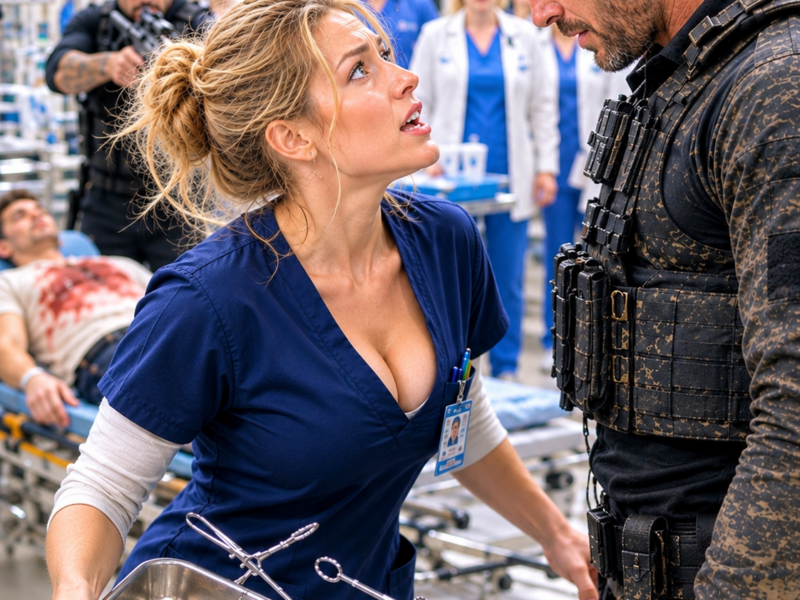
““You’re fired, Nurse. Get out of this hospital before I have security drag you out,” the chief surgeon shouted in front of thirty witnesses
The admiral held the envelope between two fingers, his eyes never leaving mine.
“Emily, I need you to read this.”
I stared at the familiar military seal stamped across the flap.
For three years, I had convinced myself that the Navy had moved on without me.
Apparently, it hadn’t.
“Sir, I don’t understand why you’re here.”
Rear Admiral Whitaker glanced at Dr. Caldwell, then at the nurses and residents gathered around the trauma bay.
“Not here,” he said. “This conversation deserves privacy.”
Caldwell stepped forward.
“Admiral, whatever personal matter you have with this employee, she’s no longer authorized to work in this facility.”
Whitaker slowly turned his head.
“Doctor, I don’t believe you understand the situation.”
“I’m the chief of surgery. I am responsible for maintaining order in my hospital.”
“And I’m a rear admiral in the United States Navy. I am responsible for ensuring that a decorated service member isn’t publicly humiliated for preventing a potentially fatal medication error.”
Caldwell’s mouth opened, but no words came out.
The admiral looked at me again.
“May I?”
I nodded.
He placed the envelope in my hands.
My fingers trembled as I broke the seal.
Inside was a single official document, a photograph, and a smaller folded note.
The document carried a heading I hadn’t seen in years.
NAVAL SPECIAL MEDICAL OPERATIONS — PERSONNEL RECOGNITION REVIEW.
My eyes moved down the page.
There was my full name.
Emily Grace Carter.
Below it were dates, service records, and a designation I hadn’t expected to see again.
Former Navy Hospital Corpsman.
Specialized operational medical training.
Combat casualty response.
Protective extraction support.
I stopped reading.
The photograph slipped halfway out of the envelope.
It showed a younger version of me standing beside three men in military uniforms outside a field medical station.
One of them was Rear Admiral Whitaker.
The other two were people I hadn’t seen in six years.
My throat tightened.
“Where did you get this?”
“From the office of Naval Personnel,” he replied.
“I thought that file was closed.”
“It was closed administratively. That doesn’t mean the people involved forgot what you did.”
I looked at the photograph again.
The young woman in it was smiling.
She looked like someone who believed that doing the right thing would always be enough.
I barely recognized her.
Caldwell cleared his throat.
“Admiral, with respect, I don’t see how any of this changes what happened today.”
Whitaker turned toward him.
“Then perhaps you should listen before deciding what happened.”
He nodded toward the smaller folded note.
“Read that too.”
I unfolded it.
The handwriting was familiar.
I knew it before I reached the signature.
Captain Daniel Reeves.
My former commanding officer.
The man who had taught me that a medical professional’s first responsibility was to the person lying in front of them, not to the rank of the person giving orders.
The note contained only four sentences.
Emily, if this reaches you, it means the review has finally been reopened. You were right to question the medication record. You were right six years ago, and you were right today. Don’t let anyone convince you otherwise.
I read it twice.
Then I looked up.
“Captain Reeves is alive?”
The admiral’s expression softened.
“Yes.”
For a moment, I couldn’t speak.
Six years earlier, I had watched a helicopter disappear into a storm carrying the last people I had ever called family.
The official report had said Reeves was missing and presumed dead.
I had spent months waiting for confirmation.
Eventually, I stopped asking.
But I had never stopped remembering.
“Why didn’t anyone tell me?” I whispered.
Whitaker didn’t look away.
“Because the operation was classified, and because the investigation involved people who had enough influence to keep the truth buried.”
He glanced toward the medication tray.
“Which brings us to today.”
I followed his gaze.
The blue-capped vial was still sitting beside the syringe.
A hospital technician had placed it inside a clear evidence bag.
The label looked ordinary.
But something about the lot number bothered me.
I leaned closer.
“Admiral, may I see that?”
The technician looked at Whitaker.
He nodded.
I examined the label.
Then I looked at the transport medication sheet.
There it was again.
The same manufacturer code.
The same batch number.
My stomach tightened.
“This is the same supplier we encountered during the evacuation.”
Whitaker’s face became serious.
“You’re certain?”
“I remember the packaging. We had a shipment with a similar batch identification. It was recalled after several patients developed unexpected reactions.”
Caldwell shook his head impatiently.
“That’s ridiculous. This is an approved hospital medication.”
I looked at him.
“I didn’t say the medication itself was unapproved. I said the batch needs to be verified.”
The admiral nodded toward his medical officer.
“Make sure that vial is preserved. No one touches it until the Navy and hospital pharmacy complete an independent review.”
Caldwell stepped between the officer and the tray.
“You cannot seize hospital property.”
Whitaker’s voice remained calm.
“Then don’t make the mistake of confusing a hospital medication investigation with a jurisdictional argument.”
The two men stared at each other.
For the first time that morning, Caldwell seemed uncertain.
I knew that look.
It was the expression of someone realizing that the situation had become bigger than the authority he was accustomed to exercising.
But I still had one question.
“Why were you looking for me?”
Whitaker exhaled.
“Because someone tried to contact Captain Reeves three weeks ago. They used a communication channel that hadn’t been active since the operation in Afghanistan.”
I felt the room shift around me.
“What did they say?”
“They asked whether you were still alive.”
My fingers tightened around the envelope.
“Who asked?”
“We don’t know yet.”
He paused.
“But they also asked whether you still remembered what happened at Forward Medical Station Seven.”
I looked down at the photograph.
The memory came back in pieces.
A generator failing.
Rain striking a metal roof.
A wounded interpreter gripping my sleeve.
A locked medication cabinet.
And a voice over the radio ordering me to leave a patient behind.
I had not forgotten.
Not for a single day.
Six years earlier, I hadn’t been a nurse at Harbor Point.
I had been a Navy hospital corpsman assigned to a specialized medical support unit operating alongside a joint military team.
My work was supposed to be simple.
Treat the wounded.
Stabilize casualties.
Get people out alive.
But Forward Medical Station Seven had become the center of an investigation that never reached the public.
The night everything happened, a convoy had been hit outside a remote village.
We received more casualties than we had beds.
Two corpsmen were injured.
The generator was failing.
And our supply of critical medication was running dangerously low.
I was treating a young interpreter named Samir when I noticed that his symptoms didn’t match his injuries.
He was sweating.
His breathing was irregular.
His pulse was weakening.
The medication he had received was supposed to stabilize him.
Instead, it was making him worse.
I checked the vial.
The batch number didn’t match the shipment record.
I reported it.
Captain Reeves ordered the medication quarantined.
Then another officer arrived with a different instruction.
Commander Nathaniel Brooks.
He outranked almost everyone in our unit and had been responsible for coordinating the medical supply deliveries.
He told us the shipment had already been approved.
He ordered us to continue using it.
Reeves refused.
The argument lasted less than a minute.
Then the station came under attack.
We were ordered to evacuate.
A helicopter was waiting.
But Samir and two wounded soldiers were still inside.
Brooks insisted there wasn’t enough time.
Reeves ordered me to take the remaining patients through the rear exit.
I did.
The last thing I saw before the helicopter lifted away was Reeves standing in the doorway, holding the medical supply manifest.
He never made it onto that aircraft.
The official report said the station had been destroyed.
The medication issue was listed as an administrative discrepancy.
No one was charged.
No one apologized.
And the people who had questioned the shipment were quietly reassigned.
I resigned from active duty eight months later.
I didn’t want another uniform.
I didn’t want another briefing room.
I wanted a small apartment, a predictable schedule, and patients whose names I could write on a chart without wondering whether someone would erase them.
Now Whitaker was standing in front of me, telling me that the past had found its way into my hospital.
“Admiral,” I said, “what exactly happened to the people who approved that shipment?”
He glanced toward the door.
“That’s what we’re trying to establish.”
“That isn’t an answer.”
“No,” he admitted. “It isn’t.”
He lowered his voice.
“Brooks retired two years ago. His name appeared in an internal review involving a defense contractor. That contractor supplied the medication batch used at Station Seven.”
“Which contractor?”
“Northstar Tactical Medical.”
I recognized the name.
Not because I had seen it on the hospital label.
Because I had seen it on a shipping document in Afghanistan.
“That’s impossible.”
“Why?”
“Northstar was supposed to have lost its military contract after the investigation.”
“They did lose one contract. They acquired another company shortly afterward.”
The admiral paused.
“Someone may have been moving the same products through a different supplier.”
I looked toward the evidence bag.
“Then the medication today wasn’t an isolated mistake.”
“We don’t know that yet.”
His caution irritated me, but I understood it.
He couldn’t accuse someone without evidence.
And I couldn’t either.
The emergency department doors opened.
A woman in a navy-blue hospital administrator’s suit hurried inside.
It was Laura Mitchell, the hospital’s chief executive officer.
She looked from the admiral to Caldwell, then to me.
“I’ve been informed there was a serious incident involving a patient and an unauthorized medication interruption.”
Caldwell immediately stepped forward.
“Thank you for coming. Nurse Carter has disregarded physician orders, physically restrained a security officer, and interfered with the administration of medication.”
Laura looked at me.
“Emily, is that true?”
I answered carefully.
“I stopped an unverified medication from being administered after the patient specifically warned me about it. His symptoms were deteriorating, and the administration record was incomplete.”
Caldwell laughed without humor.
“She’s rewriting the incident to make herself look heroic.”
The admiral stepped forward.
“Doctor, I watched the patient improve after the medication line was disconnected.”
“That doesn’t prove anything.”
“No,” Whitaker replied. “But the vial’s batch number is now part of a formal investigation.”
Laura’s eyes moved to the evidence bag.
“What investigation?”
“One involving a potentially compromised medical supply.”
The hospital administrator went quiet.
Then she turned toward Caldwell.
“Richard, I want the complete medication administration record, the transport paperwork, and the pharmacy inventory.”
“Of course.”
“And I want them preserved without alteration.”
Caldwell’s expression hardened.
“You’re suggesting I would alter records?”
“I’m suggesting that an investigation requires records to remain untouched.”
For the first time, someone in hospital leadership had questioned him in public.
He didn’t like it.
I could see it in the way he pressed his lips together.
Then Laura looked at my empty uniform pocket.
“Emily, your employment status?”
Caldwell answered before I could.
“She’s terminated.”
Laura took a breath.
“That decision is under review until we establish what happened.”
I almost laughed.
Thirty minutes earlier, I had been ordered out of the building.
Now the same people who had watched Caldwell humiliate me were suddenly speaking about due process.
I wasn’t sure whether to feel relieved or insulted.
“I don’t want special treatment,” I said.
“I want the medication records preserved, and I want the patient protected.”
Laura nodded.
“That’s reasonable.”
Whitaker studied me.
“That’s why I came looking for you.”
I shook my head.
“You came looking for a former corpsman.”
“I came looking for someone who noticed what other people ignored.”
He paused.
“And I came because I owe you an explanation.”
Before I could answer, the admiral’s medical officer approached him.
“Sir, we’ve completed the initial review of the vial.”
Whitaker turned.
“What did you find?”
“The product label is authentic. The batch number, however, doesn’t correspond to the manufacturer’s current distribution records.”
Caldwell frowned.
“That is impossible. Our pharmacy received the shipment through an approved distributor.”
The medical officer continued.
“There’s another problem. The barcode on the vial has been registered to a different lot.”
The room went quiet.
Laura looked at the pharmacy technician.
“How did this get into our inventory?”
The technician swallowed.
“I’d have to check the delivery records.”
“Check them now.”
He hurried away.
I stared at the vial.
A false barcode.
An authentic label.
A batch number that didn’t belong.
Someone had taken considerable care to make an ordinary medication look legitimate.
The admiral leaned closer to me.
“Does that remind you of anything?”
I nodded slowly.
“Station Seven.”
He looked toward the sealed envelope.
“There’s more.”
He reached inside his uniform and removed a second photograph.
This one showed a man standing outside a warehouse.
He wore civilian clothes, but I recognized his face immediately.
Commander Nathaniel Brooks.
He was older, heavier, and wearing glasses.
But there was no mistaking him.
Behind him was a delivery truck bearing the Northstar logo.
The photograph had a date printed along the bottom.
October 18.
Three weeks earlier.
I looked at Whitaker.
“Where was this taken?”
“Portsmouth. At a private medical distribution warehouse.”
“Who took it?”
“A Navy investigator.”
I studied the image.
Brooks was standing beside a woman.
Her face was partly turned away from the camera.
But I could see a small tattoo on her wrist.
Three narrow lines arranged like a triangle.
My breath caught.
I knew that mark.
I had seen it on a medic’s hand at Station Seven.
A woman named Rachel Morgan.
She had been the logistics specialist assigned to record medication shipments.
The night of the attack, she had disappeared.
The official report listed her as missing.
“That’s Rachel,” I whispered.
Whitaker nodded.
“She’s alive.”
I sat down.
For six years, I had imagined what might have happened to her.
Sometimes I pictured her trapped in the station.
Sometimes I imagined that she had made it out and was living somewhere far away.
I had never considered that she might be standing beside the man who had ordered us to use the questionable medication.
“Did she know?” I asked.
“That’s what we need to find out.”
I looked again at the photograph.
Rachel had been my friend.
She had taught me to repair a field radio with a paper clip and a piece of wire.
She had sat beside me during the long nights when we were too exhausted to talk.
When Samir became sick, she was the first person I asked to check the inventory.
She had told me everything was correct.
I had believed her.
Then, hours later, she disappeared.
I pushed the photograph away.
“She told me the shipment was clean.”
The admiral didn’t interrupt.
“Emily, we don’t know whether she was involved or whether she was being used.”
I stood.
“I need to see her.”
Whitaker shook his head.
“Not without an investigator present.”
“She was my friend.”
“And that makes this more difficult, not less.”
I looked at him.
“With respect, sir, you don’t get to decide how much of my past I’m allowed to face.”
He held my gaze for a moment.
Then he nodded.
“Fair enough.”
He turned toward his medical officer.
“Arrange a meeting through the investigative team.”
But the meeting would not happen that day.
Before noon, the hospital’s internal security office received an anonymous message.
It claimed that I had intentionally interfered with the admiral’s treatment because of a personal dispute with Dr. Caldwell.
Attached was a copy of my old military separation paperwork.
Somebody had highlighted the section referring to my resignation.
The message suggested that I had been dismissed from the Navy for insubordination.
That was not true.
I had resigned after the investigation was closed.
But the wording was designed to make people wonder.
By lunchtime, the rumor had spread through the hospital.
Some employees avoided looking at me.
Others whispered when I passed.
One nurse, Megan Lewis, approached me near the staff lounge.
“Emily, is it true you were involved in some kind of military incident?”
I looked at her.
“Yes.”
“Did you get someone killed?”
The question hit harder than I expected.
Megan immediately looked ashamed.
“Someone sent an email. I didn’t mean—”
“Who sent it?”
“I don’t know. It came from an anonymous address.”
I closed my locker.
“Then don’t repeat it.”
She nodded.
I started walking away.
“Emily?”
I turned.
Megan looked down at her hands.
“I saw you check that medication twice this morning. Before the admiral even said anything. You weren’t guessing.”
For the first time that day, I felt less alone.
“Thank you.”
She hesitated.
“Do you think someone is trying to hurt him?”
I looked toward the emergency department.
“I think someone needs us to stop asking questions.”
That afternoon, the Navy investigator arrived.
His name was Special Agent Mark Ellison.
He was in his early forties, wore a plain gray suit, and had the tired eyes of someone who spent too much time reading reports that people hoped would never be found.
He introduced himself to Laura and the admiral.
Then he asked to speak with me.
We met in a small conference room overlooking the hospital parking lot.
A folder lay on the table.
“Ms. Carter, I want to establish something before we begin.”
“Go ahead.”
“You are not being accused of any wrongdoing.”
“I appreciate that.”
“But your testimony from Station Seven is important to a reopened investigation.”
I looked at the folder.
“Is this about Commander Brooks?”
“Partly.”
He opened it.
Inside were copies of shipping manifests, purchase orders, and laboratory reports.
One document had my old signature at the bottom.
I recognized it immediately.
It was the original report I had written six years earlier, documenting the medication discrepancy.
“I thought this was destroyed.”
“It was never destroyed. It was removed from the primary investigation file and placed in a restricted archive.”
“By whom?”
Ellison turned the page.
The authorization carried the signature of Commander Nathaniel Brooks.
I stared at it.
“Why would he remove my report?”
“That’s what we’re investigating.”
He placed another sheet on the table.
It was a handwritten inventory record.
Rachel Morgan’s handwriting.
My eyes moved across the entries.
There were several shipments, each carrying a different batch number.
One line had been circled in red.
A transfer dated the night of the attack.
The destination field was blank.
“What’s this?”
Ellison leaned forward.
“We found it in a storage locker rented under Rachel Morgan’s name.”
“Does it prove she was involved?”
“Not by itself.”
He slid another document toward me.
“This is a copy of a message sent from a secure terminal three weeks ago. It was addressed to a former Navy contact of Captain Reeves.”
I read it.
The original witness is still alive. The inventory record remains with her. Do not allow her to speak before the review.
My mouth went dry.
“Who wrote this?”
“We’re tracing the terminal.”
I looked up.
“Why would they be worried about me speaking?”
Ellison folded his hands.
“Because your report identifies who approved the shipment and who overrode the quarantine order.”
“Brooks.”
“Yes. But there is another name.”
He turned the page.
I read the signature.
And for a moment, I couldn’t understand what I was seeing.
The approval line was signed by Rear Admiral Thomas Whitaker.
I looked at the investigator.
“Why is his name here?”
Ellison didn’t answer immediately.
“Because six years ago, Admiral Whitaker was the senior officer responsible for reviewing the supply chain investigation.”
I felt the room grow smaller.
“He told me he believed my report.”
“He did.”
“Then why did this happen?”
“That’s a question you should ask him.”
I pushed back my chair.
“Did he know the shipment was contaminated?”
“We have no evidence that he knew the medication was compromised at the time.”
“But he signed the review.”
“Yes.”
I looked at the signature again.
The man who had saluted me that morning had once signed a document that allowed the case to be closed.
The man I had believed was coming to help me might have been part of the reason I had spent six years thinking my friend was dead.
I left the conference room without saying goodbye.
Whitaker was waiting in the corridor.
He took one look at my face.
“You’ve seen the review.”
I held up the paper.
“You signed this.”
He lowered his eyes.
“Yes.”
“You told me the investigation had been buried by people with influence. You didn’t tell me your signature was on the report.”
“I should have.”
“Why didn’t you?”
He looked toward the windows.
“Because I was ashamed.”
I laughed once, without humor.
“That’s convenient.”
“Emily, listen to me.”
“No. You listen.”
My voice was shaking now.
“I lost people at Station Seven. I spent years wondering whether I had failed them. I left the Navy because I couldn’t bear hearing another person tell me the report was complete when it clearly wasn’t.”
Whitaker stood still.
“And you knew.”
“I knew the report was incomplete.”
“That’s not the same as telling the truth.”
He nodded.
“You’re right.”
For a long moment, neither of us spoke.
Then he explained.
The original investigation had been conducted under enormous pressure.
Brooks claimed that the medication discrepancy was caused by a clerical error.
The contractor produced certificates showing that the shipment had passed inspection.
The military laboratory’s initial findings were inconclusive.
Whitaker had been told that keeping the investigation open would compromise a larger operation involving military medical supply routes.
He signed the closure recommendation.
Not because he believed everything was fine, but because he believed the evidence was insufficient.
“That was my mistake,” he said. “I trusted the wrong people, and I accepted an answer because I wanted the operation to continue.”
I stared at him.
“And Captain Reeves?”
“Reeves challenged the decision. He sent me a private message stating that he had found evidence of deliberate substitution. Two days later, the station attack occurred.”
“Did you know he might have survived?”
Whitaker shook his head.
“No. I believed he was dead until the message three weeks ago.”
I turned away.
His apology couldn’t bring back six years.
It couldn’t restore the nights I had spent wondering whether Reeves had died believing I had abandoned him.
But there was something else I needed to know.
“Why did you come to Harbor Point today?”
He reached into his jacket.
“Because I received a warning that someone had access to my medical records and might attempt to interfere with my treatment.”
I looked at him.
“Someone knew where you were going to be.”
“Yes.”
“Who?”
“We don’t know.”
He hesitated.
“But I believe the person wanted me to receive that medication.”
The words settled between us.
The blue vial.
The missing record.
The barcode.
The person who had tried to make the admiral’s treatment look routine.
I looked back toward the emergency department.
“Then this wasn’t about an old shipment.”
“No,” he said. “It was about silencing the people who could connect it to the original investigation.”
I returned to the conference room.
Agent Ellison was still there.
I placed the report on the table.
“Admiral Whitaker signed the closure recommendation. He didn’t tell me.”
Ellison nodded.
“I know.”
“You knew?”
“We found the document before we came here.”
I looked at him sharply.
“Then why didn’t you tell me?”
“Because I needed to know whether you would identify the signature yourself. And because the admiral’s cooperation was part of the investigation.”
I sat down.
“Everyone keeps deciding what I need to know.”
Ellison didn’t defend himself.
He simply opened the folder again.
“Then let’s stop doing that.”
He placed a new document on the table.
It was an appointment record for a meeting scheduled the next morning.
Rachel Morgan had agreed to speak with the investigative team.
The location was a federal building in Norfolk.
I read her name several times.
“Will she tell us what happened?”
“That’s up to her.”
I looked at the investigator.
“I want to be there.”
He considered it.
“Only if you understand that you may not like what she says.”
“I’ve been living with what I don’t know for six years.”
He nodded.
“Then I’ll make the arrangements.”
That night, I went home to my small apartment near the waterfront.
I didn’t turn on the television.
I didn’t cook dinner.
I sat at my kitchen table with the old photograph from the envelope.
Three men.
One woman.
A medical station that no longer existed.
I studied the younger version of myself.
I remembered how certain I had been that I could save everyone if I worked hard enough.
My phone rang at 11:43 p.m.
An unknown number.
I almost let it go to voicemail.
Then I answered.
“Hello?”
A woman’s voice came through.
“Emily?”
I sat up.
“Who’s this?”
“It’s Rachel.”
I gripped the phone.
“Where are you?”
“That doesn’t matter.”
“It matters to me.”
She took a shaky breath.
“I heard Whitaker found you.”
“He’s here. He’s alive. And so are you, apparently.”
Silence.
Then she said, “You shouldn’t have trusted him.”
I closed my eyes.
“I know about the shipment, Rachel.”
A quiet sob came through the phone.
“I didn’t know what was in it.”
“Then why did you tell me the records were clean?”
“Because Brooks told me they were.”
“Why did you disappear?”
“He said if I talked, he would make sure my family lost everything.”
I leaned forward.
“Rachel, I need you to tell the investigators that.”
“I can’t.”
“Why not?”
“Because he knows where my daughter goes to school.”
The room seemed to lose its air.
I had never known Rachel had a daughter.
She had joined the unit shortly after her divorce and rarely spoke about her personal life.
“How old is she?”
“Eleven.”
“Is she safe?”
“I think so.”
“Rachel, listen to me. You need to go to the investigators.”
“I tried once.”
“What happened?”
“He sent me a picture of my daughter walking out of school. That was enough.”
I gripped the edge of the table.
“Where are you now?”
“Somewhere he can’t reach me.”
“Then let us help you.”
She was quiet for several seconds.
Then she whispered, “Emily, there’s something else.”
“What?”
“The night of the attack, I changed the manifest.”
I felt the old memory return.
“Why?”
“Because I found a second shipment. It had the same false batch numbers, but it wasn’t going to the station.”
“Where was it going?”
“To a military medical distribution center in Virginia.”
I looked at the photograph.
“Northstar.”
“Yes.”
“Did Brooks know?”
“He arranged it.”
“Who else?”
Rachel hesitated.
“Someone at the distribution center signed for it. Someone whose name appeared on the original review.”
I thought of Whitaker’s signature.
“Who?”
“Emily, I can’t say it over the phone.”
“Then tell Agent Ellison tomorrow.”
“I will.”
Her voice cracked.
“But you need to understand something. I didn’t leave you at Station Seven because I wanted to.”
I closed my eyes.
“I never said you did.”
“You thought it.”
I couldn’t answer.
For six years, I had wondered whether she had abandoned us.
I had been angry with her.
I had also missed her.
Those two feelings had lived together in me for so long that I no longer knew how to separate them.
“Rachel,” I said softly, “come tomorrow. Let us hear the truth.”
She whispered, “I will.”
Then the call ended.
The next morning, I arrived at the federal building with Agent Ellison.
Rear Admiral Whitaker was already there.
He looked tired.
For the first time since I had seen him, his uniform seemed less like armor and more like something heavy he had been carrying for too long.
“Emily,” he said.
I nodded.
I wasn’t ready to forgive him.
But I was ready to hear the truth.
Rachel arrived at 9:17 a.m.
She wore a gray coat and carried a worn leather bag.
Her hair was shorter than I remembered.
There were lines around her eyes that hadn’t been there six years earlier.
When she saw me, she stopped.
Neither of us moved.
Then she crossed the room.
“I’m sorry,” she whispered.
I looked at her.
“I wanted you to be dead for about five minutes yesterday.”
She let out a small, broken laugh.
“That’s fair.”
Then I hugged her.
It wasn’t forgiveness.
Not yet.
It was simply the first honest thing either of us had done in six years.
We sat down.
Agent Ellison placed a recorder on the table.
Rachel stared at it.
Then she began.
She explained that Brooks had been coordinating the delivery of medical supplies through Northstar Tactical Medical.
At first, she believed the shipments were legitimate.
But several months before Station Seven, she noticed discrepancies between the product labels and the distribution records.
She reported them to Brooks.
He told her the paperwork had been updated and instructed her to stop asking questions.
Then she discovered that certain medication batches had been diverted through a secondary warehouse.
The labels were being reused.
Some products had been repackaged.
Others had been replaced with different formulations.
Rachel had no authority to investigate further.
But she had access to the manifests.
So she copied them.
The night of the attack, she discovered that the same shipment had been sent to Station Seven.
She warned Brooks.
He told her to keep quiet.
When Samir became ill, she realized the medication might be connected.
She wanted to tell me.
But Brooks had already threatened her family.
“I was scared,” she said.
“I thought if I followed his instructions, I could get out with my daughter and find someone who would listen.”
“Why didn’t you come to me?” I asked.
She looked down.
“Because I had already lied to you.”
That answer hurt more than I expected.
She continued.
After the attack, she was moved to a temporary facility under the pretense of being interviewed about the evacuation.
Brooks had arranged for her to be transported out before the formal investigation began.
She spent months hiding with relatives.
Eventually, she left the country with her daughter.
She returned to Virginia two years later under a different name.
The photographs of her with Brooks had been taken while she was secretly collecting evidence.
She had been trying to identify everyone involved in the distribution network.
“Why didn’t you contact me?” I asked.
“I thought you were being watched. I thought getting near you would put you in danger.”
“Someone still found me.”
Rachel nodded.
“That’s why I called.”
Agent Ellison leaned forward.
“You mentioned another name.”
Rachel opened her bag.
She removed a small notebook wrapped in plastic.
“I kept the original shipping records.”
She placed it on the table.
Ellison opened the notebook carefully.
Several pages contained dates, batch numbers, and signatures.
One name appeared repeatedly.
Nathaniel Brooks.
Another name appeared beside his.
Dr. Alan Mercer.
Whitaker leaned forward.
“Who is that?”
Rachel looked at him.
“Former deputy director of the Navy’s medical procurement office.”
Whitaker’s expression changed.
Mercer had been the official who certified the contractor’s laboratory reports six years earlier.
He had also recommended closing the investigation.
I looked at the admiral.
“That’s the person you trusted.”
Whitaker nodded slowly.
“Yes.”
Rachel turned another page.
“There is more.”
She showed us a handwritten note attached to one shipment record.
It contained instructions to redirect a delivery if an inspection was requested.
At the bottom was a short authorization code.
Ellison studied it.
“Where did you get this?”
“From the warehouse office. I took it before I left.”
“Why keep it for so long?”
“Because I knew one day someone would need it.”
She looked at me.
“I just didn’t know whether I’d be brave enough to hand it over.”
Ellison took photographs of every page.
Then he asked Rachel whether she would provide a sworn statement.
She nodded.
“I will.”
Whitaker sat quietly.
After a few minutes, he spoke.
“Rachel, I owe you an apology.”
She looked at him.
“You signed the report that made it possible for Brooks to keep working.”
“I know.”
“You knew there were missing records.”
“I did.”
“You knew Emily had questioned the medication.”
“Yes.”
Rachel’s voice was quiet, but it carried across the room.
“Then you knew we were telling the truth.”
Whitaker lowered his head.
“I knew there were reasons to keep investigating. I should never have allowed the review to close.”
There was no dramatic defense.
No excuse.
Just an admission.
And somehow, that made it harder to hate him.
Agent Ellison collected the notebook.
“With these records, we can pursue the distribution investigation and seek warrants for the warehouse and the contractor’s remaining files.”
“Will Brooks be arrested?” I asked.
“If the evidence supports the charges, yes.”
“And Dr. Mercer?”
“His role will be examined as well.”
I looked at Rachel.
“What about the people who got sick?”
She swallowed.
“Some were transferred. Some were discharged. I don’t know how many survived.”
I thought of Samir.
The interpreter whose hand I had held while the station lights flickered.
“Did he survive?”
Rachel shook her head.
“I’m sorry.”
I looked down at my hands.
For years, I had told myself that if I had recognized the problem sooner, perhaps I could have saved him.
Now I knew that someone had deliberately hidden the truth.
It didn’t erase the loss.
But it changed the weight I had been carrying.
The investigation moved quickly after that.
Within forty-eight hours, federal agents searched the Portsmouth warehouse.
They found mislabeled medical products, altered shipping records, and boxes of unused packaging bearing counterfeit batch information.
The evidence linked the warehouse to Northstar and several shell distributors.
Commander Brooks was arrested at his home.
Dr. Mercer was detained for questioning and later charged in connection with the procurement scheme.
The hospital also launched an independent review of its medication inventory.
The blue vial from the admiral’s treatment was traced to the same distribution network.
It had entered the hospital through a legitimate-looking supplier that had concealed the false batch information.
The investigation did not prove that every person in the network had intended to harm patients.
Some had ignored warning signs.
Some had accepted documents they should have questioned.
Others had actively concealed the truth.
But the evidence was enough to establish that the supply chain had been manipulated for years.
And the people who had raised concerns had been pushed aside.
Harbor Point’s internal review took longer.
Laura Mitchell called me into her office one week after the incident.
Caldwell was already there.
He sat with his arms folded, his expression carefully neutral.
Laura gestured toward a chair.
“Emily, thank you for coming.”
I sat down.
She opened a folder.
“Our review confirms that you acted appropriately in questioning the medication order. The transport documentation was incomplete, the vial was not properly verified, and your actions prevented an additional unverified administration.”
Caldwell stared at the desk.
Laura continued.
“Your termination has been formally withdrawn.”
I looked at her.
“Does that mean I’m expected to return to the same department?”
“That’s your decision.”
I turned toward Caldwell.
He finally looked up.
“Emily, I want to apologize.”
I waited.
He cleared his throat.
“I should have listened to your concerns before dismissing them.”
“You didn’t just dismiss them.”
He nodded.
“I know.”
“You humiliated me in front of the entire department.”
“I was under pressure.”
“So was the patient.”
He looked down.
For a moment, I could see that he wanted to explain himself.
Perhaps he had spent years believing that being in charge meant never appearing uncertain.
Perhaps he had mistaken confidence for competence.
But I didn’t need another explanation.
“I don’t need you to like me, Dr. Caldwell,” I said. “I need you to listen when a nurse tells you something is wrong.”
He nodded slowly.
“I understand.”
Laura closed the folder.
“We would like you to return. We can also offer a position in the hospital’s patient safety and emergency response program.”
I considered it.
For years, I had tried to build a life where I never had to think about Station Seven again.
But I had learned something in the last week.
Avoiding the past hadn’t made it disappear.
It had only made it easier for other people to decide what it meant.
“I’ll return,” I said.
“But not because I need the job.”
Laura nodded.
“Understood.”
“I want a seat on the patient safety review committee. Nurses need to be heard when they identify medication concerns.”
“That’s reasonable.”
“And I want the hospital to review every supplier connected to the distribution network.”
Laura wrote it down.
“We’ll begin immediately.”
I looked at Caldwell.
“Can you support that?”
He hesitated.
Then he nodded.
“Yes.”
It wasn’t a perfect apology.
But it was a beginning.
Three months later, Harbor Point held a small ceremony in its main auditorium.
There were nurses, doctors, hospital administrators, and several Navy representatives.
I hadn’t wanted a ceremony.
I had asked for a quiet meeting to discuss the new medication verification program.
But Rear Admiral Whitaker had insisted that the people who helped uncover the distribution scheme deserved recognition.
I stood near the stage in my regular nursing uniform.
The audience was larger than I expected.
Whitaker stepped to the microphone.
“Three months ago, a patient in this hospital was at risk because a medication’s identity and history had not been properly verified.”
He paused.
“A nurse noticed details that others overlooked. She asked questions when it would have been easier to remain silent. She acted to protect a patient, even when doing so put her career at risk.”
He turned toward me.
“Emily Carter served this country in a capacity few people ever knew. She treated wounded service members under circumstances most of us will never experience.”
The room became quiet.
“But her most important decision that morning wasn’t made because of her military training. It was made because she remembered what every medical professional is supposed to remember.”
He looked directly at me.
“Every patient deserves someone willing to speak when something is wrong.”
The audience applauded.
I stood still for a moment.
Then I walked to the stage.
Whitaker held out a small presentation case.
Inside was a Navy commendation medal.
I stared at it.
“Admiral, I don’t know what to say.”
“Then don’t say anything.”
He smiled.
“Just accept what you earned.”
I took the case.
He brought his heels together and saluted me again.
This time, I returned the gesture.
Not because I wanted to be remembered as a soldier.
But because I finally understood that I didn’t have to choose between the woman I had been and the nurse I had become.
After the ceremony, I found Whitaker standing alone near the auditorium windows.
He was no longer wearing his service jacket.
He looked older than he had three months earlier.
“How are you feeling?” I asked.
“Better. The doctors say I should be grateful to have someone stubborn looking after me.”
I smiled.
“That sounds like good advice.”
He looked down at his hands.
“I’ve thought about what you said.”
“Which part?”
“That I knew there were reasons to keep investigating, and I signed the closure anyway.”
I didn’t answer.
“I can’t undo that,” he continued. “And I won’t ask you to forgive me because I finally admitted it.”
I looked at him.
“That’s probably the first thing you’ve said that makes forgiveness possible.”
He nodded.
We stood together for a while, watching the afternoon light fall across the parking lot.
Then he handed me a small photograph.
It was the same one from the envelope.
The four of us outside Station Seven.
Reeves.
Whitaker.
Rachel.
And me.
But there was something written on the back.
I turned it over.
The truth may arrive late, but it still deserves a place at the table.
I ran my thumb over the handwriting.
“Who wrote this?”
“Captain Reeves.”
My head lifted.
“He’s coming?”
Whitaker smiled.
“He asked me to give you that photograph. He said he would rather tell you the rest himself.”
I stared at him.
“Where is he?”
“Recovering. He has been living under protection while the investigation was reopened.”
For the first time in six years, I felt something I hadn’t allowed myself to feel.
Hope.
Two weeks later, I received a call from an unfamiliar number.
“Emily Carter?”
I knew the voice immediately.
“Captain Reeves?”
A quiet laugh came through the phone.
“Still answering questions with questions, I see.”
I covered my mouth.
“You’re alive.”
“I am.”
I sat down.
For several seconds, neither of us spoke.
Then he said, “I’m sorry it took so long.”
I closed my eyes.
“I thought you were dead.”
“I know.”
“I waited for them to tell me what happened.”
“I know that too.”
His voice softened.
“You got Samir out, Emily. You got two other men out. You followed the order that saved their lives. Don’t let the people who caused that disaster convince you that you failed.”
I looked toward the photograph on my desk.
“Why didn’t you come back?”
“I was injured during the attack. I was taken to a temporary medical facility, then transferred under a protection arrangement after I found evidence connecting Brooks to the supply operation.”
“Why didn’t anyone tell me?”
“Because they couldn’t confirm who was compromised. And because I was told you had resigned and were living quietly.”
I let out a shaky breath.
“I was angry with you.”
“You had every right.”
“I was angry with Rachel too.”
“She knows.”
“Do you think we can ever go back to how things were?”
Reeves was quiet.
“No, Emily. We can’t.”
The answer stung.
Then he continued.
“But we can build something honest from what remains.”
I wiped my cheek.
“That sounds difficult.”
“It will be.”
I smiled through the tears.
“You always did know how to make a briefing sound miserable.”
He laughed.
And for the first time in years, the sound didn’t feel like a memory.
It felt real.
The following Saturday, I met Rachel at a small café near the waterfront.
She brought her daughter, Sophie.
The girl was eleven, had bright red sneakers, and spent most of breakfast drawing pictures in the margins of a notebook.
She looked up at me.
“Mom says you helped people in the Navy.”
I smiled.
“Your mom helped people too.”
Sophie considered that.
“Did you know each other a long time?”
“Long enough to get into trouble together.”
Rachel laughed.
“She was usually the one who got us out of it.”
We talked for nearly two hours.
Not about the investigation.
Not about Brooks.
Not about the warehouse.
We talked about ordinary things.
School.
Coffee.
The terrible traffic near the hospital.
The kind of conversations I had once believed I would never have with her again.
When we finally stood outside, Rachel touched my arm.
“I don’t expect you to forget what happened.”
“I won’t.”
“But I hope one day you won’t have to carry it every time you look at me.”
I watched Sophie run ahead toward the crosswalk.
“I don’t know how long that will take.”
Rachel nodded.
“I understand.”
I looked at her.
“But we can start with breakfast.”
Her eyes filled.
“That would be enough.”
Months passed.
The hospital introduced a new medication verification protocol.
Every questionable batch required independent confirmation.
Nurses could suspend administration when a safety concern arose without fear of immediate disciplinary action.
The changes were not perfect.
There were still disagreements, delays, and difficult conversations.
But people began asking questions before reaching for the medication tray.
Dr. Caldwell eventually stepped down from his position as chief of surgery.
He remained at Harbor Point as a senior physician, where he worked under a new clinical oversight structure.
He never became my friend.
But he stopped treating nurses as if their observations were optional.
That was enough.
I returned to my regular shifts.
I still arrived early.
I still remembered which patients needed extra blankets.
I still carried spare pens because someone always lost theirs.
The difference was that I no longer mistook silence for peace.
One evening, I was finishing my shift when a young nurse named Megan approached me.
“Emily, can I ask you something?”
“Of course.”
She looked toward the nurses’ station.
“There’s a medication order I don’t feel comfortable with. The doctor says it’s fine, but the patient’s history doesn’t quite match.”
I closed the chart I was holding.
“Show me.”
We reviewed the order together.
There was a discrepancy in the dosage.
Not a criminal scheme.
Not a military secret.
Just an ordinary mistake that could have become dangerous if nobody had questioned it.
We contacted the physician.
The order was corrected.
Megan exhaled.
“I was afraid he’d get angry.”
“He might have.”
She gave a nervous smile.
“You’re not supposed to say that.”
I laughed.
“No. But you’re still supposed to ask.”
Later that night, I walked past the glass doors of the emergency department.
Outside, rain was falling over Norfolk.
A military helicopter passed in the distance, its lights moving slowly across the dark sky.
For a second, I remembered Station Seven.
The broken generator.
The smell of wet earth.
The people waiting for help.
I remembered the woman I had been before everything happened.
Then I looked down at my hospital badge.
EMILY CARTER, RN.
I used to think that leaving the Navy meant leaving that part of myself behind.
I was wrong.
The skills had stayed.
The memories had stayed.
Even the people I thought I had lost had found their way back into my life.
But the most important thing I had carried out of that station wasn’t a combat technique or a medal.
It was the belief that a person lying helpless in front of you deserves someone willing to question an order when that order doesn’t make sense.
I adjusted my badge and returned to the nurses’ station.
A patient was waiting.
And this time, I didn’t need anyone to salute me to know I was exactly where I belonged.
THE END.









