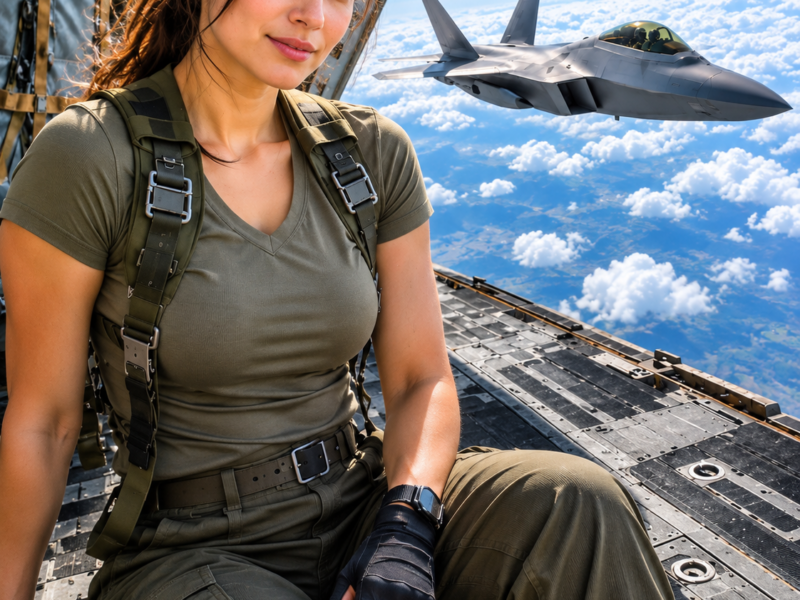
“‘You’re cargo crew, Marquez. Stay away from my fighter.’ Nine years later, those same pilots would watch me climb into an F-22 and realize they had no idea who had been loading their aircraft all along.”
“Major Reyes? That’s impossible. We buried you nine years ago.”
Colonel Marcus Whitfield stood beneath the harsh lights of the hangar, staring at me as if he had just seen a ghost.
Behind him, the base alarm continued to pulse.
Somewhere beyond the hangar doors, two unidentified aircraft were getting closer to Hollowman Air Force Base.
I didn’t have time to explain nine years of silence.
“Sir, I understand what the records say,” I replied. “But those records are wrong about one thing. I’m standing right here.”
Whitfield’s expression hardened.
“Your service record was sealed. Your death was confirmed after Operation Quiet Threshold. There was a memorial.”
“I know.”
“Then tell me why you’re wearing a cargo uniform.”
“Because somebody had to make sure these aircraft were ready.”
For a moment, nobody spoke.
Master Sergeant Dale Oay stood beside the equipment console, looking between us. Chief Master Sergeant Ray Delgado had moved closer to the F-22 parked at the far end of the hangar.
The aircraft was Tail 07.
The same aircraft whose intermittent flight-control fault I had identified eleven days earlier.
Whitfield glanced toward it.
“That’s not an answer, Major.”
“No, sir. It’s the only answer I have time to give you.”
A warning tone sounded from the control room.
The approaching aircraft had crossed another tracking boundary.
Whitfield turned toward the radio operator.
“Status?”
“Two unidentified fast movers, sir. No transponder responses. No filed flight plans. They’re maintaining course toward the southeastern range complex.”
“How long?”
“Approximately eleven minutes to the restricted area.”
Whitfield looked back at me.
“We have two fighters available on paper. One has a hydraulic leak. The other pilot is injured. Tail 07 is serviceable, but we have no qualified pilot ready to launch.”
“I can fly it.”
“You haven’t flown operationally in nine years.”
“I haven’t forgotten how.”
“That’s not the same thing.”
“No, sir. It isn’t.”
I stepped closer, lowering my voice.
“But I know this aircraft. I know its maintenance history, its recent fault trends, and the correction made to its redundant hydraulic sensor. I know what was wrong with it before anyone else believed there was a problem.”
Delgado nodded.
“She caught that fault before it became a serious issue, Colonel. I checked her findings myself. She was right.”
Whitfield studied me.
“Why didn’t you tell anyone who you were?”
“Because the name Elena Reyes was supposed to disappear.”
“And Elena Marquez?”
“She was allowed to stay.”
The colonel looked toward the runway.
I could see the calculation happening behind his eyes. Every second mattered. Every decision carried consequences.
“Give me the authorization code,” I said.
“You’re asking me to put an administratively separated officer into a combat aircraft during an active security emergency.”
“I’m asking you to protect this base.”
Whitfield’s jaw tightened.
“Your old qualifications are not automatically valid.”
“I understand.”
“You will operate under direct authorization. Your mission is limited to intercept and identification unless the rules of engagement permit further action.”
“Understood.”
“And if I order you to disengage, you disengage.”
“Yes, sir.”
He held my gaze for another second.
Then he turned to the communications officer.
“Contact command. Request emergency reinstatement verification for Major Elena Reyes, former callsign Shadow 43. Record this as a provisional emergency flight authorization under my authority.”
The room seemed to go silent.
The communications officer hesitated.
“Sir, that’s going to trigger a classified personnel review.”
“Then let it.”
Whitfield faced me again.
“Major Reyes, you have temporary authorization to fly Tail 07 for this emergency. Your status will be reviewed immediately afterward.”
I nodded.
“Thank you, Colonel.”
“Don’t thank me yet. Get that aircraft airborne.”
I turned toward the F-22.
Delgado was already moving.
“Come on,” he called. “Let’s get you suited up.”
For nine years, I had walked past that aircraft as cargo crew.
I’d loaded equipment beneath its wings, checked its paperwork, inspected its exterior, and watched pilots climb into the cockpit without ever wondering who I had been.
Now I was running toward it.
The flight suit waiting in the equipment room was not mine. It had been prepared for another pilot who would not be flying today.
It was a little loose at the shoulders.
I didn’t care.
I pulled on the boots, tightened the straps, and secured the helmet beneath my arm.
My old flight boots were still in my locker.
I’d kept them for years, even when I told myself I would never need them again.
I had never been able to throw them away.
When I returned to the hangar, Delgado was beside Tail 07.
He looked at me carefully.
“It’s been a while.”
“Too long.”
He held out a small equipment pouch.
“Your old identification tag was still in your locker. I found it when we were clearing the storage area.”
I opened it.
The metal tag was worn around the edges. The lettering was still visible.
REYES, ELENA.
I closed my fingers around it.
“Thanks, Chief.”
“Bring the aircraft back.”
“I intend to.”
I climbed the ladder and settled into the cockpit.
The familiar smell of the aircraft surrounded me. The displays illuminated. The systems came alive one by one.
For a moment, I was no longer a woman in a borrowed flight suit.
I was the pilot who had once known the sky better than the ground.
Then the radio crackled.
“Tail 07, this is Hollowman Ground. Confirm pilot identification.”
I pressed the transmit switch.
“Shadow 43. Ready for departure.”
There was a brief pause.
Then the controller responded.
“Copy, Shadow 43. Runway assignment confirmed. Wind and conditions are within limits. You are cleared for takeoff under emergency authorization.”
I took a breath.
“Understood.”
The aircraft began to move.
As I taxied toward the runway, I saw people gathering behind the safety line. Mechanics, cargo crew, ground controllers, and pilots who had spent years treating me like part of the hangar equipment.
Dale Oay stood near the front.
He wasn’t smiling.
He was watching.
I gave him a small nod.
Then I turned my attention forward.
The runway stretched ahead.
For nine years, I had watched other people take off.
This time, I was going with them.
I advanced the throttle.
Tail 07 surged forward.
The runway markings blurred beneath me. The aircraft gathered speed, and the ground began to fall away.
Hollowman grew smaller beneath the wings.
I was airborne.
“Shadow 43, Hollowman Control. Radar picture follows.”
The controller’s voice was calm, but I could hear the urgency underneath.
“Two unidentified aircraft, southeast of your position. Both traveling at high speed. No radio response to repeated calls. NORAD is tracking them, but identification remains unknown.”
“Copy. I have the intercept.”
“Your mission is to identify and deter. Do not engage unless hostile intent is established and engagement is authorized under current rules.”
“Understood.”
I checked the information coming across my displays.
Two contacts.
Fast.
Low.
Their course pointed directly toward the southeastern restricted area.
The fuel depot sat beyond that boundary. It supplied operations across the region and was one of the most sensitive facilities on the installation.
If those aircraft reached it, the consequences could be catastrophic.
I adjusted my course.
“Shadow 43, be advised. The contacts have ignored all warning attempts. No identification signal has been received.”
“Copy.”
I could feel the old concentration settling over me.
It wasn’t excitement.
It wasn’t fearlessness.
It was something quieter.
The ability to put everything unnecessary aside and focus on the one thing that mattered.
The two contacts appeared ahead.
I identified myself over the emergency frequency.
“Unidentified aircraft, this is United States military aircraft. You are approaching restricted airspace. Identify yourselves immediately and change course.”
No response.
I repeated the warning.
Nothing.
The contacts continued toward the depot.
“Control, Shadow 43. No response. Both aircraft maintaining their original course.”
“Copy. Continue identification and maintain safe separation.”
I watched their movement.
They weren’t lost.
They weren’t wandering into restricted airspace by accident.
They were holding a deliberate course.
I made another attempt.
“Unidentified aircraft, you are approaching a protected military installation. Turn away immediately. Failure to comply will be treated as a hostile act.”
One aircraft changed position slightly.
For a brief moment, I thought it might be turning away.
Then it resumed its original heading.
My stomach tightened.
“Control, the contacts are continuing toward the restricted area. I assess hostile intent.”
The reply came after a short pause.
“Shadow 43, command has authorized defensive action under the applicable rules of engagement. Protect the installation. Avoid the populated areas.”
I acknowledged the order.
There was no room left for doubt.
The first aircraft suddenly changed direction.
The second followed.
They were no longer simply approaching the base.
They were reacting to me.
I kept my distance and monitored their movements. My training came back in fragments: old briefings, old missions, old voices from instructors who had taught me to remain calm when everything around me became uncertain.
But the years away had changed me.
I wasn’t the same pilot who had left the squadron.
I had spent nine years learning patience from people who repaired aircraft with their hands. I had learned to notice small details, to respect the warning signs, and to understand how a machine could tell you something was wrong long before it failed.
That knowledge was with me now.
The first aircraft turned toward the restricted area again.
“Control, they’re attempting to bypass the intercept.”
“Copy, Shadow 43. Defensive action remains authorized.”
I made my decision.
The engagement that followed was brief and violent.
The first hostile aircraft was destroyed well away from the depot. A flash appeared in the distance, followed by a dark cloud that quickly began to disperse.
“Control, one hostile aircraft down. Second contact remains airborne.”
“Copy. Confirm your status.”
“Aircraft operating normally. Continuing to monitor the second contact.”
The remaining aircraft broke away, then turned back.
For a moment, I thought it might be attempting to escape.
Instead, it made another aggressive approach.
I warned it again.
No response.
It was moving toward the same restricted area, and the distance was closing.
The second engagement was harder.
The aircraft moved erratically, disappearing against the terrain before reappearing farther away. I kept my attention on the contact while control continued to update the threat picture.
I could hear my own breathing inside the helmet.
I thought about the people below.
The mechanics who had worked through freezing nights.
The cargo crew who loaded supplies without ever knowing where they would go.
The young airmen who had joined the base believing it was a safe place to serve.
I thought about Delgado standing beside Tail 07.
And I thought about the name on my identification tag.
Reyes.
I had spent years believing I needed to leave that name behind to protect people.
Now I was flying under it again.
The second aircraft made one final attempt to continue toward the installation.
I received confirmation that defensive action remained authorized.
I acted.
The contact disappeared from the display.
A moment later, a distant flash marked the end of the engagement.
I waited for confirmation.
“Control, Shadow 43. Second hostile aircraft no longer airborne. Requesting confirmation from your tracking network.”
The radio remained quiet for several seconds.
Then the controller answered.
“Confirmed. Both contacts neutralized. No further hostile aircraft detected.”
I looked toward the horizon.
The sky was quiet again.
“Shadow 43 copies. Request permission to return to Hollowman.”
“Permission granted. Runway is being prepared. Emergency services are standing by.”
I let out a breath I hadn’t realized I was holding.
“Returning now.”
The flight home felt longer than the engagement.
My hands remained steady, but my thoughts had begun to catch up with me.
I had flown a combat mission after nine years away.
I had used a callsign that official records said no longer existed.
And I was about to land in front of people who had known me only as Elena Marquez.
As Hollowman came into view, the runway looked strangely familiar.
The hangars.
The fuel depot.
The cargo buildings.
The small service road where I had walked to work every morning.
I lined up for landing.
The wheels touched the runway.
The aircraft slowed.
When I finally came to a stop, emergency vehicles followed at a safe distance.
I shut down the aircraft and remained seated for several seconds.
My hands rested on the controls.
I looked at them.
They were the same hands that had signed cargo manifests, driven forklifts, and repaired broken straps.
They were also the hands that had just brought an F-22 home.
The cockpit opened.
Delgado was waiting below.
“You made it,” he said.
“I told you I would.”
He gave a short laugh, then stepped back as I climbed down.
The flight line had gone quiet.
People stood in small groups, staring at me.
Some looked astonished.
Others looked uncomfortable.
A few looked as if they were trying to remember every careless remark they’d ever made about the cargo sergeant.
Dale Oay approached.
He looked at the aircraft, then at me.
“Staff Sergeant Marquez,” he said slowly.
I smiled.
“That’s still me.”
Colonel Whitfield arrived a moment later.
His expression was more serious than before.
“Major Reyes.”
“Sir.”
He glanced toward the aircraft.
“Do you want me to call you Major Reyes or Staff Sergeant Marquez?”
I looked at the people around us.
For years, I had believed those two names could never exist together.
I had treated one as a secret and the other as a disguise.
But both had belonged to me.
“I’ve been both for a long time, sir.”
Whitfield nodded.
“Then I suppose we have some paperwork to correct.”
He paused.
“Welcome back to the flight line, Major.”
For the first time in nine years, I didn’t feel like I was borrowing my own name.
The celebration never happened.
There were no speeches, no photographs, and no dramatic announcement over the base loudspeakers.
Instead, I was escorted to a secure briefing room.
The room had no windows.
A long table stood beneath fluorescent lights, and two officers were waiting beside a stack of classified files.
One was Colonel Whitfield.
The other was a JAG officer named Colonel Petrov.
Petrov gestured toward the empty chair.
“Major Reyes, please sit.”
I sat.
He opened the file.
“Your records indicate that you were administratively separated following Operation Quiet Threshold. A subsequent training accident was recorded as the cause of your death.”
“That is correct.”
“Were you informed that your identity would be permanently removed from active personnel systems?”
“I was informed that my operational identity would be sealed.”
“That’s not the same thing.”
“No, sir.”
“Did you request to become Staff Sergeant Elena Marquez?”
“I accepted the identity I was offered.”
“Why remain at this base?”
I looked down at my hands.
“Because I couldn’t stay away from aircraft.”
Petrov waited.
“I knew I wasn’t going to fly again. But I wanted to be close to the work. I wanted to be useful. I thought that if I could keep aircraft ready for other pilots, it would be enough.”
“And you never attempted to restore your identity?”
“I was told that reopening the matter could expose people connected to the operation. I believed staying quiet was the safest choice.”
Whitfield leaned back.
“Did anyone at Hollowman know?”
“Not until today.”
“Did you intentionally conceal your former qualifications?”
“Yes.”
“Why?”
“Because the people here needed a cargo crew member. They didn’t need a ghost from an old squadron.”
Petrov closed the file.
“Your actions today will require a full review. The circumstances of the emergency may justify the provisional authorization, but that does not automatically restore your former status.”
“I understand.”
“You may be placed on administrative restriction while the review is conducted.”
“I understand that too.”
Whitfield studied me.
“Do you regret flying today?”
I thought about the two aircraft.
The restricted depot.
The people who had been working beneath the same sky.
“No, sir.”
“Even knowing what this may reopen?”
“Yes.”
“Why?”
“Because if I had stayed on the ground while those aircraft approached the base, I would have regretted it for the rest of my life.”
Nobody spoke for a moment.
Then Whitfield nodded.
“That’s what I thought.”
The formal review lasted months.
Investigators examined the records from Operation Quiet Threshold. They interviewed former squadron members, reviewed classified authorizations, and reconstructed the circumstances surrounding my separation.
Some of the information remained sealed.
Some of it was finally corrected.
The official record that had described me as dead was amended.
My service history was restored.
My previous qualifications were reviewed and updated.
The seven confirmed air-to-air victories attached to my old operational record were no longer buried beneath a false training accident.
But the most important change was much simpler.
My name was back.
I was reinstated as Major Elena Reyes and returned to active flying status after completing the required evaluations and refresher training.
The first time I walked into the squadron briefing room wearing my rank again, the room fell silent.
A young pilot stood near the back.
He looked at my name badge, then at my face.
“Ma’am, are you really Shadow 43?”
I smiled.
“That’s what they used to call me.”
“I read about Shadow 43 in a restricted training summary. I thought it was a fictional callsign.”
“Most people did.”
He hesitated.
“Why did you leave?”
I considered the question.
“Sometimes the mission doesn’t end when you leave the aircraft. Sometimes it follows you into the rest of your life.”
He nodded, though I wasn’t sure he understood.
That was all right.
Some lessons take time.
A few weeks later, I returned to the cargo bay.
The smell was exactly the same.
Grease, metal, hydraulic fluid, and the faint scent of coffee that had been sitting too long in a paper cup.
Dale Oay was checking a shipment near the loading area.
He saw me and raised an eyebrow.
“Major Reyes. Lost?”
“Just visiting.”
“That’s not what your new schedule says.”
I laughed.
He handed me a clipboard.
“Since you’re here, you can tell me why this manifest doesn’t match the equipment count.”
I looked down at the paperwork.
Then I looked at him.
“You’re still doing this on purpose.”
“Doing what?”
“Making sure I don’t forget where I came from.”
He grinned.
“Wouldn’t dream of it.”
I helped him sort out the discrepancy.
Not because I had to.
Because I wanted to.
Delgado found me near Tail 07 later that afternoon.
He was inspecting a panel and checking a maintenance entry.
“She’s been behaving herself,” he said.
“Good.”
“Still glad you caught that sensor issue?”
“I’m glad you listened.”
He looked at me.
“You know, most pilots never really understand what happens beneath the aircraft. They know the controls, the displays, and the procedures. But they don’t always understand the people who keep everything working.”
“I used to be one of those pilots.”
“And now?”
“Now I know better.”
He nodded toward the aircraft.
“That’s why I think you’ll be a better pilot this time.”
I rested my hand briefly against the fuselage.
“I hope so.”
The next month, I was assigned to help mentor a new group of pilots.
One of them was a second lieutenant named Priya Anand.
She was bright, disciplined, and eager to prove herself.
During her first week, she asked me why I spent so much time around maintenance crews.
“Isn’t your job to fly the aircraft, ma’am?”
“It is.”
“Then why do you spend half your day in the hangar?”
I gestured toward the aircraft.
“Because flying starts long before the wheels leave the ground.”
She looked puzzled.
I walked her toward a maintenance station.
“Tell me what you see.”
“An aircraft undergoing inspection.”
“Look closer.”
She examined the exposed equipment.
“Hydraulic lines. Electrical connections. Access panels.”
“And?”
“Technicians.”
“Exactly.”
I pointed toward a maintenance log.
“Every warning, every unusual reading, every small inconsistency tells a story. Sometimes the person who knows the aircraft best isn’t the one sitting in the cockpit.”
Priya looked at the log.
“Do you really read all of these?”
“I used to read them because I was responsible for flying the aircraft. Then I kept reading them because I was responsible for keeping the aircraft ready.”
She smiled.
“That’s a lot of responsibility.”
“It is.”
I showed her the maintenance entry that documented the correction to Tail 07’s hydraulic sensor.
“This aircraft gave us a warning. It wasn’t dramatic. It wasn’t obvious. But somebody noticed.”
“Was that you?”
“Yes.”
She looked at me with new interest.
“You were cargo crew when you found it?”
“I was.”
“How did you know what to look for?”
“Because I had learned to listen.”
I let her study the log for another moment.
“Never dismiss the people who work beneath the aircraft,” I told her. “They may notice something you won’t see from the cockpit.”
Priya nodded.
“I’ll remember that.”
“I hope you do.”
Months passed.
My life became a strange mixture of old responsibilities and new beginnings.
I flew again.
I attended briefings.
I completed evaluations and training.
I learned how to be a pilot in a world that had continued changing while I was away.
But I never stopped visiting the cargo bay.
Sometimes I still helped check a manifest.
Sometimes I walked through the hangar and asked the crew how their shift was going.
And sometimes, when nobody was watching, I stood beside Tail 07 and remembered the woman who had once loaded its equipment without anyone knowing her name.
I didn’t hate those years.
They had been difficult.
There were nights when I wondered whether I had made the right choice. There were mornings when I watched pilots leave for missions and felt something inside me tighten.
But being Elena Marquez had taught me things that Elena Reyes might never have learned.
It taught me patience.
It taught me humility.
It taught me that an aircraft was never just a machine, and that the people who kept it ready deserved the same respect as the people who flew it.
One evening, after a long training day, I found my old locker.
It had been cleaned and reassigned, but someone had left a small box on the shelf.
Inside were my worn flight boots.
Beside them was the old identification tag.
REYES, ELENA.
I picked it up and turned it over in my hand.
For years, I had treated that tag like a reminder of something I had lost.
Now it felt like a reminder of something I had survived.
I placed it beside my current identification.
One carried the name Elena Reyes.
The other carried the name Elena Marquez.
I didn’t need to choose between them anymore.
The following morning, I walked onto the flight line before sunrise.
The sky was still dark, and the aircraft sat beneath the lights with their wings outlined against the morning haze.
A young mechanic was checking a panel on Tail 07.
He looked up when he heard my footsteps.
“Morning, ma’am.”
“Morning. Everything looking good?”
“So far.”
I nodded.
“Let me know if anything looks unusual.”
He smiled.
“Will do, Major.”
I continued toward the runway.
The base was waking up around me. Engines started in the distance. Ground crews moved between aircraft. Radios crackled with routine calls.
It was an ordinary morning.
And after everything that had happened, ordinary felt like a gift.
I had spent nine years being invisible.
I had carried cargo, checked manifests, and listened to people talk over me as if I were part of the equipment.
They had seen a staff sergeant.
They had seen a woman who belonged in the hangar, not the cockpit.
They had never imagined that the person loading their aircraft had once led a fighter squadron.
But I had never stopped being the person I was.
I had simply learned to live under another name.
When the time came, I had climbed back into the cockpit.
Not because I needed to prove anything.
Not because I wanted the people who had ignored me to feel ashamed.
I flew because the base needed someone who could protect it.
And because, after nine years, I finally had the chance to return to the sky without leaving the rest of myself behind.
The aircraft knew my hands.
The ground crew knew my work.
And now the records knew my name.
I was Major Elena Reyes.
I was Staff Sergeant Elena Marquez.
I had been both for a long time.
And neither identity was something I needed to erase.
The end.









