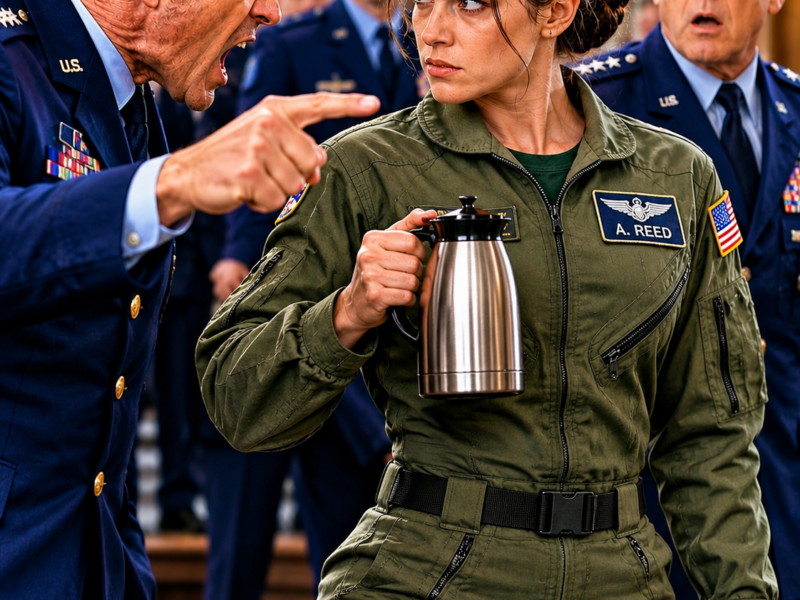
“You’re a pilot? Not in my dining hall. Now, serve the coffee.”
The room remained silent as General Morgan studied the document.
I could hear the air-conditioning humming above us.
Major Hayes stood beside the conference table, his hands resting against the back of an empty chair.
For the first time that morning, he didn’t look confident.
He looked cornered.
General Morgan turned the document toward the maintenance chief.
“Explain this entry.”
The chief leaned forward.
“This is a maintenance warning submitted eleven months ago. It involved a similar system discrepancy on Aircraft 48.”
“Was the warning resolved?”
“The flight was canceled, sir. The aircraft was supposed to undergo a full inspection before returning to service.”
“Did that inspection happen?”
The chief examined the supporting records.
“There’s no complete inspection report attached.”
Morgan looked at Hayes.
“Then why was the aircraft returned to the schedule?”
Hayes cleared his throat.
“General, I would need to review the circumstances.”
“You have the document in front of you, Major.”
“I understand, sir.”
“Then answer the question.”
Hayes glanced at the maintenance chief.
“The aircraft was released after the maintenance team reported the issue resolved.”
“Where is that report?”
“It may have been filed separately.”
Morgan leaned back.
“Then we’ll find it.”
He turned toward the room.
“Effective immediately, all aircraft with unresolved critical maintenance warnings remain grounded. No exceptions.”
The operations officer nodded.
“Understood, General.”
“Preserve every original report, electronic entry, approval, and communication related to these aircraft. I want the audit team involved before anyone touches the records.”
“Yes, sir.”
Morgan looked at me.
“Captain Carter, I want you on the readiness review team.”
I sat a little straighter.
“Sir?”
“You’re a pilot, and you identified a discrepancy that others overlooked. I need your operational assessment.”
“Am I participating as a pilot or as a witness?”
“Both, Captain.”
I nodded.
“Then I’ll accept, General. But I want the evidence to come first.”
A faint smile crossed his face.
“That’s exactly why I’m asking you.”
Major Hayes shifted behind his chair.
“General, with respect, Captain Carter has limited access to the maintenance administration system.”
“She won’t need unauthorized access. The audit team will provide the records she is cleared to review.”
Hayes pressed his lips together.
Morgan closed the folder.
“This review is no longer optional.”
I looked down at the document again.
Aircraft 48.
Eleven months earlier.
A canceled flight.
A missing inspection report.
And now, three aircraft with suspiciously similar records.
The problem was bigger than I had first realized.
After the briefing, I followed the maintenance chief to the records office.
His name was Chief Master Sergeant Robert Collins.
He had been working aircraft maintenance for more than twenty years, and he knew the difference between a routine paperwork delay and something that didn’t make sense.
He opened the original maintenance report for Aircraft 72.
“Here,” he said.
I leaned closer.
The warning had been entered by a technician named Staff Sergeant Marcus Bell.
The description was clear.
The system had shown a recurring fault.
The technician had recommended further inspection before the aircraft was released.
But several hours later, the status had changed to complete.
There was no corresponding inspection report.
“Can we see who made the change?” I asked.
“That’s what the audit team is tracing.”
“Was Bell interviewed?”
“Not yet.”
“Then we should speak with him.”
Collins nodded.
We found Bell in the maintenance hangar.
He was standing beside a tool cabinet, checking a list on his tablet.
When he saw Collins, he immediately straightened.
“Chief.”
“At ease, Sergeant. Captain Carter is assisting with the readiness review.”
Bell looked at me.
“Yes, ma’am.”
I introduced myself.
“We’re reviewing the original warning on Aircraft 72. I want to understand what you found.”
He hesitated.
“I submitted the report because the fault appeared more than once.”
“Did you complete the required inspection?”
“No, ma’am. I couldn’t close the discrepancy without further testing.”
“Then why does the system show it as cleared?”
“I don’t know.”
“Did anyone tell you to change the entry?”
“No.”
“Did anyone tell you the inspection had been completed?”
Bell shook his head.
“The system showed it as cleared the next time I logged in.”
I studied his expression.
“Did you report that?”
“I told my supervisor.”
“What did he say?”
“He said the system had been updated and that I should continue with my assigned work.”
“Did you keep a copy of your original report?”
Bell nodded.
“I saved the report before the status changed.”
He opened a folder on his tablet.
There it was.
The original warning.
The technician’s notes.
The recommendation for additional inspection.
And the timestamp showing when the report had first been submitted.
I compared it with the electronic closure.
The closure had been entered later.
But the inspection had never been documented.
“Sergeant, I need you to preserve this original report through the approved records process.”
“Yes, ma’am.”
“Don’t send it to anyone outside the review team.”
“Understood.”
As we left the hangar, Collins shook his head.
“I’ve seen mistakes in maintenance records. Everybody has. But three aircraft with the same kind of missing documentation?”
“That’s why we need the audit trail.”
He looked at me.
“Somebody is going to be unhappy.”
I glanced back toward the hangar.
“Someone already is.”
By midday, the audit team arrived.
They were led by Colonel Patricia Lawson, an officer from the wing’s independent compliance office.
She explained that the review would examine original entries, timestamps, access permissions, authorization sequences, and supporting maintenance documentation.
Nothing would be treated as proof of wrongdoing until it was independently verified.
I appreciated that.
A suspicious record wasn’t the same thing as a confirmed violation.
And I had no intention of accusing someone simply because their name appeared on a computer screen.
The first set of findings came in late that afternoon.
Colonel Lawson placed several printed records on the table.
“General, we’ve identified an irregular approval sequence.”
Morgan studied the documents.
“Explain.”
“These maintenance closures were entered after the original reports were submitted. The system shows that each approval passed through the same office.”
“Major Hayes’ office?”
“That’s the office associated with the access records. We are still verifying which authorized user completed each action.”
Hayes immediately responded.
“I followed every procedure.”
Lawson looked at him.
“Then the documentation should establish that.”
Hayes folded his arms.
“This was an administrative issue. Systems make mistakes.”
Morgan pointed toward the documents.
“Across three aircraft?”
“Possibly, sir.”
“Then explain this approval.”
Hayes leaned over the table.
He examined the timestamp.
“I don’t remember that specific entry.”
“That’s why we’re checking the audit trail,” Lawson replied.
Hayes straightened.
“I relied on my staff to process routine maintenance.”
“Then provide the records showing that the required inspections were completed.”
He didn’t answer immediately.
I watched him carefully.
His earlier confidence was gone.
But I also knew that the review had to remain fair.
A workstation could be accessed by more than one person.
An approval record could identify an account without proving who had physically used it.
The audit team needed to establish the facts.
General Morgan looked at Lawson.
“Continue tracing the authorization sequence. Preserve the original logs.”
“Yes, General.”
Then he turned to Hayes.
“Your authorization records require clarification. You will cooperate fully.”
“Of course, sir.”
The meeting ended.
But as the officers began leaving, Hayes approached me.
“Captain Carter.”
I turned.
“Sir?”
He lowered his voice.
“You seem very pleased with yourself.”
“I’m not pleased about any of this, Major.”
“You’ve made this personal.”
I shook my head.
“Flight safety isn’t personal.”
“You have no idea what you’re getting into.”
I met his eyes.
“Then explain the records.”
His jaw tightened.
“Watch your tone.”
“Watch the flight records, sir.”
Before he could respond, General Morgan’s voice came from behind us.
“That is enough, Major.”
Hayes stepped back.
Morgan looked directly at him.
“You will cooperate fully with the review. Your actions will be evaluated on the evidence.”
“Yes, General.”
I walked away.
For the first time, I understood that the coffee incident had never really been about coffee.
Hayes had wanted to put me in a position where nobody would listen to me.
He had tried to turn my uniform into a joke.
But the maintenance records were still there.
And the truth didn’t care who had poured the coffee.
The next morning, Colonel Lawson called the review team together.
She had received additional information from the audit specialists.
“Three aircraft have been confirmed with incomplete maintenance closure records,” she began.
“Have we identified who made the changes?” General Morgan asked.
“We’ve identified the accounts and workstations involved. We are now matching those records against individual access logs, authorization permissions, and duty assignments.”
She placed a second folder on the table.
“There’s also another issue.”
Morgan opened it.
“What is it?”
“One of the original maintenance warnings was entered by a technician who later reported that the discrepancy had not been resolved. The closure was entered after his report, without the required supporting inspection documentation.”
I recognized the technician’s name.
Staff Sergeant Bell.
“Has he provided a statement?” I asked.
“Yes. His statement matches the original report.”
Morgan looked at the next page.
“Any other witnesses?”
Lawson nodded.
“Lieutenant Reed reported that he raised concerns about the same aircraft before the scheduled flight.”
I glanced toward Reed.
He was sitting at the far end of the table.
His hands were clasped tightly.
General Morgan turned to him.
“Lieutenant, is that correct?”
“Yes, sir.”
“When did you raise the concern?”
Reed opened his notebook.
“Last Tuesday, sir. And again on Thursday.”
He handed the notebook to Lawson.
“I recorded both dates because I was concerned the original warning had disappeared.”
Lawson reviewed the notes.
“These dates correspond with the unresolved entries.”
Morgan nodded.
“Good. Include them in the formal review.”
Reed looked relieved.
I gave him a small nod.
He had been right to speak up.
And now his report was part of the official record.
The review continued for several days.
Every aircraft was checked against its maintenance history.
Every suspicious entry was compared with the original report.
Technicians were interviewed.
Supervisors were asked to explain missing documentation.
And the audit team followed the electronic trail.
What they discovered was worse than any of us had expected.
It wasn’t just Aircraft 72.
Three aircraft had similar record gaps.
Several maintenance warnings had been closed without the required supporting documentation.
Some entries had been changed after technicians had submitted reports recommending further inspection.
And the approvals all passed through the same department.
Major Hayes’ department.
When Colonel Lawson presented the findings, General Morgan listened without interrupting.
“Can we verify the user and authorization?” he asked.
“We can establish which accounts were used and which individuals had access. We’re still completing the final authentication.”
“How far back does the pattern go?”
“Almost a year.”
The general looked at the oldest report.
“Was an aircraft ever released with an unresolved discrepancy?”
“One flight was canceled after a separate concern was raised. The underlying documentation was never fully completed.”
“Who reviewed it?”
“The records list the same department.”
Hayes sat at the end of the table.
He looked tired.
“General, I want to clarify something. I did not personally inspect every aircraft. I relied on the maintenance staff and the administrative process.”
Morgan nodded.
“That is precisely what we are examining.”
“These systems are complicated. Entries can be delayed, duplicated, or incorrectly closed.”
“Then the audit will establish whether that happened.”
Hayes leaned forward.
“You’re treating this like misconduct before the review is complete.”
“I’m treating it like a serious safety concern.”
Morgan closed the folder.
“Until the evidence is verified, no one is being declared guilty. But no aircraft will be released simply because someone says the paperwork is complete.”
I looked at the records.
There were dozens of pages.
Every page represented a technician who had submitted a warning.
A supervisor who had reviewed it.
And a pilot who might eventually have trusted that the aircraft was safe.
A pilot could inspect instruments in the cockpit.
A pilot could run the required checks.
But a pilot couldn’t see every problem hidden inside an aircraft.
That was why the maintenance system had to be trustworthy.
And that was why falsifying a record, or approving work without proof it had been completed, could be so dangerous.
After the meeting, I walked outside.
Reed caught up with me near the operations building.
“Captain.”
I turned.
“How are you holding up, Lieutenant?”
He shrugged.
“I didn’t think it would become this serious.”
“Neither did I.”
He looked toward the flight line.
“Do you think they’ll blame us for making trouble?”
I considered his question.
“Some people may not like what we’ve reported. But we didn’t create the discrepancies. We reported them.”
He nodded.
“I was afraid to speak up at first.”
“I know.”
“What if Major Hayes had ended my career?”
I looked at him.
“Then he would have had to explain why a pilot was punished for reporting a safety concern.”
Reed smiled faintly.
“I wish I’d been that confident.”
“Confidence comes later. Sometimes you have to do the right thing while you’re still afraid.”
He looked down at his notebook.
“That’s what I’ll remember.”
I gave him a nod and continued toward the hangar.
That afternoon, the audit team confirmed an irregular approval sequence involving several maintenance closures.
They had not yet established who personally authorized every action.
But the pattern was strong enough to require formal explanations.
General Morgan requested that Hayes attend a recorded administrative review.
The major arrived carrying a folder.
He sat across from the general.
Colonel Lawson placed the verified records on the table.
“Major Hayes, did you personally authorize these maintenance closures?”
Hayes adjusted his uniform.
“I approved routine maintenance processing.”
“Did you verify that the required inspections were complete?”
“I relied on my staff.”
“Can you provide the supporting inspection records?”
“They should be in the system.”
“Some are missing.”
“Then there may have been an administrative issue.”
Lawson slid another document forward.
“This original warning remained unresolved when the closure was entered.”
Hayes looked at it.
“That doesn’t establish intent.”
“Correct,” Lawson replied. “Intent will be evaluated separately.”
Morgan leaned forward.
“Did you direct anyone to close a maintenance warning without the required inspection?”
“No, General.”
“Did you instruct anyone to alter a report?”
“Absolutely not.”
“Then we need the records and statements that support your account.”
Hayes nodded.
“I can provide them.”
Staff Sergeant Bell was called in to provide his statement.
He stood straight, visibly nervous.
“Sergeant, did you submit the original warning for Aircraft 72?” Lawson asked.
“Yes, ma’am.”
“Did you complete the required inspection?”
“No, ma’am. I couldn’t close it without further testing.”
“Did you authorize the closure?”
“No.”
“Did anyone tell you that the inspection had been completed?”
“No, ma’am.”
Hayes shifted in his chair.
“You may have forgotten a later instruction.”
Bell looked at him.
“With respect, sir, I stand by my signed statement.”
Lawson nodded.
“Your statement will be added to the record.”
General Morgan turned toward Hayes.
“Major, your authorization duties are suspended pending completion of this review.”
Hayes stood.
“General, I can explain.”
“You will have that opportunity through the proper process.”
“Sir, this is an administrative matter.”
Morgan’s expression hardened.
“Three aircraft, Major. Multiple unresolved warnings. Missing inspection records. This is not something we dismiss as paperwork.”
Hayes looked toward me.
For a moment, his expression seemed to ask why I hadn’t simply kept serving coffee.
I didn’t look away.
The meeting ended with the major escorted from the review room.
No one celebrated.
No one applauded.
The aircraft still needed inspection.
The technicians still had work to do.
And the pilots still needed to know they could trust the machines they were being asked to fly.
Later that evening, I returned to the maintenance hangar.
Jet 72 was parked inside.
Its engines were silent.
A maintenance team had begun the inspection required to identify the original discrepancy.
I stood beside the aircraft and looked at its tail number.
It was strange to think that a single warning, entered by a technician doing his job, had almost disappeared beneath layers of electronic approvals.
A voice came from behind me.
“Captain Carter.”
I turned.
General Morgan stood near the hangar entrance.
“General.”
He walked beside me.
“What are your thoughts?”
I looked at the aircraft.
“I think we were fortunate the warning was noticed before the flight.”
“Agreed.”
He paused.
“Do you think this is limited to the three aircraft?”
“I don’t know, sir. But I wouldn’t assume that until every relevant record has been checked.”
Morgan nodded.
“That’s the answer I expected.”
He looked toward the maintenance crew.
“Some of these people were afraid to speak up.”
“Yes, sir.”
“Why?”
I thought about the dining hall.
About Hayes telling me to serve coffee.
About Reed being silenced.
About Bell watching a warning disappear from the system.
“Because they believed their careers depended on staying quiet.”
Morgan looked at me.
“Then what’s the first thing you’d change?”
I considered the question carefully.
“Make it safe for people to tell the truth.”
“And after that?”
“Make sure somebody listens.”
He was quiet for a moment.
Then he nodded.
“Good answer, Captain.”
He handed me a folder.
“Headquarters wants a full review of every unresolved maintenance warning in this wing. I want you to help lead the pilot assessment portion.”
I opened the folder.
There were aircraft lists, review schedules, and instructions for evaluating operational risk.
“Sir, I can do that.”
“I also want your recommendations for a better reporting process.”
“Understood.”
He studied me.
“One more thing. You’re being considered for the Flight Safety Leadership Program.”
I looked up.
“General?”
“The selection board meets tomorrow. Your name is on the list.”
I wasn’t sure what to say.
“Thank you, sir.”
“Don’t thank me yet. You’ll have plenty of work to do.”
He gave a small smile.
“Your seat is waiting, Captain.”
I looked toward the aircraft.
For the first time since the dining hall, I felt something close to relief.
But the investigation wasn’t finished.
And I knew the most difficult part was still ahead.
The following morning, the independent audit team presented its authenticated findings.
Colonel Lawson stood at the front of the conference room.
“General, we’ve completed the initial review of the authorization records.”
Morgan nodded.
“Proceed.”
Lawson displayed a series of electronic entries.
“The audit confirms that several maintenance closures were processed through accounts assigned to Major Hayes’ department. The authorization sequence did not match the required inspection workflow.”
“Can we establish who entered them?”
“For the confirmed entries, yes. The access records, workstation logs, and duty assignments identify the user associated with each approval.”
She displayed another document.
“Several entries were processed using Major Hayes’ assigned credentials.”
The room became quiet.
Hayes was seated at the far end of the table with his representative.
He looked down at the document.
Lawson continued.
“The review also found that supporting inspection documentation was missing when those closures were entered. In several cases, the original technician reports remained open in the maintenance archive.”
Morgan folded his hands.
“Major Hayes, do you have an explanation?”
Hayes stood.
“General, I did not personally perform the inspections. I approved administrative processing based on information provided by my staff.”
“Did you use your credentials to approve the closures?”
“I don’t recall every specific entry.”
“The audit identifies your credentials.”
“I understand that, sir. But I did not knowingly authorize an unsafe aircraft to fly.”
Lawson replied carefully.
“Intent is a separate finding. The audit establishes that your credentials were used and that required supporting records were absent at the time of closure.”
Hayes looked frustrated.
“Then the system failed.”
Morgan’s voice remained calm.
“The system did not sign your approvals, Major. People did.”
Hayes sat down.
The general looked at Colonel Lawson.
“What’s the recommendation?”
“Maintain the suspension of his authorization duties. Refer the findings for the appropriate command and investigative review. Continue the fleet-wide inspection.”
“Approved.”
The meeting continued for another hour.
At the end, General Morgan stood.
“This review is larger than one officer. We need to understand how the process allowed these entries to pass without proper verification.”
He looked around the room.
“Every warning must be traceable. Every inspection must have supporting evidence. And no one should fear retaliation for reporting a safety concern.”
He turned toward me.
“Captain Carter, I want you to lead the pilot review panel.”
I nodded.
“I accept, General.”
“Your job is to examine the operational impact of every unresolved warning and ensure pilots have accurate information before they fly.”
“Understood, sir.”
“And Captain?”
“Yes, General?”
“Don’t let anyone turn this into a personal dispute.”
I met his eyes.
“I won’t, sir. The evidence comes first.”
He smiled.
“That’s why you’re the right person.”
Two days later, headquarters approved my selection for the Flight Safety Leadership Program.
I received the notification while reviewing aircraft readiness reports.
The message was short.
My selection had been approved.
I read it twice.
Then I looked across the office at Lieutenant Reed.
“What’s that?” he asked.
I turned the screen toward him.
His eyes widened.
“Captain, congratulations!”
I smiled.
“Thank you.”
He shook his head.
“After everything that happened, you really earned it.”
I thought about the coffee tray.
The laughter.
The order to stand by the door.
Then I thought about the maintenance technicians who had continued doing their jobs despite the pressure.
“I didn’t earn it by serving coffee,” I said.
Reed laughed.
“No, ma’am.”
“I earned it because I refused to ignore something that could hurt someone.”
That afternoon, General Morgan called me to his office.
He handed me my new appointment letter.
“Captain Emily Carter, Flight Safety Leadership Program.”
I signed it.
“Thank you, General.”
“You’ll be working with pilots, maintainers, and commanders. Your first task is to review how safety concerns are reported and escalated.”
I nodded.
“Then we need to make sure every report reaches someone who has the authority to act.”
“Exactly.”
He walked to the window.
Outside, aircraft were parked along the flight line.
“Captain, I want you to remember something. A good safety program isn’t measured by how many reports it closes.”
He turned toward me.
“It’s measured by whether people can trust the answers.”
I looked at the appointment letter.
“Understood, sir.”
Before I left, he added something I hadn’t expected.
“There’s another command decision being made today.”
“What decision?”
“Major Hayes is being formally relieved of his maintenance authorization responsibilities while the remaining proceedings continue. Headquarters will determine the next administrative action.”
I nodded.
“Yes, sir.”
“His position will be filled by an interim officer.”
“Who?”
Morgan paused.
“Colonel Rebecca Reed.”
I recognized the name.
She was an experienced fighter pilot and a former squadron commander.
But I hadn’t expected her to be connected to this review.
The general noticed my expression.
“You know her?”
“Only by reputation, sir.”
He smiled.
“Then you’ll have an opportunity to meet her.”
That evening, I walked into the flight operations building for the first safety leadership meeting.
A woman in a flight suit stood beside the conference table.
She turned when I entered.
“Captain Carter?”
“Yes, ma’am.”
She extended her hand.
“Colonel Rebecca Reed.”
I shook it.
“Good to meet you, Colonel.”
She studied my face for a moment.
Then she smiled.
“I’ve heard about you.”
I wasn’t sure how to respond.
“Hopefully, only the maintenance reports.”
She laughed.
“Those too.”
She pulled out a chair.
“Have a seat. We have a lot of work ahead of us.”
I sat down.
The conference room was full of officers, technicians, and safety specialists.
On the screen were the names of every aircraft still undergoing inspection.
The first task was simple.
Find every unresolved warning.
Verify every inspection.
Make sure no aircraft returned to service until it met every requirement.
But the larger task was more difficult.
We had to change the culture that had allowed people to believe silence was safer than honesty.
Colonel Reed looked around the room.
“I want every person here to understand something. Rank does not make an unsafe aircraft safe. A signature does not replace an inspection. And no one will be punished for reporting a genuine safety concern.”
She turned toward me.
“Captain Carter, would you like to explain why this matters?”
I stood.
I didn’t talk about Hayes.
I didn’t talk about the coffee.
I talked about the pilots who trusted maintenance records.
I talked about technicians who knew something was wrong but had been told the system showed it as cleared.
I talked about Lieutenant Reed, who had written down the dates of his reports because he was afraid they might disappear.
And I talked about Aircraft 72.
“Every time a pilot climbs into a cockpit,” I said, “they trust that the people behind the paperwork have done their jobs. They trust that a warning has been investigated, that an inspection has been completed, and that the aircraft is ready.”
I paused.
“If we break that trust, we put everyone at risk.”
Nobody interrupted.
“So our first responsibility is not to protect a schedule, a reputation, or an officer’s authority. It’s to protect the people who fly these aircraft.”
When I finished, Colonel Reed nodded.
“That’s where we begin.”
Over the next several weeks, the review expanded across the wing.
Every aircraft underwent a records check.
Every unresolved warning was examined.
Maintenance technicians received a clear process for escalating discrepancies.
Pilots were given a direct channel to report concerns without having to rely exclusively on their immediate supervisors.
The audit team also introduced independent verification for critical maintenance closures.
No one could simply mark a serious warning as resolved without the required inspection documentation.
The work was slow.
Some days, it felt like we were moving backward.
But the aircraft were safer.
And people were beginning to speak more openly.
Staff Sergeant Bell became one of the first technicians to brief the new maintenance reporting process.
Lieutenant Reed helped develop the pilot reporting guide.
Chief Collins volunteered to mentor junior maintainers.
And I spent most of my days reviewing reports, visiting hangars, and listening to people who had once been afraid to raise their voices.
One afternoon, I returned to the dining hall.
The same room.
The same long table.
The same polished coffee machine.
But this time, I was there for a safety leadership meeting.
General Morgan was already seated.
He looked up when I entered.
“Captain Carter. Your seat is ready.”
I smiled.
“Thank you, General.”
I sat down.
A young lieutenant entered carrying a tray of coffee.
He looked nervous.
I stood and took one of the cups from him.
“Thank you, Lieutenant.”
He looked surprised.
“You’re welcome, ma’am.”
I placed the cup on the table.
Then I looked around the room.
A few months earlier, this had been the place where someone tried to make me feel small.
Now it was simply a room where officers gathered to do their jobs.
I didn’t need an apology from every person who had laughed.
I didn’t need to prove that I was more important than anyone else.
I only needed to know that the next pilot would have a safer aircraft.
Before the meeting began, General Morgan leaned toward me.
“Captain, I received the final recommendation from headquarters.”
“Yes, sir?”
“The review confirms serious failures in the maintenance authorization process. Major Hayes will face the appropriate administrative proceedings.”
I nodded.
“And Colonel Reed?”
“She’s been appointed the new commanding officer.”
I looked up.
“Congratulations to her, sir.”
Morgan smiled.
“There’s one more thing.”
He lowered his voice.
“Colonel Reed requested that you serve as her flight safety adviser.”
I was surprised.
“Me?”
“She believes your experience is exactly what this wing needs.”
I looked across the table.
Colonel Reed had just entered.
She walked toward us and extended her hand.
“Captain Carter.”
“Ma’am.”
“Welcome aboard. I want you working directly with me.”
I shook her hand.
“Thank you, Colonel.”
She smiled.
“And I should tell you something.”
“What is it, ma’am?”
“Years ago, I was flying a mission with a damaged aircraft. Your calls helped us get home safely.”
I stared at her.
“Ma’am?”
“You were the wing pilot who stayed with us until we reached the tanker. I never forgot it.”
I finally remembered.
A mission years earlier.
A damaged aircraft.
A wingman who had been struggling to maintain formation.
I had done what any pilot would do.
“That was my job, ma’am.”
She nodded.
“And that’s exactly why I wanted you here.”
She took her seat.
The meeting began.
As the officers reviewed the next set of maintenance reports, I looked around the table.
There were no coffee trays.
No humiliating orders.
No one being told to stay quiet because of their rank.
There was just work to do.
And people who understood why it mattered.
I had once believed that respect came from the position printed on your uniform.
Now I knew better.
Respect came from what you did when speaking up was uncomfortable.
It came from doing the right thing when nobody was applauding.
And sometimes, it came from refusing to let a warning disappear simply because someone powerful wanted the schedule to stay on time.
I never forgot the morning Major Hayes handed me that coffee pot.
Not because it embarrassed me.
But because it reminded me how easily authority could be confused with leadership.
He had looked at my uniform and seen someone he could order around.
He hadn’t looked at the maintenance reports.
He hadn’t listened to the technicians.
And he hadn’t understood that the captain standing in front of him was the same pilot who had once brought two damaged aircraft safely home.
But the general had remembered.
And the people who mattered most had eventually listened.
As for Aircraft 72, it did not return to flight until the required inspections were completed and independently verified.
The other affected aircraft underwent the same process.
The flight schedule changed.
Several missions were delayed.
Some people complained.
But every pilot who eventually took off knew the aircraft had been properly cleared.
That was worth more than any schedule.
One morning, I stood beside the runway and watched Aircraft 72 taxi toward the departure point.
Its pilot gave a brief salute.
I returned it.
The aircraft accelerated and lifted into the sky.
I watched until it disappeared into the clouds.
Then I turned toward the hangar.
There would be more reports.
More difficult conversations.
More moments when someone would have to decide whether to speak up.
But that was the work.
And I was ready.
Because I had learned something that day in the dining hall.
A coffee pot could be used to humiliate a captain.
A rank could be used to silence a lieutenant.
A computer system could be used to hide an unresolved warning.
But none of those things could change the truth.
And the truth, when properly documented and courageously reported, could save lives.
I adjusted my flight jacket and walked toward the operations building.
For the first time in a long time, I wasn’t worried about who might be watching.
I knew exactly where I belonged.
Not at the head of a dining table.
Not behind a coffee pot.
But wherever someone needed the courage to ask one more question before an aircraft took off.
The End.









