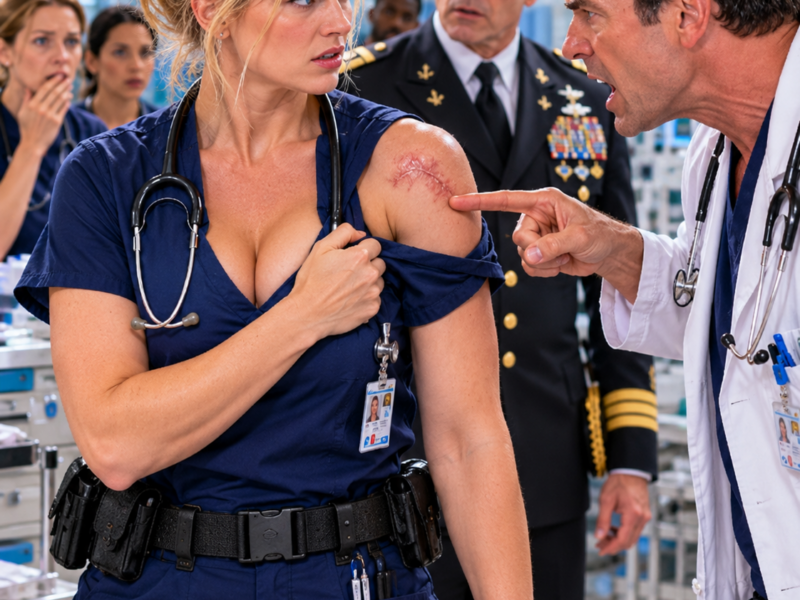
“‘You are just ER staff. Get me a competent surgeon!’ the Navy commander shouted, loud enough for the entire trauma bay to hear
Jonathan’s question hung between us.
“Do you know what Liam has been trying to tell you for six years?”
I stared at him.
“No,” I said quietly. “I thought he was gone.”
Jonathan’s face crumpled.
“He isn’t.”
For a moment, I forgot how to breathe.
“What?”
“My brother survived, Abigail. He lost a lot that day, but he survived.”
I gripped the edge of the chair beside me.
“Are you sure?”
Jonathan nodded. His eyes were wet.
“His femoral artery was nearly severed. He lost an enormous amount of blood. The doctors told us he might not make it through the first night. But he did.”
I closed my eyes.
Six years.
Six years of remembering a young Marine lying in the dirt, his face gray, his hand trembling in mine.
Six years of wondering whether the helicopter had reached him in time.
And all that time, he had been alive.
“Why didn’t anyone tell me?” I whispered.
“We didn’t know who you were,” Jonathan replied. “The report listed you as an unidentified female combat medic attached to the operation. Your unit was transferred. Your name wasn’t included in the information Liam received.”
I looked down at my shoulder.
The scar had faded around the edges, but I could still feel the sting of that day whenever the weather changed.
“I never expected a thank-you,” I said.
“I know. But Liam did expect to find you.”
Jonathan slowly stood.
“He searched for years. He contacted military offices, old commanders, medical units. He even wrote letters to people who had no idea who he was talking about. All he had was a description of a woman with a damaged shoulder who refused to let him die.”
My throat tightened.
“What happened to him?”
Jonathan hesitated.
“He uses a wheelchair. The injury to his leg was too severe. There were complications during recovery, and he never regained full use of it.”
I swallowed.
“I’m sorry.”
“Don’t be.” Jonathan shook his head. “He built a life. He works in intelligence at Naval Station Norfolk now. He’s married. He has a little girl.”
A small, disbelieving laugh escaped me.
“He has a daughter?”
“Three years old.”
Jonathan smiled through his tears.
“Her name is Abigail.”
I pressed my hand over my mouth.
For six years, I had carried the memory of that Marine as a wound I couldn’t close.
And somewhere, he had been carrying my name.
Before I could respond, a sharp alarm sounded from the intensive care unit.
A nurse rushed through the waiting room doors.
“Dr. Miller! We need you in bed four!”
Jonathan turned immediately.
“Connor?”
The nurse nodded.
“His blood pressure is dropping. He’s deteriorating.”
My heart sank.
I was moving before anyone could say another word.
“What’s his oxygen saturation?”
“Eighty-two and falling.”
I hurried into the unit.
Connor lay motionless beneath the bright lights, his ventilator delivering measured breaths. His monitor showed a dangerously rapid heart rate. His blood pressure was barely registering.
Dr. Harrison Miller stood beside the bed, studying the monitor.
“What changed?” I asked.
“Sudden hypotension. Oxygen saturation dropping despite increased support.”
I moved to the bedside.
Connor’s neck veins were distended. His chest wasn’t rising evenly. When I listened, one side was nearly silent.
My stomach tightened.
“Doctor, I’m concerned about a tension pneumothorax.”
Dr. Miller looked at me, then at Connor.
“Get respiratory therapy here. Now.”
I reached for the chart while another nurse checked the ventilator connections.
The signs were becoming unmistakable.
A tension pneumothorax could trap air in the chest, compress the lung, and prevent the heart from filling properly. With every assisted breath, the pressure could become worse.
Connor was running out of time.
Dr. Gregory Trenton, the resident physician, hurried into the room.
“What happened?”
“Possible tension pneumothorax,” Dr. Miller said. “Prepare for emergency decompression and chest tube placement.”
Dr. Trenton glanced at the monitor.
“We need imaging first.”
“We don’t have time for imaging if this is tension physiology,” I said.
He looked at me sharply.
“I’m aware of that. Let the physicians handle it.”
I didn’t argue.
I didn’t need to.
Dr. Miller was already making the decision.
“Prepare the emergency equipment,” he ordered. “Now.”
The room became a blur of movement.
I helped position Connor while the respiratory therapist adjusted the ventilator. Dr. Miller performed the emergency decompression, and a sudden rush of trapped air escaped.
Within moments, the pressure began to improve.
“Pulse is coming back,” someone called.
The monitor continued to flash, but Connor’s circulation was recovering.
“Blood pressure is rising.”
I let out a breath I hadn’t realized I was holding.
Dr. Trenton prepared for the chest tube while Dr. Miller remained at the bedside.
“Good catch, Abigail,” Dr. Miller said.
I kept my eyes on Connor.
“He wasn’t breathing right.”
“That’s why we have people watching every detail.”
I glanced toward the doorway.
Jonathan stood there, one hand gripping the frame. His face had gone pale again.
He had watched me recognize the danger.
He had watched the team act.
And he had watched his godson come back from the edge.
When the immediate crisis was under control, Dr. Miller turned toward him.
“Commander, Connor is responding to treatment. He’s not out of danger, but we’ve stabilized him.”
Jonathan nodded slowly.
“Thank you.”
His eyes shifted to me.
“And thank you, Abigail.”
I adjusted Connor’s blanket.
“Save your thanks until he wakes up.”
Jonathan gave a small nod.
For once, he didn’t argue.
The next several hours passed slowly.
Connor remained in the ICU, sedated and ventilated while the doctors monitored his lungs, abdominal injuries, and blood loss. His condition was still serious, but his blood pressure held steady.
I stayed involved in his care until the day shift took over.
When I finally stepped away, my feet hurt, my back ached, and my shoulder felt as though someone had driven a nail through the old scar.
Brenda, the charge nurse, caught me near the medication station.
“You look like you’ve been through a war.”
I gave her a tired smile.
“Some days, it feels like I never left one.”
She studied my face.
“Are you okay?”
I wanted to say yes.
Instead, I told her the truth.
“I just found out someone I thought I lost is alive.”
Brenda’s expression softened.
“Then I hope you get to see him.”
I nodded, unable to say more.
My phone vibrated inside my locker.
A message from an unfamiliar number appeared.
Abigail, this is Jonathan Pierce. Liam is on his way. He insisted on coming as soon as he heard you were here.
I read it twice.
Then a second message arrived.
He wants to thank you himself.
I sat down on the bench.
My hands were shaking.
I had treated hundreds of patients over the years. I had held strangers’ hands as they took their last breaths. I had delivered terrible news to families and celebrated recoveries that once seemed impossible.
But I didn’t know what to do with the possibility of seeing someone I had left behind in a war zone.
What if he remembered me differently?
What if he blamed me for not staying?
What if the person I remembered no longer existed?
I stared at the message until the screen dimmed.
Then I put the phone away and returned to work.
Because patients didn’t stop needing help just because your heart was breaking.
The sun was beginning to rise when I finally reached the hospital lobby.
Morning light spilled through the tall windows, turning the polished floor pale gold. People moved through the entrance with coffee cups, backpacks, and tired expressions.
For everyone else, it was just another morning.
For me, it felt like the world had quietly changed overnight.
Jonathan stood near the reception desk.
He was no longer wearing the same rigid expression I’d seen when he first entered the trauma bay. His shoulders had relaxed, and his eyes looked exhausted.
When he saw me, he stepped forward.
“He’s here,” he said.
My stomach tightened.
“Liam?”
Jonathan nodded.
“He’s in the lobby.”
I followed his gaze.
Near the entrance, a man sat in a wheelchair.
He wore dark trousers, a navy sweater, and a simple watch. His hair was shorter than I remembered, with a little gray near the temples.
His face was older.
Of course it was.
Six years had passed.
But I recognized his eyes immediately.
They were the same eyes that had looked up at me through dust and smoke, frightened but stubbornly determined to stay alive.
His hands rested on the wheels of his chair.
When he saw me, he stopped moving.
For several seconds, neither of us spoke.
Then he whispered:
“Angel?”
The word broke something inside me.
I took one step.
Then another.
“Liam.”
His eyes filled.
“You’re real.”
I laughed through the tears gathering in my own eyes.
“So are you.”
He reached toward me.
I dropped to my knees in front of his wheelchair and took his hands.
They were warm.
Alive.
I had remembered those hands covered in dust and blood. I had remembered how tightly he had held mine when I told him the helicopter was coming.
Now they were holding me.
“I thought you died,” I whispered.
Liam shook his head.
“I thought I’d never find you.”
I couldn’t hold back anymore.
I leaned forward, and he wrapped his arms around me as tightly as he could.
We cried there in the middle of the lobby, surrounded by people who had no idea why two strangers were holding each other like they had just been given their lives back.
“I tried,” Liam said against my shoulder. “I tried for six years.”
“I didn’t know.”
“I know. They couldn’t find your name. I kept telling them there was a woman who saved me. Nobody knew who I meant.”
I pulled back enough to look at him.
“You don’t owe me anything.”
He gave a quiet, disbelieving laugh.
“That’s exactly what I expected you to say.”
His eyes moved to my left shoulder.
“The scar.”
I touched it instinctively.
“Still there.”
“I remember when you got hit. You didn’t even look at it.”
“I had other things to worry about.”
“You were bleeding through your uniform.”
“So were you.”
He smiled, but his expression soon grew serious.
“I remember your voice,” he said. “You kept telling me to look at you. You told me I wasn’t allowed to close my eyes.”
“I was trying to keep you awake.”
“You told me my brother would be furious if I died before he could yell at me again.”
I laughed.
“That sounds like something I would say.”
“It worked.”
He squeezed my hands.
“Abigail, I never got to tell you what happened after the helicopter took me. I woke up in Germany. I had surgeries, infections, months of rehabilitation. There were days when I didn’t think I’d ever leave the hospital.”
I listened without interrupting.
“But I kept thinking about you,” he continued. “I kept thinking that someone had been willing to risk everything for a stranger. I wanted to know your name. I wanted to tell you that I made it.”
His voice cracked.
“And I wanted you to know that what you did mattered.”
I bowed my head.
For years, I had told myself that the work was finished when the helicopter disappeared into the sky.
I had never imagined that one day the person inside it would come back to tell me the rest of the story.
“I’m glad you’re here,” I whispered.
Liam smiled.
“I’m glad you’re here too.”
Jonathan approached us slowly.
“I think I owe you both some time,” he said.
Liam glanced at his brother.
“You definitely owe her an apology.”
Jonathan lowered his head.
“I’ve already started.”
Liam looked at me.
“What happened?”
I gave him a small smile.
“Your brother thought I was just ER staff.”
Liam’s expression changed.
He turned toward Jonathan.
“You said that to her?”
Jonathan looked genuinely ashamed.
“I did.”
Liam shook his head.
“She’s the reason I’m alive.”
“I know that now.”
“You should have known better than to judge someone by their uniform.”
Jonathan accepted the words without defending himself.
“You’re right,” he said. “I was frightened. Connor is like a son to me, and when I saw him injured, I lost control. But that doesn’t excuse what I said or how I treated her.”
He turned to me.
“Abigail, I spent years telling people how extraordinary the medic was who saved Liam. Then I stood in front of you and treated you as if your work meant nothing. I can’t undo that.”
I looked at him.
“Then don’t.”
He seemed surprised.
“Don’t?”
“Don’t spend the rest of your life apologizing. Just remember this the next time someone in scrubs tells you something is wrong. Listen to them.”
Jonathan nodded.
“I will.”
Liam gave his brother a pointed look.
“You’d better.”
For the first time since the previous night, I smiled without forcing it.
A little later, we moved to a quieter seating area near the windows.
Liam told me about his life.
He had married a woman named Claire, whom he met during rehabilitation. She had been working with a veterans’ support organization when they first spoke.
“She didn’t fall in love with the uniform,” he said with a grin. “She fell in love with the stubborn man who kept refusing to use the accessible entrance because he thought he could manage the stairs.”
I laughed.
“That sounds exhausting.”
“You have no idea.”
He showed me a photograph on his phone.
A little girl with bright eyes and a wide smile stood in a garden, holding a stuffed rabbit.
“That’s Abigail,” he said.
I stared at the picture.
“She’s beautiful.”
“She asks about you.”
I looked up.
“What?”
“Not you personally. She knows the story. We told her that a brave woman helped Daddy come home. When we decided on her name, Claire said it should be Abigail.”
My eyes filled again.
“I don’t know what to say.”
“Then don’t say anything. Just know that your name is part of our family.”
I looked at the little girl again.
There was something extraordinary about realizing that a moment of terror and bloodshed had somehow continued into a child’s laughter.
A life had grown from the day I thought I had lost one.
“Will I get to meet her?” I asked.
Liam smiled.
“That’s why I came. Claire and Abigail are waiting at home. I told them I had to come here first.”
“Why?”
“Because I wanted to thank you before I did anything else.”
I squeezed his hand.
“You don’t have to thank me.”
“I know.”
He looked at me steadily.
“But I want to.”
A nurse appeared near the entrance to the seating area.
“Abigail? Dr. Miller asked me to let you know that Lieutenant Bradley is awake.”
I stood immediately.
“Awake?”
“He’s responding to commands. They’re reducing his sedation, and his condition has improved.”
I looked at Liam.
“That’s wonderful.”
He smiled.
“Go. Someone needs you.”
I hesitated.
“I don’t want to leave you.”
Liam laughed softly.
“Abigail, I’ve waited six years. I can wait another hour.”
Jonathan stepped forward.
“I’ll stay with him.”
Liam rolled his eyes.
“Unfortunately.”
Jonathan gave him a tired smile.
“It’s good to see you too.”
I touched Liam’s shoulder.
“I’ll come back.”
“I know you will.”
I walked toward the ICU, feeling something I hadn’t felt in years.
Not relief alone.
Not happiness alone.
Something deeper.
The sense that a chapter of my life had finally been allowed to close.
Connor was awake when I entered the room.
His eyes moved slowly around the unfamiliar surroundings before settling on me.
“Hey, Lieutenant,” I said gently. “Welcome back.”
He tried to speak, but the breathing tube made it impossible.
“Don’t fight it. You’re safe. The doctors are taking care of you.”
His eyes widened slightly.
I explained that he had undergone emergency surgery, that his spleen had been removed, and that the team had treated the injuries to his liver and chest.
He listened, blinking slowly.
Then he raised one hand.
I moved closer.
He pointed toward his throat, then toward the tube.
“I know,” I said. “The doctors will remove it when it’s safe. For now, let the ventilator help you.”
He seemed frustrated.
I placed my hand gently over his.
“You’ve made it through a lot already. Don’t rush.”
A moment later, Dr. Miller entered and checked Connor’s progress.
“Looking much better,” he said. “We’ll continue monitoring him closely.”
Connor’s eyes shifted toward the doorway.
“Your commander has been here,” I told him. “He’s been worried sick.”
Connor managed a faint expression that might have been a smile.
“He’ll probably tell you about it for the next twenty years,” I added.
Dr. Miller chuckled.
“That’s a conservative estimate.”
I left Connor resting comfortably.
His recovery would take time. There would be pain, rehabilitation, and difficult conversations ahead. But he was alive, and for now, that was enough.
By the time my shift ended, the hospital was fully awake.
I returned to the lobby and found Liam still sitting near the windows.
Jonathan was beside him, holding two cups of coffee.
“You’re still here,” I said.
Liam looked offended.
“I told you I could wait.”
Jonathan handed me a cup.
“Coffee?”
“Please.”
I sat beside them.
For a while, none of us said much.
We watched the morning traffic move beyond the glass doors. A child hurried past with a backpack. A hospital volunteer pushed a cart of flowers toward the elevators.
Ordinary things.
Beautiful things.
Liam eventually broke the silence.
“So, what happens now?”
I looked at him.
“Now?”
“Now that you’ve found out I survived. Now that I found you.”
I thought about the question.
For years, I had kept my past locked away. I rarely spoke about Afghanistan. I didn’t tell coworkers why certain sounds made me tense or why I always noticed the exits in a crowded room.
I had built a life around caring for people, but a part of me had remained on that dusty road outside Marjah.
“I don’t know,” I admitted.
Liam nodded.
“That’s okay.”
“I spent a long time thinking that the people I couldn’t save were the only ones who remembered me.”
He listened.
“I never thought someone I helped could remember me too.”
Liam’s eyes softened.
“Then maybe it’s time you stopped carrying all of it alone.”
I looked down at the coffee in my hands.
“I don’t know if I can.”
“You don’t have to do it all today.”
Jonathan leaned forward.
“Liam is right. And if you ever want to speak with him again, or with me, you have our numbers.”
He placed a small card on the table.
“My personal contact information. Not the office.”
I picked it up.
“Thank you.”
He hesitated.
“There is one more thing.”
I looked at him.
“Whatever recognition you received in the military, whatever was written in your records, I want to make sure your service is acknowledged properly. You deserve that.”
I shook my head.
“I don’t need a ceremony.”
“I understand. But acknowledgment isn’t always about ceremonies. Sometimes it’s about making sure the truth is recorded.”
I considered that.
For a long time, I had been comfortable with the idea that my work would remain unseen.
But perhaps being seen didn’t have to mean being celebrated.
Perhaps it simply meant that the people who came after me would know what had happened.
“Then make sure the record is accurate,” I said. “That’s all I ask.”
Jonathan nodded.
“I can do that.”
A few days later, Connor was breathing on his own.
He was still weak, and the doctors had a long recovery plan ahead of him. But he was awake, talking, and asking when he could call his family.
When I visited, he looked at me with a serious expression.
“I’m told you saved my life twice.”
I pulled up a chair.
“Your doctors and nurses saved your life. I was one part of the team.”
He shook his head.
“Commander Pierce told me what happened.”
I smiled faintly.
“Then he probably told you too much.”
“He said he owes you an apology.”
“He already gave me one.”
Connor looked toward the window.
“He’s been worried about me since I was a kid. My parents trusted him to look after me. I guess he panicked.”
“I understand being frightened,” I said. “I don’t excuse treating people badly because of it.”
Connor nodded.
“That’s fair.”
He looked back at me.
“Thank you, Abigail.”
I held his gaze.
“Focus on getting better, Lieutenant.”
“I will.”
As I stood to leave, he called after me.
“Hey, Nurse Hayes?”
I turned.
“Yeah?”
“I’m glad you were there.”
I smiled.
“So am I.”
Two weeks later, I received a package at the nurses’ station.
There was no expensive wrapping or official seal. Just a small brown box with my name written across the top.
Inside was a photograph.
Liam stood beside Claire, one arm around her, while their little girl sat on his lap. They were smiling in front of a modest house with a bright blue door.
On the back, Liam had written:
To the woman who gave me another chance to come home. You saved more than my life. You gave me the chance to meet my daughter, love my wife, and become the man I am today. I will never have enough words to thank you.
Beneath the message was a smaller line.
Abigail keeps asking when she gets to meet her namesake.
I laughed, then wiped my eyes.
A second item rested at the bottom of the box.
A little drawing.
Three stick figures stood beneath a yellow sun. One had long hair. One sat in a wheelchair. The smallest held both their hands.
Above them, in uneven letters, was written:
MY DADDY’S ANGEL.
I pressed the drawing against my chest.
For years, I had thought the scar on my shoulder was the only thing that day had left behind.
Now I understood that it had left something else.
A family.
A future.
A little girl who knew my name.
That weekend, I drove to Liam’s house.
Claire opened the door before I could knock twice.
“Abigail?”
I smiled nervously.
“Hi.”
She immediately pulled me into a hug.
“Thank you for coming. Liam has talked about you for years.”
From inside the house, I heard a familiar voice.
“Is that her?”
Liam appeared in the doorway.
“About time.”
I laughed.
“You said I could come whenever I wanted.”
“And I meant it.”
A little girl peeked around his wheelchair.
She had bright eyes and a small pink ribbon in her hair.
Liam leaned toward her.
“Abigail, this is Abigail.”
The little girl looked at me, then at her father.
“Daddy’s angel?”
My throat tightened.
Liam nodded.
“That’s right.”
She walked over and held out a small stuffed rabbit.
“For you.”
I crouched to accept it.
“Thank you. He’s beautiful.”
“He’s a girl,” she corrected me seriously.
I laughed.
“I’m sorry. She’s beautiful.”
The little girl giggled.
Then she reached out and touched the scar near my collarbone.
“Does it hurt?”
I glanced at Liam.
He smiled gently.
“Sometimes,” I answered. “But not all the time.”
She thought about that.
Then she leaned forward and wrapped her small arms around my neck.
I closed my eyes.
There was no battlefield.
No gunfire.
No screaming.
Just a little girl holding me as if she had known me forever.
And for the first time in six years, the memory of that day didn’t end with a helicopter disappearing into the sky.
It ended here.
In a warm living room.
With laughter from the kitchen, Liam teasing his brother over the phone, and a little girl sitting beside me, showing me every drawing she had made.
That evening, after I returned home, I stood in front of the bathroom mirror.
The scar was still there.
Jagged.
Uneven.
Impossible to erase.
For a long time, I had seen it as proof of what war had taken from me.
Now I saw something different.
It reminded me of a young Marine who had survived.
Of a brother who had finally learned to say thank you.
Of a child who had been named after someone she had never met.
And of the woman I had become.
I was still a trauma nurse.
I still worked long shifts, still ran toward alarms, still held frightened hands beneath harsh hospital lights.
I was still the soldier who had once crawled through dust and smoke to reach a wounded man.
Those parts of me had never been separate.
They had always belonged to the same person.
The next morning, I returned to Santara Norfolk General.
At the entrance to the ICU, I paused for a moment.
A monitor sounded somewhere down the hall. A nurse hurried past with a chart. Someone called for a doctor.
The familiar rhythm of the hospital surrounded me.
I adjusted my badge and walked inside.
There would always be another patient who needed help.
Another family waiting for news.
Another moment when the difference between fear and hope came down to whether someone noticed the smallest change.
But I no longer felt as though I was carrying every unfinished story alone.
Somewhere in Norfolk, Liam was having breakfast with his wife and daughter.
Connor was beginning the long road to recovery.
Jonathan was learning that respect was something he needed to show before he knew someone’s history.
And I was finally allowing myself to remember that I had not only been there for the wounded.
I had been part of what came after.
I had saved a life.
That life had grown into a family.
And six years later, that family had found its way back to me.
The scar on my shoulder would always remain.
But it no longer felt like a wound that had never healed.
It felt like a reminder that even in the darkest place, one act of courage could travel farther than we would ever know.
The End.









