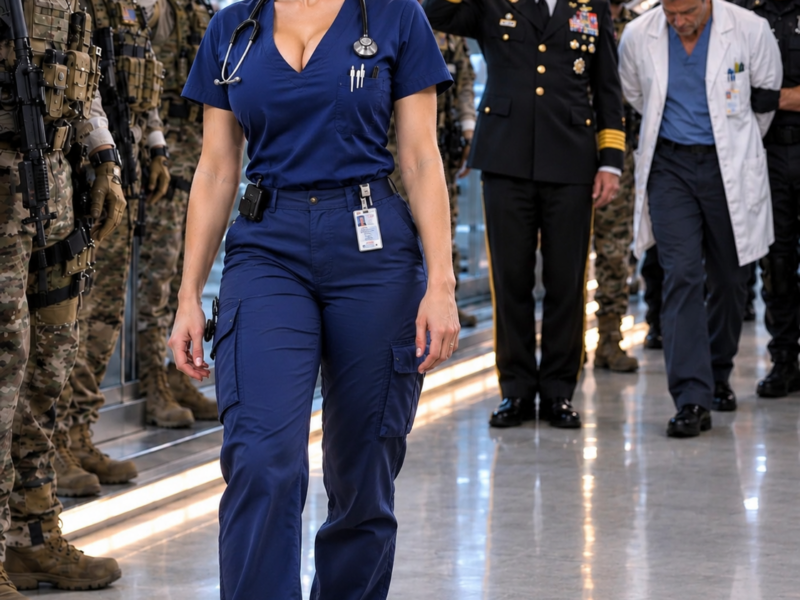
“‘Who performed emergency surgery on my sniper in complete darkness?’
Daniel Cross opened his eyes, looked straight at General Harrington, and whispered, “You’re asking the wrong question, sir. The man you buried is the only reason I’m still alive.”
For several seconds, nobody moved.
The heart monitor continued its steady rhythm. Dr. Bennett stood beside the operating table, his gloves stained with blood. Two nurses waited near the medication cart, and the security officer at the doorway had one hand resting against his belt.
General Harrington stared at Daniel.
“Who are you talking about?”
Daniel swallowed. His throat was raw from the breathing tube.
“Major Ward.”
I felt the room tilt.
I had spent seven years convincing myself that Elias Ward was dead.
Not missing.
Not captured.
Dead.
I had seen the official report. I had attended the memorial. I had stood beside an empty flag-draped coffin while men who barely knew him told me how brave he had been.
And now a wounded sniper was telling a four-star general that Ward was alive.
“Everyone out,” Harrington ordered.
Dr. Bennett stepped forward. “General, this is a hospital. My patient is not leaving my care, and neither is his medical team.”
“I said everyone out.”
“And I heard you,” Bennett replied. “But Sergeant Cross nearly died on my table. If you want to question him, you can do it with his physician present.”
The general’s eyes moved to me.
“Rebecca Hayes. You and I need to talk.”
I looked at Daniel.
His fingers were still wrapped around the torn black fabric.
The letters RAV were visible between his knuckles.
“I’m not leaving him,” I said.
Harrington’s jaw tightened.
“Then you may be making a serious mistake.”
I had heard that tone before.
Seven years earlier, Elias had used almost the same words when he told me not to board the helicopter.
I had ignored him.
I had regretted it every day since.
“General,” I said, “if Major Ward is alive, I want to hear it from someone who can prove it.”
Harrington looked toward the security officer.
“Secure the hallway. Nobody enters or leaves without authorization.”
That was when I noticed the officer wasn’t watching the general.
He was watching Daniel.
And his hand had moved from his belt to the radio clipped against his shoulder.
Something was wrong.
I leaned closer to Daniel.
“Who gave you the fabric?”
His eyes shifted toward the doorway.
“He did.”
“Who?”
Daniel struggled to raise his hand.
“Ward.”
I looked at the torn cloth again.
The fabric was old, frayed along one edge, and darkened by something that might have been dirt or dried blood.
I recognized the stitching.
It came from the inside of Elias’s field jacket.
I had repaired that jacket myself during a deployment in Afghanistan. The small embroidered mark beneath the collar had been our team’s unofficial identifier.
RAVEN.
Only six people knew about it.
Three were dead.
One was missing.
One was standing in front of me wearing a general’s uniform.
And I was the sixth.
“Rebecca,” Harrington said quietly, “you need to understand that some things are classified for a reason.”
“Then explain why a dead man is sending messages through my emergency room.”
His expression changed.
Not surprise.
Recognition.
He knew exactly what I was talking about.
Before he could answer, Dr. Bennett’s monitor alarm sounded.
Daniel’s blood pressure was falling.
I turned immediately.
“His pressure is dropping. Get another unit of blood ready.”
Bennett moved to the bedside.
“Cross, stay with us.”
Daniel’s eyes fluttered.
I checked the surgical dressing and saw fresh blood spreading beneath it.
The vessel we had repaired was holding, but something else was wrong.
“Get the portable ultrasound.”
Bennett examined the screen.
“There’s fluid collecting.”
“Not from the repair,” I said. “Look lower.”
He adjusted the probe.
A second pocket of blood appeared near Daniel’s left flank.
My stomach tightened.
“There’s another injury.”
We had missed it because the first wound had been so catastrophic.
Bennett looked at me.
“Can we take him back?”
“We have to.”
The general stepped closer.
“How long?”
“As long as it takes.”
“Doctor, I need him conscious.”
I turned toward Harrington.
“Then you should have brought him here before he was bleeding out.”
Bennett almost smiled.
“Let’s move.”
The next forty minutes passed in a blur of bright surgical light, clipped instructions, and the relentless rhythm of the monitor.
This time, I didn’t have to guess.
The ultrasound had shown us where to look.
We found a second fragment lodged near the left kidney, damaging a small artery. It had been hidden beneath a fold of injured tissue.
Bennett controlled the bleeding while I assisted with exposure and suction.
When the fragment came free, I noticed something strange.
It wasn’t ordinary shrapnel.
It was a narrow piece of machined metal with a tiny groove running along one side.
I had seen something like it before.
Seven years ago.
On the night Elias Ward disappeared.
My hand stopped.
“Rebecca?” Bennett said.
I forced myself to move.
“Nothing. Keep going.”
But it wasn’t nothing.
I remembered the explosion outside the forward medical station. The lights had gone out. The radio had filled with static. Then someone had shouted that the extraction route was compromised.
Elias had pushed me behind a concrete barrier.
I remembered the flash.
I remembered the smoke.
I remembered waking up in a helicopter with blood on my sleeves and no memory of how I got there.
And I remembered the official explanation:
A secondary explosion had killed Major Elias Ward and destroyed all recoverable remains.
But there had never been remains.
Only a report.
When Daniel was finally stable, Bennett ordered him transferred to the intensive care unit.
The general waited outside the operating room.
He looked older now.
“Where did you see that kind of fragment?” he asked.
I removed my gloves.
“Seven years ago.”
“That’s impossible.”
“You keep using that word.”
Harrington glanced toward the nurses’ station.
“Not here.”
“Then where?”
“There’s a secure room downstairs.”
“No.”
His eyes narrowed.
“Excuse me?”
“You can talk to me here, with Dr. Bennett and hospital security present. I’m done walking into rooms because someone with more stars on his shoulders tells me to.”
For a moment, I thought he might order the guards to take me.
Instead, he exhaled.
“Your instincts haven’t changed.”
“Neither have the people who keep asking me to ignore them.”
He lowered his voice.
“Elias Ward was assigned to a mission that officially never existed. The operation involved recovering a source from an unauthorized detention site. The source had information about a program operating inside our own command structure.”
“What program?”
“An intelligence extraction network. Prisoners were being moved between facilities without proper records. Some were listed as transferred. Others were listed as dead.”
I stared at him.
“And Elias found out?”
“He found evidence.”
“Then why was he declared dead?”
“Because the people responsible believed he had been killed during the extraction.”
“Did they believe it, or did they want everyone else to believe it?”
Harrington didn’t answer.
That silence told me more than any classified briefing could have.
“Where is he?” I asked.
“I don’t know.”
“You’re a four-star general. Don’t tell me you don’t know.”
“I know he was alive when Daniel last saw him.”
My throat tightened.
“When?”
“Three nights ago.”
I stepped closer.
“Three nights?”
Harrington looked away.
“Daniel was part of a surveillance team tracking a shipment connected to the old program. They were ambushed. Ward got him out, but he couldn’t reach the extraction point.”
“Where is Elias now?”
“We believe he’s still inside the facility.”
“What facility?”
“I can’t tell you until I know who else is listening.”
I glanced toward the hallway.
The security officer was gone.
I hadn’t heard him leave.
“Where is your guard?” I asked.
Harrington turned.
His expression changed instantly.
He reached for his radio.
“Security, this is General Harrington. Report.”
Static answered.
He tried again.
Nothing.
Then the ICU doors opened.
A nurse hurried toward us.
“Dr. Bennett? Sergeant Cross is asking for Rebecca.”
I moved immediately.
Daniel was awake, pale and sweating beneath the hospital blanket.
His eyes found mine.
“Did you talk to him?”
“I did.”
“Don’t trust him.”
The general entered behind me.
“Cross, you need to conserve your strength.”
Daniel gave a weak, bitter laugh.
“That’s what you told Ward.”
Harrington froze.
“What did you say?”
Daniel struggled to breathe.
“You gave him the route.”
The room became silent.
I looked from Daniel to the general.
“What route?”
Daniel closed his eyes.
“The extraction route. The one that was supposed to get us out.”
Harrington stepped closer.
“Sergeant, you’re confused.”
“No.” Daniel’s voice was barely audible. “I saw the transmission.”
I felt my pulse beating in my ears.
“Daniel, tell me exactly what happened.”
He opened his eyes again.
“Ward found the records. He copied everything. Names, dates, transfer orders. Then someone sent our coordinates to the people guarding the facility.”
“Who sent them?”
Daniel looked at Harrington.
“He did.”
The general didn’t move.
For a moment, I couldn’t tell whether he was angry or frightened.
Then he spoke.
“Rebecca, leave the room.”
“No.”
“That’s an order.”
“I don’t take orders from you.”
He turned toward the door.
Two hospital security officers entered.
But they weren’t the same men who had been guarding the corridor.
One carried a tablet.
The other had a hand resting near his holster.
“General,” the first officer said, “we need Sergeant Cross transferred immediately.”
Bennett stepped between them and the bed.
“He’s not medically cleared for transport.”
“This is a federal security matter.”
“Then bring me the paperwork and the physician responsible for accepting him.”
The officer looked past Bennett.
“Dr. Bennett, move.”
I recognized the insignia on his jacket.
It was the same unit patch Daniel had worn when he arrived.
The same unit that had brought him to my emergency department without a proper incident report.
The same unit that had somehow known exactly where I worked.
I reached for the call button.
The officer noticed.
“Don’t.”
I pressed it anyway.
An alarm sounded at the nurses’ station.
The second officer stepped forward.
Harrington moved between us.
“Stand down.”
The first officer hesitated.
“Sir, our orders—”
“Your orders are suspended.”
The officer’s hand tightened.
“You don’t have authority over this operation anymore.”
The general went still.
That was when I understood.
Harrington wasn’t in control of the men who had come for Daniel.
He might not have been in control of anything for years.
The first officer raised his radio.
“Package is compromised. Initiate secondary recovery.”
Daniel grabbed my wrist.
“Rebecca.”
I leaned toward him.
“I’m here.”
“Under the bed.”
I looked down.
A small black object had been taped to the metal frame.
It was no larger than a matchbox.
I reached for it.
The officer shouted.
“Don’t touch that!”
Too late.
I pulled it free.
A tiny indicator light blinked twice.
Then a voice came through the speaker.
“Raven Six. If you can hear this, you have less than ten minutes.”
I stopped breathing.
I knew that voice.
I had heard it in nightmares for seven years.
“Rebecca,” the voice continued. “Don’t let Harrington take you to the facility. He doesn’t know who has the keys anymore.”
I looked at the general.
His face had gone completely pale.
The voice crackled again.
“I’m sorry I couldn’t come for you sooner.”
I pressed the device closer.
“Elias?”
A pause.
Then:
“I’m alive.”
My knees nearly gave out.
I gripped the bedrail.
“Where are you?”
“Listen carefully. The facility is scheduled for a cleanup tonight. They know Daniel survived. They know he brought the fragment out. And they know you recognized it.”
“What fragment?”
“The one they used to track the people inside.”
I looked at the metal piece on the instrument tray.
The tiny groove.
The machined edge.
It wasn’t shrapnel.
It was part of a tracking device.
“Why was it inside Daniel?”
“Because they wanted him found.”
The room seemed to shrink around me.
“They wanted him brought here?”
“Yes.”
“Why?”
“Because they knew you’d be the one operating.”
I stared at the speaker.
“Why me?”
“Because you know what the fragment looks like. And because you were the only person who could recognize the signal it carries.”
The general stepped closer.
“Elias, this is Harrington. Identify your location.”
A short burst of static followed.
Then Elias answered.
“Still giving orders, General?”
Harrington closed his eyes.
“Elias, I can explain.”
“You had seven years.”
The voice was calm, but there was something beneath it that made my chest ache.
Exhaustion.
Anger.
And a kind of grief that had nowhere left to go.
“Rebecca,” Elias said, “there’s a file in the device. Open it.”
I looked at the small screen.
A single folder appeared.
RAVEN SIX.
My hands trembled as I tapped it.
Inside were dozens of scanned documents, photographs, and audio files.
The first photograph showed a concrete room with a narrow metal door.
A row of people sat against the wall.
Some wore military uniforms.
Others wore civilian clothing.
Every one of them had a small black band around one wrist.
I recognized the symbol stamped on the bands.
A circle crossed by three lines.
The same mark I had seen on the metal fragment.
The next image showed a list of names.
I scrolled slowly.
Then I found mine.
REBECCA HAYES.
STATUS: DECEASED.
I stared at the screen.
“What is this?”
Elias answered.
“The program didn’t just hide prisoners. It erased anyone who knew where they were being held.”
I felt cold spread through my body.
“My name was on a death list?”
“Your name was on a list of people who could expose them.”
I looked at Harrington.
“Did you know?”
He didn’t answer.
That was enough.
I scrolled farther.
There were names of former soldiers, medical personnel, intelligence officers, and contractors.
Some had been declared dead.
Others had disappeared without explanation.
Then I found another photograph.
It showed Elias standing beside a woman in a gray uniform.
He looked thinner than I remembered, his hair longer, a scar crossing his left cheek.
But it was him.
Alive.
I pressed my fingers against the screen.
“Where are you?”
“Warehouse 12. North side of the facility. I have six people with me.”
“Then get out.”
“We tried.”
“Try again.”
A faint laugh came through the speaker.
“You always did think everything could be fixed with a medical kit and an impossible plan.”
“I don’t care what you think I can fix. I’m coming.”
“No.”
The word hit harder than I expected.
“Elias—”
“I need you to listen. The device you have is a key. It can open the archive, but it also sends a signal when activated. They’ll know you’ve accessed it.”
The general stepped forward.
“Rebecca, give me the device.”
I pulled it against my chest.
“No.”
“Those files could cause a national security crisis.”
“Then perhaps someone should have thought about that before putting my name on a death list.”
Harrington’s expression hardened.
“You don’t understand what you’re holding.”
“Then explain it.”
He looked at the screen.
For the first time, I saw genuine fear in his eyes.
“Those records contain the identities of sources, operatives, and people who were moved under emergency authority. If they become public, innocent people could die.”
“People are already dying.”
“Some of those names were protected because they were in danger.”
“And some were declared dead because someone wanted them to disappear.”
He looked down.
“I signed the authorization.”
The confession landed between us.
I couldn’t speak.
He continued, quieter now.
“I was told the operation was temporary. A way to move compromised personnel until their identities could be secured. I believed it was being used to protect them.”
“And Elias?”
“He discovered that people were being held without authorization. He threatened to expose it. I was told he had been killed during the extraction.”
“You signed his death report.”
“Yes.”
“Without seeing a body?”
His eyes filled with something I couldn’t quite identify.
“I was told there was nothing left to recover.”
I wanted to hit him.
I wanted to ask how he had slept for seven years.
Instead, I asked the only question that mattered.
“Did you know I was alive on their list?”
“No.”
“Would it have changed anything?”
He looked at me.
He couldn’t answer.
The device chimed.
A red countdown appeared on the screen.
09:14.
Elias’s voice returned.
“Rebecca, the cleanup team is moving. They’re going to destroy the archive and everyone still inside.”
“Then we’re going to stop them.”
Harrington shook his head.
“You can’t just walk into a secured facility.”
“Watch me.”
“I’m not letting you go.”
“You lost that right seven years ago.”
Bennett stepped closer.
“I can get her out through the ambulance entrance.”
I looked at him.
“You’re coming?”
“I’m not letting a patient die because someone in uniform has decided the truth is inconvenient.”
Daniel lifted his hand.
“I can tell you where the facility is.”
Bennett turned toward him.
“You’re barely stable.”
“I don’t need to walk. I need a phone.”
I gave him the device.
He tapped the screen with shaking fingers and opened a map.
A red marker appeared outside the city, near an abandoned industrial complex.
“That’s the north access road,” he whispered. “The main gate is monitored. There’s a drainage channel along the east fence.”
Harrington stared at the map.
“That’s not possible. That site was decommissioned.”
Daniel looked at him.
“That’s what the paperwork says.”
The general finally seemed to understand how much had been hidden from him.
He reached for his phone.
“I can contact the Inspector General.”
“Do it,” I said. “And tell them you signed the original authorization.”
He hesitated.
“Rebecca—”
“Tell them everything.”
He made the call.
While he spoke, Bennett arranged for another physician to take over Daniel’s care. I left detailed instructions, made sure his blood was ready, and told the charge nurse that no one could transfer him without Bennett’s written approval.
Then I took the black device and the fragment.
Before leaving, I looked at Daniel.
“You’re staying here.”
He gave a weak smile.
“That’s not what I wanted to hear.”
“It’s what you need to hear.”
“Tell Ward I kept the promise.”
“What promise?”
Daniel’s eyes moved to the torn fabric.
“To bring him home.”
I squeezed his hand.
“I will.”
The trip to the facility took twenty-three minutes.
Bennett drove.
Harrington sat in the passenger seat, speaking continuously with the Inspector General’s office and giving them the location, the names he knew, and the authorization records he had signed.
I sat in the back with the device in my lap.
The countdown had fallen below five minutes.
The closer we got, the more my hands shook.
Not because I was afraid of being shot.
I had been afraid of that before.
I was afraid of seeing Elias and discovering that seven years had changed him so much that I wouldn’t recognize the man I had loved as a friend.
I was afraid he would look at me and remember the day I left him behind.
And I was afraid that when I finally saw him, I would have nothing to say.
Bennett glanced at me in the rearview mirror.
“You don’t have to prove anything to anyone tonight.”
“I know.”
“Do you?”
I looked down at the black fabric.
“No.”
He nodded.
“That’s honest, at least.”
We reached the industrial complex just before midnight.
The facility looked abandoned from the road.
Broken windows.
Rusting fences.
Weeds growing through cracked pavement.
But the cameras were new.
So were the tire tracks.
Harrington pointed toward a low building.
“Warehouse 12.”
A vehicle moved behind the fence.
Then another.
The countdown reached 02:18.
I opened the device.
“Elias, we’re outside.”
Static.
Then his voice.
“Who is with you?”
“Bennett. Harrington.”
A long pause.
“Keep Harrington outside.”
“He’s helping us.”
“He helped them once.”
“He’s trying to make it right.”
“That doesn’t erase what he did.”
“No,” I said. “But we don’t have time to decide whether he deserves forgiveness.”
The device crackled.
“East drainage channel. Follow the painted yellow pipe. Don’t use the main gate.”
We found the entrance beneath a concrete retaining wall.
Bennett went first.
The tunnel was narrow and smelled of oil and standing water. I followed with the device in one hand and a flashlight in the other.
Harrington stayed behind to coordinate with the incoming investigators.
At the end of the channel, we found a metal door.
Three short knocks.
Two long.
A pause.
Then the lock clicked.
The door opened a few inches.
A man stood behind it with a pistol raised.
He was thin.
His face was covered in stubble.
A scar ran from his temple toward his jaw.
His eyes were the same.
“Rebecca?”
I forgot how to breathe.
“Elias.”
For a moment, neither of us moved.
Then he lowered the weapon.
I stepped forward.
He looked at my face as if he were trying to make sure I was real.
“You came.”
“Of course I came.”
His eyes dropped to my hands.
“You’re shaking.”
“So are you.”
He gave a small, broken smile.
Then he pulled me into his arms.
He was thinner than I remembered, and there were scars beneath his shirt. His embrace was careful, almost uncertain, as if he expected me to disappear.
I held on anyway.
For seven years, I had imagined what I would say if I ever saw him again.
None of those words came.
All I managed was, “I thought you were dead.”
“I know.”
“I buried you.”
“I know.”
“I was there.”
His arms tightened.
“I know, Rebecca. I’m sorry.”
I pulled back enough to look at him.
“Don’t apologize for surviving.”
His eyes filled.
“I didn’t know how to get back to you.”
Behind him, movement caught my attention.
Five people stood in the warehouse.
Two men in civilian clothes.
A woman with a bandage wrapped around her forehead.
An older man leaning on a metal table.
And a young soldier holding a small medical bag.
They looked frightened and exhausted.
But they were alive.
Elias stepped aside.
“These are the people they were going to erase tonight.”
I looked at the woman.
“Are you injured?”
She nodded.
“Not badly.”
“Let me see.”
She sat down while I checked the bandage.
The wound was superficial, but she was dehydrated and shaking.
I gave her water and checked the others.
Old habits.
The same things I had done in field hospitals, emergency rooms, and places where people were too frightened to ask for help.
Elias watched me.
“You haven’t changed.”
“Neither have you.”
He looked away.
“That’s not true.”
I didn’t press him.
The device beeped again.
The countdown had reached zero.
A low mechanical sound echoed from somewhere deeper in the building.
Elias turned sharply.
“They’ve started the purge.”
“What does that mean?”
“The archive is being wiped. The doors will lock automatically, and the backup system will trigger a fire suppression failure.”
Bennett looked toward the corridor.
“Can we stop it?”
Elias nodded.
“If we reach the control room.”
“Then let’s go.”
He caught my arm.
“No. You stay here with them.”
I stared at him.
“Not this time.”
“Rebecca—”
“Seven years ago, you told me to stay behind. I did. I’m not doing it again.”
His jaw tightened.
For a moment, I saw the major I remembered.
The man who gave orders because he believed it was the only way to keep people alive.
Then he looked at me and seemed to understand.
“Stay behind me,” he said.
We moved through the corridor.
The building was colder than it should have been. Emergency lights flashed along the walls, turning every doorway red.
At the end of the hall, we reached a control room.
A monitor showed rows of files disappearing one by one.
Elias rushed to the keyboard.
“It’s locked.”
“Can the device open it?”
“Maybe.”
He connected the black unit.
A prompt appeared.
ACCESS DENIED.
He tried again.
Nothing.
I looked at the fragment from Daniel’s wound.
“That’s what this is for.”
Elias glanced at me.
“The tracker?”
“It’s not only a tracker. Look at the groove.”
I held it beneath the monitor’s light.
The groove matched the shape of a narrow port beside the access panel.
Elias took it from me and fitted it into the slot.
A green light appeared.
The screen changed.
ARCHIVE ACCESS RESTORED.
Rows of files began loading.
“That’s it,” he whispered.
Then another message appeared.
SECONDARY AUTHORIZATION REQUIRED.
Elias went still.
“What?”
He tried to continue.
The system demanded a second authorization code.
A name appeared on the screen.
WILLIAM HARRINGTON.
I looked at him.
“That’s why the general had to come.”
Elias shook his head.
“He doesn’t know the code.”
“Maybe he does.”
I took the device and called Harrington.
He answered immediately.
“Rebecca?”
“The archive needs your authorization.”
Silence.
Then he said, “I know.”
“Do you have the code?”
“I have the original authorization token.”
“Then use it.”
“I can’t.”
I felt anger rise again.
“Why?”
“Because if I enter it, the system will transmit the entire archive to the oversight server. Every identity. Every record. Every protected source.”
“That’s what we need.”
“Some of those people are still undercover.”
“Then we protect them.”
“You don’t understand how many lives are at stake.”
“I understand that people are about to be killed to keep those files hidden.”
He was silent.
Then I heard another voice in the background.
“General, step away from the phone.”
A man’s voice.
Calm.
Familiar.
Elias’s face changed when he heard it.
“Who is that?” I whispered.
Harrington’s voice came back, strained.
“Rebecca, get out of the building.”
The call ended.
Elias looked at me.
“Whoever is with him is the one running this.”
A second later, the warehouse lights went out.
The emergency doors slammed shut.
A warning siren began to sound.
Elias grabbed my hand.
“Move!”
We ran back toward the main room.
The others were gathered near the metal door, trying to force it open.
Bennett was checking the woman with the head injury.
“What’s happening?” he shouted.
“Lockdown,” Elias answered. “We need another exit.”
He pointed toward a maintenance corridor.
I helped the older man stand while Bennett supported the injured woman.
The young soldier carried the medical bag.
We reached a service stairwell.
At the top was another locked door.
Elias tried the handle.
Nothing.
He slammed his shoulder against it.
Once.
Twice.
The door didn’t move.
Then a voice came through the speaker above us.
“Major Ward.”
Elias stopped.
The voice was smooth and almost amused.
“You should have stayed dead.”
I recognized it.
Not from the hospital.
Not from the facility.
From seven years ago.
I had heard it over the radio during the extraction.
It belonged to Colonel Adrian Mercer, the intelligence officer who had coordinated our mission.
I thought he had retired.
I thought he had been investigated.
I thought he had disappeared from military service.
Apparently, I had been wrong about a lot of things.
“Mercer,” Elias said.
“I’m disappointed. You were always the smartest man in the room.”
“You sent the coordinates.”
“I prevented a leak.”
“You murdered people.”
“I protected an operation that kept this country safe.”
“By holding soldiers in cages?”
“By keeping dangerous information out of the hands of people who couldn’t understand it.”
I stepped toward the speaker.
“You put my name on a death list.”
A pause.
Then Mercer laughed softly.
“Rebecca Hayes. The medic who wouldn’t leave her patients.”
“I remember you.”
“I’m sure you do.”
“You told us the extraction was clear.”
“It was.”
“You gave them our location.”
“I gave them a controlled location. The explosion was supposed to destroy the evidence and end the operation.”
Elias moved closer to the speaker.
“You knew she was still inside.”
Mercer didn’t answer.
I felt the words hit me before he spoke again.
“She wasn’t supposed to survive.”
For a second, I couldn’t hear the alarm.
I couldn’t hear Bennett calling for help.
I could only hear that sentence.
Elias stepped in front of me.
“Don’t.”
But I was already moving toward the control panel.
The door had an emergency release box.
I pulled the cover away.
Inside were three switches and a manual override.
I knew enough about emergency systems to understand the basic mechanism.
“Elias, keep him talking.”
“What are you doing?”
“Buying us a door.”
I pressed the first switch.
Nothing.
The second switch triggered a warning tone.
The third caused the panel to flash.
ACCESS REQUIRES AUTHORIZATION.
I looked at the device.
The archive key was still connected to my belt.
I plugged it into the panel.
The screen blinked.
Then a prompt appeared:
MEDICAL OVERRIDE.
I stared at the words.
It was the same kind of emergency override used in military field hospitals to release sealed treatment areas during a mass-casualty event.
Elias leaned over my shoulder.
“That’s not in the security manual.”
“No,” I said. “It’s in the medical one.”
I entered the sequence I had learned years earlier.
The lock clicked.
The door opened.
Beyond it was a loading bay.
And three armed men.
One raised his weapon.
Elias shoved me behind a concrete pillar as the first shot struck the wall.
Bennett pulled the others back into the stairwell.
The young soldier returned fire.
I dropped beside the older man, shielding him as fragments scattered across the floor.
Elias fired twice.
One of the men fell.
The other two moved toward the loading bay entrance.
Then headlights flooded the space.
A loudspeaker boomed.
“Federal investigators! Drop your weapons!”
The armed men froze.
Behind them, several agents in tactical gear entered through the loading doors.
Harrington appeared at the front, hands raised and his uniform jacket open.
His face was bruised.
A federal agent stood beside him.
“Colonel Mercer is in custody,” Harrington shouted. “The archive is being secured.”
Elias lowered his weapon.
I stood slowly.
For the first time that night, the alarm stopped.
The facility lights returned.
And the people who had been hidden for years were finally able to walk outside.
The following hours were a blur of interviews, medical examinations, evidence collection, and statements.
The Inspector General’s team secured the archive before the remaining files could be destroyed.
The records revealed that twenty-three service members and civilian sources had been moved through the facility under false identities.
Nine had been officially declared dead.
Four were still missing.
The others had been released quietly, some without ever being told why they had been held.
Mercer was arrested for conspiracy, unlawful detention, falsification of military records, and obstruction.
Harrington surrendered his authorization token and gave a full statement.
He was placed under investigation for his role in approving the original transfers and signing the false death reports.
He did not ask me to forgive him.
That was the only thing he did that night that I respected.
Daniel survived.
He spent three weeks in the hospital and another month in rehabilitation.
When I visited him, he handed me the torn black fabric.
“Ward said you should have this.”
I held it carefully.
“Did he say anything else?”
Daniel smiled.
“He said you were the only person who could make him follow medical instructions.”
I laughed for the first time in days.
“He never followed medical instructions.”
“Exactly.”
A week later, Elias came to the hospital.
He was still thin.
Still recovering.
Still learning how to sleep without waking at every unfamiliar sound.
He stood outside the nurses’ station holding two cups of coffee.
I looked up.
“You’re not supposed to be walking around without someone checking your blood pressure.”
He handed me a cup.
“Good morning to you, too.”
“You’re a terrible patient.”
“I’ve been told.”
We sat in the small hospital courtyard.
For a long time, neither of us spoke.
Then Elias looked at the sky.
“I thought about coming back a thousand times.”
“Why didn’t you?”
“Because every time I got close, someone moved me. New facility. New identity. New threat.”
“You could have sent a message.”
“I tried.”
I looked at him.
“What happened?”
“Every message I sent was intercepted. The one I gave Daniel was the first one that got through.”
I looked down at the torn fabric.
“Why did you choose me?”
“Because you were the one person I knew wouldn’t believe the official story.”
I swallowed.
“I believed it for seven years.”
“You believed what they gave you. That’s not the same thing.”
I turned toward him.
“I should have looked harder.”
“No.”
His voice was firm.
“You were left with a report, a funeral, and a command structure that told you the truth was classified. You were not responsible for what they did.”
I looked away because my eyes were burning.
“I spent years thinking I had failed you.”
“You saved my life that night.”
“I couldn’t save everyone.”
“Neither could I.”
We sat quietly.
Then he reached into his jacket and placed something on the table.
A small metal pin.
The old Raven insignia.
I picked it up.
“I thought this was destroyed.”
“It was in my pocket when they took me.”
I turned it over.
On the back, someone had scratched six small marks.
One for every member of our team.
Five had been crossed out.
One remained.
Mine.
“Why did you keep it?”
“Because I needed to remember there was still someone who knew who I was before they turned me into a file number.”
I closed my fingers around it.
“I remember.”
He nodded.
“I know.”
Three months later, the military officially reopened the investigation into the mission that had supposedly killed Elias Ward.
The report was corrected.
His death declaration was withdrawn.
The records of the other missing personnel were reviewed, and families who had been given false explanations finally received answers.
Some answers came too late.
Some families had already buried empty coffins.
But the truth was no longer locked behind a classified stamp.
I returned to St. Augustine Medical Center.
The emergency department had not changed.
The same fluorescent lights.
The same crowded waiting room.
The same ringing phones.
The same patients arriving at the worst moments of their lives.
One evening, Dr. Bennett found me standing in the supply room, holding the Raven pin.
“You okay?”
I slipped it into my pocket.
“I’m getting there.”
He nodded.
“Good. We need you out there.”
I smiled.
“That’s where I belong.”
Before my shift ended, a young soldier came into the emergency department with a broken wrist.
He was nervous and kept apologizing for taking up space.
I helped him into a chair and told him we would take care of him.
As I reached for the chart, I noticed a small embroidered symbol on his backpack.
A circle crossed by three lines.
I froze.
The soldier followed my eyes.
“Oh, this?” he said. “It’s just something my old unit used.”
I looked at him carefully.
“What was your unit?”
He gave me the name.
It wasn’t one I recognized.
But beneath it, written in faded black ink, were two words.
RAVEN SIX.
My stomach tightened.
“Where did you get that?”
The young soldier looked confused.
“An older guy gave it to me. Said if I ever met a nurse named Rebecca Hayes, I should tell her he was sorry.”
I couldn’t speak.
The soldier reached into his bag and handed me a folded piece of paper.
My name was written across the front.
I opened it.
Inside was one sentence in Elias’s handwriting:
*There are still four names missing from the archive. And one of them is the person who saved us.*
I looked up.
The soldier was already gone.
I unfolded the paper again, searching for another clue.
There was a second line, written so lightly I almost missed it.
*Don’t trust the corrected report.*
I stood motionless in the middle of the emergency department.
Because I had thought the truth was finally out.
But someone had just told me that the story we had fought to expose was still missing its most important name.
The end.









