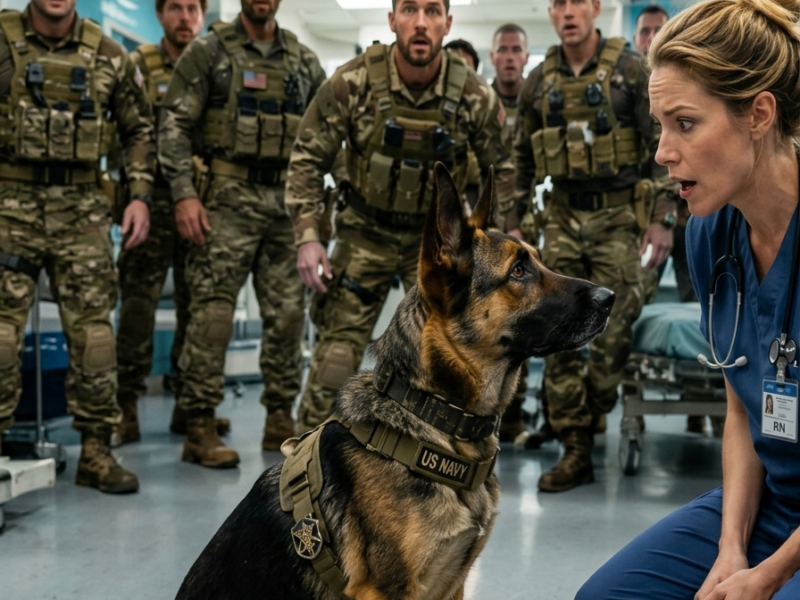
“Who lost this military K9?” I asked as the injured Belgian Malinois limped into the ER, but before anyone could answer
The emergency room doors slid open with a quiet mechanical hiss just after midnight, admitting a cold gust of rain-soaked wind and something else. Something heavy and deliberate. I looked up from the triage desk, expecting a paramedic crew or a late-night trauma walk-in. Instead, standing alone in the stark white light of the waiting area, was an injured Belgian Malinois.
“Who lost this military K9?” I asked, my voice carrying over the quiet hum of the monitors, but the question felt hollow the moment it left my mouth.
He did not look lost. He looked like a soldier returning from a war nobody else knew about. His tactical harness was torn to shreds, hanging off his lean, muscular frame in dark, mud-caked strips. One front paw was lifted slightly off the linoleum, dripping a steady rhythm of dark crimson blood onto the pristine floor. Beneath the heavy layers of dirt, grease, and rain, I could still see the faded, olive-drab military patch secured to the surviving Velcro of his vest.
I stepped out from behind the desk, signaling the security guard to stay back. Working in a trauma center near a major naval base, I was used to seeing military personnel, but a lone working dog walking into a hospital was something entirely different.
I knelt slowly beside him, keeping my hands visible, palms open. “Easy, buddy. You’re safe now.”
The Malinois did not flinch, bark, or bare his teeth. He simply lowered his large, scarred head and looked at me. His eyes, a deep and piercing amber, locked onto mine with an intensity that made the breath catch in my throat. Then, the slight trembling in his back legs stopped entirely. I had worked with military and police animals before, but something about this dog felt remarkably different. He was not afraid of the bright lights, the sharp smell of antiseptic, or the rushing nurses. He was waiting.
I gently reached out and touched his heavy tactical collar. A name was scratched deeply into the blackened metal tag, the letters worn smooth by time and sand.
“Ghost,” I whispered.
Suddenly, the heavy double doors of the ambulance bay exploded open. Four men rushed inside, moving with the terrifying, synchronized speed of a tier-one military unit. Navy SEALs. They were fully geared, soaked in rain, their faces pale and eyes wild with an exhaustion that went deeper than bone.
The tallest one, a man with a jagged scar across his jawline and captain’s bars on his wet uniform, saw the dog and froze so abruptly that the man behind him nearly crashed into his back.
“Ghost?” the captain breathed, his voice cracking.
The dog let out a low, vibrating whine and tried to stand, but his injured leg buckled. The towering SEAL dropped to his knees on the hard floor, sliding the last few inches to wrap his thick arms around the dog’s neck.
“Oh, God. You’re alive,” the captain choked out, burying his face in the dog’s wet fur.
The other three operators surrounded them immediately, dropping their tactical bags. One of them, a broad-shouldered man with a thick beard, covered his face with his hands, his shoulders shaking. Another dropped to the floor beside the captain, resting his hand on the dog’s flank, whispering, “We thought he was gone. We thought he was dead.”
I stepped back, giving them space, my mind racing. “Where did you find him?” I asked quietly, grabbing a sterile gauze pad to press against the dog’s bleeding paw.
The tallest SEAL looked up at me, his eyes rimmed with red. “We didn’t find him. The base perimeter sensors picked him up an hour ago, walking down the highway toward the city. He disappeared three years ago.”
My heart performed a violent, stuttering skip in my chest. I kept my hands steady on the gauze, not daring to look up. “Three years?”
He nodded, his hand gently stroking Ghost’s torn ears. “During a classified extraction in the Kunar Province. The whole op went sideways.”
As if triggered by the memory in the captain’s voice, Ghost suddenly pulled away from the men. He turned his heavy head toward me, limped forward, and pressed his forehead firmly against my stomach. He let out a long, heavy sigh, completely surrendering his weight against me.
Every SEAL in the room went dead silent. The ambient noise of the hospital seemed to vanish.
The tallest man stood up slowly, his tactical boots squeaking against the wet floor. He stared at me, his eyes narrowing, shifting from grief to a sharp, dangerous calculation. “Do you know him?”
I swallowed the dry lump in my throat. I kept my eyes focused on the dog. “No.”
It was a lie. And it was a lie that was burning me from the inside out. I remembered Ghost. I remembered the heavy, suffocating heat of that night three years ago. I remembered the deafening roar of the explosion that flipped our transport vehicle, the smell of burning diesel, and the chaotic gunfire echoing through the rocky valley. I remembered dragging a heavily wounded VIP through the absolute darkness, my own blood blinding my left eye, while Ghost followed right beside us, fiercely guarding our blind spot through the thick, choking smoke.
But the VIP had died before dawn. And my team had been wiped out. I was the only survivor. Fearing the betrayal came from within our own command, I had vanished into the ghosts of the civilian world, changing my name, my hair, my entire existence. I was told later, through underground channels, that the dog had perished with the rest of them.
The SEAL reached into the breast pocket of his uniform. His hand was trembling slightly as he pulled out a heavily creased, water-damaged photograph. He held it out to me.
There I was. Three years younger, my hair cropped military short, wearing a desert camouflage uniform covered in dust. I was kneeling on a tarmac, smiling, with my arm wrapped securely around a younger, unscarred Ghost.
“You were there,” the captain whispered, his voice dangerously low.
I couldn’t answer. My medical shears slipped from my fingers, clattering loudly against the linoleum.
The bearded SEAL stepped forward, snatching the photo to look at it. His eyes darted from the picture to my face. “That’s impossible. Look at her eyes, Miller. It’s her.”
Captain Miller lowered his voice so only I could hear. “Her military file says she died that night in the ambush. They recovered teeth. They held a closed-casket funeral at Arlington.”
I looked down at Ghost. The Malinois was staring up at me, his amber eyes bright and unwavering, exactly as he had looked at me in the desert. He hadn’t just wandered into this hospital by accident. He had been tracking my scent, hunting for the one person who survived that night, for three agonizing years.
Suddenly, Ghost’s ears pinned flat against his skull. The fur along his spine stood up in a sharp, rigid line. He turned his body toward the long, brightly lit hallway leading to the elevators and unleashed a deep, terrifying growl.
Everyone turned.
Standing near the elevator bank was a man wearing a blue hospital transport uniform. He held a stack of fresh linens, but his posture was completely wrong. He was rigidly still, his eyes locked directly onto me. He didn’t look like a man who worked the graveyard shift. He looked like a predator.
Ghost lunged forward, snapping his teeth, barking furiously.
The man’s face hardened. He dropped the linens. Before the hospital security guard could even unclip his radio, the man took three rapid steps backward toward the descending elevator doors. He looked right into my eyes, and his voice carried perfectly over the chaotic barking, smooth and chillingly calm.
“Tell her the mission isn’t over.”
Then, he turned and sprinted down the adjoining stairwell.
Ghost lunged to pursue him, but his injured leg gave out, sending him sliding across the slick floor. I caught him before he hit the wall.
Captain Miller drew his sidearm instantly, gesturing for his men to secure the corridor. He turned back to me, the barrel of his gun pointing toward the floor but his grip white-knuckled.
“Who are you really?” he demanded, his voice echoing in the paralyzed emergency room.
For three years, I had hidden the truth behind cheap scrubs and a quiet life. But as the hospital lockdown alarms began to scream from the ceiling, flashing blinding red light across the walls, I realized the terrifying reality. Ghost had finally found me. But he had led the people who killed my team right to my front door.
“Move! Secure the exits! Nobody leaves this ward!” Captain Miller roared over the blaring klaxons of the hospital lockdown system. The heavy metal fire doors at the ends of the hallway slammed shut, sealing the emergency department in an impenetrable box of steel and reinforced glass.
I didn’t wait for his permission. I grabbed Ghost’s heavy tactical harness and pulled him up. “Come on, buddy. Up. You have to move.” The dog grunted, shaking off the pain, and leaned his heavy frame against my leg.
Miller grabbed my arm, his grip like a steel vise. “I asked you a question. Who are you?”
I looked into his eyes, dropping the terrified civilian nurse facade instantly. My posture straightened, my center of gravity shifting into a combat stance I hadn’t used in thirty-six months. “My callsign was Wraith. I was the lone medical operator attached to Echo Team during the Kunar Valley extraction. And if you don’t let go of my arm in the next two seconds, Captain, neither of us is going to live long enough to discuss my funeral arrangements.”
Miller’s eyes widened slightly in shock, but he released his grip. He had read the files. Everyone in the special operations community knew the ghost stories about Wraith—the phantom medic who supposedly took out six insurgents with a combat knife to protect a wounded asset before finally bleeding out in the sand.
“You’re supposed to be dead,” the bearded SEAL, whose name tape read ‘Jackson’, muttered as he checked the magazine of his pistol.
“I faked it,” I said, dropping to my knees to rapidly inspect Ghost’s paw. I grabbed a staple gun from a nearby trauma cart, sterilized the wound with a splash of iodine, and quickly stapled the deep laceration shut. Ghost didn’t even whimper. I wrapped it tightly with pressure tape. “Command had a mole. Our extraction coordinates were sold to a private military cartel. We walked right into a kill box. If I had come back alive, they would have finished the job quietly on American soil.”
“So why is the dog here?” Miller asked, scanning the dark corners of the waiting room as the main overhead lights suddenly flickered and died.
The emergency backup generators kicked in a second later, bathing the ER in a sickly, dim amber glow. The electronic hum of the monitors was replaced by the low, heavy thrum of the basement generators. The phones at the nurse’s station were dead. The external network had been severed.
“He’s not just a dog,” I said, my fingers expertly tracing the thick nylon webbing of Ghost’s collar. I felt a hard, unnatural lump sewn deep into the fabric. I pulled a scalpel from my pocket and sliced the nylon open. A tiny, waterproof titanium capsule fell into my palm.
Miller stepped closer, staring at the capsule. “What is that?”
“Insurance,” I whispered. “The VIP we were extracting that night… he was a whistleblower. An intelligence analyst who uncovered a massive black-market weapons ring operated by high-ranking officials within our own Department of Defense. He had the decrypted ledgers. Before he died in my arms, he told me he hid the drive. I never knew where.”
“He hid it on the dog,” Jackson realized, his voice filled with awe. “Ghost survived the ambush, evaded capture, and has been navigating his way back to friendly lines for three years carrying the evidence.”
“And whoever orchestrated the ambush just figured it out,” I finished, pocketing the capsule. “That man in the transport uniform wasn’t alone. They cut the power and triggered the lockdown to trap us in here. They aren’t going to negotiate. They’re going to wipe this entire floor to get this drive.”
As if on cue, a deafening explosion rocked the north end of the hospital. The shockwave rattled the glass of the triage bay, sending dust raining down from the ceiling tiles. Screams erupted from the patients and medical staff barricaded in the interior rooms.
“They breached the loading dock,” the third SEAL, a young sniper named Ramirez, called out from his position by the double doors. “I’ve got multiple tangos in heavy tactical gear moving up the service stairwell. They’re heavily armed, Captain. Suppressed rifles, night vision.”
Miller looked at his men, then looked at me. “We have three sidearms and fifty rounds of ammunition between us. We’re sitting ducks in this ER.”
“Then we don’t stay in the ER,” I said, my mind snapping into the cold, calculated rhythm of combat geometry. “We take the service elevators down to the sub-basement. It connects to the old morgue and the utility tunnels. From there, we can reach the parking structure and get out.”
“The elevators are disabled under lockdown,” Miller argued.
“I have the manual override keys,” I replied, pulling a heavy ring of brass keys from my scrub pocket. “But we have to move now. Ghost, heel.”
The dog immediately limped to my side, his amber eyes scanning the dark corridor, his ears swiveling to track the distant sound of heavy boots echoing up the concrete stairwell.
We moved as a unit, slipping through the swinging doors of the trauma bay and into the dark, labyrinthine hallways of the hospital’s rear corridor. The silence was suffocating, broken only by the squeak of our shoes and the ragged breathing of the terrified staff hiding in the supply closets.
As we approached the service elevator, the stairwell door fifty feet down the hall burst open. Three mercenaries in all-black tactical gear spilled into the corridor, their weapons raised, red laser sights cutting through the dim amber light.
“Contact front!” Jackson yelled, raising his pistol.
Before he could fire, I grabbed a heavy, compressed oxygen tank from a medical cart, twisted the valve until it snapped, and hurled it down the hallway like a torpedo. The tank hit the floor, sparking wildly, and shot toward the mercenaries in a chaotic, hissing spiral.
“Cover!” one of them screamed.
As they dove out of the way, Jackson and Ramirez laid down suppressing fire. I jammed the key into the elevator control panel and cranked it violently to the right. The heavy doors slid open.
“In! In! In!” Miller ordered.
We piled into the tight metal box, Ghost pressing himself tightly against my legs. Bullets pinged off the metal doorframe, sending sparks showering over our heads. I hit the button for the sub-basement. The doors slid shut just as a bullet shattered the digital floor display above our heads.
The elevator car jerked and began a slow, agonizing descent into the dark. We were trapped in a metal box, descending into a basement with no windows and very few exits. I looked down at Ghost. The dog looked up at me, his tail giving one slow, deliberate thump against the metal floor. He was ready for a war. And after three years of hiding, so was I.
The descent felt like an eternity. The heavy mechanical grinding of the service elevator masked the sound of our breathing. I looked around the tight space. Three Navy SEALs, one battered Malinois, and a trauma nurse whose past had just aggressively kicked down her door.
“Listen to me,” I said, keeping my voice barely above a whisper. “The sub-basement houses the hospital’s main HVAC controls, the backup generators, and the morgue. It’s a maze of concrete pillars and tight corners. We have the home-field advantage. I know every inch of it.”
“If they breached the loading dock, they already have men down there waiting for us,” Miller stated, checking his weapon’s chamber.
“I know,” I replied, stripping off my blue scrub top to reveal a tight, dark grey moisture-wicking undershirt. The scrubs were too bright, too easy to spot in the dark. I tied my hair back into a tight knot. “That’s why we aren’t going to walk out the front door. We’re going to use the MRI transit corridor.”
The elevator shuddered and came to a halt. The digital bell gave a weak, distorted chime.
“Stack up,” Miller ordered. Jackson and Ramirez flanked the doors, weapons raised.
I knelt beside Ghost, unhooking the heavy metal leash from his torn harness. “Ghost, shadow,” I whispered, using his old command for silent tracking. The dog immediately dropped his belly closer to the floor, his ears swiveling like radar dishes, every muscle tensed and ready.
The doors slid open.
The sub-basement was a cavernous expanse of shadows and echoing drips. The air was frigid, smelling strongly of bleach, ozone, and old damp concrete. The amber emergency lights cast long, distorted shadows across the massive, humming generators.
Ghost sniffed the air, gave a nearly imperceptible low growl, and nudged his nose against my right knee. He was pointing.
“Two tangos,” I whispered to Miller, pointing toward a row of massive steel boiler tanks fifty yards ahead. “Ghost smells them.”
Miller nodded, using hand signals to direct Jackson and Ramirez to flank left and right. “We need their weapons,” he whispered back.
“I’ve got the one on the right,” I said.
Before Miller could object to the unarmed nurse taking point, I slipped into the darkness. I moved with a fluid, silent grace that twelve years of military ballet had burned into my muscle memory. I darted from concrete pillar to steel tank, using the heavy shadows as a cloak.
I saw him. A mercenary dressed in heavy Kevlar, holding an MK18 suppressed rifle, scanning the corridor with night-vision goggles. He was relying entirely on his optics, ignoring his peripheral vision.
I waited until he stepped past a heavy steam pipe. I didn’t use a gun. I stepped out from the shadow, grabbed the thick, braided steel hose of an emergency fire extinguisher mounted on the wall, and swung the heavy red metal cylinder in a vicious, perfectly timed arc.
The heavy bottom of the extinguisher caught the mercenary squarely in the side of his helmet. The sickening crunch of impact echoed briefly before he dropped to the floor, instantly unconscious.
I caught his rifle before it clattered against the concrete. I unclipped his tactical chest rig, stripped him of three spare magazines, and slung the weapon over my shoulder. I felt the cold, familiar weight of the rifle against my chest, and a dormant, lethal part of my brain entirely snapped awake.
Across the room, a brief, muffled scuffle indicated that Miller and his team had quietly dispatched the second guard.
They emerged from the shadows, Miller carrying a newly acquired rifle. He looked at the unconscious man at my feet, then at the rifle perfectly positioned in my hands.
“You didn’t just play medic in the valley, did you, Wraith?” Miller asked, his tone laced with absolute respect.
“I was cross-trained in close-quarters elimination,” I replied coldly, checking the optic on the rifle. “The scalpel wasn’t my only tool.”
Ghost trotted to my side, sniffing the unconscious man before looking up at me approvingly.
Suddenly, the heavy steel doors at the far end of the basement burst open. High-intensity tactical flashlights cut through the gloom, sweeping the room.
“They took out Alpha team! Open fire!” a voice bellowed.
The basement erupted into chaos. Suppressed gunfire hissed through the air, bullets sparking wildly against the steel boilers and concrete pillars.
“Move! To the morgue!” I yelled over the deafening ricochets.
We sprinted through the maze of machinery, providing covering fire for each other in textbook leapfrog bounds. Ghost ran perfectly at my side, ignoring his wounded paw, completely unfazed by the chaotic spray of bullets.
We reached the heavy, reinforced doors of the morgue. I swiped my emergency keycard, shoved the door open, and we spilled inside, locking the deadbolt behind us.
The room was freezing, lined with rows of stainless steel storage lockers. In the center of the room sat two heavy metal autopsy tables.
“They’ll blow that door in sixty seconds,” Jackson said, breathing hard as he aimed his weapon at the entrance.
“Let them,” I said, moving to the back wall. “Ghost, here.”
I knelt beside a large, stainless steel drainage grate set into the floor. It was an industrial bio-waste flush drain that led directly into the city’s main sewer line, which emptied out near the storm drains of the parking garage.
“Help me lift this,” I ordered.
Miller and Ramirez grabbed the edges of the heavy iron grate, hauling it upward with a grunt of exertion. A blast of foul, damp air rushed up from the dark tunnel below.
A massive explosion rattled the morgue doors. The deadbolt buckled, the hinges screaming under the pressure of a breaching charge.
“Go! Go!” I shouted.
Ramirez dropped into the hole, followed by Jackson. I picked Ghost up, wrapping my arms tightly around his muscular torso, and lowered him down into the darkness until Ramirez grabbed him from below.
Miller dropped in next. I was the last one standing in the morgue. The heavy metal doors began to give way, sparks flying as a cutting torch sliced through the upper hinge.
I grabbed a large jug of highly flammable formaldehyde from an open chemical cabinet, unscrewed the cap, and dumped it across the floor in front of the door. I pulled a flare from the tactical vest I had stolen, popped the cap, and tossed it into the puddle.
Blue flames erupted instantly, creating a wall of fire just as the doors burst open.
I didn’t wait to see their faces. I dropped into the dark tunnel, pulling the heavy grate shut over my head, plunging us into absolute blackness as the fire raged above us.
The tunnel was narrow, pitch-black, and smelled deeply of stagnant water and rust. We waded through knee-deep sludge, our only illumination the faint, green glow of the stolen night-vision optics Miller and I passed back and forth.
Ghost swam through the water ahead of us, his head held high. He didn’t whine or complain. He was a creature of war, and this was merely another trench.
“The tunnel slopes upward ahead,” I whispered, my voice echoing slightly off the curved brick walls. “It leads to a storm grate in the lower level of the parking garage. If we can get a vehicle, we can punch through the perimeter fence before they can mobilize their barricades.”
“And then what?” Jackson asked, his heavy breathing sounding loud in the enclosed space. “We can’t go to the police. If this conspiracy runs as high as the DoD, local cops are either on the payroll or they’re going to get slaughtered.”
“We go to the media,” I said. “The titanium capsule in my pocket has undeniable proof. Financial ledgers, communication logs, offshore bank accounts. Once it hits the encrypted servers of major news outlets, the people hunting us will be scrambling to save themselves. They won’t have the resources to hunt a ghost.”
“Wait,” Miller hissed, raising a hand.
We froze.
Up ahead, a faint shaft of grey light cut down into the darkness from the ceiling. The storm grate. But something was wrong. There was a shadow blocking the light. Someone was standing directly above the exit.
“They anticipated our route,” Miller whispered, raising his rifle.
“Hold fire,” I commanded softly. “If we shoot up through the grate, we give away our exact position, and they’ll just drop frag grenades down the hole. We have to draw them away.”
I looked at Ghost. He looked back at me, his ears twitching.
“Ghost,” I breathed, touching his wet head. “Ghost, fetch.”
I pulled a heavy metal flashlight from the stolen tactical vest and hurled it down the dark tunnel, far past the storm grate. It clattered loudly against the brick walls, splashing violently into the water.
Ghost didn’t hesitate. He launched himself silently through the water, swimming rapidly toward the noise.
Above us, the shadow shifted abruptly. We heard the harsh scrape of heavy boots on concrete moving away from the grate, rushing toward the sound of the splash further down the line.
“Move! Now!” I hissed.
We surged forward through the water. We reached the iron ladder bolted to the wall beneath the grate. Miller went up first, pressing his massive shoulders against the heavy iron bars, heaving upward with a quiet, strained grunt. The grate lifted and slid aside with a painful scrape.
Miller climbed out, his rifle instantly up, scanning the garage. “Clear. Go, go!”
I scrambled up the ladder, turning immediately to reach down into the darkness. Ghost was swimming back rapidly, his head barely above the water. I grabbed him by the harness and hoisted his heavy, soaking wet body out of the hole, collapsing onto the cold concrete floor of the garage.
Jackson and Ramirez followed.
We were in the lowest level of the hospital’s parking structure. It was dimly lit, surrounded by massive concrete pillars and a few scattered cars belonging to the night shift.
“There,” Ramirez pointed. An older, heavy-duty hospital maintenance truck was parked near the elevator bank. The keys were likely in the visor or the ignition.
We moved silently toward the truck. I kept my eyes scanning the shadows. It felt too quiet. The hair on the back of my neck stood up, a primal instinct screaming that we were walking into a trap.
“Stop,” I whispered.
But it was too late.
The floodlights of the parking garage slammed on with blinding intensity, completely illuminating the lower level. A dozen laser sights painted our chests in red dots.
From behind the concrete pillars stepped a squad of heavily armed mercenaries, their weapons perfectly trained on us. And stepping out from behind a black SUV was a man I never thought I would see again.
He wore a tailored dark suit, completely out of place in the damp, freezing garage. His hair was silver, his face lined with age, but his eyes were as cold and sharp as cracked glass.
Director Vance. The architect of the Kunar Valley ambush.
“I have to admit, Sarah—or should I call you Wraith?” Vance’s voice echoed smoothly across the concrete, devoid of any emotion. “You have been a very difficult woman to kill. And this dog… this incredibly stubborn animal has cost me millions of dollars in tracking and retrieval efforts.”
Miller stepped slightly in front of me, shielding me from the firing line. “Vance. You’re a traitor to the uniform.”
“I am a pragmatist, Captain,” Vance replied smoothly, stopping ten feet away. “The weapons trade is going to happen with or without American involvement. I simply ensured that the profits stayed within our infrastructure. That whistleblower you tried to save? He was a liability. Just like all of you.”
Vance looked down at Ghost, his lip curling in disgust. “Hand over the capsule. And I will make your executions quick. Refuse, and my men will systematically dismantle you starting with the dog.”
Ghost let out a deep, rolling growl that vibrated through the concrete floor. He bared his teeth, the hackles on his back rising in pure defiance.
I slowly lowered my rifle, letting it hang on its sling. I reached into my pocket, pulling out the small titanium capsule. I held it up between two fingers.
“You want it, Vance?” I asked, my voice deadly calm.
“Bring it to me,” Vance ordered.
I looked at Miller out of the corner of my eye. I gave him a single, microscopic nod.
“Fetch,” I whispered.
I didn’t throw the capsule to Vance. I threw it as hard as I could into the dark shadows beneath the nearest row of parked cars.
Every mercenary in the room instinctively tracked the movement of the tiny silver object. Their eyes shifted for a fraction of a second.
That was all we needed.
Ghost launched himself forward like a guided missile, not toward the capsule, but directly at Vance. He hit the Director in the chest with sixty pounds of pure muscle and fury, knocking the older man violently to the ground.
“Fire!” Miller roared.
The garage erupted into an absolute thunderstorm of violence.
Before the mercenaries could adjust their aim from the distraction, Miller, Jackson, and Ramirez opened fire with devastating precision. The deafening roar of automatic weapons echoed off the concrete ceiling, turning the parking structure into a lethal echo chamber.
Three mercenaries dropped instantly, their body armor failing against the close-range rifle fire. I snapped my MK18 up and fired a controlled burst into a man trying to flank us from the left, dropping him beside a concrete pillar.
“Move to the truck!” Miller shouted over the chaos, laying down a heavy blanket of suppressing fire.
Vance was screaming on the ground, desperately trying to pry Ghost’s crushing jaws off his forearm. The Malinois was completely relentless, violently thrashing his head, dragging the terrified Director across the concrete.
“Ghost, out!” I yelled the release command, not wanting the dog to catch a stray bullet in the crossfire.
Ghost instantly released his grip, springing backward with a feral snarl, and bounded toward me, dodging a spray of bullets that shattered the windows of the car behind him.
We reached the heavy maintenance truck. Ramirez smashed the driver’s side window with the butt of his pistol, unlocked the door, and vaulted inside. He frantically dug under the steering column.
“No keys! I have to hotwire it! Give me ten seconds!” Ramirez yelled.
“We don’t have ten seconds!” Jackson fired his last pistol magazine, the slide locking back. He drew his combat knife, holding the line near the rear bumper.
The remaining mercenaries were regrouping, advancing methodically behind the cover of the concrete pillars. Vance staggered to his feet, clutching his bloody, shredded arm, his face twisted in absolute rage.
“Kill them! Shred the truck! Don’t let them leave!” Vance screamed.
A heavy machine gun opened up from the far end of the garage, the large-caliber rounds tearing massive holes through the metal body of the truck.
“Get down!” I shoved Ghost to the floorboards as a burst of gunfire shattered the windshield, showering us in safety glass.
I popped up over the hood, acquiring the machine gunner in my optic. I took a breath, exhaled slowly, and squeezed the trigger twice. The gunner slumped over his weapon, silent.
“Got it!” Ramirez roared as the truck’s heavy diesel engine roared to life with a thick cloud of black exhaust.
“Everyone in!” Miller ordered.
Jackson dove into the bed of the truck. Miller and I piled into the extended cab with Ghost. Ramirez slammed the gearshift into drive and slammed his foot on the gas. The heavy dual rear tires spun wildly, screaming against the concrete, filling the air with the smell of burning rubber before catching traction.
The truck rocketed forward.
“Brace!” Ramirez screamed.
Instead of heading for the winding exit ramp, Ramirez drove the truck directly toward the heavy steel chain-link barricade securing the ground-floor exit.
The truck hit the barricade at forty miles an hour. Metal shrieked and tore as the massive vehicle shattered the gate, bursting out of the parking garage and into the freezing, driving rain of the city streets.
“We’re out! We’re out!” Jackson yelled from the bed, banging on the rear window.
But my eyes were glued to the rearview mirror. Two black armored SUVs burst out of the garage behind us, their headlights cutting through the rain. Vance wasn’t going to let us go.
“They’re on us!” I warned.
“Hold on!” Ramirez cranked the steering wheel, throwing the heavy truck into a sharp right turn down a narrow industrial alleyway, clipping a dumpster and sending garbage flying into the night.
The SUVs pursued relentlessly, the passengers leaning out of the windows and firing suppressed submachine guns. Bullets sparked off the heavy steel tailgate of our truck.
“Jackson, keep their heads down!” Miller yelled, passing his empty rifle back to him along with a fresh magazine.
I looked at the navigation screen on my stolen phone. “Take the next left! It leads to the shipyard. The roads are a maze of shipping containers. We can lose them there.”
Ramirez downshifted, throwing the truck into a massive drift across the wet asphalt, sliding perfectly into the entrance of the sprawling, dark shipyard. Mountains of steel containers loomed like monoliths in the rain.
We navigated the tight corridors of steel, the tires splashing wildly through deep puddles. The SUVs split up, trying to flank us through the labyrinth.
“Stop the truck,” I said suddenly.
Ramirez slammed on the brakes, throwing us forward against our seatbelts. “What? We’re sitting ducks!”
“No, we’re the bait,” I said, unbuckling my seatbelt and grabbing my rifle. I looked at Miller. “They want the capsule. I still have it. The one I threw in the garage was an empty bullet casing.”
Miller smiled a slow, dangerous smile. “You glorious ghost.”
“You three stay in the truck. Keep the engine running. I’m going to finish this.”
“You’re not going alone,” Miller said, reaching for the door handle.
“I won’t be alone,” I said, looking down at the dog. “Ghost, with me.”
I slipped out of the truck into the pouring rain, Ghost silently matching my steps. We vanished into the shadows between two massive cargo containers.
Seconds later, one of the black SUVs slowly rounded the corner, its headlights sweeping over the idling hospital truck. The vehicle stopped. Four mercenaries piled out, weapons raised, moving cautiously toward the truck.
Vance stepped out last, holding a heavy revolver in his good hand, his face pale and slick with rain.
“Clear the truck!” Vance ordered.
As the men moved toward the cab, I stepped out from the darkness twenty yards behind Vance.
“Looking for me, Director?” I called out over the sound of the rain.
The mercenaries spun around, but before they could raise their weapons, Miller, Jackson, and Ramirez opened fire from the bed of the truck, catching them entirely by surprise in a devastating crossfire. The four men dropped instantly.
Vance was left standing alone. He raised his revolver toward me, his hands shaking wildly from blood loss and fear.
“You’re just a medic,” he hissed, his voice trembling. “You’re nothing.”
“I was a medic,” I said, keeping my rifle steady on his chest. “Now, I’m the ghost that’s going to haunt your legacy forever.”
Vance pulled the trigger. His shot went wild, shattering the side mirror of a nearby truck.
I didn’t shoot him. I didn’t have to.
With a terrifying, silent leap, Ghost launched out of the shadows directly beside Vance. He hit the Director with devastating force, pinning him to the wet asphalt, his massive jaws clamped firmly around the hand holding the gun. Vance screamed, dropping the weapon.
I walked slowly forward, kicking the revolver into a storm drain. I stood over the man who had destroyed my life, who had murdered my team.
“Ghost, secure,” I commanded quietly. The dog held the man perfectly still, his eyes fixed on my face, waiting for the final order.
I looked at Vance, pathetic and broken in the mud. “The data is already uploading to five different international news agencies from a dead-man switch on my phone. Your bank accounts, your treason, your entire empire is burning to the ground as we speak.”
Sirens began to wail in the distance, a massive symphony of red and blue police lights reflecting off the low clouds. The local authorities, drawn by the chaos at the hospital and the shipyard, were finally arriving en masse.
I looked back at Miller. He had lowered his weapon, standing in the rain, a profound sense of respect in his eyes.
“You should go, Captain,” I said softly. “The police will have questions. It’s better if SEAL Team Six doesn’t officially exist at this crime scene.”
Miller nodded slowly. “What about you, Wraith? Where do you go now?”
I knelt down, resting my hand on Ghost’s wet, steady head. The dog leaned into my touch, letting out a long, contented breath. The war was over. The ghosts were finally laid to rest.
“I don’t know,” I smiled, looking out toward the rising dawn breaking through the storm clouds over the ocean. “But for the first time in three years, I think I’m finally going home.”
The end.









