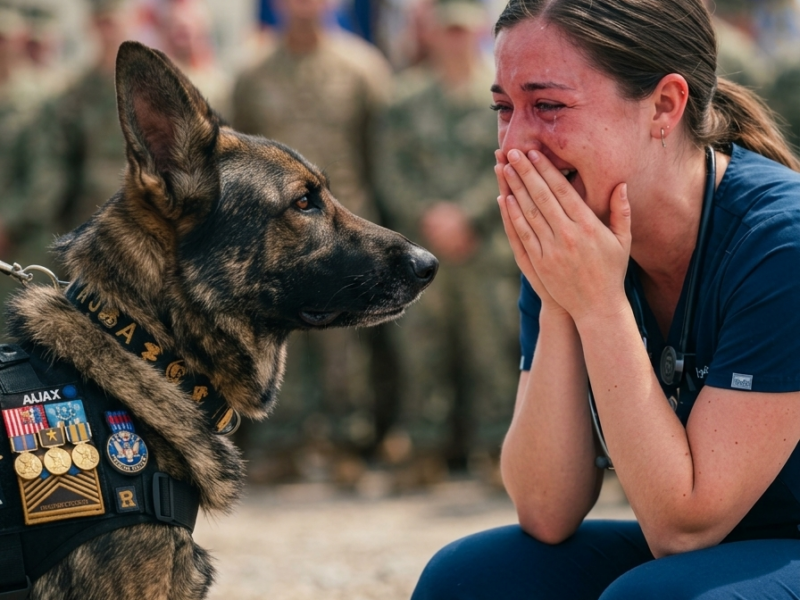
When the retiring military K9 ignored his SEAL handler and walked straight to me during his final ceremony, everyone laughed until he dropped his worn service tag at my feet
The silence inside the naval storage office hung so thick it felt like cold seawater pressing against my chest. The phone in Mason’s hand vibrated slightly, its tiny speaker broadcasting a voice that bypassed my ears and struck straight into my core.
“Emily?”
It was a voice I had spent six years trying to forget—a voice buried under folded triangular flags, crisp military posthumous commendations, and a silent bedroom back in Richmond where my mother still kept his bed made. The pitch was lower, roughened by years of exposure to environments I couldn’t imagine, but the cadence was unmistakable. It was Daniel.
Mason’s knuckles turned white around the casing of his phone. His blue eyes, previously sharp and commanding as befitted a veteran Navy SEAL, flickered with an unreadable mixture of dread and relief.
“Daniel,” Mason whispered into the receiver, his voice barely louder than the hum of the overhead fluorescent lights. “She’s here. Ranger found her.”
A static crackle filled the line. “Get her out of the installation, Mason. Right now. They know Ranger didn’t go to the handler line. Commander Vance’s team monitored the retirement broadcast. They know he dropped the tag.”
“We’re in the sub-level storage locker,” Mason said, taking a cautious step backward toward the heavy steel doorway, his body instinctively positioning itself between me and the hallway outside. “Daniel, I have the duffel. She read the notebook’s first page.”
There was a long, painful pause on the other end of the line. When Daniel spoke again, his voice was heavy with a quiet, desperate intensity. “Emily, if you can hear me… do not look at Mason like he’s your enemy. I wrote that sentence six years ago when I thought he was the one who set us up in the Helmand Province. I was wrong. Mason was the only reason I made it out of the valley alive. But if you don’t leave Dam Neck in the next ten minutes, neither of you will make it out today.”
My mind spun in dizzying circles. I clutched my brother’s worn metal dog tag—scratched, tarnished, and cold—tightly in my right palm until the sharp steel edges bit into my skin. The old German Shepherd, Ranger, sat rooted beside my knee. His grey-muzzled snout pressed firmly against my thigh, his body rigid, his ears swiveled toward the concrete corridor outside.
“What is happening?” I demanded, my voice breaking the heavy atmosphere. “Daniel! Where are you? The Navy told us your helicopter went down over water! They gave us an empty casket!”
“They gave you a lie because I uncovered a multi-million-dollar black-budget smuggling operation operating directly out of Joint Expeditionary Base Little Creek,” Daniel’s voice came back, firm and urgent. “The men running it aren’t foreign combatants, Emily. They’re wearing officer brass. Mason, check the hallway monitor. Now.”
Mason reached over to a small, dusty security terminal mounted to the wall of the storage room. He flipped a mechanical toggle switch, bringing up a grainy black-and-white feed of the main corridor leading down to the basement storage vaults.
Two men in unbadged tactical gear, carrying suppressed sidearms, were descending the concrete stairwell. They moved with absolute, practiced precision—professional breach-and-clear tactics.
“Vance’s private contractors,” Mason muttered under his breath, reaching beneath his dress uniform jacket and unholstering a dark SIG Sauer P226 pistol. He checked the magazine with a swift, fluid motion. “They’re sweeping the lower levels. They’re not here to talk.”
“Mason, what about Daniel?” I shouted, my heart hammering against my ribs like a trapped bird. “Where is he?”
“I’m three miles off the coast, Emily,” Daniel replied, the sound of wind whipping past his microphone suddenly filling the audio stream. “I’ve been living under a dead man’s name for six years, waiting for Ranger to reach retirement so I could retrieve the hard drive hidden inside his service harness. That notebook in your hands contains the decryption keys. Mason, take her through the utility access tunnel under Hangar 4. I’m coming in by boat to the north shore of First Landing State Park. Meet me at the tree line at 1500 hours.”
“Understood,” Mason said flatly. “Daniel, stay low. They’ve already locked down the main gates.”
“Get my sister out,” Daniel said, and the call disconnected into flat static.
Mason shoved the phone into his pocket and grabbed the heavy canvas duffel bag from my hands, slinging it over his shoulder. He turned to me, his expression transformed from that of a solemn handler at a ceremony into a deadly, focused operative.
“Nurse Miller,” he said, his voice cold and steady. “I need you to listen to me very carefully. You came here today thinking you were honoring an old dog’s retirement. Right now, you are a primary witness to a treason investigation that reaches the highest levels of Special Operations Command. If those men down the hall catch us, you won’t make it to a hospital shift tomorrow.”
He looked down at Ranger. The old Shepherd stood up, his deep chest expanding as he let out a low, silent exhale. His age seemed to vanish in an instant, replaced by the razor-sharp focus of an attack dog returning to active combat.
“Ranger,” Mason commanded softly, using a hand signal that pointed toward a rusted iron door hidden behind a stack of wooden crates at the rear of the room. “Point.”
Ranger didn’t hesitate. He trotted silently to the rear door, pressed his nose against the bottom seam, inhaled deeply, and gave a single, firm nod of his head. The exit was clear.
“We go through the drainage tunnels under the base runway,” Mason whispered, unlatching the iron door’s rusty bolt. “Stay behind me. Keep your eyes on Ranger. If he drops, you drop.”
As we stepped over the threshold into the damp, echoing darkness of the subterranean tunnel, a sharp thump echoed from the front office—the sound of the main door being kicked off its hinges. The chase had begun.
The air inside the utility tunnel tasted of salt, rust, and old diesel fuel. The only illumination came from narrow slits of light piercing through the heavy concrete drainage grates forty feet above our heads, casting striped shadows across the wet floor.
Ranger moved five paces ahead of us. Despite his stiff hind joints—the legacy of eight years leaping out of helicopters and navigating rocky terrain in eastern Afghanistan—his movements were fluid and completely noiseless. Every ten yards, he would pause, his head turned slightly, listening to the echoing whispers of the base above us.
I kept up with Mason’s fast, low-crouch stride, my rubber-soled hospital shoes gripping the slick concrete. My head was spinning with a violent storm of emotions. For six years, I had visited a white headstone at the national cemetery that bore my brother’s name. Every holiday, every birthday, my family had lived in the shadow of that grief. And now, my brother was alive—hunted by the very military machine he had sworn to serve.
“Mason,” I hissed quietly, stepping over a thick bundle of rusted copper wiring. “Tell me the truth. What happened six years ago in the valley?”
Mason didn’t slow down, his eyes constantly scanning the shadows ahead, his hand glued to his weapon. “Your brother was the chief communications inspector for Task Force 17,” Mason whispered back. “We were deployed near the Pakistani border. Daniel intercepted an encrypted transmission originating from our own Tactical Operations Center in Virginia. Someone was selling real-time satellite telemetry to private military contractors who were supplying illegal weapons to local warlords.”
“Commander Vance?” I asked.
“Vance was a Captain back then,” Mason replied grimly. “He realized Daniel had mapped the entire financial trail. The ambush on Daniel’s reconnaissance team wasn’t an enemy attack, Emily. Vance deliberately delayed our air support and routed Daniel’s squad into a pre-marked mortar grid. Out of eight men, only Daniel survived the initial strike—because Ranger pulled him out of the burning vehicle.”
My stomach turned. “And you?”
“I was the lead handler for the quick-reaction force,” Mason said, his jaw tightening. “When we finally breached the valley against Vance’s explicit stand-down orders, I found Daniel bleeding out in a dry riverbed. He was holding Ranger’s leash. He told me that if Vance realized he was alive, Vance would execute his entire family to keep the story quiet. So we faked his death. We burned his ID tags, logged his status as KIA, and I smuggled him out on an unmanifested cargo flight.”
“And you left him in hiding for six years?” I asked, a wave of anger surging through my voice.
“He chose to stay in the shadows,” Mason answered coldly. “Because Vance kept rising through the ranks. Vance became the commander of the entire installation. Daniel knew that the moment he resurfaced, Vance would strike. The only way to destroy Vance was to wait for Ranger’s formal service retirement.”
I stopped in my tracks, looking down at the dog trotting ahead of us. “Why Ranger?”
Mason stopped too, turning to look at me in the dim light of a tunnel grate. “Because military working dogs carry hard-coded hardware inside their tactical vests. When Daniel went down in the valley, he sewed a micro-encryption drive into the internal padding of Ranger’s official deployment harness—the very harness Ranger wore during his retirement ceremony today. Vance searched Daniel’s body, his barracks, and his home. But he never searched the dog.”
A heavy metallic click echoed from behind us in the tunnel—the sound of an iron hatch being forced open.
Ranger stopped immediately, dropping his front body low to the ground, a low, subsonic growl rising in his chest.
“They found the utility door,” Mason muttered, grabbing my arm and pulling me behind a thick concrete pillar supporting the runway structure above. “They’re inside the tunnel.”
Footsteps echoed off the damp walls—two pairs of heavy combat boots moving quickly, accompanied by the distinct sound of tactical radios clicking on key-microphones.
“Sweep Sector B,” a rough voice echoed down the concrete tube. “Vance wants the nurse brought in alive if possible, but the handler and the dog are non-essential. Use lethal force on sight.”
My heart pounded so hard I could hear it ringing in my ears. I squeezed Daniel’s dog tag tightly against my breastbone. We were trapped. The tunnel ran straight for another two hundred yards before reaching the outlet at Hangar 4, offering zero cover except for the concrete pillars spaced twenty feet apart.
Mason looked at me, then down at Ranger. He reached into his tactical vest and pulled out a small, steel dog whistle that produced no sound audible to the human ear.
“Emily,” Mason whispered, staring directly into my eyes. “When I give the signal, I need you to run as fast as you can toward the daylight at the end of this pipe. Do not look back.”
“I’m not leaving you or Ranger,” I said, my voice surprisingly steady.
“You have the notebook,” Mason snapped, shoving the duffel bag firmly into my arms. “The notebook contains the physical passwords that unlock the drive inside Ranger’s harness. Without you, the drive is useless, and Daniel’s six years of hiding mean nothing.”
He raised the whistle to his lips and looked at Ranger. The old German Shepherd looked back at his handler, his amber eyes filled with an intelligent, absolute understanding that transcended human speech.
“Go,” Mason whispered.
He blew the whistle.
Ranger didn’t attack by rushing down the center of the tunnel. Instead, using the pitch-black shadows along the wall base, the German Shepherd executed a flawless flank maneuver, springing up onto a elevated concrete pipe ledge that ran parallel to the main pathway.
A second later, Mason stepped out from behind the pillar, firing three rapid shots down the hallway. The suppressed rounds slammed into the concrete wall near the advancing contractors, forcing them to dive for cover behind an abandoned electrical junction box.
“Run, Emily!” Mason roared.
I turned and sprinted down the dark tunnel toward the blinding square of white daylight framing the exit two hundred yards away. My hospital shoes slammed against the wet floor, splashing through stagnant water. Behind me, the tunnel exploded into chaos—the sharp crack of pistol fire echoing violently against the narrow concrete walls, mingled with the ferocious, terrifying war-cry of an attacking military working dog.
I heard a man scream in pain—a high, panicked sound—followed by the heavy thud of a body hitting the concrete floor.
“Keep moving!” Mason’s voice echoed from behind me, sounding slightly breathy but strong.
I didn’t stop. I hit the daylight at the end of the tunnel, bursting out into the dense, overgrown brush lining the perimeter fence near Hangar 4. The blinding Virginia sunlight stung my eyes, but I pushed through the thick briars, clutching the canvas duffel bag to my chest.
A second later, the brush rustled violently, and Ranger tumbled out of the tunnel mouth. His coat was covered in concrete dust and mud, and a dark streak of red blood stained his left shoulder, but his stride was unbroken. He paused, looked at me, gave a sharp, authoritative bark, and gestured with his head toward the tree line bordering the north edge of the base.
Mason emerged a moment later, clutching his left side where his uniform jacket was torn, but his weapon was still drawn and held low.
“Are you hit?” I asked, running toward him.
“Grazed by a ricochet,” Mason panted, wiping sweat and dirt from his forehead. “Nothing serious. They’ll have base security rolling on the perimeter roads within three minutes. We have to cross the marsh to reach the state park boundary.”
We moved into the dense pine woods and salt-marsh terrain that separated the military installation from the public state park lands along the coast. Ranger led the way, navigating the soft mud and dense spartina grass with practiced ease, avoiding the open patrol paths and keeping us beneath the dense canopy of loblolly pines.
For twenty grueling minutes, we pushed through the marshland in absolute silence, driven by pure adrenaline. The distant sound of sirens wailed across the airfield behind us, but the dense forest muffled the sound, wrapping us in an eerie, isolated quiet.
Finally, the trees thinned out, exposing the grey, rolling waters of the Chesapeake Bay meeting the Atlantic horizon. The beach was deserted, save for a few stray pieces of driftwood sticking out of the damp sand under the overcast afternoon sky.
Mason checked his watch. “1458 hours. We made it.”
I collapsed onto a log near the tree line, my lungs burning, my uniform covered in salt-mud and burs. I pulled Ranger close to me, burying my face in his thick, coarse fur. The old dog leaned his heavy head against my knee, his tail giving two slow, exhausted wags against the sand.
“He’s really coming?” I asked softly, looking up at Mason. “Daniel is really coming?”
Mason stood near the edge of the trees, his eyes fixed on the grey water. “He’s coming, Emily. But look out there.”
I stood up and followed Mason’s gaze.
Half a mile off the coast, a sleek, black civilian powerboat was idling in the deep water. But approaching it from the south, cutting through the swells at high speed, was a heavy naval patrol craft flying the official insignia of the installation security detachment.
Through the mist, I could see two armed men standing on the bow of the security vessel, their automatic rifles pointed directly at the small powerboat.
“Vance anticipated the water pickup,” Mason said, his voice dropping an octave into pure, dark frustration. “He mobilized the coastal patrol unit before we even cleared the tunnel.”
My heart sank into my stomach. Daniel was trapped on the open water. He couldn’t come ashore without being blown out of the water by the heavy machine guns mounted on the security craft.
“What do we do?” I cried out, my hands trembling violently against my knees. “We can’t just watch them kill him!”
Mason lowered his head, analyzing the tactical geometry of the shoreline. “We have the encryption key in the notebook, and we have the drive in Ranger’s vest. But Vance doesn’t care about the drive anymore—if he destroys Daniel’s boat on the water, he can claim it was an unidentified vessel violating restricted military waters. He destroys the evidence and the witness in one strike.”
Suddenly, Ranger stood up.
The old German Shepherd walked out onto the open sand, his head lifted high into the sea wind. He looked toward the black powerboat idling off the coast, his nose twitching as he caught a familiar scent carried across the water by the ocean breeze.
He let out a single, deep, thunderous bark that echoed across the empty beach like a foghorn.
On the black powerboat floating half a mile offshore, a figure standing at the helm suddenly turned toward the beach. Even from this distance, I recognized the posture—the broad shoulders, the slight tilt of his head, the way he stood balanced against the rolling waves. It was Daniel.
He had raised a pair of binoculars, scanning the tree line, until his lens locked onto the lone German Shepherd standing on the wet sand.
The security patrol craft was closing in fast, its high-powered bullhorn crackling across the water: “UNIDENTIFIED VESSEL, THIS IS NAVAL SECURITY. SHUT DOWN YOUR ENGINES IMMEDIATELY AND PREPARE TO BE BOARDED. COMPLY OR WE WILL OPEN FIRE.”
Daniel didn’t shut down his engines. Instead, he slammed the throttles forward.
The black powerboat roared to life, its twin outboard engines throwing up a massive plume of white spray as it turned hard toward the shore—heading directly into the shallow, sandbar-choked waters where the heavy naval patrol vessel couldn’t follow without grounding its deep hull.
“He’s beaching the boat!” Mason yelled, breaking into a sprint toward the water’s edge.
The naval craft opened fire. Heavy automatic rounds skipped across the surface of the water, creating splashes of spray forty yards behind Daniel’s boat. The contractors on board were firing warning shots, trying to force him back into deep water where they could disable his steering.
“Mason!” I screamed, running down the sand behind him.
“Stay back, Emily!” Mason roared over his shoulder, unholstering his weapon and kneeling in the sand near a mound of driftwood. He lined up his sights with the naval vessel’s wheelhouse, firing three deliberate rounds aimed at the command windows to force the helmsman to pull back on his throttle.
The powerboat hit the outer sandbar at thirty knots.
The hull slammed into the shallow sand with a violent, crunching roar, lifting the entire boat four feet into the air before it skidded across the tidal pool and came to a dead stop in two feet of water, fifty yards from the dry beach.
The engine sputtered and died. Smoke poured from the stern.
For three agonizing seconds, nobody moved. The ocean waves slapped against the stalled hull. The naval security craft ground to a halt two hundred yards out, its deep draft preventing it from crossing the sandbar, but its deck-mounted machine gun was swinging around to target the stranded boat.
Then, a figure tumbled over the side of the powerboat into the waist-deep water.
Daniel stood up, coughing, soaked in saltwater and fuel, holding a waterproof tactical case over his head. He looked toward the beach, his eyes locking onto me.
“Emily!” he shouted, his voice cutting through the sound of the surf.
“Daniel!” I screamed, plunging into the cold water without thinking, ignoring the mud grabbing at my legs.
Ranger was already in the water ahead of me. The old dog swam through the breaking waves with incredible strength, his front paws churning through the foam until he reached Daniel’s side. Daniel wrapped his left arm tightly around the dog’s neck, resting his forehead against Ranger’s wet fur for a fraction of a second, before pushing himself toward the dry sand.
We met in the shallow foam at the water’s edge.
Daniel pulled me into an embrace so tight I couldn’t breathe. The smell of salt, motor oil, and the familiar scent of my childhood flooded my senses. His hands were rough and calloused, clutching the back of my jacket as if he were afraid I would vanish if he let go.
“I’m sorry,” Daniel sobbed into my hair, his voice breaking with raw, unshielded emotion. “I’m so sorry I left you alone, Em. I’m so sorry.”
“You’re alive,” I wept, gripping his soaked tactical vest. “You’re really alive.”
“Not for long if we stay on this beach,” Mason’s voice interrupted sharply as he ran up beside us, keeping his body between us and the naval vessel idling out past the sandbar. “Daniel, they’ve called in air support from the station. We have less than five minutes before security vehicles cut off the park exit roads.”
Daniel pulled back, looking into my face, his hands resting on my shoulders. His face was weathered, lined with scars I had never seen before, but his eyes were the same bright, fierce hazel eyes that had protected me when we were kids growing up in Virginia.
“Did you bring the notebook?” Daniel asked quickly.
I lifted the heavy canvas duffel bag, pulling out the leather-bound book and the metal dog tag I had picked up off the pavement during the retirement ceremony. “I have everything.”
Daniel took the tag, his fingers running over the engraved metal. “This tag contains the master hardware token, Emily. Mason, drop the harness from Ranger.”
Mason knelt immediately, unclipping the heavy tactical vest Ranger had worn throughout his service career. Daniel took out a small combat knife, sliced open the double-reinforced interior stitching near the rear lifting handle, and pulled out a razor-thin, titanium-cased micro-drive.
“This is it,” Daniel said, holding the drive in his palm. “Forty gigabytes of unredacted logistics ledgers, encrypted audio logs of Vance authorizing illegal weapons transfers, and the satellite telemetry from the night my squad was ambushed.”
Suddenly, the heavy sound of a helicopter rotor beat echoed from over the pine trees behind us. A sleek, black Bell 412 utility helicopter—bearing no military markings—cleared the tree line, hovering fifty feet above the sand dune.
A spotlight flared to life on the helicopter’s nose, pinning the four of us in a blinding cone of white light.
A voice boomed through a high-powered loudspeaker mounted on the aircraft’s belly—a voice I recognized from the base administrative offices.
Commander Vance.
“Sergeant Miller! Handler Mason!” Vance’s voice echoed down from the sky, distorted by wind and rotor noise. “You are surrounded by naval security forces. Drop your weapons and step away from the data drive. There is nowhere left to run.”
The downwash from the helicopter rotors whipped the sea foam into a violent white mist around our knees, stinging our skin with sand and salt. The spotlight held us pinned against the dark background of the ocean like insects under a microscope.
On board the hovering helicopter, I could see two armed men standing in the open side door, their rifles aimed directly down at our small group on the sand. Commander Vance stood beside them, holding a headset microphone, looking down at us with the cold, absolute confidence of a man who believed he held total dominion over the sky and the earth.
Mason raised his pistol, but Daniel reached out and firmly lowered Mason’s arm.
“Don’t shoot at a armored utility frame with a 9mm, Mason,” Daniel said calmly, his voice steady despite the hurricane of wind howling around us. “You’ll just give them a reason to clear the beach with automatic fire.”
“Daniel, he’s not going to let us walk off this sand,” Mason yelled over the deafening roar of the blades. “He has full authority over this operational zone!”
Daniel looked down at Ranger. The old German Shepherd stood firm between Daniel and the hovering helicopter, his fur pressed flat by the powerful wind, his head held high, staring up at the aircraft without a single trace of fear.
Daniel reached into the duffel bag in my hands and pulled out a small, heavy military satellite transmitter—a ruggedized tactical comms unit he had kept hidden inside the canvas bag for six years.
He slotted the titanium micro-drive into the transmitter’s side port, then held up his scratched metal dog tag, pressing the small security chip embedded on its back into the terminal’s reader.
A bright blue LED light on the transmitter screen began blinking rapidly: SECURITY OVERRIDE AUTHORIZED. DIRECT SATELLITE LINK ESTABLISHED TO DEPARTMENT OF DEFENSE INSPECTOR GENERAL COMMAND.
Daniel looked up at the helicopter, stepping directly into the center of the spotlight beam. He picked up the transmitter’s microphone and switched it to a open broadcast military frequency—the universal emergency channel monitored by every naval vessel, air traffic control tower, and command center in the Mid-Atlantic region.
“Commander Vance!” Daniel’s voice boomed through the tactical channel, picked up and amplified by the open comms loop. “This is Master Sergeant Daniel Miller, Service Number 884-02-91! I am broadcasting live on Federal Emergency Channel 16 from the north shore of First Landing State Park!”
Inside the helicopter cockpit, I saw Vance’s face instantly change. He pulled his headset tight against his ear, realizing with sudden, terrifying horror what Daniel was doing.
“I am currently transmitting forty gigabytes of classified evidentiary files directly to the Inspector General’s office, the Naval Criminal Investigative Service, and the Joint Chiefs of Staff,” Daniel continued, his voice echoing cold, clear, and absolute across the entire military radio grid. “These files contain full records of illegal arms trafficking, treason, and the deliberate murder of American service personnel under your command at Joint Expeditionary Base Little Creek!”
“Cut his signal!” Vance’s voice screamed through the radio channel, his composure completely shattering into frantic panic. “Cut the transmitter! Shooters, open fire on that position!”
The two armed men in the helicopter door hesitated for a fraction of a second, their hands hovering over their rifle triggers. They were military contractors—they understood that opening fire on an active, open-channel broadcast while a soldier was transmitting to the Inspector General was a direct, unpardonable act of high treason that would guarantee them a lifetime in a military prison.
“Check your tactical screens, Vance!” Daniel yelled up into the sky. “The upload reached 100% three seconds ago! It’s over!”
A low, deep rumble cut through the sky from the west.
Two grey Navy MH-60S Seahawk helicopters, flying high-visibility national insignia and carrying armed Military Police detachments, swept over the pine trees at high speed. They immediately flanked Vance’s black helicopter, their high-intensity searchlights painting Vance’s aircraft in brilliant beams of red and blue emergency lights.
“Black helicopter, this is Naval Air Station Oceana Security Command!” a heavy, authoritative voice roared over the emergency channel. “You are operating an unauthorized aircraft in restricted airspace during an active Federal Investigation. Land your aircraft immediately on the beach and prepare to be boarded! Failure to comply will result in immediate engagement!”
Commander Vance stood frozen in the open doorway of his helicopter. He looked down at Daniel, then at the two heavy military aircraft hovering twenty yards away, their door-gunners holding heavy .50-caliber machine guns locked onto his cockpit.
The arrogance that had sustained Vance for six years evaporated in an instant. Slowly, brokenly, Vance raised his hands into the air. His sidearm slipped from his fingers, falling out of the helicopter door and splashing harmlessly into the shallow ocean water below.
Five minutes later, the beach was filled with the flashing lights of military police vehicles, federal investigators, and medical personnel. Vance and his contractors were forced onto their knees in the wet sand, heavy steel handcuffs snapped around their wrists, before being led away toward the waiting transport vehicles.
An NCIS senior agent walked up to our group, looking at the glowing satellite terminal, then at Daniel, and finally at Mason. He offered Daniel a silent, respectful nod of his head.
“Master Sergeant Miller,” the agent said solemnly. “Your official service record is being restored as of this minute. The Inspector General’s office has already confirmed receipt of the master file. You’re coming home, son.”
Daniel turned to me, a tear cutting a clean track through the saltwater dust on his cheek. He pulled me into another deep embrace, holding me tight as the morning sun finally broke through the grey cloud cover, painting the ocean waves in brilliant shades of gold.
I looked down at Ranger. The old German Shepherd walked over, rested his heavy chin on my hand, and let out a long, quiet sigh of complete, absolute rest.
His final mission was over. His handler was safe. His family was whole again.
And as we walked off the sand together toward the waiting road, the old dog trotted proudly at my side—no longer a ghost of the past, but a living guardian who had brought my brother back from the dark.
The end.









