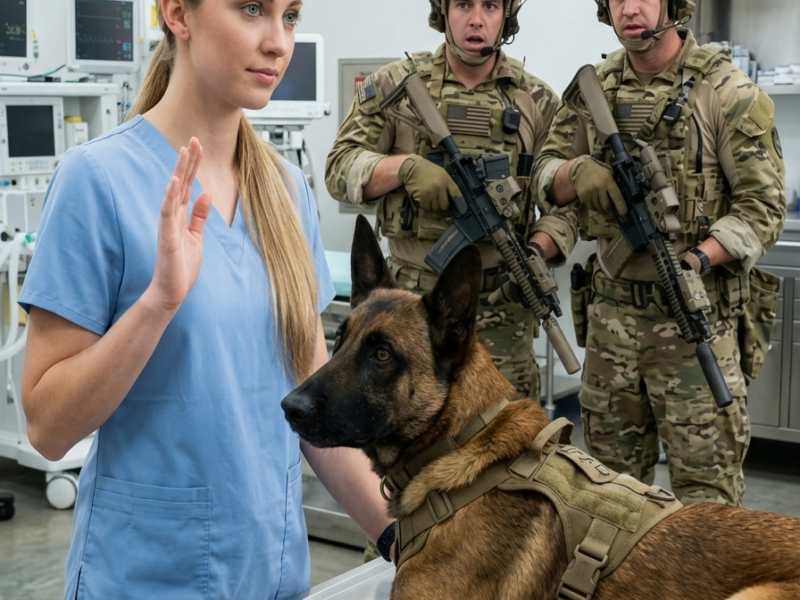
When the hospital board laughed as they called me “just a nurse” in front of thirty people, I felt my face burn, but then the chief K9 officer whispered one word to his German Shepherd
The glass-and-steel skyscraper housing the St. Jude Medical Center board of directors smelled of expensive polish, stale coffee, and subtle contempt. I sat near the end of the long mahogany table, my hands folded tightly in my lap, feeling the scratchy, cheap fabric of my clinical scrubs against my skin. Surrounding me were thirty men and women in tailored suits, silk blouses, and heavy gold watches. They were surgeons, administrative executives, and corporate investors—people who measured human life in billing codes and quarterly profit margins.
I was Emily Carter. To them, I was an invoice line item.
The emergency board meeting had been called under the guise of an operational audit, but everyone in the room knew the real agenda. They wanted to shut down the community outreach clinic I had run for three years—a low-cost sanctuary for marginalized families, veterans, and uninsured factory workers. I had spent weeks preparing data, tracking patient outcomes, and documenting how many lives our early intervention programs had saved.
When my turn came to speak, I stood up, adjusting the stack of papers in my hand. I opened my mouth to present the survival statistics, but Dr. Harrison, the senior Vice President of Surgical Services, leaned forward and cut me off with a languid wave of his hand.
“Let’s not waste time on emotional pleas, Miss Carter,” Harrison said, his voice dripping with smooth condescension. “We are looking at serious structural deficits. You are operating an expensive charity project under our brand.”
“It’s not a charity project, Dr. Harrison,” I said, trying to keep my voice steady despite the tremor in my chest. “We treated over twelve hundred patients last month alone. If you close our doors, those people will end up in your emergency department in acute crisis, costing this hospital three times as much.”
Dr. Harrison let out a soft, dismissive chuckle. He looked around the table, gathering silent nods from his peers. “You talk as if you understand health systems management. Let’s be realistic. You’re just a nurse.”
A wave of quiet laughter rippled down the thirty-foot table. A few junior executives smirked; a woman in a grey suit snickered into her coffee cup.
I felt my face burn, a sudden, blinding heat flushing from my collarbone to my cheeks. I stared down at the polished wood, watching my own reflection blur as heat stung the back of my eyes. I had spent fifteen years in high-intensity medicine. I had held arterial bleeds together with my bare fingers in war zones; I had revived dead hearts in overcrowded emergency bays. But in this air-conditioned room, to these people, my life’s work was reduced to three dismissive words.
Just a nurse.
I learned long ago that humiliation was easier to survive when you didn’t fight it. You absorb it, let it sit like led in your stomach, and keep breathing. I swallowed hard, ready to sit down and accept the death of my clinic, when the heavy double doors at the back of the conference room swung open.
The laughter died instantly.
A tall man in a dark tactical uniform stepped into the room. He wore the insignia of the State Law Enforcement Division’s Canine Unit. His hair was cropped close, silver at the temples, and his face was etched with deep, hardened lines that only years of field operations could carve. Beside him walked a large German Shepherd.
The dog was older, his muzzle heavily dusted with grey fur, his movements slow and deliberate. He walked with a slight, stiff hitch in his rear left leg—a permanent reminder of a combat injury. Yet despite his age, his dark eyes swept the room with terrifying, military intensity.
“Pardon the interruption, ladies and gentlemen,” the officer said, his voice deep and raspy. “I am Sergeant Miller. We were scheduled to brief the administrative staff on security protocols for the upcoming regional summit.”
Dr. Harrison sighed loudly, clearly annoyed by the intrusion. “Sergeant, we are in the middle of a delicate budget vote. Can’t this wait?”
Miller didn’t answer right away. He cast a brief, cool glance around the room, his eyes lingering on the lingering smirks of the board members. He turned toward me, nodding slightly. “This is Nurse Emily Carter, correct?”
Harrison sneered. “Yes, she was just finishing up.”
Sergeant Miller paid no attention to Harrison. He adjusted his grip on the heavy tactical leash. “Easy, boy,” Miller muttered under his breath.
Suddenly, the German Shepherd stopped dead in his tracks.
The dog’s ears twitched forward, erect and sharp. His nostrils flared as he drew in a deep, sharp breath of the room’s air. His gaze bypassed the executives, bypassed Dr. Harrison, and locked directly onto me.
A sudden, unnatural silence descended upon the room. The air felt thick, heavy with an inexplicable pressure.
Rex pulled against his leash. It wasn’t an aggressive lunging motion, but a desperate, straining tug forward.
“Rex, heel!” Miller commanded, his eyebrow furrowing in confusion. Rex was a retired, decorated military work dog—he did not disobey commands. Yet he ignored Miller completely.
The dog took one slow, deliberate step toward me. His dark eyes were fixed on mine, burning with a strange, haunting recognition that sent a sudden, cold shiver down my spine.
My mouth went dry. My heart pounded against my ribs like a trapped bird. Looking at that old, scarred dog, a memory I had spent seven years burying violently shoved its way to the surface of my mind. A dark, smoke-filled night overseas. The smell of burning diesel and copper blood. The sound of artillery shaking the earth.
Without thinking, without processing why or how, I opened my lips and whispered a single word into the silence of the room.
“Home.”
The word was barely louder than a breath.
Rex froze instantly.
Every muscle in the dog’s seventy-pound frame went rigid. The low whine in his throat cut off.
The conference room was so quiet you could hear the hum of the fluorescent lights overhead. Dr. Harrison looked confused; the other board members sat frozen in their leather chairs.
Sergeant Miller’s posture changed in an instant. The calm, authoritative demeanor vanished, replaced by a dark, intense shock. His hand tightened on the leash until his knuckles turned white. He stared at me as if he were looking at a ghost.
“Where did you hear that word?” Miller asked, his voice barely above a rasp, laced with an edge that made the security guards at the door shift uncomfortably.
I pulled my gaze away from the dog and looked up at Miller, my chest heaving. “I… I didn’t hear it anywhere.”
Rex slowly lowered his head. He ignored Miller’s leash entirely and took three fast, shuffling steps toward me. He didn’t bark. He reached out and gently pressed his grey muzzle directly into the palm of my right hand.
Then, the former military attack dog began to tremble violently.
I dropped to my knees right there on the carpet of the board room, completely oblivious to the thirty pairs of eyes watching me in stunned confusion. My fingers buried themselves in the dense, coarse fur around the dog’s neck. As I brushed the grey hair aside, my thumb brushed against a bare patch of pale skin beneath his heavy tactical collar.
A small, crescent-shaped scar.
My vision blurred instantly with hot tears. I knew that scar.
Seven years ago. A classified forward operating base in the desolate mountains of eastern Syria. I was a young combat nurse assigned to a mobile surgical unit. It was three in the morning when the mortar shell struck the triage center.
The explosion had ripped the world apart into fire, flying shrapnel, and screaming metal. The lights went out, replaced by the orange glare of roaring flames. I remember crawling through the rubble, my ears ringing, my uniform soaked in dust and blood.
Through the thick black smoke, a young soldier had burst into the burning medical tent. He was carrying a wounded juvenile German Shepherd in his arms—the dog had taken a piece of shrapnel to the neck. The soldier had collapsed at my feet, his body torn apart by internal injuries, bleeding through his tactical vest.
I had tried to save the soldier, but he grabbed my wrist with a iron grip, forcing me toward the dog. “Save Rex,” he had gasped through blood-flecked lips. “Save him!”
The structural beams of the tent began to collapse. Secondary explosions were detonating outside. The heat was scorching my skin. I couldn’t move the fallen soldier—he was pinned beneath a fallen steel support beam. I grabbed the bleeding puppy, pressing my hand against the arterial spurter on his neck—right where the crescent scar now lay.
As the flames roared around us, the young dog had panicked, thrashing violently in my arms. To keep him from tearing his artery open, I had pressed my face against his ears and whispered one word over and over again, like a mantra against the inferno.
“Home. Home. Easy, boy, home…”
Rescue teams had dragged me out of the inferno seconds before the roof caved in entirely. They told me no one else inside had survived. The soldier had perished in the flames.
I had spent seven long years living with the nightmare of that night. Seven years carrying the guilt of the soldier I couldn’t save.
Now, sitting on the floor of a corporate boardroom in a civilian hospital, that same dog was resting his heavy head on my knee, trembling against my touch.
“You… you were the nurse at Outpost Alpha,” Sergeant Miller said quietly. He dropped down to one knee beside me, his tactical boots squeaking against the pristine floor.
Dr. Harrison stood up, slamming his hand on the table. “What is the meaning of this circus? Sergeant Miller, remove this animal at once! We are trying to conduct official hospital business—”
“Shut up,” Miller snapped, turning his head just enough to glare at Harrison. The sheer lethality in Miller’s eyes made the Vice President freeze, his mouth hanging open in shock.
Miller turned back to me. His hands were shaking slightly as he reached toward Rex’s neck. He unclipped the heavy tactical collar and laid it flat on the carpet between us. Tucked underneath the interior leather lining, hidden from plain sight, was a tiny, oxidized metal tag—not a standard military issue dog tag, but a private, hand-stamped piece of brass.
My breath caught in my throat. My heart hammered wildly against my ribs.
Miller flipped the tag over. Engraved into the worn metal was a single name:
DANIEL CARTER.
“Daniel…” I choked out, a sob tearing through my throat.
Daniel was my older brother. He had enlisted two years before me. When I received the official Department of Defense telegram seven years ago, it stated that Private First Class Daniel Carter had been killed in action during a mortar strike at Outpost Alpha. They had never recovered his body. I had spent seven years believing my brother had died in that same burning tent—that I had been feet away from him without ever knowing it.
“I spent seven years believing Daniel died because his unit failed to reach him,” I whispered, tears streaming down my face, soaking into Rex’s fur. “I thought… I thought he burned in that tent.”
Sergeant Miller looked at me, his eyes glistening with unshed tears. He slowly shook his head.
“He didn’t die in that explosion, Emily.”
The world seemed to stop spinning. The room, the board members, the hum of the lights—everything vanished into a cold, suffocating vacuum.
“What?” I breathed. “What are you saying?”
“He wasn’t killed that night,” Miller said, his voice dropping to an intense whisper. “The official casualty report was a cover story.”
“Then where is he?” I grabbed Miller’s tactical vest, my fingers digging into the material. “Where is my brother?!”
Miller didn’t answer with words. Instead, he reached into his inner tactical pocket and pulled out a worn, black leather wallet. From inside a hidden compartment, he extracted a single, borderless photograph and handed it to me.
My hands shook so violently I almost dropped it.
The photograph showed a man standing in a barren, rocky desert landscape, framed against the backdrop of an unmarked, classified military transport vehicle. He was wearing unmarked civilian tactical gear. He had a thick beard, a long scar across his left jaw, and his eyes were tired—but his smile was undeniable.
It was Daniel. He was alive.
I flipped the photo over with trembling fingers. On the back, written in black ink in my brother’s precise, square handwriting, was a date:
OCTOBER 14, 2021.
Three months after the explosion at Outpost Alpha.
Beneath the date, written in bold, desperate strokes, were six words:
Emily cannot know until we know.
“He was taken, wasn’t he?” I whispered, looking up at Miller, terror gripping my heart. “Or he went dark. What did he do?”
Before Miller could answer, the silence of the room was shattered by a sudden, harsh ring.
It was my personal cell phone, sitting on the mahogany table next to my discarded folder of clinic reports.
Every eye in the room darted toward the phone. The screen flickered, displaying a string of zeros: [UNKNOWN CALLER / BLOCKED NUMBER].
Dr. Harrison cleared his throat nervously. “Miss Carter, turn off that—”
“Don’t move,” Miller ordered sharply, his hand instantly hovering over his sidearm. He motioned to me. “Answer it. Put it on speaker.”
My hands felt like ice as I reached up, grabbed the phone, and swiped the green icon. I hit the speaker button and held the phone between Miller and myself.
For three agonizing seconds, there was only heavy, static-filled breathing on the line.
Then, a low, rasping male voice—modified through a digital scrambler—echoed out of the phone’s speaker, filling the silent conference room:
“If Rex remembered you… they’re going to come for you too.”
Click.
The line went dead.
The quiet hum of the phone’s disconnected tone seemed to vibrate through the entire room. For five seconds, no one moved. No one breathed.
Dr. Harrison stared at me, his face pale, his previous condescension entirely replaced by sudden, terrified confusion. “What… what kind of game is this? Sergeant Miller, who was that?”
Miller didn’t waste a second on Harrison. He reached down, grabbed my arm with firm but gentle force, and pulled me to my feet. “We’re leaving. Now.”
“Wait!” Harrison shouted, stepping forward. “You can’t just walk out of a board meeting! Miss Carter, if you leave this room, your employment is terminated! Your clinic is finished!”
Miller stopped at the door, turned, and pulled back his jacket slightly, revealing the brass shield of the State Special Operations Division and the heavy Glock mounted on his chest harness. “If anyone in this room makes a phone call about what just happened here before I notify my task force, I will personally process every single one of you for obstruction of a federal counter-terrorism investigation. Am I clear?”
Harrison swallowed hard and took a step back, his jaw working silently.
Miller gripped Rex’s lead with one hand and my arm with the other, steering me out of the glass doors and into the quiet corridor. As we walked toward the service elevators, my mind was spinning out of control. My hands were still shaking, the image of Daniel’s handwritten note burned into my retina.
Emily cannot know until we know.
“Miller, stop,” I demanded as we reached the stainless-steel doors of the service elevator. I pulled my arm away. “You need to tell me what is going on right now. My brother has been dead to me for seven years. I carried his memory. I cried over an empty casket! And now you’re telling me he’s alive, and someone just threatened my life over a phone call?!”
Miller pressed the elevator call button. He looked around the empty hallway, his sharp eyes scanning the security cameras mounted near the ceiling.
“Your brother didn’t die at Outpost Alpha, Emily,” Miller said quietly, his voice tight. “The mortar strike wasn’t an enemy attack. It was a hit.”
The elevator doors slid open with a soft chime. Miller guided me inside, Rex following close at my side, his shoulder pressed against my leg as if protecting me from an unseen threat. Miller hit the button for the underground parking garage.
“A hit?” I repeated, my breath catching in my chest. “By who?”
“By people inside our own command structure,” Miller said as the elevator descended. “Daniel wasn’t just an infantry soldier. He was assigned to a specialized intelligence recovery unit. Three days before Outpost Alpha was destroyed, his team intercepted a massive, illegal weapons transaction in the Syrian desert. The buyer was a Syrian militia commander. The seller… was a high-ranking official within the United States Department of Defense.”
I stared at Miller in absolute horror. “A rogue officer?”
“A network,” Miller corrected. “They called themselves Project Aegis. They were smuggling experimental military hardware, chemical agents, and untraceable cash through conflict zones. Daniel’s team found the paper trail. They were preparing to bring the evidence back to Washington.”
The elevator bumped to a stop at Floor B2. The doors opened to reveal a dark, cavernous underground parking garage.
“They couldn’t risk Daniel blowing the whistle,” Miller continued, leading me toward an unmarked black SUV parked in a dark corner. “So they ordered a strike on Outpost Alpha to erase the evidence and everyone who knew about it. But Daniel was warned twenty minutes before the mortar fell. He couldn’t save his entire unit, but he managed to escape into the desert with the primary hard drives.”
“And Rex?” I asked, looking down at the dog trotting beside me.
“Daniel was carrying Rex to the medical tent when the first shell hit,” Miller explained. “He knew he had to go dark—he had to let the world believe he was dead, or they would hunt down his family to draw him out. That’s why he left Rex with you. That’s why he made sure you believed he was gone. To protect you.”
We reached the SUV. Miller hit the remote unlock button, and the heavy side door slid open. Rex immediately leaped into the back seat, taking up his position on a custom canine bed.
“If he went dark to protect me,” I said, leaning against the side of the vehicle, “why did that man just call my phone? How did anyone know Rex was here today?”
Miller’s face grew incredibly dark. “Because three weeks ago, Daniel surfaced.”
My heart gave a violent thump. “He’s alive? Right now?”
“He contacted me through an encrypted satellite channel,” Miller said, reaching into the front seat and grabbing a heavy tactical folder. “He said he finally had enough evidence to take down the head of Project Aegis—a man known only as ‘The Sentinel.’ But Daniel knew he was being tracked. He told me that if anything happened to him, Rex was the key.”
“The key to what?”
Miller opened the folder and pulled out a high-resolution printout of a thermal scan. It showed Rex’s left shoulder—the side opposite his crescent scar. Deep beneath the tissue, tucked alongside his shoulder blade, was a tiny, faint metallic outline.
“A bio-chip,” I whispered, recognizing the imagery from my medical training.
“A military-grade sub-dermal data drive,” Miller confirmed. “Daniel implanted it inside Rex seven years ago, right before he disappeared. It contains the raw encryption keys for Project Aegis’s financial records. But Daniel set a dual-authentication lock on the drive.”
“What does that mean?”
Miller looked me straight in the eye. “It means the chip cannot be decrypted by a computer. It can only be unlocked by a voice-frequency match combined with a specific biometric reaction from the dog.”
The realization hit me like a physical blow. The cold sweat returned to my palm.
“The word ‘Home,'” I breathed. “And my voice.”
“Precisely,” Miller said. “When you said that word today, Rex’s heart rate spiked, and his neurological response triggered the chip’s internal proximity beacon. The signal broadcasted for less than two seconds before I suppressed it with my jammer—but it was enough. Whoever is monitoring that frequency knows that the key has been activated. And they know you’re the one holding it.”
Suddenly, a loud, metallic CLANG echoed through the concrete underground garage.
Rex instantly let out a low, menacing growl from the back seat, his fur standing on end.
Miller drew his sidearm in a single, fluid motion, stepping in front of me to shield my body. “Get in the car,” he hissed.
Before I could pull the door shut, two sleek black sedans with blacked-out windows sped around the concrete pillars of the garage, locking their high beams directly onto us. The blinding LED lights cut through the gloom, leaving me completely disoriented.
The doors of the sedans flew open. Four men in dark suits, tactical vests, and suppressed automatic rifles stepped out into the aisle.
“Sergeant Miller!” a voice boomed through a megaphone from behind the lights. “Stand down! You are interfering with a classified Department of Homeland Security operation! Surrender the civilian and the canine immediately!”
Miller didn’t lower his gun. “That’s not DHS,” he muttered to me under his breath. “That’s Aegis.”
“What are we going to do?” I whispered, my chest tightening with panic.
“Hold on to Rex,” Miller said calmly.
He suddenly turned, pointed his weapon not at the men, but at the overhead sprinkler system’s main pressure valve mounted on the concrete ceiling above the sedans, and pulled the trigger three times.
THWACK! THWACK! THWACK!
The high-pressure pipe ruptured with a deafening roar. Thousands of gallons of water blasted out in a violent torrent, striking the windshields of the sedans and drenching the gunmen. The sudden wall of water created a thick, blinding mist under the fluorescent lights.
“Go! Go!” Miller screamed, diving into the driver’s seat of the SUV and slamming the door.
He threw the vehicle into reverse, stomped on the accelerator, and the tires shrieked against the slick concrete floor as we rocketed backward into the dark, chaotic depth of the parking structure.
The black SUV tore out of the parking garage exit, smashing through the wooden security barrier in a shower of splinters. Miller spun the steering wheel wildly, drifting the heavy vehicle onto the rain-slicked city avenue just as automatic gunfire erupted behind us.
Bullets whipped through the air, several dull thuds echoing as rounds flattened against the armored tailgate of the SUV. Rex didn’t bark; he pressed his heavy body against my legs, keeping me pinned low on the floorboards behind the front seats.
“Stay down!” Miller yelled, weaving through afternoon traffic, cutting off delivery trucks and running two consecutive red lights.
Through the rear tinted window, I saw the two black sedans burst out of the garage in hot pursuit. But Miller was a trained tactical driver. He pulled the SUV into an alleyway, executed a handbrake turn that sent the vehicle sliding ninety degrees, and vanished into a subterranean service tunnel beneath the financial district.
Inside the tunnel, Miller reached under the dash and flipped a series of toggle switches. The SUV’s exterior lights cut out entirely, replaced by infrared night-vision displays on his dashboard screen. He accelerated into the darkness, navigating the underground maze until the sounds of sirens and pursuing engines faded into the distance.
Forty-five minutes later, we pulled into a dilapidated, ivy-covered brick warehouse on the edge of the city’s abandoned industrial riverfront.
The heavy steel door rolled down behind us, sealing us in pitch blackness until Miller switched on a battery-powered work lamp. The air inside smelled of rust, damp cement, and old engine oil.
“We have about an hour before they trace the vehicle’s secondary transponder,” Miller said, stepping out and opening my door. “We need to extract the data from Rex now, get it to an independent federal prosecutor, and disappear.”
I scrambled out of the car, my knees shaking so badly I had to lean against the fender. Rex jumped down after me, his tail giving a tiny, hesitant wag as he nudged my hand. I dropped to my knees and threw my arms around his neck, burying my face in his fur.
“I can’t believe he’s alive,” I whispered into the dark room. “Seven years, Miller. I carried his dog tags around my neck every single day.”
Miller walked over to a metal workbench, pulling out a tactical field laptop, a specialized medical scanner, and a sterile surgical tray. “Your brother is a survivor, Emily. But he’s running out of time. If Aegis is hunting you this aggressively, it means Daniel has cornered them. They need this data drive to destroy it before he can release his copy to the public.”
“Where is Daniel now?” I asked, looking up.
Miller stopped his preparations, his face grim. “I don’t know. Three days ago, he sent me a secure ping from an abandoned naval shipyard sixty miles north of here. He said he was going to set a trap for ‘The Sentinel.’ I haven’t heard from him since.”
A sickening dread settled deep in my stomach. “We have to go there.”
“Not until we extract this data,” Miller insisted, pointing to the laptop screen. “If we go there blind, we’re walking into a kill zone. Once we download the contents of Rex’s chip, we’ll have the locations, names, and encryption codes of every Aegis operative in the region.”
Miller set up the field scanner and brought a small microphone toward me. “I need you to speak into this. The software needs to analyze your voice harmonics to generate the decryption key.”
I took a deep breath, trying to steady the trembling in my lungs. I looked down at Rex, who sat patiently beside the table, his intelligence-filled eyes fixed on mine.
“Home,” I spoke clearly into the receiver. “Home, Rex.”
The laptop screen instantly lit up with green wave-lines.
VOICE MATCH CONFIRMED: PATTERN CARTER-E-0992.
AWAITING BIOMETRIC FEEDBACK…
Miller placed a digital sensor pad against Rex’s neck, right over the hidden sub-dermal chip. The device hummed with a low electrical pulse. Rex let out a soft sigh, resting his chin on my knee.
BIOMETRIC PULSE DETECTED.
DECRYPTING FILE: AEGIS_GENESIS_CORE.DAT…
Lines of code flashed across the screen at dizzying speeds. Financial ledgers, offshore banking routes, satellite coordinates, and names—hundreds of high-ranking military and civilian names—began populating the screen.
“My God,” Miller breathed, staring at the screen. “It’s worse than I thought. They weren’t just selling weapons. They were funding a private paramilitary force right here on American soil.”
I watched the names scroll by, my eyes searching frantically for anything that could help us find Daniel. Suddenly, a high-priority file opened automatically, labeled: TARGET_ELIMINATION_LOG.
My heart plummeted.
Scroll down the list was a series of mugshots and casualty reports. And at the very bottom, highlighted in bright red text:
SUBJECT: CARTER, DANIEL P.
STATUS: CAPTURED – HELD AT NAVAL STRUCTURE B-4.
TERMINATION SCHEDULED: 18:00 HOURS.
I checked my watch. It was 4:45 PM.
“They have him,” I gasped, pointing at the monitor screen, tears filling my eyes. “Miller! They have Daniel! They’re going to execute him in little over an hour!”
Sergeant Miller stared at the screen, his face hardening into a stone mask. “Naval Structure B-4… that’s the abandoned submarine base at Blackwood Bay.”
“We have to go right now!” I yelled, grabbing Miller’s tactical jacket. “You promised me! You said he was alive!”
“Emily, listen to me,” Miller said sternly, gripping my shoulders. “That base is a fortress. It’s heavily guarded by private military contractors. If we rush in there alone, we will die, and Daniel will die anyway.”
“Then what do we do?!” I screamed, the frustration and agony of seven years breaking through my composure. “I am not letting my brother die again! Do you hear me?! Not again!”
Rex stood up, letting out a loud, booming bark that echoed through the empty warehouse, as if seconding my demand.
Miller looked at me, then down at the dog. A long, heavy silence stretched between us. Finally, Miller let out a deep, defeated breath and reached for a heavy tactical weapons case sitting under the workbench.
“We don’t go in alone,” Miller said softly, flipping open the locks of the case to reveal body armor, tactical radios, and suppressed submachine guns. “We take the data. We send an encrypted copy to every federal intelligence agency in the country with a thirty-minute delay timer. If we don’t clear that base and check in by 6:00 PM, the files go live on the internet and destroy every single person in Project Aegis.”
He pulled out a lightweight tactical vest and tossed it to me.
“Put it on, Nurse Carter,” Miller said, a fierce, tight smile touching his lips. “It’s time to go get your brother.”
Rain lashed against the windshield of the SUV as we parked on a high, pine-covered ridge overlooking Blackwood Bay. Below us, jutting out into the dark, churning ocean waters like a rotting concrete leviathan, sat the abandoned Cold War naval submarine base.
It was a grim, brutalist complex of rusted steel, cracked concrete piers, and looming crane towers. Searchlights swept the perimeter fences, cutting through the dense coastal fog. Armed men in black tactical gear patrolled the catwalks, their assault rifles held at the ready.
“They’ve set up a perimeter defense,” Miller whispered, handing me a pair of night-vision binoculars. “At least twenty armed mercs visible on the surface. God knows how many inside the lower submarine pens.”
I adjusted the focus of the binoculars. Through the green-tinted lens, I could see the heavy iron gates leading to Sub-Pen B-4. Two armored vehicles were parked near the entrance.
“Where would they keep a high-value prisoner?” I asked, my voice low.
“In the dry dock control station,” Miller replied, pointing to a raised glass observation tower overlooking the dark water. “It’s the only room in the facility with independent power and a single entry point. Easy to defend.”
He turned to the back seat. Rex was sitting alert, his ears pinned forward, staring through the front glass toward the base.
“Rex knows this layout,” Miller said suddenly. “Your brother trained him at a facility built on identical Cold War schematics. If we use the main drainage culvert near the sea wall, Rex can lead us directly under the floorboards of Pen B-4.”
I looked at the old dog. His grey muzzle glistened in the faint light of the dashboard. He was limping, his back leg stiff from age, but the intelligence and fire in his eyes burned with fierce intensity. He knew his master was inside.
“Let’s go,” I said.
We slipped out of the SUV, leaving the vehicle hidden in the dense trees. Miller carried an automatic rifle, while I wore a combat medic kit strapped over my tactical vest. Rex moved like a silent shadow through the wet underbrush, taking the lead down the steep, muddy ravine leading to the ocean shoreline.
The storm provided perfect cover. The thunder drowned out our footsteps, and the torrential rain obscured the vision of the tower searchlights. We reached the base of the concrete sea wall, where a massive iron grate covered a six-foot stormwater drainage pipe.
Miller pulled out a hydraulic bolt cutter, clamped it onto the rusted iron bars, and leaned his weight into it. With a sharp SNAP, the iron gave way.
One by one, we crawled into the pitch-black pipe.
The smell inside was suffocating—stagnant seawater, decay, and oil. We waded through knee-deep water, following the rhythmic, splashing footsteps of Rex ahead of us. The dog navigated the subterranean darkness with terrifying accuracy, turning at junction points without hesitation.
After ten minutes of crawling through the dark, Rex stopped.
He pressed his nose against a steel ladder leading straight up to an iron hatch set into the ceiling of the pipe. Above us, I could hear the faint, echoing sound of footsteps walking on metal grating, accompanied by the muffled murmur of male voices.
Miller crept up the ladder, holding a small tactical fiber-optic camera. He slid the thin lens through a gap in the hatch frame and looked at his wrist monitor.
“Two guards in the lower corridor,” Miller whispered down to me. “They’re guarding the heavy blast door leading to the observation tower.”
“How much time do we have?” I whispered back.
Miller checked his tactical watch. “17:42. Eighteen minutes before the execution order. And eighteen minutes before our automated file release goes public.”
“We take them silently,” I said, my heart pounding in my ears.
Miller nodded. He carefully unlatched the hatch. Moving with explosive speed, Miller pushed the heavy iron cover open, pulled himself up into the corridor, and neutralized the first guard with a suppressed shot before the man could even register the sound.
The second guard turned, raising his weapon, but Rex burst through the hatch like a grey thunderbolt. Despite his age, the dog launched himself through the air, knocking the guard to the concrete floor and disabling him before he could fire a shot.
“Good boy, Rex,” Miller muttered, pulling the guard’s radio off his vest and disabling the frequency.
We were inside Sub-Pen B-4.
The immense room was breathtakingly huge—a cavernous concrete cathedral built over a black water bay where submarines had once docked. Looming above the water, mounted on heavy steel pillars thirty feet up, was the glass-walled control room.
Through the reinforced glass of the control room, illuminated by harsh halogen lights, I saw a figure tied to a heavy metal chair.
His head was hanging low, his shirt torn and bloodied.
“Daniel!” I gasped, taking a step forward.
“Emily, wait!” Miller grabbed my arm, dragging me behind a stack of rusted shipping containers.
At that moment, the door of the elevated control room swung open. A man in an immaculate dark gray suit stepped out onto the steel balcony, holding a silver-plated pistol. He was flanked by four heavily armed mercenaries.
I recognized his face instantly from the hospital board reports.
It was not a military general. It was not a rogue foreign operative.
It was Dr. Harrison’s primary financial backer—the Chairman of the Hospital’s Board of Directors, Arthur Vance.
“I must admit, Private Carter,” Vance’s amplified voice echoed through the massive, hollow cavern of the sub-pen, “you have proven remarkably difficult to kill. Seven years ago in Syria, and now here. But your resilience ends today.”
Inside the control room, the bruised, bloodied figure slowly lifted his head. Even through the blood and dirt covering his face, those sharp, piercing green eyes were unmistakable.
It was my brother.
“You’re too late, Vance,” Daniel’s voice rasped out, echoed through the internal PA system. “The files are already gone. You can’t cover this up anymore.”
Vance laughed—a cold, empty sound that chilled me to the bone. “You mean the files locked inside your dog’s brain? My team is tracking your little nurse sister right now. They’ll have the dog within the hour. And once I have the encryption key, your sacrifice will mean nothing.”
Vance slowly raised his silver pistol, pointing it directly at Daniel’s forehead.
“Eighteen-hundred hours, Private,” Vance said smoothly. “Time’s up.”
“NO!” I screamed, breaking away from Miller’s grip.
I stepped out from behind the shipping container into the bright light of the sub-pen, raising my hands high in the air.
“Vance! Look at me!” I shouted, my voice echoing violently off the concrete walls.
Vance froze. He turned on the steel balcony, looking down into the dark abyss of the bay. A slow, cruel smile spread across his face as his searchlights pivoted, pinning me in a blinding cone of white light.
“Well, well,” Vance purred down through the speakers. “Nurse Carter. How delightfully convenient.”
“Emily?!” Daniel’s voice cracked through the PA system, wild with sheer panic and disbelief. “No! Emily, get out of here! It’s a trap!”
“Shut him up,” Vance ordered coldly. One of the guards smashed the butt of his rifle into Daniel’s ribs, folding my brother over in agony.
My stomach twisted in violent rage, but I kept my hands raised, walking slowly toward the center of the concrete platform directly beneath the observation tower.
“You want the encryption key, Vance?” I shouted up at him, my voice ringing with a cold, absolute authority I didn’t know I possessed. “You want the files that expose Project Aegis? I’m the only one who can unlock them! You kill my brother, and I swear to God I’ll smash the chip to pieces and destroy the key forever!”
Vance leaned over the steel railing of the balcony, his eyes scanning the dark perimeter behind me. “You brought the dog?”
“He’s here,” I lied, stepping closer to the base of the observation tower’s support pillar. “In the SUV outside with my tactical escort. Bring my brother down here, let him walk out, and I will give you the voice-activation sequence.”
Vance stared down at me for three long, agonizing seconds. Then, he let out a soft, mocking laugh.
“You really are just a nurse, aren’t you, Emily?” Vance sneered. “Empathetic, naive, and hopelessly emotional. Did you really think I didn’t know Sergeant Miller was standing in the shadows behind those shipping containers?”
My heart stopped.
Vance raised his left hand and snapped his fingers.
Suddenly, floodlights flared around the entire upper perimeter of the cavern. Dozens of hidden guards appeared on the high catwalks, their laser sights painting bright red dots across Miller’s position behind the containers, locking him down.
“Did you really believe you could outmaneuver a multi-billion dollar intelligence apparatus with a retired police dog and a bleeding heart?” Vance chuckled, aiming his silver pistol back at Daniel’s head inside the control room. “I don’t need you to give me the key voluntarily, Miss Carter. My lab technicians can extract the digital core from the dog’s brain once you’re both dead. Your presence here just saves me the trouble of hunting you down.”
“Vance, wait!” I screamed.
“Goodbye, Nurse Carter,” Vance said, his finger tightening on the trigger.
“REX! ATTACK!” I didn’t order a standard command. I used the old combat field code Daniel had taught me when we were kids.
From the dark, shadowed recesses of the lower drainage trench right beneath the elevated tower, a dark shape vaulted into the air.
Rex didn’t attack Vance. He didn’t jump for the guards.
Rex launched his seventy-pound body directly onto the main external power junction box mounted on the central steel pillar—the high-voltage line powering the sub-pen’s floodlights and security system.
BOOM!
A blinding flash of blue electrical arc-light erupted as Rex’s heavy tactical collar, laced with conductive copper wiring Miller had installed, short-circuited the main junction!
Sparks showered down like fireworks! The entire facility was instantly plunged into absolute, pitch-black darkness!
“WHAT THE DEVIL?!” Vance screamed into the sudden night.
THWACK! THWACK! THWACK!
In the total blackness, Sergeant Miller’s suppressed weapon sang. The red laser sights vanished as the guards on the upper catwalks screamed, falling into the dark waters of the bay below.
“Emily! Move!” Miller’s voice roared through the night.
I didn’t run away. I ran up the steel spiral staircase leading to the elevated control room. Emergency red backup lights flickered on, bathing the room in an eerie, blood-red glow.
I smashed through the glass door of the control room just as Vance was scrambling to regain his footing on the slick floor. He saw me, panic in his eyes, and raised his silver pistol toward my chest.
“You stupid nurse—” Vance snarled.
Before he could pull the trigger, a blood-soaked hand reached out from the chair. Daniel, despite his broken ribs, lunged forward, locking his handcuffed arms around Vance’s throat and dragging the corporate executive to the floor!
The pistol clattered across the linoleum tiles.
I didn’t hesitate. I sprinted across the room, kicked the gun over the edge of the balcony into the dark water seventy feet below, and grabbed a heavy steel fire extinguisher mounted on the wall.
I swung it with everything I had.
CRACK!
The heavy iron cylinder struck Vance across the temple. The Chairman of the Board went limp, collapsing unconscious onto the concrete.
“Emily…” Daniel gasped, lying on the floor, breathing heavily, blood dripping from his nose.
I dropped the fire extinguisher and fell to my knees beside him, pulling out my combat trauma shears from my vest. With three fast, practiced cuts, I sliced through the heavy zip-ties binding his wrists and ankles.
“I got you, Dan,” I sobbed, wrapping my arms around his neck, pulling his face into my chest. “I got you. I’m here.”
Daniel held me tight, his body trembling, tears washing tracks through the dirt on his cheeks. “You came… you actually came…”
“Of course I came, you idiot,” I cried, laughing through my tears. “You left your dog with me.”
A soft, familiar whine sounded at the broken glass doorway.
Rex stood there in the flickering red emergency light. Smoke was rising faintly from his tactical harness, his tail thumping slowly, weakly against the doorframe. He shuffled slowly across the glass-strewn floor and collapsed directly across our laps, letting out a long, exhausted sigh.
“Hey, old boy,” Daniel whispered, pressing his forehead against the dog’s grey muzzle. “Good boy. You brought her home.”
Footsteps pounded up the steel staircase. Sergeant Miller burst into the control room, his weapon lowered, his breath coming in ragged gasps. He looked at the unconscious Vance, then at Daniel and me sitting on the floor surrounded by the dog.
Miller checked his watch.
17:59:55
17:59:56
17:59:57
17:59:58
17:59:59
18:00:00
DATA TRANSMISSION COMPLETE. FILES RELEASED TO DOJ, FBI, AND MEDIA.
Miller pulled off his tactical helmet, a tired, triumphant grin breaking across his face. “It’s over. The file upload just finished. Every news agency and federal agency in the Western Hemisphere just received the Aegis files.”
In the distance, across the roaring storm over Blackwood Bay, the sound of dozens of approaching sirens cut through the night—federal marshals, state police, and military escorts descending on the facility.
Three weeks later.
The morning sun broke through the coastal fog, casting a warm, golden glow over the green hills overlooking the valley.
The St. Jude Medical Center board of directors had been entirely dismantled. Arthur Vance, Dr. Harrison, and twelve high-ranking executives were currently sitting in a federal maximum-security facility facing charges of treason, illegal arms trafficking, and attempted murder.
The hospital had been taken over by a court-appointed public trust. Their first official act had been to triple the funding for the community outreach clinic and rename it the Carter Veteran & Family Medical Center.
I stood on the front porch of a small, white farmhouse sitting on twenty acres of quiet countryside. I wore comfortable jeans and a simple cotton sweater, holding a steaming mug of black coffee in my hands.
The front door opened behind me.
Daniel walked out onto the porch, carrying two breakfast plates. He was still wearing a medical brace around his torso, but his color had returned, and the dark, haunting shadow in his eyes was finally beginning to lift.
He sat down on the wooden steps, setting the plates down beside him.
A moment later, Rex trotted out through the screen door. His stiff back leg was moving much better now, thanks to the specialized physical therapy we worked on every afternoon. He didn’t wear a tactical collar anymore—just a simple leather strap holding a shiny, new brass tag.
Rex didn’t look like a weapon of war anymore. He looked like what he was always meant to be: a beloved family dog resting in the quiet sunshine.
He walked over, laid his heavy head across Daniel’s knee, and rested his snout gently against my foot.
Daniel looked up at me, a soft, genuine smile touching his face. “What are you thinking about, Em?”
I looked out over the sunlit fields, feeling the cool morning breeze against my skin, hearing the peaceful rustle of the oak trees. No gunshots. No screaming sirens. No burning tents. Just peace.
I lowered my coffee mug, reached down, and gently petted the grey fur on Rex’s head.
“I’m just thinking,” I said softly, looking at my brother, “that it took us seven long years… but we finally made it.”
“Made it where?” Daniel asked.
I smiled, feeling a deep, unbreakable warmth fill my chest.
“Home.”
The end.









