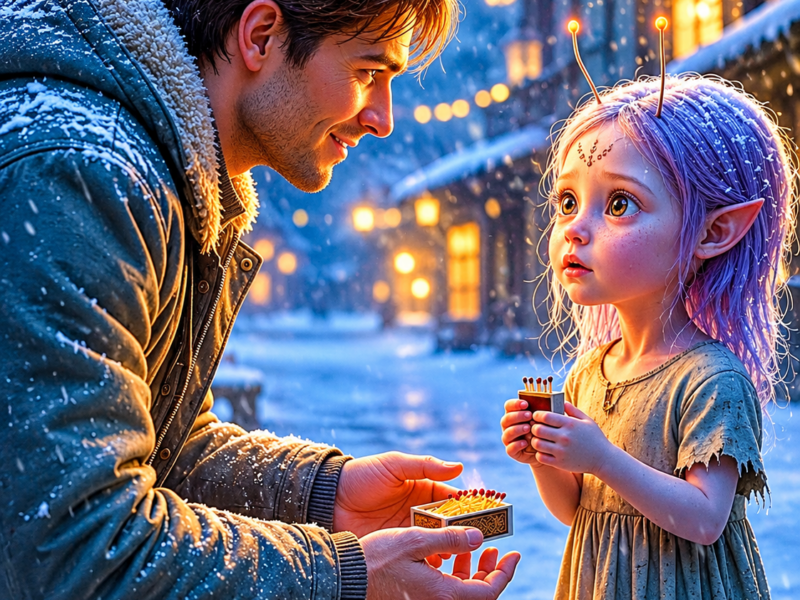
“When the caseworker told me a little alien girl would be taken to a cold holding facility because no family wanted her, I looked down at the tiny box of matches in her hands
“Dad, please tell us she’s staying.”
Maya stood in the bedroom doorway in her pink pajamas, clutching the stuffed rabbit she’d slept with since her mother died.
Zara sat on the edge of the bed, her small hands folded in her lap. The digital message on my screen cast a pale blue light across her face.
I read it again, although the words hadn’t changed.
The Melani government had approved temporary guardianship. The arrangement could last several months, possibly longer, depending on transport availability and the completion of a formal review.
There was no promise of permanent placement.
There was no guarantee that Zara would remain with us.
I looked at my daughter. Then I looked at the little girl who had spent three nights alone in the freezing corridors of New Geneva Station, selling matches because she had nowhere else to go.
“I don’t know what the officials will decide,” I said carefully. “But I know what I want.”
Zara lifted her eyes.
“I want you here.”
Her lower lip trembled. “Even if I am not human?”
I crossed the room and knelt in front of her.
“Especially because you are Zara.”
She stared at me for a moment, as if she were trying to determine whether those words were another kind of promise adults made and later forgot.
Then Maya climbed onto the bed and wrapped both arms around her.
“You can have the window side,” she announced. “I don’t even like the window side.”
“You complained about it yesterday,” I reminded her.
“That’s because I was saving it for Zara.”
Zara gave a small laugh, and I realized it was the first time I’d heard her laugh without immediately looking over her shoulder.
That night, I sent the caseworker, Sandra, a formal acceptance of temporary guardianship.
I didn’t know how complicated the paperwork would become. I didn’t know how many inspections, interviews, medical assessments, and government reviews were waiting for us.
I only knew that when I turned off the bedroom light, two little voices were whispering under the blankets.
And neither of them was alone.
The first weeks were harder than I expected.
Zara had never lived in a home with a human family. Some things that seemed ordinary to Maya were completely unfamiliar to her.
She didn’t understand why we closed the curtains at night.
She thought our refrigerator was a storage cabinet for tiny sleeping machines.
And the first time I turned on the kitchen faucet, she jumped backward so quickly that she knocked over a chair.
“Why does the wall make water?” she demanded.
“It’s a faucet.”
“Why?”
“Because we need water.”
“Then why doesn’t the water simply stay in the pipes until we ask politely?”
Maya laughed so hard she nearly fell off her stool.
I found myself smiling more often than I had in two years.
But the nights were different.
Sometimes I woke to find Zara sitting on the living room floor, staring at the small box of matches I’d placed on a shelf.
She never touched them.
She only watched them.
One night, I sat beside her.
“Do you miss selling them?”
She shook her head.
“Do you miss your ship?”
“No.”
“What do you miss, then?”
For a long time, she said nothing.
Then she whispered, “My mother used to sing when the lights went out.”
I waited.
“She said the stars were not far away. She said they were only lights from other homes.”
Her fingers moved over the edge of the matchbox.
“I keep thinking she might be looking for me.”
I wanted to tell her that her mother wasn’t looking anymore, that she had died before Zara ever reached New Geneva.
But grief doesn’t become easier because someone explains it.
So I put an arm around her shoulders.
“Then whenever you miss her, we can look at the stars together.”
She leaned against me.
That was the first night she called me Ethan without sounding afraid.
A week later, Sandra visited our apartment.
She arrived with a tablet, a folder of forms, and the serious expression of someone who had delivered difficult news too many times.
“The temporary placement is approved,” she said. “But I want you to understand that this could become a long process.”
“How long?”
“Months. Possibly years. The Melani government has limited representation in this sector, and their records are incomplete.”
She glanced toward the kitchen, where Maya was teaching Zara how to make toast.
“There are also questions about cultural placement. Some officials may argue that Zara should eventually be raised among her own people.”
I looked at the girls.
“What happens if they find a suitable placement?”
Sandra didn’t answer immediately.
“They could ask for a transfer.”
The words settled between us.
I had expected the possibility. Knowing it was possible didn’t make it easier.
“She’s already lost her parents,” I said. “She’s already been abandoned once.”
“I know.”
“I’m not going to pretend I can replace her culture or her family. But I can give her a safe home.”
Sandra nodded slowly.
“That may be exactly what she needs.”
After she left, I found Zara standing beside the kitchen doorway.
She had heard us.
“Are they going to take me away?”
I crouched beside her.
“Not today.”
“But someday?”
“I can’t promise what every official will decide. I can promise I won’t stop fighting for you.”
She looked down at her hands.
“I don’t want another room where nobody knows my name.”
I pulled her into a hug.
“You won’t have to face that alone.”
Christmas Eve arrived beneath a sky filled with station lights.
New Geneva had no real snow, but the central market had installed artificial flakes that drifted from the ceiling. Children ran through them, laughing, while vendors sold warm pastries and glowing decorations.
Maya insisted that we all go.
Zara wore a blue sweater that Maya had chosen for her. The sleeves were too long, so we folded them twice.
At the market, a man near a food stall looked at Zara and frowned.
“Where did you pick that one up?” he asked me.
I didn’t understand at first.
He nodded toward Zara.
“Some kind of station stray?”
Maya stepped in front of her.
“She’s my sister.”
The man chuckled. “I wasn’t talking to you.”
“You were talking about her.”
“Maya,” I said quietly.
But my daughter didn’t move.
“She has a name. It’s Zara. And she’s not a stray.”
The man muttered something and walked away.
Zara stood very still.
I expected her to cry. Instead, she reached for Maya’s hand.
“Thank you,” she whispered.
Maya shrugged, suddenly embarrassed.
“That’s what sisters do.”
A little farther down the market, Zara stopped in front of a stall selling glass ornaments.
Most were shaped like stars, moons, and tiny houses. One was a small blue star with a silver center.
She picked it up carefully.
“What does this one mean?” she asked.
“Nothing special,” the vendor said. “It’s just a star.”
Zara held it closer to the light.
“Then I think it can mean something special to us.”
I bought it.
That evening, we decorated our small apartment.
Maya hung paper snowflakes across the windows. I placed the blue glass star at the center of our little artificial tree.
Zara watched us for a while before taking something from her pocket.
It was one of the matches from the box she had sold on the street.
“May I put this here?” she asked.
I hesitated.
“Of course.”
She placed it beneath the tree, beside the star.
“For my mother,” she explained. “So she knows I remember.”
We didn’t have a perfect Christmas dinner. The food was slightly overcooked, Maya spilled juice on the tablecloth, and I burned the first batch of cookies.
But when we sat together, Zara looked around the table as if she were trying to memorize every detail.
Before bed, she asked me something.
“Does Santa visit children who come from other planets?”
I smiled.
“He visits children who need a little magic.”
She considered that.
“Then I hope he knows where I live.”
The next morning, Maya woke us before sunrise.
There were presents beneath the tree, including a small science kit for Maya and a collection of glowing crystal blocks for Zara.
But my biggest gift was waiting beside their breakfast plates.
I’d spent several nights putting together a digital photo frame.
It displayed a picture of Zara’s parents that Sandra had recovered from an old Melani registry. Beside it was a photograph of the three of us taken at the Christmas market.
Zara stared at the screen.
Her mother had soft silver markings along her cheeks. Her father had the same wide, dark eyes as Zara.
She reached out and touched the image.
“That’s my mother.”
“I know.”
“And that’s my father.”
“Yes.”
Her face crumpled.
I pulled her close as she cried.
“I don’t want to forget them,” she said.
“You don’t have to.”
She looked up at me.
“Can I love them and still love you?”
I felt something tighten in my throat.
“You never have to choose.”
I showed her the small wooden ornament I’d made for the tree.
It read: Cole Family — First Christmas Together.
Zara held it against her chest.
Then, very quietly, she said, “Thank you, Father.”
I had heard many words in my life. None had ever meant so much.
The following months brought more paperwork than I thought one family could survive.
There were interviews, medical checks, home visits, and long calls with officials who seemed more interested in regulations than in the little girl sleeping down the hall.
Sandra helped us through every step.
She also helped me understand something important: loving Zara didn’t mean pretending she was human.
It meant making room for everything she was.
We learned a few Melani phrases together. Zara taught us a lullaby her mother used to sing, and I learned to prepare a simple Melani meal from the ingredients available on New Geneva.
Sometimes we got it wrong.
Maya once pronounced a greeting so badly that Zara laughed until she had to sit down.
But we kept trying.
Eventually, the temporary guardianship became a long-term placement.
Then, after months of review, the Melani authorities agreed to consider adoption.
I thought the hardest part was behind us.
I was wrong.
The first day Zara attended school, another child asked whether she could breathe the same air as everyone else.
A week later, someone told her she didn’t belong in the science club because the equipment was designed for humans.
Zara came home that afternoon and placed her school bag beside the door.
She didn’t say anything.
Maya noticed immediately.
“Who upset you?”
“Nobody.”
“That’s not true.”
Zara looked down.
“They said I should go to a school for Melani children.”
Maya frowned.
“But there isn’t one here.”
“They said that’s my problem.”
I sat beside Zara.
“What did you say?”
“Nothing.”
She picked at a loose thread on her sleeve.
“I thought if I didn’t answer, they might forget.”
I knew that feeling. I’d spent years trying to avoid conversations that reminded me my family had changed.
But silence doesn’t always protect the person being hurt.
“You don’t have to prove you deserve to be there,” I told her. “You already do.”
She looked at me.
“What if they never believe that?”
“Then we’ll make sure you have people around you who do.”
The next morning, Maya walked into school beside her.
She didn’t threaten anyone or start a fight. She simply sat with Zara at lunch, joined the science club, and made it clear that her sister wouldn’t be eating alone.
It was a small thing.
Sometimes small things are how a person begins to feel safe again.
Zara found her place in the science room.
She loved the way light changed when it passed through different materials. She loved taking broken objects apart and discovering how they worked.
At home, she turned the kitchen table into a laboratory.
I found wires beside the salt shaker, crystal fragments near the bread basket, and a handwritten chart taped to the refrigerator.
“What exactly are we building?” I asked one evening.
“A better way to collect energy.”
“Does it have to be built on the dinner table?”
She looked at the wires.
“Probably not.”
Maya grinned.
“She says that every time.”
By the time Zara was twelve, she had developed an idea for a hybrid solar panel that used a Melani bioluminescent material to improve energy collection in low-light environments.
Her teacher encouraged her to enter a regional science competition.
Zara nearly refused.
“What if they laugh?” she asked.
“Then they’ll be laughing at an idea they don’t understand,” Maya said.
I sat across from her.
“What if they don’t like it?”
“Then I’ll learn why and make it better.”
“That sounds like a scientist.”
She smiled.
The competition took place in a large exhibition hall on the station.
I took the day off work. Maya wore a shirt with Zara’s project name printed across the front.
Zara stood beside her display, nervously adjusting the small model.
When the judges arrived, she explained how her design combined two energy systems to work in places where ordinary solar panels struggled.
One judge asked whether the biological material could remain stable over long periods.
Zara explained the tests she’d conducted.
Another asked how the design could be scaled.
She answered that, with further research, it might help remote stations and settlements where energy supplies were unreliable.
Her voice shook at first.
Then it steadied.
When the results were announced, Zara won first place.
Maya shouted so loudly that a nearby security officer turned around.
I watched Zara walk toward the stage, holding her certificate with both hands.
For the first time, she didn’t look like a child waiting to be told she could stay.
She looked like someone who knew she belonged.
A few months later, she was invited to present her work at the Junior Galactic Science Forum.
The invitation arrived with a note from the organizing committee.
They wanted her to speak about the science behind her design and the challenges of conducting research as a young scientist from a displaced community.
Zara read the message twice.
“Do I have to talk about being abandoned?”
I shook my head.
“You don’t owe anyone your pain.”
She thought about that for a long moment.
“But maybe I can talk about the children who are still waiting for someone to help them.”
I nodded.
“That’s your choice.”
At the forum, she spoke about energy, light, and the importance of giving young people access to the tools they needed.
Then she talked about children who arrived at new stations without families, without documents, and sometimes without anyone who knew how to pronounce their names.
She didn’t describe herself as a victim.
She described what could happen when someone offered a child a safe place to begin again.
Afterward, several people approached her.
Some asked about her research. Others asked how they could help displaced children.
One woman from a community support group gave Zara her contact information.
Zara kept it.
Years passed.
The blue glass star remained on our Christmas tree, though I had to repair its silver thread twice.
The digital photo frame stayed on the living room shelf, showing Zara’s birth parents beside pictures of our family.
Maya grew taller and louder, and Zara grew more thoughtful, though neither ever stopped arguing about who got the last piece of dessert.
Our family became ordinary in all the ways that mattered.
Then, five years after Zara first arrived on New Geneva, a message came from the Melani delegation.
They wanted to meet us.
I read the invitation at the kitchen table.
Zara sat very still.
“Are they coming to take me home?”
I folded the message.
“They want to talk about your adoption.”
She looked toward the window.
“I don’t know what to say.”
“You don’t have to decide before you meet them.”
The delegation arrived three days later.
There were two representatives, both Melani, wearing formal robes marked with the silver crest of their government.
They spoke gently to Zara and asked about her childhood, her education, and the traditions she had kept.
They also asked whether she wanted to maintain a connection with Melani culture.
Zara answered without hesitation.
“Yes. I want to know where I came from. I want to remember my parents. But New Geneva is my home.”
One representative nodded.
“Your birth family would have wanted you to have safety and love.”
The other placed a document on the table.
The Melani government formally recognized the adoption and confirmed that I was Zara’s father under their family law.
I read the document once.
Then I read it again.
I had spent years worrying that a line on a form could separate us.
Now a line on a form was finally acknowledging what we had already become.
Zara reached for my hand.
“Does this mean I can stay?”
I looked at her.
“It means nobody can make you feel like a visitor in this family.”
She leaned against me.
Maya, who had been unusually quiet, cleared her throat.
“So does this mean I get to keep calling her my sister?”
The representative smiled.
“You may call her whatever your heart has already decided.”
Maya grinned.
“Good. Because I wasn’t planning to stop.”
That evening, we cooked a Melani meal together.
The delegation joined us, and Zara taught them the human custom of decorating a Christmas tree.
They taught us a traditional Melani blessing for children who had found a new home.
For the first time, I understood that Zara didn’t have to leave one world behind to belong to another.
She could carry both.
The idea for the Coming Light Foundation began with a conversation at the kitchen table.
Zara was seventeen by then.
She had been volunteering with displaced children at the station, helping them with schoolwork and teaching them simple science projects.
One night, she came home with a notebook full of names.
“Some of them have been waiting for placement for months,” she said. “Some don’t even know where their families are.”
I looked through the pages.
“What do you want to do?”
“I want to make sure they have somewhere to go while the adults figure out the paperwork.”
She tapped the notebook.
“Somewhere warm. Somewhere they can sleep without worrying that someone will move them again.”
I remembered a little girl in a blue sweater holding a box of matches.
I remembered how small she had looked beneath the station lights.
“Then let’s help you build it,” I said.
The foundation started with a modest room near the station’s community center.
It offered temporary shelter, meals, language support, and help navigating guardianship applications.
Sandra, now a senior caseworker, became one of its first advisers.
Maya helped organize volunteers.
I repaired shelves, fixed broken heaters, and did whatever else needed doing.
The first winter, we served twelve children.
The second, thirty.
By the fifth year, the foundation had grown into a network of volunteers across several trade stations.
Zara refused to let anyone call the children cases.
“They’re kids,” she said during one meeting. “They need beds, food, and people who remember their names.”
Every Christmas, we held a community dinner.
Families from different worlds brought dishes, music, and stories.
Some children came with guardians. Others came with volunteers. A few arrived carrying everything they owned in small bags.
Nobody was asked to explain why they were there before they were offered a seat.
On the tenth Christmas after I first met Zara, the dinner filled the largest hall in New Geneva.
There were long tables, bright decorations, and children laughing beneath strings of warm lights.
I stood near the entrance, watching Zara greet a small boy who had arrived that afternoon.
He held a battered case against his chest and kept glancing toward the door.
Zara knelt so they were at eye level.
“What’s your name?” she asked.
The boy told her.
“That’s a good name,” she said. “I’m Zara. Come on. I’ll show you where the warm room is.”
He hesitated.
“Will I have to leave tomorrow?”
Zara glanced toward me.
I knew that look.
It was the same look she had given me years ago when she asked whether she could stay.
“We’ll talk about tomorrow when it comes,” she told him. “Tonight, you’re safe.”
She led him inside.
I watched them disappear into the crowd, and for a moment I saw the little girl from the snowy street walking beside the child she had become.
Maya came to stand next to me.
“You’re doing that thing again,” she said.
“What thing?”
“Looking like you’re about to cry and pretending you’re just tired.”
“I am tired.”
“Sure.”
She leaned her head against my shoulder.
Across the hall, Zara was laughing with the volunteers. Around her neck hung the small silver ornament she’d chosen at the Christmas market years ago.
It had survived ten moves, two repairs, and more than a few arguments over who got to hang it on the tree.
When the dinner ended, we returned home together.
The apartment was quieter than the hall, but it felt full.
Maya went to bed first. Zara stayed behind to help me put away the decorations.
I opened the old wooden box where we kept our Christmas ornaments.
Inside lay the blue glass star, the family ornament, and the little matchbox that had once held the matches she sold on the street.
I had kept it all these years.
Zara picked it up.
“I used to think those matches were the only things I had left,” she said.
I turned the small box over in my hands.
“And now?”
She looked toward the hallway, where Maya’s laughter drifted from her bedroom.
“Now I think they were the last thing I needed to sell before I found something I couldn’t buy.”
I didn’t ask what she meant.
I already knew.
She placed the matchbox beside the family ornament and reached for my hand.
“Thank you for stopping that night, Father.”
I squeezed her fingers.
“Thank you for letting me be your father.”
Outside, New Geneva’s station lights shimmered against the dark.
Somewhere beyond them, ships moved along the outer Andromeda corridor, carrying people toward places they hoped might become home.
I turned off the living room lights.
The blue star caught the last glow from the window and shone softly in the darkness.
And beneath it sat the little matchbox that had once been all Zara owned.
It wasn’t much to look at.
But it reminded me that a family doesn’t always begin with a shared history, a common language, or even the same world.
Sometimes it begins when one person sees a child standing alone in the cold and decides not to walk past.
The End.









