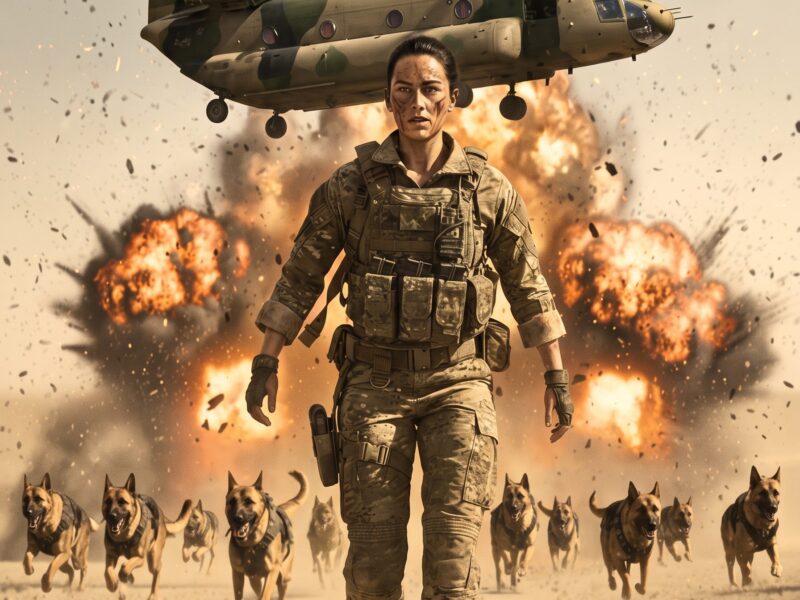
When the Air Force commander ordered everyone off the burning runway at Edwards Air Force Base
The emergency klaxons across Edwards Air Force Base did not just ring; they shook the marrow inside your bones. Black, petroleum-thick smoke rolled over the hangars, blotting out the high desert sun and painting the tarmac in a sickly, bruised orange. The air smelled of burnt aviation fuel, melted composite wiring, and charred rubber. Heat ripples bent the distant perimeter fence into liquid waves.
“Everybody out!” Commander Hayes’s voice tore through the tactical radio frequency, laced with raw fury and a strange, metallic panic. “Fall back to the secondary rally point past the perimeter road! Clear the runway immediately! Leave the dogs!”
I froze where I stood, twenty yards from the concrete apron of Hangar 6. My boots felt glued to the tarmac. My tactical vest was heavy against my ribs, soaked through with sweat. Beside me, seventeen Belgian Malinois and German Shepherds—the pride of the base’s security forces and specialized search units—did something I had never seen in my seven years as a military working dog specialist.
They stopped obeying.
These animals were conditioned through thousands of hours of intense drill to respond instantly to vocal commands, hand signals, and leash pressure. They were animals that had walked into live fire zones in foreign deserts without flinching. But right now, their ears were pinned flat against their skulls, their hackles raised like wire brushes, and their eyes were fixed not on the open escape route behind us, but directly into the heart of the raging inferno consuming Hangar 6.
“Ares, heel!” I barked, gripping the nylon lead of my assigned Malinois. The dog possessed eighty pounds of pure muscle and instinct, and every ounce of it was straining toward the fire. “Ares, down! Sit!”
He didn’t even turn his head. He let out a low, guttural vibration that resonated deep in his chest—a sound not of aggression, but of frantic desperation.
Across the line, the other handlers were losing control. Staff Sergeant Miller was practically dragged across the asphalt before his Shepherd, Blitz, wrenched the lead completely out of his gloved grip. Another dog slipped her harness with a violent, contorting twist. One after another, the line shattered. Seventeen leashes whipped through the soot-choked air. Seventeen shadows bolted directly toward the burning structure, their paws pounding against the hot concrete, barking furiously into the rolling flames.
My direct supervisor, Sergeant Cole, lunged forward and caught me by the upper shoulder strap of my body armor, his fingers digging into the Kevlar. His face was streaked with soot, his eyes bloodshot from the chemical fumes.
“Miller! Don’t do this!” Cole roared over the howling klaxon and the roaring crackle of the blaze. “Let them go! That’s an order from Hayes himself! Look at the support beams, man! The whole structural frame is going to collapse!”
“They’re going back for something, Cole!” I shouted back, tearing my arm from his grip. My heart was hammering violently against my breastbone. “Look at them! They aren’t scattering! They aren’t panicked! They’re moving in formation!”
“There’s nothing alive in there!” Cole screamed, coughing violently as a gust of greasy smoke slammed into our faces. “Hangar 6 was cleared two hours ago for the fuel transfer! It’s dead space! You run in there, you’re throwing your life away for stray instincts! The Commander will court-martial you before your boots even cool down!”
Through the dense, drifting black plumes, Commander Hayes stepped out from behind a heavy tactical transport vehicle. His uniform was spotless compared to ours, but his jaw was clenched so hard the tendons in his neck looked ready to snap. He held a sidearm loosely at his side, his radio mic keyed in his left hand.
“Sergeant Miller!” Hayes’s voice cut through the noise with venomous authority. “Stand down! Retreat behind the fire line now! If you pursue those animals into an active structural collapse zone, you are in direct violation of a lawful order! You’re acting like a coward looking for an excuse to ignore protocol! Move back!”
A coward. The word struck like a lash, but I couldn’t tear my eyes away from the hangar doors.
Ares had reached the far side of Hangar 6, near the reinforced service alcove. Blitz and three other Shepherds were right behind him. They weren’t running aimlessly through the flames. They were clustering around a heavy, reinforced steel maintenance hatch set flush into the foundation wall—a forgotten blast door half-concealed behind rusted transformer housings.
Then the roof groaned.
It was a terrifying sound, like a massive iron beast snapping its spine. A deafening roar echoed across the tarmac as a forty-foot section of corrugated steel and support girders collapsed inward, sending a blinding fountain of golden sparks and burning debris fifty feet into the air. The pressure wave knocked Cole and me back a step. The intense thermal wall pushed against our skin, blistering hot even through our flame-resistant gear.
Firefighters from the base response team rushed forward with high-pressure hoses, attempting to lay down a protective foam barrier, but the heat was too intense. They yelled through their respirators, waving us back with desperate arm motions.
Yet, through the billowing gray curtain, the dogs remained.
Ares was on his hind legs, forepaws slamming repeatedly against the industrial steel door. Blitz was beside him, tearing at the rubber weather-stripping with his teeth, ripping it away in long, jagged shreds. Three others were frantically digging their claws into the sealed seam at the base of the frame, their pads bloodying against the rough concrete.
They weren’t fleeing. They weren’t hiding. They were trying to break in.
Commander Hayes had jogged up behind us, his sidearm still drawn, his eyes wide and fixed on the dogs. When he saw the specific door they were attacking, the anger on his face vanished, replaced instantly by an absolute, bloodless shock. His skin turned an ashen, translucent gray under the dancing orange light of the fire.
“Not that hatch,” Hayes muttered under his breath, so quietly I barely caught it over the roar of the fire. “That tunnel was sealed during the Cold War decommission. It’s filled with dead pipe.”
“They smell something, sir!” I insisted, stepping closer to him, refusing to yield. “Dogs don’t throw themselves into a flashover fire for empty pipes! Let the rescue crew get the hydraulic cutters!”
“No!” Hayes barked, his voice cracking with sudden hysteria. “The structural integrity of this entire pad is compromised! We pull back to the perimeter fence right now! I will not risk base personnel for wild animals!”
“Look at them, Commander!” I yelled, stepping squarely into his line of sight. “They’re dying to get through that door! Ares won’t leave that hatch! If you order the trucks to withdraw, I’m going in with a halligan bar myself!”
For five agonizing seconds, Commander Hayes stared at me. His eyes darted from my face to the burning hangar roof, then to the seventeen dogs working in synchronized madness against the iron slab. His hand twitched around the grip of his weapon. For a split second, a chilling thought crossed my mind: he looked like a man deciding whether to shoot the lock himself or shoot the people watching it.
“Commander!” the lead firefighter shouted from twenty yards away, hauling a heavy Hurst rescue tool—the Jaws of Life—off the rear rack of Engine 4. “We can breach it before the second truss goes, but we need the call right now!”
Hayes swallowed hard, his throat bobbing. The arrogance that usually defined his command presence was entirely fractured.
“Pry it,” Hayes whispered.
“Sir?” the firefighter yelled back over the noise.
“I said open the damn door!” Hayes screamed, his voice strained and thin.
The rescue team didn’t hesitate. Two firefighters in full bunker gear bounded through the heat haze, their silver suits reflecting the raging orange walls. They wedged the hardened steel tips of the hydraulic spreader into the narrow gap between the door and the reinforced frame. The pump hummed into life, whining against the pressure.
Metal screeched against metal. The sound was deafening, a high-pitched shriek of tortured steel that cut straight through the low rumble of the fire. The dogs backed away only inches, panting heavily, tongues lolling, their coats singed with soot, forming a tight semicircle around the firefighters as if standing guard.
With a loud, concussive bang, the industrial latch sheared off.
The heavy blast door swung open three inches. Instantly, a thick, pressurized plume of cold, stale air poured out from the dark void within, colliding with the superheated atmospheric draft of the burning hangar. It smelled of old earth, damp concrete, copper… and human habitation.
Ares shoved his snout into the widening crack, whining with a feverish intensity.
“Get back!” I shouted, grabbing Ares by his tactical collar, pulling him back just far enough for the firefighters to wrench the heavy slab fully open.
Behind the steel door lay no ordinary utility closet or abandoned pipe chase. A steep concrete staircase plunged twenty feet straight down into the subterranean belly of the airfield, disappearing into an unmapped maintenance corridor completely omitted from our daily sector maps.
I pulled a high-lumen tactical flashlight from my chest rig and clicked it on. The bright beam cut through the hanging dust.
Down at the landing, illuminated by the harsh white light, sat four green military-issue oxygen cylinders, several woolen wool blankets neatly folded, stacks of empty commercial ration tins, and lined up along the damp concrete wall in a perfect, heartbreaking row—seventeen small, stainless-steel dog bowls.
My breath caught in my throat. My stomach plummeted into a cold, bottomless pit.
Someone had not just been hiding here. Someone had been living down here. And whoever it was had been secretly bringing every single one of our military working dogs down into this hole for weeks.
Then, through the heavy silence that settled beneath the roar of the flames above, a sound drifted up from the darkness.
It was tiny. Fragile. Completely out of place in a war machine facility.
A faint, muffled sob.
“There’s someone alive down there!” I yelled, dropping to my knees at the edge of the descent. “Search and rescue, on me!”
“Wait!” Hayes shouted from behind, his voice laced with an urgent, terrifying panic as his hand reached out toward my collar. “Miller, do not go down there! That is restricted space! That is an active crime scene!”
I didn’t listen. I didn’t care about the chain of command, the court-martial, or the collapsing roof above us. I plunged into the dark stairwell, following the dogs, who were already cascading down the concrete steps like a wave of fur and fury, racing toward whatever ghost was waiting at the end of the tunnel.
The temperature dropped twenty degrees the moment my boots hit the bottom of the concrete stairs, but the air felt heavy, suffocating, and charged with static electricity. The ceiling above us vibrated violently as the second truss of Hangar 6 collapsed into the inferno overhead, sending a muffled, thunderous shudder through the subterranean foundation. Dust rained down from the expansion joints, settling over my helmet and shoulders like gray snow.
“Ares! Blitz! Steady!” I called out, my voice bouncing off raw, unpainted cinder block walls.
The beam of my tactical light swept across the narrow corridor. It was roughly eight feet wide, framed by rusted conduit lines and heavy, braided communications cables that looked decades old. Yet, despite the age of the structure, the floor showed clear signs of recent, meticulous use. There were boot prints in the fine dust—clean, treaded patterns—and the unmistakable drag marks of heavy storage pelican cases.
The seventeen dogs were bunched around an offset alcove thirty yards down the hallway. They weren’t barking anymore. Instead, they produced a chorus of urgent whimpers, pressing their noses against a makeshift barrier constructed of stacked sandbags and a heavy sheet of flame-retardant canvas.
Sergeant Cole tumbled down the stairs behind me, landing heavily, his sidearm unholstered and held at low ready. He was panting, his eyes darting frantically across the ceiling that groaned under the weight of the disaster above.
“Miller, we have maybe three minutes before the fire department evacuates the perimeter entirely!” Cole hissed, coughing into his sleeve. “If the main fuel line beneath the hangar apron breaches, this entire basement is going to turn into an incinerator!”
“Help me clear these bags!” I yelled back, dropping my flashlight to the floor so its beam washed over the barricade.
I grabbed the top sandbag, hauling the seventy-pound burlap sack aside, tossing it to the concrete with a dull thud. Ares immediately thrust his front legs over the lowered barrier, his tail beating a frantic rhythm against the wall. Cole hesitated for half a second, his military discipline warring with his survival instinct, before he cursed under his breath, holstered his weapon, and grabbed the second bag.
Together, we tore the barricade down in less than forty seconds.
Behind the canvas was a small, reinforced fallout shelter, barely ten feet by twelve feet. It was illuminated by the dying red glow of a single battery-powered emergency beacon sitting atop an overturned ammunition crate. The air smelled of canned peaches, rubbing alcohol, and child’s sweat.
In the farthest corner, wedged tightly into the narrow crevice between two industrial water drums, sat a small figure curled into a tight, defensive ball.
It was a boy. He couldn’t have been more than six years old.
He wore an oversized, faded olive-drab flight jacket that completely swallowed his tiny frame, the sleeves rolled up several times to reveal thin, soot-stained wrists. His knees were pulled tightly against his chest, and his small face was pale, streaked with clean trails where tears had cut through the grime on his cheeks. In his small, trembling hands, he clutched a worn, laminated photograph against his sternum like a shield.
Ares didn’t hesitate. The massive Malinois stepped forward, his aggressive posture completely dissolving into something profoundly gentle. He lowered his massive head, walked deliberately across the cold floor, and rested his wet muzzle directly against the boy’s dirty knee.
The boy didn’t flinch. He didn’t scream. He simply buried one small hand into Ares’s thick fur, his fingers gripping the coarse hairs as if anchoring himself to the earth.
“Ares…” the boy whispered, his voice cracked, raspy from smoke and thirst. “You came back.”
One by one, the other dogs pressed into the small shelter. Blitz, the massive German Shepherd that had nearly broken Miller’s arm to escape the tarmac, dropped to his belly and crawled forward until his chin rested on the boy’s sneakers. Seventeen lethal military weapons had transformed into a protective, living wall of fur and warmth around a terrified child.
Cole stopped dead in his tracks, his flashlight beam trembling in his hand. “Sweet mother of God… Who is that? How long has he been down here?”
I dropped to my knees, lowering my profile to avoid scaring him. “Hey there, buddy,” I said softly, keeping my voice level, stripped of all the military bark. “My name is Miller. We’re here to get you out. It’s not safe here anymore. The building upstairs is coming down.”
The boy looked up at me. His large brown eyes were filled with an ancient, exhausting terror that no child should ever know. He didn’t let go of the photograph.
“My daddy said to wait,” the child murmured, his voice trembling violently. “He said… he said if the alarms went off and the loud noises started, I had to stay behind the sandbags. He said I couldn’t come up. Not for anyone.”
“Your daddy wanted you to be safe, bud,” I said, inching forward, extending a gloved hand palm-up. “And right now, the safest place is with us. With the dogs. See? Ares is with me. They trust me. You can trust me too.”
The boy looked at Ares, whose tail gave a soft, rhythmic thump against the concrete floor. The child slowly relaxed his grip on the dog’s fur and reached out toward my hand. His fingers were ice-cold.
“Where is my daddy?” he asked.
Before I could answer, heavy, hurried footsteps echoed down the concrete corridor behind us.
Commander Hayes stepped through the torn canvas entrance. His uniform was smeared with dust from the stairwell, but his face was set in a rigid, terrifying mask of absolute authority. Behind him, two members of the elite base security detachment stood with their carbines slung across their chests, looking distinctly uncomfortable.
Hayes’s eyes landed on the child, and every remaining trace of color fled his features. His lips parted, but for several seconds, no sound came out. It was the look of a man who had seen a ghost rise up from an unmarked grave to claim an unpaid debt.
“Marcus,” Hayes whispered, the name falling from his lips like a lead weight.
The boy shrank back instantly, pulling his hand away from mine and pressing himself harder against the water drums. Ares immediately snapped his head toward Commander Hayes, emitting a low, vibrating growl that echoed ominously off the cinder blocks. The hair along the Malinois’s spine stood straight up. The other sixteen dogs shifted in unison, their bodies tensing, facing the doorway, forming a physical barrier between the base commander and the child.
I stood up slowly, positioning myself between Hayes and the boy. “You know him, sir?”
Hayes ignored me. He took a single step forward, his hand extending outward. “Marcus. Give me what’s in your hand. Come here right now.”
“No!” the boy cried, tucking the laminated photograph deeper into his jacket. “Daddy said don’t let the man with the silver eagle touch it! Daddy said you were the one who broke the trucks!”
A suffocating silence fell over the bunker, punctuated only by the distant, rhythmic thuds of collapsing beams above and the deep, warning growls of seventeen military dogs.
Cole looked from the boy to Commander Hayes, his hand slowly resting near the retention holster on his hip. “Commander… what is the kid talking about? Whose boy is this?”
Hayes’s jaw twitched. When he spoke, his voice was ice-cold, stripped of all humanity. “That child is the son of former Technical Sergeant David Vance. Vance was terminated from base operations ninety days ago following a mental breakdown and the suspected theft of sensitive avionics hardware. He vanished before military police could take him into custody.”
David Vance.
The name hit me like a physical blow. Vance hadn’t been an active-duty airman when he vanished; he had been a chief civilian systems contractor responsible for the specialized avionics manifests passing through Edwards. But more than that—before he became a systems technician, David Vance had been the master trainer for the 371st Military Working Dog Squadron.
He was the man who had raised Ares from an eight-week-old puppy. He had trained Blitz. He had trained every single one of the seventeen dogs standing in this room.
Three months ago, the base bulletin had claimed Vance had suffered an episode of acute paranoid psychosis, abandoned his post in the middle of the night, and fled into the Mojave Desert, leaving his government housing abandoned. The official report said he was considered armed, dangerous, and likely dead from exposure in the salt flats.
“David Vance didn’t have a mental breakdown,” I said, my voice dropping an octave as pieces of an ugly puzzle began slamming together in my mind. “He reported a breach. I remember the chatter in the motor pool before the brass shut it down. He claimed unmarked transport planes were moving crated avionics out of Hangar 6 after midnight without flight plans.”
“That was classified operational protocol that an unstable contractor misunderstood!” Hayes snapped, taking another aggressive step into the room. Ares snapped his jaws together with a crack like a pistol shot, stopping Hayes in his tracks. “Sergeant Miller, step aside. We are evacuating this asset to the command bunker immediately. Hand the boy over to the security team.”
“He’s not an asset, sir,” I said, refusing to move. “He’s a six-year-old kid who’s been living in an abandoned blast tunnel for three months. And his father didn’t just leave him here. His father set this place up to keep him hidden from you.”
“You are dangerously close to insubordination, Sergeant,” Hayes snarled, his hand drifting toward his sidearm again. The two security airmen behind him exchanged uneasy glances, neither of them raising their weapons.
“Let the medics look at him first, Commander,” Cole intervened, stepping up beside me, his voice firm, refusing to yield the ground. “Look at him. He’s dehydrated. He’s inhaling smoke. Protocol dictates immediate triage at the field hospital.”
The boy began to cough, a deep, rattling cough that shook his tiny frame. He reached up with his left hand to wipe his nose, and as he did, the oversized flight jacket parted slightly.
Tucked into the interior lining of the jacket, held in place by a safety pin, was a piece of white plastic. It was a standard Department of Defense Common Access Card—a high-security clearance badge used to access the base’s restricted underground storage vaults. The edges were singed, as if someone had tried to burn it and failed, but the digitized photograph and the bold black text across the front were unmistakably clear.
The face on the card belonged to Commander Hayes.
Underneath his picture, stamped in bold crimson letters, was the credential: SPECIAL ACCESS PROGRAM: PROJECT OVERSIGHT – LEVEL 5.
Hayes saw the card. For a fraction of a second, the commander’s eyes betrayed pure, unadulterated terror. He knew that I had seen it. He knew that Cole had seen it.
“Marcus,” Hayes said, his voice dropping into a desperate, razor-thin whisper. “Give me the card, son. Your father made a terrible mistake. He stole things that didn’t belong to him. He was trying to hurt the base.”
The boy looked at Commander Hayes with an expression of pure, unyielding hatred that looked monstrous on a six-year-old face.
“My daddy didn’t steal anything,” the boy cried, pulling the laminated photograph from his chest and thrusting it forward for Cole and me to see. “He took the picture so people would know! He said if he didn’t come back, the dogs would find me! And he said the man with the silver eagle put the bad boxes on the plane!”
I looked down at the photograph in Marcus’s trembling hands.
It wasn’t a family portrait. It was a high-resolution surveillance photo taken inside Hangar 6 at night. It showed three men in civilian tactical gear loading olive-drab crates marked with advanced electronic guidance stencils into the belly of an unmarked, flat-black cargo transport.
Standing beside the cargo ramp, supervising the loading with a clipboard in his hands, was Commander Hayes.
And lying on the concrete floor just ten feet away from the cargo ramp, illuminated in the harsh glare of the maintenance floodlights, was a man in an Air Force contractor uniform, motionless, his head twisted at an unnatural angle, surrounded by a dark, expanding pool of blood.
David Vance hadn’t fled into the desert.
David Vance had been murdered right here on the concrete floor above our heads three months ago.
Ares let out another deafening roar of a bark, stepping directly toward Hayes, his lips pulled back to expose massive, gleaming canines. The other sixteen dogs pressed forward in a synchronized, menacing wall, their growls vibrating the very floorboards beneath our feet.
Commander Hayes backed up a step, his face completely devoid of color, his hand closing tight around the grip of his pistol.
“Nobody leaves this tunnel,” Hayes whispered.
The air in the subterranean bunker turned instantly toxic, not from the creeping smoke drifting down the stairwell, but from the sudden, lethal standoff between men who wore the same uniform.
The two security airmen standing behind Commander Hayes froze. Airman First Class Torres, a kid no older than twenty-two with fresh tactical patches on his shoulders, looked down at the photograph in the boy’s hand, then up at the back of Hayes’s head. His fingers, hovering over the pistol grip of his M4 carbine, began to shake.
“Sir?” Torres whispered, his voice cracking slightly under the strain. “What… what is that photograph?”
“Shut your mouth, Airman!” Hayes barked without turning around, his eyes locked onto me, his service pistol clearing its holster with a crisp, mechanical click. The barrel was leveled directly at my forehead. “Miller, you will take that photograph and that access badge, and you will place them on this ammunition crate. Right now.”
“You killed him,” I said. My voice was surprisingly calm, the kind of absolute stillness that settles over a soldier when the situation moves past fear and straight into survival. “David Vance caught you running black-market avionics out of Edwards. You staged his mental breakdown, dumped his truck out in the salt flats to make it look like exposure, and killed him right here in Hangar 6.”
“You don’t understand the scope of what is happening here, Sergeant!” Hayes hissed, his eyes darting frantically between me, Cole, and the seventeen dogs that were slowly, methodically spreading out to flank him. “Those guidance systems weren’t stolen! They were surplus components being redirected to foreign security contractors under an off-book directive! Vance was a technician who stuck his nose into a compartmented intelligence operation! He wouldn’t listen to reason! He pulled a weapon on a superior officer!”
“You’re lying,” Cole interrupted, his voice dropping into a dangerous, gravelly register. His hand was now firmly on his own sidearm. “I worked with David Vance for four years. The man was a church deacon. He didn’t pull a weapon on anyone. You executed him, and you burned down Hangar 6 today because an external audit team from the Pentagon landed at Sector 4 this morning.”
Hayes flinched. That single, microscopic reaction told us everything.
The fire hadn’t been an industrial accident. It was a cleanup operation. Hayes had torched the entire hangar to incinerate any physical residue of the illegal shipments, the manifests, and whatever physical evidence of Vance’s death remained embedded in the concrete foundation. But he hadn’t known about the blast tunnel. He hadn’t known that Vance, sensing his impending murder, had hidden his six-year-old son in the one place on the base that officially did not exist.
“The fire was an electrical short,” Hayes lied, his voice climbing in pitch. “And you two are about to become casualties of that very same accident. Structural collapse. Tragic loss of life. Along with these defective animals.”
Hayes began to squeeze the trigger.
He never finished the movement.
Ares didn’t wait for a verbal attack command. He didn’t need one. He had spent months being fed by the ghost of David Vance in this very room, watching the boy weep, sensing the malice radiating from the man in the polished uniform. With a concussive explosion of power, the eighty-pound Malinois launched himself off the concrete floor, clearing the ammunition crate in a single, terrifying leap.
“Ares, take him!” I yelled.
Hayes fired. The gunshot inside the enclosed concrete bunker was deafening, a sledgehammer blow of concussive pressure that blew out our eardrums and filled the room with the sharp tang of cordite. The 9mm round sparked off the ceiling conduit, showering us with white-hot sparks.
Ares hit Hayes square in the chest before the commander could reacquire his sight picture. The force of the impact slammed Hayes backward into the reinforced doorframe with a sickening thud. The pistol flew from his fingers, clattering across the floor directly to Cole’s boots. Cole kicked it violently down the dark hallway.
Hayes shrieked as Ares’s jaws clamped onto his left forearm, the heavy canvas of his flight suit ripping instantly under the crushing pressure. The commander slammed his back against the wall, trying desperately to reach for a combat knife on his belt, but Blitz and two other Shepherds surged forward, snapping their jaws inches from his throat, driving him down to his knees.
“Call them off! Call them off!” Hayes screamed, his face contorted in agony and terror. “Miller! Call them off!”
“Torres! Reyes!” I shouted, turning to the two security airmen who were backing away toward the stairs, their faces pale as sheets. “Look at your commander! Look at the child! Whose side are you on today? Are you going to commit murder for a traitor, or are you going to help me save this kid?”
Airman Torres looked at the little boy, Marcus, who was trembling violently behind me, still clutching the photo to his chest, tears streaming through the ash on his face. Then he looked at Commander Hayes, pinned to the floor by four massive military working dogs, whimpering in pain.
Torres slowly, deliberately, engaged the safety on his rifle and let it drop against its two-point sling.
“What do we do, Sergeant?” Torres asked, his voice shaking.
“Take his zip-ties,” Cole ordered, stepping forward with his own weapon drawn, keeping it trained directly on Hayes’s head. “Cuff him to the stairwell railing. If he resists, Ares gets the order to finish it.”
Ares let out another low, vibrating growl, his teeth still lightly grazing the ripped fabric of Hayes’s sleeve, daring the man to make a single twitch. Hayes went entirely limp, weeping softly in pain and humiliation as Torres and Reyes pulled his arms behind his back and bound his wrists with heavy industrial flex-cuffs.
I turned back to the boy. Marcus was shivering uncontrollably, his small body going into shock from the cold, the trauma, and the concussive blast of the gunshot.
“Marcus,” I said gently, kneeling before him again. I stripped off my heavy tactical vest, leaving only my fire-resistant undershirt, and wrapped the thick, warm Kevlar carrier around his tiny shoulders. “It’s over, buddy. The bad man can’t hurt you anymore. But we have to move right now. The roof upstairs is going to fall, and we need to get you into the sunlight.”
Marcus looked up at me, his small lower lip quivering. “Is my daddy really dead?”
The question ripped straight through my chest. In combat, you train yourself to compartmentalize everything—pain, fear, exhaustion. But looking into the eyes of a child whose father had been murdered just yards from where he had been hiding for ninety days was a wound no body armor could stop.
“Your daddy loved you more than anything in this world, Marcus,” I said, my voice thick with emotion. “He loved you so much that he taught seventeen of the toughest dogs in the United States military to be your personal guardians. And right now, we’re going to make sure his fight wasn’t for nothing.”
Marcus nodded slowly, wiping his eyes with the frayed sleeve of his father’s flight jacket. He reached out his arms, and I lifted him easily. He was terrifyingly light—barely forty pounds. He had survived on dry rations and bottled water for three months, rationed down to the calorie by a father who knew he was walking to his death.
“Cole, take point!” I ordered, shifting Marcus against my chest and pulling my secondary flashlight. “Torres, Reyes, haul Hayes up the stairs! Don’t let him out of your sight! Ares, lead the way!”
We moved in a tight tactical formation out of the fallout shelter and back down the dark corridor. Ares took the point, his tail low and alert, his ears swiveling at every groan of the ceiling. Blitz and the other fifteen dogs fell in around us, forming a living perimeter around Marcus and me, moving with the quiet, deadly precision of a seasoned combat patrol.
As we reached the base of the concrete stairs, a massive explosion rocked the surface.
The blast wave funneled straight down the stairwell like an invisible battering ram. It threw Cole against the handrail and sent a shower of burning debris and choking gray smoke cascading down the steps. The heat returned with a vengeance, thick, suffocating, and smells of burning fuel.
“Main fuel line just went!” Cole yelled, shielding his face from the raining sparks. “The hangar apron is completely engulfed! The main exit is blocked by fire!”
I looked up the stairwell. The doorway we had entered through was now a roaring rectangle of pure, blinding orange. A wall of fire stood between us and the open tarmac. The heat was so intense the concrete at the top of the stairs was beginning to crack and spall, spitting sharp stone fragments into the air.
Hayes, slumped against the railing with his hands bound behind his back, let out a dry, hysterical laugh. “You’re dead, Miller! We’re all dead! There’s no way through that door! The whole hangar is coming down on top of us!”
The dogs began to whine, pacing back and forth at the base of the stairs, turning away from the blistering heat radiating down from the surface.
Marcus buried his face in my neck, his little hands gripping my shirt with desperate strength. “Miller… there’s another way.”
I froze, looking down at the child in my arms. “What did you say, Marcus?”
The boy pointed a tiny, trembling finger past the stairs, toward the absolute darkness of the maintenance corridor that stretched deeper into the subterranean base.
“Daddy showed me,” Marcus whispered. “He said if the fire ever came to the door, the dogs knew the old tunnel to the water tower.”
Ares suddenly spun around, barking once—sharp, clear, and commanding—before turning and sprinting into the pitch-black darkness of the unexplored tunnel.
“Follow that dog!” I roared over the deafening crackle of the blaze behind us.
We abandoned the stairwell just as another massive section of the hangar floor caved in, sending an avalanche of white-hot steel girders and burning industrial roofing smashing down onto the very steps where we had been standing seconds before. A wall of dense, suffocating black smoke chased us down the corridor like a living predator, curling along the low ceiling and dropping visibility to less than five feet.
“Keep moving! Don’t stop!” Cole shouted from behind, using his flashlight to guide Torres and Reyes, who were practically dragging Commander Hayes between them. Hayes was stumbling, coughing hysterically, his boots dragging against the uneven concrete floor.
The tunnel stretched far beyond the perimeter maps of modern Edwards Air Force Base. This was infrastructure built in the early 1950s, a forgotten network of subterranean escape routes and utility chases designed to survive a nuclear blast. Rusted iron pipes ran along the walls, sweating cold moisture, while ancient glass insulators hung from rotting wooden support frames.
Ares ran twenty yards ahead, his white-tipped tail acting as our beacon through the drifting smoke. Every few seconds, he would pause, turn back, let out a single, sharp bark to verify we were keeping pace, and then dart forward again into the gloom. The other sixteen dogs ran in a synchronized pack, flanking Marcus and me, their heavy bodies brushing against my thighs, creating a physical shield that prevented me from stumbling into the jagged metal debris protruding from the decaying walls.
Marcus held onto my neck with an iron grip. His breathing was rapid and shallow, but he wasn’t crying anymore. The sheer presence of the dogs seemed to imbue the boy with an unnatural, stubborn courage.
“The pipe with the blue stripe,” Marcus whispered into my ear, his voice cutting through the hollow slapping of our combat boots against the wet concrete. “Daddy said follow the blue pipe until it turns up.”
I swept my flashlight beam across the ceiling. High above our heads, nearly obscured by decades of soot and dust, ran a thick iron conduit painted in faded navy blue.
“He’s right!” I yelled back to Cole. “Blue line leads to the old auxiliary pumping station near the water tower! It’s at least three hundred yards outside the security perimeter of Hangar 6!”
“We’re running out of air, Miller!” Cole called back, his voice ragged. “The draft from the hangar fire is pulling all the oxygen out of this tube! We have maybe two minutes before we suffocate!”
The air was indeed growing thin. My lungs burned with every stride, a cold, empty ache that signaled acute oxygen deprivation. My temples throbbed with a vicious, rhythmic hammer. Even the dogs were slowing down, their tongues hanging long and dry from their mouths, their panting turning into labored, wheezing gasps.
Suddenly, Ares stopped dead ahead.
The tunnel terminated abruptly into a massive, circular vertical shaft made of heavy, riveted iron plates. Water dripped from unseen cracks high above, splashing into a foul-smelling pool of stagnant runoff that covered the floor up to our ankles.
Rising up the center of the shaft was a rusted iron ladder, its rungs vanishing sixty feet straight up into the darkness toward a circular hatch that looked like the lid of a massive pressure cooker.
“Dead end!” Hayes gasped, collapsing to his knees in the shallow water, his face twisted in malicious triumph despite his captivity. “It’s an old inspection silo! That hatch is sealed from the outside with four mechanical dogs! You can’t open it from below! We’re trapped in a chimney!”
I set Marcus down gently on a dry concrete ledge at the base of the shaft. Ares immediately planted his front paws on either side of the boy, standing over him protectively.
I rushed to the base of the ladder, grabbing the bottom rung. It was cold, slick with algae, but solid iron. I looked up. Sixty feet above, a faint, razor-thin sliver of blinding desert daylight cut through the perimeter seal of the heavy iron hatch.
It was our only way out.
“Torres, Reyes, hold Hayes here!” I ordered, stripping off my heavy utility belt to shed weight. “Cole, stay with the kid! I’m going up to see if the latch can be forced!”
“Miller, you can’t throw an external hatch with bare hands!” Cole shouted, looking up the terrifyingly long climb. “If that thing is rusted shut, you’ll drop from smoke inhalation before you even get halfway!”
“We don’t have a choice!” I snapped, placing my boot on the first rung.
Before I could take a second step, Marcus stepped away from the concrete ledge, walking deliberately through the ankle-deep water toward the base of the shaft. Ares stayed glued to his hip, matching him step for step.
“You don’t push it,” Marcus said, looking up at the distant circle of light with complete calm.
I paused, looking back down at the six-year-old boy. “What did you say, Marcus?”
“Daddy said you don’t push the hatch,” the boy repeated, pointing to a heavy, grease-encrusted steel cable that hung down the western wall of the shaft, counterweighted by a massive, concrete block suspended four feet above the floor. “He said you pull the lever behind the box, and Ares knows what to do.”
I turned my flashlight beam toward the corner Marcus indicated. Hidden behind the massive counterweight was a heavy, cast-iron mechanical release lever, painted in peeling industrial red. It looked like an emergency manual override for an industrial blast damper.
I lunged toward the lever, grabbing the iron handle with both hands. It was completely seized by decades of rust and calcification. I planted my boots against the wall and threw my entire body weight backward, screaming through my clenched teeth.
The metal didn’t budge.
“It’s frozen!” I grunted, my boots slipping in the foul water. “The linkage is rusted solid!”
Cole ran over, grabbing the handle beside me. “On three! One… two… three—PULL!”
We strained together, the veins bulging along our forearms, our muscles screaming in agony as the suffocating smoke began to spill down from the horizontal tunnel into the base of the shaft. Hayes sat in the water, coughing violently, his laughter turning into ragged, terrified weeping as the reality of his own death finally penetrated his arrogance.
The lever groaned. A flake of rust cracked and fell. But it didn’t trip. We simply didn’t have the leverage.
Then, Marcus knelt beside Ares.
The boy took the dog’s massive head in his tiny hands, pressed his forehead against the dog’s wet snout, and spoke a single, guttural word in a language that wasn’t English, German, or Dutch. It was a nonsense word—a private, invented command David Vance had created specifically for this animal.
“Vance-hold!” Marcus whispered.
Ares’s eyes widened with an almost supernatural clarity. The Malinois spun around, charged toward the cable, and leaped.
His powerful jaws clamped around the thick, braided steel loop that hung from the release mechanism above the counterweight. He didn’t just bite it; he used his entire eighty-pound body mass to hang suspended in midair, jerking downward with violent, coordinated thrashing motions.
Blitz saw what Ares was doing. Without a single human command, the massive German Shepherd bounded through the water and leaped, clamping his teeth into the lower end of the same heavy braided line, adding another eighty-five pounds of desperate, thrashing weight.
Two more dogs joined them, biting the release chain, their bodies hanging, pulling, snapping the dead weight downward with raw, primal fury.
CLANG!
A sound like an artillery shell firing echoed through the vertical silo. The rusted iron lever sheared past its calcified stops, slamming downward into the floor.
High above our heads, the counterweight dropped with a deafening screech of industrial pulleys. The massive circular hatch at the top of the shaft popped upward with a concussive hiss of releasing pneumatic pressure, swinging open on heavy counterbalanced hinges.
A blinding, vertical pillar of pure, brilliant California sunlight cascaded down through the shaft, piercing the dark, smoky water like a divine spear.
Along with the light came a rush of clean, crisp, ninety-degree desert air—sweet, hot, and completely free of petroleum smoke.
The dogs dropped to their feet, splashing in the water, shaking their heads, looking up at the sky. Ares let out a triumphant, echoing howl that bounced off the steel walls of the silo, and one by one, the other sixteen dogs joined him in a deafening, unified chorus of resurrection.
“Ladder! Right now!” Cole screamed, tears of relief cutting through the soot on his cheeks. “Miller, take the boy! Go!”
I scooped Marcus into my left arm, pressing his face against my chest, and grabbed the iron rungs with my right hand. I didn’t feel the burning in my lungs anymore. I didn’t feel the exhaustion in my legs. I climbed with a frantic, desperate rhythm, rung by rung, ascending out of the tomb, rising directly toward the blinding blue sky of the high desert.
Breaking through the surface of that forgotten inspection hatch felt like tearing through the caul of the earth itself.
I hauled myself over the rusted iron lip, rolling onto my back onto the sun-baked desert sand, clutching Marcus tightly against my chest. The child was coughing, but it was clean desert air filling his lungs now. Above us, the sky was an unbroken, brilliant dome of turquoise, completely divorced from the nightmare consuming Hangar 6 four hundred yards to the south.
Behind us, towering over our heads, was the massive, rusted silhouette of the decommissioned auxiliary water tower. We were well beyond the inner security perimeter, hidden behind a grove of salt cedars and abandoned equipment depots.
Ares was the first dog up the ladder. He cleared the lip with a magnificent, scrambling leap, landing softly in the sand, instantly shaking his entire coat until a cloud of gray soot exploded off his fur like powder. One by one, the other sixteen dogs emerged from the hole, scrambling up the narrow iron rungs with uncanny agility, spilling out onto the desert floor like a company of rescued ghosts.
Cole emerged next, hauling himself up with a ragged gasp, followed by Torres and Reyes, who practically threw Commander Hayes out onto the sand.
Hayes collapsed onto his side, his face pressed into the dirt, his wrists still tightly bound behind him. His uniform was torn, soaked in black industrial runoff, and his left arm was heavily bruised and bleeding from Ares’s bites. He looked nothing like the untouchable, silver-eagled commander who had ruled this installation for three years. He looked broken, terrified, and utterly ruined.
In the distance, the sirens were multiplying.
Black smoke from Hangar 6 was still boiling into the stratosphere, but now, a fleet of high-speed security vehicles and civilian emergency trucks was racing along the outer perimeter road. Among them were three unmarked, dark-blue Chevy Suburbans with government plates, driving with aggressive, synchronized speed—the Pentagon inspection team.
“They saw the smoke,” Cole said, shielding his eyes from the harsh sun, panting heavily as he dropped onto the sand beside me. “The whole base is locked down. Every gate is sealed.”
“Let them come,” I whispered, setting Marcus down on the soft sand.
The boy looked around, blinking against the harsh sunlight. It was the first time in ninety days that the California sun had touched his skin. He reached out with a trembling hand and touched a sprig of dried desert scrub, feeling the brittle needles, as if confirming that the world above ground was still real.
Ares immediately padded over and sat squarely beside the child, leaning his massive body against Marcus’s small frame, offering him an unbreakable pillar of support. Blitz and the other fifteen dogs fanned out in a massive, protective perimeter around the boy, facing outward, their tongues hanging out, panting, eyes sharp and watchful.
Within two minutes, the roar of heavy V8 engines tore through the quiet scrub.
Four Air Force Security Forces patrol trucks skidded to a halt in the loose dirt fifty yards away, their tires kicking up plumes of dust. The blue Suburbans pulled up right behind them, their doors flying open before the wheels had even fully stopped rolling.
A dozen armed airmen poured out, their rifles raised, led by a tall, gray-haired woman wearing the two-star insignia of an Air Force Major General, flanked by civilian agents in crisp suits carrying federal credentials.
“Nobody move!” an armed security lieutenant yelled, his voice trembling as he surveyed the bizarre, cinematic tableau before him: two soot-covered dog handlers, two tactical airmen, seventeen battle-hardened dogs forming a tight circle around a tiny child, and the installation commander lying bound and bleeding in the dirt. “Drop your weapons! Hands where we can see them!”
Cole and I slowly raised our empty hands. Torres and Reyes did the same, stepping back from Hayes.
The Major General walked forward, her boots crunching sharply against the gravel. Her eyes swept over the dogs, lingering on Ares, who gave a single, quiet rumble in his chest but did not break formation. Then her gaze landed on the bound man in the dirt.
“Commander Hayes?” General Vance-Palmer—whose name tag caught the sun—stopped dead in her tracks. Her eyes widened in absolute shock. “What in God’s name happened out here? Sergeant, explain this scene immediately!”
“General,” I said, my voice hoarse, raw from smoke and emotion. “Commander Hayes didn’t order an evacuation today to save lives. He torched Hangar 6 to destroy evidence of an illegal black-market weapons pipeline he’s been running off this base for eighteen months.”
“That’s a lie!” Hayes spat, struggling to lift his face from the dirt, his voice muffled by the sand. “General! These men are mutineers! They assaulted a commanding officer! They’re covering for David Vance’s theft! Shoot the dogs! Shoot those damn dogs!”
Not a single weapon moved.
General Vance-Palmer looked down at Hayes, then at the seventeen dogs that were staring at her with cold, unwavering intelligence.
Marcus stepped forward. He didn’t look afraid anymore. Wrapped in my oversized Kevlar tactical vest, the boy walked through the gap between Ares and Blitz, holding the laminated photograph in one hand and Hayes’s burned security card in the other.
“He’s the bad man,” Marcus said. His voice was small, but in the absolute silence of the high desert, it carried like a rifle shot. “He killed my daddy.”
The General froze. Her eyes dropped to the child, then to the photograph he was holding out to her.
She walked forward slowly, deliberately lowering her posture so she wasn’t looming over the boy. Ares sniffed her outstretched fingers, recognized the absence of hostility, and allowed her to step into the circle.
The General took the photograph.
For nearly thirty seconds, she stared at the image of Hayes standing over the body of David Vance beside the unmarked transport plane. Her face turned to stone. The civilian agents from the Pentagon stepped up beside her, their faces darkening as they inspected the timestamp and the unmistakable digital signature embedded in the corner of the print.
One of the federal agents pulled a heavy evidence folder from his briefcase, opening it to reveal a series of audited avionics manifests.
“The numbers match, General,” the agent said quietly. “Vance’s personal identification code was used to flag these exact crates three hours before he vanished. He didn’t steal them. He tried to lock them out of the flight computer.”
General Vance-Palmer closed her eyes for a brief, agonizing moment. When she opened them, her gaze was fixed on Hayes with an absolute, terrifying coldness.
“David Vance was one of the finest men this service ever produced,” the General whispered, her voice shaking with barely suppressed fury. She looked down at Hayes. “And you left his boy in a hole in the ground to die.”
She looked up at the armed security team standing behind her trucks.
“Take Commander Hayes into federal custody,” she ordered, her voice cutting through the desert air like glass. “Transfer him directly to the Provost Marshal at Edwards Main. Article 118: Premeditated Murder. Article 108: Destruction of Military Property. Article 134: Treason. Strip his insignia right now.”
Two large security airmen marched forward. They didn’t treat Hayes with the gentleness of military courtesy. They hauled him to his feet by his bound elbows, ripped the silver eagles from his collar with a sharp, tearing sound, and shoved him into the steel cage of the nearest patrol truck, slamming the door shut.
The desert fell quiet again, save for the distant rumble of the dying fire across the airfield.
General Vance-Palmer knelt in the dirt directly in front of Marcus. She reached out, her gloved hand gently brushing a streak of black soot from the boy’s cheek.
“Marcus,” she said softly, her eyes glistening with unshed tears. “I’m your father’s cousin, Evelyn. He called me three months ago. He told me that if anything ever happened to him, I had to bring the federal inspection team directly to Hangar 6. But by the time we landed… we thought we were too late.”
Marcus looked at her, then turned his head back toward the seventeen dogs standing patiently in the sun.
“You weren’t too late,” Marcus whispered. “Daddy told them to wait for me. He told Ares.”
Ares leaned down, his wet nose bumping gently against the boy’s cheek, licking away a stray tear that had broken through the soot. Marcus wrapped his tiny arms around the Malinois’s massive neck, burying his face in the coarse fur, and for the first time since the klaxons had screamed across the burning tarmac, the boy began to cry—not with terror, but with the profound, devastating release of a child who was finally, truly safe.
I stood beside Cole, watching the civilian agents and medics approach with blankets, cold water, and medical kits. The weight of the last four hours seemed to crash down on my shoulders all at once, making my knees shake with exhaustion.
Cole reached out, his hand resting heavily on my shoulder, giving it an understanding squeeze.
“Coward, huh?” Cole murmured, a faint, tired smile touching his soot-blackened lips. “Worst damn coward I ever saw in my life.”
“Just following orders, Sergeant,” I said, my voice cracking into a tired chuckle. “Ares’s orders.”
As the medical team gently wrapped Marcus in a warm, clean wool blanket and lifted him into the back of an air-conditioned command vehicle, the boy refused to let go of Ares’s collar. The flight surgeon looked at me, questioningly.
I looked at Ares. “Up, boy. Go with him.”
The Malinois leaped into the rear of the vehicle without hesitation, curling his massive, powerful body around the boy’s legs on the padded bench, his golden eyes watching the medics with calm, steady vigilance. The other sixteen dogs sat in a silent, disciplined formation along the desert sand, their duty fulfilled, their pack unbroken.
The fire at Hangar 6 was finally dying down, sending a thin, gray smudge of smoke harmlessly into the blue sky. The base would spend months rebuilding the concrete, auditing the manifests, and burying the traitor who had disgraced the uniform.
But here, on the edge of the runway, beneath the shadow of the old water tower, something entirely different had been proven.
Men can lie. Commanders can betray their oaths. Concrete and steel can burn and collapse into ash.
But the bond between a boy, his father, and seventeen dogs who refused to abandon their post was something that no fire on earth could ever destroy.
The end.









