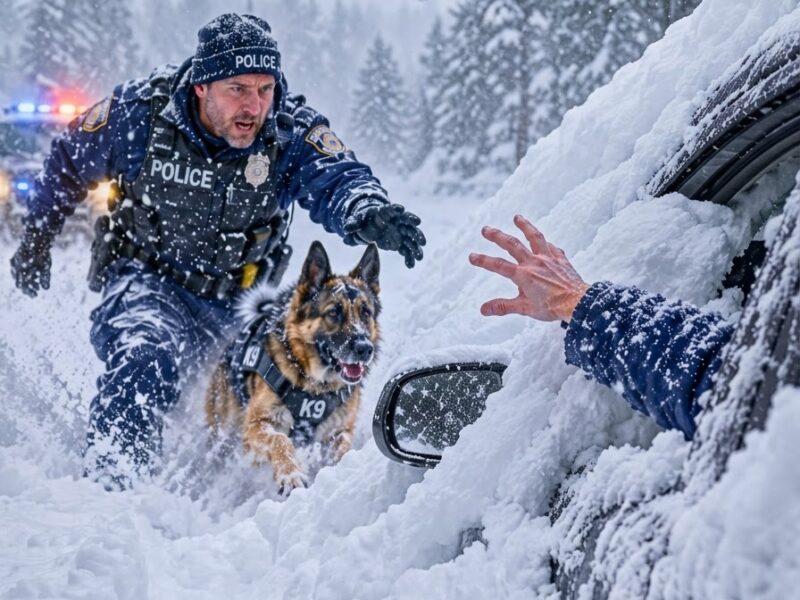
When my K9 suddenly tore away from me during a blizzard and began digging through six feet of snow beside a deserted mountain road
The wind in Blackwood Pass didn’t blow; it howled like a living thing trapped between the granite walls of the gorge. It was 3:15 in the afternoon, but the sky had collapsed into a suffocating, slate-gray gloom that turned the world into a flat expanse of white static. Sub-zero temperatures had hardened the falling snow into microscopic needles of ice that bit into the exposed flesh of my face, finding every microscopic gap between my thermal balaclava and tactical goggles.
Visibility was less than twenty feet. The asphalt of Route 9, the twisting two-lane artery carving through the northern spine of the Cascade Range, had been completely erased three hours ago. There were no lane markers, no shoulders, no distinction between the crowned surface of the highway and the steep, three-hundred-foot ravines that dropped off into the frozen pines below. The state Department of Transportation had raised the avalanche gates at the base of the pass at noon, shutting down all civilian transit.
I shouldn’t have been up there. Neither should Rex.
Rex was an eighty-pound, pitch-black Belgian Malinois with a chest like an anvil and scars across his muzzle from an illegal methamphetamine lab breach two winters back. He was six years old, at the absolute apex of his physical power and tracking capability, certified by the state police in both cadaver recovery and live-scent tracking. We had spent the previous eight hours combing the lower tree lines near Miller’s Creek for a missing sixty-two-year-old snowshoer who had wandered away from his cabin during the preliminary squalls. We hadn’t found him; search and rescue dispatch had eventually called off the grid sweep when the barometric pressure plunged off a cliff, signaling the arrival of the main arctic front.
We were crawling down the pass in my modified Ford F-250 patrol truck, chains clanking heavily against the four tires, when Rex suddenly rose from the flat deck in the rear cabin.
He didn’t whine. He didn’t pace. He placed his massive paws on the center console, thrust his snout against the defrost vents, and let out a single, sharp, percussive bark that reverberated off the reinforced windshield.
“Sit down, boy,” I muttered, my hands cramping around the steering wheel as the truck fought against a sudden forty-knot crosswind. “Ten more miles to the salt sheds. Then you get a warm steak and an electric blanket.”
Rex ignored me entirely. His dark brown eyes were dilated, locked onto the opaque swirl of snow outside the passenger window. His hackles—the stiff, coarse guard hairs along the ridge of his spine—stood rigid like iron wire. He slammed his snout against the glass, leaving a foggy crescent of condensation, and let out a low, vibrating growl that vibrated directly through the floorboards.
I knew that sound. In five years of working together across three mountain counties, Rex had made that sound only when he was locked onto human scent under extreme duress.
I tapped the brakes, feeling the anti-lock system pulse violently under my boot before the heavy truck found purchase on the packed ice. We drifted to a halt fifty yards past Mile Marker 44, a desolate, wind-scoured bend known locally as Dead Man’s Elbow.
The moment I shifted into park and pulled the emergency brake, Rex went ballistic. He threw himself against the back door, clawing at the interior latch.
I grabbed my heavy winter parka, clipped my field radio to my shoulder mic, and pulled my tactical snow goggles over my eyes. “Alright, Rex. Heel.”
The second I opened the door, the blizzard tore it out of my grip, slamming it against the exterior fender with a metallic crack. Rex didn’t wait for a heel command. He hit the snowbank in a blur of black fur, sinking belly-deep into the fresh drift before lunging forward with explosive, desperate power.
“Rex! Hold!” I shouted, but the wind stripped the words from my mouth and scattered them into the storm.
He wasn’t following a standard zig-zag pattern. He was charging in a dead-straight line toward the outer guardrail—or where the guardrail was supposed to be. At this specific curve, an ancient wooden timber barrier had rotted away decades ago, replaced only by a shallow gravel runoff that dropped into a secondary drainage ditch before falling into the ravine.
The snowdrifts here were massive, pushed into mountainous waves by the gale sweeping across the valley floor. In some places, the drifts reached seven or eight feet, sculpted like frozen tidal waves.
Rex reached the lip of the embankment and plunged headfirst into a massive, undisturbed drift. He wasn’t sniffing the air; he was violently tearing at the packed crust with his front paws. Snow flew behind him in white rooster tails.
I scrambled after him, my snowshoes sinking six inches into the powdery surface with every lunging step. By the time I reached the edge of the depression, Rex had already excavated a hole three feet deep. He was whining frantically, biting into chunks of blue ice, ripping them out with his teeth and spitting them aside.
“Rex, back! Out!” I commanded, reaching down to grab the heavy nylon handle of his tactical harness.
He refused to yield. He twisted his muscular neck, slipping my grip, and dove deeper into the trench. His nails struck something that didn’t sound like rock or frozen earth.
CLANG.
It was the hollow, resonant ring of sheet metal.
A bolt of adrenaline surged through my bloodstream, cutting through the numbness in my fingers. I dropped to my knees beside the dog, unhooking the compact aluminum avalanche shovel from my backpack.
“Good boy! Clear!” I yelled, pushing him back with my hip as I drove the shovel blade into the drift.
Rex didn’t step away; he shifted two feet to the left and began excavating along the same plane. Together, we worked with manic speed. The wind howled overhead, dumping fresh snow into our excavation almost as fast as we could throw it out, but within four minutes of frantic digging, the shovel scraped across curved automotive glass.
I brushed away the packed crust with my gloved palm.
Beneath the ice was the upper corner of a windshield. Through the tinted, frosted glass, in the faint ambient gloom of the storm, I saw the interior of a vehicle.
It was a compact sedan, crushed slightly along the passenger A-pillar, tilted at a thirty-degree angle into the drainage ditch. And in the driver’s seat, illuminated only by the gray light filtering through the snow we had cleared, was a body.
“Dispatch, this is Unit 4,” I barked into my shoulder mic, my voice shaking with exertion. “I have a 10-50 vehicle off the roadway at Mile Marker 44. Vehicle is completely submerged beneath a six-foot drift. I have an occupant inside, unresponsive. Requesting heavy rescue and EMS code three immediately.”
Static crackled over the speaker. A faint, broken voice answered: “…Unit 4… repeater down… storm conditions… ETA for… forty-five minutes minimum… plows are stuck at… Mile 22…”
“Understood. I am initiating extrication,” I said, knowing full well forty-five minutes on this mountain in this temperature was a death sentence.
I took the hardened steel window-punch from my utility belt and pressed it against the exposed top corner of the driver’s side window. I leaned my weight into it.
POP.
The tempered glass shattered into thousands of tiny, opaque pebbles, held together by the tint film. I used the back of the aluminum shovel to cave the glass inward, clearing the jagged perimeter.
A wave of air escaped from the cabin. It wasn’t warm—the car’s engine had clearly been dead for hours—but it was stagnant, smelling faintly of lavender perfume, wet upholstery, and the metallic tang of dried blood.
Rex thrust his muzzle through the opening, letting out a soft, high-pitched whimper that sounded entirely unlike him.
I reached through the opening, clearing away the glass-crusted snow, and felt for a pulse along the side of the woman’s neck. Her skin was like refrigerated marble. Her dark hair was matted with frozen perspiration and a gash along her hairline had bled down her cheek before freezing into a dark amber ribbon.
For three terrifying seconds, I felt nothing. Then, beneath the pad of my thumb, I caught it: a faint, thready, agonizingly slow pulse.
“Ma’am! Can you hear me?” I shouted, shining my high-lumen tactical flashlight into the cabin. “Sheriff’s Department! You’re safe! Can you hear me?”
Her eyelids fluttered. They were encrusted with white frost. Slowly, with an effort that seemed to take every remaining ounce of her soul, her eyes cracked open. They were a striking, feverish green.
Her gaze didn’t lock onto me. It drifted downward, toward her own lap.
Her hands—gloved in thin, soaked wool—were clamped in an iron grip over her abdomen. Underneath her heavy wool coat, her stomach rose in a pronounced, unmistakable swell. She was at least seven or eight months pregnant.
“My baby…” she breathed. The sound was barely a puff of vapor against the sub-zero air.
“Hang on,” I told her, my heart slamming against my ribs like a sledgehammer. “We’re going to get you out of here right now.”
I used the shovel to lever the bent door handle, throwing my entire body weight backward against the drift until the driver’s door groaned and popped open on screaming hinges.
“Rex, watch!” I ordered.
The dog stood at the edge of the ditch, his ears swiveling through the storm, his eyes scanning the road while I leaned into the car, unbuckled her frozen seatbelt, and carefully worked my arms behind her shoulders and knees. She was so cold she felt brittle, like she might shatter under pressure.
As I lifted her out into the blinding fury of the blizzard, she groaned, her head rolling back against my chest. Her fingers, stiffened by the onset of severe hypothermia, suddenly reached up and clamped onto the collar of my parka with surprising strength.
“No…” she rasped, her green eyes wide with a sudden, wild terror that cut straight through her lethargy. “No… you don’t understand…”
“I have you, ma’am. You’re out of the car. My truck is heated, I have emergency blankets—”
“Not an accident,” she whispered. Her lips were cracked, tinged with a deep, ischemic violet. Every word cost her dearly. “He… he pushed me.”
I reached my truck, kicked the passenger door open, and laid her across the heated seats, pulling the emergency space blankets and heavy wool utility throws from behind the bench. I cranked the climate control to maximum, aiming the vents directly at her torso while avoiding rapid warming of her extremities to prevent thermal shock.
Rex leaped into the footwell, resting his massive chin across her knees, his body acting as an eight-pound radiator of living heat. She didn’t push him away; her trembling hand drifted down and buried itself in his thick black ruff.
“Take it easy,” I said, kneeling in the open doorway, checking her pupillary response with my penlight. “Who pushed you?”
“A black truck… heavy bumper,” she choked out, her breath rattling in her chest. “He followed me from the diner in Valley Falls. He rode my tail across the lower bridge. When we hit the pass… he rammed my quarter-panel. He spun me into the ditch.”
I stared at her, the cold settling deep into my stomach. “Did he leave?”
“No,” she wept, a single frozen tear cracking on her cheek. “I… I was conscious. I couldn’t move my legs. I saw his boots through the broken glass. I thought… God, I thought he was coming to pull me out.”
She grabbed my wrist, her fingernails digging through my tactical glove.
“He didn’t help. He had an avalanche shovel in his truck. He took the snow from the roadside drifts… and he threw it over the car. He packed it down. He covered the glass. He covered the exhaust. He buried me alive.”
Her chest hitched in a violent, rattling sob.
“And before he walked away… he looked through the window. He looked right at my belly. He smiled. He knew I was pregnant.”
A cold silence fell over the cab of the truck, deeper and more terrifying than the blizzard outside.
Suddenly, through the howling whiteout behind us, the faint, wailing pulse of a siren cut through the wind. Down the switchback, two sets of amber and red emergency flashers pierced the snow—the heavy county plow accompanied by an all-wheel-drive paramedic rig.
Help had arrived.
I exhaled a breath I hadn’t realized I was holding. “You’re going to make it,” I told her, squeezing her hand. “The medics are here.”
Rex suddenly stiffened.
His head snapped up from her knees. He didn’t look toward the flashing red lights of the approaching ambulance. He turned toward the north—up the pass, toward the abandoned summit road that led into the high logging clear-cuts.
A low, serrated growl tore out of his throat.
I stepped out of the truck, resting my hand on the butt of my holstered Glock 20.
Fifty yards beyond my truck, completely dark, sitting silently on the shoulder of the snow-covered highway with its engine idling in a thin plume of gray exhaust, was a dark, heavy-duty pickup truck. It had an oversized steel brush guard bolted to the front frame, crusted in ice and scraped down to bare, rusted metal on the right corner.
No headlights. No hazard flashers.
Through the heavily tinted windshield, barely visible against the whiteout, the silhouette of a man sat behind the wheel.
Watching us.
He had been there the entire time. Sitting in the storm, waiting to confirm that the drift would remain a tomb.
I reached for my radio to call the approaching units.
The dark pickup’s high-beam halogen lights suddenly ignited with a blinding, five-thousand-lumen flash that seared through the snow, obliterating my night vision.
The heavy diesel engine roared to life, spitting black smoke into the blizzard, its tires churning through the unplowed snow as it accelerated directly toward the shoulder where we stood.
Rex lunged from the cab, hitting the snow with a ferocious roar, ready to meet the three-ton steel missile head-on.
Inside the warm cabin of my truck, the woman let out a piercing, ragged shriek that cut through the thunder of the approaching engine:
“That’s him!”
The blinding glare of the high beams swallowed my entire field of vision. The roar of the diesel was a physical blow, vibrating through the frozen crust of the road and rattling the teeth in my skull.
“Rex, back! Back!” I screamed, lunging sideways and grabbing the heavy nylon handle of his harness with both hands.
I threw myself and the dog backward toward the lee side of my patrol truck just as the black pickup blew past. The displacement of air hit us like a tidal wave of compressed slush and road grit. The truck’s steel brush guard clipped the open passenger door of my F-250, shearing the heavy hinges with an ear-splitting screech of tortured metal, sending the door spinning into the whiteout like a sheet of discarded tin.
The vehicle didn’t stop. It fish-tailed violently, its heavy studded tires catching the icy crown of the road, throwing twin geysers of frozen slush thirty feet into the air as it surged past the approaching snowplow.
The county plow driver slammed on his air brakes, his heavy V-blade cutting a deep furrow into the asphalt, horn blaring in a long, continuous blare of warning. The dark truck side-swiped the outer edge of the plow’s steel moldboard, throwing a shower of orange sparks into the gray storm, before straightening out and rocketing up the pass toward the locked summit gates.
Within seconds, its taillights were swallowed by the swirling void.
“Hold your position! Check the victim!” I shouted to the plow driver as the all-wheel-drive paramedic rig skidded to a halt behind my damaged patrol vehicle.
Two paramedics in high-visibility bunker gear tumbled out into the storm, dragging trauma bags and a portable warming unit.
“She’s in late-stage hypothermia!” I yelled over the screaming wind, guiding them into the cab of my truck where the missing door was now letting in a vortex of snow. “Head trauma, possible internal injury, approximately thirty-four weeks pregnant! The impact spun her into the ditch—she was buried under six feet of snow for hours!”
The lead paramedic, a veteran named Henderson whom I had worked with on dozens of mountain extractions, took one look at the woman’s cyanotic lips and dilated pupils and turned pale. “We need to get her off this mountain now. Her core temp is bottoming out. If we don’t get her into the trauma unit at St. Jude’s within forty minutes, she’s going into cardiac arrest, and that baby won’t survive.”
“Take my rig’s wool blankets,” I said, helping them transfer her onto the sealed, heated transport gurney.
As they lifted her, her hand slipped from the thermal wrap and caught my sleeve one last time. Her fingers were trembling violently, blue veins standing out starkly against her paper-white skin.
“Don’t… don’t let him…” she choked out, her breath shallow and rapid. “The cabin… at Mile 52… he took… he took my sister…”
Before I could ask her name, her eyes rolled back into her head, her body convulsing in a violent, uncontrollable rigor of severe hypothermic shock.
“She’s seizing!” Henderson yelled, shoving the gurney into the back of the ambulance. “Draw two of lorazepam! Spike the heated saline! Move, move, move!”
The ambulance doors slammed shut. The rig reversed with its chains screaming against the asphalt, turning around in the narrow road cleared by the plow, and began its perilous, low-gear descent down the mountain toward the valley hospital, its red flashers painting the swirling snow in pulses of crimson.
I stood in the road, the wind tearing at my parka, my patrol truck effectively crippled with its passenger door ripped off its frame. The cab was already filling with drifting snow, the dashboard electronics flickering where moisture had breached the fuse panel.
Rex was standing twenty feet ahead on the centerline of Route 9, facing north toward the summit. His nose was pointed directly into the teeth of the gale, his ears cocked forward like twin daggers. He wasn’t tracking the truck’s tires; he was tracking the scent particles riding the arctic downdraft.
Mile 52.
I unclipped my radio. “Dispatch, Unit 4. Confirm status of the summit gate at Mile 50.”
Static washed over the channel for several seconds before the voice of the night dispatcher broke through, thin and fractured: “…Unit 4… gate was locked… at fourteen-hundred hours… keycard access only for… forestry and county maintenance…”
“Check the gate logs,” I said, walking briskly toward the driver’s side of my truck to retrieve my heavy assault rifle and tactical pack. “Someone just ran the checkpoint. Suspect vehicle is an older model Dodge Ram or Ford F-350, matte black or dark charcoal, heavy custom steel bumper with severe front-end and right-side damage. Suspect is considered armed, extremely dangerous, and is actively involved in an attempted homicide and possible kidnapping.”
A long pause hung on the line. “…Unit 4… backup is impossible… county road crews have suspended operations… Highway 20 is closed due to a slide… you are completely isolated on that sector…”
“Understood,” I said. “Log my location. I’m proceeding on foot toward Mile 52.”
I didn’t have a choice. My truck was dead—the collision had severed the coolant lines near the front quarter-panel, and green anti-freeze was already steaming across the ice. If I stayed with the vehicle, I would freeze to death within two hours. If I went down the mountain, whoever was at that cabin at Mile 52 would be dead before morning.
I reached into the rear of the truck, pulling out my extreme-weather survival gear: a pair of lightweight mountaineering snowshoes, a thermal tactical bivvy, extra magazines for my sidearm, and a suppressed semi-automatic patrol rifle chambered in .308 Winchester.
I clipped Rex’s fifteen-foot tracking lead to his heavy load-bearing harness. I pulled his Kevlar-reinforced neoprene booties over his paws to protect his pads from ice-crusting, checking the straps with numb fingers.
“Rex,” I said, crouching in the lee of the truck’s tailgate, grabbing his muzzle between my gloved palms. “Track. Find them.”
He let out a single, muffled whine, his tail giving two hard thumps against the packed snow.
The moment I rose, Rex leaned into the harness with terrifying focus. He didn’t hesitate. He bypassed the plowed tracks and lunged straight up the steep, snow-choked incline of the old logging bypass that cut diagonally across the switchbacks toward Mile 52.
The ascent was brutal. The slope was angled at thirty-five degrees, covered in four feet of powder resting on a brittle layer of wind-slab ice. With every step, my snowshoes punched through the crust, dragging fifty pounds of gear through knee-deep drift. The wind was gusting over fifty knots now, screaming through the tops of the Douglas firs with the sound of a jet engine on takeoff. Broken branches, stripped of their needles and heavy with glaze, plunged from the canopy like spears, shattering into shards of frozen wood across our path.
Rex moved like a wraith through the gloom. His black coat collected no frost; his body heat was running like a furnace, driven by pure predatory drive. He paused every fifty yards, casting his nose high into the wind, checking the scent cone that was spilling down from the ridgeline.
After forty-five minutes of continuous, lung-burning climbing, we broke through the tree line onto the upper plateau of Blackwood Ridge.
Here, the wind had scoured the granite bald down to bare, black rock and patches of blue glare-ice. Far below, through a momentary tear in the storm clouds, the tiny, flashing lights of the ambulance could be seen crawling like a wounded beetle toward the valley floor. Above us, perched on a narrow spur overlooking the canyon, sat the silhouette of a structure.
It was an old Forest Service fire lookout station, abandoned in the late 1980s, connected to an auxiliary maintenance shed and a commercial communications tower.
Parked beside the rusted propane tanks, half-hidden beneath the snow-laden boughs of a dead hemlock, was the dark pickup truck.
Its hood was still ticking as the metal contracted in the sub-zero air, steam rising in thin wisps from the crumpled radiator grill. The driver’s side door hung slightly ajar, packed with drifted powder.
The suspect hadn’t just reached the cabin.
He was inside.
I dropped to one knee behind an outcrop of frozen granite, unslung my rifle, and racked the charging handle, chambering a heavy copper-jacketed round with a muted mechanical click. I looked at Rex, who had flattened himself into the snow beside me without a single command, his dark eyes fixed on the cracked wooden door of the lookout station thirty yards away.
A faint, yellow glow flickered through the frosted panes of the cabin’s lower windows.
It wasn’t electric light. It was the dancing, irregular orange pulse of an open flame.
And then, carried across the howling gale on a sudden shift of the wind, came a sound that made the hairs on my arms stand straight up.
It was a woman screaming.
The scream didn’t last. It was cut short by a dull, concussive impact that rattled the thin glass of the lookout cabin’s northern window.
“Rex, stay,” I whispered, pressing my palm firmly against his flank.
The dog sank lower into the snow, his muscular body trembling with coiled tension, his jaws parted in a silent, panting grimace of raw focus. He knew the drill. In close-quarters tactical breaches, a dog without a direct release command was an anchor; released at the wrong second, he was a casualty.
I kept low, moving along the blind side of the maintenance shed. The wind worked in our favor now, blowing the roar of the gale from the west, masking the crunch of my boots against the crust. I reached the side of the pickup truck.
The engine block was still throwing off waves of greasy heat. I glanced into the open cab through the shattered driver’s window.
The interior told the story of an obsession.
Taped to the dashboard were dozens of surveillance photographs, curled and faded at the corners. They were telephoto shots taken from across parking lots, through coffee shop windows, and along suburban streets. Every single one depicted the pregnant woman from the ditch—smiling, walking to her car, carrying groceries, sitting on a front porch with a younger woman who shared her exact almond-shaped eyes and dark, wavy hair.
Scrawled across the photos in black grease pencil were dates, mileage numbers, and a single recurring word: MINE.
In the passenger footwell lay an empty cardboard box for high-tensile zip ties, an open bottle of industrial-grade chloroform, and a heavy brass-headed framing hammer spattered with fresh, unoxidized blood.
My jaw tightened until the bone ached. This wasn’t a road rage incident gone wrong. It wasn’t an opportunistic assault in the storm. This was a premeditated, systematic execution of an entire family line, executed under the cover of the worst blizzard to hit the Cascades in forty years.
I left the truck and moved to the cabin’s western wall, pressing my back against the rough-hewn, creosote-soaked timber. The structure was elevated four feet off the granite shelf on heavy cedar posts to keep it above the winter snowline.
I crept toward the rear entrance, an old wooden storm door held shut by a simple iron hook. Through the four-inch gap where the door had slipped its frame, the interior of the main room was fully visible.
The cabin had been stripped of its official forestry gear decades ago. The central space was dominated by an ancient, cast-iron woodstove that was currently roaring with split pine, its chimney pipe glowing a dull cherry-red in the gloom.
In the center of the room, tied to a heavy steel support pillar that anchored the lookout to the foundation bedrock, was a young woman.
She couldn’t have been more than twenty-two. She was stripped to a thin thermal undershirt and torn jeans, her bare feet purple from the drafts curling along the floorboards. Her wrists were bound behind the pillar with heavy black zip ties, her face bruised and swollen where she had taken multiple blunt-force strikes. A gag made of silver duct tape was wrapped around her mouth, but her eyes—wide, terrified, identical to her sister’s—were locked onto the man standing five feet in front of her.
He was massive. He stood at least six-foot-four, wearing a stained canvas chore coat lined with sheepskin, heavy tactical boots, and yellow leather work gloves. His head was shaved bald, glistening with sweat despite the draft, and a thick, jagged scar ran from the corner of his left eye down into his graying beard.
He was holding a five-gallon plastic jerrycan of aviation gasoline.
“You should’ve answered the letters, Clara,” the man was saying. His voice was low, rhythmic, and terrifyingly calm, like a father lecturing a disobedient child. “I gave you six months. I built the nursery at the ranch in Idaho. I had the crib set up. I had the clothes bought. Everything was prepared for the family.”
The girl shook her head violently, tears carving clean trails through the grime and blood on her cheeks, muffled screams vibrating against the tape.
“Your sister thought she could take the baby away,” the man continued, unscrewing the yellow cap of the fuel can with a mechanical twist of his wrist. The sharp, chemical stench of high-octane gasoline instantly drifted through the cracks in the wall, burning my nostrils. “She told you to file that restraining order. She told the judge I was unstable. She poisoned your mind, Clara.”
He tipped the can.
A thick, clear stream of fuel splashed across the wooden floorboards, soaking into the dry pine, pooling around the girl’s bare feet. Clara shrieked behind the gag, pulling frantically against the zip ties, the plastic cutting deep into her wrists until blood ran down her forearms.
“Don’t worry,” the man murmured, pulling a vintage brass Zippo lighter from his coat pocket. He spun the flint wheel with his thumb. A soft, clean yellow flame bloomed in the dim room. “Sarah’s already asleep. She’s resting down at the bottom of the gorge. The snow is very quiet down there. In an hour, the storm will bury this whole peak. They won’t find a single bone until July.”
I didn’t wait. In a tactical breach against an accelerant and an open flame, negotiation is a fantasy.
I kicked the storm door with the heel of my boot.
The rotten latch tore out of the frame with a concussive bang. I brought the rifle up to my cheek, my red-dot sight zeroing in on the center of the man’s chest.
“State Police! Drop the lighter!” I roared, my voice cutting through the hiss of the woodstove.
The man didn’t flinch. He didn’t drop the lighter. He turned his head slowly, his dead, colorless eyes tracking from the barrel of my rifle to my badge, and then to my face. A slow, grotesque grin spread through his beard.
“You’re too late, Officer,” he whispered.
He dropped the lighter into the puddle of gasoline.
The fuel didn’t catch slowly; it ignited with a concussive WHOOSH that sent a wall of orange fire three feet into the air, instantly cutting across the floorboards between the man and the bound girl. The heat wave slammed into my face, singing my eyelashes.
I squeezed the trigger of the .308.
The rifle bucked against my shoulder, the suppressed report sounding like a heavy hammer striking an anvil. But in the exact microsecond I fired, the man threw himself backward behind the heavy cast-iron stove. The round punched through the corner of the iron sheet, throwing sparks, but missed his vitals.
The flames were already crawling up the cedar pillar toward Clara’s hair.
“Rex, ATTACK!” I yelled, dropping the rifle on its sling, pulling my tactical knife from my vest, and lunging directly through the wall of fire toward the girl.
From the snow outside, an eighty-pound black missile tore through the shattered doorway.
Rex cleared the line of fire in a single, magnificent leap. He didn’t hesitate. He bypassed the flames entirely, tracking the scent of blood and violence behind the woodstove, and hit the suspect with the full, bone-crushing momentum of an apex predator.
A blood-curdling scream echoed through the burning room—not from the girl, but from the man.
Rex’s jaws had clamped down on the suspect’s right forearm, the titanium-reinforced canine teeth biting clean through the heavy canvas coat, crushing the radius bone with an audible crunch. The man roared in agony, thrashing violently against the back wall of the cabin, slamming the dog’s ribs against the timber studs.
Rex didn’t let go. He clamped harder, thrashing his head from side to side, utilizing his entire body weight to drag the massive man down toward the floorboards.
“Clara, hold still!” I shouted, dropping to my knees beside the girl, ignoring the blistering heat of the fire that was already consuming my pants leg.
I slid the serrated edge of my knife beneath the thick plastic zip ties behind her back and sawed through with two frantic strokes. The plastic snapped. I ripped the duct tape from her mouth.
“My sister—!” she gasped, collapsing forward into my arms.
“She’s alive! She’s with the paramedics!” I yelled, hauling her up by her belt, throwing her over my shoulder in a fireman’s carry. “Get to the door! Go, go, go!”
Behind us, a deafening crack shook the cabin.
The man had managed to draw a heavy, snub-nosed revolver from his inner coat pocket with his free left hand. He pressed the barrel directly into Rex’s flank and pulled the trigger.
The gunshot inside the burning cabin sounded like a cannon firing in a basement.
The concussive muzzle blast kicked up a cloud of ash and burning splinters from the floorboards. Clara screamed on my shoulder. I spun around, drawing my sidearm with my right hand, fully prepared to empty the entire fifteen-round magazine into the suspect’s skull.
Rex let out a high, ragged yelp of agony—a sound that tore through my chest like jagged glass.
The heavy bullet had grazed his left shoulder, tearing an eight-inch furrow through the thick muscle and hide, scorching the black fur into white ash, but the Malinois’s jaws remained locked on the man’s right forearm like an industrial vice. Rex’s eyes were blood-red with adrenaline, his front paws scrambling against the man’s chest, using the sheer leverage of his seventy-pound frame to pin the larger man against the blazing base of the woodstove.
The man’s canvas coat caught fire.
The flames from the floorboards leaped onto his sheepskin collar, curling around his neck and ears. Screaming in raw, primal agony from the combined pain of the dog’s bite and the third-degree burns searing his flesh, the man swung the heavy revolver like a club, smashing the steel cylinder across Rex’s skull.
The blow cracked the dog’s forehead open. Rex’s grip slipped. He tumbled backward into the burning puddle of gasoline, scrambling frantically on the slick floorboards before regaining his footing, his coat smoking, blood streaming down his face from between his eyes.
“Rex, OUT!” I bellowed, stepping forward and firing three rounds in rapid succession through the smoke.
The 10mm hollow-points punched through the suspect’s left shoulder and collarbone, spinning him around with the violent transfer of kinetic energy. He dropped the revolver onto the burning floorboards.
He didn’t die. Driven by an inhuman, psychotic surge of rage and survival instinct, the burning man threw himself through the floor-to-ceiling glass window on the northern wall of the lookout.
The plate glass shattered into a million glittering shards. The man vanished into the black abyss of the hurricane, rolling down the sixty-foot scree slope into the dense timber below.
“Miller, the roof is going!” Clara coughed, choking on the black smoke that was now filling the upper ceiling like a toxic blanket.
The cedar rafters had caught. The fire was feeding hungrily on sixty years of dried pine and creosote, creating an interior thermal storm that was pulling in the freezing winds from the broken doors and windows, turning the entire room into a blast furnace.
I grabbed Clara around the waist, whistled a frantic recall cadence, and threw ourselves through the shattered rear doorway into the sub-zero night.
We hit the snowbank outside and rolled, the icy powder instantly hissing as it extinguished the burning edges of my tactical pants and Clara’s clothing. Rex tumbled out behind us, collapsing onto his side in the drift, panting heavily, his tongue coated in gray ash, red blood dripping from his muzzle and shoulder onto the pristine white snow.
“Rex! Rex, come here, boy!” I scrambled on hands and knees through the drift, my hands shaking as I reached him.
I rolled him onto his uninjured side. The wound on his shoulder was horrific—a deep, jagged trench that had exposed the white sheen of the deltoid fascia—but it was bleeding dark, venous blood, not the bright, pulsing red of an arterial breach. The round had missed the chest cavity by two inches. The wound on his head was a blunt laceration, swollen and ugly, but his pupils were equal and reactive.
He was alive.
He pushed his nose into my neck, letting out a short, shuddering whine, his tail moving once in the snow.
“Good boy. You did it, Rex. Good boy,” I choked out, pulling a roll of combat gauze and a pressure dressing from my trauma kit.
I packed the wound on his shoulder, wrapping the elastic bandage tightly around his chest and front legs with practiced speed. The cold was working in our favor now, constricting the peripheral blood vessels and slowing the hemorrhage, but if we stayed on this mountain for another thirty minutes, hypothermia would finish what the bullet had started.
Behind us, the lookout station groaned in its death throes.
With a thunderous crash that sent a pillar of orange sparks two hundred feet into the blizzard, the central watchtower collapsed inward, disintegrating into a raging bonfire that lit the surrounding forest in an eerie, blood-red glow.
Clara stood shivering violently in the snow, her arms wrapped around her chest, staring down into the black timberline of the northern ravine.
“He’s not dead,” she said, her teeth chattering so hard she could barely articulate the words. “I saw him hit the snow… he stood up. He had a flashlight.”
I looked down the slope.
Sure enough, a hundred yards down through the dense, snow-laden canopy of the hemlocks, a faint, trembling beam of white light was moving rapidly toward the west.
“He’s heading for the service road at the base of the flume,” I muttered, looking at my compass. “If he reaches the hydro substation, there’s an old tracked snowcat stored in the maintenance barn. If he gets that engine started, he can cross the Canadian border through the high passes before dawn.”
Rex scrambled to his feet.
He was limping heavily on his left front leg, the pressure dressing stained with a dark patch of red, but his head was up. His ears were pinned back. He looked down into the dark valley, caught the scent of burning sheepskin and fresh human blood drifting up on the thermal draft of the burning cabin, and let out a low, predatory rumble that vibrated through the snow under our boots.
“You can’t track him,” Clara pleaded, her face white with exhaustion. “Your dog is wounded. You’re bleeding. We have to wait for rescue!”
“There is no rescue coming up this mountain tonight, Clara,” I said, checking the chamber of my sidearm and clearing the snow from the slide. “And if that man gets off this ridge, he will spend the rest of his life finishing what he started today. He knows your sister survived. He knows where the hospital is.”
I looked down at Rex.
“Rex. Finish it.”
The dog didn’t wait. Despite the wound, despite the blood crusted on his brow, the Malinois launched himself down the steep, forty-degree incline, sliding through the powder, using his powerful hindquarters to brake against the trees, following the blood trail the burning man had left across the mountain.
I took Clara’s hand, locking her arm into mine, and plunged into the darkness of the trees behind the hound.
The descent through the hemlock forest was a descent into an icy underworld.
The canopy was so dense that the falling snow was filtered into a fine, swirling mist, but the wind here was different—it didn’t roar; it moaned through the dead boughs like the voices of the damned. Every twenty yards, the trail was marked by dark, frozen spatters of crimson against the snow, accompanied by charred fragments of sheepskin that had peeled away from the suspect’s scorched coat.
The man was bleeding heavily. His strides were erratic—long, lunging steps where he had slid down the ice, followed by deep, wallowing gouges where he had crawled on hands and knees through the six-foot drifts.
Rex stayed thirty paces ahead of us.
He was moving with an eerie, mechanical rhythm, his nose hovering two inches above the blood trail, his tail held rigid and level with his spine. Every time his left foot came down, a faint wince rippled through his shoulders, but the predatory drive of the Malinois had overridden every pain receptor in his brain. He was locked into the kill-cone, the ancient, hardwired instinct that has bound dog and man together since the first fires were lit against the Pleistocene ice.
After twenty minutes of brutal, agonizing tracking, the trees suddenly peeled back, revealing the concrete spillway of the abandoned Blackwood Flume.
The flume was a massive, dry aqueduct built eighty years ago to channel meltwater down to the timber mills in the valley. It was ten feet wide, with vertical concrete walls rising eight feet on either side, running like a frozen highway down the spine of the gorge. The floor of the flume was covered in two feet of wind-packed snow, slicked with blue ice where the water had seeped from the mountain face.
At the far end of the flume, two hundred yards ahead, sat the squat, corrugated-steel outline of the hydro substation.
The door to the substation was hanging open. A yellow emergency generator was already coughing into life inside the structure, its rhythmic, mechanical thrum echoing down the concrete channel: chug-chug-chug-chug.
And standing in the center of the flume, twenty yards from the substation entrance, was the suspect.
He couldn’t run anymore.
The fire had burned away the entire right side of his coat, leaving his arm and torso wrapped in shredded, blackened wool. His face was a horrific mask of blistered skin, soot, and frozen blood. He was leaning against the concrete wall of the flume, breathing in ragged, wheezing gasps that sprayed pink foam onto the ice—a clear sign of a punctured lung from the .308 round.
In his left hand, he held a long, double-edged hunting knife, the six-inch steel blade gleaming in the faint moonlight that had finally broken through the thinning storm clouds.
“Come on, then!” the man screamed into the wind, his voice high, shredded, insane. “Come on, you bastard! Bring the dog!”
I stepped out onto the ice of the flume fifty yards away, drawing my weapon, my boots sliding slightly on the slick surface. “Drop the knife! Get on your knees! It’s over!”
“It’s never over!” the man shrieked. He looked past me, his wild, bloodshot eyes locking onto Clara, who stood trembling at the edge of the timberline. “She was mine! She was promised to me! If I can’t have the family, nobody leaves this mountain!”
He didn’t surrender. He raised the knife, turned his back on me, and lunged toward the substation, intent on barricading himself inside with the heavy equipment.
Rex didn’t wait for a command.
He knew this was the end of the line. The dog hit the ice of the flume in a full, flat-out sprint. His claws dug into the frozen crust, throwing chips of ice behind him, closing the fifty-yard gap in less than four seconds.
The man heard the claws on the ice. He spun around, raising the heavy hunting knife with both hands, bringing the blade down in a vicious, overhead strike intended to split the dog’s skull.
Rex didn’t go for the arm this time.
He had learned.
Two feet before the blade descended, the Malinois dropped his shoulders, slid on his belly across the blue ice beneath the arc of the knife, and slammed his entire seventy-pound body straight into the man’s shattered right knee.
The joint gave way with a sickening, wet crack.
The man collapsed onto the concrete floor of the flume with a howl of agony, the knife flying from his grip and skittering fifty feet across the ice.
Before he could roll over, Rex was on top of him.
The dog didn’t bite to kill. With the exquisite, terrifying training of an elite police service animal, Rex clamped his jaws onto the thick leather of the man’s uninjured left shoulder, pinning him flat against the frozen concrete, pressing his massive, scarred forehead against the man’s throat.
Rex’s lips were pulled back to his gums. His breath came in hot, ragged bursts against the man’s terrified face. A single growl, deep and vibrating with the force of an earth tremor, hummed against the suspect’s windpipe.
One twitch, and the jugular was gone.
The man knew it. The madness in his eyes broke, replaced by a sudden, hollow, infantile terror. He threw his hands out onto the ice, palms up, his body trembling violently against the cold concrete.
“Call him off…” the man wept, tears freezing instantly on his blistered cheeks. “Please… please don’t let him tear my throat out… call him off…”
I walked up slowly, my boots crunching on the ice, my rifle held at low ready.
I looked down at the monster who had buried a pregnant woman alive under six feet of snow, who had tried to incinerate a twenty-two-year-old girl in an abandoned cabin, who had terrorized an entire family across three states.
He looked small now. He looked pathetic. Just a broken, bleeding animal trapped in an icy ditch.
“Rex,” I said quietly. “Out.”
The dog didn’t release instantly. He held the grip for two more seconds, his dark eyes boring into the man’s soul, making sure the lesson was permanently branded into his nervous system. Then, slowly, Rex released the leather, stepped back two paces, and sat down on the ice, his ears forward, watching the man’s every breath.
I dropped my knee into the suspect’s back, pulled his arms behind him, and ratcheted two pairs of steel handcuffs around his wrists until the metal bit into the bone.
“David Vance,” I said, reading the name off the dispatch warrant that had finally registered in my memory. “You are under arrest for attempted murder, aggravated kidnapping, and arson.”
He didn’t answer. He just buried his face into the snow and sobbed.
Six hours later, the sun rose over the Cascade Range.
It wasn’t the bruised, terrifying gray of the blizzard, but a blinding, crystalline blue that turned the millions of tons of fresh snow into a glittering field of diamonds. The wind had died completely, leaving the mountain in a silence so profound that you could hear the pine needles dropping from the boughs three hundred yards away.
At the base of the flume, the snow was torn apart by the thundering downdraft of two Sikorsky UH-60 Black Hawk helicopters bearing the insignia of the State Police and the National Guard.
Paramedics swarmed the landing zone.
Clara was wrapped in four thermal blankets, sitting in the open bay of the first helicopter, sipping hot broth from a thermos. Before they closed the door, she looked at me, then looked down at Rex, who was lying on an emergency triage pad beside the landing skid.
She didn’t say thank you. She didn’t have to. The look in her green eyes—the exact same green eyes as her sister’s—held a lifetime of gratitude that words would have only diminished.
The flight surgeon knelt beside Rex, finishing the thirty-second staple closure on his shoulder laceration. The wound was clean, packed with antiseptic foam, and wrapped in a clean, bright-orange tactical bandage. The cut on his head had been glued shut, his black fur parted around a neat row of surgical sutures.
“He’s going to be fine, Sergeant,” the doctor said, smiling as he scratched Rex behind his good ear. “Bruised ribs, minor concussion, flesh wound on the deltoid. But this dog has the heart of a grizzly bear. Two weeks of rest and he’ll be back on the active roster.”
“He’s not taking two weeks,” I said, running my hand down the dog’s thick back, feeling the steady, rhythmic warmth of his breathing. “He’s taking two months. On my couch.”
The tactical radio in my vest crackled to life.
“Unit 4, this is Dispatch. Priority traffic from St. Jude’s Regional Trauma Center.”
I unclipped the mic, my fingers still stiff from the night. “Unit 4, go ahead.”
“Message from Dr. Henderson in the neonatal unit. Sarah Vance has stabilized. Her core temperature is back to ninety-eight degrees. Internal bleeding has been arrested.”
The dispatcher paused, her voice breaking slightly with emotion.
“And Sergeant… she just delivered a baby girl. Seven pounds, two ounces. Both mother and daughter are expected to make a full recovery.”
I lowered the radio to my knee.
I looked out across the valley floor, where the morning sun was burning off the river fog, turning the whole world golden and clean. The nightmare was over. The snow had tried to bury the truth, had tried to make a tomb out of a drainage ditch, but the instinct of one loyal animal had ripped the grave open.
Rex pushed his heavy head against my thigh, his tail giving three slow, heavy thuds against the aluminum floor of the helicopter bay.
“Good boy,” I whispered, pressing my forehead against his scarred, bandaged brow. “Good boy, Rex. We’re going home.”
The end









