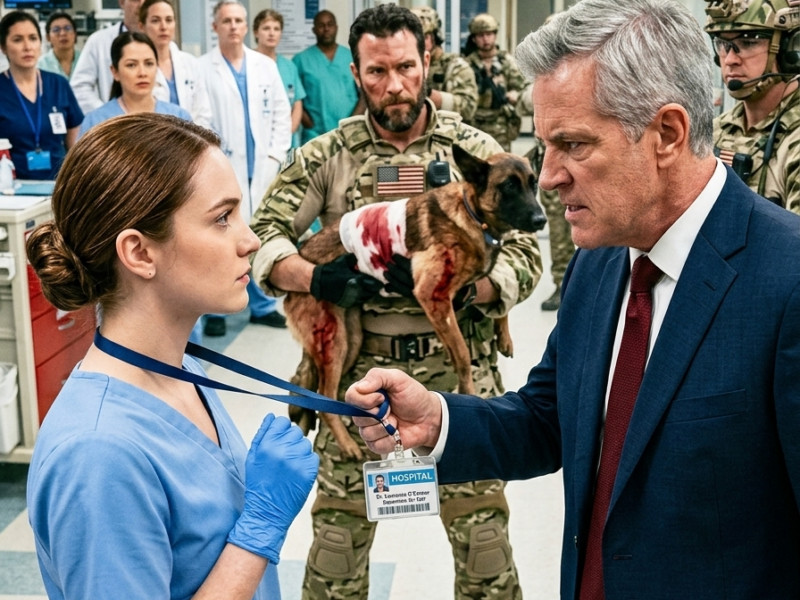
When I was suspended for saving a bleeding military K9 in our emergency room, the commander called me reckless and ordered security to remove me, but minutes later
The fluorescent lights of St. Jude Military Memorial Hospital hummed with a sterile, relentless buzz that usually calmed me. Tonight, that hum was drowned out by the harsh, metallic smell of fresh blood and hot diesel fuel.
My hands were covered in thick, crimson fluid that had already begun to dry into a tight film across my knuckles. I was kneeling on the cold tile of Trauma Bay 4, my knees soaked through the light blue fabric of my medical scrubs. Beneath my hands, a massive German Shepherd lay stretched out across an emergency gurney, his chest heaving with shallow, agonizing breaths.
I had barely finished putting the final double-knot in the nylon suture thread, securing the torn muscle of his left shoulder, when the heavy double doors of the treatment room slammed open.
Captain Reeves entered the room. His military fatigues were pressed, his boots polished to a high sheen, completely untouched by the chaos that had spilled into the ER twenty minutes ago. His face was a mask of cold, bureaucratic fury. Behind him, lying on a separate mobile bed, was a young infantry soldier, groaning quietly with an intravenous line hooked into his arm and a clean white bandage wrapped neatly around his forearm.
“You were told to stabilize the soldier first, Nurse Carter,” Reeves said, his voice flat, razor-sharp, and vibrating with controlled rage.
I didn’t immediately let go of the needle driver. I looked over my shoulder at the unconscious soldier, then back at the monitor hooked to his chest. His heart rate was a steady seventy-two beats per minute; his oxygen saturation sat at a comfortable ninety-eight percent.
“He was stable,” I said, keeping my voice as even as possible despite the adrenaline surging through my veins. “His vitals were completely within normal parameters when he came through the bay.”
Reeves didn’t look at the monitor. He took two steps forward, pointing a gloved finger directly at the German Shepherd lying beneath the glare of the surgical light.
“That animal was not your priority,” Reeves spat out. “You disobeyed a direct order from an officer to attend to a military property unit.”
I glanced down at the dog. His dark brown eyes were open, glazed with shock, fixed entirely on me. His tongue was pale, his tongue hanging slightly out of his mouth.
“He was dying, Captain,” I said softly. “If I had waited five more minutes to clamp his subclavian artery, he would have bled out on your boots.”
Nobody spoke in the small treatment room. The two junior medics standing near the supply cabinet lowered their eyes, terrified of catching Reeves’s attention. The silence stretched between us, thick and suffocating, punctuated only by the rhythmic beep of the cardiac monitor.
Slowly, Reeves reached into his side pocket. He pulled out a folded white piece of paper—a pre-drafted administrative suspension notice—and slapped it hard against the stainless-steel tray next to my surgical tools.
“Turn in your badge,” Reeves said, his eyes narrowing into cold slits. “You are relieved of duty, effective immediately. Pack your personal belongings and clear out of this facility.”
My hands shook as I laid the needle driver down on the tray, but not because I was afraid of Captain Reeves.
The dog had been brought into the trauma center twenty minutes earlier, rushed through the ambulance bay under the official classification of a “training accident at the tactical firing range.” The initial radio report claimed the animal had been caught in a barbed-wire enclosure during a night-breach exercise.
But while the rest of the trauma team rushed to treat the young soldier’s superficial arm lacerations, I had dropped to my knees to evaluate the dog. And as I parted the thick, blood-matted fur around his neck to clear his airway, I had noticed something that sent a chill down my spine.
The injury was not a tear from rusted barbed wire.
Beneath his heavy tactical collar, tucked behind his left ear, were two tiny, perfectly circular puncture wounds. They were spaced less than half an inch apart. The edges of the skin around the punctures were bruised a deep, unnatural purple, surrounded by a faint ring of white, dead tissue.
Too clean. Too deliberate.
I had spent four years as a trauma nurse on a forward operating base in Afghanistan before taking this civilian contract at St. Jude. I had seen wounds like that before. Someone hadn’t caught this dog on wire; someone had pinned him down and injected him with a concentrated neuro-paralytic agent disguised as a trauma injury.
So I saved him. I ignored Reeves’s orders, grabbed two ampoules of atropine and a vascular repair kit, and spent twenty minutes pumping the toxin out of his system while sewing his shredded artery back together.
I stripped off my bloody rubber gloves, tossing them into the biohazard bin. Without saying another word to Reeves, I unclipped my plastic security badge from my collar, laid it on top of the suspension letter, and walked out of Trauma Bay 4.
Twenty minutes later, I was sitting alone on a plastic chair in the main waiting lobby outside the ER entrance. The hospital was eerily quiet. The night shift was always slow, but tonight the empty rows of chairs and the flickering overhead lights gave the atrium a desolated, haunting atmosphere. My hands were still cold. My badge sat in my lap, useless and inert.
Suddenly, the heavy glass double doors at the front entrance of the hospital slid open with a sharp hydraulic hiss.
A blast of cold night air swept into the lobby.
Six people walked in single file. They weren’t wearing standard military fatigues, nor were they dressed in civilian law enforcement uniforms. They wore jet-black, non-reflective tactical suits without flag patches or unit insignia. They moved with a terrifying, synchronized grace, their heavy combat boots making almost no sound on the polished linoleum floor.
Nobody spoke. Nobody in the lobby stopped them. The two armed hospital guards standing near the security desk took one look at the lead operative’s posture and froze, their hands hovering nervously over their holsters.
The man in front—tall, broad-shouldered, with a short-cropped silver beard and eyes like flint—bypassed the metal detectors entirely. He walked straight toward the reception desk.
“Where’s the nurse?” his voice was a deep, gravelly baritone that commanded immediate obedience.
The terrified receptionist slowly raised her trembling hand and pointed her finger directly toward me sitting in the corner.
The lead operative turned. His sharp eyes locked onto my face. He gestured to his team, who immediately fan out in a tactical perimeter, blocking the main exits of the lobby. He walked directly over to me, stopping three feet away.
“Are you Emily Carter?” he asked.
“Yes,” I said, standing up slowly, my heart thumping against my ribs.
A subtle, profound wave of relief washed over the man’s hardened face. He let out a long breath. “Thank God.”
Before I could ask who he was, two of the black-uniformed operators behind him unslung their short-barreled carbines and moved swiftly past us, pushing through the doors into the inner ER treatment corridor.
Moments later, the inner doors burst open again. Captain Reeves strode out, his face red with sudden outrage.
“What is the meaning of this?!” Reeves shouted, pointing at the tactical team. “This is a restricted military medical zone! You can’t be here!”
The lead operator didn’t even turn his head fully. He casually reached into his inner tactical vest, pulled out a matte-black leather wallet, and flipped it open in front of Reeves’s face.
The wallet displayed a single, high-level intelligence clearance card bearing a gold eagle symbol surrounded by three star cutouts—a classification level that didn’t technically exist on public military registries.
“We can,” the operator said simply.
Reeves glanced at the card, and all the color drained from his face in an instant. He took a slow step backward, his lips parting in shock, but he remained silent.
The team leader turned back to me, lowering his voice so only I could hear. “That German Shepherd in Bay 4 belongs to our special operations intelligence unit. His name is Titan.”
My stomach dropped into a cold pit. “He wasn’t injured in a training accident, was he?”
“No,” the man said, his eyes burning with a dark, intense gravity. “He was carrying evidence.”
I stared at him, my breath catching in my throat. “What kind of evidence?”
The operator glanced sideways toward Captain Reeves, who was standing ten feet away, staring at us with intense, darting eyes while his hand hovered nervously near his trousers pocket.
“Evidence that someone inside this hospital has been helping an international enemy network smuggle bioweapons through military medical supply chains,” the operator whispered.
My heart stopped beating for a full second. The air in the room felt suddenly ice-cold.
Before I could process his words, a sharp, frantic sound echoed from the back corridors of the ER.
It was a dog. Titan was barking.
It wasn’t the weak, whining sound of an injured animal coming out of anesthesia. It was a deep, guttural, chest-shaking roar of pure predatory fury.
A second later, the doors to the treatment bay burst open. Titan came staggering out into the hallway. His left shoulder was bound in the white bandages I had just applied, and his legs were unstable, trembling from the lingering effects of the neurotoxin. But he moved with terrifying purpose.
The six operators immediately lowered their weapons, but Titan paid them no attention. He didn’t look at the team leader. He didn’t look at me.
Titan stopped ten feet away, his ears pinned flat against his head, his lips pulled back over flashing white fangs, and stared directly at Captain Reeves.
Everyone froze.
The silence in the lobby became absolute. The only sound was Titan’s low, terrifying growl rattling through the quiet hall.
One of the black-uniformed operators standing near the wall slowly shifted his posture, his gloved hand resting on the grip of his sidearm.
Reeves backed away, his hands raised in front of him, sweating profusely under the bright lights. “I… I don’t understand. Get that animal away from me! It’s rabid!”
The team leader looked slowly from Reeves down to me. “You said the wounds on his neck were injection marks?”
“Two punctures,” I nodded, my voice trembling. “Sub-dermal. Administered from above.”
The operator reached into his tactical pocket and pulled out a high-resolution photograph. He held it out to me.
The photo showed Titan standing in a dark, wet alleyway two days earlier, his muzzle resting beside the body of a fallen man in a suit—a senior intelligence officer. On the back of the photograph, written in dark blue ink in precise handwriting, was a short message:
If Titan survives the breach, trust the nurse.
I raised my eyes from the photograph and looked directly at Captain Reeves.
Reeves was no longer looking at Titan. He was no longer looking at the team leader. His face was twisted in sheer terror, and his right hand was already reaching deep into his jacket pocket, pulling out a small, encrypted burner phone.
“Reeves! Don’t move!” the team leader barked, reaching for his weapon.
Before anyone could take a step, a loud, metallic THUNK echoed through the entire hospital building.
Every single light in the lobby, the hallways, and the treatment rooms instantly went out.
The hospital was plunged into pitch, suffocating darkness.
In the sudden, total night, Titan let out one final, vicious growl. And from somewhere deep inside the inner corridor of the ER, a heavy steel emergency security door slammed shut with a deafening bang, locking automatically from the other side.
The darkness in the emergency room was absolute for three long, agonizing seconds. The heavy silence was broken only by the sound of rapid, shallow breathing and the distant, mechanical clatter of backup generators attempting to engage deep in the hospital’s basement.
“Contact left! Perimeter control!” the team leader shouted, his voice ringing through the blacked-out lobby like a gunshot.
Instantly, six bright, intense beams of tactical green light cut through the gloom as the operators clicked on their helmet-mounted night-vision and weapon lights. The beams danced wildly across the polished floor, illuminating swirling dust motes, the empty reception desk, and the terrified face of the civilian receptionist huddled beneath her counter.
“Where is Reeves?!” I shouted, dropping to my hands and knees as the green lights swept overhead.
“He moved during the blackout!” the operator nearest to me yelled back.
A sharp, amber glow suddenly flickered to life along the ceiling as the facility’s low-voltage emergency circuit activated. The harsh white fluorescent tubes were replaced by a dull, blood-red light that cast long, grotesque shadows across the walls.
Captain Reeves was gone. The heavy steel door leading back into the surgical wing had slammed shut, its electronic keypad glowing a solid, impassable red.
Titan was crouched near the base of the sealed door. His chest was heavy, his tail rigid, a thin line of fresh dark blood seeping through the white bandages on his shoulder where his stitches had been strained. He pressed his snout against the gap beneath the door and let out a low, desperate whine.
The team leader rushed over to me, grabbing my upper arm with a firm, steadying grip, dragging me behind a reinforced concrete pillar. “Are you hit?”
“No,” I gasped, clutching my medical bag to my chest. “I’m fine. Who are you? What is happening here?”
The man adjusted his tactical helmet, the red emergency light glinting off his dark visor. “I am Major Vance. Special Reconnaissance Directorate. Titan is our primary biological containment K9. Three days ago, our unit uncovered a rogue operation operating within the Defense Logistics Agency. They were using medical transport helicopters to move uncatalogued viral strains out of biological research facilities.”
My heart pounded against my ribs. “And Reeves?”
“Reeves is the logistics coordinator for this entire medical district,” Vance said, his face tightening into grim lines. “He controls the inventory manifests. Two days ago, our primary undercover asset—Officer Miller—was murdered while trying to secure a sample of a synthetic pathogen codenamed ‘Aegis-9.’ Before Miller died, he injected the tracking drive into Titan’s collar and set the dog loose.”
I looked over at Titan. The brave animal was still standing at the door, guarding the exit despite his blood loss and the lingering poison in his bloodstream.
“They didn’t just try to kill Titan to hide the drive,” I realized out loud, my eyes widening as the pieces fell into place. “Reeves injected him with the neurotoxin to paralyze him long enough to retrieve the drive before the dog could reach your team!”
“Correct,” Vance said. “And when you saved the dog, you ruined his window of extraction. Reeves knows he’s exposed. That blackout wasn’t a system failure—he just initiated a site-wide quarantine protocol to lock us inside this wing while his extraction team cleans the building.”
Suddenly, a loud, artificial chime echoed from the ceiling speakers overhead. A computerized female voice began repeating a mechanical warning:
Attention. Biohazard containment breach detected in Lower Sub-Level 2. Automatic air-lock seal initiated. All personnel remain in designated safety sectors. Decontamination protocol will commence in ten minutes.
“Decontamination?” I whispered, looking at Vance. “What does that mean for an ER wing?”
Vance’s expression grew terrifyingly cold. “It means they flood the ventilation system with concentrated ethylene oxide gas to sanitize the zone and burn the evidence. Anyone left inside suffocates in less than two minutes.”
“There are eighteen patients in the intensive care ward upstairs!” I screamed, grabbing Vance’s tactical vest. “And six nurses on duty!”
“They’re locking down the entire structure,” Vance said, turning to his men. “Jackson! Get the breach charge on that steel door! We need to get to the main security hub in the basement and manual-override the gas valves before the timer hits zero!”
Operator Jackson, a heavily built man carrying a tactical breaching kit, ran forward and slapped a rectangular strip of grey explosive material along the frame of the heavy door. “Stand back! Detonation in three!”
I instinctively dove over Titan, wrapping my arms around his neck and shielding his head with my body as Jackson hit the trigger.
POP-CRACK!
A contained, blinding flash of orange fire blew the lock housing straight out of the steel frame. Smoke filled the corridor. Vance kicked the door open with a heavy boot, and Titan immediately scrambled through the opening, his nose to the floorboards.
“Follow the dog!” Vance ordered, drawing his sidearm.
We sprinted down the narrow, red-lit service corridor behind the ER. The air was already growing thick, carrying a faint, chemical smell that burned the back of my throat—the precursor gas entering the vents.
Titan led us past dark, abandoned patient rooms, his paws slipping slightly on the smooth tile. He didn’t hesitate at the main elevator bank; instead, he rounded a corner and stopped at a heavy metal door marked STAIRWELL 3 – MAINTENANCE ONLY.
The door was standing slightly ajar. A single, bloody handprint was smeared across the yellow push-bar.
“Reeves went down,” I said, pointing at the blood. “He’s bleeding. When Titan bit him during the initial confrontation in the bay, he must have tore his forearm.”
“He’s heading for the sub-level parking garage,” Vance said, checking his tactical watch. “There’s an underground service tunnel that connects this hospital to the civilian rail network. If he gets to that train, he vanishes with the Aegis-9 master strain.”
“We have six minutes before the gas reaches lethal concentration,” Jackson warned from behind us, holding his gas mask. “Major, we have to choose: the security hub to stop the gas, or Reeves.”
I looked at Vance. I looked at the dark stairwell plunging down into the bowels of the hospital. Then I looked at Titan, who was looking up at me, his ears forward, waiting for my signal.
“You take your team to the security hub and save the patients,” I said, my voice surprisingly steady.
Vance stared at me as if I had lost my mind. “You’re a civilian nurse.”
“I am a former combat medic who knows every inch of this hospital’s underground maintenance layout,” I corrected him, pulling a heavy tactical flashlight and a scalpel from my emergency bag. “And Titan won’t follow anyone else right now. His neurotoxin levels are spiking again—he needs continuous medical monitoring or his heart will arrest before you reach the basement.”
Titan let out a soft bark, pressing his shoulder against my leg.
Vance looked at the dog, then at me. He unclipped a small, black tactical radio from his shoulder and pressed it into my hand.
“Frequency four,” Vance said sternly. “If you find Reeves, do not engage. Channel his position to us. We will turn off the gas and meet you in the lower tunnel.”
He reached into his pouch, pulled out a spare compact sidearm, and held it out to me.
I looked at the weapon, then looked Vance in the eye. I pushed the gun back toward him.
“I save lives, Major,” I said quietly. “I don’t take them. Give me the medical pulse-oximeter instead.”
Vance let out a grim, respectful breath, nodded once, and handed me his personal field kit. “Good hunting, Nurse Carter.”
Without another second of delay, Vance and his three operators sprinted down the main hallway toward the security core, while I gripped Titan’s harness, stepped through the maintenance door, and descended into the dark, echoing abyss of Stairwell 3.
The stairwell was a vertical shaft of damp concrete and rust-stained pipework, illuminated only by the faint, rhythmic pulse of a single red emergency beacon three floors below. Every footstep echoed through the concrete tube like a hollow drumbeat.
Titan moved down the stairs with methodical precision, his head low, sniffing every step. I stayed one step behind him, one hand lightly resting on his wounded shoulder, feeling the irregular, thumping rhythm of his racing heart.
“Easy, boy,” I whispered into the darkness, my voice trembling slightly. “Keep your breathing steady. Don’t strain the suture.”
The chemical smell in the air was growing stronger. A faint, white haze was beginning to accumulate near the ceiling of the stairwell—the ethylene oxide gas was leaking through the ventilation grates. My eyes began to water, and a sharp, metallic taste coated my tongue.
We reached the landing for SUB-LEVEL 2: MEDICAL STORAGE AND PIPELINE MAINTENANCE.
The heavy steel door had been wedged open with an overturned oxygen tank. Fresh drops of dark, venous blood speckled the concrete floor, leading out into a cavernous, dark room filled with towering rows of metal supply shelves, wooden pallets, and massive, green-painted oxygen cylinders.
This was the hospital’s central logistics hub—a forty-thousand-square-foot subterranean warehouse where all pharmaceutical supplies, surgical tools, and heavy equipment were processed before being sent to the upper floors.
Titan stopped at the threshold. His body went dead rigid.
A low, vibrating rumble began in the back of his throat.
I flattened my back against the cold concrete wall beside the door, clicking off my flashlight to avoid giving away our position. The warehouse was bathed in an eerie twilight of deep shadows and faint red safety lights.
Suddenly, a voice echoed out from behind a row of metal shelving fifty yards away. It was Captain Reeves, his voice distorted by a rubber gas mask.
“I know you followed me down here, Nurse Carter!” Reeves shouted, his words bouncing off the concrete ceiling. “You always were too smart for your own good! If you had just stayed in your lane and let that stupid dog die, you’d be sitting at home right now with a suspended license and your life intact!”
I didn’t answer. I stayed frozen in the shadows, my hand pressing gently against Titan’s chest to keep him from charging forward.
“You think those black-ops operators are going to save you?” Reeves continued, the sound of his footsteps crunching slowly over broken glass somewhere to our left. “They don’t care about this hospital! They don’t care about the patients! They only care about the drive inside that dog’s collar! Project Aegis is bigger than a few military units, Emily. We are restructuring the entire defense supply network, and this hospital was our central distribution hub!”
I reached down to my tactical belt, pulled out the small radio Vance had given me, and silently clicked the side button three times—a pre-arranged signal indicating I had located the target.
Click. Click. Click.
The radio gave a tiny, silent vibration in my palm, confirming Vance had received the transmission.
“Come out, Emily!” Reeves’s voice was getting closer. He was moving along Isle 4, less than thirty feet from our position. “Give me the dog, and I’ll leave the master gas valve open long enough for you to escape the building! You have three minutes before the main ventilation seal ruptures!”
Titan twitched under my hand. His nostrils flared as he caught Reeves’s scent.
I looked down at the floor near my feet. Sitting on a discarded wooden pallet was an empty glass intravenous bottle.
I picked it up slowly, taking extreme care not to make a sound. I looked at Titan, pointed to the dark shadow behind a stack of crate boxes to our right, and made a sharp hand gesture—the military sign for STAY AND COVER.
Titan understood instantly. He dropped into a low, silent crouch behind the wooden crates, his dark eyes fixed on me with intense comprehension.
I stepped away from the door, winding my arm back, and threw the glass bottle with all my strength across the massive warehouse toward Isle 12.
CRASH!
The glass bottle shattered violently against a metal support pillar fifty yards away, echoing through the cavernous room like a gunshot.
“There you are!” Reeves screamed.
Heavy, panicked footsteps slammed across the concrete as Reeves sprinted toward the sound of the crash, his weapon drawn.
“Go, Titan!” I hissed.
Titan exploded from his cover like a dark strike of lightning. Despite his stiff leg and torn shoulder, the dog covered thirty feet of concrete in less than two seconds. He rounded the end of Isle 4, leaping over a fallen box, and launched his seventy-pound body straight into Reeves’s back!
“AAAARRGGHH!” Reeves shrieked as Titan brought him crashing down onto the concrete floor.
The pistol flew out of Reeves’s hand, skidding across the floor and vanishing beneath a heavy metal rack. Reeves rolled over frantically, pulling a tactical combat knife from his belt and swinging it wildly toward the dog’s chest!
“Titan! NO!” I screamed, sprinting forward.
Titan dodged the blade by an inch, his fangs sinking deep into Reeves’s right shoulder, pinning the traitorous captain to the ground. Reeves screamed in pain, striking Titan repeatedly in the ribs with his free fist, trying to break the dog’s iron grip.
I arrived at the scene, grabbed a heavy steel wrench from a nearby tool cart, and slammed it down with all my strength against Reeves’s right wrist.
CRACK!
Reeves howled, dropping the knife as his wrist fractured. Titan released his jaw bite and stood over Reeves’s chest, his dripping fangs inches from the captain’s throat, barking with a terrifying, rhythmic roar.
Reeves lay on the cold floor, gasping for air through his shattered gas mask, his face pale with pain and terror.
“Don’t… don’t let him kill me,” Reeves sobbed, staring up at me with wide, terrified eyes. “Emily… please… we were colleagues…”
“You left eighteen innocent patients to suffocate in their beds, Captain,” I said, standing over him, my eyes burning with absolute disgust. “You aren’t my colleague. You’re a murderer.”
Suddenly, a massive mechanical roar vibrated through the floorboards.
The red emergency lights in the warehouse flickered three times and slammed back to bright, sterile white. The heavy ventilation fans overhead reversed their direction with a deafening WHOOSH, sucking the poisonous white gas out of the room and pumping fresh, crisp night air into the subterranean sub-level.
From the stairwell door, Major Vance and his three operators burst into the warehouse, their weapons raised.
They swept the room in a single second, locking their sights onto the subdued captain.
“Area secure!” Vance shouted, stepping forward and placing a heavy tactical boot directly onto Reeves’s neck, cuffing the traitor’s hands behind his back with heavy plastic zip-ties.
Jackson ran over to the main distribution crate sitting near the back wall, pulled out a cutting tool, and sliced open the heavy steel locks. Inside were row upon row of silver, temperature-controlled biological transport cases—the missing Aegis-9 master strains.
“We have the payload,” Jackson reported, looking back at Vance with a proud nod. “Every single canister is accounted for.”
Vance looked down at Reeves, then turned his gaze to me and Titan.
Titan was still standing, but his legs were shaking violently now. His strength was completely spent. As the adrenaline faded, the dog’s eyes rolled back slightly, and he collapsed onto his side on the concrete floor, his breathing shallow and rapid.
“Titan!” I cried, dropping to my knees beside him, pressing my fingers to his femoral artery.
His pulse was thready, dropping fast—eighty beats per minute… sixty… fifty.
“The toxin is overwhelming his myocardium!” I yelled up at Vance. “He’s going into cardiac arrest! I need a crash cart! NOW!”
“There are no crash carts in a logistics warehouse!” Major Vance shouted, dropping down to his knees on the opposite side of the dog. “What do you need, Nurse?!”
“Atropine! Epinephrine! And a six-inch central line!” I screamed, my hands flying across Titan’s chest as I began manual cardiac compressions, pressing down rhythmically on his ribcage. “One! Two! Three! Four! Titan, don’t you dare die on me! Breathe!”
Operator Jackson dropped his heavy medical pack onto the floor, unzipping the compartments with frantic speed. “I have military-grade epipens and auto-injectors in the tactical kit! Will that work?!”
“Hand them to me!” I ordered.
Jackson thrust two long, stainless-steel auto-injector tubes into my hand. I didn’t hesitate. I lined up the tip of the first injector directly between Titan’s fourth and fifth ribs, targeting the left ventricle of his heart, and slammed the plunger down.
THWACK!
A concentrated dose of pure epinephrine surged directly into the dog’s dying heart muscle.
For three horrifying seconds, nothing happened. Titan lay completely motionless on the concrete floor under the harsh white lights. His eyes were blank, staring unseeingly into the distance.
“Come on, boy,” Vance whispered, his hardened tactical composure cracking as he laid a gloved hand on the dog’s head. “Come on, Titan. Fight it.”
THUMP-THUMP.
A violent spike jolted through Titan’s body. His chest expanded in a massive, gasp-filled breath! His back legs kicked wildly out against the floor, and his dark eyes snapped back into focus, locking directly onto my face.
He let out a long, shuddering whine, his tail giving a single, weak thump against the concrete floor.
I let out a ragged sob, collapsing forward and resting my forehead against the top of his soft, furry head. “You idiot… don’t scare me like that.”
“His pulse is stabilizing,” Jackson said, monitoring the handheld heart reader pressed to Titan’s thigh. “One-hundred and ten beats per minute. He’s back.”
Vance let out a deep, heavy sigh of relief. He stood up, grabbed his radio, and clicked the transmission button. “Command, this is Vanguard-1. Objective Aegis is fully secured. Traitor asset Reeves is in custody. Biological payload recovered intact. We require immediate medical extraction at Access Gate 4.”
Received, Vanguard-1, a voice crackled over the radio speaker. Medevac chopper is three minutes out. Be advised, military police and federal agents are currently securing the upper hospital levels. The lockdown is lifted.
Vance walked over to Reeves, who was groaning on the floor, and pulled him to his feet by his collar, handing him over to two black-uniformed operators. “Get him to the transport. The Department of Justice is going to want to ask him questions for the next twenty years.”
As the operators dragged Reeves away, Vance turned back to me. He stepped over, extended his hand, and helped me stand up from the floor.
“You’re not just a nurse, Emily,” Vance said, his voice laced with profound, quiet respect. “I’ve served with elite operators across three continents. I have never seen anyone show the kind of courage you showed down here tonight.”
I wiped a streak of blood and dirt from my cheek, looking down at Titan, who was slowly, miraculously pushing himself up into a sitting position.
“Where I come from, Major,” I said softly, “we don’t leave anyone behind. Not soldiers, and certainly not the ones with four legs who protect them.”
Ten minutes later, we emerged from the underground service exit of the hospital into the cool, crisp night air.
The night sky above St. Jude Memorial was filled with the flashing red and blue lights of dozens of police cruisers, federal emergency vehicles, and military transport trucks. A massive twin-rotor medical evacuation helicopter sat on the central helipad, its blades spinning down with a heavy, rhythmic thrumming sound.
Medical teams in hazmat suits were pouring into the main hospital entrance to clear the building, while federal agents led handcuffed logistics staff out of the administrative wing.
A tall, grey-haired man in a three-star general’s uniform was standing near the base of the helicopter ramp, surrounded by armed guards. As we approached, his sharp eyes scanned our group, lingering on Captain Reeves in handcuffs, then on Vance, and finally on me and Titan.
“Major Vance,” the General said, his voice carrying absolute authority. “Report.”
“Operation Aegis is complete, General Vance,” Major Vance replied, standing at sharp attention. “The traitor network inside the hospital has been dismantled. The pathogen master strains are secured. And the primary data drive has been preserved.”
The General nodded slowly. He stepped closer, looking down at Titan, who was walking slowly at my side, his shoulder wrapped in clean medical gauze.
“And the canine?” the General asked.
“He sustained severe vascular injuries and toxic exposure, sir,” Vance reported. “He would have died in Bay 4 if it weren’t for Nurse Emily Carter. She defied illegal orders, neutralized the toxin, and led us directly to the suspect.”
The General turned his gaze to me. His eyes were cold, calculating, assessing every detail of my blood-stained scrubs, my dirt-smeared face, and the calm, steady way I returned his look.
“Nurse Carter,” the General said, taking a step forward. “I understand Captain Reeves issued a formal administrative suspension against your license tonight for insubordination.”
“He did, General,” I said, holding my head high.
The General reached into his pocket, pulled out a small leather folder, and gestured to an aide behind him.
“Effective immediately,” the General declared, “that suspension is expunged from all military and civilian records. Furthermore, under Executive Authorization 902, I am transferring your administrative contract out of this hospital’s jurisdiction.”
I blinked, confused. “Transferring me where?”
The General offered a rare, slight smile, pointing a thumb toward the black tactical helicopter waiting on the pad.
“To our central special operations medical unit,” the General said. “Titan needs a full-time lead medical officer who understands how to keep him alive. And frankly, Nurse Carter… our boys could use someone with your specific kind of recklessness.”
Six months later.
The morning sun rose bright and clear over the rolling green hills of Fort Meade, Maryland. The air was crisp, carrying the sweet smell of morning dew, pine needles, and fresh-cut grass.
I stood on the concrete flight line outside Hangar 7, wearing a clean, fitted set of dark green tactical scrubs with a gold medical officer crest pinned to my chest. In my right hand, I held a warm cup of coffee; in my left, a digital tablet displaying the morning health diagnostics for the 4th Special Forces K9 Division.
The heavy steel doors of the hangar slid open behind me.
Major Vance stepped out onto the tarmac, dressed in his working utility uniform, holding two files. Beside him, trotting with a proud, smooth gait, was Titan.
The heavy scarring on Titan’s left shoulder had healed into a thin, silvery line beneath his thick, lustrous fur. His back leg was fully recovered, moving with explosive, athletic power. His tactical collar was back on, adorned with a silver commendation medal that glinted in the morning sunlight.
The moment Titan saw me, he broke away from Vance’s side. He trotted over, letting out a soft, happy huff of air, and pressed his massive, warm head directly into my hand.
“Good morning, handsome,” I smiled, dropping down on one knee and scratching him behind his ears—right above where his double-puncture wounds used to be.
Titan closed his eyes in contentment, leaning his entire seventy-pound weight against my knee.
“He still likes you better than the rest of the team, you know,” Vance said, walking up beside us with a rare, genuine smile on his face. “Jackson tried to give him a steak yesterday, and Titan just took it, buried it near the fence, and walked right back to your office door.”
“That’s because Jackson doesn’t know the proper spot behind his left ear,” I laughed, standing up and taking a sip of my coffee. “How are the new diagnostic reports looking?”
“Clean,” Vance said, handing me one of his files. “The Department of Justice finished the final indictments yesterday. Captain Reeves and twenty-four executives across three military medical supply contractors have been sentenced to federal prison. The entire Aegis network has been scrubbed clean.”
I looked at the file, feeling a quiet, profound sense of closure wash over me. Six months ago, I was sitting in a dark, empty lobby, stripped of my badge, told I was useless because I cared too much about a dying animal. Now, looking out over the airfield where six newly trained medical K9 units were running through their morning drills, I knew I was exactly where I was meant to be.
“We have a deployment briefing at nine hundred hours,” Vance added, looking out over the tarmac. “A joint task force mission in Eastern Europe. The team wants to know if their chief medical officer is ready for field rotation.”
I looked down at Titan. The great German Shepherd looked up at me, his sharp, intelligent eyes bright with energy, his tail wagging slowly in the warm morning sun.
“We’re ready, Major,” I said, turning back toward the hangar with my hand resting safely on Titan’s shoulder.
“We’re already home.”
The end









