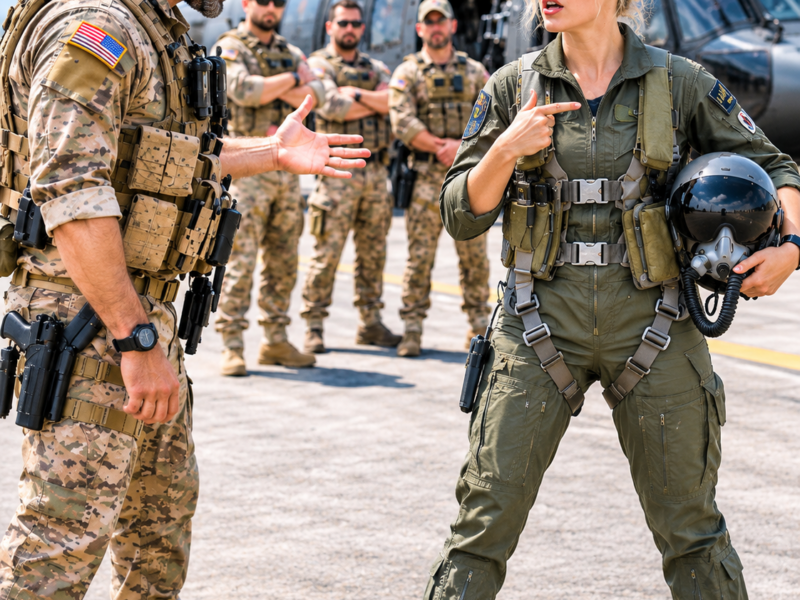
“When Commander Nathan Brooks slammed both fists onto the briefing table at our remote military outpost in northern Iraq and demanded someone fly the experimental helicopter into a deadly mountain storm
The first thing I heard through my headset was Master Chief Graves calling out a warning.
“Commander, we’re picking up stronger crosswinds than forecast.”
I adjusted the aircraft’s heading.
“How much stronger?”
“About twenty knots. And increasing.”
I looked at the weather display.
The storm was moving faster than expected, its outer bands already sweeping across the mountain range.
“Keep monitoring the rotor readings.”
“Already doing it.”
Graves had worked on the XR-27 program almost as long as I had. He knew the aircraft’s strengths, but he also knew its habits, including the ones that had never made it into the official manuals.
Behind us, Lieutenant Sarah Kim checked the medical equipment.
She had spent most of her career treating wounded service members in places where medical facilities were little more than tents and generators.
She understood what waited for us in that valley.
“How long until we reach them?” she asked.
“Twenty-three minutes.”
“Walker won’t have twenty-three minutes if his bleeding hasn’t stopped.”
I tightened my grip on the controls.
“Then we’ll try to make it sooner.”
The helicopter climbed through a layer of clouds.
For several minutes, everything went according to plan.
Then the aircraft lurched violently to the left.
Graves caught the warning before I did.
“Port-side vibration increasing.”
I checked the instruments.
The readings were still within the emergency operating range, but barely.
“Could be the wind?”
“Could be. Could also be the rotor assembly.”
He looked toward me.
I knew what he was thinking.
The Nighthawk had been designed to tolerate extraordinary conditions, but its experimental systems were not forgiving of neglected maintenance.
“Can we continue?”
“Yes, but I wouldn’t promise you a comfortable ride.”
I almost smiled.
“Comfort wasn’t on the mission requirements.”
He nodded and returned to his instruments.
For a moment, I thought about the last time I had flown this aircraft.
The desert in Nevada had been bright that afternoon.
The sky was clear, the wind was mild, and the aircraft had passed every inspection.
We had been conducting an emergency landing evaluation when a mechanical component failed.
Marcus Webb had been standing near the designated ground crew position.
He was twenty-three years old.
He had been talking about his younger sister, Diane, before the test began.
He wanted to finish his certification so he could help pay for her college tuition.
When the failure occurred, I had made the only maneuver that could prevent the helicopter from striking three other crew members.
The aircraft landed hard.
Marcus didn’t survive.
The investigation found no negligence on my part.
But I remembered his sister standing outside the hangar afterward, holding his belongings in a cardboard box.
I remembered how she had looked at me.
She hadn’t screamed.
She hadn’t accused me.
She had simply asked, “Did he know he wasn’t coming home?”
I had no answer.
The memory followed me into every cockpit afterward.
Eventually, I stopped climbing into one.
“Commander?”
Graves’s voice brought me back.
“You’re drifting two degrees east.”
I corrected the heading.
“Thanks.”
He studied me briefly.
“You all right?”
“I’m flying.”
“That wasn’t what I asked.”
I kept my eyes on the instruments.
“Then ask me after we get those men out.”
He accepted that.
Below us, the mountains appeared as dark shapes beneath the clouds.
Twenty miles away, Echo Team was fighting to stay alive.
Lieutenant Aaron Cho crouched behind a rock formation, trying to keep his radio antenna above the wet ground.
Rain had begun falling in thin, cold sheets.
Beside him, Senior Chief Daniel Ruiz watched the eastern ridge through his night-vision goggles.
“Movement,” Ruiz whispered.
Cho turned.
“How many?”
“At least four. Maybe more behind the rocks.”
Their position was becoming impossible to defend.
The original extraction point had been compromised, and the only route through the ravine was exposed.
Ethan Walker lay on a makeshift stretcher several feet behind them.
His breathing was shallow.
A dressing covered the wound in his side, but blood had soaked through the outer layer.
Kim’s remote medical instructions had helped them stabilize him as much as possible.
It wasn’t enough.
Walker opened his eyes.
“Are we still arguing about where to go?”
Cho crouched beside him.
“We’re discussing options.”
“That’s what people say when they’re arguing.”
Ruiz glanced toward him.
“Save your strength.”
Walker managed a weak smile.
“Hard to do when you two keep talking about me like I’m already dead.”
Cho leaned closer.
“You’re going home, Ethan.”
“Tell Grace I want chocolate cake at my birthday party.”
“Your birthday isn’t for another month.”
“Then I have time to make requests.”
The radio crackled.
Everyone went still.
A woman’s voice came through.
“Echo Team, this is Nighthawk. Confirm your current position.”
Cho grabbed the radio.
“This is Echo Team. We hear you.”
“Give me your exact location and current landing zone assessment.”
He transmitted their coordinates and explained that the primary landing zone was blocked by fallen debris.
The aircraft was approaching from the north.
Cho looked at the narrow clearing beside an abandoned stone building.
It was barely large enough for a helicopter.
“There’s an alternate position about two hundred yards west. Small clearing. Partially sheltered by a ridge.”
“Any overhead obstructions?”
“Low stone walls on the southern edge. No trees.”
“Enemy activity?”
“Possible movement east of the clearing.”
There was a pause.
“Understood. I need you to mark the northern edge with your infrared strobe.”
Cho switched it on.
“Marked.”
“Stand by.”
High above the valley, I searched the darkness for the signal.
The first few seconds showed nothing but rain and broken terrain.
Then I saw it.
A small, rhythmic pulse of light appeared through my night-vision display.
“There,” Graves said.
“I have it.”
I studied the surrounding terrain.
The stone building would create unpredictable airflow.
The ridge would shelter us from one direction but create turbulence from another.
The clearing was smaller than the specifications recommended.
It was also our only realistic option.
“Approach from the northwest,” Graves advised.
I watched the wind indicator.
“Not quite.”
He looked at the display.
“The wind is shifting.”
“Exactly.”
I made a wide turn to evaluate the airflow.
The helicopter dropped several feet as we crossed the ridge.
Kim grabbed the overhead support.
“That was unpleasant.”
“Sorry.”
“Don’t apologize. Just land.”
I almost laughed.
Then the aircraft entered the final approach.
The clearing came into view.
I corrected left.
Then right.
A sudden gust pushed the Nighthawk toward the stone building.
Graves called out the altitude.
I adjusted the controls and reduced our forward movement.
For three seconds, the aircraft seemed to hang between the mountain and the ground.
Then the landing gear touched down.
The impact was hard.
The helicopter shook.
But it remained stable.
“Echo Team, Nighthawk. We’re on the ground. Sixty seconds. Get aboard.”
The side door opened.
Seven men emerged from the darkness, two supporting Walker on the makeshift stretcher.
Kim was already waiting.
“Bring him here!”
She cleared a space and began examining him.
“Pulse is weak. We need to move.”
Ruiz and Cho helped secure the stretcher.
The remaining men climbed aboard.
Graves checked the rotor readings.
“Commander, we’ve got a problem.”
I looked at him.
“How serious?”
“Port-side vibration is worse. The landing impact didn’t help.”
“Can we lift?”
He studied the numbers.
“We can try. But I wouldn’t want to stay here.”
Neither did I.
Outside, a burst of gunfire echoed from the eastern ridge.
One of the SEALs pulled the door shut.
“Contact!”
I raised the collective.
The Nighthawk struggled for a moment before rising.
Then the aircraft climbed above the stone building.
“All aboard?” I called.
Kim answered.
“Seven passengers. All accounted for.”
“Graves?”
“Still with you.”
I turned north.
“Then we’re going home.”
Back at the operations center, Commander Nathan Brooks watched the tracking screen.
The helicopter’s signal had remained stationary in the valley longer than he liked.
Senior Chief Ryan Mitchell stood beside him.
“Why aren’t they moving?”
“Probably loading Walker.”
Ryan stared at the screen.
Then the signal shifted.
It moved north, climbed briefly, and suddenly dropped.
Nathan leaned toward the display.
“What was that?”
Nobody answered.
The radio operator tried to establish contact.
“Nighthawk, this is command. Report.”
Static.
Five seconds passed.
Then ten.
Ryan’s hand tightened around the edge of the table.
“Come on.”
Finally, Ashley’s voice came through.
“Command, Nighthawk. All seven passengers aboard. We’re airborne.”
Nathan exhaled.
“Copy, Nighthawk. Good work. Report your destination.”
“Diverting to the Coalition medical outpost. Aircraft condition is deteriorating.”
Nathan looked at the tracking map.
“Understood. Medical team has been alerted.”
A brief silence followed.
Then Ashley spoke again.
“Command, I need one piece of information.”
“Go ahead.”
“The medic. Ethan Walker. His daughter’s name?”
Nathan looked toward Denton.
“Grace,” Denton answered.
Nathan returned to the radio.
“Her name is Grace.”
For a moment, there was only static.
Then Ashley’s voice came back.
“Tell him Grace needs him home.”
Ryan turned away from the console.
He had served with men who made promises in combat.
He knew how often those promises were broken.
But something about Ashley’s voice made him believe she intended to keep this one.
The return flight was worse than the journey in.
The storm had swallowed the valley behind us, and the mountain winds were pushing the aircraft from several directions.
Graves watched the rotor assembly.
“Vibration is increasing.”
“How much time?”
“Twelve minutes, maybe.”
I looked at the navigation display.
“Distance?”
“Thirteen minutes.”
He didn’t need to say anything else.
We were already one minute short.
In the rear cabin, Kim was working on Walker.
I could hear her voice through the headset.
“Ethan, stay with me.”
“I’m trying.”
“Tell me about your daughter.”
“Grace?”
“That’s the one.”
“She likes dinosaurs. Thinks they’re better than people.”
Kim adjusted his oxygen supply.
“She might have a point.”
Walker laughed weakly, then winced.
I listened without turning my head.
I imagined a little girl waiting for her father to come home.
I wondered how many children had waited for Marcus Webb.
The thought came without warning.
I tightened my grip on the controls.
Graves noticed.
“Stay with me, Commander.”
“I am.”
“Then listen to the aircraft.”
I did.
The Nighthawk had developed a subtle vibration in the main rotor.
It wasn’t visible on the instruments yet.
But I could feel it through the controls.
“Graves, check the secondary system.”
He examined the readings.
“Backup flight control is offline.”
I stared at the display.
“When?”
“Just now.”
“Can we restore it?”
“Not safely in this weather.”
I nodded.
“Then we stay on primary.”
He looked at me.
“You sure?”
“No. But that’s what we have.”
He gave a short nod.
The aircraft continued west.
Five minutes passed.
The vibration worsened.
Graves leaned toward the instrument panel.
“Commander, we’ve got to reduce stress on the rotor.”
“At our current speed?”
“Yes.”
“That adds another two minutes.”
He didn’t answer.
He didn’t have to.
We were already running out of time.
In the rear cabin, Walker’s voice came through again.
“Pilot?”
I pressed the intercom.
“Go ahead.”
“I know you’re busy.”
“That’s true.”
He paused.
“I have a six-year-old girl. Her name is Grace.”
“I know.”
“Her birthday is next Saturday.”
“I know that too.”
“I promised her I’d be there.”
I looked at the mountains ahead.
“Then you need to keep that promise.”
He was quiet for a moment.
Then he said, “I’m trying.”
“So am I.”
I adjusted our course.
The medical outpost was now visible on the navigation display.
Its runway lights were shining through the rain.
Three minutes away.
The vibration increased again.
Graves checked the readings.
“Two minutes at this rate.”
“Then we’re going to have to shorten the approach.”
He looked at me.
“How?”
I studied the terrain.
A conventional approach would require a wider descent path.
But the aircraft was losing stability, and we didn’t have enough time.
I could descend more steeply, reduce the time spent in the unstable air, and accept a harder landing.
It was risky.
But waiting was becoming riskier.
“Prepare for a steep approach.”
Graves understood immediately.
“That’s going to be rough.”
“Tell Kim to secure Walker.”
I switched to the rear intercom.
“Medical team, we’re making a hard landing. Secure the patient.”
Kim answered without hesitation.
“Understood.”
I began the descent.
The warning tones grew louder.
The Nighthawk shook as we entered the lower air.
For a moment, the aircraft drifted toward the edge of the approach path.
I corrected.
The landing lights grew brighter.
“Twenty seconds,” Graves called.
The rotor vibration became almost unbearable.
I kept my hands steady.
“Ten.”
The landing pad filled the windshield.
I reduced forward speed and raised the nose.
The aircraft struck the ground.
A violent grinding sound came from the port side.
The cabin shook.
Then everything stopped.
For a second, nobody moved.
I checked the controls.
The aircraft was down.
Stable.
Alive enough.
“Shut it down,” Graves said.
I followed the emergency procedure.
The rear doors opened.
Medical personnel rushed toward us.
Kim climbed out first.
Then the SEALs began helping one another down.
Walker was carried out on the stretcher.
His eyes were open.
He was still breathing.
A surgeon ran toward him.
“Get him inside!”
The medical team disappeared through the doors.
I remained in the cockpit.
My hands were shaking.
I stared at them for several seconds.
Then I let them.
For the first time in almost two years, I had flown the Nighthawk through a crisis and brought everyone aboard home.
And I was still sitting in the cockpit.
At 5:11 a.m., confirmation reached the operations center.
All ten people aboard the Nighthawk had survived.
Nathan Brooks put down the radio.
Nobody cheered immediately.
The men in the room simply stood there, absorbing the news.
Ryan Mitchell finally sat down.
He covered his face with both hands.
“Seven men,” he whispered.
Nathan looked at the tracking screen.
“Seven men.”
Then he picked up the radio again.
“Nighthawk, command. Excellent work, Commander Bennett.”
Ashley answered.
“Thank you, sir.”
“How’s Walker?”
“He’s in surgery.”
“We’ll get an update.”
There was a pause.
Then Nathan said something that surprised everyone listening.
“And, Commander?”
“Yes, sir?”
“Welcome back.”
Ashley didn’t answer immediately.
When she did, her voice was quieter.
“Thank you.”
I found a wooden crate outside the medical hangar and sat down.
My right hand had a small cut from the cockpit controls.
I hadn’t noticed it until the adrenaline began to fade.
The morning air was cold.
Somewhere nearby, a generator rattled.
I was looking at the bandage around my hand when Nathan approached.
He carried two cups of coffee.
He handed me one.
“Fair warning. It’s terrible.”
I took a sip.
He was right.
We sat quietly for a while.
Finally, he spoke.
“You saved my men.”
“I flew an aircraft.”
“Don’t reduce what happened to a job description.”
I looked toward the medical building.
“Walker isn’t out of danger yet.”
“No. But he’s alive because you got him here.”
I didn’t know what to say.
Nathan leaned forward.
“Why did you stop flying?”
I looked at him.
“Didn’t you read my record?”
“I read the investigation report. I also read the psychological evaluation.”
I looked away.
“Then you know.”
“I know what happened to Marcus Webb. I don’t know what happened to Ashley Bennett afterward.”
I held the coffee cup between both hands.
“His name was Marcus Webb. He was twenty-three. He was good at his job, and he was always talking about his sister.”
Nathan waited.
“The investigation cleared me. They said I had no other choice. They said my decision prevented three additional casualties.”
I swallowed.
“But I still remember the way his sister looked at me when I couldn’t answer her question.”
“What did she ask?”
“Whether he knew he wasn’t coming home.”
Nathan didn’t interrupt.
“I couldn’t sleep. I couldn’t fly. Every time I sat in a cockpit, I heard that question again.”
“So you came here.”
“I thought if I stayed away from aircraft, I wouldn’t have to remember.”
Nathan looked toward the hangar.
“Did it work?”
I gave a small, humorless laugh.
“No.”
He nodded.
“That’s what I thought.”
For a while, neither of us spoke.
Then he said, “You don’t honor someone by spending the rest of your life punishing yourself.”
I looked at him.
“That’s easy to say when you weren’t the one holding the controls.”
“You’re right. I wasn’t.”
He paused.
“But I know what it means to lose someone and spend years wondering whether a different decision would have changed anything.”
His voice had softened.
“Sometimes there isn’t a different decision. Sometimes there is only a terrible situation and the best choice you can make inside it.”
I looked down at my bandaged hand.
“I never called his sister.”
“Why?”
“Because I didn’t know what to say.”
Nathan nodded.
“Maybe you don’t need the perfect words. Maybe you just need to tell her the truth.”
Before I could respond, Ryan Mitchell approached.
He stood in front of us, looking uncomfortable.
“Commander Bennett?”
I looked up.
“Chief?”
He took a breath.
“I owe you an apology.”
I waited.
“When you said you could fly the Nighthawk, I thought you were putting yourself forward because you wanted to prove something.”
He rubbed the back of his neck.
“I judged you before I knew anything about you. That’s not how I want my people treated.”
I looked at him.
“Apology accepted.”
He nodded.
Then I added, “Next time, maybe check someone’s flight record before deciding what they can do.”
He blinked.
Nathan laughed.
Ryan shook his head.
“Fair enough, ma’am.”
For the first time that morning, I laughed too.
The surgery lasted four hours and eleven minutes.
I knew because I counted every minute.
I sat in the waiting room with Echo Team.
Nobody asked me to leave.
Nobody made a speech about what I had done.
The men simply made room.
Ruiz brought me a bottle of water.
Cho asked if I had eaten.
Ryan returned with another cup of coffee, which was somehow worse than the first.
It was a strange kind of acceptance.
Quiet.
Uncomplicated.
And more meaningful than I expected.
At 9:22 a.m., the surgeon finally appeared.
Everyone stood.
“He’s out of surgery.”
Kim, who had been waiting near the hallway, stepped forward.
“How is he?”
“Critical, but stable. We controlled the bleeding. The next twenty-four hours will be important.”
Ruiz closed his eyes.
Cho leaned against the wall.
Ryan let out a long breath.
Then the surgeon added, “He asked about the pilot.”
I looked up.
“Me?”
“He wants to thank you when he’s awake.”
I nodded.
“Tell him to concentrate on getting better.”
The surgeon smiled.
“I’ll tell him.”
I saw Ethan Walker that afternoon.
He was pale, connected to several monitors, and looked considerably smaller than the man in the personnel photograph.
But his eyes were open.
When he saw me, he tried to raise one hand.
I moved closer.
“Don’t do that. You’re supposed to be resting.”
He smiled weakly.
“You’re the pilot?”
“That’s what they tell me.”
“I heard your voice on the radio.”
I pulled a chair beside his bed.
“How are you feeling?”
“Like someone parked a truck on my chest.”
“That’s not a medical diagnosis.”
“Should’ve been a medic.”
I laughed.
Then his expression became serious.
“I heard what you said about Grace.”
I looked at him.
“She needs her father.”
He stared at the ceiling for a moment.
“In the valley, I thought I might never see her again.”
His voice cracked slightly.
“I kept thinking about the last time we talked. She was upset because I wouldn’t let her take our dog to school.”
He smiled faintly.
“She told me I was the worst father in America.”
“Sounds like a difficult situation.”
“She also said she’d forgive me if I brought her a dinosaur.”
I laughed.
“That’s a reasonable negotiation.”
He turned his head toward me.
“Thank you for bringing me home.”
I looked at the photograph beside his bed.
Grace was holding her stuffed rabbit.
“You did your part too, Ethan. You kept fighting.”
He shook his head.
“I was just lying on a rock.”
“You kept talking. You stayed conscious. You gave your team something to work with.”
He was quiet.
Then he said, “I heard about Marcus.”
My fingers tightened around the edge of the chair.
“Who told you?”
“Ryan.”
I looked down.
“That was a long time ago.”
“Maybe. But I wanted you to know something.”
He struggled to adjust his pillow.
“That aircraft brought seven of us home. Whatever happened in Nevada, that young man didn’t disappear from the world.”
I didn’t answer.
“His work helped build something that saved lives. And you knew how to fly it.”
He paused.
“I’m not saying that makes what happened okay. I wouldn’t insult you by pretending it does.”
My eyes burned.
“But I think Marcus mattered. I think he still matters.”
For the first time, I couldn’t find a professional answer.
So I simply nodded.
“Thank you, Ethan.”
He smiled.
“Now I have a birthday party to attend.”
“Then you’d better get some rest.”
Two days later, Colonel Marcus Hale called me into his office.
He had my flight evaluation, the maintenance report, and a copy of the mission recording spread across his desk.
“Commander Bennett, I’ve reviewed everything.”
I sat down.
“Yes, sir.”
“Your simulator performance was excellent. Your flight execution was better than I expected under those conditions.”
“Thank you.”
He tapped the mission report.
“However, I want to discuss the aircraft.”
I leaned forward.
“The port-side vibration began increasing before the valley landing.”
“We saw it.”
“And the secondary flight control failed during the return.”
“Yes, sir.”
He looked at me.
“Why did you continue?”
I considered the question.
“Because the primary system remained operational, the rotor readings were within the emergency limits, and the medical outpost was closer than any alternative landing site.”
“And if the readings had exceeded those limits?”
“I would have looked for a place to land.”
“Even if the team had to remain in hostile territory?”
I met his eyes.
“Yes, sir. An aircraft that cannot be controlled is not a rescue vehicle. It’s another emergency.”
Hale nodded slowly.
“Good answer.”
He closed the folder.
“I’m recommending your full return to flight status.”
I looked at him.
“Full status?”
“With the appropriate recertification and training requirements. Your technical experience with the Nighthawk is also needed.”
I didn’t speak.
He studied me.
“Is there a reason you don’t want to return?”
I thought about the Nevada hangar.
The investigation.
The empty chair in the flight evaluation room.
Then I thought about Grace holding her stuffed rabbit.
And seven men walking away from a helicopter that had almost failed them.
“I want to fly again, sir.”
Hale leaned back.
“Then that’s where we’ll start.”
There was one thing I still needed to do.
I requested a private room, sat down with a phone, and wrote an opening sentence on a piece of paper.
I crossed it out.
Wrote another.
Crossed that out too.
Finally, I dialed the number I had carried in my personal notes for almost two years.
A woman answered.
“Hello?”
I swallowed.
“My name is Ashley Bennett. I was one of the pilots on the XR-27 evaluation program in Nevada.”
There was a long silence.
Then the woman spoke.
“You’re the pilot who was there when my brother died.”
“Yes.”
Her name was Diane Webb.
She lived in Ohio and taught fourth grade.
I had known those details from the investigation file.
But hearing her voice made them feel painfully real.
“I’ve wanted to call you for a long time,” I said.
“Why didn’t you?”
The question was direct.
I closed my eyes.
“Because I was afraid.”
“Of what?”
“That anything I said would sound like an excuse. I was afraid you’d think I was calling to make myself feel better.”
Diane didn’t answer.
So I continued.
“Marcus was a good man. He was careful, talented, and proud of the work he was doing. He talked about you often.”
Her voice softened.
“What did he say?”
“He said you were the smartest person in your family.”
A small laugh came through the phone.
“He used to say that.”
I smiled.
“He also said he wanted to finish his certification so he could help you with college.”
Diane was quiet.
Then she said, “He always wanted to take care of everybody.”
I looked at the paper in front of me.
“I need you to know that the investigation found I had no other option. I made the decision that saved the other three crew members. But I also know that doesn’t bring Marcus back.”
“No,” she said.
“It doesn’t.”
I waited.
Then I said the words I had avoided for almost two years.
“I’m sorry, Diane. I’m so sorry.”
She breathed in slowly.
“I thought about calling you too.”
I opened my eyes.
“You did?”
“Many times. I wanted to know what happened. I wanted to know whether he was scared.”
I couldn’t answer immediately.
“Was he?”
Diane asked.
I thought carefully.
“He was doing his job. He was focused. I can’t tell you exactly what he was thinking in those final moments, and I won’t pretend I can.”
I heard her crying softly.
“Thank you for not making something up.”
We talked for nearly two hours.
I told her about the aircraft.
About the work Marcus had done.
About the seven men who had survived a rescue mission because of technology he had helped test.
When I finished, Diane said something I had never expected to hear.
“I’m glad he was part of something that mattered.”
I pressed my hand against my forehead.
“He mattered before any of that,” I said.
“Yes,” she answered. “He did.”
Before we hung up, she asked me a question.
“Ashley, are you flying again?”
I looked through the window toward the aircraft on the landing pad.
“Yes. I’m going back.”
She was quiet for a moment.
“Then I hope you have a good flight.”
It wasn’t forgiveness.
It wasn’t a declaration that everything was fine.
It was simply a kindness I hadn’t known how badly I needed.
Six weeks later, I stepped off a plane at Naval Air Station Fallon, Nevada.
The dry air hit my face.
The mountains stood in the distance, unchanged by the years I had spent avoiding them.
For the first time, I didn’t feel the urge to turn around.
Colonel Hale met me outside the training building.
“Welcome back, Commander.”
“Thank you, sir.”
He handed me a folder.
“Your recertification schedule. Simulator training begins Monday.”
I opened it.
There was another document inside.
A proposal for a new rescue-pilot training program.
Hale pointed toward the classroom.
“We’ve been discussing the possibility of having you help train the next group.”
I looked up.
“You want me to teach?”
“You understand the Nighthawk better than most of the people who designed it. And you know what happens when pilots mistake confidence for competence.”
I looked through the classroom window.
A group of young officers were preparing their equipment.
Some were nervous.
Some were trying very hard not to look nervous.
I recognized the expressions.
“I’d like that,” I said.
“Good. First class starts Monday.”
Before returning to Fallon, I had attended Grace Walker’s sixth birthday party.
It was held in a small apartment decorated with paper dinosaurs and colorful balloons.
Ethan was there, still recovering, moving carefully but smiling more than I had seen him smile in the medical outpost.
Grace ran toward him when I entered.
“Daddy!”
He bent down and hugged her.
Then he pointed toward me.
“Grace, this is the pilot I told you about.”
She looked up at me.
“Did you fly the big helicopter?”
“I did.”
“Was it scary?”
I considered the question.
“Sometimes.”
She thought about that.
“Did you bring my daddy home?”
I looked at Ethan.
“He did most of the hard work. I just helped.”
Grace seemed satisfied with that explanation.
She grabbed my hand and pulled me toward the cake.
“You have to have some. It’s chocolate.”
I laughed.
“I wouldn’t want to offend the birthday girl.”
She gave me a serious look.
“Good. Because there’s a dinosaur on top.”
That afternoon, while Ethan watched his daughter blow out the candles, I realized something.
For almost two years, I had thought the only way to honor Marcus was to stop doing the work that had cost him his life.
But perhaps honoring him meant something else.
It meant remembering him honestly.
It meant refusing to turn his death into an excuse to abandon everything he had helped build.
And it meant allowing myself to live again.
On Monday morning, I stood in front of my first class of rescue pilots.
The classroom smelled of coffee, paper, and aviation equipment.
I wrote a sentence on the whiteboard.
“Confidence tells you that you can handle anything. Responsibility makes you understand what happens if you’re wrong.”
The young officers copied it into their notebooks.
A female ensign near the front raised her hand.
“Commander Bennett?”
“Yes?”
“Were you ever afraid you weren’t good enough to fly the Nighthawk?”
I looked at her.
“Yes.”
“Even after all your experience?”
“Especially after all my experience.”
She frowned.
“Then how did you know when you were ready?”
I thought about the briefing room at 2:17 a.m.
About Nathan’s desperate order.
About the simulator.
About the storm and the seven men waiting in the valley.
And about Marcus Webb.
“I didn’t wait until I stopped being afraid,” I told her. “I made sure I understood the aircraft, understood the risks, and knew what I was responsible for. Fear isn’t always a warning to walk away. Sometimes it’s a reminder to pay attention.”
The ensign wrote that down.
After class, I walked outside.
The morning sun reflected off the Nighthawk’s dark fuselage.
Nathan Brooks was standing near the hangar with Ryan Mitchell.
Walker had sent a photograph the night before.
He was standing beside Grace, holding a ridiculous chocolate dinosaur cake.
The message beneath it read:
Grace says you still owe her another piece of cake.
I smiled.
Then my phone rang.
It was Diane Webb.
“Hi, Ashley.”
“Hi, Diane.”
“I just wanted to tell you something. I put Marcus’s old photograph on the wall in my classroom today.”
I looked toward the aircraft.
“That’s nice.”
“One of my students asked about him. So I told them he helped build something that saved lives.”
I swallowed.
“Thank you for telling me.”
She paused.
“And Ashley?”
“Yes?”
“I’m glad you’re flying again.”
For a moment, I couldn’t speak.
Then I answered.
“So am I.”
After the call ended, I walked toward the hangar.
The aircraft was waiting beneath the morning sky.
I placed my hand against its fuselage, just as I had done on that terrible night in Iraq.
But this time, I didn’t feel like I was saying goodbye to the person I used to be.
I felt like I was finally meeting her again.
And when I climbed into the cockpit, the memories came with me.
So did the names of the people who had trusted me with their lives.
I fastened my harness, checked the instruments, and looked through the windshield at the open sky.
For the first time in twenty-one months, I wasn’t trying to escape the past.
I was ready to fly toward the future.
The End.









