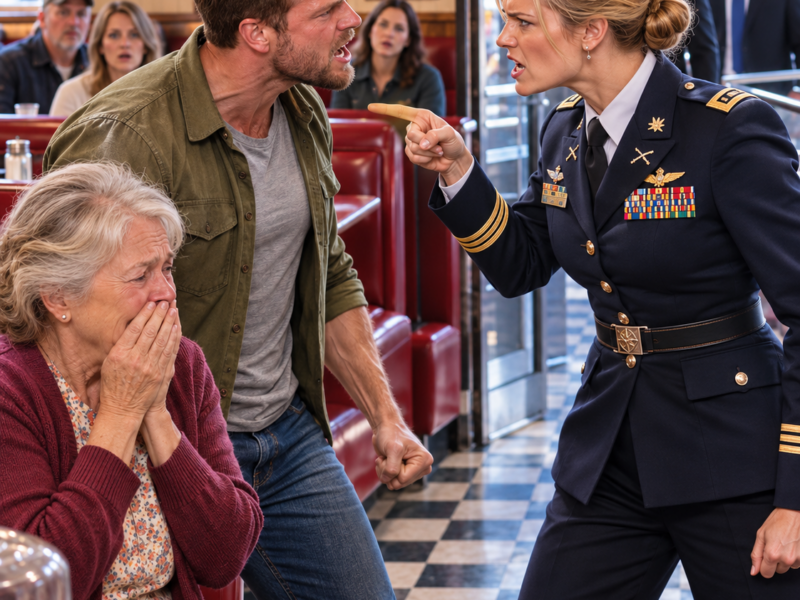
When a wealthy, arrogant man shoved my 75-year-old mother onto the floor of her own diner and smirked, “In this town, I can do whatever I want,”
The first man through the door wore a dark suit and carried a leather folder. The second was a woman in a navy blazer, followed by two uniformed state investigators.
My mother looked up from behind the counter.
“Alexandra?” she whispered.
I stood.
“It’s all right, Mom.”
The man in the suit approached me and extended his hand.
“Colonel Alexandra Reed?”
“That’s correct.”
“I’m Daniel Mercer, with the North Carolina State Bureau of Investigation. This is Special Agent Laura Bennett. We received the evidence you submitted last night.”
A murmur spread through the diner.
I hadn’t told anyone I had contacted the state investigators. I hadn’t wanted the sheriff to have another opportunity to make evidence disappear.
Mercer placed his folder on the counter.
“We need to speak with you and your mother. We also need to secure the original recordings and obtain statements from anyone who witnessed the incident.”
At the word witnessed, several customers suddenly became very interested in their coffee.
Then the door opened again.
Sheriff Robert Hayes walked in.
His expression changed when he saw the investigators.
“What is this?” he demanded.
Mercer turned toward him.
“An independent investigation into an alleged assault, possible witness intimidation, and suspected public corruption.”
Hayes gave a short laugh.
“Public corruption? Based on what?”
“That’s what we’re here to determine.”
The sheriff looked at me.
“You went over my head?”
“I reported a crime.”
“You’re making a serious mistake, Colonel.”
“No,” I replied. “Someone made a serious mistake when they decided my mother could be hurt without consequences.”
He stepped closer, but Agent Bennett moved between us.
“Sheriff, we’d like you to remain available for questioning.”
For the first time since I had returned, Robert Hayes looked uncertain.
Brandon Cole arrived twenty minutes later.
He came in wearing an expensive watch, polished shoes, and the same careless smile from the video.
His father followed him.
Richard Cole looked older than I remembered from the few photographs I had seen over the years. His silver hair was neatly combed, his suit immaculate, and his expression controlled.
He stopped when he noticed the investigators.
“What is going on here?” he asked.
Mercer introduced himself.
“Mr. Cole, we’re investigating an assault involving your son and Margaret Reed.”
Brandon laughed.
“That’s ridiculous. She fell.”
Agent Bennett opened her tablet.
“Would you like to explain why your statement differs from the forty-seven-second recording?”
His smile disappeared.
Richard glanced at his son.
“What recording?”
I reached into my bag and placed my phone on the counter.
“The one showing you standing beside the pie display while Brandon shoved my mother.”
Richard stared at the screen.
For several seconds, he said nothing.
Then he turned toward me.
“Alexandra, surely we can handle this privately.”
I almost laughed.
Privately.
That was what powerful people called it when they wanted the truth kept out of public view.
“My mother was assaulted in front of an entire room,” I said. “There is nothing private about this.”
Richard lowered his voice.
“You don’t understand the business realities of this town.”
“I understand that a seventy-five-year-old woman was injured in her own restaurant.”
Brandon stepped forward.
“You should be careful how you speak to my father.”
I looked directly at him.
“You should be careful how you speak to anyone.”
Mercer interrupted before the situation could escalate.
“Mr. Cole, both of you will have an opportunity to provide statements. For now, please don’t approach Ms. Reed or her mother.”
Richard’s jaw tightened.
He had spent years making people move when he entered a room.
That morning, nobody moved for him.
Over the next three days, the investigation began expanding.
The state investigators obtained the original security footage from the diner’s camera system, including the audio that the sheriff had refused to review.
They interviewed Emily Parker.
They spoke with the customers who had claimed they saw nothing.
And, one by one, people began changing their stories.
The first was an elderly man named Walter Finch.
He had been sitting in the booth closest to the counter when Brandon shoved my mother.
He had eaten at Reed’s Family Diner every Sunday for twenty-three years.
When Agent Bennett asked why he had initially denied seeing anything, Walter stared at his hands.
“Cole Realty owns the building where my daughter runs her salon,” he said. “They threatened not to renew her lease.”
He swallowed.
“I thought if I kept quiet, they’d leave her alone.”
The second witness was a delivery driver.
The third was a retired schoolteacher.
Then a young couple came forward with photographs they had taken moments after the assault.
The town hadn’t suddenly become brave.
People were simply beginning to realize they weren’t alone.
Meanwhile, I kept digging into the property records.
The thirty transfers I had discovered weren’t isolated transactions.
They followed a pattern.
A business owner would receive a sudden inspection notice. Then a fine. Then a permit delay. Sometimes a tax dispute appeared out of nowhere.
Within weeks, a representative from Cole Realty would arrive with an offer to purchase the property for a fraction of its market value.
If the owner refused, the pressure intensified.
One family had lost its grocery store after a series of unexplained electrical inspections.
Another had been forced to sell a small farm after the county challenged an access road their family had used for generations.
A third had watched its restaurant shut down after repeated health inspections found violations that disappeared when the property changed hands.
The paperwork pointed toward a coordinated scheme.
But I knew suspicion wasn’t proof.
So I turned everything over to the investigators.
I had no intention of conducting my own criminal investigation or using my military position to intimidate anyone.
My responsibility was to preserve evidence, protect my mother, and make sure the right authorities could do their jobs.
Then I found the document that changed everything.
It was buried in an old folder from my father’s estate.
A copy of a letter he had sent to the county planning office four weeks before his death.
He had objected to a proposed development that would have required the purchase of our family’s property and several neighboring parcels.
His letter included a list of irregularities in the purchase offers.
At the bottom, he had written:
“I believe these transactions are being coordinated through public offices. I am requesting an independent review before another family loses its home.”
Attached was a handwritten note from an unidentified county employee.
“Mr. Reed was advised to stop asking questions.”
My hands went cold.
I took the folder to Agent Bennett.
She read the letter twice.
“Did your father ever mention threats?”
“Not to me.”
“Did he have any disputes with the Cole family?”
“Apparently, more than I knew.”
She looked at the date.
“We’ll need to compare this with the records surrounding his accident.”
For six years, I had accepted that my father’s death was a terrible accident.
Now I couldn’t ignore the questions.
I handed over everything.
The investigators reopened the review of the original accident file, not because they had established that it was anything other than an accident, but because the new evidence gave them a reason to examine the circumstances more closely.
That distinction mattered.
I wasn’t going to turn my father’s death into a conclusion before anyone had the facts.
A week later, Richard Cole requested a meeting.
His attorney contacted me through Agent Mercer.
I declined.
Then he requested a meeting with my mother.
She declined, too.
Finally, he came to the diner himself.
I was sitting at the counter when he walked in.
The restaurant was quiet. My mother was in the kitchen, preparing a fresh pot of coffee.
Richard stopped several feet away.
“I’d like to talk.”
“Then talk.”
He glanced toward the kitchen.
“Alone.”
“No.”
His eyes narrowed.
“You’re making this difficult.”
I put down my cup.
“You’ve had years to make things easy for yourself. You don’t get to decide the terms now.”
He exhaled slowly.
“Brandon made a mistake. He’s young, impulsive, and he shouldn’t have touched your mother. I understand that.”
“He’s thirty-eight.”
Richard’s expression tightened.
“I can arrange compensation. Medical expenses, repairs, lost business. Whatever is necessary.”
“You think this is about money?”
“Everything has a price, Colonel.”
“Not this.”
He leaned closer.
“Your mother has worked hard. She deserves to enjoy her remaining years without a court case hanging over her head.”
I stood.
“Don’t use my mother’s age as an argument for silence.”
His face hardened.
“You have no idea what you’re interfering with.”
“I’ve read the records. I’ve seen the recordings. I’ve found my father’s letter.”
For the first time, Richard’s composure cracked.
“What letter?”
“The one he sent before he died.”
He looked toward the door.
Then back at me.
“You should leave the past alone.”
“Why?”
He didn’t answer.
Instead, he straightened his jacket.
“Your father was a stubborn man.”
“He was an honest man.”
Richard’s expression became almost pitying.
“Honesty doesn’t protect people, Alexandra.”
“No,” I said. “But silence protects the people who hurt them.”
He walked out.
That afternoon, Agent Bennett called.
The investigators had obtained financial records showing that several companies connected to Richard Cole had purchased properties shortly after county enforcement actions.
They had also discovered payments to a consulting firm that shared an address with a company owned by a former county official.
The sheriff’s office was now under a separate review.
And the original accident report concerning my father contained a discrepancy.
A witness had reported seeing a dark SUV following my father’s truck shortly before the crash.
That statement had never appeared in the final report.
It was not proof of murder.
It was, however, a serious omission.
The investigators were examining it.
Two days later, Brandon Cole was arrested.
The charges initially filed against him included assault on an older adult and related offenses supported by the available evidence.
He was taken into custody outside his father’s office.
Someone recorded the arrest on a phone.
By lunchtime, the video had spread throughout the county.
The same man who had once stood in my mother’s diner and declared that he could do whatever he wanted was now being escorted into a courthouse.
He looked furious.
He also looked frightened.
Richard was not arrested that day.
Instead, investigators executed search warrants at several business offices and at the county sheriff’s department.
Sheriff Hayes was placed on administrative leave.
Mayor Catherine Walsh issued a statement claiming she had no knowledge of any improper activity.
But the documents told a more complicated story.
Emails showed that her office had received repeated complaints from residents whose properties had been targeted.
Several had been marked “resolved” without inspections or meaningful follow-up.
One email from Richard Cole’s assistant read:
“Mayor Walsh has confirmed that the outstanding issues will be handled before the next council meeting.”
The mayor’s attorney later described the message as being taken out of context.
The investigation continued.
For the first time, residents who had spent years afraid of losing their businesses began gathering together.
They met in the back room of the public library.
At first, only six people attended.
Then twelve.
Then nearly forty.
They brought deeds, inspection notices, letters, photographs, and copies of correspondence they had been too afraid to share before.
My mother attended one meeting, although her shoulder was still healing.
She sat quietly while a woman named Denise Carter described how her parents had been forced to sell their hardware store.
When Denise finished, Mom reached across the table and took her hand.
“I know what it feels like to be frightened in a place you’ve called home your whole life,” she said.
Then she looked around the room.
“But we don’t have to be frightened separately.”
Those words stayed with me.
I had spent most of my adult life in an institution where responsibility, discipline, and accountability were not optional.
But I was learning something about courage in that little library.
Sometimes courage wasn’t a uniform or a weapon or a commanding voice.
Sometimes it was a sixty-year-old shopkeeper deciding to tell the truth.
Sometimes it was a waitress handing over a recording.
Sometimes it was a neighbor refusing to pretend she hadn’t seen an elderly woman pushed to the floor.
And sometimes it was a mother who had been hurt, frightened, and humiliated deciding to stand behind her counter again.
Three months passed.
The case against Brandon moved forward.
His attorney challenged the video, the witness statements, and the circumstances of his arrest.
But the recordings had been authenticated, and several witnesses testified that they had seen him shove Margaret Reed.
Brandon eventually entered a guilty plea to the assault charge.
At sentencing, he stood before the judge without his usual smile.
My mother sat beside me.
The judge listened to the victim impact statement.
Mom spoke slowly, occasionally pausing to steady her voice.
“I have worked in that diner since my husband and I opened it forty-two years ago,” she said. “I have fed children who grew up to become parents. I have served people who couldn’t afford to pay me until Friday. I never thought I would be afraid to stand in my own restaurant.”
She looked at Brandon.
“You didn’t just hurt my shoulder. You made people believe that being powerful meant you were allowed to be cruel.”
Then she turned toward the judge.
“I don’t want revenge. I want him to understand that nobody should have to live that way.”
The judge imposed a sentence consistent with the applicable law, along with restitution and conditions designed to protect my mother.
It wasn’t a dramatic courtroom moment.
There was no applause.
But when the hearing ended, my mother took a deep breath as though she had been carrying something heavy for months.
“It’s finished,” she whispered.
“His assault case is finished,” I said gently. “The other investigation is still going.”
She nodded.
“I know. But at least I don’t have to wonder whether anyone believed me.”
The broader investigation took longer.
The state eventually filed charges against Sheriff Hayes for misconduct and obstruction-related offenses. Several allegations involving the mayor and Richard Cole were referred for further prosecution after financial records and communications were examined.
Richard was indicted on multiple counts connected to an alleged conspiracy involving fraudulent property transactions and misuse of public office.
He pleaded not guilty.
The legal process continued, and I learned to resist the temptation to treat every accusation as a proven fact.
But the evidence was no longer being buried in a desk drawer.
People were testifying.
Records were being examined.
And families who had once believed they had no choice were finally being heard.
Then, late one afternoon, Agent Bennett called about my father’s case.
“We’ve completed the initial review,” she said.
I stepped outside the diner.
“What did you find?”
“The original witness statement was improperly omitted. We have identified the officer who removed it from the report, and we’re examining whether that decision was connected to the broader corruption investigation.”
I gripped the phone.
“And the crash?”
“At this stage, we cannot establish that it was deliberate. The physical evidence is incomplete, and the passage of time limits what can be determined.”
I closed my eyes.
For six years, I had wanted an answer.
I had imagined that uncovering the truth would either bring my father back in some impossible way or finally give his death a meaning.
But there was no easy answer.
There was only an investigation that should have happened years earlier.
“Thank you for telling me,” I said.
“I’m sorry we can’t give you more.”
“Neither are you responsible for what happened six years ago.”
After the call, I sat on the diner steps.
My mother came out carrying two cups of coffee.
She lowered herself beside me.
“What did they say?”
“They found evidence that part of Dad’s accident report was deliberately left out. They’re still investigating why.”
She looked toward the road.
“Your father always believed people should tell the truth, even when it cost them something.”
“I wish I’d known how much it cost him.”
Mom rested her good hand on my arm.
“You were his daughter. You weren’t supposed to carry every battle he fought.”
I stared at the cup in my hands.
“I should have come home more often.”
She shook her head.
“You had a life. You served your country. Your father was proud of you.”
I leaned my head against her shoulder.
For a long moment, neither of us spoke.
Then she said, “You know what he would have wanted?”
“What?”
“He’d have wanted us to keep the diner open.”
I smiled faintly.
“That sounds like him.”
The following spring, Reed’s Family Diner reopened after a small renovation.
The crimson booths were repaired.
The chrome tables were polished.
The brass bell above the entrance was replaced with a new one, but Mom insisted on keeping the old bell on a shelf behind the counter.
“It rang through forty-two years,” she explained. “It deserves to stay.”
The town came back slowly.
At first, only a handful of customers entered.
Then the regulars returned.
Walter Finch came every Sunday and apologized again for staying silent.
Mom told him she was glad he had eventually spoken.
Emily Parker returned to work.
The young couple who had taken photographs brought their little boy in for pancakes.
And Denise Carter opened a new hardware store on the other side of town.
One morning, I watched Mom serve coffee to a customer who had once refused to look at her after the assault.
He stood awkwardly at the counter.
“Margaret,” he said, “I owe you an apology.”
Mom placed the cup in front of him.
“Yes, you do.”
He looked down.
“I was afraid.”
“I know.”
“I should have helped.”
“Yes,” she replied. “You should have.”
He nodded, accepting the words without trying to excuse himself.
Mom didn’t offer instant forgiveness.
She simply moved on to the next order.
I realized that was her way of rebuilding: not pretending the hurt hadn’t happened, but refusing to let it dictate every day that followed.
A few weeks later, I received orders sending me back to my unit.
I packed my things slowly.
My mother stood in the doorway of the guest room, watching me fold my uniforms.
“You don’t have to rush,” she said.
“I know.”
“You’ve got a job to do.”
“I know that, too.”
She smiled.
“Then stop looking like you’re going to war.”
I laughed.
She stepped closer and adjusted the collar of my civilian jacket.
“You came home when I needed you.”
“I should have been here sooner.”
“You came when you could.”
I hugged her carefully, avoiding her injured shoulder.
“Call me if anything happens.”
“Alexandra, I survived forty-two years of running a diner. I think I can handle a lunch rush.”
“I mean it.”
“So do I.”
At the door, she pressed something into my hand.
It was the old brass bell from the diner.
“Mom, I thought you wanted to keep this.”
“I do. But I want you to have it for now.”
I turned it over in my palm.
“Why?”
“Because sometimes you need a reminder of where home is.”
I carried it back to my room and placed it in my bag.
Before I left, I walked through the diner one last time.
The morning sunlight fell across the crimson booths.
The coffee machine hissed.
A young waitress laughed near the kitchen.
And behind the counter stood my mother, wearing her faded apron, greeting customers as though the last few months had been nothing more than a difficult storm.
But we both knew better.
The town had changed.
Some people had faced consequences.
Others were still waiting for their day in court.
My father’s death remained surrounded by questions that might never receive complete answers.
Yet the diner was still standing.
My mother was still standing.
And the people who had once believed they were powerless had finally learned that silence was not their only option.
At the door, I looked back.
Mom raised one hand.
I raised mine in return.
Then I stepped outside and heard the new brass bell ring behind me as the next customer entered.
For the first time in months, it sounded like more than a warning.
It sounded like home.
THE END.









