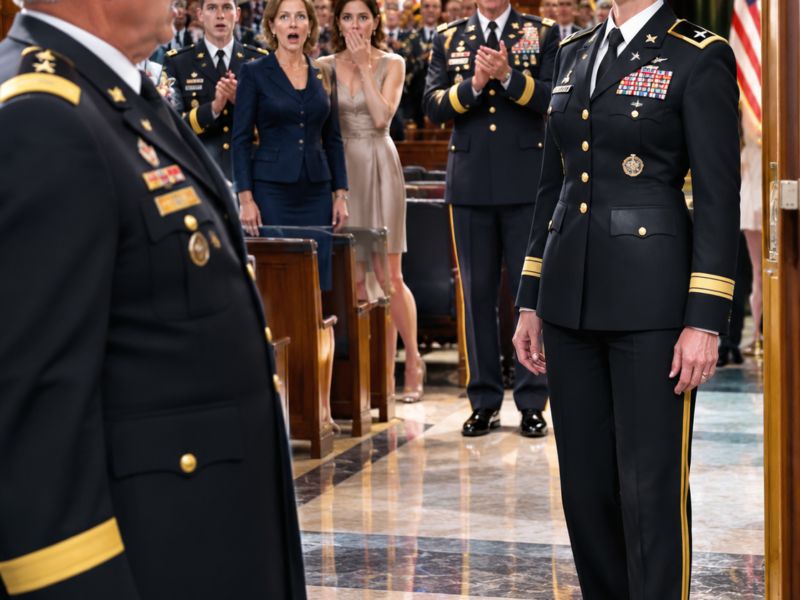
“What the hell is she doing here?” my father whispered as I stepped into the auditorium at Fort Halder
The signature at the bottom of the document was unmistakable.
My father’s handwriting had always been distinctive.
He wrote his H’s with a sharp upward stroke, and the final line of his signature curled beneath his name like an underline.
I had seen it on birthday cards, military commendations, and the occasional check he’d sent me when I was too young to understand why he never simply called.
But I had never seen it beneath my name on an official military record.
General Whitaker held the folder without speaking.
My father finally stood.
“General, I believe there’s been a misunderstanding.”
Whitaker didn’t look at him.
“Please remain seated, Lieutenant General.”
The words landed harder than a shout.
My father slowly lowered himself into his chair.
Penn leaned toward him again, whispering something I couldn’t hear.
I looked at the commander.
“Sir, may I see the document?”
Whitaker studied me for a moment.
“Of course.”
He handed it over.
The paper was a copy of a formal authorization request, dated fourteen months earlier.
At the top was a classification marking.
Below it was a paragraph describing a request for access to restricted intelligence material connected to a joint operational review.
My name appeared in the second section.
My rank was wrong.
It listed me as a colonel.
That alone made no sense.
I had been promoted to brigadier general nearly two years earlier.
Then I reached the signature block.
Harlan Vale.
Underneath, a statement indicated that I had personally approved the release of certain restricted operational records to a civilian defense consulting firm.
I read the sentence twice.
I had never approved such a release.
I had never even heard of the company.
“What is this?” I asked.
Whitaker answered carefully.
“An authorization submitted through an administrative channel. It was flagged during a routine audit.”
“Who submitted it?”
He glanced toward my father.
“Your father initially represented that the request had been coordinated with you.”
My fingers tightened around the paper.
“That isn’t true.”
“I know.”
I looked up.
Whitaker’s expression remained steady.
“The authorization was never accepted. The discrepancies were identified before any restricted material was released.”
A quiet murmur moved through the auditorium.
My father stood again.
“Thomas, we can discuss this privately.”
“That’s precisely what we’ve been trying to do for several weeks.”
My father glanced at the audience.
His face had lost the confidence I’d watched him wear for most of my life.
“Not here.”
Whitaker closed the folder.
“Then perhaps you should have considered that before allowing this matter to reach a formal review.”
I looked toward Penn.
He was staring at the floor.
Liora had moved her chair slightly away from him.
My mother sat perfectly still, both hands gripping the program.
I returned the document to Whitaker.
“Sir, I want a copy of every record associated with this request.”
“You’ll receive it through the appropriate channels.”
“Thank you.”
He nodded.
Then he turned toward the audience and calmly explained that the ceremony would proceed after a short recess.
Nobody applauded.
The sound of hundreds of people shifting in their seats was suddenly louder than the applause had been.
I stepped off the stage.
My father intercepted me near the side entrance.
“Sable.”
I kept walking.
“Stop.”
I turned.
He lowered his voice.
“You have no idea what you’re walking into.”
“Then explain it.”
“Not here.”
“You’ve said that twice now.”
His eyes flickered toward the audience.
“You’re making this bigger than it needs to be.”
I stared at him.
“My name is on a document authorizing the release of intelligence records I never approved. How much smaller would you like it to be?”
His mouth tightened.
“You don’t understand the circumstances.”
“Then help me understand.”
For a moment, he looked almost tired.
Not angry.
Not superior.
Just tired.
“Penn was trying to establish himself. There were complications with a contract.”
I waited.
“He needed access to certain historical information. Nothing operational. Nothing that would have harmed anyone.”
“You used my name.”
“I was trying to help your brother.”
“And you signed it.”
He looked away.
“It was an administrative matter.”
I felt something inside me settle into a cold, hard place.
“An administrative matter doesn’t require a forged authorization.”
His head snapped back.
“Watch your language.”
“Then watch your signature.”
He stared at me.
For the first time, I realized he was not surprised by the accusation.
He was afraid of what I might discover.
Before he could answer, Penn approached us.
“Can we please not do this in front of everybody?”
I looked at him.
“You knew?”
He shook his head too quickly.
“No.”
My father turned sharply.
“Penn.”
That single word stopped him.
I looked between them.
“Interesting.”
Penn swallowed.
“I didn’t know about the document.”
“But you knew there was a problem.”
He said nothing.
I took one step closer.
“Did you use my name to get that contract?”
“That’s not what happened.”
“Then tell me what happened.”
He rubbed his forehead.
“It was supposed to be temporary.”
“What was?”
“The access request.”
My father closed his eyes.
Penn looked at him, then back at me.
“I needed to show the company that I had someone inside the military who could help with their transition work.”
I stared at him.
“Someone inside the military?”
He nodded.
“They were interested in bringing in former senior officers. They wanted people with operational experience.”
“So you told them you could reach me.”
“I said I had family connections.”
“And when they asked for proof?”
He looked down.
My father stepped between us.
“Enough.”
I almost laughed.
Not because anything was funny.
Because after twenty years of being ignored, my father was still trying to decide when I was allowed to speak.
“Move, Dad.”
His eyes hardened.
“Don’t speak to me that way.”
“Then don’t stand between me and the truth.”
He moved aside.
Penn’s face had become strangely pale.
“What was the company’s name?” I asked.
He hesitated.
“Northstar Strategic Solutions.”
I repeated it silently.
I didn’t recognize it.
“Who was your contact?”
“Daniel Mercer.”
My father’s expression changed.
It was slight, but I saw it.
He knew that name.
“Do you know him?” I asked.
“No.”
The answer came too quickly.
I looked at him for another second.
Then I turned away.
“I’ll be speaking with the inspector general.”
My father reached for my arm.
I stepped back before he could touch me.
“Don’t do that,” he said.
I looked at his hand.
Then at his face.
“You already did.”
I left the auditorium without attending the rest of the ceremony.
Outside, the April wind had picked up.
I walked toward my vehicle with the document’s details turning over in my mind.
Northstar Strategic Solutions.
Daniel Mercer.
A forged authorization.
A family connection used as leverage.
I had spent years learning how to recognize the difference between an isolated mistake and a coordinated attempt to gain access.
This didn’t feel isolated.
My phone rang before I reached the parking lot.
It was General Whitaker.
“General Vale, I need you to come back inside.”
“Is there another issue?”
“Yes. There’s something else in the file.”
“What?”
A pause.
“Your father didn’t just submit the authorization. He attached a supporting letter.”
I stopped beside my car.
“What kind of letter?”
“One claiming you had agreed to provide informal assistance to Northstar.”
I closed my eyes briefly.
“That is false.”
“I assumed as much.”
“Who wrote it?”
Another pause.
“Your brother.”
I looked toward the auditorium.
Through the glass, I could see people beginning to leave.
“Send me a copy.”
“We’re going to handle this formally. I don’t want you investigating anything on your own.”
“I understand.”
“I mean it, Sable. This could become a criminal matter.”
“I understand, sir.”
After we disconnected, I sat in my car without starting the engine.
My brother had used my name.
My father had signed his approval.
And my mother had watched me being excluded from the ceremony as though I were the one who had done something wrong.
For years, I’d thought their silence meant they didn’t care.
Now I wondered whether it had been protecting something.
That evening, I checked into a hotel outside the installation.
I didn’t go to my parents’ house.
I didn’t call Penn.
I opened my laptop and sent a formal request to the appropriate oversight office, disclosing the potential misuse of my identity and requesting preservation of all related records.
Then I called my attorney, Colonel Rachel Morgan, who had recently retired from active service and now handled complex military administrative matters.
She listened without interrupting.
When I finished, she asked one question.
“Did you sign anything for your brother?”
“No.”
“Did you verbally authorize him to represent you?”
“Never.”
“Good. Don’t contact him about the details again.”
“Rachel, I think my father knows more than he’s saying.”
“Then let the investigators establish what he knows. Don’t give anybody an opportunity to claim you influenced a witness.”
I leaned back in the hotel chair.
“I spent twenty years protecting people from things they never knew were happening. I never imagined I’d need to protect myself from my own family.”
Her voice softened.
“That doesn’t make you responsible for what they chose to do.”
I didn’t answer.
After we ended the call, I opened the supporting documents Whitaker had sent through the secure channel.
The letter from Penn was three pages long.
It described our relationship as close and cooperative.
It stated that I had agreed to provide him with general guidance on military procurement procedures.
It even included a paragraph about our childhood.
According to Penn, our father had encouraged both of us to pursue military careers, and we had always shared a strong professional bond.
I read that paragraph three times.
My brother and I had not shared a room since he was twelve.
We had never discussed my assignments.
He had never asked what military intelligence actually involved.
Yet now, on paper, he had made himself the person who knew me best.
At the bottom was his signature.
There was also a contact number for Daniel Mercer.
I didn’t call it.
Instead, I searched the company through public records.
Northstar had been incorporated six years earlier.
Its listed services included defense consulting, logistics analysis, and strategic risk management.
Nothing unusual on the surface.
But its registered managing partner was Daniel Mercer.
I recognized the name now.
Not personally.
Professionally.
Mercer had once been associated with a defense contractor whose access privileges had been suspended following an investigation into improper handling of operational information.
The case had never resulted in a public conviction.
The contractor had dissolved.
Mercer had disappeared from the industry for several years.
Now he was back.
I forwarded the information to Rachel.
Her reply came within minutes.
Do not contact him. Let the investigators handle it.
I closed the laptop.
For the first time that day, I noticed how tired I was.
I slept badly.
At 6:40 the next morning, my phone rang.
My mother.
I watched it vibrate until the call ended.
A minute later, a message appeared.
Please come home. Your father isn’t doing well.
I read it twice.
Then I typed:
I’ll come by at noon. We need to talk.
Her response came immediately.
Don’t bring anyone.
I stared at those four words.
I hadn’t planned to.
But I wondered why she felt the need to ask.
At noon, I drove to the house where I’d grown up.
The brick colonial looked almost exactly as it had when I left for my first assignment.
The maple tree near the driveway had grown wider.
The white porch railing had been repainted.
A small American flag hung beside the front door.
My mother opened it before I knocked.
She looked older than she had at the ceremony.
“Come in.”
My father sat in the living room.
His retirement uniform had been replaced with a gray sweater and pressed trousers.
The television was off.
Penn wasn’t there.
I remained standing.
“Where’s Penn?”
“He’s dealing with the company,” my father said.
“What does that mean?”
“He has meetings.”
“With Daniel Mercer?”
My father looked toward my mother.
She lowered her eyes.
I pulled a chair away from the coffee table and sat down.
“Let’s start with the authorization.”
My father sighed.
“Sable, I made a mistake.”
“That’s not an explanation.”
“I was trying to help Penn.”
“By signing a document in my name?”
“I believed the request was harmless.”
“Did you know what information he wanted?”
“Historical logistics data.”
“What data?”
He hesitated.
“Old deployment schedules. Transportation patterns. Nothing current.”
I felt my shoulders tighten.
“Those records can reveal far more than you think.”
“I know that now.”
“No, Dad. You should have known it then.”
He rubbed his hands together.
“I was approached by Mercer. He said Northstar needed someone with military experience to review legacy procedures.”
“Why didn’t he approach you?”
“He did.”
“And?”
“I told him I was retired and couldn’t assist.”
“So you sent him to Penn?”
My father didn’t answer.
My mother finally spoke.
“Your father thought it would be a good opportunity for your brother.”
I looked at her.
“Did you know they were using my name?”
She pressed her lips together.
“I knew there was a letter.”
“What letter?”
“The one Penn wrote.”
“And you didn’t think I should know?”
She looked down at her hands.
“Your father said it was only paperwork.”
I stood.
“That’s what everyone keeps calling it.”
My father rose too.
“Sit down.”
“No.”
“Sable, please. We can resolve this as a family.”
I stared at him.
“You had fourteen months to resolve it as a family. You chose to submit the document instead.”
His expression tightened.
“Do you think I wanted this to happen?”
“I think you wanted something else badly enough to put my career at risk.”
For several seconds, nobody spoke.
Then my mother got up and walked toward the hallway.
I heard a drawer open.
When she returned, she was holding a thin blue folder.
She placed it on the coffee table.
“I think you should read this.”
My father immediately stepped forward.
“Marion.”
She didn’t look at him.
“You told me it was handled.”
“It was.”
“No, Harlan. It wasn’t.”
She turned toward me.
“There’s something you don’t know.”
I opened the folder.
Inside were printed emails, several bank statements, and a copy of a contract between Northstar Strategic Solutions and a small consulting company registered in Penn’s name.
The first email was dated nine months earlier.
It was from Daniel Mercer to my father.
The subject line read: “Vale Family Authorization.”
I began reading.
Mercer had explained that Northstar was competing for a defense logistics review contract.
The company needed an adviser with knowledge of legacy military intelligence procedures.
He mentioned my name.
He said my professional history would strengthen the proposal.
My father replied that I was unlikely to participate.
Mercer suggested that Penn could serve as the family representative.
Then came my father’s response.
“Use the attached biography. She won’t be involved directly, but her credentials will establish credibility.”
I looked up.
My father was staring at the carpet.
“Did you write this?”
He didn’t answer.
I turned the page.
The next email was from Penn.
He thanked Mercer for the opportunity and asked whether the company could advance part of his consulting fee.
Mercer agreed.
The payment would be made after the authorization was accepted.
But the most disturbing email was dated three weeks later.
Penn had written:
“My father says Sable won’t make trouble if this stays internal. She doesn’t discuss family business with anyone anyway.”
I read the sentence again.
My mother sat beside me.
“He told us you wouldn’t care,” she whispered.
I looked at her.
“And you believed him?”
She shook her head slowly.
“I didn’t know what to believe.”
My father finally spoke.
“That email was taken out of context.”
“What context could possibly make it acceptable?”
“I thought Penn was going to handle everything properly.”
“You signed the authorization.”
“I was trying to give him a chance.”
“At my expense.”
He looked up.
For a moment, I saw the father who had taught me to ride a bicycle, who had waited outside my bedroom when I had pneumonia, who had once driven six hours to bring me a forgotten school project.
That man was still somewhere inside him.
But he was buried beneath years of pride and decisions he couldn’t admit were wrong.
“I thought you had everything,” he said quietly.
I didn’t understand.
“Your career. Your rank. Your medals. You were always so independent.”
“So you decided I could afford to lose my reputation?”
He looked away.
“I never thought it would go this far.”
I closed the folder.
“That’s the problem. You never thought about what it would cost me.”
My mother reached for my hand.
I moved mine gently away.
“Did you know about the money?”
She nodded.
“Penn said he was getting paid for his consulting work.”
“How much?”
She looked at my father.
He answered.
“Forty thousand dollars.”
I let out a slow breath.
Forty thousand dollars.
That was apparently the price of my brother’s opportunity.
“Did he receive it?”
My father shook his head.
“Only part of it.”
“How much?”
“Ten thousand.”
I looked at the bank statement.
The payment had been transferred to Penn’s company.
But another entry caught my attention.
Three days later, the same amount had been withdrawn and sent to an account belonging to Northstar.
“What’s this?”
My mother leaned forward.
“I don’t know.”
I read the transaction description.
It was labeled as a reimbursement.
But the date matched the day the authorization request had been flagged.
I photographed the page and sent it to Rachel.
Her response came quickly.
Do not remove the originals. I am notifying the investigator.
I put the phone away.
My father watched me.
“Are you involving the authorities?”
“They’re already involved.”
“You’re going to destroy your brother.”
I stared at him.
“Penn signed a false statement. You signed a false authorization. Neither decision was mine.”
“He made a mistake.”
“So did I. I spent years believing that if I worked hard enough, you would eventually be proud of me.”
My father flinched.
It was the first time I had ever said that to him.
I continued before I could lose my nerve.
“I thought if I came home often enough, called often enough, and remembered every birthday, eventually you would stop treating my service like an excuse.”
My mother began to cry.
I didn’t.
“I didn’t need you to understand every assignment. I needed you to ask whether I was okay.”
My father lowered his head.
For once, he didn’t interrupt.
I left the folder on the table.
“Don’t destroy anything. Don’t contact Mercer. Don’t discuss the investigation with Penn.”
Then I walked out.
For the next several weeks, the investigation moved slowly.
There were interviews, document reviews, and secure meetings with investigators.
Rachel helped me organize my records and establish a clear timeline of events.
I was careful not to speak with Penn about the allegations.
He tried contacting me several times.
At first, his messages were defensive.
You know Dad was only trying to help.
Then they became angry.
You always think you’re better than everybody.
Finally, one arrived late at night.
I didn’t know Mercer was using the company to get restricted information.
I read it without replying.
Two days later, he sent another.
I should have told you.
That one stayed on my screen longer.
Because for the first time, it sounded like something approaching the truth.
The investigators eventually established that Mercer had deliberately recruited Penn as an intermediary.
He knew Penn wanted a place in the defense industry.
He knew my father wanted to help his son.
And he understood that my professional record could make a proposal look credible even without my participation.
Penn had signed a statement claiming I had agreed to help.
My father had signed the authorization.
Neither had informed me.
The request had been rejected before restricted information was released.
But the investigation uncovered something else.
Northstar had been collecting publicly available documents and improperly obtained administrative records to build profiles of military personnel.
The company wanted to identify people who could provide access to sensitive logistical information.
My name had been included because of my intelligence background.
Mercer had not been interested in helping Penn build a career.
He had been interested in using the Vale family name to get through a door that would otherwise remain closed.
And my father had opened it.
The next significant development came on a Tuesday afternoon.
I was in my office when Rachel called.
“They’ve interviewed Penn.”
I stopped typing.
“And?”
“He admitted writing the letter.”
“Did he admit knowing what it was for?”
“He says he believed the information was nonclassified and that the authorization was only a formality.”
I leaned back.
“Do they believe him?”
“They’re still evaluating his statements.”
“What about my father?”
“He’s cooperating, but his account has changed twice.”
I closed my eyes.
“What did he change?”
“Initially, he said he had never spoken directly with Mercer. Now he admits they met several times.”
I looked out the window.
“Why?”
“That’s what they’re trying to establish.”
A few days later, I received an official request for an interview with Daniel Mercer.
He had agreed to cooperate after investigators obtained financial records showing additional payments to Penn’s consulting company.
The interview took place in a secure conference room.
Mercer was in his late fifties, with neatly combed gray hair and an expensive watch.
He looked like the kind of man who could sit through an entire meeting without saying anything meaningful.
He began by denying that he had requested restricted information.
Then the investigators showed him the correspondence.
He changed his explanation.
He said he had only wanted a senior military perspective.
Then they showed him the authorization.
His eyes paused on my name.
“General Vale was never expected to participate directly,” he said.
I looked at him.
“Then why use my credentials?”
He folded his hands.
“Your record demonstrated credibility.”
“My record?”
“Your service history.”
“Without my knowledge.”
He shifted slightly.
“Your father assured us that the arrangement had been discussed within the family.”
I kept my voice level.
“My father doesn’t have authority to discuss my professional responsibilities.”
“I understand that now.”
I studied him.
“Did you?”
He said nothing.
The investigators continued.
They showed him the emails, the payments, and the supporting letter.
Eventually, Mercer acknowledged that Northstar had wanted access to historical logistics material that could help its bid for a government contract.
He maintained that he had not intended to obtain classified information.
But the documents showed that the company had sought access beyond the public records available to it.
The meeting ended without a dramatic confession.
It didn’t need one.
The evidence was already there.
What mattered most was what happened afterward.
Northstar’s contract proposal was suspended.
Its access privileges were reviewed.
The company eventually lost the opportunity.
Mercer faced federal charges related to fraudulent representations and improper access attempts.
Penn’s consulting arrangement was terminated.
My father’s role was referred for further administrative and legal review.
He was not treated as someone who had simply made a harmless family mistake.
His years of service were considered, but they did not erase the responsibility attached to his signature.
Penn was eventually required to cooperate fully with investigators.
He also lost the position he had hoped would launch his career.
There was no dramatic arrest in front of the family.
No television cameras.
No shouting outside the house.
Just official letters, interviews, legal proceedings, and consequences that arrived one envelope at a time.
Somehow, that was harder to watch.
Three months after the ceremony, my mother called.
“Your father wants to see you.”
I was sitting at my kitchen table, reviewing a report.
“Why?”
“He says he needs to apologize.”
I didn’t answer immediately.
“Is he asking because he wants me to help him?”
“No.”
“Does he want me to speak to the investigators?”
“No.”
She took a breath.
“He just wants to see his daughter.”
I looked at the report in front of me.
For a long time, that was all I had wanted.
Now I wasn’t sure what it would feel like to hear it.
“All right,” I said. “I’ll come Sunday.”
When I arrived, my father was sitting on the back porch.
He wore an old navy sweater and held a cup of coffee between both hands.
The retirement ceremony photograph was no longer on the living room wall.
In its place was a framed picture of the three of us from years earlier.
I was about sixteen.
Penn was twelve.
My father stood behind us with both hands resting on our shoulders.
It was one of the few photographs where nobody looked as though they had been told to smile.
He looked up when I approached.
“Thank you for coming.”
I sat across from him.
For several minutes, neither of us spoke.
Then he placed his coffee on the table.
“I’ve been trying to find the right words.”
“You don’t need to make a speech.”
He nodded.
“I know.”
He looked toward the backyard.
“When you were little, I thought you were the one who would understand me.”
I frowned.
“What do you mean?”
“You were always serious. Disciplined. You wanted to know how everything worked.”
He rubbed his thumb along the edge of the cup.
“When you joined the military, I thought we’d have something in common that would last the rest of our lives.”
I waited.
“But you became successful in a way I couldn’t control. You went places I couldn’t reach. You worked with people who didn’t need my approval.”
His voice grew quieter.
“Penn stayed close. He asked for advice. He needed me.”
I looked at him.
“So you chose the child who needed you.”
He nodded.
“I suppose I did.”
I looked down at my hands.
“That wasn’t fair to either of us.”
“No.”
He swallowed.
“I confused being needed with being loved.”
The words hung between us.
I had spent years imagining an apology.
In some versions, he admitted everything.
In others, he explained that he had been proud all along but didn’t know how to say it.
The real apology was less polished.
And perhaps more honest.
“I was proud of you,” he said. “I just didn’t know how to be proud without making it about me.”
I felt my throat tighten.
“Why didn’t you tell me?”
“Because every time you came home, I saw how much of your life I didn’t know. Instead of asking, I made it your fault.”
He looked at me.
“That was cowardly.”
I didn’t rush to comfort him.
He had spent years allowing me to carry the discomfort of our relationship.
He could sit with some of it now.
“Did you ever read my award citations?” I asked.
He nodded.
“All of them.”
“Did you understand what I did?”
“Not completely.”
“Did you ever ask?”
He shook his head.
I looked toward the garden.
“That’s what hurt.”
He wiped his eyes with the heel of his hand.
“I’m sorry, Sable.”
For a moment, I could hear a lawn mower somewhere down the street.
A neighbor’s dog barked.
The ordinary world continued around us.
“I don’t know if I can go back to how things were,” I said.
“I don’t expect you to.”
“And I won’t pretend the investigation didn’t happen.”
“I understand.”
“If we’re going to have a relationship, it has to be different.”
He nodded.
“Tell me how.”
I looked at him.
“Start by telling the truth, even when it makes you look bad.”
He lowered his head.
“I can try.”
“Don’t try for me. Do it because it’s right.”
He nodded again.
It wasn’t forgiveness.
Not yet.
But it was the first conversation we’d had in years where I didn’t feel like I had to earn the right to be heard.
Penn called me the following week.
I almost let it go to voicemail.
Then I answered.
“Hey.”
There was a long silence.
“Hi, Sable.”
He sounded different.
Less confident.
Less certain that the world would eventually arrange itself around him.
“I wanted to apologize.”
I said nothing.
“I lied in that letter. I knew I was using your name to make the proposal stronger.”
He exhaled.
“I told myself it wasn’t really hurting you because you weren’t involved. I thought it was just paperwork.”
“That’s what Dad said.”
“I know.”
He paused.
“I also knew Mercer wanted more than public information. I didn’t understand how far he intended to go, but I knew enough to ask questions.”
I closed my eyes.
“Why didn’t you?”
“Because I wanted the job.”
The honesty hurt more than another excuse would have.
“I wanted Dad to be proud of me. I wanted people to think I was capable of something important.”
“So you borrowed my reputation.”
“Yes.”
He began crying quietly.
“I don’t expect you to forgive me.”
“Good.”
He went silent.
“Penn, I need you to understand something. I didn’t spend twenty years away from home because I thought I was better than you.”
“I know.”
“I missed things I can never get back. I missed our grandmother’s funeral. I missed Mom’s surgery. I missed birthdays. And every time I came home, I was made to feel like I was the one who had abandoned everybody.”
“I know.”
“No, I don’t think you do.”
He didn’t argue.
I continued.
“I don’t need you to become a military officer. I don’t need you to compete with me. I needed you to be my brother.”
His breathing became uneven.
“I’m sorry.”
This time, I believed he meant it.
That didn’t mean I was ready to trust him.
“We can talk again,” I said. “But I won’t help you avoid the consequences of what you did.”
“I understand.”
“And you need to build something that belongs to you. Not something that depends on my name.”
“I will.”
We ended the call.
I didn’t feel relieved.
I felt tired.
But it was a different kind of tired from the one I’d carried for years.
The investigation concluded several months later.
My name was formally cleared of any involvement in the authorization request.
The record was corrected.
Penn accepted responsibility for his false statements and cooperated with the authorities.
My father received formal disciplinary consequences related to his misuse of his position and the unauthorized representation of my approval.
His retirement benefits were reviewed under the applicable rules, and the matter became a permanent part of his professional record.
He had spent forty years building a reputation for discipline.
He would have to live with the fact that one of his final official acts had contradicted the values he claimed to represent.
Mercer faced the most serious consequences.
The government terminated its relationship with Northstar, and the legal case proceeded.
The company eventually dissolved.
There was no way to undo the choices that had brought us there.
But at least the truth was no longer hidden behind a family name.
Nearly a year after the ceremony, I received a letter from my father.
It arrived in a plain white envelope with my full name written across the front.
Inside was a single sheet of paper.
He hadn’t used official stationery.
He hadn’t mentioned his rank.
He hadn’t listed his achievements.
He wrote:
“Sable,
I used to believe that a family was strongest when everyone followed the person at the head of the table.
I understand now that I was wrong.
You spent years serving people who depended on your judgment, while I made you feel that your own family couldn’t find a place for you.
I cannot give you back the birthdays, holidays, or conversations I took from you.
I cannot erase what I signed.
But I can stop asking you to carry the burden of my choices.
I am proud of you.
Not because of your rank.
Not because of the people who stood up for you.
Because you told the truth when lying would have been easier.
Your father.”
I read it twice.
Then I placed it in the drawer beside my old military identification card.
I didn’t write back that day.
I wasn’t ready.
A few months later, I invited my parents and Penn to dinner.
Not at their house.
Not at some formal restaurant where my father could feel compelled to make a speech.
I chose a small Italian place near my apartment.
My mother arrived early and helped me set the table.
Penn brought flowers.
My father arrived carrying a pie from a bakery he’d passed on the way.
Nobody knew quite what to say at first.
Then my mother asked about my work.
Not my rank.
Not my awards.
My work.
“What does a normal day look like for you now?”
I smiled slightly.
“Longer than I’d like. More meetings than I ever thought possible.”
She laughed.
My father listened.
He didn’t interrupt to tell me how things had been done during his generation.
Penn asked a question about one of my old assignments.
I couldn’t share operational details, but I told him what I could.
For the first time, he listened without trying to turn the conversation toward himself.
Halfway through dinner, my father raised his glass.
“I’d like to say something.”
I looked at him.
He hesitated.
“To Sable. I spent too long seeing the uniform and not the person wearing it.”
He lowered his glass slightly.
“I hope I get to know both.”
Nobody applauded.
There were no cameras, no commanding officers, and no polished speeches.
Just four people around a table, trying to learn how to be a family again.
I raised my glass.
“To telling the truth.”
My father nodded.
“To that.”
Later, when I was washing dishes, he came into the kitchen.
He stood beside me for a moment.
“Do you need help?”
I handed him a towel.
“Sure.”
He dried the plates while I rinsed them.
We didn’t talk about the ceremony.
We didn’t talk about Northstar.
We didn’t pretend that everything had been repaired.
But when I handed him the last plate, he looked at me and said something I had waited most of my life to hear.
“Tell me about the work you did overseas. Only what you’re allowed to tell me.”
I smiled.
And for once, I didn’t have to explain why I had been away.
I simply began.
Years earlier, I had thought recognition would feel like the entire room standing when my name was announced.
But that wasn’t what stayed with me.
What stayed with me was a quiet afternoon in my parents’ kitchen, the sound of water running into the sink, and my father finally asking a question he should have asked twenty years before.
I had spent most of my life learning how to disappear without leaving a room.
I was done disappearing.
And this time, I didn’t need anyone to stand up and applaud.
The end.









