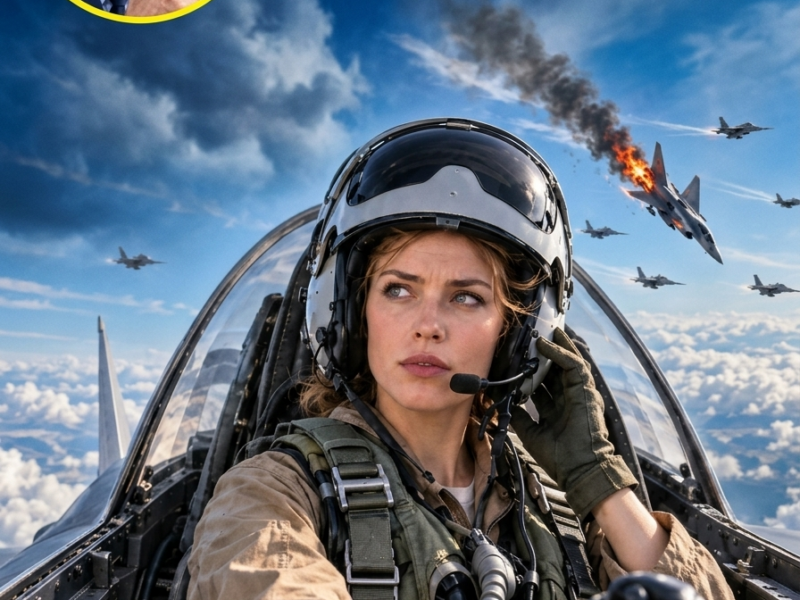
“WE’RE LOSING THE SKY!” the command radio screamed as six enemy jets tore through our formation, but I calmly keyed my microphone and whispered one word
The sky above Guam was bleeding orange and violet as the sun dipped beneath the Pacific, but three thousand feet above the water, it was a storm of violent contrails, screaming alarms, and distant flashes of detonating ordinance.
“WE’RE LOSING THE SKY!” the command radio screamed into my helmet, the voice of Colonel Vance frantic, distorted by high-altitude static as six enemy jets tore through our strike formation.
My cockpit was a chaotic orchestra of death. Red warning lights strobed against the glass of my canopy. The radar warning receiver emitted a continuous, high-pitched screech—two enemy Su-35s were actively painting my airframe with weapons-grade radar from ten miles out. To my left, a ball of orange fire punched through the cloud layer; Captain Miller’s F-16 went down, his radio signal dying instantly in a burst of white noise. Seconds later, my wingman’s icon flickered on my multi-function display and vanished.
Two down. Four left in our original flight. Six hostiles sweeping the corridor.
“Ghost, where are you?” Command demanded, the desperation in Vance’s voice mounting. “Say again, Ghost, we’ve lost your transponder! We have multiple fast-movers closing on the airfield! Where are you?”
I reached up with a gloved hand, clicked off my emergency beacon, and brought my thumb to the radio key. I kept my breathing steady, deep, and rhythmic, forcing my pulse down to fifty-four beats per minute despite the gravity-well pulling at my chest.
“Behind them,” I whispered.
There was a long, stunned pause on the encrypted channel. “Say again, Ghost?”
I didn’t answer. Words were drag. Words were noise.
Instead, I pulled the stick back, slamming my body into the leather seat as six Gs pressed the air from my lungs. The F-16 Block 70 responded instantly, rolling upside down before slicing vertically through a dense bank of gray cirrus clouds.
For eighteen months, I had been relegated to the forgotten corridors of Pacific Air Forces—a ghost pilot assigned to classified tactical trials that didn’t exist on official rosters. They called me Ghost because I flew without a footprint, using terrain masking, thermal inversion layers, and the electromagnetic shadows cast by heavy cloud cover to disappear from radar screens. The air force spent billions on radar-absorbent paint and angular stealth airframes, but I knew the truth: the sky was not a vacuum. It had ridges, valleys, blind spots, and thermal currents. You didn’t need a hundred-million-dollar stealth fighter to be invisible; you just had to know how to hide in the geometry of the atmosphere.
Below the cloud deck, the dark, churning waters of the Philippine Sea rushed toward me at six hundred knots. I leveled off at eighty feet above the wave tops. The altitude warning system screamed inside my mask—ALTITUDE! ALTITUDE! PULL UP!—but I reached forward and flipped the warning override switch, drowning out the computer’s artificial panic.
The enemy flight of six advanced multi-role fighters was flying in a classic wall-of-spikes sweep, spaced three miles apart, sweeping their radars forward in a desperate search for the American interceptors they believed were retreating toward Andersen Air Force Base. They thought they were the hunters. They thought the sky belonged to them. They never looked down into the spray of the ocean.
I throttled back, letting my engine signature cool as I slid beneath their low-altitude radar horizon, riding the crests of the waves like a razor blade.
One by one, I pulled up behind their trailing element.
Tone.
It wasn’t the screaming lock-on of an active radar missile that would alert their missile approach warning systems. It was the soft, persistent heat-seeking chime of an AIM-9X Sidewinder tracking the raw thermal signature of their twin tailpipes against the cold evening sky.
I squeezed the trigger.
A tongue of solid fuel flame leapt from my left wingtip. The missile sliced upward, leaving a thin gray line in the air. Two seconds later, the rearmost enemy jet blossomed into a sudden, blinding sphere of fire. The pilot didn’t even have time to eject; the airframe split in half, tumbling into the dark sea below.
“Contact lost on Lead Four!” a panicked voice shouted in foreign chatter over the open tactical frequency. “Where did it come from? Check your six!”
“I don’t have a contact! Radar is clean!”
I didn’t give them time to process the geometry. I hauled the stick back, popping through the cloud floor like a rising specter, rolling ninety degrees to line up on the second jet in the rear element.
Tone. Trigger press.
Another flash of orange illuminated the gray clouds. The second jet’s wing sheared off, sending it into an uncontrollable flat spin.
The radio channel exploded with terrified, confused shouting.
“Where is she?”
“Break formation! Break formation!”
“I have no target on scope!”
I pulled back into the dense cloud bank, turning off my radar entirely, flying purely by visual horizon and thermal tracking. Five minutes passed in absolute, suffocating silence. I floated through the white mist, a shadow waiting for the enemy to expose their flanks in their panic.
They broke their neat line, scattering into pairs, sweeping their heads left and right, throwing out magnesium flares that burned like dying stars against the dark clouds. But flares only work if you know where the missile is coming from.
I slid out of a cloud bank five hundred feet above the third target. I didn’t even use a missile. I selected the 20mm M61 Vulcan cannon, brought the reticle over his left engine intake, and pulled the trigger. High-explosive incendiary rounds chewed through his wing root and fuel lines. The jet dissolved into a shower of burning aluminum.
Ten minutes in. Four hostiles down.
Command’s voice returned, no longer panicked, but hushed with a strange, reverent disbelief. “Ghost… you’re clearing the entire formation.”
I adjusted my oxygen mask, watching the fifth jet panic and dive toward the deck, only to misjudge his altitude in the dark and smash directly into the ocean surface in a towering geyser of white water and fire.
I smiled faintly beneath my mask. “Not yet.”
Because the sixth jet hadn’t panicked.
The flight leader—the adversary commander—hadn’t scattered. While his squadron dissolved in terror, he had climbed to twenty thousand feet, executing a high-altitude combat spread, watching the cloud tops, calculating the vector of every strike I had made. He was a veteran. He knew he wasn’t fighting an squadron; he was fighting a single pilot who understood the sky better than he did.
Suddenly, my radar warning receiver blared a single, sharp tone.
He was above me.
For the first time, the hunter became the hunted.
We entered a vertical rolling scissors through the clouds, our two aircraft twisting around each other like twin serpents in a dark vault. Six Gs. Eight Gs. The blood pulled from my brain, darkening the edges of my vision into a narrow tunnel of red and black. I gritted my teeth, executing the anti-G straining maneuver, forcing blood back into my optic nerve.
He was good. Every time I tried to roll behind his tail, he reversed his bank, using his vectoring nozzles to keep his nose pointed near my canopy. We were losing altitude fast, tumbling through twelve thousand, eight thousand, four thousand feet, tied in a lethal dance where the first pilot to make a single millimeter of error would either take a missile or slam into the water.
Then he made his mistake.
He relied on his computer instead of his eyes. He executed a classic doctrine break, expecting me to overshoot upward into the sun’s glare. But I didn’t climb. I cut my throttle to idle, deployed my speed brakes, and let him slide right past my nose.
For half a second, his jet filled my entire HUD.
Tone.
I didn’t use a missile. I fired a three-second burst from the cannon. The 20mm rounds shattered his cockpit canopy and shredded his tail surfaces. The aircraft pitched up violently, stalled, and plunged straight into the dark sea below.
Six enemy jets. Fourteen minutes.
Silence returned to the sky. The clouds drifted peacefully over the ocean, erasing the smoke trails and the burning oil slicks on the water.
The tactical frequency was dead quiet for twenty seconds. Nothing but the rhythmic hiss of my own oxygen regulator filled my ears.
Then Colonel Vance spoke from the bunker at Andersen, his voice dropping an octave, heavy with a weight I didn’t understand.
“Ghost… identify yourself for the record.”
I banked my F-16 toward the east, pointing the nose toward the faint runway lights of Guam glowing on the horizon.
“My name is Captain Elena Carter.”
A agonizingly long pause followed. I could hear rustling papers, muffled whispers, and the distant hum of computer banks in the background of the command center.
When Vance spoke again, his voice was barely a whisper. “Captain Carter… we’ve been looking for you for three years.”
My hands tightened around the flight stick, the cold leather digging into my knuckles. “Why? My records are clear. I was reassigned to PACAF tactical evaluation after my tour in the Gulf.”
His answer made my blood run cold.
“Your records were falsified, Captain. According to Naval Intelligence and the Joint Chiefs… your last mission was never supposed to end.”
Static suddenly roared across the main command frequency, wiping out Vance’s voice in a wall of harsh white noise.
Before I could reset my radio frequency, a second light flashed on my console. A secure, point-to-point laser communications channel—a signal that could only be transmitted from a satellite directly above my position—locked onto my aircraft.
A voice came through my private helmet headset.
It wasn’t a military controller. It was old, rasping, trembling with an impossible mix of terror and love. A voice I hadn’t heard since I was sixteen years old. A voice belonging to a man whose grave I had visited every Memorial Day for twelve years.
“Elena,” my father whispered through the static. “If you’re hearing this… don’t land at Guam. Don’t go home. They know you survived.”
The radio channel didn’t snap shut; it dissolved into a low, rhythmic pulse, like the beating of a heavy iron heart beneath the floorboards of the world.
My left boot hovered over the rudder pedal, frozen. My thumb remained glued to the radio toggle, but my throat was closed, blocked by a mass of sudden, suffocating ice.
“Dad?” I whispered into the oxygen mask.
No answer. Just that low, mechanical pulse—thump-thump, thump-thump—threaded with the faint, metallic hiss of deep-space telemetry.
“Vance, do you have this transmission?” I slammed my thumb onto the primary tactical frequency switch. “Andersen Command, this is Ghost-One, I have a signal override on a military-grade satellite band. Identify source!”
Nothing. The main channel was completely dead. The green numbers on my radio display flickered, then rolled back to zero across all broad-spectrum bands.
My instrument panel didn’t die—it was far worse. The digital flight displays began rewriting themselves. Lines of raw, non-standard code scrolled down the green glass of my Head-Up Display, wiping out my fuel calculations, my navigational waypoints, and my weapon inventories.
PROTOCOL 00-ORIGIN DETECTED
BIOMETRIC MATCH: CARTER, E.
LOCATION: VECTOR 090-PACIFIC
STATUS: TERMINAL RETRIEVAL
“What is this?” I muttered, pulling the stick back to stabilize my altitude at five thousand feet.
Below me, the dark outline of Guam was visible, the long white lines of Andersen Air Force Base’s twin runways glowing like twin ladders of light against the black velvet of the island. But as I watched, the runway lights flickered three times and went dark.
The entire base had gone to black-site protocol.
A sudden flash of light caught my eye at ten o’clock high.
Two radar signatures materialized on my secondary scope—not from behind me, and not from the western horizon where the enemy flight had come from. They had been orbiting in the high stratosphere above thirty-five thousand feet, waiting in absolute radar silence.
They weren’t foreign jets. Their transponders were broadcasting friendly identification codes, but their airframe profiles were all wrong. They were dark, tailless delta-wings—the long-rumored, never-acknowledged SR-72 Darkstar platforms operated exclusively by the Defense Advanced Research Projects Agency’s Special Projects Office.
“Vance!” I shouted into the dead radio. “I have two black-budget platforms descending on my position! What is your status?”
The radio crackled once. Vance’s voice returned, but it sounded thin, distant, like a man speaking from the end of a long concrete tunnel.
“Elena… listen to me very carefully,” Vance said, his voice stripped of all military decorum. “Do not execute a landing approach. Do not establish contact with ground security. The team waiting for you at the end of Runway Two-Eight is not PACAF Security Forces.”
“Who are they?” I demanded, banking hard to the right to keep the two descending delta-wings in my crosshairs.
“They are the same team that signed your father’s death certificate in 2014,” Vance replied, his breath raspy over the dying signal. “They’ve been waiting for a flight telemetry match on your personal combat algorithms for three years. Every time you flew a simulator, every time you logged a tactical sortie… they were running your neural flight profile against your father’s old research files.”
“My father died in a prototype test over the Nevada Test and Training Range!” I shouted. “I was there! I saw the folded flag!”
“You saw a box of sand, Captain,” Vance said bitterly. “Your father didn’t crash. He stole the primary core of Project VANGUARD—the autonomous combat system you just used to wipe out those six Su-35s.”
My heart hammered against my ribs like a sledgehammer hitting sheet metal.
Project VANGUARD. The experimental neural-link software I had been asked to test eight months ago at Edwards. They had told me it was an AI-assisted target prioritization tool designed to help solo pilots manage complex multi-threat environments. They told me it was a software patch.
“The patch,” I breathed, the air turning to frost inside my mask as the realization struck me. “It wasn’t helping me target those jets. It was… it was reading my mind.”
“It was copying you,” Vance corrected. “It was completing the neural map your father left unfinished when he escaped the Nevada bunker. They didn’t need your father anymore, Elena. They just needed his daughter to fly a live combat intercept to validate the system’s final parameters under extreme life-or-death stress.”
The two black delta-wings dropped out of the cloud deck above me, sliding into formation on either side of my F-16. They were monstrous, sleek machines, their dark composite skins absorbing the faint moonlight, completely devoid of national markings, insignia, or tail numbers. They didn’t have cockpits. There were no glass canopies.
They were unmanned. They were flying on the software my father had built—and that I had just completed.
A new voice clicked onto the private laser channel. It wasn’t my father this time. It was a cold, smooth, feminine voice, synthesized, devoid of any human inflection.
“VANGUARD Unit Zero-One to Target Alpha,” the voice said. “Your flight parameters have been successfully uploaded to the central network. Thank you for your service to the United States Air Force. Please prepare for remote system override and forced recovery.”
My cockpit controls went dead.
The flight stick in my right hand suddenly went limp, the hydraulic feedback dropping to zero. My throttle lever slid backward on its own rail, pulling my engine down to sixty percent power. The F-16 began a slow, bank-angle turn away from Guam, pointing its nose toward the open, empty expanse of the deep Pacific.
“Override engaged,” the synthetic voice announced softly. “Pilot authority terminated.”
I stared at the dead stick in my hand, my breath coming in short, jagged gasps. My chest tightened until I couldn’t expand my lungs.
They had built a cage out of my own mind.
I looked out the left canopy glass. The unmanned delta-wing was flying thirty feet from my wingtip, its sensor head rotated toward me, a cold red optical eye staring directly into my cockpit.
Don’t come home, my father’s voice echoed in the dark corners of my skull.
“Like hell,” I whispered through my teeth.
I didn’t try to pull the flight stick. I didn’t try to touch the throttle.
Instead, I reached down between my knees, unlocked the emergency manual breaker panel beneath the ejection seat housing, and ripped the main flight-computer bus fuse straight out of its socket with my bare fingers.
A blinding cascade of red sparks erupted from beneath my seat.
The smell of ozone and burning insulation filled the cockpit instantly. Every digital display in the F-16 died—not a system reboot, but a complete, catastrophic electrical blackout. The head-up display vanished. The digital gauges went black. The fly-by-wire flight control computers went dark.
The jet pitched violently downward, stripped of its digital stabilization systems.
An F-16 is inherently unstable; without a computer making thousands of micro-adjustments every second to keep the airframe level, the plane is nothing more than a thirty-thousand-pound lawnmower blade tumbling through the air.
The two unmanned delta-wings instantly broke formation as my aircraft began to spin wildly out of control, their automated collision-avoidance algorithms forcing them to pull away from the wildly tossing fighter.
“System error,” the synthetic voice squeaked once through my helmet before the internal intercom died entirely.
I was falling through four thousand feet in total darkness, blind, spinning at two hundred RPM toward the black ocean floor.
“Come on… come on, you old iron bitch,” I snarled, reaching down to grab the heavy, mechanical backup flight-control cables—the emergency mechanical linkage that bypassed the digital fly-by-wire system, a feature installed only on the early-block test models.
It felt like trying to steer a runaway locomotive with a rope. The control stick violently kicked against my hands, threatening to break my wrists as the air pressure slammed against the un-stabilized tail fins.
I planted my boots against the mechanical rudder pedals, hauled the stick into my left hip, and slammed the manual fuel-bypass lever forward.
The engine coughed, spat a three-foot plume of yellow flame from the tailpipe, and roared back to life with a primitive, un-throttled scream.
The jet caught the air at eight hundred feet above the water.
My teeth slammed together so hard I bit through the inside of my lip, filling my mouth with the salty taste of blood. The G-meter pinned itself at nine Gs. The airframe groaned—a sickening, metallic screech of stress fractures forming along the wing roots—but the aircraft held together.
I leveled off fifty feet above the dark, white-capped waves, flying south-southwest into the black void of the open Pacific, far below any shore-based radar coverage.
Behind me, high above the clouds, the two drone platforms were circling, their sensors searching the empty sea for a radar signal that no longer existed. I was a true ghost now—no radio, no radar, no fly-by-wire computer, flying a dying, mechanically linked fighter by the raw feel of the wind against the control surfaces.
I flew for two hours in the pitch-black silence, guided only by the magnetic compass floating in its glass bubble on the dashboard and the cold stars burning above the canopy.
My fuel gauge was dead, but I knew the numbers by heart. At sixty percent manual throttle, with my drop tanks empty, I had maybe twenty minutes of airtime left before the engine starved and died.
Ahead of me, floating in the middle of nowhere—six hundred miles south of Guam, far outside any commercial shipping lanes—a tiny light flashed.
It wasn’t a ship. It was a derelict, cold-war era oil drilling platform, its rusting iron legs rising out of the black water like the skeleton of a forgotten sea monster.
As I approached, a single green flare arced into the night sky from the platform’s upper helipad, burning bright against the clouds before falling into the sea.
The signal.
I brought the F-16 in low, chopping the manual fuel valve, dragging the tail hook across the rusted steel deck. The hook caught a heavy cable strung across the helipad with a violent, spine-snapping jerk that threw my head forward against the canopy frame.
The jet slammed onto the deck, skidding across the rusted metal before coming to a dead stop five feet from the edge of the drops into the black ocean below.
Silence settled over the world.
I sat in the dark cockpit, my lungs burning, my hands shaking so violently I couldn’t unclip my oxygen mask.
The canopy latch creaked as someone manually turned the external release lever from the outside. Cold, salt-heavy night air rushed into the cockpit, carrying the smell of rust, wet sea-weed, and warm hydraulic fluid.
A tall figure stood on the boarding ladder, wearing an old leather flight jacket, his face illuminated by the soft amber glow of an industrial flashlight.
He was thin, his hair completely white, a deep scar running from his left temple down to his jawline—the mark of a canopy glass breach from twenty years ago.
He looked at me through eyes that were the exact same shade of storm-cloud gray as my own.
“You always did land too fast, Elena,” my father said softly.
I didn’t move. I couldn’t move.
The flight suit felt like lead wrapped around my limbs. My throat was so dry it felt as if it were coated in sand. I stared at the man standing on the ladder—at the lines around his eyes, at the slight tremor in his left hand, at the old, faded patches on his flight jacket that bore the insignia of the 4477th Tactical Test Squadron.
“You’re dead,” I whispered, the words barely carrying over the sound of the ocean swells slamming against the platform’s iron pylons below. “I stood at the cemetery in Arlington. I touched the marble.”
My father reached out a gloved hand, his fingers resting gently against the side of my helmet. His touch was warm. Real.
“They buried a empty casket, birdy,” he said, using the nickname he hadn’t spoken since I was ten years old. “They had to. If the world thought I was alive, they would have used you to find me ten years ago.”
“They did use me!” I spat out, the sudden rage bursting through the numbness in my chest like a flare. I ripped my oxygen mask off, wincing as the rubber tore against my bruised skin. “They put your software in my cockpit! They used my combat telemetry to finish your code! I almost died over Guam because of your ghost program!”
My father didn’t flinch. He took the anger, his eyes filled with an unbearable, quiet sadness.
“I know,” he said softly. “I watched your flight telemetry from the terminal below deck. You flew the canyon route through the clouds… just like I taught you in the simulator at Nellis.”
“Why?” I demanded, leaning forward, grabbing his jacket collar with both hands. “Why let them build it? Why let them turn me into a key to unlock your weapon?”
“Because VANGUARD isn’t a weapon, Elena,” he said, leaning closer so his voice wouldn’t carry into the wind. “It’s an execution order.”
He stepped back down the ladder, gesturing for me to follow. “Unclip your harness. We have less than forty minutes before the satellite sweep picks up the thermal signature of your landing.”
I unclipped my legs and shoulder straps, my knees trembling as I climbed out of the cockpit. My boots hit the rusted deck plating with a dull, hollow thud.
The oil rig was an empty shell—a ghost station stripped of its machinery decades ago. But as my father led me down a narrow steel staircase into the lower decks beneath the waterline, the smell of salt was replaced by the dry, air-conditioned chill of high-powered server banks.
We stepped into a small, steel-walled compartment crammed with retrofitted computer monitors, satellite links, and glowing hard drive racks.
In the center of the room, hanging from the ceiling on heavy steel cables, was a spherical titanium core—the exact same design as the target system I had seen in classified briefing slides, but this one was covered in hand-soldered wires, custom cooling lines, and physical copper switches.
“When I built the original VANGUARD architecture in 2012,” my father said, standing beside the glowing sphere, “the Department of Defense wanted a system that could eliminate the human element from aerial combat. They wanted a central AI that could take control of every tactical aircraft in the Western Pacific during a conflict and fly them as a single, unified hive-mind.”
“Absolute air dominance,” I murmured, staring at the blue light pulsing within the core.
“Absolute authority,” my father corrected coldly. “No pilot could disobey a strike order. No pilot could abort a mission based on human conscience. If the system decided a civilian target was acceptable collateral damage, the flight computers would lock the pilots out and execute the drop.”
He turned to face me, his face grim in the blue light.
“I realized what they were building three weeks before the final test flight. I tried to erase the core architecture from the mainframes at Groom Lake, but they had backups. The only thing I could do was steal the primary encryption key—the master neural map—and fake my own death.”
“And you hid the key… in me,” I said, the cold truth settling into my stomach like a stone.
“Not in your brain, Elena,” he said gently, reaching out to touch my temple. “In your flying style. In your instincts. Human flight logic isn’t code—it’s muscle memory, spatial perception, the micro-second decisions a pilot makes when she’s staring death in the face. I knew that if you became a pilot, your combat algorithms would eventually reproduce the key.”
“So you used me as a vault,” I said, my voice dropping to a dangerous hush.
“I used you as a lock,” he replied. “A lock that could only be opened if you survived a live combat engagement against overwhelming odds. Because I knew that if you were good enough to survive… you would be good enough to help me destroy it forever.”
Before I could answer, an alarm chimed on the main console behind him.
A red warning box flashed across the primary monitor screen:
THERMAL ANOMALY DETECTED
VECTOR 180-NORTH
DISTANCE: 45 NAUTICAL MILES
CLOSING SPEED: MACH 4.2
My father looked at the screen, his face draining of color. “They found us. The satellite telemetry from your landing… they tracked the residual heat from your engine manifold.”
“Is it the drones?” I asked, stepping toward the console.
“No,” my father whispered, staring at the radar track. “It’s not the drones. It’s the primary network node. They’ve launched the operational VANGUARD platform from the carrier strike group off Okinawa.”
He looked at me, his eyes wide with a sudden, desperate fear.
“They aren’t coming to recover the key anymore, Elena. They’ve already extracted enough data from your flight over Guam to run the basic system. They’re coming to wipe this platform—and us—off the face of the earth.”
The floor beneath our feet shuddered as a low, mechanical hum vibrated through the steel legs of the oil rig.
“How long until impact?” I demanded, grabbing my helmet from the console table.
“Four minutes,” my father said, his hands moving across a mechanical keyboard with terrifying speed. “They’ve armed a long-range hypersonic cruise missile. We can’t outrun it. There are no boats, no escape pods, and your F-16 is out of fuel and missing its primary avionics.”
“Then we don’t outrun it,” I said, my voice surprisingly calm as the familiar, cold focus of combat settled over my mind. “We blind it.”
My father paused, looking up from his keys. “Elena… it’s a closed-loop terminal guidance system. It doesn’t rely on GPS or external radar. It’s reading the optical and thermal profile of this platform directly through the VANGUARD neural net.”
“Which means it’s reading my neural profile,” I said.
I stepped up to the glowing titanium sphere hanging in the center of the room. I picked up the heavy interface cable that hung from its base—the same custom neural connector my father had designed twelve years ago.
“What are you doing?” my father yelled, reaching out to grab my arm. “If you link directly to the core while the network is active, the feedback loop will overload your central nervous system! It’ll burn out your optic nerve!”
“It’s not going to burn my nerve out, Dad,” I said, holding his gaze with a cold, absolute certainty. “Because I’m not going to download its data. I’m going to feed it a corrupt vector.”
I looked down at the interface cable, then back at his scarred face.
“You built this system based on how I fly when I’m trying to win,” I said, a faint, razor-sharp smile cutting across my lips. “You forgot to program how I fly when I’m ready to take the other guy down with me.”
Before he could stop me, I slammed the neural connector into the port on the back of my flight helmet.
Instantly, the world exploded into pure, blinding white light.
It wasn’t pain—it was an unimaginable inundation of pure information. Millions of data points, altitude calculations, wind vectors, and target profiles rushed through my visual cortex. I could see the sky above the ocean through fifty different optical sensors simultaneously. I could feel the cold, sharp air pressing against the wings of the incoming hypersonic missile forty miles away. I was inside the network. I was the sky.
VANGUARD SYSTEM OVERRIDE
HOST PILOT: CARTER, E.
NEURAL SYNC: 99.8%
TARGET LOCK: RIG-7 (TERMINAL)
“Target locked,” the synthetic voice whispered inside my head, resonance echoing from every computer speaker in the room. “Impact in one hundred and twenty seconds.”
Look at me, I thought, forcing my consciousness through the data stream, targeting the guidance computer of the approaching missile. Look at the ghost.
I didn’t try to shut the missile down. I didn’t try to break its guidance lock.
Instead, I unlocked my own personal combat memory bank—the raw, unedited neural data from my flight over Guam—and I inverted every single spatial calculation. I fed the system a false horizon, a mirrored ocean, a sky where down was up and gravity pulled toward the stars.
I showed the AI a world that didn’t exist, wrapped in a mathematical paradox that its rigid, perfection-seeking algorithms couldn’t process.
In the physical world, forty miles north, the hypersonic missile’s control fins began to twitch violently.
SYSTEM ERROR: GEOMETRY PARADOX
RE-CALCULATING HORIZON…
RE-CALCULATING…
CRITICAL EXCEPTION IN NEURAL LOGIC
“Disconnect!” my father screamed in the room, his hands tearing at the interface cable on the sphere. “Elena! Disconnect! The power surge is spiking!”
Sparks flew from the titanium core. The glass monitors along the walls shattered one by one, raining blue light and broken glass onto the floor. The temperature in the room plummeted as the cooling lines ruptured, filling the air with thick, white frost.
I couldn’t breathe. Blood was pouring from my left nostril, warm and metallic against my skin, but I held the link. I held the missile by its throat, dragging its digital mind deeper and deeper into the impossible maze of my own instincts.
“Erase it all, Dad,” I choked out through my blood-soaked lips. “Do it now!”
My father grabbed a heavy, solid-steel emergency demolition lever mounted to the main server rack—a physical breaker that dropped a high-voltage capacitor bank directly into the core’s memory drives.
He looked at me, tears streaming down his scarred cheeks, his hand trembling on the iron handle.
“I love you, birdy,” he whispered.
He pulled the lever down.
A blinding, blue-violet arc of raw electrical energy leaped from the ceiling, consuming the titanium sphere in a single, roaring flash of lightning.
The shockwave threw my father against the back wall and hurled me off my feet, slamming my body onto the hard steel deck plating as the helmet interface ripped free from my head.
The world went dead silent.
No hum. No cooling fans. No synthetic voice.
Forty miles to the north, high in the moonlit sky, the hypersonic missile’s guidance computer died entirely. Stripped of its horizon, its control surfaces locked at maximum deflection. The missile pitched up into a vertical climb, stalled out at eighty thousand feet, and plunged harmlessly into the empty ocean twelve miles away from the platform, detonating in a quiet, distant flash of orange light on the horizon.
Inside the ruined server room, thick white smoke drifted through the shattered glass.
I lay on my back, gasping for air, staring up at the blackened, melted shell of the titanium sphere hanging from the ceiling. My vision was blurry, dark around the edges, but as I blinked away the blood in my eyes, the white light returned to normal.
A hand reached down, grabbing my flight suit, pulling me up into a sitting position.
My father was bruised, his sleeve burned, but his eyes were bright, clear, and free of the heavy shadow that had hung over him for twelve years.
“Is it gone?” I rasped out, coughing as the acrid smoke filled my lungs.
He looked at the melted lump of metal and shattered copper, then down at the dead monitors.
“The core is vaporized,” he said quietly. “The network is dead. There are no backups. There are no other keys.”
He helped me to my feet. My legs were weak, but they held.
We climbed the narrow steel stairs back to the upper deck of the oil rig.
The night air was fresh, cold, and clear. The storm clouds over Guam had cleared, revealing a vast, infinite sky studded with millions of white, burning stars.
The old F-16 sat on the rusted helipad, its metal cooling, its black silhouette standing proud against the sea. It was a dead machine now—no digital flight controls, no AI networks, no classified software. Just a frame of aluminum, steel, and fuel lines waiting for a pilot who knew how to fly by hand.
My father walked to the edge of the helipad, looking out toward the dark horizon to the south—toward Australia, toward the vast, untracked expanses of the southern hemisphere where no military radar could reach.
“They think we died in the strike,” he said, turning back to look at me. “The missile signature, the explosion of the core… on their satellite telemetry, it will look like a complete thermal wipe of the platform.”
“Good,” I said, unzipping my flight jacket and letting the heavy, blood-stained helmet drop from my fingers onto the rusted deck. It rolled across the steel plates before falling into the sea below with a soft splash.
I walked to the ladder of the F-16, reaching down to pull the manual auxiliary fuel line from the rig’s emergency storage tanks.
“There’s fifty gallons of mechanical jet fuel left in the platform’s surge tanks,” I said, looking back at my father with a faint, genuine smile. “Enough to get us to an unmapped strip in the Solomon Islands.”
My father looked at the dual-seat cockpit of the old fighter, then at me, a low, dry chuckle escaping his chest—the first real laugh I had heard from him in half a life.
“You think this old bird can carry two of us with a dead flight computer?” he asked, stepping up to the ladder.
I climbed into the front seat, placing my gloved hands on the cold, mechanical control stick, feeling the raw, unassisted tension of the steel cables connecting my hands directly to the wings outside.
I looked back over my shoulder at the old pilot climbing into the seat behind me.
“Dad,” I said, flipping the manual ignition toggle, listening to the jet engine cough and roar back to life with a deep, glorious, un-monitored scream. “I’m the Ghost. I can fly anything.”
The engine roared into the night sky, throwing a bright column of yellow fire across the black water.
We lifted off from the rusted steel deck, pulling up into the dark, silent vault of the heavens—free of the radar, free of the network, and disappearing forever into the vast, open sky.
The end.









