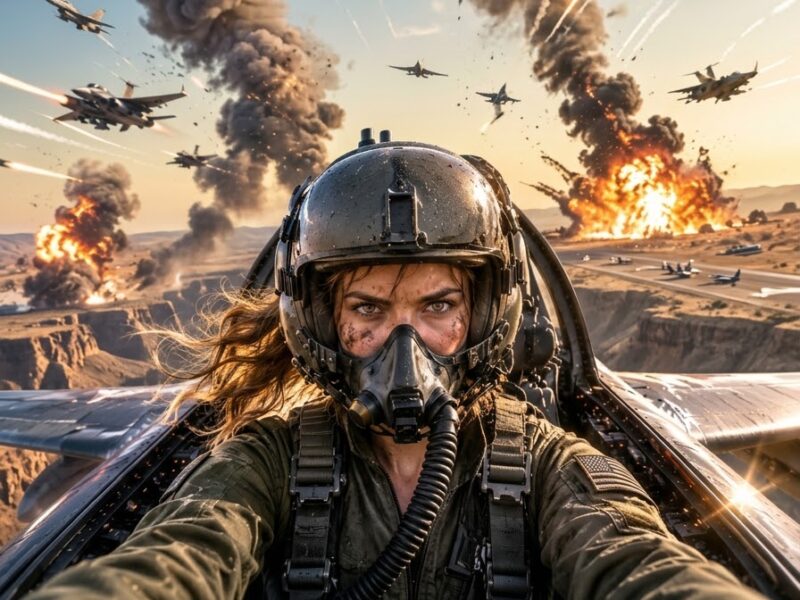
“We’re done!” the Navy SEAL commander screamed as enemy fire trapped his team inside a burning valley in Afghanistan
The mountains of Hindu Kush at twilight were a jagged silhouette of cold slate and dark granite, painted in bruising shades of purple and burnt orange. Outside the thick, armored canopy of my A-10C Thunderbolt II—callsign Viper One—the air was minus twenty degrees Celsius. Inside the cramped cockpit, the heat was stifling, heavy with the metallic tang of sweat, recycled oxygen, and pure adrenaline.
Below me, three thousand feet down in the shadows of the Shok Valley, the sky was tearing open.
“We’re done!”
The scream came through my helmet speakers, shattered by heavy static, panic, and the frantic, rhythmic thump-thump-thump of a heavy machine gun firing nearby.
“Viper One, we’re surrounded! They’re on the high ridge! They have RPGs on the extraction zone!”
It was Lieutenant Commander Thomas Miller, the ground commander for SEAL Team Three. For two hours, his seven-man element had been pinned down in an ancient, dried-up riverbed, guarding a critically wounded Defense Intelligence Agency officer they had pulled from a remote Taliban compound. The extraction MH-47 Chinook had taken heavy small-arms fire to its port turbine twenty minutes ago and had been forced to limp back across the Pakistani border, leaving the team abandoned in the dark.
I pulled the flight stick gently to the left, banking the seventy-foot wingspan of the heavy attack jet in a slow, predatory circle.
“Viper One, this is Ground Lead,” Miller’s voice cracked again, dropping an octave into pure desperation. “We’re out of hand grenades! Ammunition is at ten percent! We have two priority-one urgent surgical casualties! If you don’t drop ordnance on the eastern ridge in the next two minutes, they’re going to overrun this ditch!”
I tightened my gloved fingers around the control stick, my thumb resting on the red weapon-release button. “Ground Lead, Viper One. Say again your target coordinates. The valley floor is completely choked with smoke and dust. I am blind on your visual panel.”
“Grid Uniform-November Eight-Seven-Four-Two!” Miller screamed. “Just put the bombs on the ridge! Anything! Drop it now!”
From the right cockpit seat of my trailing two-ship formation, my wingman, Captain Mark “Grizzly” Vance, called out on our intra-flight frequency.
“Viper One, Viper Two. Do not engage. Command just came up on the SATCOM circuit. Base Ops at Bagram is issuing a freeze order. The cloud deck is dropping to fifteen hundred feet, and the valley walls are less than eight hundred yards wide. They’re calling it a controlled withdrawal area. We are ordered to orbit at Flight Level Two-Zero-Zero and wait for the F-16 flight out of Kandahar.”
“F-16s are twenty minutes out, Grizzly!” I shot back, my voice clipped and cold. “They won’t have eyes on the target until the team is dead! Look at the ground fire!”
“Harper, listen to me,” Grizzly pleaded. “You’re a first-deployment lieutenant. If you dive into that canyon with a low ceiling and drop unguided ordnance within fifty meters of friendly positions, they’ll court-martial you before your tires touch the tarmac at Bagram!”
I didn’t answer him. I looked down through the canopy.
Beneath the swirling blanket of black smoke and grey rain, bright red streams of tracer fire were crisscrossing the valley floor like burning threads. The SEALs were trapped against a ninety-foot vertical rock face. On the high ridge directly above them, dozens of muzzle flashes erupted in continuous, rhythmic pulses.
“Command isn’t down there,” I muttered to myself.
I slammed the dual throttles of the General Electric TF34 engines straight into full power. The thirty-thousand-pound jet surged forward, its nose dropping steeply as I rolled the aircraft inverted and dove straight into the dark, narrow jaws of the valley.
“Viper One! What are you doing?!” Grizzly yelled over the radio. “Pull up!”
“Switching to manual target acquisition,” I said, my voice dropping into the flat, monotone rhythm of combat. “Engaging ground targets.”
The cloud deck swallowed the jet. Gray mist slammed against the glass, blinding me for three terrifying seconds as the altimeter unwound in a violent blur: four thousand… three thousand… two thousand…
Then, the sky cleared.
The floor of the valley rushed up to meet me like an oncoming wall. The steep, rocky cliffs were so close on either wing tip that my radar altimeter began to scream in a high-pitched, frantic tone: TERRAIN! TERRAIN! PULL UP!
I ignored it. My eyes swept the night-vision display on my Helmet-Mounted Cueing System.
Down in the rocky creek bed, a tiny green infrared strobe light was flashing—the friendly marker for SEAL Team Three. Less than sixty yards up the steep dirt slope above them, a thick cluster of heat signatures was advancing, throwing Soviet-era fragmentation grenades down into the ditch.
Then, a voice broke through the tactical net. It wasn’t the commander. It was a voice that was rough, strained, and filled with a deep, agonizing pain.
“Air… Air Force, if you’re up there… please. We can’t hold the ridge. We need a gun run on the upper tree line… now…”
My blood turned to liquid ice. My chest seized so violently that for a second, I couldn’t inhale the pressurized oxygen coming through my mask.
I knew that voice. I had heard it in my nightmares every night for six long years.
It belonged to Sergeant First Class Daniel Brooks.
Six years ago, in a burning pine forest in the mountains of Kunar Province, an Air Force HH-60 Pave Hawk helicopter had crashed after taking an RPG to the tail rotor. I had been a nineteen-year-old ROTC cadet on a ride-along observation flight. Sergeant Brooks—a young, indestructible Army Ranger back then—had pulled my broken, bleeding body from the twisted aluminum frame just seconds before the fuel tanks exploded.
He had saved my life. But my younger brother, Caleb, who had joined the infantry six months before me and was serving as a rifleman on that same extraction team, had been trapped in the forward cabin.
Brooks had promised my brother before the flight that he would bring him home safe. He couldn’t. The fire had been too fast, too violent. Caleb died in that wreckage.
For six years, I had carried the suffocating weight of surviving while my brother burned. I had left the ROTC officer track, transferred to flight training, endured every cruel joke about my youth and gender, and fought my way into the cockpit of the air support community for one single, solitary reason: so I would never again stand helpless while someone I loved died beneath a dark sky.
“Brooks,” I whispered into my mask, my hand tightening on the stick until my fingers went numb. “This is Viper One.”
There was a long, agonizing pause on the frequency, broken only by the sound of heavy boots crunching on gravel and distant explosions.
“Harper?” Brooks’ voice came through, barely above a whisper, laced with shock. “Evelyn… is that you?”
“Hold your breath, Sergeant,” I said, my teeth grinding so hard my jaw burned. “I’m clearing the ridge.”
I aligned the optical sight crosshairs on the green HUD display directly over the upper tree line—forty meters above the friendly infrared strobe.
The A-10’s nose pointed down at a thirty-degree angle. The thirty-millimeter GAU-8 Avenger Gatling gun—a massive seven-barreled cannon built into the belly of the jet—spooled up with a high-pitched electrical whine.
I squeezed the trigger.
The sound of an A-10’s thirty-millimeter cannon firing in a narrow mountain canyon is not a roar. It is an apocalyptic, tearing shriek—a mechanical rip in the fabric of the atmosphere itself, followed two seconds later by the deafening BRRRRRRRRRRT of three thousand armor-piercing depleted-uranium rounds hitting the earth at four times the speed of sound.
The airframe trembled violently beneath my seat as the heavy gun pushed back against the jet’s forward momentum with four tons of recoil force.
Down on the eastern ridge, a continuous line of orange fire and white dust erupted across the rocks. The explosive incendiary shells pulverized the stone, shattering trees, boulder nests, and mortar positions in a four-hundred-foot wall of absolute destruction.
“Good effect! Good effect on target!” Miller screamed over the radio, his voice nearly hysterical with relief. “You wiped out the upper line! The fire has stopped!”
“Viper One, pull up! Pull up!” my wingman Grizzly yelled as he circled above the cloud ceiling. “You’re heading straight into the southern cliff face!”
I yanked the flight stick back into my stomach, slamming the throttles into full military power.
The twin TF34 engines shrieked as six Gs of force slammed me down into the ejection seat. My vision narrowed into a grey tunnel as the blood was dragged from my brain, but the A-10’s massive straight wings bit into the thin mountain air, pulling the nose up in a sheer, vertical climb.
The belly of the jet skimmed over the jagged granite crest of the southern ridge by less than forty feet, kicking up a cloud of loose pine needles and snow before breaking back through the top of the grey cloud deck into the pale moonlight.
“Viper One, clear of terrain,” I gasped, wiping sweat from my eyes with the back of my gloved hand.
“Harper, you crazy idiot,” Grizzly breathed into his mic. “That was fifty meters from friendly troops! If one of those rounds had strayed—”
“It didn’t,” I cut him off. “Ground Lead, Viper One. Status report.”
“That bought us a few seconds!” Brooks’ voice returned on the circuit. He was panting heavily, the sound of agonizing movement clear over the channel. “They’re retreating down the backside of the saddle! But we’ve got a secondary team coming up from the western gully! They have a heavy DShK machine gun setup!”
Before I could answer, a bright red streak flashed from the floor of the western gully, shooting straight up through the clouds.
WARNING! MISSILE LAUNCH! the automated threat system blared in my ears. IR LOCK! IR LOCK!
“Chaff! Flares!” I shouted, slapping the dispenser button on the throttle quadrant with my left thumb.
A cloud of burning magnesium flares ejected from the wingtips, lighting up the grey clouds with brilliant white light. But the heat-seeking shoulder-fired missile—an old, uncooled SA-7—was too close. It cut straight through the flare cluster and detonated fifteen feet behind my starboard engine tailpipe.
BOOM!
The shockwave slammed into the rudder controls like a physical blow from a sledgehammer. The F-16 or F-15 would have disintegrated on impact, but the A-10 was built out of titanium armor and hardened steel. The airframe groaned, pitching violently to the right, but the wings stayed intact.
Yellow and red warning lights exploded across the right-hand annunciator panel:
HYD PRESS FAIL – SYSTEM 1
ENGINE 2 FIRE
FLAP DEGRADATION
“Viper One is hit! I am hit!” I announced, my voice remarkably calm despite the fire light strobing against my face.
I pulled the starboard engine fire handle, cutting fuel to the burning engine and firing the internal fire extinguisher bottle. The fire light flickered and died, but the hydraulic pressure gauge for System One was rapidly unwinding toward zero.
“Harper, disengage immediately!” Grizzly ordered, his voice laced with panic. “You’re operating on single-engine hydraulics! Vector zero-nine-zero, head straight for the emergency strip at Jalalabad!”
I checked the flight controls. The mechanical backup system was holding. The left engine was running cool and strong. I had partial stick control, but my pitch response was sluggish, heavy, and unresponsive.
I had enough fuel and hydraulic fluid for one more pass. If I left now, I could make it to Jalalabad. If I made one more pass into that dark canyon on a single engine, I might never climb back out.
Through the radio, I heard Brooks coughing violently down in the ditch.
“Harper…” Brooks whispered, his voice weak, laced with the metallic rhythm of a man bleeding from his chest. “Leave us. Get out of here. You did enough… you saved Miller and the DIA officer. Get yourself home.”
I looked down at the dark gap in the clouds.
Six years ago, I had sat on the freezing ground of a military hospital in Germany, watching my parents weep over an empty flag-draped casket, while the Army investigation report concluded that “pilot error and atmospheric conditions” were to blame for my brother’s death. I had spent six years running away from that dark forest.
I wasn’t running anymore.
“Not today, Sergeant,” I said quietly.
I rolled the crippled A-10 onto its left side, dropping the nose back toward the burning valley.
“Viper Two, this is Viper One,” I said into the intra-flight net. “I am executing a final strafing run on the western gully. Mark my impact point and cover my exit.”
“Harper, no!” Grizzly screamed. “You won’t pull out on one engine!”
“Watch me,” I muttered.
I dove back into the hell of Shok Valley.
The single TF34 engine roared at maximum thrust, its high-pitched whine echoing off the canyon walls as the damaged jet plummeted through the clouds for the second time.
Without Hydraulic System One, the flight stick felt like it was embedded in wet cement. I had to use both hands, pulling with my shoulders and legs, just to hold the target crosshair steady against the dark outline of the western gully.
Below, the heavy DShK machine gun on the ridge was firing continuously, its massive green tracers chewing through the rocks twenty feet above Brooks’ position.
“Hold on…” I growled through my teeth, my arm muscles screaming under the strain.
At six hundred yards, I squeezed the trigger again.
The GAU-8 Avenger cannon barked its final, violent song. A quarter-second burst—one hundred heavy thirty-millimeter rounds—ripped through the air, hitting the heavy machine gun nest dead center. The gun, the ammunition crates, and the ridge itself exploded in a towering shower of orange sparks and pulverized dirt.
“Target destroyed!” I yelled, instantly letting go of the trigger and hauling back on the flight stick with everything I had left.
The crippled jet didn’t respond like it had on the first pass. With only one engine producing thrust and single-system hydraulics struggling to move the heavy elevator, the nose came up agonizingly slow.
“PULL UP! PULL UP!” the synthetic voice in my helmet shrieked.
The bottom of the fuselage scraped through the branches of the highest pine trees on the southern ridge. I felt the violent vibration rattle through the rudder pedals as wood and foliage slammed against the titanium armor plating beneath my feet.
For three terrifying seconds, the aircraft suspended itself on the absolute ragged edge of an aerodynamic stall, shaking violently, its stall-warning horn screaming a continuous, horrifying tone.
Then, slowly, miraculously, the wings bit the air.
The A-10 cleared the mountain crest, staggering up into the clear night air like a wounded beast, smoke trailing from its dead right engine.
“Viper One is clear!” I breathed, my head falling back against the headrest, my breathing ragged and wild. “Ground Lead… report!”
A long, agonizing silence sat on the radio frequency. Ten seconds passed. Fifteen seconds.
Then, the high-pitched, rhythmic beat of rotor blades cut through the static.
“Viper One, this is Pedro Three-Four,” the deep voice of an Air Force Rescue HH-60 Pave Hawk pilot broke over the net. “We just cleared the eastern ridge under cover of your run. We have eyes on friendly positions. Commencing hoist operations now.”
I looked over my shoulder through the canopy.
Down in the valley, two massive rescue helicopters were hovering fifty feet above the creek bed, their searchlights cutting through the smoke, winching the seven trapped SEALs and the wounded DIA officer up into the safety of the cabin.
“Pedro Three-Four, all survivors on board!” the helicopter pilot called out three minutes later. “Repeat, all personnel accounted for! We are egressing to the north!”
I let out a long, shuddering breath, the tension leaving my body so suddenly that my hands began to shake uncontrollably against the controls.
“Viper One,” a voice whispered on the tactical channel. It was Brooks. He was inside the rescue helicopter now, the sound of medical monitors beep-beeping in the background. “Harper… you saved us. Just like… just like you saved me six years ago.”
I closed my eyes behind my dark helmet visor, a single tear cutting a warm track through the dust on my cheek.
“No, Sergeant,” I whispered into my mic, my voice trembling with six years of unexpressed pain. “This time, I got there before it was too late.”
“Harper, you’ve got a trail of hydraulic fluid twenty miles long behind you,” Grizzly called out, bringing his F-16 up alongside my left wing to inspect my damage. “Your starboard wing is peppered with shrapnel, and your right engine casing is melted. But your gear is down and locked. Let’s get you back to Bagram.”
“Lead the way, Grizzly,” I said softly, turning the nose of my broken warbird toward the north.
The sun was just beginning to peek over the jagged peaks of the Hindu Kush when my crippled A-10 touched down on the main runway at Bagram Airfield.
The nose gear slammed hard onto the concrete, sending a shower of sparks flying from the damaged hydraulic assembly, but the heavy titanium frame held firm. Fire trucks and emergency rescue humvees, their red and blue lights flashing in the pale morning mist, raced alongside my jet as I rolled to a stop on the tactical parking ramp.
When the canopy finally powered open, the cool, crisp mountain air rushed into the cockpit, carrying the smell of jet fuel, wet earth, and fresh pine.
I climbed down the side maintenance ladder, my flight suit soaked with sweat, my left leg stiff and aching from the pull of the G-forces. My knees felt like water, but I forced myself to stand tall as my wingman Grizzly and a dozen ground crew members ran toward me.
Grizzly stopped five feet away, looking at the scorched, bullet-riddled starboard engine casing of my A-10, then down at my face. Without a word, he pulled off his gloves, stepped forward, and wrapped his arms around me in a tight, fierce hug.
“You absolute lunatic,” he muttered into my shoulder. “That was the finest piece of flying I’ve ever seen in my life.”
“Thanks, Grizzly,” I whispered, patting his back with my gloved hand.
“Lieutenant Harper!” a voice barked from the edge of the flight line.
I turned. Standing beside an armored medical transport vehicle was Sergeant First Class Daniel Brooks.
His right arm was tightly bound in a white sling across his chest, a thick bandage wrapped around his neck, his flight suit torn and stained with dried blood and mud. He looked exhausted, aged ten years by the night’s horrors, but his eyes were bright, clear, and fixed entirely on me.
He walked toward me slowly, his boots dragging on the concrete.
When he reached me, he didn’t offer a military salute. He stood in front of me for a long moment, his lip trembling slightly, before reaching into his inner tactical vest pocket with his left hand.
He pulled out a small, worn plastic sleeve containing a single, faded photograph.
I took it from him with trembling fingers.
The photograph showed five young infantrymen standing in front of a green UH-60 helicopter under the bright summer sun of Fort Bragg seven years ago. In the center of the group was my younger brother, Caleb. He was nineteen years old, his helmet pushed back on his head, laughing as he threw his arm around a younger, grinning Daniel Brooks.
My breath caught in my throat. I hadn’t seen Caleb’s face in six years. My parents had removed all his military photos from our house after the crash, unable to bear the pain of looking at them.
“I carried that every day, Evelyn,” Brooks said softly, his voice cracking with emotion. “Every single mission. Every jump. Every patrol.”
I turned the photograph over in my hand.
On the back, written in black ballpoint ink that had begun to fade and bleed into the paper, was a short three-line message:
FLIGHT MANIFEST ALTERED PER ORDERS.
CALEB WAS NEVER ON THE SECONDARY LIST.
HARPER WAS NEVER SUPPOSED TO KNOW WHAT REALLY HAPPENED THAT NIGHT.
I stared at the handwriting. It wasn’t my brother’s. It wasn’t Brooks’. It was written in the neat, precise block lettering of a senior military administrative officer.
I raised my eyes to look at Brooks, my blood suddenly running cold in the morning chill.
“Who wrote this?” I asked, my voice barely audible above the hum of the distant taxiing jets. “Daniel… who wrote this?”
Brooks’ face turned pale, all the color draining from his cheeks as his eyes darted nervously toward the large, three-story concrete building at the center of the base—the Headquarters for the Joint Special Operations Task Force.
“Someone who was on the board of inquiry six years ago,” Brooks whispered, stepping closer to me so the surrounding ground crew couldn’t hear. “Someone who ordered the flight into Kunar despite knowing the tail rotor assembly had a known mechanical defect. They blamed pilot error to protect the manufacturer’s contract.”
My hands began to shake so violently that the plastic sleeve rattled in my grip.
“Who?” I demanded, steping forward, grabbing Brooks’ tactical vest with my good hand. “Who signed that report, Daniel?!”
Brooks swallowed hard, his eyes fixed on the third-floor window of the headquarters building, where a dark silhouette was currently standing behind the glass, looking down at us on the flight line.
“Major General Thomas Vance,” Brooks whispered. “Your wingman’s father.”
The morning sun finally cleared the tops of the mountains, flooding the tarmac at Bagram with bright, golden light.
I stood motionless beside the scorched wing of my A-10, the faded photograph held tight in my hand, the crisp mountain wind whipping loose strands of hair across my forehead.
Beside me, Mark “Grizzly” Vance took a slow step backward, his face frozen in a look of absolute, unadulterated horror as he looked from Brooks to me, then up toward the third-floor window of the task force headquarters.
“Evie…” Grizzly stammered, his voice choked with sudden, terrible realization. “My dad… my dad was the presiding officer for the 2020 aviation safety board in Europe. He… he signed off on the Kunar crash investigation.”
I didn’t answer him immediately. I looked down at the photograph of my brother Caleb—his goofy grin, his bright eyes, his whole life stretching out ahead of him before a corrupt pencil stroke in an air-conditioned office in Pentagon signed his fate away.
For six years, I had believed that my brother died because of bad weather, bad luck, and a pilot’s mistake. I had believed that I was a survivor by pure, unfair accident, carrying a debt that could never be repaid.
Now, looking at the ink on the back of that photograph, the fog in my mind cleared away, replaced by something cold, clean, and entirely indestructible.
I wasn’t a survivor by accident. I was a witness.
“Mark,” I said softly, turning my head to look my wingman in the eye.
Grizzly looked at me, tears welling up in his eyes, his hands trembling at his sides. “Evie, I swear to God… I didn’t know. I swear on my life I didn’t know what he did.”
“I know you didn’t,” I said gently.
I reached out and placed my hand flat against his chest, right over his pilot wings.
“You’re my wingman, Grizzly. You covered my tail in that valley today. You’re a good pilot, and you’re a good man.”
I turned my eyes back toward the main task force building.
Up on the third floor, behind the dark tinted glass, the silhouette of Major General Thomas Vance turned slowly and walked away from the window.
“What are you going to do, Evelyn?” Brooks asked, stepping up beside me, resting his left hand on my shoulder.
I looked at the damaged, scorched A-10 standing behind me—its armor plating dented by bullets, its titanium bathtub holding strong, its thirty-millimeter gun still smelling of burned gunpowder and victory.
I folded the photograph carefully, tucked it into the inner zippered pocket of my flight suit, right over my heart, and zipped it closed.
“I’m going to finish the mission,” I said.
I turned away from the flight line and began walking toward the task force headquarters, my flight boots clicking loudly against the hard, sunlit concrete.
With every step I took across the tarmac, the weight six years of guilt and pain fell away from my shoulders, drifting off into the morning mountain wind like smoke from a dying fire.
The sky above Bagram was clear, blue, and wide open.
And for the first time in six years, I was ready to fly.
The end.









