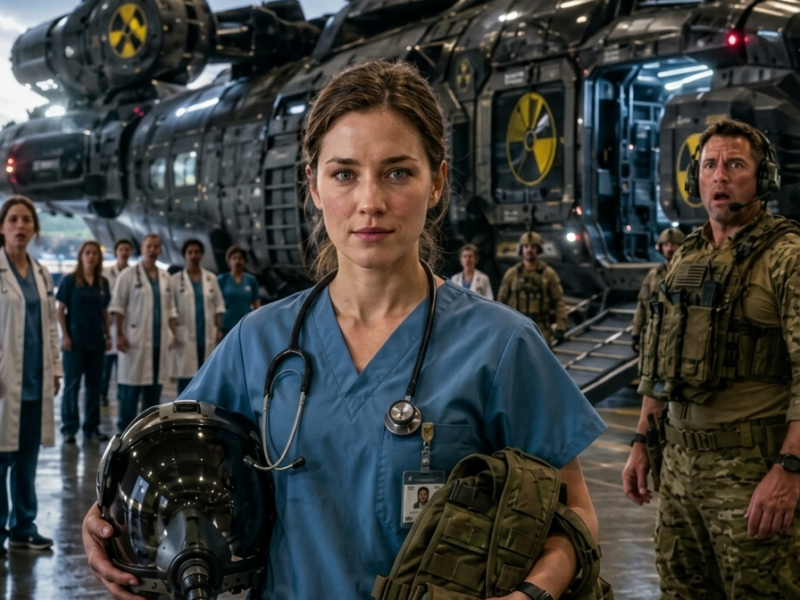
“We need someone who can fly this beast,” the SEAL leader shouted over the screaming engines at a remote airfield in Alaska, then froze when I walked toward the helicopter in a nurse’s uniform
The whiteout over the remote Alaskan airstrip felt less like weather and more like an eraser, slowly wiping away the sky, the jagged pine ridges, and finally the runway itself. Inside the improvised aid station—a corrugated steel hangar that smelled of antiseptic, wet wool, and hydraulic fluid—the wind howled against the metal roof like a dying animal.
I pulled my blue cotton scrubs tighter around my chest, adjusting the strap of my heavy leather trauma kit. My hands were stained with dried iodine and scrubbed raw from cold water. For the past six months, I had been Sarah Miller, a quiet civilian contract nurse assigned to this bleak, godforsaken perimeter outpost north of the Brooks Range. Nobody asked about my past, and I didn’t offer any. In a place where men came to forget or be forgotten, a middle-aged nurse who kept her head down and never complained was a ghost nobody bothered to spook.
Until the heavy double doors of the hangar burst open, letting in a blinding wall of snow and four men carrying a stretcher.
They were Navy SEALs from a classified cold-weather development unit, dressed in white winter camouflage, their faces caked with ice and grime. The leader—a massive man with a jagged scar cutting through his left eyebrow and tactical gear heavy with ice—shouted above the scream of the storm outside.
“Medics! Get over here! We’ve got a compound fracture and internal bleeding from a snowmobile rollover!”
I moved instantly, slipping into the automatic rhythm of triage. I dropped beside the wounded operator, cut through his thermal layers with trauma shears, and began stabilizing his shattered femur. My hands were calm, precise, and steady—the hands of someone who had seen blood flow in far worse places than a heated hangar.
“Where’s the bird?” the SEAL leader barked, wiping grease and melted ice from his face as he paced toward the open bay doors. “We have a secondary team pinned down at Survey Site Echo! They’re taking mortar fire from an unidentified force, and we have thirty minutes before the thermal envelope collapses!”
A young mechanic in greasy coveralls stepped out from under the tail boom of an aircraft sitting in the center of the bay. He shook his head grimly.
“The storm just crossed the ridge, Lieutenant,” the mechanic yelled back. “Base flight operations issued a total ground stop ten minutes ago. Your assigned pilot looked at the barometric pressure drops and refused to spool the rotors. He said flying into that gorge right now is a suicide run.”
“Where is he?!” the SEAL leader roared, stepping up to the mechanic, his hand tightening into a gloved fist. “We need someone who can fly this beast!”
His voice echoed off the steel girders, competing with the deafening roar of the twin-turbine engines of the aircraft parked inside: an MH-60M Black Hawk, painted in matte low-visibility grey, retrofitted with oversized ski-skids and long-range auxiliary fuel tanks. It was a heavy, violent, beautiful machine built for special operations in the worst environments on Earth.
“He’s in the mess hall,” the mechanic stammered. “He won’t budge.”
The SEAL leader let out a bitter curse, turning back toward his team. The mission window was closing fast, and their teammates were dying on a frozen mountain ridge forty miles north.
I stood up from the stretcher, wiping my blood-stained rubber gloves on a towel, and walked directly past the pacing officer toward the helicopter.
He froze when he saw me. He looked at my faded blue medical scrubs, my practical rubber-soled work shoes, and the heavy red-cross trauma bag slung over my shoulder.
“Ma’am, you’re medical,” the team leader said, stepping in front of me to block my path to the pilot’s side door.
“I know.”
“Then stay medical,” he growled, his voice laced with the harsh authority of a commander losing control of his operation. “We’re trying to figure out a tactical extraction, not a medevac.”
I didn’t step back. Instead, I looked past his broad shoulder, through the frosted hangar doors, toward the black, jagged peak of the mountain disappearing behind a wall of white oblivion.
“Who else is flying?” I asked softly.
He didn’t answer. He couldn’t. The hangar was silent except for the wind.
That was answer enough.
I brushed past him, unlatched the heavy aluminum crew door of the Black Hawk, and climbed into the armored pilot’s seat.
The younger SEAL sitting on an ammo crate near the tail rotor let out a nervous, incredulous laugh. “She’s serious. Hey, Boss, the nurse is taking the stick.”
The leader stepped up to the cockpit window, his face tight with a mixture of rage and sheer disbelief. He stared at my hands as they moved across the overhead panel, my fingers instinctively flipping switches, setting fuel flow valves, and powering up the primary flight displays with a speed that no civilian could ever mimic.
“You’ve flown this?” he demanded, his voice dropping into a dangerous, deadly quiet.
“Something like it,” I said, my gaze fixed on the digital instrument cluster lighting up in soft green hues.
“That isn’t an answer.”
“No,” I said quietly, looking him dead in the eye as I pulled the flight helmet off the center hook and strapped it over my ears. “It isn’t.”
Ten years ago, before I wore scrubs, before the Department of Defense deleted my records, and before I buried my entire crew in an unmarked mass grave in Eastern Europe, I had been Major Sarah Vance—callsign Raven. I had flown classified low-altitude interdiction missions for the most secretive aviation unit in the United States military. Officially, that unit never existed. Officially, I had died in a mid-air collision over the Baltic Sea.
“Get your team in the back,” I told the SEAL leader, setting my hands on the collective lever and cyclic stick. “Or watch your men die on that ridge. Your choice.”
He stared at me for three long, agonizing seconds. Then he turned and barked at his men. “Load up! Lock in! We’re flying!”
The twin General Electric turboshaft engines shrieked to life, the massive main rotor blades sweeping through the freezing air, throwing a cyclone of snow across the hangar floor as we lifted off into the white screaming dark.
Within two minutes of clearing the perimeter lights of the airfield, visibility dropped to absolute zero.
The night was a solid wall of swirling ice. The windshield turned into a sheet of grey frost, the windshield wipers useless against the rapid buildup of freezing rain. The aircraft shuddered violently, thrown sideways by fifty-knot crosswinds whistling down through the glacial passes of the Brooks Range.
In the back, the four SEALs held onto the ceiling straps as the helicopter dropped fifty feet in a sudden downdraft, the airframe groaning under the aerodynamic stress.
“Jesus Christ!” the younger SEAL shouted over the intercom.
The team leader unbuckled his harness, crawled forward between the pilot and copilot seats, and grabbed the back of my armored headrest. His knuckles were white.
“Can you handle this?” he yelled over the deafening whine of the engines and the storm battering the skin of the aircraft.
I didn’t answer him immediately. My eyes were locked onto the digital terrain-following radar and the synthetic vision display on the primary flight screen. But behind my eyes, I wasn’t in Alaska anymore.
I remembered another cockpit. Another storm. Another night eight hundred miles off the coast of Norway, flying a modified stealth transport through a blinding blizzard while heavy anti-aircraft fire lit up the clouds below us.
I remembered my copilot, Captain Daniel Reed—a twenty-four-year-old kid with a newborn daughter—screaming as a surface-to-air missile severed our hydraulic lines. I remembered the ice on the glass, the smell of burning aviation fuel, and the voice on the encrypted radio telling us that no rescue force was coming because our mission was officially “non-existent.”
I had been twenty-eight then.
My copilot never came home. Neither did the mission.
“Ma’am!” the SEAL leader’s voice snapped me back to the present. “I asked if you can handle this!”
“Hold on,” I muttered.
I pulled the collective, dipping the nose of the heavy Black Hawk down into the pitch-black abyss below us. I bypassed the standard safety altitude limits, dropping the aircraft below the mountain crests, down into the narrow, winding throat of a river canyon where the surrounding granite walls shielded us from the worst of the upper-altitude gale.
We roared between two massive, ice-coated mountain ridges, the tips of our main rotor blades sweeping less than fifteen feet from the jagged rock faces protruding through the snow. The maneuver was insane, lethal, and mathematically precise—a low-altitude terrain-masking technique taught only at the highest levels of clandestine military aviation.
The cabin behind me went instantly, totally silent. Even the hardened SEAL leader stopped breathing, his hands frozen on my seat as he watched the canyon walls flash past the side windows in a blur of white and grey.
Suddenly, the cockpit radio—locked onto a secure tactical channel—burst into life with high-frequency static.
A cold, automated military voice synthesized through the flight headset.
“Unknown rotary-wing aircraft, position six-six-north, you are entering restricted military airspace under DEFCON Three protocols. Identify yourself immediately or you will be targeted by automated defense batteries.”
The SEAL leader frowned, reaching for his tactical vest radio. “That’s impossible. This whole sector is designated as a public wilderness reserve. There are no defense batteries out here.”
I didn’t answer. My heart slammed against my ribs like a trapped beast.
The automated warning repeated once. Then, the static cleared, and a second voice came through the speaker.
It wasn’t automated. It was human. It was older, gravelly, precise, and weighed down by an unforgettable, icy authority.
“Callsign Raven,” the voice said, echoing through the dark cockpit. “If you’re hearing this broadcast… abort your heading immediately. Turn back to the airfield. You are flying into a trap.”
My hands froze on the controls. The aircraft drifted slightly in the turbulence before I caught the vector and stabilized our tilt.
The SEAL leader noticed the sudden change in my posture. He leaned closer, his eyes narrowing as he stared at the radio display panel.
“You know that voice?” he asked, his tone shifting from suspicion to dead seriousness.
I stared straight ahead into the blinding wall of snow, my jaw clenched so hard my teeth ached.
“Yes,” I whispered.
“Who is it?”
“The man who ordered my last crew to die,” I said, my voice cold enough to freeze the water in the air. “General Arthur Vance. Chief of Strategic Reconnaissance.”
Before the SEAL leader could process what I had just said, a shrill, ear-splitting audio tone erupted from the Black Hawk’s radar warning receiver.
BEEP-BEEP-BEEP-BEEEEEEP!
A bright red light flashed on the center console: ACTIVE RADAR TRACK / MISSILE LOCK.
The SEAL leader reflexively reached for his assault rifle, his eyes darting to the windows. “We’re being painted! They’re locking onto us from the ridge ahead!”
I tightened my grip on the flight controls, feeling the cold, familiar surge of adrenaline wiping away ten years of quiet, numb survival.
“Don’t worry,” I whispered, nudging the throttles forward until the turbines roared at maximum continuous power.
“About what?!” he shouted, bracing himself against the instrument console. “They’ve got a ground-to-air lock on us!”
I looked through the side window toward the shadow of the mountain peak looming ahead through the snow, where two faint red tracking lights flickered in the storm.
A faint, bitter smile crossed my face for the first time in a decade.
“They’re not trying to shoot us down,” I said softly.
“Then what the hell are they doing?!”
“They’re trying to make sure I never reach the other side,” I replied. “Because on the other side of that ridge isn’t a wounded SEAL team. It’s the wreckage of the plane I lost ten years ago.”
The revelation hung in the air like poison. The SEAL leader, whose tactical callsign was Grizzly, stared at me with a mix of shock and cold, recalculating threat analysis.
“What do you mean, your plane from ten years ago?” he demanded, his hand lingering near his sidearm. “My team sent a distress beacon from Survey Site Echo! We came out here on an official search-and-recovery contract!”
“Your contract was a lie, Lieutenant,” I snapped, dropping the Black Hawk into a hard right bank, skimming the snow-covered treetops to break the ground radar’s line-of-sight. “Look at your primary GPS display. Look at the grid coordinates.”
Grizzly reached down and tapped the hardened digital tablet mounted to his chest harness. He pulled up the encrypted mission overlay. His face went pale.
The coordinates for “Survey Site Echo” didn’t point to a military outpost or a temporary survey camp. They pointed directly into the center of a nameless, uncharted glacier nestled in a high-altitude crater known as Dead Man’s Basin—a region that had been marked as a permanent No-Fly Zone on all civilian and military aviation charts for over a decade.
“Ten years ago,” I said, my voice flat and devoid of emotion, “I was the pilot of a prototype stealth transport carrying a quantum-encryption drive. We were intercepted over international waters by an unidentified strike team using classified military frequencies. When we were hit, my commander—General Vance—refused our request for an emergency landing at our backup base. He remote-locked our navigation systems and ordered us to crash the plane into the arctic ice to prevent the drive from being captured.”
In the back, the three other SEALs listened through the open cockpit intercom, their tactical chatter completely dying out.
“I managed to override the lock just enough to crash-land the airframe on this glacier,” I continued, dodging a looming outcrop of black granite. “My copilot died in the crash. I was pulled from the burning cockpit by an off-grid civilian search team. Two days later, the Pentagon issued a press release claiming my aircraft had disintegrated over the Baltic Sea with no survivors. I was declared dead. My family was given a folded flag and an empty box.”
“If you were dead,” Grizzly said slowly, “why stay dead? Why hide as a nurse in an Alaskan outpost?”
“Because the moment I tried to access my old records, everyone who helped me recover began disappearing,” I replied, looking him in the eye. “My records didn’t just vanish—they were erased. I realized that if General Vance found out I had survived the crash, he wouldn’t just kill me. He’d kill anyone I had ever spoken to.”
“And the distress signal?” Grizzly asked, his brow furrowing. “The signal my unit picked up two hours ago?”
“It wasn’t a distress signal from your men,” I said, pointing the nose of the helicopter straight up into the roaring whiteout, climbing hard over the final ridge. “It was an automated emergency beacon inside my crashed aircraft. The glacier shifted. The ice finally melted enough to expose the hull, and the battery backup kicked on after ten years.”
We cleared the top of the snow-covered ridge and swept into the bowl of Dead Man’s Basin.
The storm seemed to pause for a brief, eerie second inside the crater. The wind dropped just enough for the clouds to part beneath the pale moonlight, revealing the floor of the valley three hundred feet below us.
There, embedded in a massive wall of blue glacial ice, was the shattered, blackened tail section of a massive, delta-winged aircraft. Its low-observable black paint was cracked and peeled, but the ghost-grey military markings on the tail boom were still clearly visible: USAF – SPECIAL OPERATIONS COMMAND – EXPERIMENTAL.
And surrounding the crash site were four black, unmarked turbine-powered snow vehicles and a dozen armed operators in dark gear, actively drilling into the side of the frozen fuselage with industrial thermal torches.
“They aren’t search-and-rescue,” Grizzly muttered, his eyes widening as he recognized the high-caliber automated weapon turrets mounted to the black snow vehicles. “That’s a private military security detail.”
“They’re General Vance’s private cleanup crew,” I said, pulling the collective stick to hover the Black Hawk behind a high ridge of snow. “They came to recover the encryption drive before anyone else found out the crash wasn’t at the bottom of the Baltic Sea.”
Suddenly, the radio crackled again. General Vance’s voice cut through the cabin, cold, calm, and utterly merciless.
“Sarah,” he said quietly. “I know it’s you piloting that helicopter. I recognized the flight profile when you dropped into the canyon. You always had a habit of flying like you were invincible.”
I hit the transmit button on the cyclic stick. “I’m not invincible, General. But I’m alive. Which is more than you can say for the men you sacrificed ten years ago.”
A long silence stretched over the radio link.
“You were a dedicated officer, Major Vance,” the General said, his tone lacking even a shred of guilt. “But that technology could not fall into public hands, nor could it be analyzed by an open military court. You were acceptable collateral damage in a game much larger than your flying career.”
“Is that what you told my copilot’s widow?” I hissed.
“I told her he died a hero,” Vance replied smoothly. “And now, Sarah, you have a final choice. Set that Black Hawk down on the ice, step away from the aircraft, and I promise your death will be painless. If you refuse… I will order my perimeter team to destroy your helicopter, and the four Navy SEALs in the back with you will share your unmarked grave.”
Grizzly didn’t hesitate for a single second.
He unclasped his shoulder safety harness, reached back into the main cabin, and grabbed a heavy heavy-caliber sniper rifle from the weapons rack. He racked the bolt back with a sharp, mechanical metallic CLACK.
“Ma’am,” Grizzly said, stepping between the seats and looking at me with a fierce, uncompromising grin. “I don’t know what rank you used to hold, but right now you’re the pilot in command of this bird. And Navy SEALs don’t surrender to dirty generals.”
Behind us, the three other operators checked their automatic weapons, racking chambers and locking tactical night-vision goggles down over their eyes.
“We have four armed vehicles on the ground,” Grizzly reported rapidly, scanning the target area through his thermal optics scope. “Two heavy machine-gun nests near the engine wreckage. No surface-to-air missile launchers visible, but they have shoulder-fired thermobaric rockets.”
“They have the high ground on the glacier,” I said, calculating the air-speed vectors, the wind shear dropping off the canyon wall, and the engine weight limits of our Black Hawk. “If we hover, we’re a sitting duck.”
“Then don’t hover,” Grizzly replied, racking his rifle again. “Give us a firing run.”
“Hold on tight,” I said, pushing the twin throttles to the maximum emergency stop.
The Black Hawk roared like a wounded predator, pitching forward at a forty-five-degree angle and diving straight out of the cloud deck into the crater.
“Target sighted!” one of the ground operators below screamed into his radio as the roaring sound of our main rotor blades echoed off the ice walls.
The four black snow vehicles immediately opened fire. Bright lines of tracer rounds cut through the darkness, snapping through the freezing air past our cockpit windows and punching holes through the outer fiberglass skin of our nose cone.
“Rockets! Left side!” the younger SEAL yelled.
A thermal rocket erupted from the snow below, leaving a thick trail of grey smoke as it spiraled toward our engine intakes.
I kicked the right rudder pedal with all my weight and yanked the collective back. The heavy Black Hawk executed a sudden, violent lateral slide, slipping sideways through the air. The rocket passed less than three feet beneath our ski-skids, detonating against the ice wall behind us with a blinding flash of orange fire and a thunderous shockwave that rattled our teeth.
“Grizzly, take the lead vehicle!” I yelled over the alarm buzzers ringing in the cockpit.
“On it!”
Grizzly leaned half his body out of the open side crew door, secured only by a safety lanyard, and pulled the trigger of his heavy anti-material rifle.
BANG! BANG! BANG!
The massive .50-caliber armor-piercing rounds tore through the engine block of the lead black snow vehicle three hundred feet below. The vehicle erupted into a fountain of sparks and dark diesel fuel, spinning out of control across the slick ice and slamming into a thermal drilling rig.
“Second pass!” I shouted, pulling the Black Hawk into an inverted wing-over maneuver—a high-G aerobatic turn that pushed us all deep into our seats—sweeping around the back of the crashed stealth plane to catch the remaining ground forces in a crossfire.
The three other SEALs leaned out of the opposite cabin door, firing controlled bursts from their tactical rifles into the machine-gun positions on the glacier floor. The ground forces, completely unprepared for an air-assault maneuver executed by an elite tactical pilot, began breaking formation in absolute chaos, scattering into the deep snow drifts to avoid our low-altitude strafing runs.
Within three minutes of terrifying, violent air combat, the ground fire ceased. Three of the dark snow vehicles were burning on the ice, their ammo compartments cooking off in bright white pops, while the surviving security personnel surrendered, throwing their weapons into the snow with their hands raised above their heads.
I brought the Black Hawk down into a soft, perfectly controlled hover five feet above the glacier, settling our wide ski-skids onto the hard-packed ice right beside the exposed belly of my long-lost aircraft.
Grizzly and his three men unbuckled and jumped out onto the frozen ground, their weapons raised as they secured the perimeter and bound the wrists of the surviving mercenary operators.
I sat in the pilot’s seat for a moment, the engine idling at lower power, my hands trembling slightly on the cyclic stick. The adrenaline that had sustained me for the past hour was beginning to fade, replaced by a profound, crushing weight that had been building inside my heart for ten long years.
I unstrapped my flight helmet, let it drop onto the copilot’s seat, and opened the cockpit door.
The freezing arctic air bit into my scrub-clad arms as I stepped down onto the ice. I carried my heavy medical bag in my left hand, walking slowly toward the blackened, shattered nose cone of my former plane.
There, half-buried in the ice beneath the cockpit glass, was a small, rusted steel plate bearing the manufacturer’s serial numbers and the names of the original crew.
My finger traced the frozen metal letters of my own name—MAJOR SARAH VANCE—and beside it, the name of my dead copilot: CAPTAIN DANIEL REED.
A lone tear fell from my eye, freezing instantly on my cheek.
“I found you, Dan,” I whispered into the howling wind. “I brought us home.”
Ten minutes later, Grizzly walked out from the shadowed interior of the crashed hull, holding a heavy, reinforced titanium storage box sealed with a biometric lock. The metal surface was covered in frost, but the internal status indicator light was still flashing a faint, green code: DATA INTACT.
“This is it, isn’t it?” Grizzly asked, coming to a stop beside me under the turning rotor blades of the idling Black Hawk. “The quantum drive Vance tried to bury ten years ago.”
“That’s it,” I replied, looking at the box. “Inside that drive are the complete financial records, target lists, and operational logs of every off-the-books intelligence program General Vance operated over the last twenty years. It’s the only thing that can destroy him.”
Grizzly handed the heavy box to one of his operators, who carried it carefully into the cabin of our helicopter.
“We just intercepted a long-range radio transmission from base,” Grizzly said, looking down at his chest tablet. “General Vance realized his ground team failed. He just boarded his private command transport at the airfield and ordered an emergency departure for Washington. He’s going to use his political influence in the Pentagon to scrub this entire incident before we can get back.”
I looked up at the sky. The clouds above the crater were beginning to thin, revealing the vast, starlit expanse of the arctic night sky stretching infinitely toward the southern horizon.
“He won’t make it to Washington,” I said softly.
Grizzly looked at me, a raised eyebrow showing his surprise. “What are you talking about? He’s flying in a Mach 2 executive jet with NORAD escort clearance. We can’t catch him in a helicopter.”
I turned toward the idling Black Hawk, my hands feeling cold and steady against my medical scrubs.
“We don’t need to catch him in the air,” I said. “The moment we clear this valley, we bypass the military satellite relay and broadcast the raw data stream from that titanium box directly to the Inspector General’s office and every major news network in North America on an open emergency frequency. My old flight codes are still embedded in the drive’s master key. I can unlock it from the cockpit console.”
Grizzly stared at me for a long, silent moment. Then a slow, deep laugh escaped his chest, echoing against the frozen walls of the crater.
“You really aren’t just a nurse, are you, Major?” he asked, stepping back and saluting me with sharp, military precision.
“I haven’t been a Major in ten years, Lieutenant,” I said, returning his salute with an effortless, ingrained muscle memory. “Right now, I’m just a pilot finishing a flight.”
We climbed back into the Black Hawk. I strapped into the pilot’s seat, pulled my flight helmet over my ears, and felt the power of the twin turbine engines vibrating through the airframe, up into my boots, and straight into my soul.
I reached out to the center control pedestal, pulling up the satellite communications array. I connected the quantum drive into the secondary flight interface board, entering my old twelve-digit master authorization code—a code I had memorized on a cold night ten years ago when my world ended.
The screen flashed bright green: AUTHORIZATION ACCEPTED. DATA BROADCAST READY.
I grabbed the collective stick, pulled it toward my chest, and lifted the heavy helicopter up off the ice.
We rose slowly out of the dark, frozen crypt of Dead Man’s Basin, climbing straight up into the clear, freezing blue sky above the storm cloud layer. The sun was just beginning to peek over the eastern horizon, painting the jagged peaks of Alaska in brilliant shades of gold, rose, and amber.
Below us, the storm was dying. Ahead of us, the horizon was clear, wide, and endless.
I reached down to the main transmission switch on the cyclic control, my gloved thumb resting over the red broadcast button.
“Major Vance,” General Vance’s voice crackled one final time through my headset, sounding small, weak, and stripped of all power as he realized his private jet’s communications array had just been intercepted by our broadcast signal. “If you push that button… you ruin everything I built. You destroy your own legacy.”
I looked out at the golden morning light flooding the cockpit, feeling the heavy, suffocating weight of ten years of silence lifting off my shoulders like melted ice.
“My legacy isn’t your war, General,” I said quietly. “My legacy is the truth.”
I pressed the button.
The green transmission light flickered rapidly as gigabytes of encrypted data flooded out into the sky, cutting through every military and civilian network across the globe.
I pulled the Black Hawk around, pointing its nose toward the rising sun, and set our course for home.
The end.









