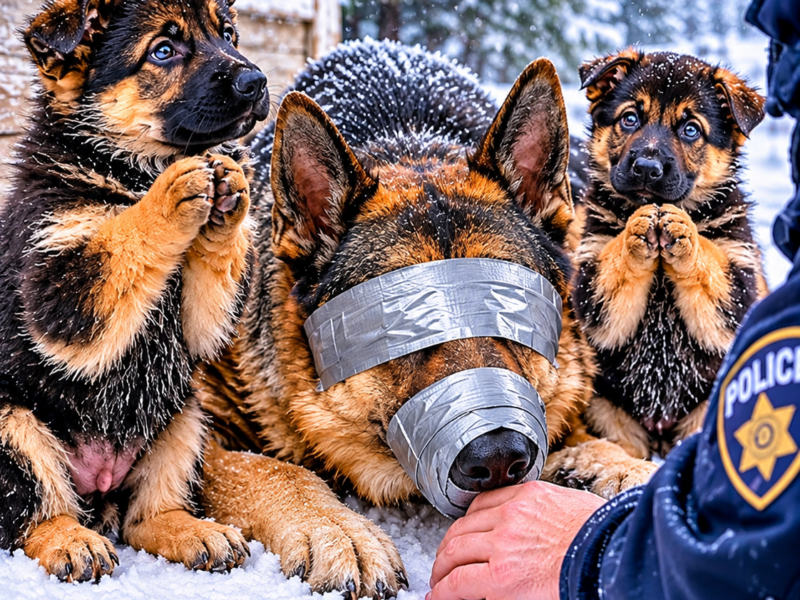
“Two tiny German Shepherd puppies stood trembling in the snow, refusing to let a police officer reach their mother
The headline on the newspaper clipping read:
“WHITAKER MEDICAL SYSTEMS FOUNDER MISSING AS COMPANY FACES LEADERSHIP CRISIS.”
I read it twice.
Then I looked at Eleanor.
“Whitaker,” I said quietly. “As in Whitaker Medical Systems?”
She nodded.
The name was familiar.
Even in the Marines, where most of us cared more about whether equipment worked than who manufactured it, I had heard of the company. Its medical devices were used in military hospitals, emergency rooms, and field treatment units across the country.
“You founded it?”
“I did.”
I glanced down at the article again.
It described her as a billionaire businesswoman, philanthropist, and longtime advocate for military families. There was a photograph of her standing beside a row of hospital beds, wearing a tailored suit and smiling for the cameras.
The woman beside me wore a faded coat and shoes that had clearly seen better winters.
“I don’t understand,” I said. “Why were you asking strangers for food?”
Eleanor folded her hands over the newspaper.
“Because I was hungry.”
“That doesn’t explain why.”
She looked toward Daniel’s headstone.
“Because I left without telling anyone where I was going.”
I waited.
“I had spent forty years building that company,” she continued. “I started with a small workshop and three employees. We repaired equipment that larger manufacturers considered too expensive to fix. Then we began designing our own products.”
Her voice softened.
“Daniel used to come by after school. He would sit in the office and draw little airplanes on the backs of my invoices. He thought every machine should have a button that made it fly.”
A faint smile crossed her face.
“He was a terrible businessman.”
“He sounds like a good kid.”
“He was.”
She brushed a small piece of snow from the top of the headstone.
“He joined the Marines. I argued with him for months. I told him he could do anything he wanted with his life. He told me that was exactly why he wanted to serve.”
I understood that kind of answer.
Some people don’t choose the easiest path.
They choose the one they can live with.
“Daniel died fourteen years ago,” she said. “After that, I put everything I had into the company and the foundation we created in his name. I thought staying busy would make the silence easier.”
“Did it?”
“No.”
She looked at me.
“It only made me better at pretending.”
For a while, neither of us spoke.
The wind moved through the bare branches above us.
Then Eleanor explained what had happened.
The company had grown beyond anything she imagined. Its medical technology was helping patients all over the country, and its profits supported programs for injured veterans, military families, and service dogs.
But success brought people who saw the company differently.
Some executives wanted to cut expensive research projects.
Others wanted to reduce the foundation’s funding and redirect money toward investments that would produce faster returns.
Eleanor had refused.
“They told me I was too emotional,” she said. “They said I was running a corporation like it was a family charity.”
“Were you?”
“I was running it like people’s lives mattered.”
Her answer came without hesitation.
She had also been dealing with exhaustion.
After decades of being the person everyone called when something went wrong, she had reached a point where she couldn’t remember the last time someone asked how she was doing without wanting something afterward.
Her son was gone.
Her closest friends had either passed away or moved on.
The people around her called her powerful, respected, and successful.
But almost no one called her Eleanor.
“They called me Mrs. Whitaker,” she said. “Or Madam Chairwoman. Or the woman who signs the checks.”
She looked down at her hands.
“I wanted to know if I could still exist without the name.”
“So you left?”
“I took a few days. I thought I would walk, think, and come back when I could breathe again.”
“What happened to your money?”
She gave a small, embarrassed laugh.
“I left my wallet in a drawer. My phone was nearly dead, and I turned it off because I didn’t want anyone tracking me. I had some cash in my coat, but I lost the envelope somewhere along the way.”
“You didn’t have anyone you could call?”
“I could have called someone. I simply couldn’t bring myself to do it.”
That was the part I understood less.
But I didn’t judge her for it.
People sometimes make decisions that look foolish from the outside because the pressure inside has become unbearable.
“You could have frozen to death,” I said.
“I know.”
“You could have been robbed.”
“I know.”
“You could have ended up somewhere much worse than that market.”
She lowered her eyes.
“I know that now.”
Knox moved closer and rested his head against her leg.
Eleanor placed one hand on his neck.
“Your dog doesn’t seem to care who I am,” she said.
“He’s a good judge of character.”
“Or perhaps he’s a better judge of hunger.”
“Both can be true.”
For the first time since I had met her, Eleanor laughed without trying to hide it.
It was a small sound.
But it was real.
I drove her back to the farmhouse.
This time, she didn’t sit in the passenger seat like a guest who was afraid of taking up too much space.
She held the newspaper in her lap and watched the snowy fields pass by.
When we arrived, she asked if she could use my phone.
I handed it over.
She stared at the screen for a moment before dialing a number from memory.
“Richard,” she said when someone answered. “It’s Eleanor.”
A long silence followed.
Then a man’s voice came through the speaker, loud enough for me to hear.
“Mrs. Whitaker? Where in God’s name have you been?”
“I’m safe.”
“That’s not an answer.”
“I know.”
“We’ve been looking for you for eleven days.”
Eleanor closed her eyes.
“I’m sorry.”
“Are you injured? Do you need a doctor? Where are you?”
“I’m outside Bozeman. I’m staying with someone who helped me.”
“Give me the address. I’ll send a car.”
“No.”
“Eleanor, please.”
“I said no car. I need you to listen.”
Her voice changed.
It wasn’t louder, but it carried the kind of authority that made people stop talking.
“I’m coming back. But I’m not coming back to a boardroom full of people deciding my life for me.”
Richard went quiet.
“I want the foundation’s accounts reviewed independently. I want every proposed transfer frozen until the review is complete. And I want the board to understand that my absence was not permission to change the mission.”
“I can arrange that.”
“Also, I want the names of everyone who approved the recent restructuring proposal.”
Another silence.
“Eleanor,” Richard said carefully, “there are things you need to know.”
“I imagine there are.”
“Some of the directors have been telling investors that you’re no longer capable of managing the company.”
She looked at the photograph of Daniel on the mantel.
“Then they can explain that to me in person.”
After the call, she handed me the phone.
“I’m sorry,” she said. “I seem to have brought trouble to your doorstep.”
“You brought a newspaper.”
“That newspaper may be enough to fill a courtroom.”
“Then I’m glad I didn’t throw it away.”
She smiled.
The next morning, a dark sedan arrived at the farmhouse.
A man in his early sixties stepped out before the driver could open his door.
He wore a long navy coat and carried no umbrella, even though snow was falling.
“Eleanor.”
He crossed the porch quickly.
For a second, she looked almost afraid.
Then he wrapped his arms around her.
“I thought something had happened to you,” he said.
“I know, Richard.”
“I thought I’d never see you again.”
“You’re seeing me now.”
He pulled back and looked at her face.
“You’ve lost weight.”
“I’ve had a difficult week.”
“Eleven days.”
“Richard.”
He stopped.
That one word was enough.
He looked at me.
“I’m Richard Hail. I’ve worked with Mrs. Whitaker for twenty-eight years.”
“Cole Barrett.”
His eyes briefly moved to the Marine photograph on the wall.
“Thank you for taking care of her.”
“She needed somewhere warm.”
Richard nodded.
“I’ll never forget that.”
Eleanor packed slowly.
She folded the scarf she had left behind and placed it in her suitcase.
Then she walked into the kitchen and looked at the small table where she had eaten soup, bread, and scrambled eggs.
“I’ve been treated better here than I have in some very expensive buildings,” she said.
“It’s a farmhouse,” I replied. “The standards are low.”
She laughed.
Then she turned serious.
“Cole, would you come with me?”
“Where?”
“To the company. Not as an employee. Not as security. I want you to hear what happens next.”
“I don’t belong in a corporate boardroom.”
“Neither did I, once.”
I considered it.
My leave was nearly over.
The idea of sitting among executives in expensive suits held about as much appeal as spending a week in a dentist’s chair.
But I had seen the way she had been treated at that market.
I had also seen the look on her face when she stood at Daniel’s grave.
“I’ll come,” I said. “But I won’t pretend to be someone I’m not.”
“I wouldn’t ask you to.”
Before she left, Eleanor crouched beside Knox.
“Take care of your person,” she whispered.
Knox licked her hand.
She pressed her forehead against his for a moment.
Then she stood and walked to the car.
I watched the sedan disappear down the snowy road.
For the first time since she had arrived, the farmhouse felt strangely quiet.
I didn’t know then that the next few days would change both our lives.
Three days later, Richard called.
“The board meeting is tomorrow,” he said. “Eleanor wants you there.”
I glanced at the calendar.
“Tomorrow?”
“Yes. She says she doesn’t want to enter that building without someone who remembers her as a person.”
I looked at Knox.
He was lying beside the door, watching me with the same patient expression he had worn when Eleanor first arrived.
“Fine,” I said. “I’ll be there.”
The company’s headquarters stood in a glass-and-steel building in downtown Bozeman.
The lobby was polished marble.
The reception desk looked expensive enough to pay my mortgage.
Employees walked quickly, holding tablets and coffee cups, speaking in low voices.
I followed Richard and Eleanor toward the elevators.
She had changed.
Her hair was neatly styled.
She wore a simple dark-blue suit and a small silver necklace.
But she hadn’t returned to the version of herself in the newspaper photograph.
There was something quieter about her now.
Something steadier.
As we entered the executive floor, several people stopped talking.
One woman stood from her desk.
“Mrs. Whitaker?”
Eleanor smiled.
“Good morning, Susan.”
The woman looked close to tears.
“We’re so glad you’re back.”
“Thank you.”
Then a man stepped out of a conference room.
He was tall, with silver hair and a perfectly fitted charcoal suit.
I recognized him immediately.
He was the man from the roadside market.
The one who had said, “You chose this, Eleanor.”
His expression changed when he saw her.
“Eleanor.”
“Martin.”
The woman who had stood beside him at the market appeared behind him.
Her name was Vanessa Cole.
She looked at Eleanor, then at me.
I could almost see her trying to decide whether she should pretend not to recognize us.
Martin recovered first.
“We’ve been very concerned.”
Eleanor regarded him calmly.
“I imagine you have.”
“We should discuss your absence privately.”
“No. We should discuss it with the board.”
His jaw tightened.
“That’s not necessary.”
“It’s necessary to me.”
She walked past him.
I followed.
The conference room had a long table, a wall of windows, and enough polished wood to make the place feel like a courtroom.
Ten people were seated around it.
Some looked relieved.
Others looked uncomfortable.
Martin took the chair at the head of the table.
Eleanor didn’t challenge him for it.
She chose a seat near the middle.
That surprised me.
Richard placed a folder in front of her.
The meeting began with formalities.
Martin spoke about stability, investor confidence, and the importance of protecting the company’s future.
He used words like efficiency and modernization.
He mentioned that the board had been forced to make difficult decisions during Eleanor’s absence.
Then he turned to her.
“We understand you’ve been under considerable personal strain.”
Eleanor folded her hands.
“I have.”
“And perhaps a period away from the business was necessary.”
“It was.”
“We all agree your contributions are extraordinary. But the company cannot depend on one person’s emotional attachment to its history.”
I watched her face.
She didn’t react.
Martin continued.
“The proposed restructuring would allow us to reduce costs, streamline operations, and redirect capital toward more profitable divisions.”
“Which divisions?” Eleanor asked.
He glanced at his notes.
“Advanced commercial products. Private hospital systems. International expansion.”
“And the veterans’ programs?”
“They are not part of the core business.”
“The rehabilitation research?”
“Too expensive.”
“The field trauma equipment project?”
“Low-margin.”
Eleanor nodded slowly.
Then she opened the folder.
“Those are the exact projects that helped establish this company.”
“They were important once.”
“They are still important.”
Martin leaned back.
“Eleanor, the world has changed.”
“Yes,” she said. “But a wounded soldier still needs a working medical device. A rural hospital still needs reliable equipment. A family still needs help when its service member comes home with injuries no one can see.”
She slid a document across the table.
“This is an independent review of the proposed transfers.”
Martin didn’t touch it.
Richard spoke.
“The review found several transactions that were approved without the required foundation oversight.”
Vanessa shifted in her chair.
Martin’s face hardened.
“Those transactions were preliminary.”
“Some were already executed,” Richard replied.
“Within our authority.”
“Not under the foundation agreement.”
Eleanor looked around the room.
“I created that foundation because my son believed service should mean something beyond the uniform. Its money was never intended to become a convenient source of capital.”
She paused.
“Neither was my absence.”
Martin’s voice grew colder.
“You left without informing the board. You endangered the company’s reputation. You cannot expect everyone to simply wait for you to return.”
“I don’t.”
“Then perhaps it’s time to consider a transition.”
Eleanor looked at him for a long moment.
“Martin, do you remember the first field hospital we supplied?”
He frowned.
“Of course.”
“Do you remember why we built the equipment?”
“We were filling a market need.”
“No. We were trying to solve a problem.”
She opened another folder.
“Do you remember the soldier who lost both legs in the first trial? He came to our workshop six months later. He told us the new transfer system allowed his wife to move him without hurting her back.”
She looked around the table.
“He didn’t care about our market share. He cared that his wife could help him without being injured herself.”
Nobody spoke.
“That was the company I built,” she said. “And that is the company I intend to protect.”
Richard placed a final document in front of the directors.
It outlined the foundation’s governing rules, the review findings, and Eleanor’s voting rights.
The board members read in silence.
Martin looked at the pages.
Then he looked at Eleanor.
“You’re making a serious mistake.”
“No,” she said. “I made one when I allowed people to confuse my trust with their permission.”
The vote took less than twenty minutes.
The restructuring proposal was suspended.
The foundation transfers were frozen pending a full audit.
An outside review of executive conduct was approved.
Martin and Vanessa were placed on administrative leave while the investigation proceeded.
Eleanor didn’t celebrate.
She didn’t raise her voice.
She simply thanked the directors and closed her folder.
When we left the room, she stopped beside the windows.
Below us, traffic moved through the city.
“Are you all right?” I asked.
She nodded.
“I think so.”
“You just took on half the board.”
“I’ve faced worse.”
“Such as?”
She looked at me.
“Raising a teenager who believed he could repair a motorcycle with a butter knife.”
I laughed.
For a moment, she looked like the woman who had once sat at my kitchen table.
Then her expression became thoughtful.
“Cole, I need to ask you something.”
“Go ahead.”
“Would you consider helping me with a project?”
“What kind of project?”
“Something Daniel and I talked about for years.”
She told me about a place she wanted to build.
Not another corporate office.
Not a polished memorial with a bronze statue and a plaque.
A working center where veterans could recover alongside trained service dogs.
A place where former military handlers could train new dogs.
Where injured veterans could receive rehabilitation support, learn new skills, and find people who understood what it meant to come home changed.
She wanted families involved.
She wanted quiet rooms for people who couldn’t handle crowded spaces.
She wanted a garden, a workshop, and a kennel large enough for dogs to run without feeling trapped.
“I don’t want it to be another program where people are treated like numbers,” she said.
I thought about Daniel.
I thought about the veterans I had served with.
I thought about the ones who came home and discovered that the war didn’t always end when the plane landed.
“It’s a good idea,” I said.
“I need someone who understands the military side. Someone who will tell me when an idea sounds good in a boardroom but won’t work in real life.”
“You need a veteran who can tell you when your budget is ridiculous.”
“That too.”
I smiled.
“I’ll help when my leave allows. But I can’t promise to run it.”
“I don’t want you to run it.”
She paused.
“I want you to help us build it properly.”
I agreed.
Over the next two months, the center became more than an idea.
Eleanor purchased an old ranch outside Bozeman.
The property had open fields, a large barn, a small house, and a creek that ran along the western edge.
It needed work.
A lot of work.
The roof leaked.
The barn doors barely moved.
The old fencing was falling apart.
But the land had space.
It had quiet.
And it had room for people and dogs to breathe.
Eleanor named it the Daniel Whitaker Veterans and Canine Recovery Center.
She insisted that the name be carved into a simple wooden sign rather than printed on a giant stone monument.
“Daniel would have hated anything too fancy,” she told me.
Henry Doyle, the veteran from the church warming center, became one of the first people we hired.
He had spent years helping at shelters and community programs.
He knew how to organize supplies, talk to people who were struggling, and recognize when someone needed a conversation rather than another form to fill out.
Eleanor offered him a paid position coordinating the grounds and supplies.
Henry stared at the employment letter.
“Are you sure?”
“Absolutely,” she said.
“I don’t have a degree.”
“You have experience.”
“I don’t know much about business.”
“Then we’ll teach you.”
He looked down at the paper.
For a moment, he couldn’t speak.
Finally, he said, “I thought people like me were supposed to be grateful just to get a chance.”
Eleanor shook her head.
“You don’t have to be grateful for being treated fairly.”
That sentence stayed with me.
We hired trainers, rehabilitation specialists, and counselors.
We partnered with local veterans’ groups.
We built a small medical room and converted the barn into a training space.
Knox became a regular visitor.
At first, he simply followed me around.
Then he started spending time with the younger dogs.
He was old enough to know when to be patient and experienced enough to recognize when another dog was nervous.
Eleanor loved watching him.
“He seems happier here,” she said one afternoon.
“He likes having a job.”
“Doesn’t he ever get tired?”
“Of course. That’s why he gets to choose when he’s finished.”
She looked at me.
“People should be allowed to do that too.”
I nodded.
We had one more thing to settle.
Eleanor wanted to return to her house in town.
She had spent years living there, surrounded by expensive furniture and photographs of people she barely remembered.
But she no longer wanted to be alone in it.
She began inviting employees to dinner.
Not executives.
The people who designed equipment, repaired machines, answered phones, and kept the company moving.
She learned the names of their children.
She asked about their parents.
She listened when someone said a project wasn’t working.
And she started taking one afternoon a week away from the company.
No meetings.
No calls.
No obligations.
Sometimes she spent that afternoon at the center.
Sometimes she sat beside the creek and read.
Sometimes she visited Daniel’s grave.
She never apologized for those hours.
One afternoon, I found her sitting outside the barn with Knox.
He was resting his head on her boot.
She was holding the old scarf she had left at my farmhouse.
“You kept it,” I said.
“Of course.”
“I thought you might have a dozen better ones.”
“I do.”
“Then why that one?”
She looked down at the worn fabric.
“Because it reminds me of the first place I felt safe after I disappeared.”
I sat beside her.
The sun was lowering over the fields.
A few young dogs were running in the distance while their trainers watched.
Henry was fixing a fence post.
A veteran named Marcus was teaching another man how to walk with a mobility harness.
There was noise, but it wasn’t the kind that demanded anything.
It was the sound of people slowly finding their way back to themselves.
Eleanor watched them for a long time.
“Do you think Daniel would have liked this?” she asked.
“I think he would have liked the dogs.”
She smiled.
“He would have tried to take every one of them home.”
“Then he’d have needed a bigger house.”
“He would have insisted he could build one.”
We both laughed.
Then she grew quiet.
“I still think about that market,” she said.
“The day I met you?”
“The day those people looked at me and saw nothing.”
I remembered Martin’s expression when he recognized her at headquarters.
He had known exactly who she was.
He had known what she had built.
But he hadn’t cared whether she was hungry.
“You weren’t nothing,” I said.
“I know that now.”
She rubbed Knox’s ears.
“I used to believe that if I lost the company, I would lose everything. Then I lost my son, and the company couldn’t fill the space he left. I think I spent years trying to make my life important enough to compensate for the fact that I couldn’t save him.”
I didn’t have an answer.
Some grief doesn’t need one.
She continued.
“When I walked away, I thought I was testing whether I could live without my name. But I was really trying to find out whether anyone could see me without it.”
“And now?”
She looked toward the barn.
“Now I know.”
A few weeks later, the center held its first open house.
There were no television crews.
No grand speeches.
No celebrity guests.
Just veterans, families, volunteers, trainers, and dogs.
Eleanor stood near the entrance, greeting people as they arrived.
She wore a simple sweater and jeans.
No expensive jewelry.
No formal title.
One young Marine approached her with his wife.
He had a prosthetic leg and a nervous expression.
“Ma’am,” he said, “I heard you helped start this place.”
“I did.”
“Why?”
Eleanor looked at the dogs running in the field.
Then she looked at him.
“Because coming home should not mean facing everything alone.”
The Marine nodded.
His wife squeezed his hand.
A few minutes later, Eleanor stepped aside to let them enter.
She didn’t ask for a photograph.
She didn’t tell anyone who she was.
She simply held the door.
I watched her from the porch.
Knox was lying beside my boots.
He had slowed down over the winter, but he still insisted on coming whenever I visited.
Henry walked over carrying two cups of coffee.
“She’s different,” he said.
“Different how?”
“Before, she looked like someone who was always waiting for the next problem.”
He handed me a cup.
“Now she looks like someone who’s finally allowed to be where she is.”
I watched Eleanor laugh with a little girl who was trying to convince one of the dogs to sit.
“Maybe she is.”
The sun began to set.
People gathered around the fire pit.
Someone brought out food.
A veteran started telling a story that made the whole group laugh.
For a while, no one talked about company shares, investments, headlines, or boardroom votes.
They talked about dogs.
Families.
Bad coffee.
The weather.
And the strange ways life sometimes gives people another chance.
Eleanor came over and sat beside me.
“Thank you,” she said.
“For what?”
“For stopping that day.”
I shook my head.
“You were hungry. I had food.”
“You could have driven past.”
“So could a hundred other people.”
“But you didn’t.”
She looked across the field.
“I spent years believing that the most important thing I could give someone was money. I was wrong.”
“What was it?”
“Time. Attention. The feeling that they weren’t invisible.”
I thought about the roadside market.
The woman in the faded coat.
The expensive SUV.
The half loaf of bread she had wrapped in a napkin because she was saving it for someone else.
Then I thought about the woman sitting beside me now.
She had returned to a company worth billions.
She had protected the foundation.
She had built a place that would help people long after we were gone.
But none of that was the part I remembered most.
I remembered her asking for leftover food.
I remembered Knox resting his head on her knee.
And I remembered the way she had whispered, “At least you still see me.”
“You know something?” I said.
“What?”
“Knox liked you before he knew anything about you.”
She looked down at him.
“I liked him for the same reason.”
Knox lifted his head, blinked at her, and placed one paw across her boot.
Eleanor laughed softly.
Then she leaned down and kissed the top of his head.
That evening, when the guests began leaving, she walked with me toward the parking area.
The sky had turned dark blue.
The first stars were appearing over the mountains.
“Cole,” she said, “I used to think being remembered was the same as being seen.”
“It’s not.”
“No.”
She stopped beside my truck.
“I don’t need everyone to know my name anymore.”
I looked back at the center.
Warm light spilled from the windows.
Inside, people were still talking.
Dogs were sleeping on blankets.
Henry was packing away the last of the food.
For once, Eleanor wasn’t standing at the center of a room because everyone needed something from her.
She was simply part of it.
And I think that was what she had been looking for all along.
Not a bigger company.
Not another award.
Not another headline.
Just a place where she could sit down, share a meal, and be called Eleanor.
Before she got into her car, she turned toward me.
“Tell Knox I’ll see him tomorrow.”
“He’ll expect you.”
“I know.”
She smiled and drove away.
I stood there for another minute, listening to the quiet.
Then I looked down at my old dog.
“Come on, partner,” I said.
“Let’s go home.”
Knox rose slowly and leaned against my leg as we walked toward the truck.
I had spent much of my life believing that protecting people meant standing between them and danger.
I still believed that.
But Eleanor taught me something I hadn’t understood before.
Sometimes people don’t need someone to fight for them.
They need someone to notice they’re hurting.
Sometimes the most important thing you can offer another person isn’t money, power, or a solution.
It’s a warm meal.
A safe room.
A patient dog.
And the simple dignity of looking someone in the eyes and treating them like they matter.
Because a person can lose their fortune, their position, and the name printed on the front page.
But they should never have to lose the feeling that they are still human.
And no one should have to become invisible before the world remembers to see them.
The end.









