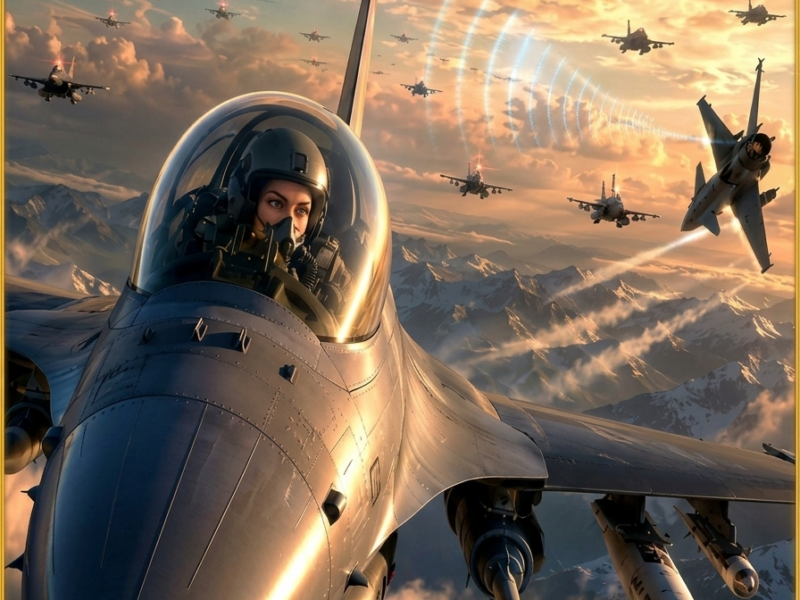
Twenty fighter jets locked their missiles onto my F-16 over the Pacific, and the enemy commander ordered my immediate destruction
The cockpit of my F-16C Fighting Falcon was drowning in an abrasive, pulsing red strobe. Inside my helmet, the Radar Warning Receiver shrieked like a dying animal, a persistent, warbling klaxon that bored directly into my temples. The digital canopy display was a nightmare of clutter.
One square box had become five.
Five had bled into ten.
Ten had blossomed into twenty solid, hostile tracking diamonds, each one signifying a cutting-edge Russian-built Su-35 Flanker-E locking an active radar homing missile directly onto my exhaust nozzle.
I had been flying combat sorties for over a decade, but I had never seen that many fire-control radars converge on a single target. It wasn’t an interception. It was an execution firing squad in the middle of an empty night, forty thousand feet above the pitch-black abyss of the Western Pacific.
“Viper One, you are surrounded,” a voice rasped across the open Guard channel. The English was measured, cold, and coated in a thick, unmistakable Slavic cadence. “Turn south and surrender.”
I glanced down at my auxiliary console, my hand trembling slightly against the side-stick controller. The fuel totalizer was ticking downward with sickening speed. Eight hundred pounds remaining. At military thrust, that gave me less than six minutes of engine life before the turbine choked on vapor and turned my multi-million-dollar fighter into a lead weight.
Worse, my left wingtip was weeping hydraulic fluid from a high-explosive fragment sustained during the dogfight forty miles north. The trailing edge fluttered with an unnatural, violent vibration that rattled my teeth through my jawbone.
Behind me, there was nothing. No aircraft carrier group. No friendly tankers. Just four thousand miles of cold, black water waiting to swallow whatever fell out of the sky.
“I can’t do that,” I said, my voice dry as parchment through the oxygen mask.
The enemy flight lead let out a low, mocking laugh that buzzed in my headset. “You don’t have a choice, Captain Vance. Eject now, or become scrap metal.”
Then, twenty distinct auditory tones escalated into a solid, ear-splitting whine. Twenty missiles had just gone into terminal pre-launch acquisition. Twenty radar seekers were warming their gyroscopes, hungry for the heat radiating from my Pratt & Whitney afterburner.
My thumb hovered over the yellow-and-black striped ejection handle nestled between my thighs. The instinct was primal, shouting at me to pull the curtains, let the rocket motor launch me into the sub-zero stratospheric winds, and pray a rescue helicopter picked me up before hypothermia set in.
Then, out of the dark recesses of my memory, came my father’s gravelly voice. He had been an aviator in the forgotten wars of the late twentieth century, a man who returned home with hollow eyes and silver scars across his neck. Before my very first combat patrol over the mountains of the Middle East, he had gripped my shoulder until the bone bruised: Never let them know you’re afraid, Cole. The moment they smell your fear, you’re just another carcass. Remind them who commands the sky.
I exhaled slowly, my breath fogging the inside of my visor before the environmental control cleared it. I pulled my thumb away from the ejection seat.
I reached for the auxiliary radio panel, toggling the rotary switch away from the open tactical frequency and punching in a vintage, frequency-hopping code stored deep in my subconscious—a sequence I hadn’t dialed since I was a fresh-faced, black-ops test pilot operating out of unmapped airstrips in Central Asia.
I opened the encrypted channel.
“This is Viper One,” I said, keeping my cadence ice-cold.
Static crackled, heavy and atmospheric.
Then, I spoke the two words I had sworn on my father’s deathbed never to utter again. A call sign that had been wiped from Pentagon servers, purged from flight logs, and buried under a mountain of top-secret redaction stamps thirteen years ago.
“Ghost Seven.”
The silence on the frequency was immediate. The mocking laughter cut off as if the speaker had been struck across the mouth.
For three agonizing seconds, the only sound was the white noise of cosmic radiation bouncing off the ocean.
Then, a young pilot’s voice broke the airwaves, cracked and unsteady: “Say that again. Origin of transmission, say that call sign again!”
“Ghost Seven,” I repeated, leveling my aircraft, allowing the stick to center. “I say again: this is Ghost Seven.”
Another voice cut through, deeper, weathered by decades of high-G turns and burnt kerosene. It was the flight leader, but his tone had completely flipped. The mocking arrogance had vanished, replaced by an edge of sheer, unadulterated dread.
“Impossible,” the commander whispered. “That aircraft was vaporized over the Kuril Trench.”
“Look at my transponder handshake, Commander,” I said, flipping the covert IFF toggle on my left console.
The silence returned, heavier this time. Across the twenty cockpits surrounding me in the darkness, digital screens were blinking with an algorithmic cryptographic signature that had been dead for over a decade.
“All aircraft, disengage,” the enemy commander suddenly barked. His voice shook with an urgency that bordering on panic. “Disengage! Break locks! Break locks immediately!”
Nobody moved for a second. The pilots were paralyzed by disbelief.
“I said break locks immediately, you fools!” the commander screamed. “Stand down all active radar! Vector one-eight-zero, now!”
One by one, the red tracking diamonds vanished from my heads-up display. The piercing audio warnings inside my helmet dropped in pitch, snapping off until my cockpit was eerily, unnervingly quiet.
I stared at the empty radar sweep. Twenty top-tier fifth-generation fighters were banking hard away from my lone, limping jet, their afterburners glowing like dying embers as they turned south into the storm clouds.
“Why are you retreating?” I breathed into the microphone, my heart hammering against my ribs. “Why aren’t you firing?”
No answer came from the flight lead.
Then, out of the southern gloom, one lone Su-35 broke away from the retreating swarm. It reversed its turn, slicing through the midnight air with lethal elegance until it leveled off just three hundred meters off my port wing. I could see the silhouette of the pilot inside the bubble canopy, bathed in the sickly green light of his cockpit instruments.
The pilot keyed his radio. His voice sounded like an old man speaking from beyond the grave.
“I flew with Ghost Seven,” the old pilot whispered, his words trembling against the static.
My breath hitched. The blood in my veins turned to ice water. “Who are you?”
“I was a lieutenant at Voronezh,” he said. “Thirteen years ago, when the sky caught fire over the sea. They told us your squadron was an experimental ghost wing. They told us you died in the deep water.”
I looked across the narrow gap between our wings. “I survived.”
The old pilot paused, and when he spoke again, his voice was so faint I had to strain to hear it over the roar of my slipping turbine.
“You don’t understand, American. You were never the one we were hunting tonight.”
The world seemed to tilt on its axis. “What does that mean? My orders were to draw your combat air patrol away from the carrier strike group!”
“Your squadron commander lied,” the pilot said, each syllable heavy with foreboding. “They didn’t send you out here to bait us. They sent you out here to be erased. We were scrambled to intercept an unflagged rogue asset. They told us you were carrying a dirty warhead to the mainland.”
Before I could form a response, before my brain could process the magnitude of the betrayal, my cockpit instruments exploded into chaos.
A new warning shrieked. It wasn’t the rhythmic, sweeping lock of an enemy fighter’s radar.
It was the continuous, unrelenting scream of an ultra-high-frequency, semi-active surface-to-air tracking array—the kind used only by the Aegis combat systems mounted on United States Navy guided-missile cruisers.
The signal was originating from the southeast. From my own carrier strike group.
From my own home.
Launch warning. Missile in the air.
A massive, hypersonic radar track appeared on my tactical datalink, accelerating toward me at Mach 4.5. My own people had just fired an SM-6 interceptor directly at my tail.
Beside me, the old Russian pilot slammed his stick forward, his Flanker’s twin engines dumping fuel as he rolled violently away into the clouds. Before his signal vanished into the soup, his voice crackled over the radio one final time:
“Viper One, if you want to know why they called you Ghost Seven… do not go home. Fly into the black, Cole. Fly into the black.”
The transmission dead-ended.
I stared at the horizon, watching the faint, blinding needle of fire rising from the distant sea, racing toward me with homicidal intent. My fuel warning light turned a solid, terminal scarlet.
And in that freezing cockpit, forty thousand feet above the darkness, the truth settled over me like a shroud:
The twenty enemy jets hadn’t turned away out of fear of me.
They had turned away because they knew who was really pulling the trigger.
The SM-6 surface-to-air missile was traveling at five thousand feet per second, an unyielding spear of solid rocket propellant and high-explosive shrapnel.
On my heads-up display, the time-to-impact counter was a brutal countdown: 00:18… 00:17… 00:16.
There is no outrunning a naval interceptor in a wounded fighter, especially not with a dry fuel tank. You cannot out-climb it. You cannot out-turn it. You can only give it something it wants more than you, or force it into an aerodynamic trap where physics tears it apart.
“Apex Command, this is Viper One!” I roared into the radio, cycling through our fleet’s primary tactical frequency. “Cease fire! Cease fire! I have an inbound friendly launch on my position! Transponder mode four is active! Confirm abort sequence!”
Static. Cold, flat, deliberate static.
Not an equipment failure. The channel was open; I could hear the faint, ambient hum of the carrier’s combat information center in the background. Someone was sitting on the key, deliberately jamming the frequency with a continuous carrier tone. They weren’t just shooting at me. They were ensuring I couldn’t broadcast my death scream to the rest of the fleet.
00:11… 00:10…
“Come on, you bastard,” I muttered, my left hand snapping down to the countermeasure panel.
I hauled back on the stick with everything my forearms had, rolling the F-16 inverted. The world flipped upside down: the dark heavens swapped places with the churning, ink-black surface of the Pacific. I shoved the nose straight down into a vertical power dive.
The airspeed needle went berserk. Mach 0.9… Mach 1.1… Mach 1.3.
The damaged left wing shrieked. Through the floorboards, I felt the terrifying vibration of delaminating composite carbon. The wing was peeling apart under the extreme aerodynamic load. If the structural spar snapped, the airframe would cartwheel into thousands of pieces before the missile even touched me.
00:06… 00:05…
Through the top of my canopy, I saw the smoke trail—a searing, blinding white streak slicing through the storm clouds, illuminating the ocean like a continuous lightning strike. The missile had acquired my heat bloom. It was leading my dive, predicting where my shattered jet would be in three seconds.
“Not today,” I growled.
At three thousand feet above the waves, with the water rushing up like a solid concrete wall, I yanked the stick into my gut, kicked full right rudder, and punched the chaff and flare salvo button three times in rapid succession.
A wall of magnesium flares and aluminum strips exploded into the supersonic slipstream behind me, blooming into a miniature sun.
At the exact same instant, the extreme G-force caught my body. My vision tunneled into gray, then black, as my blood was shoved down into my legs with the force of nine gravities. I fought the blackout, grunting through the anti-G straining maneuver, my vision reduced to a pinhole of light in the center of my eyes.
The SM-6’s seeker head made its choice. At Mach 4.5, it couldn’t differentiate between the burning thermal bloom of twelve magnesium flares and the choked exhaust of my single engine.
The missile detonated six hundred feet above me.
Even at that distance, the shockwave felt like a freight train slamming into the spine of my jet. The canopy cracked, a web of spiderweb fractures spreading across the polycarbonate glass directly over my forehead. Shrapnel hammered the fuselage like a blast from a twelve-gauge shotgun. The left wing’s control surface gave up completely, ripping free with a sickening metallic tear that yawed the aircraft violently into a flat spin.
“Recover… recover…” I grunted, fighting the spinning ocean, my hands wrestling the unresponsive stick.
The computerized flight control system was fighting me, screaming FLT CONT FAIL in bright amber across both primary displays. I slammed the manual trim overrides, cutting off the automated stability computers, and wrestled the jet level using raw aerodynamic control surfaces.
I pulled out of the dive at barely two hundred feet above the whitecaps. The sea spray physically pelted the underside of my wings.
Silence returned.
The missile was gone. But my aircraft was bleeding out.
The master warning light was a solid, glowing brick on the main console. The engine temperature was spiking into the red—shrapnel had chewed through the bypass duct. And the fuel totalizer flashed the terrifying number: 0000.
The turbine gave one last, agonizing metallic rattle, followed by a hollow thump that echoed through the airframe. The constant hum of the engine died.
The jet went quiet. The only sound left was the hiss of the wind slicing past the cracked canopy and the rhythmic slosh of the ocean sixty yards beneath my belly.
I was gliding. Dead-stick over hostile waters.
“Mayday, Mayday, Mayday,” I whispered into the emergency transponder frequency. “Viper One is flameout. Ditching at grid coordinates Delta-Tango-Seven.”
No response came from the American fleet. But fifty miles to the west, barely visible against the dark horizon, a tiny, glowing beacon caught my eye.
It wasn’t a carrier. It was a cluster of jagged rocks rising from the ocean—an uninhabited volcanic atoll known on navigation charts as Minami-Tori, a forgotten dot of coral and basalt that housed an abandoned World War II auxiliary airstrip.
The runway had been cracked and swallowed by jungle sixty years ago. But it was flat. It was solid land. And right now, it was the only thing standing between me and the freezing floor of the Mariana Trench.
I adjusted the glide ratio, holding the nose at seven degrees, trading my precious altitude for distance. Every foot of descent was a battle against the dying momentum of thirty thousand pounds of cold metal.
The island rushed forward out of the mist—a black tooth of rock jutting from the white foam of the surf. The rusted skeleton of an old control tower stood at the edge of the shore, surrounded by encroaching palm trees and broken concrete.
“Gear down,” I said aloud to an empty cockpit.
I reached for the emergency gear extension handle and pulled. Gravity dropped the three heavy wheels into the slipstream with a heavy, dragging clunk.
The runway appeared through the cracked glass: fractured, covered in drift sand, barely eight hundred feet of usable asphalt surrounded by sharp volcanic coral.
I touched down hard.
The tires shrieked as they hit the uneven surface. The right main gear immediately blew, shredded by an exposed rebar spike protruding from the ancient tarmac. The F-16 tilted violently to the right, the wingtip digging into the sand like a plow.
A shower of sparks and pulverized rock erupted along the side of the cockpit as the jet skidded sideways, tearing through rusted chain-link fencing, snapping young palm trees like matchsticks, until the nose finally crumpled into the soft mud of a drainage ditch at the base of the island’s rocky cliffs.
The sudden deceleration threw me forward against the harness with bruising force.
Then, everything stopped.
Steam hissed from the ruptured engine compartment. The smell of scorched rubber, salty brine, and leaking JP-8 jet fuel filled the cold night air.
I hung in the harness, gasping for air, blood trickling down the side of my face from where my helmet had slammed into the canopy frame.
I was alive.
I reached up, unlatched the helmet buckle, and threw the heavy helmet onto the floorboards. I popped the emergency canopy release, shoving the cracked bubble open with my boots.
The cool, tropical night air hit my face, smelling of damp earth and sea salt. It was dead silent, save for the crashing of the surf against the outer reef.
I unbuckled my harness and dragged myself out of the mangled cockpit, sliding down the scarred, smoking flank of the jet until my boots hit the muddy soil of the island. My legs gave out beneath me, and I collapsed onto my hands and knees, vomiting sea water and adrenaline into the sand.
I pushed myself up, leaning against the crushed intake of my aircraft, my hand resting on the faded stencil near the nose.
CAPT. COLE VANCE – VIPER ONE.
Beneath that modern paint, visible only because the shrapnel and sea salt had scraped the surface away, was an older layer of primer. A faded, stencil-painted insignia that had been sealed under three layers of military-grade lacquer.
A winged skull with a single dagger through the center. And below it, the letters:
PROJECT GHOST – SECTOR 7.
I touched the peeling paint with trembling fingers.
The old Russian pilot had been right. My commander, Admiral Hayes, hadn’t sent me out tonight on a standard intercept. He had known I was Ghost Seven. He had used me to draw out the Russian squadron, and the moment the old ghosts spoke my name, he had pushed the button to ensure I never came back to tell the world what happened thirteen years ago.
A twig snapped in the dark jungle twenty yards to my left.
My hand instantly dropped to the tactical holster on my hip, pulling my standard-issue Beretta M9 from its holster and racking the slide with a crisp, lethal clack.
“Step out into the open,” I yelled into the black foliage, raising the weapon. “Step out, or I empty this magazine into the brush!”
A voice replied from the darkness. Not in English. Not in Russian.
It was spoken in a soft, dry whisper that carried the terrifying familiarity of an old instructor.
“Lower your weapon, Cole. If I wanted you dead, that SM-6 wouldn’t have missed.”
A figure stepped through the palm fronds into the pale moonlight, holding a short-barreled assault rifle at his side. He wore an unbadged flight suit, his graying hair cropped short, his eyes cold and calm.
It was Admiral Hayes’ former chief of staff—the man who had supposedly committed suicide ten years ago.
Captain David Miller.
Miller stood motionless at the edge of the tree line, the silver moonlight catching the sharp contours of his weathered face. He looked older than the framed photograph that hung in the memorial hall at Pearl Harbor, but his stance was identical: perfectly balanced, shoulders back, radiating the quiet menace of a career operative who had spent his adult life in the margins of black budgets.
“Miller,” I whispered, the name tasting like ash on my tongue. The pistol in my hands didn’t waver, its tritium sights aligned squarely between his eyes. “You’re dead. I attended your ramp ceremony. I watched them carry an empty casket onto a C-17.”
“They had to put something in the ground, Cole,” Miller said, taking a slow, unhurried step forward into the clearing. He didn’t raise his rifle. He held it barrel-down, his index finger resting along the frame, well clear of the trigger. “An empty box satisfies the accountants in Washington. It satisfies the press. Most importantly, it satisfied Hayes.”
“Admiral Hayes tried to splash me twenty minutes ago,” I said, my finger tightening on the Beretta’s trigger. “He locked me up with twenty Flankers, and when they wouldn’t pull the trigger, he used an Aegis cruiser to clean up the mess. Tell me why I shouldn’t put a nine-millimeter round through your skull right now.”
Miller offered a faint, bitter smile. “Because if you shoot me, you’ll die on this rock within forty-eight hours. Because Hayes didn’t just fire one missile. He launched a sanitization sweep. A strike package from the USS Ronald Reagan is already airborne. Two F/A-18 Super Hornets carrying laser-guided bunker-busters, tasked with cratering this island until nothing remains except glass and smoking coral.”
My chest tightened. “Why? What did I do?”
“It’s not what you did tonight, Cole,” Miller said, his voice dropping into a harsh, urgent rasp. “It’s what you were born to do. It’s what your father built thirteen years ago.”
Miller turned his back to me—a calculated gesture of trust, or perhaps sheer indifference to the gun in my hands—and gestured toward the rusted silhouette of the World War II control tower jutting from the jungle canopy.
“Follow me,” Miller said over his shoulder. “Or stay out here and see if your flight suit protects you from a two-thousand-pound Joint Direct Attack Munition.”
I glanced back at the ruined, smoking carcass of my F-16. The aircraft was dead. The ocean was black and empty. With nowhere else to turn, I lowered the hammer of the pistol, kept it gripped tightly in my right hand, and plunged into the dense jungle after the ghost of a man who should have been ten years in the grave.
The jungle floor was treacherous, choked with thick roots and razor-sharp coral rocks that tore through my flight boots. Miller moved with disturbing familiarity through the darkness, navigating a barely visible footpath that wound toward the base of the island’s rocky spine.
We reached a rusted iron door set directly into the sheer volcanic cliffside, half-concealed beneath a curtain of hanging banyan roots. It looked like an old Japanese imperial munitions depot from 1944. Miller pulled a heavy brass key from his pocket, unlocked a padlock the size of a dinner plate, and shoved the heavy slab open with his shoulder.
A rush of cool, dehumidified air washed over us, smelling of diesel oil, battery acid, and old paper.
Miller stepped inside and flipped a breaker switch.
A string of low-wattage yellow bulbs flickered to life along the arched concrete ceiling, illuminating a massive subterranean bunker. It wasn’t an abandoned ruin. The center of the room was dominated by humming server racks, tactical mapping tables, and a bank of green phosphor monitors that were tracking satellite trajectories across the Pacific basin.
I stopped in my tracks. “What is this place?”
“The real Sector Seven,” Miller said, walking over to a wooden table and setting his rifle down. He pulled a silver flask from his pocket, unscrewed the cap, and took a long pull before offering it to me. “Your father built this listening post during the twilight of the Cold War. When the Soviet Union collapsed, the Navy forgot it existed. But your father didn’t. And neither did Hayes.”
I ignored the flask, stepping up to the main mapping table. The screen showed the Western Pacific, marked with dozens of tactical symbols. In the center of the display was a pulsating red circle directly over our coordinates. Heading toward us at five hundred knots were two blue triangular icons: the strike package from the American carrier.
Time to target: twenty-two minutes.
“Explain it to me, Miller,” I demanded, slamming my palm down on the edge of the tactical table. “No more riddles. Why did the Russian squadron break their locks when I gave that call sign? Why did their lead pilot say I wasn’t the one they were hunting?”
Miller leaned against the edge of the table, his eyes turning hollow, haunted by memories he had tried to bury for over a decade.
“Thirteen years ago, your father wasn’t just a combat instructor, Cole. He was the director of Project Ghost—a joint, highly classified black-budget program between rogue elements of American intelligence and a reformist faction inside the Russian military.”
I shook my head, my mind refusing to accept the words. “A joint program? With Moscow? That’s treason. That’s insane.”
“It was survival,” Miller spat, his voice suddenly blazing with venom. “Both nations had built automated nuclear command networks—systems designed to launch retaliatory strikes even if the human leadership was completely wiped out. The Americans had their decentralized command pods; the Russians had the Perimetr system, the ‘Dead Hand.’ But in the early 2010s, a cabal of defense contractors and military hawks led by then-Rear Admiral Hayes discovered a way to hijack both systems.”
Miller walked over to a metal filing cabinet, pulled out a thick, yellowed ledger bound in weathered canvas, and tossed it onto the table between us. The cover was stamped with the same insignia I had just uncovered on my jet’s wing: the winged skull and the dagger.
“They called it the Prometheus Protocol,” Miller continued. “A computer worm designed to trigger false-positive launch warnings on both sides simultaneously. Hayes and his benefactors wanted a controlled exchange—a small, non-existential tactical exchange in the northern oceans that would permanently lock both superpowers into an endless, trillion-dollar war economy.”
My throat went dry. “And my father?”
“Your father found the trigger code,” Miller said softly. “He realized that Hayes was using an experimental test squadron—the Ghost Wing—to carry the transmission relays into the upper atmosphere. Ghost Seven wasn’t an aircraft, Cole. It was a digital cryptographic key. A hardware cipher stored inside the flight computers of seven specific F-16 airframes.”
I looked down at my hands. The memories hit me like physical blows: being twenty-two years old, an arrogant young lieutenant, being assigned to a nameless test wing in the Aleutian Islands. Flying night sorties into the blinding snowstorms, running mysterious radar sweeps while my father watched from the command van with a face carved from stone.
“My father put the cipher inside my plane,” I whispered, the realization crashing down on me.
“He put the only functional kill-switch inside your plane,” Miller corrected. “The day Hayes ordered the test run that was supposed to trigger the Prometheus Protocol over the Kuril Trench, your father sabotaged the mission. He altered the telemetry. He made the Russian command believe a rogue American unit was attacking them, but he also transmitted the abort codes directly to a young Russian captain named Viktor Volkov.”
“Volkov…” The name echoed in my mind. “The old pilot on my wing tonight. He was there.”
“Volkov was the only one who realized your father was trying to save them all,” Miller said. “Your father’s plane was shot down by Hayes’ escorts that night. They told the world he crashed during a training exercise. They told the Russians the incident was a tragic misunderstanding. But they never found your aircraft, Cole. You were flying Ghost Seven. You landed in an auxiliary base in Alaska with the cipher burned into your memory drives, completely oblivious to the fact that you were carrying the only evidence that could send Admiral Hayes to the gallows for high treason.”
“So Hayes spent thirteen years waiting,” I said, cold fury beginning to take root in my chest.
“He spent thirteen years hunting the seven airframes,” Miller said, pointing toward the computer screen. “He found six of them. He had them scrapped, melted down, their avionics crushed into dust. Yours was the last one. It was lost in the logistical paperwork of the Air National Guard for a decade until Hayes was promoted to Commander of Pacific Naval Forces. The moment he saw your name on the deployment manifest for this carrier strike group, he knew the final ghost had returned.”
A loud, piercing chime echoed through the bunker.
On the main monitor, the two blue triangles representing the American strike fighters had just crossed the fifty-mile threshold. Their targeting radars were sweeping the island.
Time to target: nine minutes.
“They’re coming to incinerate the evidence,” I said, reaching for my pistol. “And us with it.”
“They’re coming to finish what they started thirteen years ago,” Miller said, walking toward a heavy reinforced bulkhead at the rear of the bunker. He gripped a hydraulic wheel and began to turn it with a series of heavy, metallic clanks. “Your father knew this day would come, Cole. He knew Hayes would eventually corner you.”
The heavy steel door swung inward, revealing a dimly lit tunnel that led deep into the core of the volcanic mountain.
“What is down there?” I asked.
Miller looked back at me, his eyes gleaming with the dangerous, desperate light of a man who had waited ten years for revenge.
“Your father didn’t just build a listening post here, Cole,” Miller said. “He left you an inheritance.”
The air inside the mountain was frigid, cooled by ancient geothermal currents and the steady hum of industrial air scrubbers. As I followed Miller down the sloping concrete ramp, the shadows gave way to a subterranean hangar carved directly out of the basalt heart of the island.
It was vast, towering fifty feet high, reinforced by massive steel arches that looked capable of surviving a direct nuclear strike.
And in the center of the hangar, bathed in the soft glow of floor-mounted halogen floods, sat a monster.
It wasn’t an F-16. It was something entirely unholy—an aircraft that existed only in the classified rumors whispered among black-budget engineers over lukewarm coffee at Edwards Air Force Base.
It was an F-15 S/MTD, the experimental STOL/MTD variant of the Eagle, but heavily modified beyond recognition. Its twin canted vertical stabilizers were coated in radar-absorbent obsidian paint. Canards were mounted forward of the wings like predatory fins. Its twin Pratt & Whitney engines terminated in massive, rectangular two-dimensional thrust-vectoring nozzles. Mounted on its centerline station wasn’t a standard fuel tank or a bomb, but an armored, matte-black avionics pod marked with a single, white stencil:
CHRONOS – CIPHER CORE.
“What did he build?” I breathed, walking slowly toward the aircraft, my hand reaching up to touch the cold, composite skin of the fuselage. The airframe felt alive, humming with the faint residual charge of active ground maintenance power.
“Your father called it Ghost Zero,” Miller said, walking to a mobile flight-line console and tapping a sequence into the mechanical keyboard. “When he realized Hayes was going to compromise the fifth-generation fleet with the Prometheus Protocol, he knew standard airframes would be useless. Modern fighters are computers wrapped in aluminum. If the network is poisoned, the pilot is just a passenger in a flying coffin.”
Miller turned to look at me, his eyes burning with fierce intensity.
“This aircraft is purely analog where it matters. Hydraulic linkages with fly-by-wire redundancy that cannot be accessed from the outside. Its fire-control system is an isolated optical network. No satellite datalinks. No fleet-wide telemetry handshakes. You cannot hack it. You cannot remotely command it to detonate. And inside that centerline pod is the entire decrypted ledger of Admiral Hayes’ treason—every offshore account, every faked maintenance report, every order he gave that resulted in the murder of your father and forty-seven other airmen.”
The floor beneath our boots suddenly shuddered.
A deep, rolling thunder vibrated through the rock walls of the hangar, accompanied by a rain of fine volcanic dust that drifted down through the halogen beams like gray snow.
“First bomb just hit the runway,” Miller said, checking the tactical readouts on his wrist display. “The Super Hornets are dropping five-hundred-pounders on the tarmac to ensure your F-16 is pulverized. In four minutes, they will switch to the bunker-busters. They will aim for the control tower, and the seismic shock will collapse this cavern on top of us.”
“We can’t launch from here,” I said, looking around the sealed rock walls. “There’s no runway. The outside strip is cratered.”
Miller pointed upward.
High above the nose of the F-15, set into the arched ceiling of the cavern, was a massive diagonal shaft lined with steel blast doors. It rose at a thirty-degree angle toward the seaward cliff of the island, pointing directly into the prevailing ocean winds.
“Steam-assisted catapult launch,” Miller said. “Built into the caldera during the Cold War to launch alert interceptors against Soviet bombers. The boilers are fully charged. You won’t have a runway, Cole. You will have four hundred feet of rail, two solid-rocket booster bottles strapped to the belly, and the open Pacific.”
“And what happens when I clear the cliff?” I asked, looking him dead in the eye. “I’ll have two fully armed Strike Fighters on my six before my gear even locks into the wells.”
“You won’t be fighting the strike fighters,” Miller said, walking over to a flight gear locker and pulling out an olive-drab high-G flight suit and a matte-black helmet with an integrated heads-up display. He shoved them into my chest. “You are going to fly straight to the flag ship. The USS Ronald Reagan. Admiral Hayes is commanding the strike from the flag bridge. You will breach their airspace, you will force their local network to download the Chronos cipher, and you will broadcast his confession across every open channel in the Pacific Theater.”
“The carrier group has three cruisers and four destroyers,” I said, zipping the suit over my bruised body, the tight fabric compressing my aching ribs. “They have two hundred surface-to-air missiles between them. I won’t get within twenty miles.”
“They won’t fire on you, Cole,” Miller said, helping me buckle the leg restraints.
“Why the hell wouldn’t they?”
Miller smiled, a cold, terrifying grin that made my blood run hot.
“Because thirty seconds ago, I used this facility’s emergency transmitter to send the Ghost Seven authentication key to the entire Russian Northern Fleet. Captain Volkov didn’t retreat to his base, Cole. He called his admiral. Right now, three regiments of Russian long-range strike aircraft are crossing the maritime boundary, vectoring directly toward the Reagan.”
I stopped buckling my harness, staring at him in horror. “You’re going to start World War Three.”
“No,” Miller said, slamming his hand against my shoulder harness to lock the buckle. “I’m going to stop it. Hayes wants a shadow war where he controls both sides from the dark. We are dragging him into the daylight. The Russians aren’t coming to attack the American fleet; they’re coming to witness the truth. If you deliver that cipher, both fleets stand down. If you fail… the sky catches fire, and nobody survives the sunrise.”
He pushed me toward the ladder leaning against the cockpit of the F-15.
I climbed the aluminum rungs, my body aching with every movement, my muscles screaming from the high-G turn that had almost killed me an hour before. I dropped into the cockpit.
The cockpit was a work of brutal, beautiful engineering. It smelled of new leather, ozone, and liquid oxygen. Unlike the digital glass sea of the modern F-16, the F-15 S/MTD was an imposing mix of heavy mechanical switches, circular steam gauges, and two high-contrast tactical displays mounted squarely below the gun-sight.
I jammed my helmet on, clicked the oxygen mask into the bayonet lugs, and flipped the battery master switch.
The instrument panel roared to life. A low, mechanical whine vibrated through the seat as the gyroscopes spun up to fifty thousand revolutions per minute.
On the center console, a single green line of text appeared:
GHOST ZERO – WELCOME HOME, PILOT.
Miller’s voice crackled through my helmet’s internal intercom.
Catapult bridal is engaged. Solid rocket booster bottles are armed. Blast doors are opening.
Above me, the massive steel slabs in the ceiling groaned and separated with a screech of shearing rust. For the first time in sixty years, the cool Pacific wind rushed into the subterranean hangar, bringing with it the roar of the surf and the smell of burning jet fuel from the cratered runway outside.
Through the angled shaft, I could see the midnight stars framing the mouth of the tunnel.
Cole, Miller’s voice came through, softer now, stripped of all tactical edge. Your father was proud of you. Finish this.
“Clear the rail, David,” I replied, my left hand wrapping around the twin throttle levers, advancing them to seventy percent.
The twin Pratt & Whitney engines roared into life, a thunderous, chest-compressing vibration that shook the entire mountain. The jet strained against the mechanical holdback bar, the tires smoking against the steel launch sled.
On the ceiling rail, a green launch light flashed.
Three.
Two.
One.
I slammed the throttles into full afterburner and hit the rocket booster toggle.
The world vanished.
The solid-rocket boosters ignited with a violent, concussive crack that slammed my spine flat against the armored seat back.
Five gravities of instantaneous acceleration shoved the air from my lungs in a ragged gasp. The walls of the volcanic launch shaft blurred into a gray, streaking tunnel of concrete and basalt. The F-15 S/MTD surged up the thirty-degree incline like an artillery shell fired from the bowels of the earth.
Two seconds.
Four hundred feet.
The mouth of the shaft exploded into view.
The jet cleared the cliff edge at two hundred and sixty knots, bursting into the open sky three hundred feet above the surging ocean surf. The rocket bottles on the belly burned out with a sharp pop, their spent aluminum casings detaching automatically and tumbling into the dark sea below.
I leveled the aircraft, slamming the thrust-vectoring paddles into forward trim.
The F-15 answered with breathtaking responsiveness. It wasn’t the flight-by-wire lag of modern fighters; it was raw, mechanical muscle, the canards slicing through the turbulence with razor-sharp authority.
Instantly, my radar detector wailed.
Above me, circling at eight thousand feet through the rain clouds, were the two F/A-18 Super Hornets that had just finished cratering the island. Their targeting radars locked onto my climb profile within milliseconds.
“Unidentified fast-mover out of the volcanic atoll,” an American voice barked over the fleet tactical channel. “Target matches no known profile. Vectoring for immediate intercept. Fox Three!”
They didn’t ask for a challenge code. They didn’t ask for an IFF handshake.
They were under shoot-on-sight orders.
An AIM-120D AMRAAM dropped from the lead Hornet’s belly, its solid-propellant motor flaring into life, streaking downward through the cloud deck.
“Break right!” I muttered to myself, hauling the stick into my ribs and kicking the thrust-vectoring pedals.
The F-15 performed an impossible aerodynamic maneuver. The rectangular exhaust nozzles tilted upward by twenty degrees while the forward canards pitched down. The aircraft literally pivoted on its own center of gravity, swapping its nose forty degrees off its flight path in a fraction of a second without losing forward momentum—a post-stall kulbit maneuver that defied conventional aerodynamics.
The AMRAAM missile, expecting a standard evasive turn, screamed past my starboard wingtip by less than thirty yards, unable to calculate the violent, non-linear displacement. It detonated harmlessly into the ocean below.
I reversed the stick, bringing the nose up directly underneath the lead Hornet’s tail.
The targeting reticle on my heads-up display locked onto the Super Hornet’s exhaust. My thumb hovered over the red trigger on the control stick. A single squeeze would send a twenty-millimeter volley of high-explosive incendiary rounds ripping through his fuel tanks.
Don’t kill your brothers, my father’s voice whispered through the roar of the slipstream. They are blind. Show them.
I released the trigger.
Instead of firing, I flicked the auxiliary radio switch, broadcasting on the wide-band tactical link that fed directly into every cockpit within two hundred miles.
“Hornet Lead, this is Captain Cole Vance, call sign Viper One,” I said, my voice steady, cutting through the static with absolute clarity. “Break off your attack. You are firing on an American officer under the illegal direction of Admiral Hayes. I am carrying the Chronos ledger. Look at your datalink.”
I flipped the red switch on the centerline pod.
A high-frequency burst of digital data exploded from the aircraft’s antennas, transmitting on the unencrypted emergency military channel. It wasn’t a computer virus; it was a pure, uncompressed data dump: flight logs, encrypted communications, banking transfers to overseas accounts, and the classified audio recording of Admiral Hayes ordering the execution of Ghost Flight thirteen years ago.
In the cockpit of the lead Hornet, the pilot broke his turn. I could see his jet rocking its wings, his targeting radar shutting down as the sheer volume of damning evidence populated his cockpit displays.
“Viper One… is that you?” the Hornet pilot’s voice came back, sounding shaken, horrified. “Command told us you were shot down by the Russians. They told us an enemy strike craft was launching from that island.”
“They lied to you, Lieutenant,” I said, pushing the throttles forward. “Keep your missiles on the rails and form up on my wing if you want to save this fleet.”
The two Hornets didn’t fire again. Slowly, deliberately, the two naval strike fighters fell into an escort formation, flanking my obsidian F-15 as we crested forty thousand feet, racing westward toward the carrier strike group.
Ten minutes later, the horizon began to glow.
It wasn’t the sun. It was the vast, sprawling constellation of the USS Ronald Reagan carrier strike group—a nuclear carrier, three cruisers, and five destroyers slicing through the dark ocean, their hulls throwing up white wakes of foam.
And converging on them from the north, flying in a massive, disciplined wedge formation at thirty-five thousand feet, were thirty Russian Su-35s and Tu-22M Backfire bombers.
The two fleets were locked in a lethal, hair-trigger standoff. Every ship had its vertical launch tubes open. Every Russian jet had its cruise missiles fueled and armed. One single nervous finger on a launch button would turn the Pacific into an apocalyptic graveyard.
“All units, this is Captain Cole Vance, aboard Ghost Zero,” I broadcasted across every frequency—American, Russian, civilian, maritime. “Admiral Hayes, this is the son of Commander Marcus Vance. I am holding the ledger.”
I put the F-15 into a steep, shrieking dive, cutting through the center of the airspace directly between the American carrier and the Russian bombers. The massive, twin-tailed black fighter screamed across the flight deck of the Reagan at barely eight hundred feet, the sonic boom rattling the windows of the carrier’s flag bridge with the force of an earthquake.
On the primary tactical frequency, a cold, trembling voice finally spoke from the carrier’s command deck.
“Cole…” Admiral Hayes rasped, his aristocratic composure completely shattered. “You were supposed to die in the Kuril Trench.”
“My father died to expose you, Hayes,” I said, banking the jet hard around the carrier’s superstructure, holding the aircraft in a tight, mocking orbit above the flight deck. “And he left me the key to your coffin. The entire Pacific Fleet is reading your files right now. The Russian command has the ledger. It’s over.”
Silence settled over the ocean.
Across thirty combat vessels and fifty combat aircraft, thousands of men and women were listening to the unmasking of a monster.
Through the radio, I heard the faint, distinct sound of heavy boots entering the flag bridge of the USS Ronald Reagan.
Admiral Hayes, a deep, stern voice announced over the ship’s internal communications. This is Master Chief Master-at-Arms Keller. By order of the Chief of Naval Operations and the Joint Chiefs of Staff, step away from the command console. You are relieved of duty, sir. Place your hands behind your back.
A muffled scuffle echoed through the channel, followed by the metallic click of handcuffs closing around a wrist.
Then, the voice of the Russian flight lead—Captain Viktor Volkov—broke through the international Guard frequency. His English was clear, steady, and filled with a profound, solemn respect.
“Ghost Zero, this is Russian Air Force Colonel Volkov,” he said. “The northern boundary is secure. We are standing down all active radar. We are returning to base.”
The Russian bombers began to bank slowly away to the north, their wingtip lights blinking once in a universal military salute.
Beneath me, the flight deck of the Ronald Reagan turned on its green recovery lights. The emergency barricades were lowered, and the deck crews in their colored jerseys began clearing the arrestor wires for an incoming aircraft.
I pulled back on the throttles, feeling the immense weight of the last thirteen years lift from my shoulders. The crushing fatigue finally hit me—the bruised ribs, the cut on my forehead, the adrenaline receding like a retreating tide, leaving behind a deep, aching exhaustion.
To the east, the first thin sliver of golden light cracked the black line of the horizon.
The storm clouds were breaking apart, scattered by the morning wind. The sunlight spilled across the calm water of the Pacific, painting the ocean in deep shades of amber and gold.
I looked at my instrument panel. The center console was quiet, the green line of text glowing softly in the dawn:
MISSION ACCOMPLISHED. SYSTEM SECURE.
I tapped the rudder pedals, aligned the nose of the black fighter with the carrier’s angled deck, and lowered the landing gear into the sunrise.
The end.









