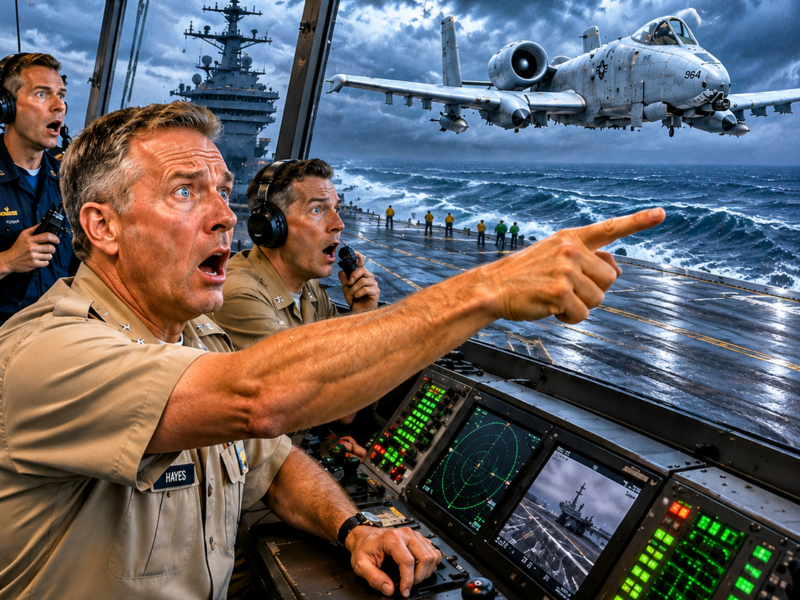
“‘Turn to heading 270 and eject, Captain. That is your only chance,’ the Navy commander ordered. I looked at the fuel gauge, then at the violent ocean beneath my damaged A-10.
The first thing I heard after the aircraft stopped was the rain.
It hammered against the canopy so violently that, for several seconds, I couldn’t hear my own breathing.
Then came a voice over the radio.
“Bore 21, do you read? Confirm you’re alive.”
I swallowed, my throat dry.
“Bore 21 reads. Aircraft is stopped.”
A burst of static followed.
Then Lieutenant Ryan Mitchell, the carrier’s landing signal officer, shouted, “You actually did it!”
I looked through the rain-streaked canopy.
The A-10 was sitting crooked on the flight deck, its nose angled toward the ocean. The arresting cable still stretched beneath my aircraft. Beyond the deck edge, the Philippine Sea churned like a living thing.
I was twenty feet from the end.
Twenty feet.
My hands were shaking so badly I couldn’t release the control stick.
“Bore 21, shut down your engines,” Mitchell ordered. “We’ve got a fire crew coming to you.”
I followed the checklist, one switch at a time. The twin engines wound down, their familiar roar fading into the storm.
When the canopy finally opened, cold rain struck my face.
Sailors were already running toward me.
Some carried fire extinguishers. Others held emergency equipment. A few simply stood there, staring at the A-10 as if it had fallen out of the sky.
A deck crewman reached up.
“Ma’am, can you move?”
“I think so.”
He helped me climb down the ladder. The moment my boots touched the deck, my knees buckled.
Two sailors caught me before I fell.
“Easy, Captain,” one said. “You’re on our ship now.”
I looked back at my aircraft.
Its left wing was battered. Hydraulic fluid streaked the fuselage. One of the landing gear doors hung at an ugly angle.
But it was still there.
And so was I.
Commander Thomas Hayes approached through the rain. His flight suit was soaked, and his expression was impossible to read.
He stopped a few feet away.
“Captain Jenkins?”
“Yes, sir.”
He looked at the A-10, then at the arresting cable.
“You understand what you just attempted?”
“Yes, sir.”
“You brought an aircraft that was never designed for carrier operations onto my flight deck in a typhoon.”
“I didn’t have another option, sir.”
For a moment, I thought he was going to tear into me.
Instead, he glanced toward the sailors still gathered around the aircraft.
“You just gave my crew something they’ll be talking about for the rest of their careers.”
I wanted to smile, but I was too exhausted.
Then I noticed something hanging beneath the aircraft.
An AGM-65 Maverick missile was still attached to its damaged pylon, but the mounting assembly had twisted. The missile was swinging slightly in the wind.
“Everyone back!” I shouted.
Hayes turned.
“What is it?”
“Missile on the left-side pylon. The mount is compromised.”
The deck crew froze.
One sailor pointed toward it.
“Is it armed?”
I stared at the weapon.
The storm had battered the aircraft, but the missile’s status indicators were impossible to confirm from where we stood.
“I don’t know,” I said. “Treat it as live.”
Hayes immediately ordered the area cleared.
The fire crews pulled back. Weapons personnel were called to the flight deck, and the aircraft was secured as carefully as the conditions allowed.
I tried to explain what I had seen, but my legs were beginning to give out.
A corpsman took my arm.
“Captain, you’re going to medical.”
“I need to tell them about the missile.”
“Commander Hayes has it.”
I looked at Hayes.
He nodded once.
“Go. That’s an order.”
As the corpsman led me away, I glanced back at the A-10.
It had survived the storm.
I had survived the landing.
But I knew the night wasn’t finished with us.
The medical department smelled of disinfectant and wet clothing. A corpsman checked my blood pressure, examined my hands, and asked the same questions several times.
Had I hit my head?
Had I lost consciousness?
Was I experiencing chest pain?
I answered as best I could.
When the doctor finally stepped away, I asked about my aircraft.
“Still on the flight deck?”
“For now.”
“What does that mean?”
“It means the admiral wants it gone.”
I sat up.
“Gone where?”
The corpsman hesitated.
“Overboard, if they decide it’s too damaged to move safely.”
I stared at him.
“That aircraft saved four Navy sailors tonight.”
“I know, Captain.”
“Then they can’t just throw it away.”
He didn’t answer.
A few minutes later, Commander Hayes entered the compartment.
He had changed into a dry uniform, but his face looked even more tired than before.
“Captain Jenkins, Admiral Bradley wants to speak with you.”
“About the aircraft?”
“Among other things.”
He pulled a chair beside my bed.
“The missile team secured the Maverick. It hadn’t detonated, and they’re handling the weapon now. Your aircraft is stable enough to move, but the admiral is concerned about the damage.”
“It’s still flyable?”
Hayes gave me a look.
“That’s not the question right now.”
I understood.
The aircraft was an unusual guest aboard a carrier. It had no place in the normal recovery cycle, and the storm had made everything more complicated.
But I couldn’t accept the idea of leaving it behind.
“Sir, I know the A-10 isn’t built for this ship. I know what I asked your crew to do. But that aircraft is the only reason those four sailors made it home.”
Hayes studied me.
“Believe me, Captain, I know.”
He stood.
“I’ll do what I can.”
When he left, I leaned back against the pillow.
For the first time since the emergency began, I allowed myself to close my eyes.
I woke to the sound of raised voices outside the compartment.
One voice was unmistakably older and sharper.
“It’s an unacceptable hazard. I want that aircraft off my flight deck.”
Another voice answered.
“Admiral, we can move it into the hangar.”
“It’s damaged, nonstandard, and carrying equipment we haven’t fully inspected. You want to put that inside my ship?”
“I want to preserve an aircraft that brought a pilot aboard alive in conditions most people wouldn’t attempt to launch in.”
A pause followed.
Then the admiral spoke again.
“Commander Hayes, this is not a museum.”
“No, sir. It’s a warship. And we don’t abandon people or equipment without exhausting our options.”
I pushed myself upright.
A moment later, Hayes appeared in the doorway.
“Captain, you’re supposed to be resting.”
“I’m trying, sir.”
He almost smiled.
“Admiral Bradley has agreed to a temporary solution. Your aircraft will be moved into the hangar for inspection. That’s all I can promise.”
“Thank you, sir.”
“Don’t thank me yet. Moving it will be difficult.”
He glanced toward the passageway.
“Get some rest. The crew is preparing the elevator.”
The move took hours.
I wasn’t allowed on the flight deck, but I watched part of it through a small observation window.
The A-10 was carefully positioned for the hangar elevator. Deck crews worked slowly, checking every clearance and securing the aircraft against movement.
The damaged wing left almost no margin.
At one point, the aircraft had to be angled carefully to clear the surrounding structure.
Every movement seemed to take an eternity.
Finally, the elevator began descending.
I released a breath I hadn’t realized I was holding.
My aircraft was inside.
For the first time that night, I thought we might actually get through this.
Then the ship’s alarm sounded.
It wasn’t the ordinary announcement for a routine drill.
A sharp warning tone echoed through the passageways, followed by a voice ordering personnel to clear the hangar area.
I looked toward the door.
The corpsman rushed in.
“Captain, stay here.”
“What happened?”
“Possible hazardous-material leak in the hangar.”
My stomach tightened.
“From the A-10?”
He didn’t answer immediately.
Then he said, “They’re investigating a damaged emergency power unit.”
I knew what that meant.
The A-10’s emergency power unit used hydrazine, a highly toxic chemical. Even a small leak could be dangerous, especially in an enclosed space.
I swung my legs over the side of the bed.
The corpsman stepped forward.
“Captain, no. You’re medically restricted.”
“That’s my aircraft.”
“And that’s a toxic-material response. You are not going in there.”
I looked at him.
“I’m not going to touch anything. I just need to tell them where the unit is.”
“Then tell them over the radio.”
I picked up the handset.
“Bore 21 to Commander Hayes. Do you read?”
Static crackled.
Then Hayes answered.
“Go ahead, Captain.”
“Possible hydrazine leak from the emergency power unit. The unit is located in the aft fuselage. Don’t let anyone approach without proper protective equipment.”
“We know, Captain. The hangar is being evacuated.”
“Is anyone inside?”
A pause.
“Two crewmen were checking the aircraft when the alarm sounded. We’re trying to locate them.”
My blood ran cold.
“Are they accounted for?”
“Not yet.”
I gripped the handset.
“Commander, listen carefully. The leak could be feeding into the ventilation system. You need to isolate the area and keep personnel away from the compartment.”
“We’re working on it.”
I heard another voice in the background.
Then Hayes returned.
“Captain, stay where you are. That’s an order.”
The radio went silent.
I sat there, staring at the handset.
The two crewmen had been working on my aircraft.
They had been trying to save it.
And now they might be paying for it.
I couldn’t stay in that bed.
I made it as far as the passageway before a nurse caught up with me. She tried to stop me, but I showed her the emergency diagram I had memorized during my years maintaining flight-line procedures.
“I know where the unit is,” I told her. “I can help them identify the access panel.”
“You’re not wearing protective equipment.”
“Then don’t let me enter the hot zone. Just get this information to the response team.”
She hesitated, then took the diagram.
“Stay here.”
I stayed.
Every second felt like an hour.
Then the radio came alive.
“Hangar response to command. Two crewmen located. Both conscious. Evacuation in progress.”
I closed my eyes.
Thank God.
A second transmission followed.
“Leak source identified. Isolation valve is damaged. We need additional support at the aft access panel.”
I looked toward the passageway.
Hayes appeared at the far end, wearing protective equipment and carrying a sealed emergency case.
“Captain,” he said, “I need you to explain exactly how that assembly is arranged.”
I stepped toward him.
“Sir, I can walk you through it.”
“From here. You’re not coming inside.”
I nodded.
We worked through the diagram together. I explained the access sequence, the location of the isolation valve, and the mechanical linkage that could be reached without disturbing the damaged tank.
Hayes repeated the instructions to the response team.
A few minutes later, Chief Warrant Officer John Masterson joined the radio net.
“Commander, we’ve got the panel open. I can see the valve.”
“Can you isolate it?”
“Not from this angle. The linkage is bent.”
I leaned closer to the handset.
“Chief, look for the manual override behind the lower bracket. It should be protected by a small metal cover.”
There was a pause.
“Found it.”
“Use the emergency isolation tool. Don’t force the linkage.”
Another pause.
Then Masterson’s voice returned.
“Valve is moving.”
The radio crackled.
“Pressure dropping. Leak appears to be slowing.”
Hayes looked at me through his visor.
“Keep talking, Captain.”
I guided them through the final steps, carefully describing the sequence I had learned during aircraft emergency training.
At last, Masterson spoke again.
“Valve secured. No further discharge detected.”
For several seconds, nobody said anything.
Then the hangar response leader confirmed the area was being monitored and the ventilation system was being checked.
Hayes removed his helmet outside the controlled area.
His face was pale.
“You may have just saved two more lives.”
I shook my head.
“They were doing their jobs, sir.”
“So were you.”
The two crewmen were taken for medical evaluation. Neither had suffered a fatal exposure, though both would remain under observation.
The aircraft, however, was no longer simply damaged.
It was contaminated and would need a full safety inspection before anyone could approach it without protective equipment.
Admiral Bradley was furious.
He summoned Hayes and me to a briefing room several hours later.
I was still wearing my hospital-issued clothing, and my hands were bandaged from the rough descent.
The admiral stood at the head of the table.
“Captain Jenkins, I understand you provided technical guidance during the hangar incident.”
“Yes, sir.”
“You were ordered to remain in medical.”
“Yes, sir.”
“And yet you involved yourself in an active hazardous-material response.”
“I stayed outside the restricted area, sir. I provided information to the response team.”
He studied me for a long moment.
“Your aircraft has caused a remarkable amount of trouble aboard my ship.”
I held his gaze.
“Yes, sir.”
“First, you land it on my carrier. Then you nearly lose a missile over the flight deck. Then we have a chemical leak in the hangar.”
“I understand, sir.”
He looked at Hayes.
“And you continue to defend her.”
Hayes stood straight.
“Because she keeps giving us reasons to.”
The admiral’s expression softened slightly, though his voice remained stern.
“Captain, you saved four Navy sailors. You brought your aircraft aboard in a storm. And when a dangerous leak threatened my crew, you helped the response team stop it.”
He paused.
“But courage does not excuse ignoring medical orders.”
“No, sir.”
“You are grounded until the medical team clears you. Do you understand?”
“Yes, sir.”
“Good.”
He closed the folder in front of him.
“Now get some rest.”
I thought that was the end of the meeting.
Then he added, “And Captain?”
“Sir?”
“Your aircraft stays in the hangar until we determine what can be done with it.”
I nodded.
It wasn’t a promise that it would fly again.
But it was something.
Over the next two days, the typhoon weakened and moved away from the carrier group. The ship continued its mission, though the storm had left damage across the flight deck and radar systems.
I spent most of that time in medical, watching updates and asking anyone who passed my room about the A-10.
The four sailors from the downed MH-60 were transferred to the carrier.
When they arrived, I recognized one of them from the rescue coordinates I’d relayed through the radio.
He was a young petty officer with a bandage around his forehead.
He stopped outside my room.
“Captain Jenkins?”
I sat up.
“That’s me.”
He stepped forward.
“Petty Officer Daniel Brooks. I was on that helicopter.”
I remembered the transmission.
The one reporting the crew trapped near the wreckage.
The one that had gone silent for almost a minute.
“You made it,” I said.
“Because you stayed with us.”
He held out his hand.
I shook it.
“We heard your aircraft overhead,” he said. “We thought nobody was coming.”
“I was never going to leave you out there.”
His eyes lowered for a moment.
“My daughter is six. I was thinking about her when the helicopter went down.”
I didn’t know what to say.
He continued.
“I didn’t know if I’d ever see her again. But I did. And I wanted you to know that.”
I squeezed his hand.
“I’m glad you’re here, Daniel.”
He nodded, then stepped aside.
The other three sailors were waiting in the corridor.
They thanked me one by one.
I tried to tell them I had only done what any pilot would do.
But the words sounded empty.
I knew not every pilot would have stayed.
I also knew that staying had nearly cost me my life.
That evening, Commander Hayes visited my room.
“There’s a development.”
I sat up.
“About the A-10?”
“Partly.”
He placed a tablet on the table.
The carrier’s radar system had sustained damage during the typhoon. Several external sensors were offline, and the ship was relying on a reduced surveillance picture while technicians worked to restore them.
“Command has received reports of unidentified fast-attack craft operating in the area,” Hayes said. “We don’t know their intentions.”
“Are they approaching the carrier?”
“Not yet. But we want a better picture of what’s out there.”
He tapped the tablet.
A photograph of my aircraft appeared.
The fuselage was battered, but the targeting pod beneath the wing was still attached.
“Your LITENING pod appears undamaged. The maintenance team believes it can be powered externally for a limited period.”
I looked at him.
“You want me to use it?”
“I want you to help identify what our damaged sensors cannot.”
I stared at the image.
“I’m still grounded, sir.”
“I know. Nobody is asking you to fly.”
He leaned forward.
“The aircraft is on the hangar deck. We can position it safely, power the pod through an external source, and use its imaging capability to examine the contacts.”
I studied the screen.
The idea was unusual, but not impossible.
The targeting pod had been designed to give pilots a detailed view of objects far beyond what the naked eye could identify.
If it could be powered and connected to the ship’s systems, it might provide useful information.
“Have the technicians confirmed the connection?”
“Not yet.”
“Then we need to test it carefully.”
Hayes nodded.
“That’s why I’m here.”
For the first time since the landing, I felt something close to hope.
The next morning, I was escorted to the hangar.
My A-10 sat behind a safety perimeter, its damaged wing supported and its hazardous systems isolated. The aircraft looked smaller inside the vast hangar than it had on the flight deck.
But seeing it again felt like seeing an old friend.
A maintenance crew had prepared an external power connection for the targeting pod. Engineers worked beside the aircraft, checking every connection before the system was energized.
I stayed outside the marked area.
“Captain,” one technician said, “we’re ready for the initial test.”
I watched the display.
The pod powered up.
A faint image appeared.
Then the picture sharpened.
The ocean filled the screen, dark and restless beneath scattered clouds.
I adjusted the viewing controls under the technician’s supervision.
“Try the western sector,” I said.
The image shifted.
At first, there was nothing but waves and distant rain.
Then I saw three shapes.
Small vessels.
Moving quickly.
I leaned closer.
“Commander Hayes?”
He stepped beside me.
“What do you have?”
“Three fast-moving contacts. Bearing approximately two-seven-zero. They’re traveling in formation.”
“Can you identify them?”
“Not yet.”
I adjusted the magnification.
The vessels became clearer.
Low profiles. Dark hulls. No visible navigation lights.
One appeared to have a mounted weapon near its bow.
Hayes called the operations center.
“Possible unidentified surface contacts. We have visual confirmation from the A-10 targeting pod.”
The room changed instantly.
Sailors began moving between consoles. Officers gathered around the display.
I continued tracking the vessels.
They were closing the distance.
“Range is decreasing,” I said.
Hayes looked at the screen.
“Can you determine their intent?”
I watched the lead vessel turn.
Then the second.
Then the third.
They were not moving randomly.
They were changing formation.
“Commander,” I said quietly, “I think they’re trying to approach from multiple directions.”
The operations officer stepped forward.
“Can you identify markings?”
I increased the magnification again.
The image flickered as the aircraft’s power connection fluctuated.
For one moment, the lead vessel came into sharp focus.
I saw a dark shape mounted behind its cockpit.
Then the image stabilized.
It was a weapon.
Hayes turned toward the operations officer.
“Alert the admiral.”
The officer reached for the communications panel.
I kept my eyes on the display.
The three vessels were still moving toward us.
And then the lead boat changed course again.
Not away from the carrier.
Toward it.
I felt the room go quiet around me.
“Commander,” I said, “they’re coming in.”
Hayes stared at the screen.
“General quarters.”
The alarm began seconds later.
Across the ship, sailors ran to their stations. Watertight doors closed. The carrier shifted into combat readiness.
I stood beside my aircraft, unable to do anything but watch the contacts move across the display.
My A-10 couldn’t fly.
Its weapons were secured.
Its systems were damaged.
But its targeting pod had given the carrier the one thing it needed most: a clear picture of the threat.
Admiral Bradley entered the hangar with two officers behind him.
“Captain Jenkins,” he said, “how confident are you in those contacts?”
“Very confident, sir.”
“Can you maintain tracking?”
“Yes, sir, as long as the power connection holds.”
He looked at Hayes.
“Keep that picture on the screen.”
Then he turned back to me.
“Captain, I believe your aircraft has one more contribution to make.”
I looked at the three vessels.
They were closer now.
And this time, nobody aboard the carrier was laughing at the idea of an A-10 helping a Navy warship.
The admiral’s next order would determine whether we were about to stop a threat—or discover that we had misunderstood it entirely.
THE ENd.









