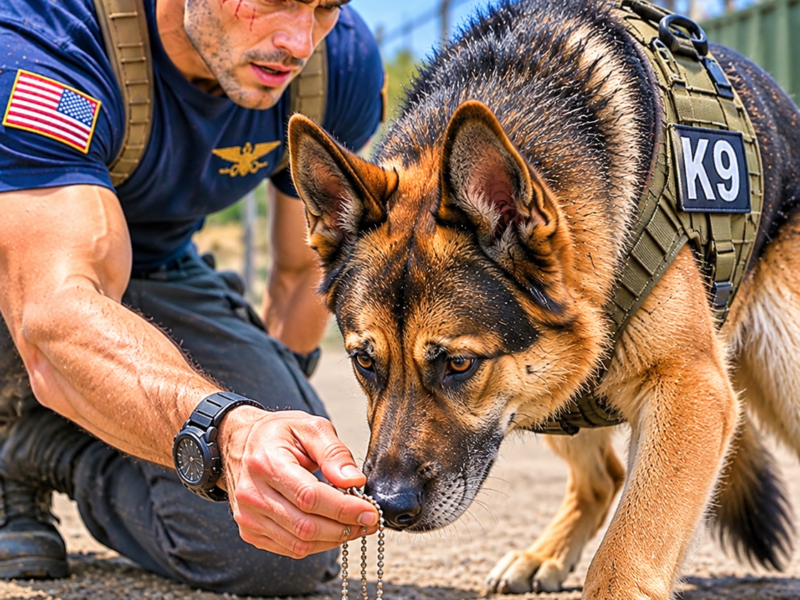
Three years after his best friend was declared dead, a retired Navy SEAL heard a whistle that made his military dog do something he had never done before: disobey an order
The first thing Silas Reynolds noticed about Washington was how ordinary it looked.
Traffic crawled along the highway. Office workers hurried across sidewalks with coffee cups in their hands. Tourists photographed monuments beneath the afternoon sun. Somewhere in the distance, a siren rose and faded.
Nothing about the nation’s capital suggested that three people inside a stolen black SUV were carrying evidence that could bring down a billion-dollar defense empire.
Silas kept both hands on the steering wheel.
His right knee throbbed with every movement, but he refused to acknowledge it. He had learned long ago that pain was information, not permission to stop.
In the back seat, Derek Mitchell leaned against the leather upholstery. His missing left arm was tucked beneath his jacket, and his scarred face looked exhausted.
Aldrich lay beside him, his gray muzzle resting across Derek’s thigh.
Every few minutes, the old German Shepherd lifted his head to check that his original handler was still there.
Derek noticed.
“Still don’t trust me to stick around, huh, buddy?”
Aldrich’s tail struck the seat twice.
Derek smiled faintly.
For several miles, neither man spoke.
There were too many things between them. Three years of grief. Three years of unanswered questions. Three years during which Silas had believed that his closest friend was dead while Derek had deliberately stayed away.
Finally, Silas broke the silence.
“You owe me an explanation.”
Derek looked through the window.
“I know.”
“No. You don’t.”
Silas tightened his grip on the steering wheel.
“I buried an empty casket. I stood beside your parents while they cried. I listened to people tell me what a hero you were. And every night for three years, I wondered whether I could have done something differently in that valley.”
Derek lowered his eyes.
“I know, Tommy.”
“You watched us mourn you.”
“I had no choice.”
“Everybody has a choice.”
The words hung between them.
Derek didn’t argue.
After a moment, he reached into his jacket and pulled out a small waterproof pouch.
Inside was a black encrypted flash drive.
“This is why I stayed away.”
Silas glanced at it.
“The ledger?”
“Part of it. The financial records, shipping manifests, payment authorizations, names of shell companies. Everything I could recover.”
“Enough to put Penhaligan in prison?”
Derek shook his head.
“Enough to make him dangerous. Not enough to guarantee a conviction.”
Silas frowned.
“What else do we need?”
“The original authorization chain. The orders that moved the weapons and equipment. The records proving the intelligence was deliberately altered before our mission.”
Derek paused.
“And the name of the person who approved it.”
Silas thought about Bradley Davis.
The commander’s nervous expression at the memorial returned to his mind.
“Someone inside the Navy?”
Derek looked directly at him.
“Someone with access to the people who approved our mission.”
Silas felt the familiar coldness settle into his stomach.
“Then why Washington?”
“Because that’s where the original records are. And because there’s one person I still believe might be willing to help us.”
“Who?”
“Admiral Nathaniel Brooks.”
Silas knew the name.
Brooks had served as a senior intelligence officer and later become an influential figure within the Department of Defense. He had overseen several special operations reviews and was known for demanding documentation before accepting intelligence assessments.
He had also worked with Silas’s unit.
“If Brooks is involved, we’re finished,” Silas said.
“He’s not.”
“How do you know?”
“Because he was the one who initially questioned the intelligence package three years ago. His objections disappeared from the official record.”
Derek looked down at the drive.
“I don’t know whether he’s still clean. But he’s the only person with enough authority to open the right doors.”
Silas considered that.
Then he looked into the rearview mirror.
Aldrich had closed his eyes, but one ear remained pointed toward their conversation.
“All right,” Silas said. “Let’s go find your admiral.”
They reached a modest motel outside Arlington shortly before sunset.
Derek had chosen the location because it was away from the major government buildings and offered enough privacy to examine the evidence.
Silas parked behind the building.
For several seconds, he remained seated.
He was thinking about the memorial plaque.
The bronze letters.
The chaplain’s speech.
The men who had stood there believing they were honoring a fallen brother.
He wondered how many of them knew the truth.
Derek opened the passenger door.
“Tommy?”
Silas didn’t move.
“What?”
“We need to get inside.”
Silas finally stepped out.
Aldrich followed, moving more slowly than he had at Coronado.
Inside the room, Derek placed the flash drive on the small table and connected it to a compact laptop.
The screen filled with encrypted directories.
Silas watched him work.
“You’ve been carrying that thing for three years?”
“Not this particular copy. I’ve made several encrypted backups.”
“Where are they?”
Derek gave him a tired smile.
“Somewhere safer than this motel.”
“That’s not an answer.”
“It’s the only one you’re getting until I know who we can trust.”
Silas shook his head.
“You disappear for three years, come back with half an arm, bring armed men down on us, and now you want me to trust your instincts?”
Derek looked up.
“Yes.”
For the first time, Silas almost laughed.
It was the same Derek Mitchell he remembered.
Stubborn, irritating, and completely convinced that he was right.
Derek returned to the computer.
The first directory contained financial transactions.
Hundreds of them.
Some were routed through companies registered in the Cayman Islands. Others passed through logistics firms in Germany, Turkey, and the United Arab Emirates.
Silas recognized several Department of Defense contract numbers.
“What am I looking at?”
“Equipment that was supposed to be accounted for by the government. Night-vision systems, thermal imaging equipment, drone components, encrypted communication modules.”
“And all of it went missing?”
“Not exactly.”
Derek enlarged a spreadsheet.
“Some shipments were officially recorded as destroyed. Others were listed as damaged beyond repair. A few were supposedly transferred to allied forces.”
“But they weren’t?”
“No. They were sold.”
Silas leaned closer.
The amounts were staggering.
Millions of dollars had moved through the network.
“How did you get this?”
“One of Penhaligan’s logistics managers made a mistake. He reused an old accounting credential on a private server. I followed the transactions until I found the central ledger.”
“Who’s the manager?”
Derek hesitated.
“Arthur Penhaligan himself.”
Silas looked at him.
“You’re telling me the billionaire defense contractor personally signed off on this?”
“Not every transaction. But enough of them.”
Derek opened another file.
A scanned document appeared.
It was a mission intelligence summary from August 2023.
Silas recognized the operation number immediately.
Corenal Valley.
His stomach tightened.
Derek pointed to a paragraph near the bottom.
“This is the version command received.”
Silas read it.
The report described a high-value target believed to be hiding in an abandoned compound. It identified the surrounding area as relatively secure, with limited enemy activity.
He remembered the briefing.
He remembered how confident everyone had been.
“What’s wrong with it?”
Derek opened another document.
“This is the original intelligence assessment.”
Silas read the second report.
The differences were immediately obvious.
The original assessment had warned of possible enemy reinforcements, unusual vehicle movement, and suspected weapons positions overlooking the valley.
The revised version removed those warnings.
It also changed the estimated enemy strength.
Silas felt his jaw tighten.
“They knew.”
“Yes.”
“They sent us there knowing we were walking into a kill zone.”
Derek nodded.
“And someone made sure the mission proceeded anyway.”
Silas stared at the screen.
For three years, he had blamed himself for the deaths of his teammates.
He had replayed every decision, every radio call, every moment when he had ordered Derek to move toward the sniper position.
Now he was looking at a document that suggested their deaths had been planned before they ever entered the valley.
He stepped away from the table.
“Who approved the revision?”
Derek opened the final page.
There were several authorization fields.
One signature belonged to Arthur Penhaligan.
Another belonged to a government liaison.
The third was partially obscured by a digital security marker.
Derek zoomed in.
Silas leaned closer.
The name appeared.
Bradley Davis.
Silas stared at the screen.
For a moment, the motel room seemed to become very small.
“Brad.”
Derek nodded.
“He signed the revised intelligence assessment.”
Silas shook his head slowly.
“No.”
“Tommy—”
“Brad was our commander. He was with us. He knew every man on that team.”
“That doesn’t change what the document says.”
Silas rubbed his face.
He remembered Davis at the memorial.
The warning.
The uncomfortable glance toward the administration building.
The way he had said the brass were still reviewing irregularities.
Silas had assumed the commander was frightened because he knew someone had made a mistake.
Now he understood that Davis might have been frightened because he knew exactly what had happened.
“Why would he do it?”
“Money. Pressure. Blackmail. I don’t know yet.”
Derek closed the file.
“But he knows where the remaining authorization records are.”
Silas looked at him.
“Then we’re going to ask him.”
Derek gave a small, humorless smile.
“That was my plan.”
The following morning, Derek made contact with Admiral Nathaniel Brooks through an old military communication channel.
He sent a brief message.
No names.
No explanation.
Just a reference number from the Corenal Valley operation and a request for a private meeting.
The response arrived twenty-three minutes later.
One sentence.
If you are who I think you are, come alone.
The meeting was scheduled for that afternoon at a small office building near the Pentagon.
Silas objected immediately.
“Alone? That’s ridiculous.”
“He’s trying to protect himself.”
“Or he’s trying to put us in a room where nobody can hear us scream.”
Derek shrugged.
“Either way, we’re going.”
They couldn’t bring Aldrich into the meeting.
Silas hated the idea of leaving him behind, but the old dog needed rest after the previous day’s escape.
They arranged for him to remain in the motel room with water, food, and a comfortable place to sleep.
Before leaving, Derek knelt beside him.
“Stay.”
Aldrich stared at him.
“Guard the room.”
The dog gave a quiet bark.
Derek rested his forehead against the Shepherd’s.
“I’ll be back.”
Aldrich whined softly.
Silas watched them.
He had seen men leave their families before dangerous missions. He had watched fathers kiss their children goodbye and husbands promise to return.
There was something particularly difficult about watching an old military dog struggle to understand why his handler had to leave again.
Silas crouched beside them.
“He’s coming back, buddy.”
Derek glanced at him.
For a moment, neither man said anything.
Then they left.
Admiral Brooks was waiting inside a conference room with no windows.
He was in his late sixties, with silver hair and a straight posture that suggested a lifetime of military discipline.
When Silas entered, Brooks stood.
“Chief Reynolds.”
“Admiral.”
Brooks looked at Derek.
His expression changed.
For several seconds, he simply stared.
Then he walked around the table.
“Petty Officer Mitchell?”
“Yes, sir.”
Brooks closed his eyes briefly.
“My God.”
He extended his hand.
Derek shook it with his right.
“I apologize for the entrance.”
Brooks gave a short, disbelieving laugh.
“I spent three years reading reports about your death.”
“So did I.”
The admiral gestured toward the chairs.
“Sit down. Both of you.”
Silas remained standing.
“Before we start, I want one thing understood.”
Brooks looked up.
“Go ahead.”
“We aren’t here for another investigation that ends with a classified report and a memorial service. We want the truth.”
The admiral nodded slowly.
“Then I suggest you show me what you brought.”
Derek placed the flash drive on the table.
Brooks examined it without touching it.
“What is this?”
“The financial ledger for Vanguard Global. Shipping records, payment trails, shell companies, and the original intelligence revisions for our mission.”
Brooks looked at him sharply.
“Where did you obtain it?”
“That doesn’t matter right now.”
“It matters considerably.”
Derek leaned forward.
“Admiral, our men died because someone sold military technology and decided that a SEAL team was an inconvenient witness. I watched them execute our people. I watched them try to kill my dog. I lost my arm. Then I spent three years making sure I could prove what happened.”
His voice hardened.
“I didn’t come here to discuss where I found a file.”
Brooks remained silent.
Finally, he nodded.
“Fair enough.”
He opened a secure workstation and began examining the documents.
The more he read, the more his expression changed.
When he reached the altered intelligence assessment, he stopped.
“This cannot be right.”
Silas pushed a copy toward him.
“Look at the authorization field.”
Brooks examined the signature.
His face became pale.
“Bradley Davis.”
“You know him?” Silas asked.
“Of course. I know his record.”
“Then you know he was our commander.”
Brooks removed his glasses.
“I also know he was removed from the review process shortly after your mission.”
Silas frowned.
“Why?”
“Officially, he requested reassignment for personal reasons.”
“Unofficially?”
Brooks looked at the documents again.
“His name appeared in an internal inquiry concerning the intelligence package. The inquiry was terminated before any formal findings were issued.”
Derek leaned forward.
“Who terminated it?”
Brooks hesitated.
Then he gave them the name of a senior procurement official.
A man who had worked closely with Penhaligan on several defense contracts.
Silas felt anger rising in his chest.
“How many people are involved?”
“I don’t know.”
“How many people knew what happened to Derek?”
“I don’t know that either.”
Silas struck the table with his palm.
“Then what do you know, Admiral?”
Brooks didn’t flinch.
“I know that someone inside this building has been protecting Penhaligan for years. I know that every attempt to reopen the Corenal investigation was stopped before it reached the proper authorities. And I know that the records you’re showing me are enough to trigger a major federal investigation.”
Derek sat back.
“Then trigger it.”
Brooks looked at him.
“That is not how this works.”
“How does it work?”
“We establish an independent chain of custody. We verify the documents. We notify the appropriate investigative authorities. We protect the evidence and the witnesses.”
“Meanwhile, Penhaligan gets another chance to destroy everything.”
Brooks looked toward Silas.
“He’s right about one thing. We cannot wait long.”
Silas folded his arms.
“Can you protect us?”
The admiral considered the question.
“I can arrange protection through an office outside the compromised chain of command. But I need to know whether the evidence is genuine.”
Derek pushed the laptop across the table.
“Then let’s verify it.”
For the next two hours, Brooks worked through the files.
He made calls to a small number of officials whose names he trusted.
He requested original procurement records and cross-checked several contract numbers.
The results were worse than Derek had expected.
Some of the missing equipment had appeared in foreign inventories. Several shipments had been routed through companies directly connected to Vanguard. Payments had been authorized through accounts linked to Penhaligan’s private holding company.
And the altered intelligence assessment had been submitted from a government terminal using Bradley Davis’s credentials.
The evidence was becoming difficult to dismiss.
But one question remained.
Why had the entire operation been allowed to continue for so long?
Brooks found the answer in a series of archived correspondence files.
A senior procurement official had repeatedly intervened to protect Vanguard from audits.
The official had also directed investigators away from several suspicious shipments.
His name appeared on multiple financial records.
Silas read it twice.
“That’s the man you mentioned.”
Brooks nodded.
“Yes.”
Derek leaned closer.
“Is he still in the building?”
Brooks looked at the clock.
“He is scheduled to attend a procurement review this afternoon.”
Silas exchanged a glance with Derek.
“Then we need to get this evidence out before he knows we’re here.”
Brooks agreed.
He began preparing a formal notification to federal investigators.
But before he could finish, his secure phone rang.
He looked at the caller ID.
His expression changed.
“Excuse me.”
He stepped away from the table.
“Brooks.”
Silas watched him listen.
At first, the admiral said nothing.
Then his shoulders stiffened.
“Who authorized that?”
A pause.
“No. Absolutely not.”
Another pause.
Brooks looked toward Silas and Derek.
“Understood.”
He ended the call.
“What happened?” Silas asked.
Brooks returned to the table.
“The Pentagon has received an emergency notification claiming that classified materials were stolen from Naval Amphibious Base Coronado yesterday.”
Derek shook his head.
“They’re calling the ledger stolen.”
“More than that. They’ve identified the two individuals responsible.”
Silas already knew what was coming.
Brooks looked at them.
“Chief Reynolds and Petty Officer Mitchell.”
For a moment, nobody spoke.
Then Derek laughed softly.
“That didn’t take long.”
Brooks wasn’t amused.
“They’ve issued instructions to detain you both pending investigation.”
Silas stood.
“Then I guess we’re done here.”
“Not yet.”
Brooks closed the laptop.
“I have enough to know you’re telling the truth. But I need something stronger than your word and a collection of digital files.”
Derek reached into his jacket and removed another small storage device.
“This contains the original audio from the valley.”
Brooks looked at it.
“You have recordings?”
“Radio traffic from the operation. Including the men who entered the kill zone after the mortar strike.”
Silas stared at Derek.
“You never told me you had that.”
“I wasn’t sure it survived.”
Derek connected the device.
A recording began.
Static filled the room.
Then came the familiar sounds of gunfire, shouting, and explosions.
Silas heard his own voice issuing commands.
He heard Derek responding.
Then a different voice came through.
A calm male voice speaking in English.
“Confirm the western position. No survivors. Make sure the dog doesn’t get out.”
Silas felt his stomach turn.
He recognized the accent.
He recognized the tone.
It was the voice of someone who had spoken to their unit during the operation.
Someone who had been monitoring the mission.
Derek stopped the recording.
“That’s one of Vanguard’s field supervisors.”
Brooks leaned forward.
“Do you know his identity?”
“Yes.”
Derek opened another file.
A photograph appeared.
The man was identified as a former special operations contractor who had worked for Vanguard in Afghanistan.
Brooks stared at the screen.
“He’s been employed by the government as a security consultant.”
Silas looked at him.
“Where?”
Brooks didn’t answer immediately.
Then he said, “Here.”
The meeting ended abruptly.
Brooks arranged for a secure vehicle to transport the evidence to a federal investigative office outside the compromised procurement chain.
He also instructed them to remain in a protected location until an official team could meet them.
Silas wanted to stay.
Derek wanted to leave.
They argued in the corridor.
“We have a chance to put this in the hands of people who can actually do something,” Silas said.
“And I have a chance to keep us alive long enough to make sure it gets there.”
“You think running is going to solve this?”
“No. I think surviving long enough to testify might.”
Silas stopped.
He knew Derek was right.
They returned to the motel.
The moment Silas opened the door, Aldrich lifted his head.
Then he rose slowly and crossed the room.
His tail began wagging.
Derek crouched.
“Hey, old man.”
Aldrich pushed his muzzle into Derek’s chest.
Derek wrapped his right arm around the dog’s neck.
For several seconds, he remained there.
Silas looked away.
He didn’t want Derek to see his expression.
After everything that had happened, the sight of them together still felt impossible.
But the peace didn’t last.
Aldrich suddenly lifted his head.
His ears turned toward the hallway.
A low growl vibrated in his chest.
Silas immediately reached for the door.
“What is it?”
Derek stood.
The dog moved between him and the entrance.
Another sound came from outside.
A faint metallic click.
Silas looked at Derek.
Neither man moved.
Then someone knocked.
Three slow knocks.
Silas raised one finger, signaling silence.
He approached the door carefully and looked through the peephole.
A man in a gray jacket stood outside.
He carried a folder.
Silas didn’t recognize him.
The man knocked again.
“Mr. Reynolds? I’m here from the security office.”
Silas glanced at Derek.
Derek shook his head.
“Don’t open it.”
The man outside shifted his weight.
Then he leaned closer to the door.
“We need to speak with you about the incident at Coronado.”
Silas stepped backward.
“Show me your identification.”
The man raised a badge.
Silas couldn’t read the details.
But Aldrich was no longer merely growling.
His lips had pulled back, revealing his teeth.
Derek whispered.
“Tommy. Get away from the door.”
The hallway went quiet.
Then a second voice came from farther down the corridor.
“Clear the room.”
Silas moved.
He grabbed the small emergency bag they had prepared and pulled Aldrich toward the rear entrance.
Derek followed.
A loud crash sounded behind them.
The front door buckled.
They were out the back before it opened.
The motel parking lot was nearly empty.
Silas had deliberately left the stolen Suburban behind. They had used a rental vehicle arranged through a legitimate travel service, but Derek had insisted on keeping a second set of keys in his bag.
They reached the car.
Silas opened the rear door.
Aldrich climbed inside with difficulty.
Derek followed.
Silas started the engine.
The front entrance of the motel came into view through the rearview mirror.
Two men in civilian clothes rushed outside.
One pointed toward their vehicle.
“Move!” Derek shouted.
Silas accelerated.
The car shot out of the parking lot and merged into traffic.
For several minutes, neither man spoke.
Then Silas glanced at Derek.
“How did they find us?”
Derek looked at the laptop bag.
“The drive.”
“What’s on it?”
“Not what they think.”
Silas frowned.
Derek opened the bag.
Inside was a small black device.
“The ledger I showed Brooks was a copy. I left out the original authorization records.”
Silas stared at him.
“You gave him an incomplete file?”
“I gave him enough to establish that the evidence was real. The full records are still protected.”
“Where?”
Derek tapped the device.
“Encrypted backup. It requires a second key.”
“And where is that?”
Derek looked toward the windshield.
“Bradley Davis.”
Silas felt the blood drain from his face.
They spent the next several hours moving between safe locations.
Derek finally explained why Davis mattered.
The former commander had been involved in the original intelligence revision, but the document they had recovered contained only his authorization.
The complete record included the correspondence surrounding the decision.
That correspondence could establish whether Davis had acted voluntarily, under pressure, or as part of the conspiracy.
The second encryption key had been generated using a security credential tied to his old command account.
Without it, the full authorization chain remained inaccessible.
“Why would Davis keep the key?” Silas asked.
“Because he created the original archive. He probably believed nobody would ever need to see it.”
“Or he kept it as insurance.”
“Possibly.”
Silas stared at the road.
“Either way, we’re going to find him.”
Derek nodded.
But there was something else he hadn’t told Silas.
During his three years in hiding, he had learned that Penhaligan’s operation was not simply about selling equipment.
The defense contractor had built an entire network around government procurement.
He had used legitimate contracts to conceal missing equipment, manipulated shipping records, and moved money through layers of private companies.
The money had gone to people who could protect the operation.
Some were civilians.
Others wore uniforms.
And one of them had access to the same intelligence systems that had sent Silas’s team into Corenal Valley.
Derek had been tracking the network, but he had never found the complete list of beneficiaries.
Now, with the original authorization records, they might finally identify everyone involved.
Silas looked at him.
“How many?”
Derek shook his head.
“Too many.”
They found Bradley Davis in a small house outside Alexandria.
The former commander looked older than Silas remembered.
His hair had thinned. His shoulders seemed narrower. There were deep lines around his eyes.
When he opened the door and saw Silas, he froze.
“Tommy.”
Silas didn’t answer.
Davis looked past him.
Then he saw Derek.
His face lost its color.
“That’s impossible.”
Derek stepped forward.
“Apparently, not.”
Davis backed away.
They entered the house.
Aldrich remained close to Derek, watching the former commander with intense attention.
Davis stared at the missing arm.
“My God, Derek.”
“Save it.”
Davis swallowed.
“How long have you been back?”
“Long enough.”
Silas stood in the middle of the living room.
“You knew.”
Davis looked at him.
“Tommy—”
“You knew what happened in that valley.”
The commander lowered his head.
“I knew the intelligence was wrong.”
Silas stepped forward.
“Wrong?”
Davis flinched.
“Don’t make me say it twice.”
The older man sat down heavily.
For a long moment, he looked at the floor.
Then he began to speak.
Penhaligan had approached him several months before the mission.
At first, the contractor had presented the relationship as a routine intelligence partnership. Vanguard Global had access to local sources, regional logistics, and information that government agencies struggled to obtain.
Davis had been encouraged to use the contractor’s intelligence assessments to support certain operations.
The relationship gradually became more complicated.
Penhaligan offered money through intermediaries.
He promised that the payments were legitimate consulting fees.
Davis accepted them.
He told himself that the money compensated him for helping a private company navigate military bureaucracy.
Then came the Corenal Valley mission.
Davis had received an intelligence package identifying the target compound.
The original assessment contained several warnings.
He noticed them.
He also noticed that the revised version removed the warnings and reduced the estimated enemy presence.
He knew the changes were suspicious.
But Penhaligan had assured him the intelligence had been independently verified.
Davis signed the authorization.
The mission went forward.
When the ambush happened, Davis immediately understood that something had gone terribly wrong.
He contacted the command center and requested an immediate investigation.
But before the review could begin, Penhaligan’s people contacted him.
They showed him records of the payments he had accepted.
They threatened to expose him as the person who had approved the altered intelligence.
They also made it clear that anyone who continued asking questions could become another casualty.
Davis stopped cooperating.
He signed additional paperwork.
He allowed the official explanation to stand.
And he watched the men he had commanded become names on a memorial wall.
Silas listened without moving.
When Davis finished, the room was silent.
Finally, Silas spoke.
“You let us bury him.”
Davis’s eyes filled.
“I didn’t know Derek survived.”
“You didn’t know?”
“I swear to you, I thought he was dead.”
Derek stepped closer.
“You knew they were killing us.”
Davis looked at him.
“I knew the intelligence was compromised. I didn’t know they were going to send a team to execute everyone.”
Derek’s jaw tightened.
“You signed the paper that put us there.”
Davis nodded.
“Yes.”
For the first time, the former commander seemed unable to defend himself.
He looked at Silas.
“I have regretted it every day.”
Silas gave a bitter laugh.
“Regret doesn’t bring back the men in that valley.”
“No.”
“Doesn’t give Derek his arm back.”
“No.”
“Doesn’t give me three years of my life back.”
Davis lowered his head.
“No.”
Silas turned away.
He wanted to hit him.
He wanted to ask how someone could accept money while men under his command risked their lives.
But he also knew that violence would solve nothing.
Not now.
Not after everything they had fought to uncover.
Derek placed the small encrypted device on the table.
“We need the second key.”
Davis stared at it.
Then he looked toward the window.
“If I give you that, Penhaligan will know everything.”
“He’s already hunting us.”
Davis shook his head.
“You don’t understand. The records identify people much higher than him.”
Silas stepped closer.
“Then let them be identified.”
Davis looked at him for a long time.
Finally, he stood and walked to a locked cabinet.
He removed a small metal case and opened it.
Inside was an old encrypted security token.
He placed it on the table.
“This is the original credential.”
Derek picked it up.
“Does it still work?”
“It should.”
Silas studied Davis.
“Why now?”
The older man looked at the floor.
“Because I have spent three years pretending that silence was the same thing as survival.”
He paused.
“And because I don’t want another man standing at a memorial wondering why his friends never came home.”
The full archive opened just after midnight.
Derek connected the security token to the laptop and entered the recovery credentials.
The screen displayed a series of encrypted folders.
He opened the first.
Then the second.
Then the third.
Silas stood behind him.
Aldrich lay on the floor beside Derek’s chair, his eyes following every movement.
The records were extensive.
There were original intelligence assessments, payment schedules, internal correspondence, and messages between Penhaligan’s representatives and government officials.
Some documents showed that equipment had been deliberately removed from official inventories.
Others showed that the missing shipments had been sold through intermediaries.
Then Derek opened a file marked with the date of the Corenal operation.
Inside was a series of messages.
One had been sent two days before the mission.
It contained a direct warning that an American special operations team might approach the smuggling route.
Another message discussed the possibility that the team could discover the equipment cache.
A third contained instructions to alter the intelligence assessment.
Silas read the final message.
His hands began to tremble.
It was short.
The sender had instructed Vanguard personnel to ensure that no surviving members of the SEAL team could identify the operation.
The message was not signed with a personal name.
It carried an internal authorization code.
Derek opened the associated records.
A list of approved contacts appeared.
Silas recognized one name.
The senior procurement official Brooks had mentioned.
Another belonged to a government intelligence liaison.
A third belonged to a private security executive.
But the most important record was a payment authorization.
It showed a large transfer from one of Penhaligan’s companies to an account controlled by a consulting firm connected to Bradley Davis.
Silas looked at the former commander.
Davis had gone pale.
“I didn’t know about that.”
Derek turned toward him.
“Your name is on the account.”
“I never received that money.”
“Then someone used your identity.”
Davis looked sick.
“Penhaligan.”
Silas leaned forward.
“Can you prove it?”
Davis nodded slowly.
“There were accounts opened in my name after I signed the original authorization. I reported them to my bank, but the investigation went nowhere.”
Derek returned to the screen.
The records were now telling a more complicated story.
Davis had accepted payments before the mission. But someone had also used his identity to move money afterward, creating the appearance that he had received additional compensation.
Penhaligan had been building a second layer of protection.
If Davis ever talked, the contractor could portray him as the sole government official responsible for the corruption.
It was a carefully constructed trap.
Silas looked at Davis.
“You should have told someone.”
“I know.”
“You should have gone to the investigators.”
“I know.”
“You could have saved lives.”
Davis closed his eyes.
“I know, Tommy.”
Silas turned away.
The man had made his choices.
And now everyone had to live with them.
By morning, the evidence had been copied to multiple encrypted storage devices.
Brooks arranged for the original files to be transferred to independent federal investigators.
He also contacted an official within the Department of Justice who had previously worked on large-scale procurement fraud cases.
This time, the investigation would not remain inside the Navy’s command structure.
The financial records would be reviewed independently.
The intelligence revisions would be authenticated.
The audio recordings would be examined by forensic specialists.
And the surviving witnesses would be protected.
For the first time since the Corenal Valley operation, there was a realistic path toward accountability.
But Arthur Penhaligan wasn’t finished.
At 9:17 that morning, Derek received a message from an unknown number.
It contained a photograph.
The picture showed the motel room they had occupied the previous night.
A second image showed Aldrich sleeping beside Derek’s chair.
Beneath the photographs were six words.
You should have stayed dead, Mitchell.
Derek stared at the screen.
Silas noticed immediately.
“What?”
Derek handed him the phone.
Silas examined the photographs.
His expression hardened.
“They know where we were.”
“They’ve been watching us.”
“Then we move.”
Derek shook his head.
“Not this time.”
Silas looked at him.
“What do you mean?”
“We’re done running.”
He placed the phone on the table.
“They’ve spent years making sure nobody can connect them to Corenal Valley. They have destroyed records, intimidated witnesses, and used their money to bury investigations.”
Derek looked at the laptop.
“But now we have the original files.”
Silas nodded.
“Then let’s finish it.”
The next forty-eight hours were a blur of interviews, forensic examinations, and formal statements.
Silas gave a detailed account of the ambush.
He described the mission briefing, the altered intelligence, the mortar attack, and the moment he lost sight of Derek.
He also described the discovery of the blood-soaked vest and the official conclusion that Derek had been captured and killed.
Derek provided his own testimony.
He described waking beneath the shale, witnessing Vanguard operatives executing surviving team members, and escaping after Aldrich attacked one of the gunmen.
He explained how he had survived without a left arm, moved between safe locations, and spent three years tracking the financial network.
Bradley Davis gave a separate statement.
He admitted accepting improper payments.
He admitted signing the altered intelligence assessment.
And he admitted remaining silent after the ambush.
His cooperation did not erase his responsibility, but it gave investigators a clearer picture of how the operation had been protected.
Admiral Brooks also provided documentation concerning the original intelligence review and the subsequent efforts to suppress it.
For the first time, the investigation had something it had lacked for three years.
Multiple witnesses.
Original documents.
Financial records.
And recordings from the operation itself.
The case was no longer simply a disputed military intelligence failure.
It had become a major criminal investigation.
Arthur Penhaligan learned that the evidence had reached federal investigators on a Thursday morning.
He was sitting in his private office when his legal adviser entered.
The office overlooked a broad stretch of the Potomac.
Penhaligan had spent years building an image of himself as a patriotic businessman. He donated to military charities, attended defense conferences, and regularly spoke about the importance of supporting American troops.
He had never imagined that the men he had tried to eliminate would come back.
“What do you mean, the archive is authenticated?” he asked.
His adviser placed a folder on the desk.
“They have the original procurement records. They’re also examining the financial transfers.”
“Who gave them the files?”
“Derek Mitchell.”
Penhaligan’s face tightened.
“He’s supposed to be dead.”
“He isn’t.”
For several seconds, Penhaligan said nothing.
Then he stood.
“Where is he?”
“Under federal protection.”
Penhaligan walked toward the window.
“Find out which office is handling the case.”
“We’ve already tried.”
“And?”
“They won’t provide details.”
Penhaligan turned.
“Then find someone who will.”
His adviser hesitated.
“Arthur, I think we need to discuss legal representation.”
Penhaligan stared at him.
Then he slowly returned to his desk.
For the first time in years, the man who had controlled the operation was no longer certain that he could control what happened next.
The arrests began the following week.
Federal agents executed search warrants at several offices connected to Vanguard Global.
They seized computers, financial records, private communications, and company documents.
A number of executives were taken into custody for questioning.
The procurement official whose name appeared in the ledger was placed under investigation.
Several government employees were suspended pending review.
Penhaligan’s attorneys issued a statement denying wrongdoing and describing the investigation as politically motivated.
But the documents told a different story.
The financial transfers matched the procurement records.
The altered intelligence assessments were authenticated.
The audio recordings were consistent with the timeline described by Derek.
And the original archive contained communications that connected Penhaligan’s organization to the operation in Corenal Valley.
The case would take months to resolve.
But the carefully constructed story that had kept Derek Mitchell officially dead was finally beginning to collapse.
Three weeks later, Silas stood in a federal building overlooking Washington.
He had just finished another round of interviews.
His knee hurt.
His back hurt.
He hadn’t slept properly in days.
But for the first time in three years, the pain didn’t come with the same helplessness.
Aldrich lay beside him.
The old German Shepherd had been examined by a veterinarian after the escape from Coronado. His joints were badly worn, and his heart needed monitoring.
The veterinarian had recommended limited activity.
Derek had listened carefully.
Then he had asked whether Aldrich could still enjoy short walks.
The answer was yes.
That was enough.
Derek approached from the hallway.
He was carrying two paper cups of coffee.
“How did it go?”
Silas accepted one.
“Long.”
“Useful?”
“Very.”
Derek sat beside him.
For a while, they watched people moving through the lobby.
Then Silas spoke.
“Do you think we’ll ever know everything?”
Derek looked at him.
“About what happened?”
“All of it. Who knew. Who signed what. Who decided we were expendable.”
Derek considered the question.
“I don’t know.”
Silas took a sip of coffee.
“That’s not a very comforting answer.”
“It’s an honest one.”
Derek looked down at Aldrich.
“But we know enough to make sure they can’t tell the same lie again.”
Silas nodded.
He understood.
Justice would not return the men they had lost.
It would not erase the ambush.
It would not undo the years Derek had spent hiding or the months Silas had spent recovering from his injuries.
But it could give the dead something the official report had denied them.
The truth.
The following month, a formal military review was announced.
The Department of Defense reopened the Corenal Valley operation.
Investigators examined the original mission planning records and interviewed surviving personnel.
Bradley Davis was formally charged in connection with his role in the corruption investigation. His cooperation became part of the legal proceedings, but he would still have to answer for his actions.
Arthur Penhaligan and several associates faced federal charges related to the alleged procurement fraud, conspiracy, and illegal trafficking of restricted military equipment.
The investigation continued to expand.
For Silas and Derek, the most important development came when the military officially corrected the record concerning their team.
The original report had described the mission as an intelligence failure caused by unreliable local sources.
The revised findings acknowledged deliberate manipulation of the intelligence package and evidence of a coordinated effort to conceal the circumstances of the ambush.
The names of the fallen men were formally cleared of any implication that their deaths resulted from operational misconduct.
Silas read the report alone.
He sat at a small desk in the temporary apartment where he and Derek were staying.
The document was several pages long.
It contained technical language, legal qualifications, and carefully worded conclusions.
But one paragraph stood out.
The investigation found no evidence that the team had knowingly disregarded established operational procedures or acted outside the mission orders provided to them.
Silas read it again.
Then he closed the document.
He had spent three years believing he had failed his men.
Now he could finally accept that he had not been responsible for the trap.
Aldrich approached slowly.
The dog placed his head on Silas’s knee.
Silas rested a hand on his muzzle.
“Looks like we finally got something right, old man.”
Aldrich sighed.
Several months later, the Navy organized a second memorial ceremony at Coronado.
This time, the ceremony was different.
There were no vague speeches about an unfortunate intelligence failure.
There were no unanswered questions about the missing men.
The official findings had been made public, and the families of the fallen had been informed.
Silas arrived early.
He wore his old dress uniform, carefully adjusted despite the stiffness in his knee.
Derek walked beside him.
His left sleeve remained pinned neatly beneath the elbow.
Aldrich moved between them.
The dog was slower now.
His muzzle had turned almost entirely gray, and his hind legs required occasional assistance.
But his eyes remained bright.
Master Chief William Miller was waiting near the memorial.
When he saw them, he stepped forward.
For a moment, he simply looked at Derek.
Then he extended his hand.
“Welcome home, Mitchell.”
Derek shook it.
“Good to see you, Master Chief.”
Miller glanced at Aldrich.
“Looks like someone has been keeping you busy.”
Derek crouched and scratched the dog behind the ears.
“He’s been doing most of the work.”
Miller smiled.
Then his expression became serious.
“I heard about the investigation.”
Derek nodded.
“There’s still more to do.”
“Always is.”
The small group gathered around the memorial.
The bronze plaques reflected the afternoon sun.
Silas stood before Derek’s name.
For the first time, he wasn’t looking at it as the name of a dead friend.
He was looking at it as a reminder of everything they had survived.
A chaplain stepped forward.
The ceremony began.
When it was time for the families to approach the memorial, Silas stepped back to give them space.
He noticed Derek standing quietly beside Aldrich.
The dog was watching the bronze plaque.
Then Derek reached into his jacket.
He pulled out a small metal whistle.
The same whistle Silas had found in the sand at Coronado.
The initials D.M. were still visible on its back.
Derek raised it to his lips.
Two short notes.
One long, descending trill.
Aldrich lifted his head.
His ears moved forward.
For a moment, the old German Shepherd looked as if he were back on a battlefield, waiting for the next command from the man who had trained him.
Then he walked toward Derek.
Slowly.
Carefully.
He pressed his head against Derek’s leg.
Derek lowered the whistle and rested his hand on the dog’s neck.
“Good boy.”
Silas watched them.
He remembered the day Aldrich had first run toward the shipping containers.
He remembered the blood-soaked vest in Afghanistan.
He remembered the memorial plaque and the three years of believing that Derek would never come home.
Now the man stood beside him.
Scarred.
Changed.
But alive.
And the dog who had never forgotten him was finally at peace.
After the ceremony, Silas and Derek walked toward the edge of the beach.
The Pacific stretched out beneath a pale blue sky.
Waves rolled toward the shore, breaking into white foam before retreating across the sand.
Aldrich walked between them.
Derek carried a small bag containing his old military identification, a photograph of the original team, and a few personal belongings he had recovered after the investigation.
He stopped near the water.
“You remember the first time we brought him here?”
Silas smiled.
“Of course.”
“Couldn’t get him out of the water.”
“He thought every wave was something he needed to fight.”
Derek laughed.
“Still does.”
Aldrich looked toward the ocean as if he understood the conversation.
Silas lowered himself onto a nearby bench.
Derek sat beside him.
For a while, they said nothing.
Then Silas asked the question he had carried for months.
“Do you ever regret coming back?”
Derek looked toward the water.
“Sometimes.”
Silas nodded.
“I figured.”
“I regret leaving you in the dark. I regret not finding a way to tell you I was alive. I regret that the first time you saw me again, armed men were chasing us.”
Silas smiled faintly.
“That part was memorable.”
Derek laughed.
Then his expression softened.
“But I don’t regret exposing them.”
Silas looked at his friend.
“Neither do I.”
Derek rested his hand on Aldrich’s back.
The old dog had finally settled between their feet.
His breathing was slow.
His eyes were half closed.
For the first time in years, there was no urgency in his posture.
No distant explosion.
No incoming radio transmission.
No command to move.
Just the sound of the ocean.
Silas looked down at him.
“He’s getting old.”
Derek nodded.
“I know.”
“Veterinarian says we need to be careful.”
“I know.”
Silas hesitated.
“He’s done enough.”
Derek looked at the dog.
“More than enough.”
Aldrich shifted slightly and placed his head across Derek’s boot.
Derek rubbed the fur behind his ears.
“Hey, buddy. You remember what I used to tell you?”
The dog lifted one ear.
“Never leave your partner.”
Silas looked toward the horizon.
“Looks like he listened.”
Derek smiled.
“Better than most people.”
They sat there until the sun began to lower.
Neither man needed to say anything more.
The legal proceedings continued over the following months.
Penhaligan’s defense team challenged the evidence and questioned the authenticity of several records. But the original procurement documents, financial transactions, and recorded communications gave investigators a substantial foundation.
Several former Vanguard employees agreed to cooperate.
Their statements helped establish how equipment had been diverted from government inventories and sold through intermediary companies.
The government also identified additional officials who had received improper payments or concealed irregularities.
Penhaligan eventually faced a series of federal charges.
The proceedings were lengthy, and not every allegation resulted in a conviction. Some aspects of the wider network remained under investigation.
But the operation that had destroyed Silas’s team was no longer hidden behind a classified report.
It had become part of the public record.
Bradley Davis was held accountable for his role in approving the altered intelligence and concealing what he knew. His cooperation helped investigators understand the chain of decisions that had sent the team into the valley.
Silas never forgave him completely.
He wasn’t sure he ever could.
But he eventually stopped spending every night imagining what he would say if they met again.
That, in its own way, was a kind of freedom.
Derek also began adjusting to life outside the shadows.
The loss of his arm made some everyday tasks difficult. His injuries sometimes caused pain severe enough to keep him awake.
He had spent years surviving through instinct and discipline.
Now he had to learn how to live without constantly looking over his shoulder.
It wasn’t easy.
But he had Silas.
And he had Aldrich.
For the first time since the ambush, he had people who knew the entire truth.
He no longer needed to disappear.
One spring morning, Silas received a call from the Navy.
The caller was Master Chief Miller.
“We’re making some changes to the memorial,” Miller explained.
“What kind of changes?”
“We’re adding a section recognizing the working dogs who served with the teams.”
Silas looked toward the living room.
Aldrich was sleeping beside Derek’s chair.
“That sounds right.”
“We’d like to include Aldrich.”
Silas was quiet.
Miller continued.
“His service record is extraordinary. His actions in Afghanistan and what happened at Coronado have been documented. We think he deserves recognition.”
Silas looked down at his phone.
“Let me talk to Derek.”
“Of course.”
He ended the call.
Derek was sitting at the table, reading through a document.
“What was that?”
“Miller.”
Derek raised an eyebrow.
“What did he want?”
“They’re adding a section to the memorial for military working dogs. They want Aldrich included.”
Derek looked toward the sleeping Shepherd.
For a few seconds, he didn’t speak.
Then he smiled.
“He’d probably prefer a steak.”
Silas laughed.
“Probably.”
Derek closed the document.
“Tell Miller yes.”
Silas nodded.
He looked at Aldrich again.
The old dog opened one eye, as if he had heard his name.
Silas crouched and rubbed his chest.
“Looks like you’re getting another plaque, buddy.”
Aldrich yawned.
Then he rested his head again.
Derek watched him.
“He never cared about medals.”
“No.”
“He never cared about recognition.”
“No.”
Derek looked at Silas.
“He just wanted his people.”
Silas nodded.
That was the truth of it.
The dog had never understood politics, contracts, classified intelligence, or the difference between a government investigation and a corporate cover-up.
He had understood only the people he loved.
He had remembered the sound of his handler’s whistle.
He had refused to accept that the man he loved was gone.
And when that sound finally returned, he had followed it.
Not because he knew what was waiting at the end.
But because he knew who was calling.
The dedication took place several weeks later.
A small bronze panel was installed beside the Naval Special Warfare memorial.
It listed the names of several military working dogs who had served alongside American operators.
Among them was Aldrich.
Beneath his name was a simple inscription:
MILITARY WORKING DOG. FAITHFUL PARTNER. NEVER FORGOTTEN.
Silas stood in front of the panel with Derek beside him.
Aldrich sat between them.
His chest was broad, though his movements had become slow. His gray muzzle rested proudly above the collar he had worn for years.
A group of young trainees stood nearby.
One of them approached.
“Chief Reynolds?”
Silas turned.
“Yes?”
The young sailor looked at Aldrich.
“Is that the dog from the Corenal operation?”
Silas glanced at Derek.
Then he looked down at Aldrich.
“Yes. That’s him.”
The sailor crouched slightly.
“Can I pet him?”
Silas nodded.
“Approach slowly. Let him smell your hand first.”
The young man did.
Aldrich sniffed his fingers, then leaned forward.
The sailor gently scratched the dog’s neck.
“Thank you for your service, buddy.”
Aldrich’s tail moved once against the ground.
The sailor stood.
“Chief, can I ask you something?”
“Go ahead.”
“How did you know the dog recognized Derek after three years?”
Silas looked at Derek.
Derek smiled.
“Because he never forgot him.”
The sailor seemed to consider that.
Then he looked toward the memorial panel.
“Do you think dogs understand what sacrifice means?”
Silas took a moment before answering.
“I don’t know if they understand it the way we do.”
He rested his hand on Aldrich’s head.
“But I know they understand loyalty.”
The young sailor nodded.
Then he returned to his group.
Silas watched him go.
Derek stood quietly beside him.
The two men remained there for several minutes.
They had lost friends.
They had lost years.
They had learned how easily powerful people could manipulate the truth.
But they had also discovered something that had carried them through the darkest parts of their lives.
A bond that could survive distance.
A bond that could survive injury.
A bond that could survive even death, or at least the belief that death had come.
Later that afternoon, Silas and Derek walked along the beach one final time before returning home.
Aldrich moved slowly through the sand.
Every so often, he stopped to investigate something interesting.
Silas watched him with a smile.
“You know, I used to think the hardest part was surviving the war.”
Derek looked over.
“What do you think now?”
Silas considered the question.
“Learning how to live afterward.”
Derek nodded.
“That’s the part nobody trains you for.”
They continued walking.
The breeze carried the smell of saltwater across the beach.
Far behind them, the training grounds echoed with the familiar voices of instructors.
New recruits were running the obstacle course.
Some would become SEALs.
Some would leave.
All of them were learning what it meant to depend on the person beside them.
Derek stopped and looked toward the distant structures.
“Remember when we used to run that course?”
Silas laughed.
“Remember when you fell off the cargo net?”
“I didn’t fall.”
“You absolutely fell.”
“The rope broke.”
“The rope was fine.”
Derek shook his head.
“You’re getting old, Tommy.”
Silas smiled.
“Look who’s talking.”
Aldrich stopped between them.
He looked up at Derek.
Then he looked at Silas.
For a moment, the three of them stood together beneath the afternoon sun.
Derek reached into his jacket.
He took out the small aluminum whistle.
The metal was worn from years of use.
He held it in his hand without blowing it.
Silas watched him.
“You still carry that thing?”
“Every day.”
“Why?”
Derek looked down at Aldrich.
“Because some things are worth keeping.”
He placed the whistle back in his pocket.
Aldrich leaned against his leg.
Silas rested a hand on the dog’s back.
They started walking again.
There would be more difficult days.
Derek would still have to adjust to life with one arm. Silas would still deal with the injuries that had ended his military career. Aldrich’s health would continue to decline, and eventually the three of them would have to face a goodbye that none of them wanted.
The investigation would continue.
The legal process would take its course.
Nothing could completely undo what had happened in Corenal Valley.
But the truth was no longer buried.
The men who had died were no longer remembered through a false account of their final mission.
And the man whose name had been placed on a memorial plaque as a fallen hero had returned to stand beside the friend who had never stopped mourning him.
As they reached the end of the beach, Aldrich slowed down.
His hind legs trembled slightly.
Derek crouched and rubbed his neck.
“Take your time, buddy.”
The old German Shepherd looked up at him.
His amber eyes were calm.
For three years, he had searched for a familiar voice that never came.
For three years, he had waited.
And when the whistle finally sounded again, he had known exactly what to do.
Derek placed his hand against the dog’s forehead.
“Good boy, Aldrich.”
The dog closed his eyes.
Silas stood beside them, looking out across the Pacific.
He thought about the men who had never made it home.
He thought about the families who had waited for answers.
He thought about the empty casket, the bronze plaque, and the day a single whistle had changed everything.
Then he looked at Derek.
“Ready to go home?”
Derek smiled.
“Yeah, Tommy.”
He helped Aldrich rise.
Together, the three of them walked toward the parking lot.
Not as fugitives.
Not as ghosts.
But as survivors who had finally brought the truth home.
And behind them, beside the names of the men who had given everything, the bronze inscription caught the afternoon light.
A reminder that some heroes are remembered for what they did.
Others are remembered for the people they refused to leave behind.
And sometimes, the strongest promise a soldier ever makes isn’t spoken in a briefing room or written into a mission report.
Sometimes, it is as simple as a dog waiting for his handler to come home.
The End.









