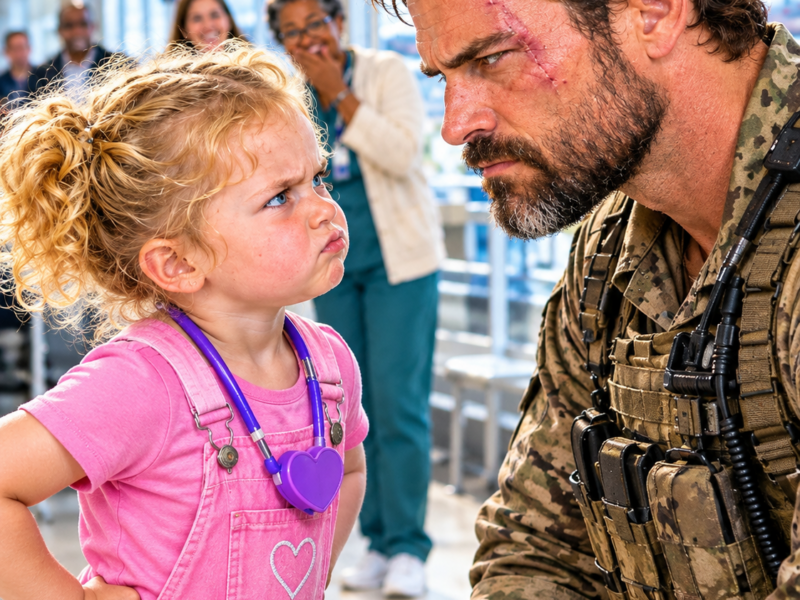
Three nurses had asked to be removed from his case
Chief Petty Officer Jack Ror had spent most of his adult life learning how to endure pain without showing it.
He had endured long nights in unfamiliar places, injuries he couldn’t afford to acknowledge, and missions where a single mistake could put the lives of everyone around him at risk. He knew how to follow orders, how to stay focused, and how to keep moving when every part of his body wanted him to stop.
But none of that had prepared him for waking up in a hospital room and seeing his own face.
The accident had happened during a training exercise. A fall, a hard impact, a series of moments that blurred together before he was lifted into an ambulance. By the time he reached the hospital, he had several broken ribs on his left side, a badly damaged shoulder that required surgery, and a deep facial injury that left a prominent scar running across one side of his face.
The doctors told him the surgery had gone well.
They told him his injuries were treatable.
They told him he was lucky.
Jack didn’t feel lucky.
He felt trapped inside a body he no longer recognized.
The first time a nurse brought him a mirror, he turned his head toward the wall.
The second time, he told her to take it away.
He declined visitors. He ignored his phone. He refused video calls and gave one-word answers whenever someone tried to make conversation.
The respiratory exercises were another problem.
His broken ribs made every deep breath hurt. The plastic incentive spirometer sitting on his bedside table seemed to mock him. He knew exactly why the doctors wanted him to use it. He also knew that each breath would hurt.
So he didn’t use it.
Three nurses asked to be removed from his case.
They described him as difficult, withdrawn, and uncooperative. One said he barely spoke. Another said he refused nearly every suggestion. A third admitted she didn’t know how to help someone who seemed determined to reject every form of help offered to him.
The charge nurse eventually assigned the case to Nora Bell.
Nora was twenty-seven, had been a nurse long enough to recognize the difference between a difficult patient and a frightened one, and was raising a three-year-old daughter named Poppy on her own.
She was also exhausted.
Her daycare had called that morning to announce an unexpected closure. Nora had already used most of her backup childcare options, and her shift couldn’t be covered. After speaking with her supervisor and following the hospital’s arrangements, she had no choice but to bring Poppy with her for part of the day.
She hoped the little girl would stay quietly in the designated staff area with her coloring books and snacks.
Poppy had other plans.
At first, Nora didn’t notice the small footsteps moving down the hallway. She was checking a patient’s medication when she realized the familiar sound of Poppy humming had disappeared.
She looked toward the staff area.
The little chair was empty.
“Poppy?”
No answer.
Nora’s stomach tightened.
She stepped into the hallway and looked both ways. Then she heard a small voice coming from one of the patient rooms.
“You’re not supposed to look so grumpy.”
Nora froze.
The voice came from room twelve.
Jack Ror’s room.
She hurried toward the doorway, already preparing an apology.
Then she stopped.
Poppy was standing beside Jack’s bed, her hands planted firmly on her hips.
Jack was staring at her.
Poppy was staring right back.
Neither appeared willing to surrender.
“What are you doing?” Nora asked.
Poppy didn’t turn around.
“I’m playing.”
“Playing what?”
“Staring.”
Jack’s expression remained fixed.
Poppy narrowed her eyes.
Jack narrowed his.
Poppy puffed out her cheeks.
Jack raised one eyebrow.
For several seconds, the two of them continued their silent contest. Then Poppy made an exaggerated face, scrunching her nose and pushing her lips together until her entire face looked like a bulldog preparing to bark.
Jack tried to keep his expression neutral.
He failed.
A short laugh escaped him.
The laugh immediately pulled at his injured ribs. His face tightened, and he reached for the pillow beside him.
Nora rushed forward.
“Careful. Don’t move too quickly.”
But Jack was still smiling.
It wasn’t a big smile. It was small and surprised, as if he hadn’t expected his face to remember how to do it.
Poppy looked pleased with herself.
“I won.”
Jack breathed carefully through the discomfort.
“Did you?”
“Yep.”
She pulled a small sticker sheet from her pocket and examined it.
“You need a doctor.”
Nora stepped in.
“Poppy, sweetheart, you can’t just walk into patients’ rooms.”
Poppy looked up at her mother.
“But he needs fixing.”
Jack looked from the child to Nora.
For the first time since his admission, he seemed genuinely interested in what someone else had to say.
Nora apologized and explained that Poppy was supposed to stay with her. She promised it wouldn’t happen again.
Jack shook his head slightly.
“She’s fine.”
It was the first complete sentence Nora had heard from him.
Poppy climbed onto the visitor’s chair, pulled a folded paper towel from the bedside table, and announced that she was going to make him a contract.
“Doctors need rules,” she explained.
Jack watched her with the solemn attention of someone being briefed before an important mission.
Poppy began writing.
Her letters were uneven, and several words were more like drawings than actual writing. Nora tried to read them without laughing.
The rules were simple.
No frowning before lunch.
Take your medicine.
Blow into the breathing thing ten times.
If you do all three, you get a sticker.
Poppy pushed the paper toward Jack.
“Sign.”
Jack studied the contract.
“That’s a lot of rules.”
“Doctors make rules.”
“You’re the doctor?”
Poppy nodded.
“The best one.”
Jack picked up the pen.
His shoulder hurt, so he moved slowly. Eventually, he managed to write his name at the bottom.
Poppy beamed.
“Good. Now breathe.”
She pointed at the incentive spirometer.
Nora expected Jack to refuse.
Instead, he reached for the device.
He placed the mouthpiece between his lips and tried to inhale. The first attempt was shallow. His ribs protested, and he stopped.
Poppy watched him closely.
“Again.”
Jack glanced at Nora.
She gave him a small, encouraging nod.
He tried again.
This time, he managed a deeper breath.
The marker inside the device rose.
Poppy clapped.
“See? You’re getting better!”
Jack set the device down carefully.
“Only one?”
“Ten,” Poppy reminded him.
Nora helped him through the remaining attempts, allowing him to rest between breaths. It wasn’t easy. Each inhale made his face tighten, and his injured shoulder limited how comfortably he could sit.
But he completed the exercises.
Poppy awarded him a yellow sticker.
She placed it on the bedside table with the seriousness of a surgeon completing a procedure.
“Tomorrow, you get another one.”
Jack looked at the sticker.
“Looking forward to it.”
Nora noticed something that afternoon.
Jack was still in pain. He was still withdrawn. He still didn’t want visitors or mirrors.
But he was breathing more deeply.
And he had spoken more in fifteen minutes with Poppy than he had during several hours of nursing care.
Nora didn’t mistake that small improvement for a miracle. She knew recovery would take time.
She also knew she had to pay attention to something more important.
Jack’s breathing.
During her assessment, she heard crackling sounds at the base of his left lung. His temperature was beginning to rise, and his performance on the incentive spirometer had declined compared with the morning.
She documented her findings and brought them to Dr. Alan Price, the surgeon overseeing Jack’s care.
Price was busy reviewing surgical notes when Nora approached.
“Dr. Price, I’m concerned about Mr. Ror.”
He didn’t look up immediately.
“What about him?”
“His left lung sounds worse. There’s increasing crackling at the base. His temperature is climbing, and his incentive spirometry has dropped considerably.”
Price glanced at the chart.
“He’s had chest trauma and surgery. He’s going to have some discomfort.”
“I understand. But his respiratory effort has declined by roughly forty percent. I’d like a chest X-ray.”
Price finally looked at her.
“Did you get him to cooperate?”
“Yes. But that’s not the issue. His lung sounds have changed.”
Price closed the chart.
“He’s recovering from a serious injury. We don’t need to order imaging every time a patient has a bad afternoon.”
Nora held his gaze.
“I’m not asking because he had a bad afternoon. I’m asking because his assessment is changing.”
Price’s expression hardened.
“And I am telling you to monitor him and wait until morning.”
Nora felt frustration rise in her chest.
She knew what it meant to challenge a physician’s decision. She also knew what it meant to ignore a warning sign.
She returned to the room and continued monitoring Jack.
Throughout the afternoon, she checked his temperature, respiratory rate, oxygen saturation, and lung sounds. She encouraged him to use the spirometer, but his breaths remained shallow.
Poppy was still in the hospital, coloring at the nurses’ station under supervision.
Every so often, she asked whether Jack had earned another sticker.
Nora told her he was working on it.
At 5:40 p.m., Nora entered room twelve for another assessment.
The change was immediate.
Jack’s face looked gray. His skin was damp, and his breathing was faster than before. He seemed to be working harder just to draw air into his lungs.
Nora checked the monitor.
His temperature was 101.8 degrees.
His heart rate was 112.
His respiratory rate was 26.
His oxygen saturation had dropped to 89 percent.
She listened to his chest.
The crackling sounds on the left were now unmistakable.
“Jack, I need you to stay still for me.”
He tried to answer, but the effort left him short of breath.
Nora pressed the call button and activated the rapid response team.
Within minutes, the room filled with clinicians. Oxygen was applied, additional assessments were performed, and the team ordered urgent imaging.
Nora stayed near the bedside, explaining what was happening to Jack as calmly as she could.
The X-ray confirmed what she had feared.
There was an opacity at the base of the left lung.
It was in exactly the area where she had documented abnormal sounds earlier that morning.
The diagnosis was consistent with pneumonia developing in a patient whose breathing had been limited by pain and reduced lung expansion.
Treatment began.
Jack received antibiotics and oxygen. His pain management plan was reassessed, and the team arranged a nerve block to help him breathe more deeply without the same degree of pain.
As the immediate crisis settled, Dr. Price returned to the room.
He looked at the X-ray, then at Nora’s documentation.
He was quiet for a moment.
“You were right to be concerned,” he said.
Nora didn’t answer immediately.
Price continued.
“I should have listened when you brought this to me.”
It wasn’t a dramatic apology, but it was direct.
He also made sure the team understood that Nora had identified the change early and had pushed for further evaluation.
Jack heard the conversation from his bed.
When Price left, he looked at Nora.
“You caught it.”
Nora adjusted his oxygen tubing.
“That’s my job.”
“You caught it before I knew anything was wrong.”
“That’s also my job.”
Jack looked down at his hands.
For a while, neither spoke.
Then he said something Nora hadn’t expected.
“I don’t want my daughter to see me.”
Nora stopped.
Jack kept his eyes on the blanket.
“Her name is Emma. She’s six.”
He swallowed carefully.
“She saw me on a video call after the accident. Before I got here. I thought I could just talk to her like normal.”
His voice became quieter.
“But she saw my face.”
Nora waited.
“She screamed. Then she hid behind a chair. She said the person on the screen wasn’t her dad.”
Jack turned his head toward the wall.
“I can’t blame her. I look different.”
Nora sat in the chair beside the bed.
“That must have hurt.”
Jack let out a short breath.
“More than the ribs.”
He told her that he had stopped answering his phone after that call. He didn’t want Emma to see him again. He didn’t want her to become frightened every time she looked at him.
He had spent his life learning to handle other people’s fear.
He hadn’t known what to do with his daughter’s.
“I don’t want her to remember me like this,” he said.
Nora thought about the way Poppy had entered the room that morning.
She thought about the staring contest, the paper-towel contract, and the yellow sticker.
“Can I tell you something?” she asked.
Jack nodded.
“Most adults walk into your room and see how angry you look. They see the scar, the injuries, and the fact that you don’t want to talk.”
Jack looked at her.
“But my daughter walked in, looked at your face, and decided you needed fixing.”
A faint smile appeared at the corner of his mouth.
“She’s three.”
“Exactly. She doesn’t know anything about what happened to you. She doesn’t know what a Navy SEAL is. She doesn’t know what your scar means.”
Nora paused.
“She just sees a person who looks sad and needs a friend.”
Jack stared at the ceiling.
“Emma isn’t three anymore.”
“No. She’s six. But she’s still your little girl.”
Nora leaned forward slightly.
“She may have been frightened by what she saw. That doesn’t mean she stopped loving you. It means she saw something she didn’t understand.”
Jack didn’t answer.
Nora continued.
“You don’t have to pretend the scar isn’t there. And you don’t have to pretend you’re not scared. But if you keep hiding from her, she’ll only have that one video call to remember.”
Jack closed his eyes.
For several seconds, he didn’t move.
Then he reached toward the bedside table.
His phone was still lying there, screen down.
“Can you help me call her tomorrow?”
Nora smiled.
“Of course.”
That night, Jack used the spirometer again.
Not because someone had threatened to withhold a sticker.
Not because a doctor had ordered it.
Because he wanted to be strong enough to talk to his daughter.
The following morning was Saturday.
Nora brought Poppy to the hospital again after making the necessary arrangements with the unit.
Poppy marched into room twelve with a fresh sheet of stickers and a serious expression.
“Doctor’s here.”
Jack was sitting more upright than he had been the day before. The oxygen was still in place, and his breathing remained uncomfortable, but his color had improved.
Poppy inspected him.
“Did you do your breathing?”
“Yes.”
“How many?”
“Ten.”
“All ten?”
“All ten.”
Poppy considered this.
“Good.”
She placed another yellow sticker near the first one.
Then she looked at the phone.
“Are you going to call your girl?”
Jack glanced at Nora.
Nora gave him an encouraging smile.
“Whenever you’re ready.”
Jack picked up the phone.
His thumb hovered over the screen for several seconds.
He looked at his reflection in the dark glass.
The scar was still there.
The stitches were still visible.
His face was still unfamiliar.
He nearly put the phone down.
Then he remembered the way Emma had hidden behind the chair.
He remembered the fear in her voice.
And he remembered what Nora had said.
If he kept hiding, that frightened moment would be all his daughter had.
He opened the contact.
Emma.
He pressed the video-call button.
The phone rang.
Once.
Twice.
Three times.
Then the screen lit up.
A little girl’s face appeared.
“Hi, Daddy.”
Jack’s breath caught.
“Hey, sweetheart.”
Emma smiled at first.
Then her eyes moved across his face.
The smile disappeared.
She stared at the scar.
Jack felt his stomach tighten.
For a moment, he wanted to turn away.
Instead, he stayed where he was.
“Emma, I know I look different.”
She didn’t speak.
“This is my new face,” he said gently. “But I’m still your dad.”
Emma looked at the screen.
Jack continued.
“I’m sorry I scared you. I didn’t mean to. I was scared too, and I didn’t know what to say.”
He swallowed.
“I should have called you sooner.”
Emma’s small face remained serious.
Then a voice came from somewhere off-screen.
“Emma? Is that Daddy?”
It was Clare, her mother.
“Yes,” Emma answered.
Clare appeared beside her, looking at the phone with a mixture of relief and emotion.
Jack tried to smile.
“Hey, Clare.”
She nodded, her eyes already wet.
“Hi, Jack.”
There was a pause.
Then Poppy stepped closer to the phone.
“Hi!”
Emma looked at her.
“Who are you?”
“I’m Poppy. I’m a doctor.”
Jack’s mouth twitched.
Poppy pointed at his face.
“Your dad has a boo-boo.”
Emma looked back at Jack.
“Does it hurt?”
“Sometimes,” he answered honestly.
Poppy shook her head.
“But he’s brave.”
Jack glanced at her.
Poppy studied his scar.
“It looks like a sticker.”
Emma frowned.
“Why?”
“Because he got hurt being brave.”
Jack didn’t know what to say.
For the first time in days, the silence in his room didn’t feel like a punishment.
It felt like a space where something important could happen.
Emma looked carefully at the scar again.
“Does it hurt when you smile?”
Jack tried a small smile.
“A little.”
Poppy immediately made her bulldog face.
Jack recognized it.
The nose scrunched.
The lips tightened.
The eyebrows lowered.
He tried to copy her.
His face pulled awkwardly around the healing injury, and he had to stop because his ribs hurt.
Poppy looked at him.
“You’re doing it wrong.”
Jack let out a breath that was almost a laugh.
“Am I?”
“Yep.”
She made the face again, even more dramatically.
Emma watched.
Then, slowly, she copied Poppy.
Her cheeks puffed out, and her nose wrinkled.
Jack looked at the screen.
“That’s pretty good.”
Emma tried again.
This time, she made the face so exaggerated that Poppy burst into laughter.
Jack laughed too, then winced and reached for the pillow beside him.
Nora moved closer to make sure he didn’t strain himself.
But Jack was smiling.
And Emma was smiling back.
Clare covered her mouth with one hand. Tears ran down her cheeks, but she was laughing too.
For the first time since the accident, Jack didn’t feel like he had to hide his face.
He looked directly at his daughter.
“Can you come see me tomorrow?”
Emma nodded.
“Can I bring my drawing?”
“I’d love that.”
“And can I see your stickers?”
Jack glanced at Poppy.
“I think I have a few.”
Poppy nodded proudly.
“He earned them.”
Emma looked back at the screen.
“Okay, Daddy. I’ll come tomorrow.”
Jack held the phone a little closer.
“I love you, sweetheart.”
“I love you too.”
When the call ended, Jack continued looking at the blank screen.
His eyes were wet.
Nora pretended to be busy adjusting the bedside table, giving him a moment.
Poppy, however, had no intention of letting the room become too serious.
“Now you need another sticker.”
Jack laughed softly.
“I just got off the phone with my daughter.”
“That’s not on the contract.”
“You’re right.”
Poppy pulled out the paper towel contract.
She examined the three rules.
Then she added a fourth.
Call Emma.
Her letters were uneven, and the words were squeezed into the remaining space.
Jack watched her write.
When she finished, she handed the paper to him.
“Now it’s official.”
Jack held it carefully.
“Very official.”
Later that morning, Dr. Price passed by the room.
He stopped when he saw Poppy standing beside Jack’s bed with her sticker sheet.
She looked up at him.
“Why are you making that face?”
Price blinked.
“What face?”
“That grumpy face.”
Jack looked toward Nora.
Nora pressed her lips together, trying not to laugh.
Price glanced at the paper-towel contract.
Then he looked at Poppy.
“Do I have to follow the rules too?”
Poppy nodded.
“No frowning before lunch.”
For a moment, Price looked as if he was going to explain that he was a physician and had a schedule to keep.
Instead, he smiled.
It wasn’t a big smile.
But Poppy noticed.
“Better,” she said.
Over the next few days, Jack’s recovery continued.
The antibiotics began to work. His fever settled, and his oxygen requirements gradually decreased. The nerve block helped him take deeper breaths, and the respiratory exercises became more manageable.
He still had difficult moments.
Some mornings, the scar looked worse to him than it had the day before. Sometimes the pain made him impatient. There were nights when he couldn’t sleep and found himself staring at the ceiling, wondering whether his face would ever feel familiar again.
But he stopped turning his phone over.
He began answering messages.
He talked to Emma regularly.
Sometimes they discussed ordinary things: what she had eaten, what she had drawn, what she had done at home. Other times, she asked about his injuries.
He didn’t lie to her.
He explained that his face was healing and that some parts might look different for a while.
Emma accepted this in the way children sometimes do: with a few questions, a little uncertainty, and then a sudden interest in something else.
When she visited the next day, she brought a drawing.
It showed three people standing in front of a yellow house. One was tall, one was smaller, and one was tiny.
The tall figure had a dark line across its face.
Jack studied it.
“Who’s this?”
“That’s you.”
He looked at the line.
“What’s that?”
“Your scar.”
Jack nodded slowly.
“And who’s this?”
“Me.”
“And the little one?”
Emma pointed toward the third figure.
“That’s Poppy.”
Jack looked toward Nora.
“She made it into the family.”
Nora smiled.
“She has a way of doing that.”
Emma climbed onto the visitor’s chair and handed Jack another drawing.
This one showed a yellow sticker.
“It’s for your face,” she explained.
Jack looked at the drawing for a long moment.
“Thank you, sweetheart.”
She leaned toward him.
“Can I touch it?”
Jack hesitated, then nodded.
Emma reached out carefully and touched the edge of the healing scar with one finger.
She didn’t pull away.
She didn’t hide.
She simply looked at him.
“You’re still Daddy,” she said.
Jack’s eyes filled.
“Yeah,” he whispered. “I’m still Daddy.”
The visit was short because Jack still needed rest, but something had changed.
The scar was no longer a wall between them.
It was simply part of the face of the man she loved.
Over the following days, Jack continued making progress.
He walked farther each morning, used the breathing device without being reminded, and gradually returned to more normal activity.
The medical team monitored his recovery closely. Nora continued to check his breathing and encourage him to move at a pace that was safe for his injuries.
The paper-towel contract stayed on the bedside table.
Someone from the unit eventually suggested having it laminated.
Jack agreed.
The original sheet was a little wrinkled, with a small yellow sticker stuck to one corner. The handwriting was uneven, but the rules were easy to read.
No frowning before lunch.
Take your medicine.
Blow into the breathing thing ten times.
Call Emma.
Nora found herself smiling every time she passed the room.
It had started as a joke between a little girl and a patient who didn’t want to speak.
Now it had become a reminder of how much had changed.
Jack had arrived at the hospital convinced that the best thing he could do was keep people from seeing him.
He had refused mirrors, visitors, and phone calls.
He had treated his own face like something shameful.
But Poppy hadn’t cared about the scar.
Nora hadn’t cared about his silence.
And Emma, after the first frightening moment, had found her way back to him.
Jack began to understand that healing wasn’t only about repairing the injuries visible on an X-ray.
Sometimes it meant allowing the people who loved you to see you before you felt ready.
Eleven days after his admission, Jack was cleared for discharge.
His shoulder still needed rehabilitation. His ribs would take more time to heal. He would have follow-up appointments and restrictions on what he could do.
But he could breathe more comfortably, walk independently, and continue recovering at home.
On the morning he left, Nora came into his room with the discharge paperwork.
Jack was sitting on the edge of the bed, dressed and ready.
The laminated contract was in his bag.
The yellow sticker Poppy had given him was still attached to the shoulder of his shirt.
Nora checked the paperwork one final time.
“All set?”
Jack nodded.
“Looks like it.”
“Remember the breathing exercises.”
“I know.”
“Medication schedule.”
“I have it.”
“Follow-up appointments.”
“Already written down.”
Nora gave him a look.
“You’re making this very easy.”
Jack smiled.
“I’m trying to be a good patient.”
Poppy wasn’t there that morning, but Jack had asked Nora to give her something.
He handed her a small envelope.
Inside was a drawing of a yellow sticker with the words BEST DOCTOR written underneath.
Nora smiled.
“She’ll love this.”
Jack stood slowly.
Nora watched him carefully as he took his first steps toward the doorway.
He moved cautiously, but he was steady.
When they reached the nurses’ station, several members of the unit looked up.
Jack stopped.
He turned toward Nora.
“Thank you.”
Nora shook her head.
“You did the work.”
“Maybe.”
He glanced at the yellow sticker on his shoulder.
“But you helped me remember what I was working for.”
Nora’s expression softened.
Jack looked down the hallway.
“And tell Poppy she still hasn’t beaten me.”
Nora laughed.
“She’ll disagree.”
“She usually does.”
He took another step, then paused.
“One more thing.”
“What’s that?”
Jack looked back at her.
“Thank you for not letting me give up on breathing.”
Nora understood what he meant.
It hadn’t only been the physical act of taking deeper breaths.
It had been the first step toward answering his phone, looking at his daughter, and allowing himself to be seen.
She nodded.
“Take care of yourself, Jack.”
He continued down the hallway.
The sticker remained on his shoulder.
The scar remained on his face.
Neither had disappeared.
But he wasn’t trying to hide either one anymore.
And somewhere in the middle of that hospital, a laminated paper-towel contract sat in a nurse’s station, preserving the rules written by a three-year-old who had decided that a wounded stranger needed a little help.
No frowning before lunch.
Take your medicine.
Breathe ten times.
Call Emma.
For Jack Ror, those four simple rules had become more than a child’s game.
They had become a way back to the life waiting for him outside the hospital doors.
The end.









