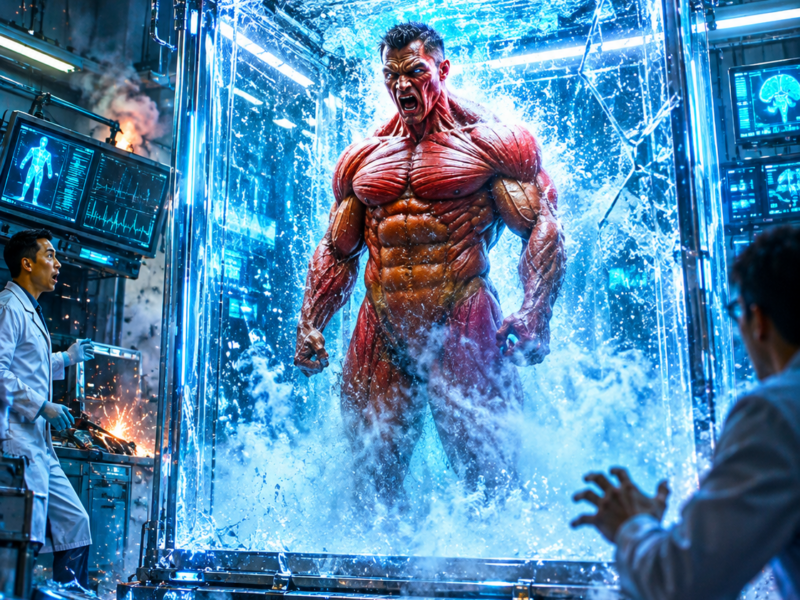
“Three minutes after I opened my eyes inside the cryo chamber, six armed scientists were pointing rifles at me
Dr. Voss didn’t answer my question.
She simply stared at the red symbol on the photograph, then at the identical marking engraved inside my cryogenic chamber.
“Everyone out,” she ordered.
The officer didn’t move.
“Doctor, we have a security breach.”
“I said everyone out.”
“You’re asking me to leave an unidentified enhanced human alone in a room with you?”
Dr. Voss looked at him.
“Captain Reeves, if I wanted him dead, I wouldn’t have spent six months trying to bring him back.”
That made me look up.
“Six months?”
She ignored me.
Captain Reeves finally lowered his rifle, but he left two guards outside the examination room.
When the door sealed, Dr. Voss pulled a chair toward me.
“Daniel, I need you to listen carefully. Some of what I’m about to tell you will sound impossible.”
“That’s been the theme of my morning.”
She almost smiled.
Then she opened a secure file on her tablet.
The photograph appeared again.
This time, she enlarged the red symbol.
It was a circle divided by three vertical lines, with a small black mark in the center.
“Do you recognize this?”
“No.”
“Have you ever experienced unusual dreams? Violent nightmares? Memories that don’t belong to you?”
I shook my head.
“I was a regular guy. I worked in construction. I had a daughter. I wasn’t a soldier, a scientist, or whatever you think that picture shows.”
Dr. Voss studied me.
“Your medical records say otherwise.”
“My medical records say I died in a hospital.”
“Your original records do.”
She swiped to another document.
It contained a scan of a hospital report dated October 14, 2026.
My name appeared at the top.
Daniel James Mercer.
Age: thirty-seven.
Cause of death: cardiac arrest following traumatic neurological deterioration.
I leaned forward.
“That’s my hospital.”
“Yes.”
“That’s the night I remember.”
She nodded.
Then she opened another file.
It was dated 2041.
The same name appeared, but the age was different.
Daniel Mercer.
Age: fifty-two.
Classification: Human Biological Preservation Project.
I stared at it.
“How can there be another record of me?”
“Because someone continued working on your case after your death.”
“Who?”
She hesitated.
“That’s what we’re trying to determine.”
I rubbed my temples.
The room seemed too cold.
“Why am I so strong?”
Dr. Voss put the tablet down.
“Your body underwent modifications before entering cryogenic suspension. We found microscopic structures throughout your muscles, bones, and nervous system.”
“Modifications?”
“Artificial cellular reinforcements. They’re unlike anything currently manufactured.”
She pulled up a three-dimensional scan of my skeleton.
My bones were covered in faint silver patterns.
“Your muscle fibers have a similar structure. They’re capable of generating force far beyond normal human limits without tearing.”
“Who did this to me?”
“Someone with technology we don’t fully understand.”
I looked at the image.
“Was I part of some experiment?”
“Possibly.”
“Did I agree to it?”
Dr. Voss looked away.
That was answer enough.
Before I could ask anything else, the door opened.
Captain Reeves entered with a woman wearing a dark blue uniform.
She was older than Dr. Voss, perhaps in her late fifties, with gray hair pulled tightly behind her head.
“Commander Sato,” Dr. Voss said.
The woman studied me.
“So this is the man.”
I didn’t appreciate the way she said it.
“My name is Daniel.”
She nodded without apology.
“I’m Commander Sato, director of security aboard Horizon.”
“Good. Maybe you can tell me why your people are pointing guns at me.”
“Because the last time someone with your physical capabilities woke up on this vessel, eleven people died.”
Dr. Voss stood abruptly.
“Commander, we agreed not to discuss the incident until—”
“He’s awake now. He deserves to know.”
I looked between them.
“What incident?”
Sato pulled up another file.
A video began playing.
The footage showed a laboratory corridor.
Several scientists were running toward an emergency exit.
Behind them, a tall figure moved through the smoke.
At first, I thought it was a machine.
Then it turned its head.
It had a human face.
A man’s face.
The camera shook violently.
The figure reached a sealed security door and pushed one hand against it.
The entire metal panel bent inward.
I leaned closer.
The man’s movements were slow, almost confused.
Then a security officer raised his weapon.
A bright flash filled the corridor.
The footage ended.
“Who was that?” I asked.
Commander Sato looked directly at me.
“An earlier subject.”
“Earlier subject?”
“You’re not the first person we’ve recovered from cryogenic storage.”
I looked at Dr. Voss.
She seemed uncomfortable.
“How many?”
“Three,” she said.
“And the others?”
“One died during recovery. One was transferred to a secure facility.”
“And the man in that video?”
Sato answered.
“His name was Elias Ward. He escaped containment and killed eleven members of the recovery team.”
I looked at the frozen frame on the screen.
“Why?”
“Because he believed we were trying to control him.”
“Were you?”
Neither woman answered.
I pushed myself away from the examination table.
“Maybe he had a reason.”
Commander Sato’s expression hardened.
“That’s enough.”
“No. I woke up in a metal box two centuries after my daughter died. I’ve been told I’m some kind of military experiment, and now you’re showing me footage of a man who looks like he could tear through a battleship. I think I’ve earned a few honest answers.”
For the first time, Dr. Voss seemed to agree with me.
She took a breath.
“There’s a reason the project was classified.”
She opened another file.
Its title was HUMANITY’S LAST DEFENSE.
I read the words twice.
“Last defense against what?”
Dr. Voss turned the screen toward me.
A map of the solar system appeared.
Beyond the orbit of Neptune, several red markers were moving toward Earth.
“They call themselves the Architects,” she said.
“Who?”
“An extraterrestrial civilization. We first detected their signals in 2038. By 2050, we had confirmed that they were approaching our solar system.”
I stared at her.
“Aliens?”
“Yes.”
“And you brought me back because of them?”
She nodded.
“The original preservation project was created to develop human soldiers capable of surviving the coming invasion.”
I sat down slowly.
“How did I become involved?”
Dr. Voss opened the oldest document.
It contained a photograph of a hospital room.
My hospital room.
The date was October 14, 2026.
My daughter, Sophie, was sitting beside my bed.
She looked about eight years old.
I recognized the pink sweater she was wearing.
I remembered that day.
She had brought me a drawing of our house.
I had promised to take her camping when I recovered.
I had never gotten the chance.
But there was something else in the photograph.
Behind the glass partition stood a man wearing a white laboratory coat.
I didn’t recognize him.
He was holding a small black device.
Dr. Voss enlarged his face.
“His name was Dr. Nathaniel Cross. He was the original director of the biological preservation program.”
I swallowed.
“What was he doing in my hospital?”
“According to the recovered records, your heart had stopped for eleven minutes. The hospital declared you dead. But Cross detected unusual activity in your cells.”
“What kind of activity?”
“Your body was producing an energy signature that shouldn’t have existed.”
I looked at my hands.
“Why?”
“That’s still unclear.”
She enlarged another photograph.
This one showed a medical scan of my brain.
A small structure appeared near the base of my skull.
It looked like a dark metallic seed.
“Cross believed your body had developed a natural compatibility with alien biological technology.”
I stared at the image.
“You’re telling me something from another planet was inside my head?”
“Not exactly. He believed it was dormant in your DNA.”
Commander Sato folded her arms.
“And that makes you either our greatest military asset or our most dangerous unknown.”
I looked at both women.
“Can I see my daughter?”
The question seemed to catch them off guard.
Dr. Voss lowered her eyes.
“We’ve recovered some historical records.”
“That’s not what I asked.”
“I know.”
“Can I see her?”
She nodded.
“I’ll arrange it.”
For the first time since waking up, I felt something other than confusion.
It wasn’t hope.
Hope was too fragile for that.
It was the desperate need to know whether the little girl who had held my hand had lived a good life.
Two hours later, I was sitting in a small observation room.
Dr. Voss had found a digital archive of my family records.
The first file contained Sophie’s birth certificate.
The second contained her school records.
The third contained an old photograph.
She was standing beside a man I didn’t recognize.
He had one arm around her shoulders.
She looked happy.
Older, maybe twenty-five.
I touched the screen.
“Who is he?”
“Her husband, according to the archive.”
I nodded.
“Did she have children?”
Dr. Voss opened another file.
“Two.”
A photograph appeared.
A little boy with dark hair stood beside a girl wearing a yellow dress.
I stared at them for a long time.
“Grandchildren,” I whispered.
Dr. Voss didn’t interrupt.
I wondered whether Sophie had told them about me.
Whether they knew their grandfather had been a man who couldn’t keep his promises.
Whether she had eventually stopped waiting for me.
I opened the next record.
It was a newspaper article dated 2094.
The headline read: LOCAL TEACHER CELEBRATES FIFTIETH WEDDING ANNIVERSARY.
Beneath it was a photograph of an elderly woman holding flowers.
It took me several seconds to recognize her.
Sophie.
Her hair was white.
Her face had wrinkles around her eyes.
But she was smiling.
I placed my hand against the screen.
“She made it.”
Dr. Voss nodded.
“She lived to be eighty-five.”
I closed my eyes.
For a moment, I could hear her voice again.
Dad, you promised you’d come home.
I hadn’t.
But she had grown up.
She had built a family.
She had found someone who stayed.
That mattered.
I didn’t know how long I sat there.
Eventually, Dr. Voss spoke.
“There’s another file you should see.”
I opened my eyes.
She placed a small encrypted folder on the table.
It was labeled PROJECT MERCER.
The access date was 2041.
“Where did you find this?”
“In the original archive. It was buried beneath several layers of encryption.”
I opened it.
The first document contained a list of medical procedures.
The second contained neurological observations.
The third was a handwritten note.
I recognized the name at the bottom.
Nathaniel Cross.
The note read:
Subject’s physical capabilities remain within predicted parameters. However, emotional attachment to surviving family members may interfere with activation. Do not allow the subject to establish contact with relatives.
I read it again.
“Activation?”
Dr. Voss leaned closer.
“There’s more.”
She opened an audio recording.
A man’s voice came through the speaker.
“Project Mercer was never intended to produce a soldier. The subject is not a weapon. The modifications are merely a containment mechanism.”
I stopped breathing for a moment.
The recording continued.
“The organism has been dormant in his genetic structure since birth. If the neural trigger is activated, it may attempt to establish a connection with the larger network.”
Dr. Voss looked at me.
“That’s what we found inside your DNA.”
I stared at the screen.
“What organism?”
Before she could answer, the lights flickered.
A warning tone sounded throughout the vessel.
Commander Sato’s voice came over the speakers.
“All personnel, report to emergency stations. We have an unidentified contact approaching the vessel.”
Dr. Voss grabbed her tablet.
“That’s impossible. We’re outside the projected detection range.”
A second alarm followed.
Then the room shook.
I caught the edge of the table.
“What was that?”
Dr. Voss looked at the display.
Her face lost its color.
“The contact just changed course.”
“Toward us?”
She nodded.
“Directly.”
We were escorted to the bridge.
The corridor was crowded with crew members running between stations.
Some carried weapons.
Others were dragging equipment toward emergency compartments.
Nobody looked at me.
I suspected they had been told not to.
When we entered the bridge, a massive display showed a dark object floating beyond the ship.
It was enormous.
At least twice the length of Horizon.
Its surface looked like polished black stone, but strange patterns moved beneath it like veins.
There were no visible engines.
No lights.
No windows.
Just a smooth, curved structure suspended in space.
“Is that one of the Architects?” I asked.
Commander Sato nodded.
“An unmanned reconnaissance craft, according to the historical records.”
“How do you know?”
“Because we’ve seen one before.”
A young officer turned from his console.
“Commander, we’re receiving a signal.”
“Translate it.”
“We’re trying.”
The signal appeared on the main screen.
At first, it looked like a series of random shapes.
Then the patterns rearranged themselves.
A sentence appeared.
NOT THE ONE WE SENT.
Dr. Voss stepped forward.
“That’s not possible.”
I looked at her.
“What does it mean?”
She didn’t answer.
The message changed.
YOU HAVE OPENED THE CONTAINER.
A third message appeared.
RETURN HIM.
The bridge became silent.
Every person in the room looked at me.
I took one step backward.
“Return who?”
Dr. Voss whispered something I couldn’t hear.
Commander Sato approached the main console.
“Cut the signal.”
The young officer shook his head.
“We can’t. It’s overriding the communication system.”
Another message appeared.
HE IS NOT YOURS.
Then the ship’s lights went out.
Emergency lighting activated a second later.
A heavy metallic impact sounded somewhere below us.
The deck vibrated.
“Damage report!” Sato shouted.
A technician checked his screen.
“Something has attached itself to the lower hull.”
“Can you identify it?”
“No, Commander.”
The main display flickered.
The black vessel was gone.
In its place was a small object drifting beside Horizon.
It looked like a capsule.
A familiar red symbol glowed on its surface.
The same symbol from my cryogenic chamber.
Dr. Voss approached the screen.
“That’s the original containment marker.”
Commander Sato turned toward her.
“What does that mean?”
“It means the object was designed to interact with his chamber.”
I looked at the capsule.
“Why would it come here?”
Nobody answered.
Then the capsule opened.
Something moved inside.
A human hand appeared against the glass.
The fingers were long and pale.
I recognized the shape immediately.
It was the hand of the man from the old security footage.
Elias Ward.
Commander Sato ordered the bridge sealed.
“All weapons teams, prepare for boarding.”
Dr. Voss grabbed my arm.
“Daniel, you need to stay away from that thing.”
“Is Elias alive?”
“I don’t know.”
“But he was frozen like me?”
She nodded.
“His chamber was recovered from a different location. We lost contact with the facility transporting him.”
“Why didn’t you tell me?”
“Because we didn’t know he was coming.”
A sharp vibration ran through the deck.
Then the communication system crackled.
A man’s voice came through.
It sounded tired.
Almost human.
“Daniel?”
I looked toward the speaker.
Commander Sato immediately reached for the console.
“Who is this?”
The voice ignored her.
“Daniel Mercer. If you can hear me, don’t let them open the door.”
Dr. Voss looked at me.
“That’s Elias.”
The voice continued.
“They’ll tell you you’re the reason the Architects are coming. They’ll tell you that your body contains something dangerous.”
I stepped toward the console.
“Who are you?”
A pause.
Then he answered.
“I’m the reason you were put to sleep.”
The bridge went silent.
“Why?”
“Because I couldn’t stop them from taking your daughter.”
My mouth went dry.
“What did you say?”
Dr. Voss grabbed my shoulder.
“Daniel, don’t listen to him.”
But Elias kept speaking.
“Your daughter wasn’t just a witness at the hospital. She was part of the original project.”
I shook my head.
“No.”
“I know what they showed you. The family photographs. The historical records. But they never told you why Cross chose you.”
“Why?”
“Because your daughter was born with the same genetic signature.”
I felt the floor shift beneath me.
“You’re lying.”
“I wish I were.”
The bridge screens flickered.
A new image appeared.
It showed a little girl sitting in a hospital room.
Pink sweater.
Dark hair.
A drawing of a house in her lap.
Sophie.
But the date on the image was not 2026.
It was 2041.
She looked exactly as she had the night I died.
I stepped closer.
“That’s impossible.”
Elias’s voice became quieter.
“Daniel, your daughter didn’t grow old. The records they showed you were fabricated.”
I turned toward Dr. Voss.
She was staring at the floor.
“Tell me he’s lying.”
She didn’t answer.
I moved closer.
“Elena.”
Her eyes filled with tears.
“I’m sorry.”
The bridge seemed to disappear around me.
“Where is my daughter?”
Dr. Voss finally looked up.
“She’s on the other side of that capsule.”
I stared at the screen.
A second figure appeared behind the glass.
Small.
Still.
A child’s face pressed against the transparent surface.
I recognized her immediately.
The little girl who had held my hand.
The little girl I had promised to come home to.
She hadn’t aged a single day.
I ran toward the nearest airlock.
Two security officers stepped in front of me.
“Stop!”
I didn’t slow down.
They raised their weapons.
I grabbed the railing and pushed myself forward.
The metal tore loose from the wall.
The officers scattered.
Commander Sato shouted my name.
I barely heard her.
All I could see was the capsule on the external display.
Sophie was inside it.
Dr. Voss caught up with me near the docking corridor.
“Daniel, wait!”
I turned.
“How long have you known?”
She struggled to catch her breath.
“I suspected the family records weren’t genuine. The archive contained too many inconsistencies.”
“How long?”
“Since yesterday.”
I stared at her.
“You knew there was a chance my daughter was alive, and you showed me a photograph of an old woman?”
Her face tightened.
“I didn’t know where she was. I was trying to confirm—”
“You let me believe she had lived a whole life without me.”
“I thought it would be kinder than giving you false hope.”
I looked away.
There was no answer that could make that better.
Commander Sato arrived with four guards.
“Daniel, step away from the docking corridor.”
“Open the airlock.”
“No.”
“My daughter is out there.”
“We don’t know what is inside that capsule.”
“I do.”
Sato’s voice hardened.
“That thing may be an alien construct. It could be using your memories to manipulate you.”
“Then let me look.”
She shook her head.
“Not until we understand the situation.”
A sudden metallic groan echoed through the corridor.
The capsule had connected to the ship.
The docking clamps locked into place.
A message appeared on the wall display.
CONTAINMENT TRANSFER COMPLETE.
Then a second message appeared.
SUBJECTS: MERCER AND MERCER.
Dr. Voss whispered, “Two subjects.”
I looked at her.
“What does that mean?”
She swallowed.
“Both of you.”
The airlock door began opening.
Commander Sato raised her weapon.
“Nobody moves.”
The first figure stepped through.
Elias Ward.
He looked thinner than the man in the security footage.
His face was pale, his hair almost completely white.
But his eyes were clear.
He looked at me.
Then he glanced toward the capsule behind him.
“You’re late,” he said.
I stepped forward.
“Where is my daughter?”
Elias didn’t answer immediately.
He placed one hand against the capsule.
“She’s alive.”
I wanted to believe him.
But I had learned that two hundred years could turn a promise into a grave.
“Open it.”
Elias shook his head.
“Not yet.”
I grabbed his collar.
The guards shouted.
He didn’t resist.
“Open it!”
His expression barely changed.
“If you open that chamber without shutting down the network, you’ll wake something that has been waiting for you.”
I let go.
“What network?”
He glanced at the red symbol.
“The Architects didn’t create the organism inside your DNA. They found it. They were trying to use it to control every living system on Earth.”
I looked at my hands.
“Why me?”
“Because it couldn’t control you.”
“Why not?”
Elias finally met my eyes.
“Because you weren’t its host.”
He paused.
“You were its lock.”
We moved into the docking control room.
Elias explained that the original project had begun after scientists discovered an unusual genetic pattern in a small number of humans.
The pattern appeared harmless.
It didn’t cause disease.
It didn’t affect intelligence or physical development.
But when exposed to certain electromagnetic signals, it could interact with technology that had not been invented on Earth.
Cross had discovered that my cells could absorb and redirect those signals.
The artificial reinforcement in my bones and muscles wasn’t designed to make me stronger.
It was designed to prevent my body from breaking when the organism attempted to activate.
“You’re saying my strength is a side effect?”
Elias nodded.
“Your body is generating force to resist an external system. The more that system tries to control you, the stronger your resistance becomes.”
Dr. Voss studied him.
“Why didn’t you tell us this earlier?”
“Because you were using the same equipment that activated the others.”
Commander Sato stepped forward.
“That’s a serious accusation.”
Elias looked at her.
“Your ship has been broadcasting a signal every seventeen seconds since it recovered Daniel.”
The bridge officer checked the telemetry.
His face changed.
“Commander, he’s right.”
Dr. Voss moved toward the console.
“The cryogenic chambers were designed to suppress that signal.”
“Originally,” Elias replied. “But the network has evolved.”
I looked at the capsule.
“And Sophie?”
Elias lowered his eyes.
“Your daughter inherited the same genetic pattern. Cross discovered it when she was eight.”
I remembered the hospital.
The pink sweater.
The drawing.
The way she had held my hand.
“Did they take her from the hospital?”
“No. Cross brought her into the project after you died. He claimed he could protect her.”
“Was he lying?”
Elias shook his head.
“At first, no. He believed he could use her DNA to understand the organism without activating it in you.”
“Then what happened?”
“The Architects contacted him. They offered technology, medical advances, a way to preserve human consciousness. He thought he could negotiate.”
Elias looked at me.
“He was wrong.”
A recording appeared on the console.
It showed Dr. Cross standing in a laboratory.
Behind him was a chamber similar to mine.
A little girl lay inside.
Sophie.
Cross looked exhausted.
His voice trembled.
“If anyone finds this recording, the containment system has failed. The Architects have established a connection through the child. I attempted to sever it, but the network has already recognized the father.”
I stared at the screen.
Cross continued.
“Daniel Mercer is the only biological lock capable of shutting it down. If he wakes, he must not be allowed to make contact with the child until the connection is severed.”
The recording ended.
I looked at Elias.
“Why did you say you were responsible for putting me to sleep?”
He looked down.
“Because I was the one who approved the procedure.”
“Why?”
“Cross wanted to use you as a weapon. I believed putting you into cryogenic suspension would buy us time to find another way.”
“You left my daughter here.”
His face tightened.
“I tried to get her out. I failed.”
I wanted to hit him.
I wanted to ask him how many nights he had slept while my little girl lay in a laboratory.
But I saw something in his expression.
He had spent two centuries carrying the same failure.
It didn’t excuse him.
It simply made him human.
Commander Sato interrupted us.
“There’s another problem.”
She pointed to the main display.
The black alien vessel had returned.
This time, it was not alone.
Hundreds of smaller objects surrounded it.
Their surfaces pulsed with the same red symbol.
The ship’s communication system activated.
A voice spoke in perfect English.
“THE LOCK HAS AWAKENED.”
A second message followed.
“THE KEY MUST BE RETURNED.”
Dr. Voss stared at the display.
“They’re talking about Sophie.”
Elias shook his head.
“No. They’re talking about both of them.”
The display changed.
A map of Earth appeared.
Red lines spread across the continents.
Power grids.
Communication networks.
Satellite systems.
All of them were being connected.
The Architects weren’t simply approaching Earth anymore.
They were preparing to take control.
Commander Sato ordered the ship’s weapons systems activated.
The bridge filled with alarms.
“Target the largest vessel,” she instructed.
The weapons officer hesitated.
“Commander, their shields are absorbing our scans.”
“Fire anyway.”
A burst of energy crossed the distance between Horizon and the alien craft.
The projectile disappeared before reaching its target.
The enemy ship responded with a pulse of red light.
Every screen on the bridge went black.
Then the ship’s engines shut down.
We drifted silently through space.
Dr. Voss looked at the diagnostics.
“They’ve taken control of the vessel.”
Commander Sato drew her sidearm.
“Can we restore the systems?”
“No.”
“Can we disconnect the network?”
Elias shook his head.
“Not from here.”
He pointed toward the capsule.
“The connection is being routed through the child. If we separate her from the system, the network loses its anchor.”
I looked at him.
“Then do it.”
“It’s not that simple.”
“What does that mean?”
“The organism has already established a connection with her nervous system. Disconnecting her suddenly could kill her.”
I stared at the capsule.
“What do we need?”
Elias looked at me.
“Your hand.”
Dr. Voss understood first.
“No. Absolutely not.”
Elias continued.
“Daniel can absorb the signal. If he connects with Sophie while the network is active, his genetic structure can redirect the connection.”
“Can he survive it?” I asked.
Elias didn’t answer.
Dr. Voss stepped between us.
“We have no proof that this will work. We could lose both of them.”
I looked at the small figure behind the glass.
I had already lost two hundred years with her.
I wasn’t going to lose another minute because someone was afraid of what might happen.
“Open the capsule.”
The docking bay was illuminated by emergency lights.
The capsule stood in the center of the room, surrounded by cables that pulsed like veins.
Sophie lay inside.
Her face was peaceful.
The same dark hair.
The same small hands.
The same pink sweater, carefully folded beside her rather than worn.
I pressed my palm against the glass.
For a moment, I couldn’t speak.
Then I whispered, “Hey, sweetheart.”
Her eyelids moved.
A tiny sound came from the chamber.
The glass began to fog.
Dr. Voss approached the control panel.
“I can open it manually, but once the seal breaks, the connection will begin transferring.”
“How long?”
“Maybe thirty seconds.”
I nodded.
“Do it.”
Elias grabbed my shoulder.
“Daniel, listen. You may experience memories that aren’t yours. Don’t fight every sensation. Find your own memories and hold on to them.”
I looked at him.
“What if I can’t?”
He glanced at Sophie.
“Then remember why you woke up.”
The capsule opened.
Cold vapor rolled across the floor.
Sophie coughed.
I reached inside and lifted her carefully.
She was lighter than I expected.
Her eyes opened slowly.
“Dad?”
The word nearly brought me to my knees.
I held her against my chest.
“I’m here.”
She looked at my face.
For several seconds, she seemed confused.
Then her expression changed.
“You’re old.”
I laughed through tears.
“That’s what two hundred years will do.”
She smiled faintly.
“Did you come home?”
I pressed my forehead against hers.
“I’m trying.”
The lights flashed red.
A violent pulse traveled through the cables.
Sophie gasped.
Her body stiffened.
Dr. Voss shouted, “The transfer has started!”
I felt something move beneath my skin.
Not physically.
It was as if thousands of tiny electrical currents were racing through my nerves.
The walls seemed to disappear.
I could hear voices.
Not human voices.
They were thoughts, overlapping and endless.
I saw cities.
Oceans.
Forests.
Millions of people going about their lives.
Then I saw something else.
A vast structure beneath the surface of the Earth.
It had been there long before humans.
The Architects had not come to conquer our planet.
They had come to reclaim the system buried beneath it.
And the organism inside my DNA was the only thing preventing them from reaching it.
I understood why my body was so strong.
It wasn’t trying to make me a better soldier.
It was trying to keep me alive long enough to protect something.
Sophie screamed.
I held her tighter.
The red light spread across my arms.
Dr. Voss shouted my name.
“Daniel! You need to disconnect!”
I couldn’t.
Something was pulling at my thoughts.
It showed me images of my daughter growing up.
The life I had missed.
Her first day of school.
Her wedding.
Her children.
But the images began changing.
Sophie stood alone in a dark room.
She called my name.
Nobody came.
Then the voice appeared.
THE LOCK IS BROKEN.
I realized what the Architects were doing.
They were using my memories to weaken my resistance.
They were offering me the one thing I wanted most.
A chance to live the years I had missed.
I saw Sophie as an old woman.
I saw myself beside her.
I saw a house with a porch and a garden.
I saw everything I had lost.
All I had to do was surrender.
Then I heard a small voice.
Not from the network.
From my arms.
“Dad, you’re hurting me.”
The vision shattered.
I looked down.
Sophie was crying.
I loosened my grip.
“I’m sorry.”
She placed her hand against my cheek.
“You came back.”
I looked at her.
And suddenly, the network didn’t feel as powerful as it had a moment earlier.
It could imitate memories.
It could reproduce voices.
It could show me a thousand possible futures.
But it couldn’t understand why I would choose a frightened little girl over an entire imagined lifetime.
I placed my hand over hers.
“Always.”
The energy inside my body surged.
A bright flash filled the docking bay.
Every cable snapped at once.
The red symbols disappeared from the walls.
Across Horizon, the lights came back on.
On the main display, the alien vessels began drifting away from Earth.
One by one, their signals vanished.
The largest ship remained for several seconds.
Then a final message appeared.
THE LOCK HAS CHOSEN.
And the vessel disappeared into the darkness.
When I woke up, I was lying in a medical bed.
My body ached.
My hands were bandaged.
A monitor beeped steadily beside me.
Dr. Voss sat in a chair near the window.
She looked exhausted.
“How long?”
“Thirty-six hours.”
I turned my head.
“Sophie?”
“She’s alive.”
I tried to sit up.
Dr. Voss gently pushed me back.
“She’s recovering. Her nervous system is stable.”
I closed my eyes.
“Can I see her?”
“She’s waiting outside.”
A moment later, the door opened.
Sophie walked in slowly.
She was wearing a gray sweatshirt and loose medical pants.
She looked small beneath the bright lights.
When she saw me awake, she smiled.
“Hi, Dad.”
I reached for her hand.
“Hi, sweetheart.”
She sat beside me.
For a while, neither of us spoke.
Then she asked, “Did you really sleep for two hundred years?”
I nodded.
“That’s what they tell me.”
“Did you dream?”
I thought about the images the network had shown me.
About the life I had wanted.
About the memories it had tried to use against me.
“Sometimes.”
“Was I in them?”
I squeezed her hand.
“Every time.”
She looked down.
“I waited for you.”
I couldn’t find an answer.
“I know.”
“I used to think you were coming back after the doctors fixed you.”
Her voice became quieter.
“Then Dr. Cross told me you were gone. I didn’t believe him.”
I felt the words settle in my chest.
“I’m sorry.”
She shook her head.
“I know you didn’t leave on purpose.”
I looked at her.
“Do you remember what I promised you?”
She smiled.
“Camping.”
I nodded.
“Yeah.”
She glanced toward the window.
“Do you think we can still do that?”
I laughed softly.
“I think we can figure something out.”
The days that followed were difficult.
Horizon had suffered significant damage, but the crew managed to restore most of its systems.
The Architects had disappeared beyond Neptune.
Nobody knew whether they would return.
Commander Sato ordered a full investigation into the original preservation project.
Dr. Voss gave the recovered files to an independent scientific council.
For the first time, the truth about the experiments became public.
The names of the subjects were released.
So were the records of the people who had died trying to contain the technology.
Elias Ward testified before the council.
He admitted his role in the project and accepted responsibility for the deaths aboard the earlier recovery vessel.
He didn’t ask for forgiveness.
I respected that more than I expected.
Commander Sato eventually apologized for treating me as a threat before treating me as a person.
I accepted her apology.
But I didn’t agree to become a soldier.
They offered me a position in the planetary defense program.
I refused.
They offered me a laboratory, medical specialists, and unlimited resources.
I refused those too.
I had spent enough of my life being treated like an experiment.
There was one thing I did agree to.
I allowed Dr. Voss to study the connection between my biology and the alien network, provided that every procedure was voluntary and fully documented.
She agreed.
Sophie asked to be included in the medical decisions.
That mattered to me.
For the first time, nobody was making choices about our lives without asking us.
Three months later, we left Horizon aboard a transport vessel bound for Earth.
I had seen photographs of the planet from orbit, but nothing prepared me for the real thing.
The blue atmosphere stretched beneath us.
Clouds moved over the oceans.
The coastlines looked familiar and completely different.
When we landed, I stepped onto the observation deck and stared at the planet through the glass.
I had once believed the world ended in the hospital room where I died.
Now I was standing in a future I had never imagined.
Sophie came to stand beside me.
“Are you scared?”
I thought about it.
“Yeah.”
She smiled.
“Me too.”
I looked at her.
“But I’m glad we’re here.”
She slipped her hand into mine.
Outside, the sun began setting over the Pacific.
For a long time, we watched without speaking.
Our first trip together was not particularly impressive.
There were no mountains or dramatic wilderness views.
Just a small campground near the coast, a borrowed tent, and a portable stove that refused to work.
Sophie sat on a folding chair, laughing while I struggled with the tent poles.
“You can bend steel with your hands, but you can’t put up a tent?”
“Steel doesn’t come with instructions.”
She laughed harder.
It was the first time I had heard that sound without an alarm going off somewhere nearby.
Eventually, we got the tent standing.
We ate sandwiches.
We watched the waves.
We talked about the things she remembered from 2026 and the things I had missed.
She told me about her favorite childhood books.
I told her about the old house where I had grown up.
Sometimes, the conversation became difficult.
She wanted to know what her mother had been like.
I wanted to know what it had been like for her inside the project.
Neither of us had all the answers.
But we stopped pretending that silence would make the pain disappear.
That evening, Sophie pulled a folded piece of paper from her bag.
It was an old drawing.
A small house.
A tree.
Two stick figures standing beside a tent.
I recognized it immediately.
The drawing she had brought to my hospital bed.
She had kept it for more than two centuries.
“I thought you might want this,” she said.
I held the paper carefully.
The edges were worn.
The colors had faded.
But the little house was still there.
“I thought I lost this.”
“I know.”
I looked at her.
“Why did you keep it?”
She shrugged.
“Because you promised.”
I swallowed.
“I didn’t keep my promise.”
She sat beside me.
“You came back.”
For a moment, I couldn’t speak.
Then I placed the drawing on the small table between us.
The wind moved gently through the trees.
Somewhere beyond the campground, waves broke against the shore.
I had spent two hundred and eighteen years believing that the most important thing about me was what my body could do.
How much weight I could lift.
How much damage I could survive.
How many enemies I could defeat.
But none of that mattered when Sophie reached for my hand.
I had been strong enough to survive the future.
Now I had to learn how to live in it.
And this time, when my daughter asked me to come home, I was going to be there.
THE END.









