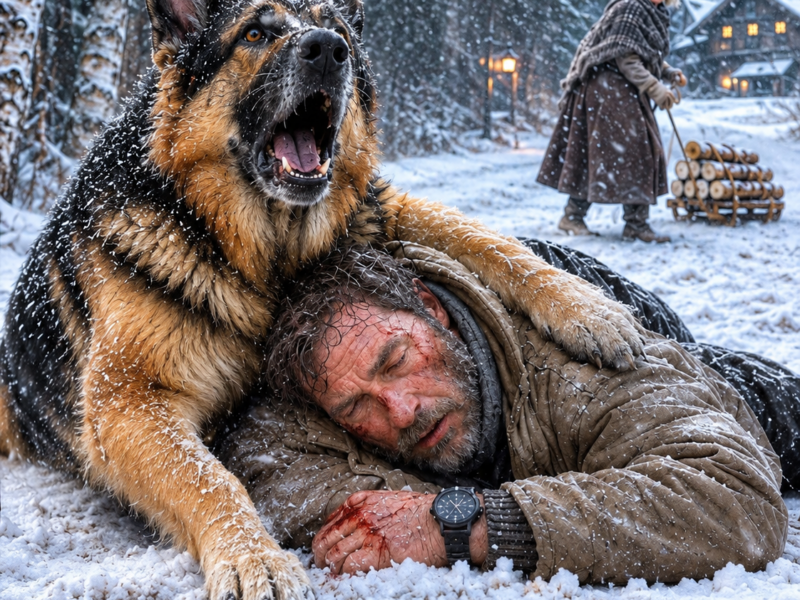
“Three knocks at the door. Three strangers in the snow. And one old German Shepherd who knew something was wrong before any of us did.”
I kept my hand on the doorknob, but I didn’t turn it immediately.
Bishop stood beside me, his silver muzzle lifted toward the frosted glass. His injured paw trembled slightly, yet he refused to step aside.
Behind me, June Carver reached for the radio clipped to her shoulder.
“Wesley,” she called through the door. “Are you alone?”
A pause followed.
Then the familiar voice answered.
“June, please. I need to speak with Hollis.”
I glanced at the deputy.
“You know why he’s here?”
She shook her head.
“No. But I don’t like surprises during an ice storm.”
Neither did I.
I opened the door just far enough to see Wesley Dre standing on the porch.
His county parker was covered in ice. His pale face looked almost gray beneath the porch light. In one hand, he held a lantern. In the other, he carried a thick brown envelope.
Behind him stood an older man in a dark winter coat.
He was tall and lean, with a white beard, a red scarf, and a walking stick.
I recognized him immediately.
Arthur Bell.
But Arthur was already inside.
The man on the porch looked at me.
“Name’s Thomas Vale,” he said. “I used to work county road maintenance.”
Wesley stepped forward.
“Let us in. We don’t have much time.”
I looked at June.
She gave a reluctant nod.
I opened the door.
The two men entered, bringing a gust of icy air with them.
Rosalie looked up from the kitchen.
“Wesley Dre,” she said. “I was beginning to think the county had forgotten where my house was.”
Wesley didn’t answer.
He placed the envelope on the table.
“I need everyone to listen.”
Elaine folded her arms.
“You’ve already told us we shouldn’t be here.”
“I know.”
“And now you’ve come back?”
Wesley looked at the floor.
“Yes.”
There was something different about him.
The nervous smile was gone. So was the confidence he’d worn when he arrived with his yellow folder.
He looked like a man who had spent the entire drive arguing with himself.
Thomas Vale removed his gloves.
“Before anybody starts shouting, I’d like to explain why we’re here.”
Caleb Pike leaned against the kitchen counter.
“Go ahead. We’re all ears.”
Thomas looked toward me.
“Your crash wasn’t the first serious incident at Silver Rail Bend.”
“I know about the hazard reports.”
“Then you know the county ignored them.”
Wesley closed his eyes.
Thomas continued.
“Thirty-five years ago, a maintenance truck went off that same curve. The driver survived, but the truck rolled down the embankment. The brakes failed.”
I felt something tighten in my chest.
“Who was driving?”
Thomas looked at the envelope.
“Your father.”
For a moment, the room seemed to lose its warmth.
I stared at him.
“Elias Mercer?”
He nodded.
I had spent most of my life believing my father disappeared because he couldn’t stand being responsible for anyone.
Now a stranger was telling me he had nearly died on the same road where I had crashed.
“What happened to him?”
Thomas pulled out a folded document.
“Your father was working for the county that winter. He reported a problem with the brake system on his maintenance truck. He also reported that the guardrail at Silver Rail Bend was damaged.”
“And?”
“The repairs were delayed.”
Wesley lowered his head.
“By the time the truck went off the road, the maintenance request had been sitting on someone’s desk for weeks.”
I looked at him.
“Whose desk?”
He hesitated.
“My father’s.”
Nobody spoke.
Wesley took a breath.
“My father was the county road supervisor back then. He signed off on the maintenance schedule. He knew about the reports.”
The stove popped.
Rosalie slowly set down her spoon.
“Your father knew?” she asked.
Wesley nodded.
“He said the county didn’t have the money. He told the crew to wait until spring.”
Thomas tapped the document.
“Elias survived the crash. He made it to Lantern Ridge House, where Rosalie and her husband took him in.”
I looked toward the attic stairs.
The name on the wooden board suddenly seemed heavier.
Elias Mercer. Winter of 91.
“What happened after that?” I asked.
Thomas looked at Rosalie.
She stepped closer.
“He stayed three nights,” she said quietly. “Your father had a fever. He barely spoke. But he kept asking whether the road had been fixed.”
I swallowed.
“Did it?”
“No.”
Rosalie looked at Wesley.
“Not until another truck went off it.”
Wesley rubbed his forehead.
“My father eventually approved the repair. But he never wanted the first accident discussed again.”
Thomas placed another paper on the table.
“This is a copy of the original report. Your father wrote that the brake failure was caused by a damaged line and that the road hazard had contributed to the crash.”
I read the page.
The handwriting was uneven.
The ink had faded.
But the words were clear.
My father had reported the danger.
He had tried to prevent another accident.
And someone had ignored him.
I looked at Wesley.
“Why bring this here now?”
His answer came slowly.
“Because the same thing happened again.”
He opened the envelope.
Inside were copies of recent maintenance requests, inspection notes, and photographs of the damaged guardrail.
“Three reports came in over the last two months,” he said. “The drainage ditch was blocked. The rail had weakened. The warning sign was missing.”
June stepped forward.
“We already have those reports.”
“There are more.”
Wesley pulled out a photograph.
It showed a section of brake tubing from a county vehicle.
“This was found in the maintenance garage yesterday. It belongs to your SUV.”
My stomach tightened.
“That’s impossible. The vehicle is at the bend.”
“The garage mechanic inspected it after the tow crew brought it in.”
June took the photograph.
“What are you saying?”
Wesley looked at me.
“The brake line had severe corrosion. The mechanic says it should have been replaced months ago.”
I stared at the photograph.
“So the crash was caused by neglected maintenance?”
“That is what the preliminary inspection suggests.”
June’s expression hardened.
“And who signed the last inspection?”
Wesley didn’t answer.
He didn’t need to.
His name was printed at the bottom of the report.
For several seconds, the only sound in the room was the wind pushing against the windows.
Elaine spoke first.
“You knew?”
Wesley looked at her.
“I knew the reports were overdue. I didn’t know the brake line was that bad.”
“You knew there was a problem.”
“Yes.”
“And you let people drive that vehicle?”
He looked down.
“Yes.”
Caleb straightened.
“That’s not a mistake, Wesley. That’s a decision.”
Wesley’s face tightened.
“I know.”
I studied him.
I wanted to be angry.
Part of me was furious enough to put him outside and lock the door.
But another part recognized the expression on his face.
It was the expression of a man who had finally understood that an excuse could not carry the weight of what he’d done.
“What changed?” I asked.
Wesley looked toward Rosalie.
“Your father.”
I frowned.
“What?”
“Elias Mercer came to see my father after the first crash. He wanted the road fixed. He wanted someone to admit the reports had been ignored.”
Rosalie’s eyes filled.
“He came back here afterward,” she said. “He was angry. He said nobody had listened.”
Thomas nodded.
“He left a letter with Rosalie’s husband. A letter addressed to the county supervisor.”
Wesley removed another paper from the envelope.
“My father kept it. He never filed it. When he died, I found it among his records.”
I reached for the letter.
The paper was brittle.
The handwriting was unmistakable.
I knew it from the few birthday cards my father had sent when I was a child.
The first line read:
To whoever decides whether a road is safe enough for someone else’s family.
I couldn’t breathe properly.
I read the rest.
My father had written about the crash.
About the broken brake line.
About the damaged rail.
But what struck me most was the final paragraph.
I have a son. He is young, and he believes I can fix anything. I don’t want him to learn that a man can call himself responsible while leaving dangerous things for somebody else to discover. Fix this road before another father has to explain why he didn’t come home.
I lowered the letter.
My father’s name was at the bottom.
Elias Mercer.
For years, I had thought he had left because he didn’t care enough to stay.
Now I was holding proof that, at least once, he had fought to make sure someone else could get home safely.
It didn’t erase what he had done to us.
It didn’t change the years of silence.
But it changed the shape of the man I remembered.
Bishop pressed his nose against my hand.
I rested my palm on his head.
“Good boy,” I whispered.
Rosalie stepped beside me.
“He wanted you to know he wasn’t only the man who left,” she said.
I looked at her.
“Why didn’t you tell me before?”
She shook her head.
“I didn’t know where you were. Your father never gave me an address. And when he spoke about you, it was usually when the fever came back.”
Her voice softened.
“He loved you, Hollis. He just didn’t know how to come home.”
I folded the letter carefully.
For a moment, I couldn’t look at anyone.
Then Bishop stood.
His ears lifted.
His body turned toward the basement door.
A low growl rolled through his chest.
I followed his gaze.
“What’s wrong?”
The dog took two careful steps toward the basement.
Then he stopped and looked back at me.
Elaine stood up.
“He’s been doing that all evening.”
I glanced at the old furnace.
“Did anyone check the basement?”
Caleb shook his head.
“Not since the power started flickering.”
I picked up my flashlight.
Elaine immediately stepped in front of me.
“Your shoulder is injured.”
“I can hold a flashlight.”
“And you have a head injury.”
“I’ll stay on the stairs.”
June reached for her radio.
“Caleb and I will check it.”
Bishop moved ahead of us.
His bandaged paw made a soft scraping sound against the floor.
The basement door opened with a long creak.
Cold air rolled up the stairs.
The smell hit me first.
Something oily.
Something sharp.
And beneath it, the unmistakable odor of exhaust.
I stopped.
“Don’t go down.”
Caleb looked at me.
“What?”
“Something’s wrong with the furnace.”
Elaine moved closer, her medical instincts suddenly replacing every other concern.
“Could it be carbon monoxide?”
“Possibly. We don’t know yet.”
June pulled her radio closer.
“Everyone away from the basement.”
She called for emergency assistance.
Caleb reached for the door and pulled it shut.
Bishop barked once.
Then he backed away from the stairs.
The dog had been trying to warn us for hours.
We had nearly ignored him.
I looked at Rosalie.
“Has the furnace been running all evening?”
She nodded slowly.
“I thought it was just making its usual noise.”
Elaine closed her eyes.
“Mom, the alarm had no batteries.”
Rosalie looked stricken.
“I know.”
For a moment, the old woman seemed smaller than she had before.
Then she straightened.
“Get everyone outside?”
June shook her head.
“Not yet. The storm is too dangerous. We’ll move everyone to the far end of the house, open the windows where we can do so safely, and wait for the fire crew to assess the building.”
Caleb checked the back door.
“I’ll get the emergency blankets.”
The kitchen became a place of careful movement.
No shouting.
No panic.
Just people doing what needed to be done.
I helped Arthur move away from the basement wall.
Elaine checked Milo and his mother.
June coordinated with the emergency crew.
Rosalie carried the lanterns into the front room.
And Bishop stayed close to me.
When the fire crew finally arrived, they brought portable detectors and equipment.
They confirmed that the basement had an unsafe level of carbon monoxide.
A damaged exhaust connection had allowed fumes to escape into the house.
The furnace was shut down immediately.
Everyone was moved to the safest available part of the building while the firefighters assessed the structure.
No one had lost consciousness.
No one needed emergency treatment.
But the discovery was a hard lesson.
A warm house could become dangerous just as quickly as a cold road.
The fire captain, a broad man named Peter Lund, checked the old chimney framing and the furnace connection.
He spoke quietly with June.
Then he came to me.
“You people got lucky.”
I looked toward Bishop.
“Not all of us noticed the danger at the same time.”
Peter glanced at the dog.
“Looks like he earned his dinner.”
Bishop wagged his tail once.
I scratched behind his notched ear.
“You hear that? You’re getting promoted.”
He looked unimpressed.
By midnight, the fire crew had confirmed that the house needed repairs before it could safely serve as a public warming shelter again.
The roof required work.
The chimney framing needed replacement.
The furnace exhaust had to be repaired.
The alarms needed proper batteries.
Rosalie listened to the list without arguing.
That worried me more than if she had.
When the crew left, she sat in her old chair by the window.
The lantern burned beside her.
“I suppose the house has finally told me it’s tired,” she said.
Elaine sat beside her.
“It’s been trying to tell you for years.”
Rosalie looked at her daughter.
“I know.”
Elaine took her hand.
“I don’t want you to lose this place.”
Rosalie’s eyes filled.
“I don’t want to lose what it means.”
I sat across from them.
“Maybe you don’t have to.”
Both women looked at me.
I glanced toward the attic.
“Lantern Ridge House doesn’t have to be the place that saves everybody by itself. It can be part of a bigger plan.”
June nodded slowly.
“An official warming site with inspections, trained volunteers, emergency equipment, and county support.”
Caleb rubbed his chin.
“I can help organize the repairs.”
Thomas Vale leaned against the wall.
“I know a few retired road workers who’d volunteer.”
Wesley looked up.
“And I’ll make sure the county provides what it should have provided years ago.”
Elaine stared at him.
“You can’t just promise that.”
“No,” he said. “I can’t.”
He looked at June.
“But I can put everything in writing. I can give you the records, the inspection reports, and the names of everyone who signed them.”
June nodded.
“That’s a start.”
Wesley looked toward the front door.
“I’ll also report my own failure.”
Nobody praised him.
Nobody forgave him.
But nobody stopped him from doing it either.
That night, the storm kept us together.
Matt helped Arthur organize his medication.
Laya sat with Milo beneath a pile of blankets.
Caleb and Thomas checked the windows and doors.
Elaine made sure Rosalie rested.
June kept the radio close.
And I sat near the stove with Bishop’s head resting against my boot.
For the first time in years, I wasn’t thinking about how to get away from a place.
I was thinking about how to help it stay standing.
Morning arrived slowly.
The storm had weakened, but the world outside looked completely different.
Trees were bent beneath the ice.
The road had vanished under snow.
The porch lantern still burned.
Rosalie stood beside the window.
“Your father used to stand there,” she said.
I followed her gaze.
“Elias?”
She nodded.
“He always checked the lantern before a storm. He said people needed to see a light before they could decide where to go.”
I looked at the small flame.
“Did he ever come back?”
Rosalie shook her head.
“No. But he wrote once.”
My chest tightened.
“When?”
“About a year after he left.”
She went to an old cabinet and opened a small wooden drawer.
Inside was a faded envelope.
My name was written across the front.
Not Hollis Mercer.
Just Hollis.
The handwriting was my father’s.
I stared at it for a long time.
“Why didn’t you send it?”
Rosalie looked embarrassed.
“I tried. The address was old. It came back. After that, I didn’t know where to find you.”
I opened the envelope carefully.
The letter was short.
Hollis,
I don’t know whether you’ll ever read this.
I am sorry I taught you that leaving was easier than staying. I thought silence protected people from my failures. It only made them carry questions I should have answered.
I cannot ask you to forgive me.
But I want you to know that when I think of you, I don’t remember the arguments. I remember a boy who used to sit beside me while I fixed things.
You would hand me the wrong tools, and I would pretend they were exactly what I needed.
I hope you still fix things.
I hope you let somebody help you when something breaks.
Your father,
Elias.
I read the letter twice.
Then I folded it and held it against my chest.
I didn’t cry loudly.
I didn’t fall apart.
I just stood there, looking at a piece of paper that had arrived thirty-five years too late.
Bishop pressed against my leg.
I put a hand on his head.
“I’m all right,” I whispered.
For once, it wasn’t a lie.
The next few weeks changed Lantern Ridge House.
The county arranged a full inspection.
The furnace was replaced.
The chimney framing was rebuilt.
Caleb organized a crew of volunteers to repair the roof and reinforce the porch.
June helped create an emergency contact system for the surrounding roads.
Thomas volunteered to review old maintenance records.
And Wesley gave investigators access to every document related to Silver Rail Bend.
The investigation confirmed that the road hazards and vehicle maintenance problems had been reported repeatedly and inadequately addressed.
Wesley was removed from his supervisory duties while the county reviewed his role.
The county also began a full inspection of its older vehicles and rural roads.
I didn’t celebrate.
There was nothing to celebrate about a man being held responsible after someone had nearly died.
But I was relieved that the truth was finally being recorded instead of buried.
My SUV was beyond repair.
The county offered a replacement vehicle while the investigation continued.
I accepted it.
I also accepted something else.
A phone call from Marin.
I had listened to her voicemail several times since the crash.
Every time, I found a reason not to answer.
This time, I called.
She picked up after the second ring.
“Hollis?”
Her voice sounded cautious.
“It’s me.”
A long silence followed.
Then she said, “I didn’t think you’d call.”
“I know.”
“Did you get my message?”
“I did.”
She breathed out.
“I wasn’t sure you still listened to that number.”
“I should have called sooner.”
Another silence.
Then she asked, “Are you okay?”
I looked across the kitchen.
Rosalie was arranging clean towels.
Elaine was helping Milo with a puzzle.
Caleb was arguing with Thomas about the best way to reinforce the porch railing.
Bishop lay beside the stove.
“I’m getting there,” I said.
“What happened?”
I told her about the crash.
About Bishop.
About Lantern Ridge House.
And about the letter from my father.
I didn’t hide the parts that hurt.
I told her about his leaving.
I told her what I had believed.
And I told her what I had learned.
When I finished, Marin was quiet.
Then she said something I hadn’t expected.
“Mom always wondered whether Grandpa ever tried to come back.”
I closed my eyes.
“Your mother knew him better than I thought.”
“She used to say people can love you and still hurt you.”
I looked at the letter in my hand.
“Your mother was right.”
Marin’s voice softened.
“I’ve been angry with you for a long time.”
“I know.”
“I don’t know if we can fix everything.”
“I don’t expect you to.”
She paused.
“Can we start with a conversation?”
I looked at Bishop.
He had lifted his head.
His tail moved once.
“Yes,” I said. “We can start there.”
We talked for nearly an hour.
It wasn’t a perfect conversation.
There were difficult questions.
There were memories neither of us wanted to revisit.
But we stayed on the phone.
When the call ended, I realized I had done something my father had struggled to do.
I had stayed.
A month later, Lantern Ridge House held its first official community meeting.
The snow had begun to soften around the trees.
The repaired porch stood firm.
The new lantern hung beside the front door.
A fresh carbon monoxide detector blinked quietly in the hallway.
The furnace ran without rattling.
The roof no longer leaked.
And the old wooden board in the attic had been cleaned and restored.
Rosalie stood beneath it with a small group of neighbors.
She had asked me to add one new name.
I held the carving knife in my hand.
Bishop sat beside me.
His paw had healed, though he still walked with a slight stiffness when the weather turned cold.
I looked at the board.
Names covered nearly every inch.
Some were written carefully.
Some were crooked.
Some had small stars or hearts beside them.
I found my father’s name.
Elias Mercer.
Then I looked at the empty space below it.
I began carving.
Not my name.
Not Bishop’s.
I carved:
The ones who opened the door.
Rosalie read the words and touched the board.
“That’s good,” she whispered.
I stepped back.
Bishop leaned against my leg.
For a moment, I thought about the morning he had led two animal-control officers to an injured man.
I thought about the three barks that had brought Rosalie through the snow.
I thought about the basement warning, the furnace, and the danger we might have missed.
That old dog had done more than save my life.
He had brought me somewhere I could finally stop running.
Later that afternoon, Marin called again.
She wanted to visit.
I told her the road was clear.
She asked whether she could bring her children.
I said there was plenty of soup.
Rosalie overheard me and smiled.
“Make sure you tell her the house has rules.”
“What rules?”
“Everyone who comes in has to eat.”
I laughed.
“I’ll pass that along.”
That evening, the house filled with voices.
Arthur complained about the weather.
Matt brought a fresh supply of medical deliveries.
Laya and Milo arrived with a plate of cookies.
Elaine sat beside her mother, listening as Rosalie told another story about Elias.
June came in after her patrol.
Caleb and Thomas argued about the porch railing again.
And Bishop lay near the front door, watching everyone with the quiet authority of an old soldier.
I sat beside him.
Outside, the last light faded behind the birch trees.
The lantern glowed against the winter darkness.
I thought about how close I had come to dying on Silver Rail Bend.
I thought about how easily Bishop could have been lost in the snow.
I thought about the father I had spent years judging, the daughter I had avoided calling, and the old woman who had opened her door without asking whether we deserved it.
For most of my life, I believed strength meant never needing anyone.
I had been wrong.
Strength was knowing when to stand.
It was also knowing when to sit down, accept a bowl of soup, and let somebody else keep watch for a while.
Bishop raised his head as a car approached.
Its headlights swept across the windows.
I stood and walked toward the door.
Through the glass, I saw Marin stepping out of her car.
She looked toward the lantern.
Then she smiled.
I opened the door before she could knock.
“Welcome home,” I said.
She looked at me for a moment.
Then she stepped inside.
Bishop moved forward, tail wagging.
Marin crouched and wrapped her arms around his neck.
“Hello, old boy.”
He pressed his silver muzzle against her shoulder.
I watched them, feeling something inside me finally settle.
Behind us, Rosalie placed another bowl of soup on the table.
The fire crackled.
The lantern burned.
And the old house, repaired and warm, stood ready for whoever might need its light next.
The end.









