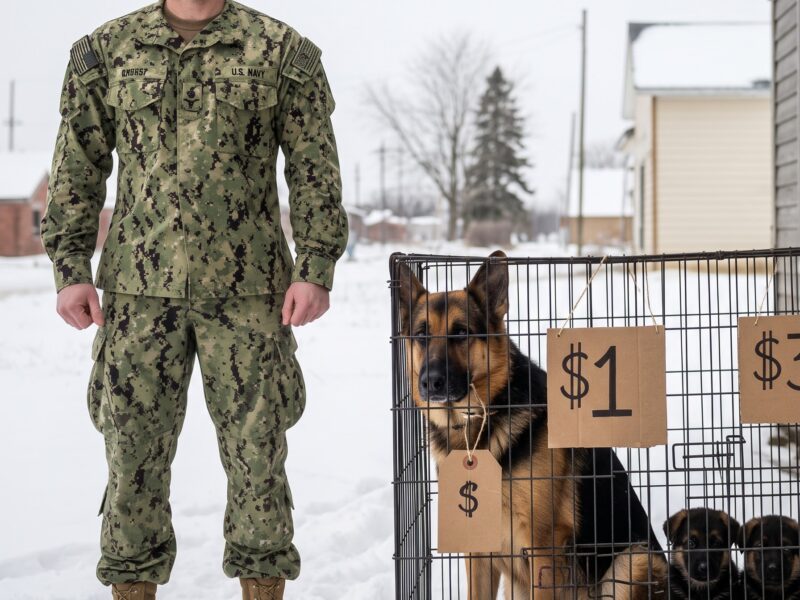
They were charging $4,800 for each puppy at a crowded Pennsylvania kennel, but when I asked what they wanted for the exhausted mother trembling behind a wire gate
The air inside the Pennsylvania breeding kennel smelled of damp concrete, bleached ammonia, and cold cedar shavings. Rain rattled like handfuls of pebbles against the corrugated metal roof, filling the cavernous barn with a steady, hollow roar.
I had driven two hours from Philadelphia in search of a quiet companion—a shelter rescue, perhaps an older dog who needed nothing more than a warm rug and a soft voice. My apartment had been too quiet since my father passed away, and the winter nights felt far too long. A local flyer had directed me to this farm at the edge of Lancaster County, advertising “purebred companions raised with love.”
What I found instead was a high-volume factory disguised as a rural sanctuary.
Bright halogen lamps hung from the steel rafters, illuminating a row of spotless display pens near the front entrance. Inside those pens, fluffy golden retriever puppies tumbled over pristine white fleece blankets. Heated panels glowed behind them, and polished glass bowls held clean, filtered water. Affixed to each enclosure was a laminated card decorated with blue ribbons: $4,800. Champion Bloodline.
Prospective buyers—wealthy couples in designer raincoats and families with eager children—milled about, cooing at the tumbling balls of fur. The owner of the establishment, a thick-set man named Donald Vance with grease under his fingernails and an artificial, wide-toothed smile, glided between them, collecting deposit checks in a leather binder.
I walked past the bright front displays, drawn toward the darker, colder corridor at the rear of the barn.
Here, away from the warm lights and clean blankets, the air grew chilly and dank. The floor was rough, stained concrete, unheated and swept only with sawdust. There were no glass partitions here, only rusted chain-link gates.
In the farthest, darkest corner, curled tightly against the dripping cinder-block wall, lay a dog.
She was an Belgian Malinois mix, though her coat was so matted with dirt and dried mud that her true colors were almost impossible to discern. Her body was a map of visible suffering. Her ribs pressed sharply against her dull fur like the wooden frames of an old boat. One of her ears was torn at the tip, notched with jagged pink scar tissue. A thick wooden crate blocked half her cage, as if meant to hide her from the paying customers up front.
She did not bark. She did not whine. She simply lay there, her head resting on her front paws, watching the footsteps of strangers with dark, hollow eyes. She had learned the cruelest lesson a captive animal can learn: that showing hope only invites disappointment.
Five feet away, in a adjoining pen lit by a warm infrared lamp, four fat, golden-brown puppies tumbled over one another. A small card on their gate read: $4,800 EACH.
I knelt on the cold floor in front of the dark cage. “Hey, sweetheart,” I whispered gently.
The dog’s ears twitched faintly. Slowly, painfully, she uncurled herself. Her rear legs trembled as she stood, her joints stiff from the damp chill. She walked to the wire gate, lowered her head, and pressed her cold nose through one of the rusted diamonds in the fence.
She lifted her right front paw slightly off the ground, holding it suspended in an unspoken, desperate plea.
My heart felt as if it had been squeezed by an iron fist. I reached out and gently rested two fingers against her muzzle. Her skin was freezing, but her breath was warm against my skin.
“Looking at the old one?”
I turned to see Donald Vance standing behind me, his leather binder tucked under his heavy arm. The warm smile he gave the families in the front was completely gone, replaced by a look of mild irritation.
“Why isn’t she in the warm room with her puppies?” I asked, keeping my voice steady despite the anger rising in my chest.
Vance shrugged, taking a toothpick from his shirt pocket and sliding it into the corner of his mouth. “Puppies need heat to stay sellable. She doesn’t. She’s strong enough.”
“She’s shivering,” I said. “Her ribs are showing.”
“She eats what she needs,” Vance replied coolly. “She’s just lean. That breed is always lean.”
“How much for her?” I asked, looking back at the dark eyes behind the wire.
Vance snorted, a short, ugly sound. “For her? She’s finished. Her litters are getting smaller, and she’s too tired to nurse them properly anymore. I was going to haul her down to the auction in Reading next Tuesday. But if you take her off my hands today, right now, so I don’t have to feed her through the weekend… she’s worth twenty dollars.”
Twenty dollars. The price of a cheap dinner.
“And her puppies?” I asked, pointing toward the heated pen next door.
His artificial salesman smile flashed back on like a light switch. “Four thousand eight hundred each. Top quality. Great temperaments.”
“Why is the mother twenty dollars while her babies are five grand?” I asked, standing up to face him. “What did you do to her?”
Vance’s eyes narrowed, his jaw hardening. “Listen, pal. You want a cheap dog or do you want to ask stupid questions? I run a legal business here. She’s old, she’s worn out, and she’s twenty bucks. Take it or move along.”
I opened my mouth to demand her medical records, but before I could utter another word, a heavy boot echoed against the concrete behind us.
“Her ear isn’t torn from age,” a deep, quiet voice said.
We both turned.
Standing at the entrance of the rear corridor was a broad-shouldered man in his late thirties. He wore a faded blue Navy T-shirt despite the chilly rain outside, dark cargo pants, and worn combat boots. Beside him stood a charcoal-black Labrador retriever wearing a red service harness.
The man’s eyes were cool, grey, and completely unreadable, but there was an intense, disciplined tension in his posture.
The black Labrador froze the moment it saw the Belgian Malinois behind the wire. Its tail did not wag. Instead, the service dog let out a low, soft whine—not of aggression, but of profound recognition.
The man stepped past Vance without looking at him and crouched down directly in front of the shaking mother. He didn’t offer a hand to be smelled. He simply looked into her eyes, studying the scar on her snout, the tear in her ear, and the subtle, squared-off posture of her chest despite her weakness.
“What happened to her?” the man asked quietly.
Vance crossed his arms, stepping into the man’s space. “I already told the other guy. She’s an old farm dog. She got into a scrap with a raccoon years ago. Look, mister, if you’re not buying a puppy, the front room is closed.”
The man stood up smoothly. He was at least three inches taller than Vance, moving with a fluid, terrifying efficiency.
“My name is Daniel Carter,” he said, his voice dropping an octave, carrying a calm, dangerous authority that made the ambient noise of the kennel seem to fade away. He pointed a scarred finger toward the trembling dog. “What is her name?”
Vance shifted his weight, his slick confidence beginning to fray at the edges. “We don’t name dogs that aren’t worth keeping. She’s Lot 42.”
Daniel’s jaw tightened until a muscle twitched in his cheek. He looked down at the black dog at his side, then back at Vance.
“Show me her intake papers and her medical file,” Daniel said. “Now.”
“I don’t have to show you anything,” Vance sneered, though he took a half-step back. “This is private property. Get off my farm before I call the state police.”
Daniel didn’t flinch. He reached into his pocket, pulled out a heavy smartphone, and tapped the screen once.
“You can call the state police,” Daniel said softly. “Or I can call the Pennsylvania Department of Agriculture and the Federal Working Dog Oversight Committee. I’m sure they’d love to inspect your breeding logs, your veterinary clearances, and why a dog with a military tattoo inside her flank is sitting in a wet cage without food.”
Vance went completely white. His toothpick slipped from his lips and fell onto the stained concrete floor.
The air in Vance’s back office was thick with stale tobacco smoke and old dust. The room was a chaotic disaster of overflowing filing cabinets, stacks of unpaid bills, and yellowed dog registry forms.
Daniel stood in the middle of the small room like a statue, his service dog sitting motionless at his heel. I stood near the doorway, watching Vance’s trembling hands as he unlocked a rusted green filing cabinet in the corner.
“I bought her legally,” Vance muttered, his voice shaking with a mix of anger and fear. “I bought her at a private liquidation auction three years ago. I have a bill of sale. I didn’t break no law.”
“Produce the file, Vance,” Daniel said quietly.
Vance pulled out a thick, faded manila folder and slammed it onto the metal desk. “There. Take a look. See if I care.”
Daniel stepped forward, pulled a pair of thin latex gloves from his pocket, and opened the folder. I stepped up beside him, leaning over his shoulder to look.
The first page was a standard canine transfer agreement, but stamped across the top in bold red ink were the words: PROPERTY OF U.S. DEPARTMENT OF DEFENSE – MILITARY WORKING DOG.
Beneath the stamp was a color photograph taken six years prior.
The dog in the picture was unrecognizable compared to the broken creature shivering in the dark pen outside. She was lean, muscular, and radiant, her coat gleaming black and mahogany in the harsh desert sun. She wore a heavy tactical harness fitted with handles and camera mounts. Her head was held high, her eyes blazing with fierce intelligence and purpose.
Standing beside her in the photograph was a young Marine in desert camouflage, his arm wrapped around her chest, smiling brightly at the camera.
“Her name isn’t Lot 42,” Daniel whispered, his thumb resting gently on the edge of the photograph. “Her name is Rosie. She was an Explosive Detection Canine. Tactical Assault K9, 2nd Raider Battalion.”
“She was retired!” Vance shouted, waving a yellowed piece of paper. “Medical discharge! Shrapnel injury to her rear hip! The military decommissioned her and transferred her to a certified civilian adoption contractor! I bought her from the contractor!”
Daniel flipped to the second document in the file. It was a contract—a legally binding transfer agreement between the United States Government and a private kennel syndicate.
Daniel’s eyes scanned the fine print rapidly. “Clause 4,” Daniel read aloud, his voice dropping into a register of cold rage. “‘The adopting entity agrees that the retired canine shall be provided lifelong veterinary care, proper nutrition, and sanctuary. The animal shall NOT be used for commercial breeding under any circumstances.'”
I looked at Daniel, horrified. “He was breeding a wounded combat veteran.”
“She had four litters in three years,” Daniel said, turning the pages of Vance’s handwritten breeding log. “Over twenty puppies. At five grand a pup. He worked her until her body failed, kept her in the dark so no one would see her tattoo, and then put a twenty-dollar price tag on her head when her hips gave out.”
“I ran a business!” Vance yelled, his face turning bright red. “I fed her! I gave her a roof! You think the government cares about an old dog? They threw her away!”
“They didn’t throw her away,” Daniel said coldly. He pulled out his phone again, snapped clear, high-resolution photographs of every single page in the binder, and then snapped a photo of Vance’s state handler license hanging on the wall.
“What are you doing?” Vance demanded, lunging forward to grab the folder.
Daniel caught Vance’s wrist with a speed that was almost impossible to follow. He didn’t squeeze hard, but Vance froze instantly, gasping as his arm was held immovable in mid-air.
“You’re going to open that gate,” Daniel said, looking Vance directly in the eyes. “You’re going to let me take Rosie out of that pen. And then you’re going to sit at this desk and wait for the federal marshals.”
“You can’t just steal my dog!” Vance squeaked.
“She isn’t your dog,” Daniel replied, releasing Vance’s wrist. “She never was. She’s a decorated veteran. And you are in breach of federal contract.”
Daniel turned to me. “Get the door.”
We walked back into the dark corridor. Daniel approached the iron gate of Lot 42. He didn’t use the latch key Vance had left on the desk; instead, he pulled a multi-tool from his belt, slipped it into the padlock, and popped it open with a single, practiced twist.
The heavy gate swung open with a loud creak.
Inside the dark pen, Rosie didn’t move. She cowered against the wet cinder blocks, her eyes wide with fear, bracing herself for pain or hard words.
Daniel unclipped his service dog’s leash and commanded his Labrador to stay outside the gate. Then, the heavily built Navy veteran dropped to his knees in the sawdust and wet dirt. He didn’t care about the mud ruining his pants or the cold air seeping into his bones.
He lowered his head, tucked his hands against his chest, and made himself small.
“Rosie,” he whispered, his voice trembling slightly. “Hey, girl. The watch is over.”
He used a specific military command phrase—a soft, two-syllable call used only by tactical handlers.
The moment the words left his mouth, Rosie’s ears went flat against her head. A soft, breathless sound escaped her throat—a whine so filled with sudden, overwhelming grief and recognition that it felt like a sob.
Slowly, dragging her stiff hind legs behind her, the broken Malinois crawled across the concrete. She didn’t walk; she crawled on her belly, inch by inch, until her head reached Daniel’s chest.
Daniel wrapped his strong arms around her emaciated body, pulling her tight against his chest. He buried his face in her dirty, matted fur.
And for the first time in three years, the trembling stopped.
I wiped a tear from my cheek, stepping closer. “Is she going to be okay?” I asked softly.
“She’s coming home with me,” Daniel said, his voice muffled against her fur. “She’s never going to sleep on cold concrete again.”
He stood up, gently lifting the thirty-five-pound dog into his arms as if she weighed nothing at all. As he adjusted his grip under her hindquarters, a yellowed, folded piece of paper slipped out from the back flap of the manila file he had tucked under his arm.
The paper fell to the damp floor.
I leaned down and picked it up. It was a hand-written note, stained with grease and old watermarks, tucked behind her military medical discharge summary.
“Daniel,” I said, unfolding the fragile paper. “There’s something else here.”
He stopped at the exit door, turning back to look at me. “What is it?”
“It’s a note,” I said, reading the faded ink. “Written by her original handler before she was decommissioned.”
Daniel’s face changed. The stoic, intense expression softened into something vulnerable, almost fearful. “Read it.”
I looked down at the handwriting—sharp, desperate, and hurried.
‘My name is Sergeant Marcus Vance. Rosie saved my life in Helmand Province. They are separating us because of my injuries. If anyone finds her, if she is ever in danger, do not give up on her. Wherever Rosie goes, find me. Call 215-555-0198. Please. Don’t let her die alone.’
Daniel stared at me, his breath hitching in his chest.
“Marcus…” Daniel whispered, the name dropping from his lips like a ghost.
“You know him?” I asked, astonished.
“Marcus wasn’t just her handler,” Daniel said, his voice cracking for the first time. “He was my younger brother.”
The rain had turned into a torrential downpour by the time we loaded Rosie into the back of Daniel’s SUV. We laid her on a thick, heated memory-foam bed that Daniel kept for his own service dog, wrapping her in a thermal fleece blanket. She lay motionless, her deep brown eyes fixed entirely on Daniel, as if afraid that if she blinked, he would disappear and the dark concrete pen would return.
I sat in the passenger seat, the handwritten note resting on my lap.
“You said Marcus was your brother,” I said quietly as Daniel started the engine and pulled out of the kennel’s gravel driveway, leaving the bright lights of the puppy mill behind us in the dark mist. “Where is he now? Why wasn’t he with her?”
Daniel gripped the steering wheel so tightly his knuckles turned white. The windshield wipers beat a slow, rhythmic cadence against the glass.
“Marcus joined the Marines six years after I joined the Navy,” Daniel said, his voice heavy with memories. “He was assigned to the 2nd Raider Battalion as a multi-purpose K9 handler. They paired him with Rosie when she was just a pup. They spent three years together—deployment after deployment. They were inseparable.”
He paused, taking a deep breath to steady his voice.
“In 2021, their unit was hit by an improvised explosive device outside Sangin. Rosie detected the primary charge and saved six men in the squad, but a secondary device went off as they were evacuating. Rosie took shrapnel to her hip. Marcus… Marcus took the blast directly.”
I gasped softly, looking back at Rosie, who was resting her chin gently on Daniel’s service dog’s flank.
“Did he…?”
“He survived,” Daniel said, his eyes fixed on the dark highway ahead. “Barely. He spent eighteen months at Walter Reed. Amputations, severe traumatic brain injury, massive PTSD. When the military decommissioned Rosie due to her injuries, Marcus was still in a medically induced coma. He couldn’t claim her.”
Daniel reached down and touched the edge of the note on my lap.
“When he finally woke up, Rosie was gone. The private contractor told him she had been adopted by a loving family in Pennsylvania. But they lied. They sold her to Vance’s breeding farm for a quick profit.”
“And Marcus?” I asked. “Have you spoken to him?”
Daniel’s face darkened with a profound, aching sorrow.
“Marcus broke,” Daniel said softly. “He blamed himself for losing her. He believed he failed his partner. Two years ago, he cut ties with the family. He stopped taking his medical calls. He vanished into the system. I’ve been searching for him across three states ever since. I came to this kennel today because I traced a lead on a stolen service dog contract… I had no idea Rosie was here.”
“The phone number on the note,” I said, lifting the paper. “Have you tried calling it?”
“That number was disconnected three years ago,” Daniel said. “I tried it a thousand times.”
“Look at the bottom,” I urged, turning the paper over under the dim dashboard light. “There’s a second line written in pencil. It’s faint, but it’s there.”
Daniel pulled the truck over onto the shoulder of the rain-slicked highway, hazard lights blinking amber against the dark trees. He took the paper from my hands, holding it close to the ambient light of the dashboard.
Written in faint, shaky pencil at the very bottom edge were six words:
‘St. Jude’s Veterans Shelter. Room 12.’
Daniel stared at the words. “St. Jude’s… that’s in South Philadelphia. Less than forty miles from here.”
Without another word, Daniel shifted the SUV into drive, slammed his foot onto the accelerator, and swung the vehicle back onto the highway, tires spraying rain into the dark night.
As we sped toward Philadelphia, the tension inside the vehicle grew palpable. Rosie shifted on her bed, letting out a soft, low whine. It wasn’t a whine of pain—it was an anxious, eager sound. Her ears were perked forward, her black nose twitching as if she could smell the shift in our direction.
“She knows,” I whispered, turning in my seat to watch her. “Daniel, look at her. She knows where we’re going.”
“Dogs don’t forget the ones who carried them through the fire,” Daniel said, his hand trembling slightly on the gear shift. “Neither do brothers.”
An hour later, we pulled into the narrow, dimly lit alleyway behind St. Jude’s Veteran Shelter—a red-brick, Victorian-era building with peeling paint and iron security bars over the basement windows.
The rain had eased into a cold, biting drizzle. The streetlights cast long, shimmering orange reflections across the wet asphalt.
Daniel parked near the rear emergency exit. He turned off the engine, and for a long moment, the only sound was the clicking of the cooling exhaust and the quiet breathing of the two dogs in the back.
“Are you ready?” I asked softly.
Daniel didn’t answer immediately. He looked at his reflection in the rearview mirror, wiping a hand across his tired face.
“What if he isn’t the same man?” Daniel whispered, his voice bare and stripped of all military composure. “What if he’s too far gone? What if he sees her like this… broken, starved… and it destroys whatever he has left?”
Before I could answer, a loud, sharp bark echoed from the back seat.
Rosie was standing up. Despite the pain in her scarred hip, despite her severe emaciation, she had pushed her blanket aside. She was pressing her nose against the dark rear window, staring directly at the metal door of the shelter.
Her tail—which had hung limp and motionless at the kennel—gave a single, hard thump against the leather seat.
Daniel looked back at her, then down at his hands.
“She’s ready,” Daniel said quietly. “So I have to be.”
He opened his door and stepped out into the cold night air.
The interior of St. Jude’s Shelter was quiet, bathed in the dim yellow glow of fluorescent nightlights. The smell of old coffee, floor wax, and damp wool hung heavy in the narrow hallways.
A night administrator—an elderly veteran with a silver beard and a missing left arm—sat behind a battered wooden desk in the lobby. He looked up, his eyes widening as Daniel walked in carrying the frail, blanket-wrapped Malinois in his arms, with me and the black service dog following close behind.
“Can I help you, son?” the old man asked, taking in Daniel’s intense expression and military posture. “Visiting hours ended at eight.”
“I’m looking for Marcus Carter,” Daniel said, his voice steady despite the emotional weight behind it. “Room 12.”
The administrator sighed, his posture slumping. “Marcus doesn’t take visitors. He barely leaves his room. He’s… had a hard week. The VA cut his physical therapy allowance again. He’s packing his things to leave tomorrow morning. Doesn’t say where.”
“He’s my brother,” Daniel said simply. “And I brought someone who’s been looking for him.”
The administrator looked down at the blanketed bundle in Daniel’s arms. He saw the scarred snout, the torn ear, and the brilliant, sharp eyes peering out from the fleece. The old man’s eyes softened, a faint, sad smile touching his lips.
“Down the hall to the left,” the administrator whispered. “Last door on the right. Good luck, son.”
We walked down the long, silent corridor. Our footsteps echoed softly against the worn linoleum floor.
At the end of the hall stood a heavy wooden door with a small brass plate bearing the number 12.
Daniel stopped in front of the door. He gently set Rosie down on the floor. She wobbled slightly on her thin legs, but she refused to sit. Her entire body was rigid with anticipation, her dark eyes fixed on the bottom crack of the door where a thin sliver of light showed through.
Daniel lifted his hand, paused for three seconds, and knocked—three measured, deliberate raps.
Silence answered from inside.
Then, a faint, hollow voice spoke from behind the wood. “Go away, Artie. I told you, I’ll turn the keys in by eight tomorrow.”
Daniel swallowed hard, his throat tight. He leaned his forehead against the cool wood of the door.
“Marcus,” Daniel called out softly. “It’s Dan.”
A sudden, sharp movement echoed inside the room—the metallic clatter of something heavy falling onto a hard floor, followed by the slow, uneven scrape of a prosthetic limb dragging across rug.
The lock clicked. The brass handle turned slowly.
The door swung inward.
Standing in the dim light of the small room was a young man. His face was thin and drawn, bearing deep lines of exhaustion that no twenty-eight-year-old should ever have. His right leg was a sleek carbon-fiber prosthetic, and deep, pale shrapnel scars ran down the left side of his neck and jaw. He wore a faded Marine Corps physical training shirt that hung loose on his diminished frame.
Marcus stared at his older brother, his eyes wide with shock and disbelief.
“Dan…?” Marcus breathed, his voice barely a whisper. “How… how did you find me?”
“I didn’t find you,” Daniel said, tears finally spilling over his dark eyelashes. “She did.”
Daniel stepped aside.
Marcus looked down at the floor.
Rosie took one slow, deliberate step forward. She didn’t bark. She didn’t jump. Her strength was nearly gone, but she pushed herself across the threshold of the room, lowered her head, and pressed her scarred nose directly against the carbon-fiber shell of Marcus’s right knee.
Marcus froze as if struck by lightning.
He stared down at the thin, matted dog at his feet. His eyes swept over the torn ear, the visible ribs, the faded tactical tattoo on her inner thigh, and finally met the dark, loving eyes that had guarded his sleep through three deployments in the desert sand.
“Rosie…?” Marcus gasped, his voice fracturing into a ragged, guttural sob.
His mechanical leg buckled beneath him. He slid down the doorframe, crashing heavily onto his knees on the carpeted floor.
Rosie didn’t hesitate. She threw her front legs over Marcus’s shoulders, burying her head against his neck, whining frantically as she washed his tear-stained face with desperate, tender licks.
Marcus wrapped his arms around her thin frame, pulling her so tight against his chest that it seemed impossible to tell where the man ended and the dog began. He wept openly, his body shaking with years of stored grief, pain, guilt, and unimaginable isolation.
“I’m sorry… I’m so sorry, girl,” Marcus sobbed into her matted fur, his hands clutching her back. “I searched for you… I thought you were dead… I thought they killed you…”
Rosie let out a soft, deep sigh—a sound of absolute, unconditional peace—and rested her heavy head on his shoulder, her eyes closing at last.
Daniel knelt beside them, placing one heavy hand on his brother’s shaking shoulder and his other hand on Rosie’s back.
I stood in the doorway, tears blurring my vision, watching three shattered lives finally come back together in the quiet light of a sanctuary room.
Six months later, the morning sun broke over the rolling green hills of Chester County, Pennsylvania, burning away the low silver mist that clung to the valleys.
I pulled my car up the long gravel driveway of The Guardian Haven Sanctuary—a forty-acre former horse farm surrounded by white wooden fences and towering oak trees.
The air was clean and sweet, filled with the scent of fresh-cut grass and wild clover. It was a world away from the cold concrete, iron bars, and damp shadows of Donald Vance’s puppy mill.
As I stepped out of the car, I was greeted by the joyous, loud barking of three dogs racing across the open meadow.
Leading the pack was Rosie.
She was almost unrecognizable from the starving, broken animal I had found shivering in the dark six months ago. Her coat had regrown into a rich, velvety dark mahogany, shining bright under the summer sun. Her posture was proud, powerful, and alert. Though she still carried a slight limp in her right hip, she ran with fluid, effortless grace, her tail held high.
Beside her ran Daniel’s black Labrador and a newly adopted young rescue shepherd.
Standing near the large red barn at the top of the hill were Daniel and Marcus.
Marcus looked transformed. He stood tall, leaning lightly on a wooden cane, but his shoulders were broad, his face fuller, and his eyes clear and alive with purpose. He wore a dark green hat bearing the seal of the Marine Raiders, and his smile—broad, genuine, and warm—could be seen from across the driveway.
“Hey!” Marcus called out, waving his hand as I walked up the hill toward them. “You made it just in time for the dedication!”
“I wouldn’t miss it for the world,” I said, smiling as Rosie bounded up to me, pressing her warm snout into my palm. I knelt and rubbed her ears—including the torn tip that now served as a badge of honor rather than a mark of cruelty. “Look at you, sweetheart. You look like a champion.”
Rosie let out a happy bark, gave my hand a quick lick, and then bounded back to Marcus’s side, sitting precisely at his left heel, her eyes never leaving his face.
Daniel walked over and gave me a firm handshake, a proud smile on his face. “Thanks for coming,” he said. “The county inspector signed the final permits this morning.”
After the night at the shelter, Daniel had used his personal savings—along with legal assistance from veterans’ rights organizations—to expose Donald Vance’s illegal breeding operation. The state authorities had shut down Vance’s kennel permanently, revoking his license, levying massive fines, and rescuing thirty-four breeding dogs from his facility, all of whom were placed into verified, loving homes. Vance himself was currently facing federal charges for breach of military contract and animal cruelty.
In the aftermath, Daniel and Marcus decided that no retired service dog—and no veteran—should ever be left behind again.
Using the compensation Marcus received from his military back-pay and donations from local veteran charities, the brothers bought this farm. They transformed it into The Guardian Haven—a specialized rehabilitation center and permanent sanctuary for retired military and police working dogs, paired directly with combat veterans suffering from severe PTSD and physical injuries.
“We have six new retired K9s arriving next Tuesday,” Marcus said, looking out over the green pastures where two other veterans were walking dogs along the fence line. “All of them decommissioned, all of them needing a place to heal.”
He looked down at Rosie, reaching hand down to gently scratch her behind her ears.
“She saved me twice,” Marcus said softly, his voice full of emotion. “First in the desert… and then right here, when I had nothing left to live for. She reminded me that my mission wasn’t over.”
Rosie leaned her heavy head against Marcus’s prosthetic leg, looking up at him with pure, unwavering devotion.
The rain was gone. The dark cages were gone. The twenty-dollar price tag was forgotten, replaced by something beyond measure—love, honor, and a forever home built on the unbreakable bond between a soldier and his dog.
“Come on,” Daniel said, putting an arm around his brother’s shoulders and smiling at me. “Let’s go show the new dogs their home.”
Together, under the bright morning sun, we walked up toward the farmhouse, with Rosie leading the way into the future.
The end.









