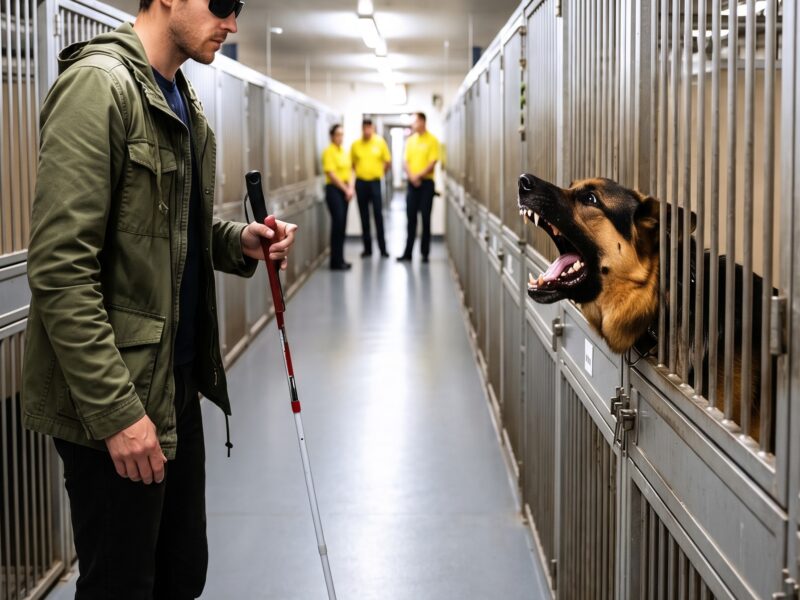
They warned me never to touch the retired police dog chained behind the veterans’ shelter, calling him violent and dangerous
The winter wind in Chicago didn’t just blow; it carved through wool coats like a rusted razor, carrying the acrid stench of exhaust and frozen river water. For eighteen months, I had lived in total darkness, adjusting to a world defined entirely by acoustics, temperature shifts, and the subtle vibrations beneath the rubber tip of my white cane.
Losing my sight in an industrial explosion at the age of thirty-two had stripped away my career as a structural inspector, but worse, it had changed how people spoke to me. In every voice that greeted me on the street, I could hear it—the soft, patronizing cadence of pity. It was in the way the barista handed me my coffee, in the way strangers held doors open a fraction too long, and in the polite, carefully rounded tones of the volunteers at the St. Jude Veterans’ Community Shelter.
That Thursday afternoon, I had walked six blocks from my apartment to the shelter to pick up a heavy surplus winter coat. The sky was a heavy sheet of slate grey, predicting a harsh lake-effect snowstorm before dusk.
As I navigated the cobblestone courtyard behind the shelter’s main brick hall, the crisp winter air was broken by a sound that vibrated right through the soles of my boots.
It was a deep, guttural growl—not the frantic yapping of a territorial pet, but the measured, weaponized warning of a massive working animal. Chain links rattled violently against steel posts as heavy weight slammed against the enclosure gate.
“Hey! Buddy, stop right there!” a voice shouted from the shelter porch. A staff member, his heavy boots crunching rapidly on the packed snow, trotted toward me. “Don’t go near that corner fence. Step back toward the ramp.”
I tapped my cane twice against the curb to orient myself. “Is that a dog?”
“That’s Ranger,” the staff worker said, his breath hitching from the cold run. “Retired police Malinois. The precinct dumped him here three months ago after his handler died. He’s completely unhinged. Attacked two certified handlers who tried to feed him. We keep him behind the double-latch gate until animal control figures out what to do with him. He’s violent, unpredictable, and dangerous.”
I stood still, listening past the worker’s nervous banter. Behind the iron mesh, about twenty feet away, I heard the rapid, shallow panting of the dog. There was no lunging now. Just rhythm. A steady, vigilant pacing. I couldn’t see his amber eyes or his dark mask, but I felt the phantom weight of his gaze locked onto my chest.
“I’ll stick to the main path,” I said softly, lifting my cane.
“Good man. Office is right through those double doors.”
I took three measured steps forward along the north side of the courtyard. The brick wall to my right held the faint warmth of the building’s radiator pipes, but the ground beneath my boots was treacherous. A thin sheet of black ice, concealed under a dusting of fresh snow, stretched across the drainage slope.
My white cane slid forward. Before my hands could adjust my weight, the tip caught nothing.
My right heel slipped out from under me.
For a terrifying split second, gravity tore away my balance. I fell hard onto my side, my knee slamming against the frozen concrete with a sickening thud. My palm scraped across the jagged ice, tearing skin, and my white cane clattered loudly across the courtyard, rolling out of my reach.
Pain flared up my hip, bright and sharp. I gasped, pinned to the frozen ground, disoriented in the pitch-black cold.
“Hold on! Don’t move!” the staff member yelled from thirty yards away.
Then came another sound—a sharp, metallic CLANG.
The double latch on the enclosure gate had given way under a heavy impact. Claws scraped violently against the pavement. Heavy, rhythmic pawfalls charged directly across the courtyard, picking up speed with terrifying momentum.
“GET BACK! HE’S OUT! GET INSIDE!” voices screamed from the porch.
I froze on my hands and knees, my heart hammering against my ribs like a trapped bird. I couldn’t run. I couldn’t see where the strike would come from. I braced my shoulders, tucking my chin instinctively to protect my neck, waiting for teeth to sink into my jacket.
The rushing air grew freezing cold as a massive body broke through the wind.
Instead of a strike, instead of a tear of jaws, a heavy, muscular mass slammed to a halt directly against my left side.
Ranger didn’t bite. He dropped his lower body flat against the icy pavement, wedging his warm, dense torso under my shoulder. He pressed his massive chest firmly against my ribs, creating a solid wall of muscle to brace me against the cold ground. He stayed completely motionless, his deep, rhythmic breathing vibrating straight into my bones.
The courtyard went deathly quiet. The frantic shouts of the shelter staff died in their throats.
Shaking from the fall and the sheer adrenaline, I slowly lifted my bleeding right hand. My fingers brushed against dense, coarse fur. It was thick, stiff with the winter air, but radiating an intense, living heat.
“Good boy,” I whispered, my voice barely audible over the wind. “Hey… good boy.”
Ranger let out a low, soft exhalation—a long, deep sigh that released the tension in his rigid shoulders. Slowly, with delicate precision, he lifted his heavy front paw and placed it directly over my scraped, trembling palm.
Steps crunched slowly across the ice. A new voice spoke—older, raspy, carrying the quiet gravity of someone who had spent decades around working dogs.
“That’s impossible,” the man said. It was Miller, a former police K9 trainer who volunteered at the shelter on weekends. “That dog hasn’t let a human come within five feet of him without showing teeth in three years. He’s spent thirty months trying to bite the world.”
Ranger shifted his weight. He nudged his cold nose firmly against my cheek, then leaned down, took the nylon wrist strap of my fallen cane between his teeth, and gave a gentle, insistent tug.
He wasn’t trying to escape. He was giving me an order.
I pushed myself up from the icy ground, using Ranger’s sturdy shoulders as a pillar of support. My right knee throbbed with a dull, sickening ache, but the dog didn’t move an inch until he felt my full weight balanced on my feet. He pressed the handle of my cane directly into my fingers, whining softly until my grip tightened around the grip.
“Where is he taking you?” Miller asked, his footsteps closing in carefully. “Ethan, stay still. Let me put a slip lead on him.”
Ranger let out a short, sharp bark—a clear command of warning that made Miller instantly freeze in his tracks.
The dog nudged my knee with his muzzle, turning his body toward the far eastern edge of the courtyard, away from the shelter’s main entrance. He walked slowly, matching his pace to my limping stride, keeping his broad flank pressed against my hip so I wouldn’t lose my balance on the icy patches.
“He’s taking me somewhere,” I said, my voice echoing in the cold air. “Follow us, Miller.”
We crossed the cobblestones, the wind whipping snow around our legs. Ranger led me past the main kitchen doors, down a narrow concrete ramp, and into the shadow of the old brick annex—a disused nineteenth-century storage building that the city had turned over to the veterans’ shelter for overflow supplies.
Ranger stopped dead in front of a heavy, iron-reinforced wooden door.
He lifted his right paw and scratched the lower panel once. Then twice. He sat down heavily on the snow-covered threshold, his dark ears pinned back, his tail giving a single, rigid thump against the wood.
Miller caught up to us, his heavy breathing ragged in the quiet alley. “This is the old archive room. It’s just broken furniture, retired city records, and old precinct files from the district overhaul five years ago. There’s nothing in there.”
“Unlock it,” I said.
Miller hesitated, the jingling of a heavy brass key ring echoing against the brick walls. “Ethan, this building hasn’t been opened since the city council closed the old 4th District station. It’s restricted storage.”
“Miller,” I turned my sightless eyes toward him. “This dog just broken through a gate, saved me from a concussion, and marched me straight to this door. Open it.”
Keys scraped against the cold brass lock. With a dry, creaking groan, the heavy door swung inward.
A wall of stagnant air hit us—smelling of old paper, damp concrete, rusted iron, and decades of settled dust.
Ranger didn’t hesitate. He stepped across the threshold, his claws clicking rhythmically on the concrete floor. I followed his heavy tread, using the sound of his movement to navigate through the cramped, narrow aisles between towering rows of rusted steel shelving.
He stopped deep inside the gloom of the room, near the far wall where the smell of moldy cardboard was thickest.
Ranger let out a low, mournful whine. He lowered his snout into the gap beneath the bottom shelf of a rusted unit, nudging a heavy, water-stained bankers box that sat tucked behind broken wooden crates.
“What is that?” I asked, kneeling beside him on the dusty floor.
Miller pulled a flashlight from his belt, the beam cutting through the dim archive. “It’s an old homicide evidentiary backup file from 2021. Box 408-B. It was transferred here when the precinct renovated its basement.”
Ranger thrust his nose under the corner of the box, grunting with effort as he slid the heavy cardboard container two feet out into the middle of the aisle. He sat down beside it, placing both paws firmly over the lid.
Miller knelt on the other side of the box, his thick fingers popping the aged plastic tape that sealed the top. Paper rustled loudly as he pulled open the flaps.
“What’s inside?” I asked, my fingers resting on Ranger’s head. The dog’s body was trembling violently now, a low tremor running from his neck down to his spine.
“Old case folders… crime scene photos… inventory logs from the old 4th District evidence locker,” Miller muttered, sifting through the yellowed documents.
He paused. The rustling stopped completely.
“What is it?” I pressed.
“It’s a personnel file,” Miller whispered, his voice suddenly hollow. He pulled a heavy photograph from the folder. “It’s Ranger. From four years ago.”
Miller’s thumb ran over the gloss of the photo. “He’s sitting beside a young officer. Officer Daniel Hayes. Tactical Narcotics Division. Hayes was Ranger’s original handler… the officer who trained him from a pup.”
“What happened to Hayes?” I asked.
Miller swallowed hard. “Late-night vehicular accident on the Calumet Expressway in November 2021. Single-vehicle crash. The official report says Hayes lost control on black ice during a storm, flipped his cruiser down an embankment, and died on impact. Ranger was in the custom K9 kennel in the back. He survived with a fractured shoulder and severe trauma.”
“An accident,” I repeated, feeling a sudden, cold knot tighten in my stomach.
“That’s what the internal affairs report says,” Miller said quietly.
Suddenly, Ranger shoved his snout violently under the bottom lip of the bankers box. He rooted through the loose papers at the bottom, his teeth clicking against something metallic.
With a sharp flick of his head, he pulled out a small, heavy object wrapped in dry leather and dropped it directly into the center of my open, palm.
It was a standard-issue metal dog tag, cold and worn smooth at the edges. But as my fingers traced the back of the stamped steel, I felt deep, jagged scratches—not machine-engraved, but crudely carved by hand with a pocketknife or a nail.
I ran my thumb over the rough grooves. “There’s writing on the back. Read it to me, Miller.”
Miller leaned in close under his flashlight beam. His breath caught in his throat, and for three long seconds, he didn’t speak.
“Read it,” I demanded.
“It says…” Miller’s voice cracked. “‘Trust the dog, not them. Nov 14.’“
The archive room felt suddenly colder, as if the winter wind outside had leaked straight through the thick brick walls.
Ranger rested his heavy head on my knee, his dark muzzle pressed against my hand, letting out a soft, shuddering breath. The metal tag felt impossibly heavy in my palm. The carved letters—rough, hurried, and deep—were an unmistakable cry for help left behind by a dying man.
“November 14th was the night Officer Hayes died,” Miller said, his fingers rapidly turning the pages of the case folder. “Look at these dispatch logs… something doesn’t line up.”
“What do you mean?” I asked, leaning forward, relying entirely on Miller’s description of the yellowed pages.
“The official accident report filed by the 4th District states that Hayes was off-duty, driving home from his shift when he hit the ice on the expressway,” Miller explained, his voice dropping to an anxious whisper. “But look at the evidence ledger from his cruiser. His service weapon was missing two rounds. His tactical vest was unzipped. And the dashcam footage… the log says the memory card was ‘damaged beyond recovery’ in the fire.”
“And the dog?” I asked, my fingers tracing the scars on Ranger’s torn ear. “What happened to Ranger that night?”
“According to the vet report attached to the file, Ranger was found three hundred yards away from the wreckage, covered in mud and high-grade diesel oil,” Miller said. “He wasn’t sitting by the car. He was standing near the access gate of the railyard at 115th Street… barking at the dark.”
Miller turned another page, his scanner light humming faintly as he took photos with his phone.
“Here,” Miller gasped. “A supplemental handwritten note from the responding paramedic. It was buried under the toxicology sheets. Listen to this: ‘Officer Hayes was found in the driver’s seat, but seatbelt trauma is inconsistent with steering wheel impact. Unidentified tire tracks leading from the railyard fence onto the embankment were noted by State Trooper Vance, but omitted from the final scene sketch by District Detective Miller.’“
“Detective Miller?” I blinked toward him. “Is he related to you?”
“No relation,” Miller said grimly. “Marcus Miller. He was the lead investigator on internal affairs cases back then. He retired six months after Hayes’s death… bought a million-dollar marina up in Door County.”
The pieces began to fit together with sickening clarity. A dedicated narcotics officer discovers corruption within his own unit. He carves a final warning onto his dog’s tag, knowing he might not survive the night. His cruiser is run off the road, his death written off as a tragic winter accident, and the only witness left alive is an animal that can’t speak human words.
Ranger stood up suddenly, his posture turning rigid. His ears rotated toward the open doorway of the archive building.
From the courtyard outside came the heavy, rhythmic crunch of tires crushing fresh snow. A vehicle had just pulled through the shelter’s back gates—a heavy, idling engine vibrating through the frozen ground.
“Who’s here at this hour?” Miller muttered, standing up and sliding the file back into his jacket. “The shelter closes at four.”
Footsteps echoed down the concrete ramp—two men, walking with measured, heavy authority.
“Miller!” a sharp voice called out from the entrance corridor. “Are you in there? We got a call from shelter dispatch that the Malinois broke fence and someone got hurt.”
Miller stepped out into the main aisle, placing himself between the doorway and me. “We’re fine, Chief. Just getting the dog secured.”
I stood up slowly, keeping my hand flat against Ranger’s flank. I felt the dog’s muscles tighten like steel cables. A low, vibration began in Ranger’s throat—a silent, deadly vibration that meant he recognized the voice.
Two men stepped into the light of the archive room.
“You shouldn’t be in here, Miller,” said the taller man, his voice smooth, calculated, and entirely devoid of warmth. “This annex is city property. And that dog is scheduled for transport to the county veterinarian for behavioral liquidation at five o’clock.”
“Who are you?” I asked, stepping forward with my cane.
“Assistant Chief Robert Vance,” the man replied, his heavy leather coat rustling as he stepped closer. “And you must be the citizen who was attacked.”
“I wasn’t attacked,” I said firmly, holding Vance’s cold gaze with my blind eyes. “Ranger saved my life. And he brought us right to Box 408-B.”
The silence that followed was suffocating.
I heard Vance’s breathing stop for a fraction of a second. Beside him, the second man shifted his boots on the concrete—the distinct leather-on-leather scrape of a hand moving toward a sidearm holster.
“Box 408-B was supposed to be shredded two years ago,” Vance said softly, his voice dropping into a register of cold, terrifying calm. “It seems the records clerk was sloppy.”
“Officer Hayes didn’t die in a car accident, did he, Vance?” I said, taking a half-step forward, feeling Ranger’s shoulder pressing against my leg, ready to spring. “He was murdered because he found out about the evidence thefts from the 4th District locker.”
Vance chuckled—a dry, bitter sound that held no humor. “You’re a blind civilian standing in a damp basement holding an old dog tag. You don’t know anything.”
“I know what’s carved on this tag,” I said, holding up my left hand where the metal tag rested against my fingers. “And I know State Trooper Vance—your brother—was the one who wiped the tire tracks from the accident report.”
The room snapped into extreme tension.
“Give me the file, Miller,” Vance commanded, his voice dropping all pretense. “And step away from the blind man.”
“No,” Miller said, standing his ground. “This goes to the State Police Integrity Task Force tonight.”
Vance reached into his coat. “Nobody is leaving this building with those papers.”
Before Vance’s hand could clear his jacket lapel, Ranger moved.
The Malinois didn’t bark. He launched his hundred-pound body across the ten feet of concrete like a missile. His heavy paws slammed into Vance’s chest with staggering force, knocking the heavy man backward into the steel shelving units with a deafening crash of falling boxes and metal frames.
“GET HIM OFF ME!” Vance screamed as his sidearm clattered onto the concrete floor.
“RUN!” Miller yelled, grabbing my arm and pulling me violently toward the rear emergency exit of the storage building.
We burst through the metal panic door into the blinding, freezing blizzard outside. The lake-effect storm had hit with full force, turning the alley into a roaring whiteout of wind and swirling snow.
Ranger emerged a second later, sprinting through the deep snow, trailing close behind us. He nudged my hand, guiding me through the whiteout with infallible instinct, leading us away from the shelter alley toward the industrial perimeter of the south side.
Behind us, shouts and the sharp crack of a gunshot shattered the storm. The bullet struck the brick wall above our heads, showering us with frozen mortar dust.
“This way!” Miller yelled over the gale, guiding my left shoulder as Ranger surged ahead through six inches of fresh powder. “The old 115th Street railyard is two blocks east! There’s an active rail tower with security guards!”
We ran through the freezing darkness, my chest burning with ice-cold air, my blind eyes useless against the howling storm. Every step was a battle against the frozen ground, but Ranger was our lighthouse. He stayed two feet ahead of me, his heavy tail brushing against my knee at every turn, picking the path of least resistance through the snowdrifts.
We reached the rusted chain-link perimeter of the railyard. The wind roared through the open steel girders of the freight cars parked on the sidings.
Ranger stopped near a derelict switching shed. He lifted his head, his black nose catching a scent over the smell of creosote and diesel exhaust.
He let out a sharp, urgent bark, turning toward an abandoned maintenance pit beneath a line of rusted hopper cars.
“What is he doing?” Miller panted, leaning against the cold steel frame of a boxcar, holding his phone in a desperate attempt to find a cell signal in the storm.
“He isn’t just running away,” I realized, the cold truth hitting me like a wave of ice water. “He brought us to the exact spot where he fled four years ago. This is where Hayes was taken before the crash.”
Ranger scrambled down into the concrete maintenance pit, pawing frantically at a rusted steel floor hatch sealed with a heavy padlock. He barked again—a deep, resonant sound of absolute certainty.
He had held this memory in his heart for four long years, waiting for someone who would listen.
The storm raged around the railyard, turning the rusted steel freight cars into roaring, metallic monoliths in the dark.
Miller scrambled down into the pit beside Ranger, using the heavy iron crowbar from the switching shed to wedge into the rusted latch of the floor hatch. With a sharp, agonizing groan of tearing metal, the lock snapped open.
Inside the concrete maintenance vault, protected from the rain and snow for four years, lay two heavy waterproof duffel bags stamped with the seal of the Chicago Police Department Evidence Division.
Inside those bags were three hundred thousand dollars in unrecorded cash, six brick-sealed narcotics packages from the 4th District vault, and a digital voice recorder bearing Officer Daniel Hayes’s initials.
Miller picked up the recorder, his hands trembling as he pressed the play button.
Through the static of the tiny speaker, a clear, confident voice echoed through the cold concrete pit:
‘This is Officer Daniel Hayes, Badge 4108. If you are listening to this, Assistant Chief Vance and Detective Miller have forced my vehicle off the road. They are moving the seized evidence to the 115th Street railyard vault. Ranger and I are pinned down. If I don’t make it out, trust the dog. He knows where the truth is buried.‘
The recording ended with the distant sound of a siren.
Ten minutes later, the railyard was flooded with blinding red and blue lights as six state police cruisers, accompanied by the Federal Bureau of Investigation Corruption Task Force, tore through the snowdrifts.
Vance and his accomplice were apprehended at the perimeter fence as they tried to flee the area. The evidence recovered from the vault, along with Officer Hayes’s final recording, provided undeniable proof of a multi-year corruption ring operating within the district.
Six months later, the spring sun shone warm and bright over the green lawns of the Illinois State Police K9 Training Academy in Springfield.
The air was filled with the sweet scent of blooming lilacs and fresh clover.
I sat on a wooden bench near the main training field, holding my white cane in one hand and a cold glass of lemonade in the other. Beside me, sitting proudly with his head held high, was Ranger.
His coat was rich, glossy, and thick, shining like dark gold under the afternoon sun. He wore a brand-new, custom-fitted leather service harness bearing a silver badge engraved with his name and the words: HONORARY CHIEF GUARDIAN.
After the trial that sent Vance and six corrupt officials to federal prison, the state police officially retired Ranger with full department honors, awarding him the Distinguished Service Cross—the highest honor ever given to a police working dog in the state’s history.
And by unanimous decree of the city council, Ranger was legally placed into my permanent custody.
Footsteps approached along the gravel path. Miller walked up, carrying two folders under his arm, smiling broadly.
“How’s the Chief doing today?” Miller asked, leaning down to scratch Ranger behind his ears.
“He’s doing great,” I smiled, listening to the happy thump of Ranger’s tail against the grass. “He spent the morning helping me navigate the new obstacle course at the shelter.”
“He’s a legend, Ethan,” Miller said quietly, looking out over the green fields where young working dogs were being trained. “The academy built a memorial statue of Officer Hayes near the front gate. Ranger’s name is carved right at the base.”
I reached down, my fingers finding the heavy, worn dog tag that now hung alongside Ranger’s new official badge. The carved letters—Trust the dog, not them—were smooth now, polished by time and care.
Ranger leaned his heavy, warm head against my knee, letting out a long, contented sigh.
I couldn’t see the spring sunlight, nor the green fields, nor the silver badge on his chest. But as I ran my hand over the dense, velvet fur of his ears, I didn’t need eyes to see the truth.
In the dark silence of a cold winter afternoon, a forgotten animal had chosen to trust a blind stranger. And together, we had given a fallen hero his voice back.
“Come on, boy,” I whispered softly, standing up from the bench. “Let’s go home.”
Ranger stood up smoothly at my side, pressing his shoulder against my leg, guiding me forward into the warm light of a brand-new day.
The end.









