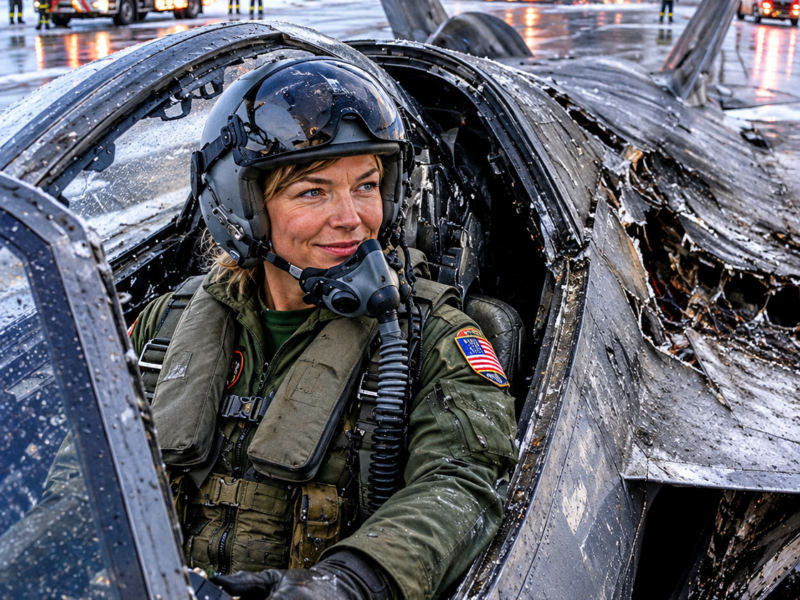
“They told me the landing was mathematically impossible. They said my F-22 would break apart the moment its wheels touched the runway
The coastline was getting closer, but the aircraft was becoming harder to control with every passing second.
My left hand gripped the throttle. My right hand fought the stick, trying to keep the crippled F-22 from rolling toward the damaged wing. The cockpit shook so violently that the instrument displays blurred.
“Bulldog Six, this is Talon Twelve. I’m still with you,” Connor Nash said over the radio. “I have visual on your aircraft. You’re losing altitude.”
“I know, Connor.”
“Your right wing is shedding more material. You need to get out of there.”
I glanced at the damage indicators. The right engine was gone. The right-side control surfaces were either destroyed or frozen. Hydraulic pressure was nearly nonexistent. The aircraft was flying because of a combination of the remaining engine, whatever control authority I had left, and a great deal of stubbornness.
“I’m not leaving this aircraft,” I said.
There was a pause.
“Copy that,” Connor answered. “Then I’m staying with you.”
I looked ahead. Somewhere beyond the coastline was King Salmon Airport. Its runway was long enough to give me a chance, but only if I could get the aircraft there in one piece.
The problem was that the F-22 was never designed to fly like this.
It was designed to dominate the sky, not crawl toward a runway with half its control systems destroyed.
“Bulldog Six, this is Anchorage Control,” Major Gregory Donovan said. His voice was tight. “We have your estimated position. Emergency services are being notified. King Salmon is preparing the runway.”
“Tell them to clear everything.”
“Already done. Fire crews are standing by.”
“Good.”
Then another voice entered the communications channel.
“Captain Reed, this is Dr. Miller. I need you to listen carefully.”
Dr. Robert Miller had been on the engineering support line since the failure. He had been studying the aircraft’s damaged systems and trying to find a way to bring me home.
“Go ahead, Doctor.”
“I’ve reviewed the telemetry again. Your right main landing gear may not deploy. The hydraulic system that controls it is almost completely gone.”
“I figured.”
“Your left main gear may still function, and the nose gear has a separate deployment path. But even if those two lock into position, your aircraft will be dangerously unstable.”
“How unstable?”
“Unpredictable. Especially at low speed.”
I glanced at the airspeed indicator.
“Then I won’t go low speed.”
There was silence.
Dr. Miller finally answered. “Captain, the normal landing speed for that aircraft is approximately 150 knots. Your damaged configuration may require considerably more. The landing gear isn’t designed to absorb the force of a touchdown at that speed.”
“I understand.”
“No, I don’t think you do. If you touch down too fast, the gear could collapse immediately. If you slow down too much, the aircraft could stall. You have almost no margin.”
I watched the coastline slide beneath me.
“Then help me find a margin.”
The engineer took a breath.
“There may be one possibility. It’s not a conventional landing procedure. We would need to use the left engine’s thrust-vectoring system to help control your yaw. You could approach at a much higher speed, use a controlled sideslip to reduce some of that speed, and keep the nose aligned with the runway as much as possible.”
“How much speed?”
“Roughly 280 knots crossing the threshold.”
I almost laughed.
Two hundred and eighty knots.
That wasn’t a landing. That was a controlled collision with the ground.
“And the gear?” I asked.
“You deploy it as late as possible. If the right gear remains stuck, you may have to accept a one-sided touchdown.”
“What about the flare?”
“Don’t attempt a normal flare. You don’t have the control authority for it.”
I looked down at the runway distance estimate.
“So what do I do?”
“Keep the nose stable. Use the remaining thrust-vectoring authority. Let the aircraft settle onto the runway.”
“Drive it like a spear,” I said.
Dr. Miller hesitated.
“Yes,” he replied. “Something like that.”
Major Donovan cut in.
“Captain Reed, I need to make something clear. This is an extremely dangerous maneuver. We cannot guarantee the aircraft will remain controllable after touchdown.”
“I know, Major.”
“You could be killed.”
I looked at the photograph clipped beside my instrument panel. It was a small picture of my family, taken before I left for Alaska. I had looked at it before every difficult mission, not because it made me fearless, but because it reminded me why I wanted to come home.
“I’d rather take the chance on the runway than in the water.”
Donovan didn’t argue.
“Understood. King Salmon is yours. All other aircraft have been diverted.”
Connor’s voice returned.
“Harper, I’m moving to your left side. I’ll keep an eye on the wing and call out anything I see.”
“Stay clear of my flight path.”
“Always do.”
His voice sounded calm, but I knew him well enough to hear the fear beneath it.
The coastline passed under my aircraft. The open water was behind me now, and the dark land of the Alaska Peninsula stretched ahead.
I had made it this far.
Now I had to land.
***
The first sight of King Salmon Airport appeared through a break in the clouds.
The runway looked impossibly narrow.
I could see the emergency vehicles lined up along the side. Fire trucks. Ambulances. Ground crews standing behind safety barriers. Even from the air, I could tell they were watching the damaged F-22 approach.
“Bulldog Six, King Salmon Tower,” a controller said. “Runway is clear. Wind is from the west at eight knots. You are cleared for emergency landing.”
“Copy. Runway clear.”
I checked the fuel gauge.
Less than two minutes.
The warning light blinked again.
I had spent years training for emergencies, but no simulator had ever given me this exact combination of problems. A dead engine, a damaged wing, almost no hydraulics, a jammed stabilizer, and a runway that might be the only thing between me and the Bering Sea.
I lowered my eyes to the landing gear controls.
“Here goes.”
I moved the switch.
A warning tone sounded.
The nose gear indicator turned green.
The left main gear indicator followed.
The right main gear remained red.
“King Salmon Tower, I have partial gear deployment,” I reported. “Nose gear and left main appear locked. Right main is not confirmed.”
“Understood, Bulldog Six. Emergency crews are standing by.”
Connor came back.
“Harper, I can see the right gear door. It’s warped. The gear looks like it’s hanging halfway out.”
“Can you tell if it’s locked?”
“Negative. It doesn’t look stable.”
I stared at the indicator.
One good main gear.
One nose wheel.
One right gear that might collapse, break away, or catch the runway and send the aircraft tumbling.
I had no time to think about any of those possibilities.
“Connor, get clear. I’m beginning the approach.”
“I’m staying until you tell me otherwise.”
“That’s an order, Nash.”
He hesitated.
“Copy. Breaking away.”
His aircraft moved farther to the left and began climbing away from my flight path.
I was alone now.
I lined up with the runway.
The airspeed indicator showed 310 knots.
Too fast.
But if I reduced power too quickly, the damaged aircraft could lose what little stability it had left. I adjusted the remaining engine and began the controlled sideslip Dr. Miller had described.
The nose drifted left.
I corrected.
The aircraft rolled slightly.
I corrected again.
Every movement felt delayed. The controls responded unevenly, as if the aircraft were fighting against my hands.
“Bulldog Six,” Miller said. “Your left engine thrust vectoring is responding. Use small inputs. Don’t overcorrect.”
“Copy.”
I eased the controls.
The nose began to align with the runway.
The airspeed dropped through 300 knots.
Then 290.
The runway was growing rapidly in my windshield.
“Captain Reed,” Donovan said, “your fuel is critical.”
“I know.”
“Do you have enough to go around?”
I looked at the fuel gauge.
There was no meaningful answer.
“No.”
A brief silence followed.
“Then make this one count,” he said.
I swallowed.
“That’s the plan.”
At 280 knots, I crossed the runway threshold.
I did not flare.
I held the nose steady and let the aircraft descend.
For one brief moment, everything seemed strangely quiet.
Then the left main gear struck the runway.
The impact was enormous.
The tire exploded instantly. The landing strut collapsed, and the left side of the aircraft dropped toward the pavement.
Metal screamed against concrete.
A shower of sparks erupted beneath the fuselage.
The aircraft lurched violently to the right.
I pulled against the remaining controls and added left thrust vectoring, trying to keep the nose pointed down the runway.
The right side slammed down.
The damaged gear caught the pavement and snapped away.
The F-22 was now sliding on its belly.
Fire appeared beneath the right engine area.
I could see it in the reflection of the canopy, a bright orange streak racing beside me.
“Bulldog Six, you’re on fire!” Connor shouted over the radio. “Harper, eject!”
I ignored him.
At that speed, ejecting could be just as deadly as staying inside. The aircraft was still moving down the runway, and I had no idea whether the canopy or ejection system would function correctly after the violent impact.
I needed to stop first.
The runway markings blurred beneath me.
Five thousand feet remained.
Then four thousand.
The aircraft continued sliding, leaving a trail of sparks and smoke.
“Fire crews are moving!” the tower announced.
I could hear the alarm tones inside the cockpit. The engine temperature was climbing. The electrical system was failing. The remaining displays began flickering.
I tried to reduce the remaining thrust, but the damaged aircraft continued forward.
Three thousand feet.
The runway end was approaching.
I had one option left.
The right wing was already badly damaged. Its outer section had been torn away, leaving a jagged stump. If I could bring that damaged section into contact with the runway, it might create enough drag to slow the aircraft.
It might also flip me over.
I looked at the runway edge.
Then at the remaining wing.
I had to decide.
I pushed the stick carefully to the right.
The damaged wing dropped.
Metal struck concrete.
The aircraft yawed violently. The fuselage began rotating, and the cockpit filled with a deafening grinding sound.
I fought to keep the nose from turning completely sideways.
The wing stump dug into the pavement.
The F-22 shuddered.
Then it began to slow.
The aircraft spun across the runway, carving a long trench into the surface. Sparks burst around the canopy. The remaining engine made a final, uneven roar before the cockpit went dark.
I felt one last violent jolt.
Then silence.
The aircraft stopped.
For several seconds, I couldn’t move.
I could hear my own breathing inside the helmet.
The warning alarms had gone quiet. The displays were black. Smoke drifted past the canopy.
I looked ahead.
The runway end was still visible.
We had stopped perhaps two hundred feet before it.
I was alive.
The realization came slowly, almost reluctantly.
I was alive.
***
“Bulldog Six! Bulldog Six, respond!”
Connor’s voice came through the emergency radio channel.
I reached for the microphone.
My hand was shaking.
“I’m here.”
“Harper!”
“I’m here, Connor.”
“Are you injured?”
I looked down at myself. My shoulder hurt. My left hand was trembling, and there was blood near my forehead, probably from striking the side of the helmet during the impact.
But I could move.
“I think I’m okay.”
“Don’t move. Fire crews are coming to you.”
Through the smoke, I saw red emergency lights approaching.
Fire trucks surrounded the aircraft, spraying foam over the burning wreckage. Rescue personnel moved toward the cockpit with protective equipment.
I tried to release the canopy.
The first attempt failed.
I tried again.
Nothing.
“Canopy release isn’t responding,” I reported.
A firefighter appeared beside the cockpit and signaled for me to stay back. Another member of the rescue team approached with equipment to force the canopy open.
I reached for the manual release.
My fingers found the handle.
I pulled hard.
For a moment, nothing happened.
Then the canopy shifted.
A firefighter grabbed the edge and helped lift it.
Cold Alaskan air rushed into the cockpit.
“Captain, can you hear me?” someone shouted.
“Loud and clear.”
“Don’t try to stand. We’re going to get you out.”
“I can climb out.”
“Captain, please let us—”
“I said I can climb out.”
I unbuckled my harness and slowly raised myself from the seat. Every muscle seemed to protest. My legs felt weak, but they held.
The rescue crew helped me down onto the pavement.
As soon as my boots touched the ground, someone wrapped a blanket around my shoulders.
A medic began checking my injuries.
“Any difficulty breathing?”
“No.”
“Pain in your chest?”
“Just my pride.”
The medic gave me a look that suggested he had heard enough jokes for one day.
Then I turned toward the aircraft.
The F-22 was almost unrecognizable.
Its nose was scraped and battered. The right wing was a twisted wreck. The underside was torn open, and the remaining landing gear lay scattered along the runway. Foam covered much of the fuselage, while smoke continued rising from the engine section.
Tail number 06-4115 had brought me home.
But it would never fly again.
I stared at it for a long moment.
Then I reached for the radio.
“Anchorage Control, this is Bulldog Six.”
Donovan answered immediately.
“Go ahead, Captain.”
“Cancel the Coast Guard.”
There was a pause.
“Say again?”
I looked at the wreckage and managed a tired smile.
“I told you I wasn’t swimming today. The jet is on the ground. Mostly.”
For a second, nobody spoke.
Then the communications channel erupted.
Connor was laughing. Someone in the command center shouted. The tower controller sounded as if he had forgotten how to speak.
Finally, Major Donovan came back.
“Captain Reed, confirm you are safely out of the aircraft.”
“Confirmed.”
“Are you injured?”
“Nothing serious, I think.”
“Stand by for medical evaluation. And, Captain?”
“Yes, Major?”
“Welcome home.”
I looked up at the gray Alaskan sky.
“Good to be here.”
***
The medical team took me to a small treatment area near the airport terminal.
They checked my head, examined my shoulder, and made sure I had no serious injuries from the impact. I had bruising, a cut near my hairline, and enough soreness to remind me of the landing for weeks.
But I had survived.
Outside, firefighters continued working around the wreckage.
Connor arrived a short time later.
He walked into the treatment area still wearing his flight gear. His face was pale, and his expression changed the moment he saw me sitting upright.
“You look terrible,” he said.
I smiled.
“You should see the airplane.”
He laughed, but the sound quickly faded.
For a moment, he simply stood there.
Then he stepped forward and gripped my shoulder carefully.
“I thought I lost you.”
“I know.”
“I was about to ignore your order and follow you down.”
“I’m glad you didn’t.”
He shook his head.
“You’re impossible.”
“That’s what I’ve been told.”
He pulled a chair beside me and sat down.
Neither of us spoke for a while.
There was nothing left to prove.
The mission had begun as a routine interception of an unidentified radar contact. It had turned into a fight for survival against a failure no pilot could have predicted.
We later learned that the aircraft had struck a fragment of falling satellite debris. The object was tiny, moving at extraordinary speed, and nearly impossible to detect in time. The impact damaged the engine and tore through critical parts of the aircraft.
It wasn’t enemy fire.
It wasn’t a mechanical problem that had slowly developed over months.
It was a collision with a piece of debris that had been traveling through space before falling into the path of an F-22.
A reminder that even the most advanced aircraft could be vulnerable to something smaller than a person’s hand.
Dr. Miller arrived later that evening.
He looked exhausted.
When he saw me, he stopped in the doorway.
“Captain Reed.”
“Doctor.”
He walked closer.
“I have to admit something.”
“What?”
“When we first reviewed your telemetry, I didn’t believe there was a survivable landing profile.”
“I remember.”
“I still don’t know how you managed to keep that aircraft aligned.”
I looked at him.
“You gave me the idea.”
“I gave you a possibility. You made it work.”
I shook my head.
“It was a team effort.”
He glanced toward the window, where the damaged aircraft could still be seen under the floodlights.
“It’s a terrible loss.”
“It is.”
“That aircraft was worth tens of millions of dollars.”
I followed his gaze.
“I know.”
He looked back at me.
“Do you regret it?”
I thought about the question.
The aircraft was expensive. It represented years of engineering, maintenance, testing, and training. It had been built to perform missions few other aircraft could attempt.
But it had also been carrying a pilot.
And that pilot had made it home.
“No,” I said. “I regret losing the airplane. I don’t regret saving the person inside it.”
Dr. Miller nodded slowly.
“I suppose that’s the right answer.”
***
The investigation took months.
Every part of the flight was examined. The radar recordings, the engine data, the damaged control systems, and the communications from the command center were reviewed in detail.
Engineers studied the debris impact. Flight-test specialists reconstructed the final approach. Investigators examined the landing gear failure and the damage caused by the emergency touchdown.
They wanted to understand exactly what had happened.
They also wanted to know whether another pilot could have survived the same situation.
There were no easy answers.
Some parts of the landing had depended on training and experience. Others had depended on quick decisions made with incomplete information. And some had depended on circumstances that could never be repeated in exactly the same way.
The aircraft had not survived.
The runway had suffered significant damage.
But the pilot had.
When I eventually returned to duty, people asked me the same question again and again.
“Were you afraid?”
The honest answer was yes.
I had been afraid when the right engine failed. I had been afraid when the wing began breaking apart. I had been afraid when the runway disappeared beneath the nose of the aircraft.
Fear had been there throughout the entire flight.
But fear wasn’t the thing making decisions.
Training was.
Experience was.
The people on the radio were.
And, most importantly, the decision to keep thinking when every instinct was telling me to panic.
I had learned something that day that no simulator could fully teach.
Technology gives pilots extraordinary capabilities. It gives us information, precision, speed, and control. But technology can also fail. Systems can be damaged. Displays can go dark. Procedures can become useless when reality stops following the manual.
When that happens, a pilot must understand the machine well enough to make decisions beyond the checklist.
That doesn’t mean ignoring engineers or dismissing safety procedures. It means listening, evaluating the situation, and knowing when the circumstances demand a different approach.
Dr. Miller’s calculations had shown us what the aircraft could no longer do.
My job was to find out what it could still do.
I never forgot that distinction.
I also never forgot Connor.
He had stayed beside me over the freezing water when he could have continued with his own mission. He had watched the aircraft come apart and refused to abandon his wingman. Even when I ordered him away during the final approach, he remained close enough to help if I needed him.
A pilot may sit alone in a cockpit, but no one survives a mission entirely alone.
The people in the control room, the engineers on the radio, the ground crews waiting beside the runway, and the wingman watching from the sky all become part of the same fight.
I owed my life to every one of them.
As for tail number 06-4115, it was eventually declared a total loss.
I visited the wreckage before it was moved.
The aircraft looked smaller on the ground than it had in the air. Its sleek shape was gone, replaced by torn metal, broken panels, and blackened surfaces.
I placed my hand against the damaged fuselage.
“Thanks for bringing me home,” I whispered.
Then I stepped away.
I would fly again.
But I would never forget the day an almost destroyed F-22 crossed the threshold at King Salmon, struck the runway at nearly twice its normal landing speed, and somehow came to a stop before the end.
People later called it an impossible landing.
Maybe it was.
But I knew what had happened inside that cockpit.
I had not beaten physics. I had not discovered some secret way to make a broken aircraft behave like a perfect one.
I had worked with what remained.
I had listened to the people who understood the machine.
I had trusted my training.
And when the runway finally appeared beneath me, I had made one decision at a time.
That was all.
Sometimes survival doesn’t come from having a perfect plan.
Sometimes it comes from refusing to stop thinking when the plan falls apart.
And sometimes, when everything goes wrong at thirty thousand feet, the only thing left to do is keep flying.
THE END









