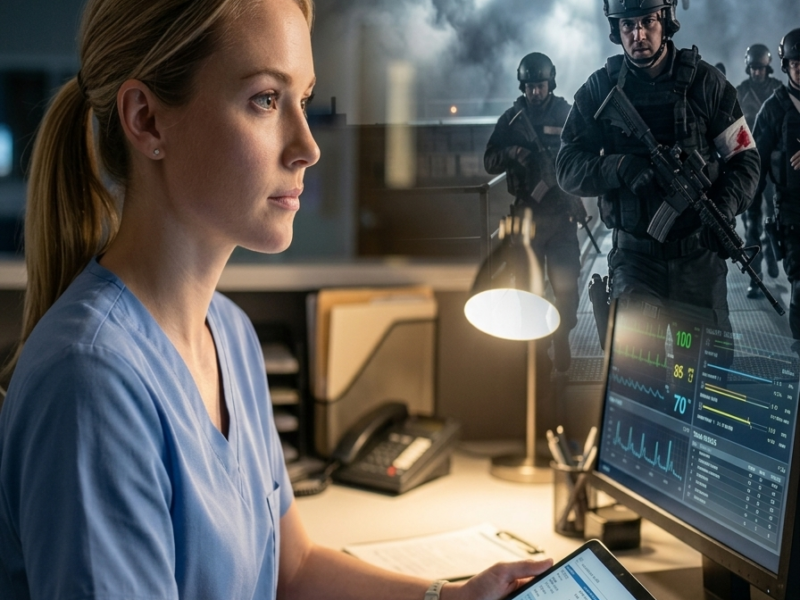
“They stuck the rookie nurse with the worst shift,” my supervisor laughed as she handed me the midnight trauma assignment, but three hours later
The rain fell against the frosted glass of Mercy General Hospital in long, greasy streaks that blurred the pine barrens of eastern North Carolina into a smear of black and gray. It was late autumn, the kind of damp, biting cold that settled deep into the concrete foundation of the county hospital and stayed there until March.
At the central nursing station of Trauma Wing B, the fluorescent overhead tubes buzzed with a flat, maddening hum. I was twenty minutes into charting fluid outputs for four elderly post-op patients when Evelyn Reed, the night-shift clinical coordinator, tossed a plastic clipboard onto the laminate counter in front of me. The clip hit the formica with a sharp clatter that echoed down the empty corridor.
“Trauma triage coverage,” Evelyn said, leaning against the divider with a smirk playing around the corners of her mouth. Her hair was pulled back into a severe, dyed-blonde knot, and her gold name tag caught the pale light: Evelyn Reed, RN, BSN – Operational Supervisor. “Congratulations, Harper. You drew the midnight line.”
I looked down at the assignment sheet. The emergency department was divided into three sections: general admissions, minor urgent care, and the trauma bay. The trauma bay was situated directly under the roofline of the old south wing, an outdated single-story architectural extension grafted onto the four-story brick main building back in the late nineteen-eighties. Nobody wanted to be back there on the graveyard shift. The heating vents rattled like dry bones, the supply closets smelled of damp mildew, and the walk back to the central pharmacy took a full four minutes through three sets of heavy fire doors.
“Evelyn, I’ve only been on the floor for six weeks,” I said, keeping my voice level, keeping my tone scrubbed of any emotion. Over the last three years, I had trained myself to speak in a quiet, neutral monotone that neither invited questions nor offered resistance. “The hospital orientation handbook says probationary staff aren’t supposed to cover solo trauma triage without a senior preceptor.”
Evelyn chuckled, a dry, dismissive sound that was entirely devoid of warmth. “The hospital orientation handbook was written for nurses who don’t have sudden, convenient gaps on their state license applications. You want to keep this job, Clara? You take the hours nobody else will touch. Davis called in sick with bronchitis, Miller is down in pediatrics managing an asthmatic child, and you’re the one sitting here breathing my air. Go down to south trauma, stock the crash carts, and count the narcotics in the sub-station. If the county dispatch sends in an auto wreck from the interstate, page the house resident. It’s not rocket science.”
She didn’t wait for an answer. She pivoted on the rubber heels of her white nursing shoes and strode toward the break room, her lanyard swaying against her hip.
I stared at the paperwork. My name was typed across the top in crisp, black dot-matrix ink: Harper, C. – Staff Nurse, RN.
Just Harper. Not Clara Harper. Certainly not the military rank that had preceded it seven years ago in another hemisphere, under skies that burned with yellow dust and chemical smoke.
I stood up, gathered my stethoscope and trauma shears, and pushed through the double swinging doors that led down the long, linoleum-tiled south corridor. The air grew immediately colder as I crossed the threshold into the old wing. Mercy General was a tertiary care facility operating on county grants and razor-thin operating margins; the heating units in the auxiliary corridors were routinely dialed down to fifty degrees after midnight to shave pennies off the regional utility bill.
The south trauma suite was cavernous, smelling faintly of bleach and oxidized copper. Six bay stations sat empty, their overhead surgical lamps hanging like enormous, dormant insects above vinyl-covered gurneys. At the far end of the room, a row of reinforced wire-glass windows looked out onto the ground-level ambulance apron and the concrete pillars of the multi-level parking deck that abutted the roof of the wing.
The digital clock mounted on the wall above the crash cart read 2:39 a.m.
I pulled on a pair of blue nitrile gloves, opened the steel supply drawer, and began running my fingers over the plastic casings of the intravenous catheters. Fourteen-gauge. Sixteen-gauge. Normal saline flushes. Tourniquets. My fingers moved across the sterile packaging with an automatic, uncanny speed that had disturbed my instructors during clinical trials. They had called it “natural aptitude.” They had praised my calm demeanor under pressure.
They didn’t know that my hands had packed abdominal cavities with combat gauze before my twenty-third birthday. They didn’t know that I had spent months learning how to forget that exact same muscle memory.
At 2:41 a.m., the building began to vibrate.
It was not the sharp, horizontal jolt of an earthquake. It was a rhythmic, bone-deep shudder that came through the soles of my shoes, vibrating through the concrete slab beneath the floorboards. The saline bags hanging from the metal IV poles swayed gently, their plastic hooks clicking against the aluminum rods.
Then came the sound.
It was a low, churning thunder that swallowed the wind, a deep, mechanical roar that seemed to fall straight out of the low clouds. It grew in volume with horrifying speed—not the high-pitched whine of a civilian medical chopper, but the heavy, air-shredding beat of twin turbine engines operating at catastrophic terminal thrust.
I dropped the IV supplies. My hands went flat against the cold stainless-steel counter.
Twin turbines. Four rotor blades. Sikorsky.
The realization hit my brain not as a thought, but as a visceral jolt of sheer terror that made the hair on the back of my neck stand on end.
Above my head, the acoustic ceiling tiles began to buckle. Dust, gray insulation foam, and dried mastic poured down into the bay like a dirty snowfall. Outside, the night sky turned from pitch-black to an incandescent, blinding sheet of yellow-white flame.
“Get down!” I screamed, though there was nobody in the room to hear me.
The reinforced wire-glass windows did not merely break; they disintegrated inward under a massive wave of superheated air and concussive pressure. A deafening, metal-rending screech tore through the structure as ten tons of olive-drab steel slammed through the roof of the upper parking structure directly above Trauma Bay 4.
The structural steel beams groan-screamed, bending like wire. Concrete chunks the size of engine blocks crushed through the ceiling, bringing down high-voltage electrical conduits, copper oxygen piping, and ventilation trunks in an avalanche of sparks and choking smoke. The blast wave lifted me off my feet, throwing me six feet across the floor until my back struck the reinforced concrete pillar near the triage desk.
The lights did not flicker; they were obliterated.
The world went dark, save for the roaring vortex of orange flame chewing through the twisted wreckage forty feet away. Sprinkler heads sheared off in the ceiling, dumping thousands of gallons of freezing, rust-brown water onto the flaming debris, creating blinding clouds of boiling white steam that hissed like a nest of vipers.
Through the ringing in my ears, through the deafening shriek of the fire alarms and the hiss of ruptured medical oxygen lines, a voice cut through the carnage.
It was a man’s voice—raw, gravelly, shredded by smoke, yet carrying the iron authority of a commander who had spent a lifetime shouting over artillery.
“Contain the perimeter! Secure the primary asset! Where is she?”
Metal boots crunched violently across shattered glass and broken drywall.
“Check the triage desk!” another voice yelled, younger, frantic, choked with blood. “The flight manifest put her on the midnight rotation! Where is Nurse Harper?”
I lay pinned against the concrete pillar, coughing violently as the acrid stench of burning JP-8 jet fuel flooded my lungs.
My heart hammered against my ribs like a trapped bird.
Harper.
I had not used that name on a military roster in seven years. To the hospital board, to the state licensing division, to the landlord who cashed my checks on the first of every month, I was Clara Harper—a quiet, unremarkable woman from rural Ohio with no living family and a blank four-year period on her tax records.
The soldiers in that burning wreckage were not calling for a civilian floor nurse.
They were calling for someone who was supposed to be dead.
I pulled myself onto my hands and knees, my palms slicing open on shards of broken glass. Through the billowing curtains of steam and burning fuel, the silhouette of a shattered aircraft materialized. It was an MH-60M Black Hawk—the heavily modified, radar-absorbent variant used exclusively by the 160th Special Operations Aviation Regiment. Its tail boom had been sheared clean off by the concrete parking deck parapet, its cockpit crushed against the load-bearing pillar of the trauma suite, its main rotor assembly wrapped in twisted girders like a dead spider.
A figure emerged from the torn cabin of the fuselage.
He wore scorched, flame-retardant flight gear stripped of all patches and rank insignia. A tactical plate carrier was strapped tightly across his broad chest, blackened with soot and dripping with fuel. His face was smeared with carbon and blood; his left arm hung limp at his side, clearly dislocated at the shoulder, while his right hand maintained a death grip on a short-barreled carbine.
He stumbled through the curtain of sparks, coughing heavily, his eyes wild and bloodshot as he swept the burning room.
When his gaze cut through the smoke and locked onto my face, he froze.
The carbine’s muzzle dropped two inches. The man took a ragged, uneven breath that ended in a wet, rattling gasp.
“Clara,” he whispered. Even over the deafening scream of the fire klaxons, the word struck me like a physical bullet.
He stumbled forward, his combat boots slipping in the mix of water and hydraulic fluid, collapsing onto one knee three feet from where I sat against the pillar. His hand reached out—gloved, burned, trembling with uncontrollable shock—and clamped onto my left wrist.
His grip was desperate, bone-crushing, the grip of a drowning man grabbing a rope.
“I don’t know you,” I gasped, pulling back against his weight, my back hard against the concrete. “I’m a civilian nurse! Let go of me!”
The soldier leaned in closer. Through the grime and the blood pouring from a jagged laceration across his forehead, I saw his eyes. They were a piercing, pale slate-gray, framed by lines of exhaustion that went deeper than physical fatigue.
“You’re alive,” he rasped, his voice breaking into a dry sob. “Jesus Christ… you’re actually alive. They told us… they told the entire regiment you died in the ditch outside Jalalabad.”
“Let go of me!” I shouted again, struggling to break his grip. “Who are you?”
He didn’t release my wrist. His fingers tightened, pressing into the radial artery of my arm, feeling the frantic, galloping beat of my pulse.
“You were supposed to die seven years ago, Harper,” he whispered, his face inches from mine, his breath smelling of copper and burnt electrical wire.
Before I could scream for help, another figure crawled out from beneath the crushed fuselage of the helicopter, shouting through the roar of the flames: “Cross! We’ve got structural collapse in the main corridor! The ceiling’s coming down! We need to move the package!”
The wounded man—Cross—never took his eyes off me.
He leaned forward until his lips were brushing the shell of my ear, and in a voice so low and steady it seemed to cut directly through the ringing in my skull, he spoke two words that shattered the silence of my carefully constructed world:
“Blue Lantern.”
The room seemed to tilt on its axis.
A wave of dizziness washed over me so violently that my vision went black at the edges. A cold, metallic taste filled the back of my mouth—the taste of old epinephrine, the taste of dry mountain dirt, the taste of adrenaline mixed with fear. The words were not just an operational name; they were a key turning in a lock that had been rusted shut for seven years inside my own brain.
“Stay here,” Cross commanded, releasing my wrist and struggling back to his feet using the edge of the crushed crash cart for leverage.
He turned back toward the flaming belly of the Black Hawk. He disappeared into the dense cloud of black smoke for five seconds, then re-emerged carrying a scorched, rectangular Pelican case sealed with heavy steel locking lugs. The exterior of the case was scorched black, its military serial numbers scratched out with a bayonet, but in the center of the lid, a small LED diagnostic panel was pulsing with a dull, rhythmic crimson glow.
Cross stumbled back to where I was kneeling, dropped to the wet floor, and shoved the heavy case directly into my arms.
“Open it,” he said.
“What is this?” my voice shook, my fingers trembling as they touched the hot plastic of the latches.
“Open it, Clara! Before the second wave arrives!”
My thumb hit the central release lever. The vacuum seal hissed open, releasing the faint, unmistakable smell of ozone, dried blood, and old paper.
Inside lay a single, laminated photograph, its edges curled by heat.
I pulled it out with shaking hands. The photograph had been taken under the harsh white glare of a field surgical tent. Nine people stood in two rows, wearing dust-covered desert multicam uniforms without unit patches. In the center of the front row stood Master Sergeant Aaron Cross, seven years younger, his arms crossed, a rare, confident smile on his face. Standing to his right, wearing a combat medic armband and a trauma vest that hung loose on her slender frame, was a twenty-two-year-old girl with dark hair and wide, hyper-alert eyes.
It was me.
Every single face in that photograph was familiar. The memories surged up like bile: Miller, the anesthesiologist who played harmonica; Dawson, the surgical tech from Texas; Vance, the team leader who never slept.
Every single one of them had been officially declared dead in the crash of an aeromedical evacuation flight over the Hindu Kush in October of 2017. Their names were carved into the black granite memorial wall at Fort Bragg.
Everyone was dead.
Except me.
“Look at the back,” Cross commanded quietly.
I turned the photograph over with numb fingers. Scrawled across the white backing in black permanent marker was a single handwritten line:
Operation Blue Lantern: All biological witnesses neutralized. Primary payload secured.
“What is this?” I whispered, looking up at him, tears of terror burning my eyes. “What did we do over there, Cross? What happened to us?”
“You didn’t survive that crash by accident, Clara,” Cross said, his slate-gray eyes boring into mine. “And they didn’t leave you alone for seven years out of mercy.”
“Step away from the case, Harper.”
The voice came from behind us, coming from the shadow of the doorway that led back to the central hospital corridor.
I froze.
Standing on the threshold of the burning trauma bay, completely untouched by soot or blood, was Evelyn Reed.
Her blonde hair was still neat. Her white uniform was spotless. But the clipboard was gone. In her right hand, held with the casual, practiced ease of someone who had fired thousands of rounds on a tactical range, was a black, suppressed SIG Sauer P229.
She was staring not at the burning helicopter, and not at the dying soldier beside me.
Her cold, blue eyes were fixed entirely on the scorched metal box in my lap.
“You were always so obedient, Clara,” Evelyn said, her voice smooth, calm, and utterly devoid of the petty supervisory malice she had displayed twenty minutes ago. “You took the midnight shifts. You never asked about the audit reports. You never checked the names on the regional VA procurement transfers. You were the perfect ghost.”
Evelyn raised the pistol, aligning the tritium night sights with the center of my forehead.
“You really shouldn’t have opened that box.”
The silence that fell between us was heavier than the roar of the fire chewing through the Black Hawk’s cabin. The only sound was the rhythmic, frantic drip of rusty water from the shattered sprinkler pipes and the dull, crimson blink of the Pelican case resting against my knees.
Cross moved before I could process the sight of my supervisor holding a suppressed handgun.
With a speed that defied the severe injuries tearing through his body, Cross pivoted on his right knee, his tactical carbine snapping up from the wet floor. The barrel locked onto Evelyn’s chest with mathematical precision.
“Drop it, Reed,” Cross growled. His voice was no longer that of a concussed crash survivor; it was the flat, lethal tone of an operator who had killed men in rooms smaller than this one. “Drop the weapon, or I put three rounds through your sternum before you can clear the trigger reset.”
Evelyn didn’t lower the gun. A faint, condescending smile curved her lips, though her pale blue eyes tightened as she evaluated Cross’s stance. She was a professional; she knew that even with a dislocated shoulder, a man trained in the special operations aviation cadre would squeeze the trigger before her nervous system could complete a reactionary squeeze.
“Sergeant Cross,” Evelyn said smoothly, her voice carrying an eerie, measured calm that chilled me far more than her weapon did. “I see you managed to survive the surface-to-air missile over the Cape Fear River basin. A truly remarkable piece of flying by your pilot. Too bad he’s currently burning to a crisp inside that cockpit.”
“Shut your mouth,” Cross spat, his knuckles white around the carbine’s pistol grip.
“Who are you?” I whispered, my voice trembling as I looked between the woman who had signed my timecards for six weeks and the bleeding soldier kneeling in front of me. “Evelyn… what are you talking about? What surface-to-air missile?”
“She isn’t a nurse, Clara,” Cross said without looking away from her. “She’s Directorate of Plans and Operations. Defense Logistics Agency Special Audit Branch. She was the logistics handler who signed off on the medical supply manifests for Blue Lantern seven years ago in Bagram.”
“Senior Inspector Reed, actually,” Evelyn corrected, her tone light, almost conversational, as if we were discussing a medication dosage error at a nursing station. “And you, Clara, were never supposed to wake up from that field hospital in Landstuhl. When they pulled you out of that ravine three days after the crash, the medical assessment said your retrograde amnesia was permanent. Complete traumatic memory dissociation caused by blast-induced closed-head trauma. The brass decided it was cleaner to leave you alive as a monitoring beacon than to stage another suspicious death within the medical group.”
My stomach lurched with a sickening, violent spasm.
A monitoring beacon.
Seven years of quiet, mundane life—the nursing school classes in Cleveland, the solitary apartment on the outskirts of Raleigh, the endless nights spent reading medical journals to drown out the nightmares I could never quite remember—had not been a recovery.
It had been an observation pen.
“You put me here,” I said, the realization rising in my throat like bile. “You assigned me to this shift tonight. You laughed when you gave me this assignment.”
“Of course I did,” Evelyn replied, her smile fading into a look of cold, bureaucratic detachment. “A low-observable extraction team was detected moving north from Fort Bragg four hours ago. We knew Cross had broken out of the holding facility at Camp Mackall. We knew he had the telemetry drive from the crash site. Where else was he going to go? You are the only person on earth who can authorize the final biometric decryption of that ledger. So, I placed you in the most isolated, indefensible sector of this hospital, cleared the floor of civilian staff, and waited for him to walk into the funnel.”
“She didn’t know anything, Evelyn,” Cross hissed, his breathing growing more labored, his chest hitching with each word. “She didn’t know what was in the box. You could have left her in the dark. She was out.”
“Nobody who touched Blue Lantern is ever out, Sergeant,” Evelyn said softly. “You know how this works. Forty-two billion dollars in unaccounted black-budget foreign military aid doesn’t simply vanish into the Afghan sand. The people who built that network are currently sitting in the Senate Armed Services Committee and on the boards of three major defense aerospace firms. They cannot allow a wandering medic with a restored memory to walk into a federal courthouse.”
Suddenly, the red LED on the scorched Pelican case changed.
The dull, slow pulse shifted to a rapid, high-pitched staccato chirp. The small liquid crystal display beneath the lens blinked with bright amber text:
PROXIMITY SYNC DETECTED. BIOMETRIC KEY IN RANGE. INITIATING ARCHIVAL AUDIO DECRYPT.
Evelyn’s eyes snapped to the box. The calm facade cracked, replaced by a flash of raw, desperate panic.
“Shut that off!” she shouted, her voice losing its composed modulation. “Harper, close that lid right now!”
“Don’t touch it, Clara!” Cross roared.
A click echoed from the internal speaker of the case. A thin hiss of magnetic tape static whispered through the wet room, followed by a sound that made every drop of blood in my veins turn to ice water.
It was my own voice.
Not the quiet, cautious voice of Clara Harper, the night-shift nurse. It was the sharp, exhausted, terrifyingly clear voice of twenty-two-year-old Captain Clara Harper, Combat Medic, 160th Joint Special Operations Medical Task Force:
“Log date: October 14, 2017. If you are hearing this recording, they lied about the crash. The bird didn’t go down because of an insurgent RPG. Colonel Vance ordered the auxiliary fuel tanks vented over the drop zone. They are executing the flight crew to cover the transfer of the—”
CLACK.
The sound came from the ceiling above the central corridor.
It was not the groaning of collapsing plaster. It was the sharp, heavy impact of steel cables dropping into elevator counterweights.
The high-pitched wail of the hospital fire alarms suddenly died.
The emergency amber backup lights in the hallway snapped off in unison, plunging the entire southern wing of the hospital into absolute, suffocating darkness. The only light remaining in the entire world was the fierce, crackling orange flame from the belly of the ruined Black Hawk and the pulsing red glow of the Pelican case between my knees.
Down the long corridor, three distinct, synchronized electronic chimes rang out through the blackness.
Ding.
Ding.
Ding.
The service elevators. All three cars had descended from the executive fourth floor and arrived at the ground-level trauma wing at the exact same second.
The heavy stainless-steel doors slid open with a smooth, oiled hiss.
From the black corridor came the sound of multiple footsteps—not the hurried, dragging gait of civilian doctors or panicked patients, but the synchronized, heel-to-toe crunch of combat boots moving in tactical formation. The distinct shhk-shhk of nylon load-bearing vests rubbed against weapons slings.
Evelyn did not look surprised. She slowly lowered her pistol, taking three cautious steps backward into the deeper shadows near the pharmaceutical closet.
“They’re here,” she whispered, and for the first time, I heard a genuine tremor of fear in her voice. She wasn’t their commander; she was just their advance spotter.
Cross didn’t look at the hallway. He grabbed me by the collar of my scrub top with his good right hand and dragged me violently behind the massive steel carcass of an industrial autoclave machine.
“Listen to me, Clara,” Cross hissed into my ear, his breath hot and ragged. “The people coming out of those elevators aren’t military. They’re Blackcell contractors from Ironclad Solutions. They are sanitizers. Their orders are zero-footprint. They will kill every nurse, every patient, and every orderly on this floor until that box is melted down.”
I clutched the heavy Pelican case against my chest. The metal was burning hot against my arms, the audio recording still hissing with my own past voice through the darkness.
“What do they want from me?” I choked out, tears of terror finally spilling over my eyelids. “Why me?”
Cross reached into his tactical vest, pulled out a spare magazine for his carbine, and clicked it into the receiver with a sickening, final snap.
“Because you didn’t just record that log, Clara,” Cross whispered, his slate-gray eyes reflecting the dying flames of the helicopter. “You stole the master decryption cipher. You hid the encryption keys inside your own biometric data profile before they wiped your brain. Without you alive to press your thumb against that scanner, the evidence is useless to them.”
From the dark corridor, a voice whispered through the smoke.
It didn’t come through a megaphone. It didn’t come with a shout. It was broadcast through a portable directional acoustic speaker that focused the sound directly into the room, making it sound as though the speaker was standing two inches behind my neck.
“Nurse Harper,” the voice purred, smooth, cultured, and terrifyingly familiar. “We know you’re in the bay. Put the box on the floor, Clara. Let’s finish the debriefing we started seven years ago.”
Beside me, Cross went completely still.
“Vance,” he whispered through gritted teeth. “The bastard came himself.”
The darkness of Trauma Bay 4 felt like a physical weight, pressing down on our lungs alongside the heavy soot of burning composite plastic. The only illumination came from the dying embers of the helicopter’s turbine housing, casting long, grotesque shadows across the shattered drywall and the pooling water on the floor.
“Move,” Cross whispered into my ear. “Back toward the maintenance corridor behind the utility shafts. If they catch us in the open bay, we’re fish in a barrel.”
“What about Evelyn?” I whispered back, my hands trembling against the cold steel of the autoclave.
“She’s already repositioning,” Cross muttered, his eyes darting through the smoke. “She won’t shoot until she knows where Vance wants the kill zone. Keep your head down and stay on my heel.”
We crawled on our bellies through the mixture of glass, fire-suppressant foam, and black water. The Pelican case was heavy, its sharp molded corners digging into my ribs with every inch I gained, but I held onto it with the desperate, unthinking grip of someone clutching their own severed limb.
From the main corridor, the tactical team advanced.
They moved with the horrifying, fluid grace of tier-one operators who had cleared thousands of structures across the globe. Four beams of high-intensity infrared and visible green laser light cut through the smoke, scanning the debris in overlapping sixty-degree sectors. The men behind the lights were ghosts in black tactical nylon, their faces hidden behind ballistic carbon-fiber masks, their carbines fitted with massive cylindrical suppressors that silenced the discharge to a dull mechanical click.
Pop-pop.
A burst of suppressed fire echoed from the far corner of the triage area. A wounded orderly who had crawled out from under a fallen ceiling beam went limp, his body slumping over the nurse’s desk with a wet thud.
They weren’t taking prisoners. They weren’t checking credentials.
My breath hitched in my throat. A scream of pure horror rose into my mouth, but Cross’s hand clamped down hard over my lips, muffling the sound against his bloody palm.
“Quiet,” he breathed, his slate-gray eyes wild and hard. “You scream, and they drop three frag grenades into this alcove. Swallow it, Clara. Remember who you are.”
Remember who you are.
The phrase struck a chord deep within the locked vaults of my subconscious. A sudden, violent flash of imagery tore through my mind: the smell of burnt flesh under the baking sun of the Helmand Valley; the rhythmic, mechanical click of surgical clamps being handed across a field operating table; the voice of a younger version of myself screaming over the deafening whine of helicopter rotors: Tension pneumothorax! Give me a fourteen-gauge needle, right now!
My hands stopped shaking.
The blind, paralyzing panic that had gripped me since the Black Hawk tore through the roof began to crystallize, hardening into the cold, detached situational focus of a combat trauma nurse. I looked at the floor around us: four crushed oxygen cylinders, copper pneumatic delivery lines dangling from the sheared ceiling, and a secondary electrical distribution panel three feet from the utility door, its breaker switches exposed and sparking against the wet concrete.
“Cross,” I whispered, reaching up to gently pull his hand from my mouth. “The oxygen main.”
He looked at me, his brow furrowing through the grime on his face. “What?”
I pointed with my thumb toward the wall behind the autoclave. The central hospital oxygen manifold—a heavy, four-inch copper pipe marked with bright green bands—had been partially ruptured by the falling concrete girders. A high-pressure jet of pure, gaseous oxygen was hissing violently into the confined space beneath the ceiling joists, pooling in the upper level of the room.
“Pure O2,” I murmured, my voice dropping into the steady, flat tone of an operative evaluating a field dressing. “It’s sitting right above their heads in the ceiling pocket. If you hit that electrical panel with a high-velocity round, the spark will turn this entire wing into a fuel-air bomb.”
A slow, grim smirk broke across Cross’s soot-stained face. “You really are the same Harper. You haven’t lost a step.”
“We have to clear the fire doors before it blows,” I said. “The maintenance stairs lead down to the sub-basement morgue and the industrial laundry. The walls down there are eighteen-inch reinforced poured concrete. It’ll hold the overpressure.”
“On my lead,” Cross whispered. “Three… two…”
He didn’t aim at the approaching operators. He rolled onto his back, raised his short-barreled carbine with his uninjured right arm, and squeezed the trigger twice directly into the exposed circuitry of the electrical distribution panel.
The heavy copper wires exploded in a blinding shower of blue-white electrical arcs.
The shower of sparks drifted upward, touching the invisible cloud of pure pressurized oxygen trapped against the ceiling.
The world vanished in a roar of blinding orange fire.
The overpressure wave hit us like a freight train, tearing the heavy autoclave from its floor mountings and sending it skittering across the tile. The ceiling collapsed entirely, bringing down twenty tons of concrete, steel decking, and flaming insulation in a deafening cascade that buried the three lead tactical operators in an avalanche of burning rubble. Screams of agony tore through the smoke as the contractors were crushed beneath the flaming girders.
Cross grabbed my tactical vest, hauling me backward through the bent steel frame of the maintenance fire door just as a massive fireball swept through the upper hallway, blistering the paint off the walls and blowing the remaining glass out of the south wing.
We tumbled down the dark, concrete stairs, bouncing off the walls, until we hit the cold, damp floor of the sub-basement.
The heavy fire door slammed shut behind us under the force of the blast wave, cutting off the worst of the heat, leaving us in the freezing, pitch-black silence of the hospital’s lowest foundation.
I lay on the concrete, clutching the Pelican case to my chest, my ribs aching, my ears ringing so loudly I could hear the high-pitched squeal of my own auditory nerves.
Cross was lying five feet away. He didn’t get up.
A wet, bubbling cough tore from his chest.
“Cross?” I scrambled over to him on my hands and knees, my fingers feeling blindly through the dark until they touched his vest.
The fabric of his combat shirt was soaked. Not with water. Not with hydraulic fluid. It was hot, thick, and smelled heavily of arterial iron.
I pulled my penlight from my scrub pocket, shielding the small beam with my fingers, and clicked it on.
The light illuminated a horrifying scene. A six-inch jagged shard of structural steel—sheared off during the roof collapse—was protruding from Cross’s right upper quadrant, buried deep between his eighth and ninth ribs. The skin around the puncture was already dusky, bruised, and bubbling with small pockets of pink, frothy blood.
“Sucking… chest wound,” Cross whispered, his lips turning blue in the pale LED beam. “Diaphragm’s… punctured. Hepatic artery… might be nicked.”
“Shut up,” I said, my voice dropping into the absolute, terrifying command of a lead trauma nurse. “Stop talking. Save your air.”
“Clara… the case,” he wheezed, his good hand weakly tapping the scorched plastic box on the floor between us. “The file… you have to open the final archive. If I flatline… the biometric sync… will default to you alone.”
“I am not letting you flatline, Sergeant,” I snarled, stripping off my scrub jacket and tearing it into long, wide strips with my trauma shears.
I looked around the dark basement. We were in the old morgue prep area, abandoned ten years ago when the hospital built the new pathological wing in the north tower. Stainless steel embalming tables stood like ghostly altars in the gloom, surrounded by rusted instrument trays, cabinets of formalin, and old suction pumps.
I needed chest seals. I needed a large-bore needle to decompress his pleural cavity. I needed sterile clamps.
And above our heads, through the concrete ceiling, the muffled, heavy vibrations of boots began to echo again.
Vance and his remaining cleaners hadn’t died in the explosion. They were regrouping. They were finding the stairwells.
And then, the intercom speaker on the wall above the morgue desk crackled to life with a burst of static.
“Clara,” Colonel Vance’s voice echoed down into the cold concrete chamber, calm, smooth, and intimately terrifying. “That was a very clever trick with the oxygen manifold. Truly, your tactical assessment remains exceptional. But you’re trapped in the basement, Clara. There are no exterior exits down there. Just thirty feet of earth and the dead.”
A pause, followed by the sound of a magazine being tapped against a helmet.
“I have your supervisor, Clara. Well… what’s left of her. Evelyn was quite talkative before she expired. She told me you still don’t remember the primary cipher. She told me you think you’re just an innocent girl who got caught in a storm.”
The speaker hissed.
“Come up the north elevator shaft, Clara. Bring the box. If you don’t, I will personally walk through the pediatric intensive care unit on the third floor, and I will disconnect every ventilator, one by one. You have seven minutes.”
The intercom speaker clicked off, leaving only the sound of Cross’s ragged, wet breathing echoing through the damp concrete vaults of the sub-basement.
“Don’t… don’t listen to him,” Cross wheezed, his fingers clawing at the concrete as his chest hitched with agonizing spasms. “He’ll… he’ll kill the kids anyway. That’s Vance. He leaves… zero footprint.”
“Be quiet,” I ordered, my hands moving with cold, mechanical efficiency.
I didn’t have an occlusive chest seal, so I took the plastic wrapper from a roll of old autoclave tape, smoothed it over the puncture wound in his chest, and taped down three of the four sides, creating a makeshift flutter-valve that allowed the trapped air and blood to hiss outward without being sucked back into his pleural space. Then I took a sixteen-gauge IV catheter from my pocket kit, found the second intercostal space along his midclavicular line, and drove the needle straight through the muscle wall into his chest cavity.
A loud, pressurized hiss of trapped air vented through the plastic cannula.
Cross let out a long, shuddering gasp as his collapsed lung partially re-expanded. The blue tint around his lips faded slightly, replaced by the pale, waxy gray of severe hypovolemic shock.
“Good… good hands, Harper,” he whispered, his eyes fluttering open. “Still got… combat hands.”
“Save your strength,” I said, leaning back against the steel pedestal of an old autopsy table.
My hands were covered in his blood. I stared down at my red-stained palms under the dim glow of the penlight.
And then, the dam broke.
It did not come as a gentle realization. It hit me like a physical blow to the back of the skull—a violent, sensory avalanche that shattered the seven-year wall of dissociative amnesia into dust.
Bagram Airfield. October 12, 2017.
I wasn’t a passive medic watching from the sidelines. I was Captain Clara Harper, Chief Medical Logistics Officer for the Special Operations Joint Evacuation Unit.
I remembered the smell of the briefing room: cheap burnt coffee, tobacco smoke, and the stale grease of tactical maps. I remembered standing across the metal table from Colonel Thomas Vance, watching him cross out flight manifests with a red grease pencil.
Forty-two billion dollars.
It wasn’t just foreign aid. It was the complete, unrecorded off-the-books financing for an entire shadow infrastructure—arms transactions through Eastern Europe, private contractor slush funds, covert biological extraction programs run out of unregistered black sites in the mountains along the Pakistani border. Blue Lantern wasn’t a rescue unit; it was the cleanup crew. Whenever a black site went hot or threatened to leak into congressional oversight, Vance sent our aeromedical evacuation birds in to “extract the wounded.”
Only the wounded never reached the hospital at Landstuhl.
They died in transit. Heart attacks. Pulmonary embolisms. Tragic complications from combat wounds.
And I had been the officer signing the death certificates.
Until the night I refused.
I remembered the screaming match inside the hangar at Bagram. I remembered downloading the entire encrypted logistics ledger onto a hardened tactical telemetry drive—every bank routing number, every assassinated whistleblower, every forged manifest bearing Vance’s signature. I remembered Cross standing by the door of the Black Hawk, his weapon drawn, holding off Vance’s private security team while I loaded the drive into the Pelican case.
“If we go down,” my younger self had whispered into the cockpit voice recorder as the helicopter lifted into the black Afghan night, “the cipher is keyed to my own genome. My retinal scan, my blood-type antigen sequence, my pulse frequency. They can’t open it without my body alive.”
We had taken a surface-to-air missile over the mountains three hours later. Vance had launched it from his own perimeter outpost.
I hadn’t forgotten because of a brain injury.
I had forgotten because when the rescue team pulled me from the burning snow three days later, Vance’s medical team had injected me with massive doses of scopolamine and experimental dissociative neuro-blockers, scrubbing my conscious mind like an erased hard drive, hoping the trauma would keep the cipher locked forever until they could figure out how to bypass the biological key.
They hadn’t left me alone out of mercy.
They had kept me alive because without me, the forty-two billion dollars remained frozen in Swiss holding accounts, locked behind an algorithmic door that required my living pulse to open.
“I remember,” I whispered into the dark basement.
Cross looked up at me, his slate-gray eyes wide with painful clarity. “Clara?”
“I remember everything, Aaron,” I said, using his first name for the first time. “I remember the hangar. I remember the flight. I remember what Vance did to the boys in the valley.”
I reached down and pulled the scorched Pelican case onto my lap.
The LED screen was still pulsing with its rapid amber light: BIOMETRIC KEY REQUIRED FOR FULL DATA DUMP.
I didn’t hesitate. I pressed my right thumb firmly against the optical glass scanner embedded in the latch.
The scanner flashed bright blue. A sharp, stinging prick bit into the meat of my thumb—a micro-needle drawing a microscopic bead of capillary blood to verify the genetic antigens.
A mechanical chime echoed through the case.
BIOMETRIC CONFIRMED: CAPTAIN CLARA HARPER, US ARMY MEDICAL CORPS.
DECRYPTING ARCHIVE 01 THROUGH 88.
SYSTEM READY FOR GLOBAL DISPATCH.
The lid clicked open fully. Inside was not just an audio recorder. Nestled in custom-cut foam was a military-grade satellite transponder link, its high-gain antenna folded flat against the casing, and an internal solid-state hard drive loaded with thousands of scanned documents, signed memorandums, and video logs.
Above us, the heavy iron door at the top of the stairwell groaned as an oxyacetylene torch began to cut through the hinges.
Sparks rained down through the crack in the concrete ceiling.
Vance was coming down.
“He… he said seven minutes,” Cross coughed, his hand reaching for the carbine lying beside his leg. “He didn’t… wait.”
“He never waits,” I said, my voice cold, calm, and utterly devoid of fear.
I looked at the satellite terminal. The screen displayed a single command prompt:
SELECT BROADCAST DESTINATION:
I didn’t select an internal military frequency. I didn’t select the Department of Defense. Vance owned those channels; any transmission sent to the Pentagon would be swallowed by the same Directorate officers who had funded Blue Lantern.
Instead, I used the terminal’s manual routing protocol to enter three distinct addresses: the public press distribution network of the Associated Press, the emergency operational queue of the Federal Bureau of Investigation’s Public Corruption Division, and the personal, unlisted secure terminal of the Chairman of the Senate Intelligence Committee—a man whose son had died in the Helmand Valley under Vance’s command seven years ago.
TRANSMISSION READY. AWAITING FINAL EXECUTION COMMAND.
“Clara,” Cross breathed, his vision fading as his blood pressure plummeted. “If you… send that… Vance will kill everyone in this building to contain it.”
“No, he won’t,” I said, standing up from the concrete floor.
I picked up Cross’s sidearm—a blackened Beretta M9 with two magazines remaining in his pouch—and racked the slide with a crisp, practiced metallic snap.
“He won’t kill anyone else in this hospital,” I said, looking up at the burning sparks falling from the top of the stairwell. “Because he’s not leaving this basement alive.”
The heavy steel fire door at the top of the concrete stairs gave way with a thunderous crash, tumbling down the flight of steps in a shower of orange sparks and pulverized masonry.
Silence followed.
Then, two flashbang grenades arced through the open doorway, bouncing down the concrete risers before detonating in the stairwell with a blinding white flash and a concussive roar that rattled the water pipes along the foundation.
I was already behind the secondary bulkhead wall of the old morgue refrigeration vault, my hands clamped over my ears, my mouth open to equalize the pressure.
Through the thick, gray smoke that drifted down the stairwell, three operators entered.
They were not rushing. They moved in a wedge formation, their suppressed weapons held tight against their shoulders, their weapon lights cutting through the darkness in disciplined, overlapping sweeps. Behind them, stepping calmly through the debris with an unbuttoned tactical trench coat over an immaculate charcoal suit, walked Colonel Thomas Vance.
He had aged. The hair at his temples was silver now, trimmed with military precision, and his face carried the smooth, sun-tanned polish of a high-level Washington lobbyist. But the cold, dead detachment in his pale eyes had not changed in seven years.
He stepped onto the basement floor, his expensive Italian leather shoes clicking softly against the wet concrete.
“Clara,” Vance said, his voice echoing smoothly off the vaulted brick ceiling. “You don’t have to die down here in the dark with the dead. You were an exceptional officer. You had a brilliant mind. You simply lacked the strategic vision to understand that nations are built on blood and commerce, not sentimentality.”
The three operators spread out, sweeping their weapon lights toward the old autopsy bays.
“Where is the box, Clara?” Vance asked, taking a slow step toward the center of the room. “Give me the box, and I will personally ensure Sergeant Cross is transported to Walter Reed for top-tier thoracic reconstruction. He might even survive the night. But if you force my men to search this room, I will have them drop thermite charges down the main ventilation shafts of the pediatric wing. Three hundred innocent people, Clara. Their blood will be on your hands, not mine.”
From the shadows behind the rusted industrial autoclave, a voice answered him.
“You always were a terrible negotiator, Thomas.”
Vance stopped. His eyes narrowed.
Step by step, I walked out of the darkness of the morgue vault into the center of the room.
I wasn’t holding the box. I wasn’t holding the gun in my hands. My hands were held high, open, empty, coated in dried blood and gray soot.
The three operators immediately snapped their weapon lights onto my chest, the blinding white beams pinning me against the dark concrete wall like a specimen on a dissecting table.
“Look at you,” Vance said softly, a thin, patronizing smile touching his lips. “The great Nurse Harper. Resigned to the inevitable.”
“The transmission finished three minutes ago, Vance,” I said.
The smile on Vance’s face vanished. The muscles along his jaw tightened into stone. “What did you say?”
“The global broadcast,” I said, my voice steady, ringing clear and cold through the damp vault. “Every ledger. Every offshore shell corporation in Cyprus and Zurich. Every audio recording of you giving the drop coordinates for the mortar strike on our own field hospital in the valley. It went out over the commercial satellite uplink to the Associated Press, the Senate Oversight Committee, and the FBI’s Washington Field Office.”
“She’s bluffing,” the lead operator hissed, his weapon steady on my forehead. “The sat-link takes ten minutes to handshake with the constellation.”
“Not when you have the primary military bypass ciphers,” I replied, never taking my eyes off Vance. “You taught me that protocol yourself, Colonel. At Bagram. Before you tried to melt my brain with scopolamine.”
Vance’s face twisted into an expression of pure, unadulterated venom. The suave, aristocratic mask dissolved, revealing the rabid, cornered animal beneath.
“Kill her,” Vance snarled, stepping back toward the stairwell. “Kill her and burn everything in this room to the foundation!”
The lead operator’s finger began to squeeze the trigger of his suppressed carbine.
He never finished the movement.
From the dark shadow beneath the nearest stainless-steel autopsy table, a gun roared.
BANG-BANG-BANG.
Cross had dragged his shattered body across the floor, propping himself up against the heavy iron pedestal of the table, his Beretta locked in both hands. The three heavy nine-millimeter hollow-point rounds slammed into the lead operator’s pelvis and lower abdomen beneath his tactical plate carrier, tearing through the femoral artery and dropping him to the concrete with a choked, bubbling scream.
In the split second of chaos—as the other two operators swung their barrels toward the flash—I moved.
Seven years of suppressed reflexes exploded into motion. I lunged forward, grabbed the fallen operator’s discarded carbine by the barrel shroud, and swung the heavy aluminum receiver with all my strength into the side of the second operator’s knee.
The joint broke with a sickening, wet crunch.
As the man stumbled, I drove the steel flash hider of the barrel upward under the lip of his ballistic helmet, catching him squarely beneath the jaw with concussive force. He collapsed backward into the pool of water, his weapon skittering away into the dark.
The third operator pivoted, his muzzle swinging toward my chest.
BANG.
A single shot cracked from the shadows behind the morgue desk. The bullet took the third man through the side of the neck, severing the carotid artery. He dropped to his knees, his hands clawing at his throat, before slumping face-down onto the concrete floor.
Silence returned to the basement.
The air smelled of cordite, blood, and burning hydraulic fuel.
I stood in the center of the room, holding the captured carbine, my breathing slow, rhythmic, and deep.
At the base of the stairwell, Colonel Thomas Vance was crawling backward up the concrete steps, his designer suit torn, his hands slipping in the blood and water pooling on the risers. He reached into his coat pocket, his fingers frantically clawing for a concealed backup pistol.
I didn’t shout. I didn’t hesitate.
I raised the carbine, took one step forward, and fired a single round through his right shoulder.
The heavy five-point-five-six slug tore through his collarbone, pinning him violently against the concrete wall of the staircase. The small pistol flew from his fingers, clattering down the steps and splashing into the bloody water at my feet.
Vance slumped onto the bottom step, clutching his shattered shoulder, his face white with shock and agony. He looked up at me through the drifting smoke, his eyes wide with disbelief as he stared down the barrel of the weapon held by the woman he had tried to erase from existence.
“Clara…” Vance choked out, blood leaking through his expensive silk tie. “You… you can’t do this. I have clearances… I have immunity protocols signed by the Joint Chiefs… you don’t know what you’ve unleashed…”
“I know exactly what I’ve unleashed, Thomas,” I said, stepping until the hot muzzle of the carbine was resting against the center of his forehead.
“You’re a nurse,” he whispered, his voice trembling with pathetic, desperate pleading. “You took an oath. To do no harm.”
“I was a soldier before I was a nurse,” I said softly. “And my oath was to the men you burned in the sand.”
Before I could squeeze the trigger, a hand reached out from the darkness behind me and touched my ankle.
It was Cross.
He was propped against the base of the autopsy table, his skin gray, his uniform soaked in crimson, but his slate-gray eyes were clear, steady, and filled with an ancient, weary wisdom.
“Don’t, Clara,” Cross whispered, his voice barely audible over the hum of the distant emergency generators. “Don’t give him a soldier’s death. Let the world see what he is. Let him die in a federal prison cell with his name stripped from the wall.”
I looked down at Cross. Then I looked down at the shivering, pathetic man pinned beneath my rifle.
Slowly, deliberately, I lowered the barrel.
From above our heads, the sound of multiple sirens began to echo through the shattered roof of the hospital. The high-pitched wail of state police interceptors, the heavy thrum of county tactical units, and the deep, air-shredding beat of federal helicopters descending upon the hospital grounds filled the night air.
The world had received the transmission.
I stepped back from Vance, walked over to Cross, and dropped to my knees beside him. I pulled off my torn scrub shirt, pressed it firmly against his bleeding chest wound, and took his cold, calloused hand in mine.
“Hold on, Aaron,” I whispered, my voice breaking with the first genuine tears I had shed in seven years. “The MEDEVAC is coming. The real one.”
Cross looked up at me, a faint, tired smile touching his bloodied lips.
“What’s… what’s your name, Captain?” he murmured, his eyes slowly closing as the sound of boots and shouts echoed down the upper corridors.
I turned my face toward the gray morning light that was beginning to filter through the shattered ceiling of Trauma Bay 4, illuminating the dust and the smoke in beams of pale, golden light.
“Harper,” I said, my voice strong, steady, and finally whole. “My name is Captain Clara Harper. And I’m going home.”
The end.









