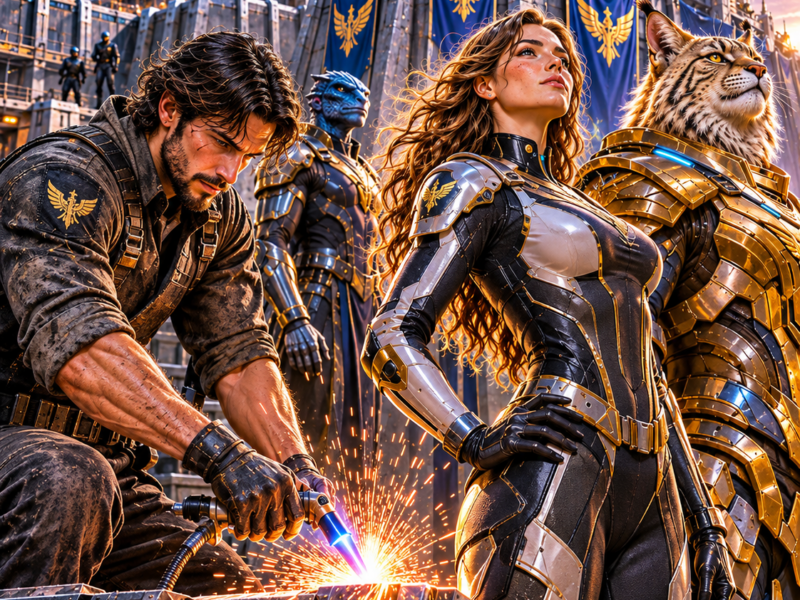
“They sent me to die at Outpost Seven, laughing as they handed me a broken rifle and a one-way transport ticket
I stared at the communications screen.
The admiral’s face appeared through the static, older than I remembered, with deep lines around his mouth and a fresh scar running along his left temple.
Admiral Richard Kane.
The man who had personally signed my reassignment orders.
The man who had told the review board that I was too stubborn to serve in the Terran Defense Corps.
And apparently, the man who knew exactly what was buried beneath my feet.
“Michael, do you understand me?” he demanded.
I leaned closer to the microphone.
“Actually, Admiral, I’m hoping you can explain a few things.”
“There’s no time.”
“Funny. You’ve had six months.”
His expression tightened.
Behind me, Commander Serah Voss stepped into the command room.
She had dismissed her soldiers outside, but kept one hand close to the weapon attached to her belt.
“Admiral Kane,” she said.
The old man’s eyes widened.
“Commander Voss? What are you doing at that installation?”
“Apparently, asking the same question as your human.”
Kane ignored her.
“Michael, listen carefully. The structure beneath Outpost Seven must not be activated.”
I glanced at the tactical display.
The red markers were getting closer.
“That’s an interesting request from a man who sent me to maintain an abandoned station without mentioning an underground structure.”
“It was classified.”
“So was the fact that this planet is crawling with Kharvax warships?”
Kane rubbed his forehead.
“Your assignment was designed to keep you away from the main defense network.”
I stopped moving.
“Why me?”
The admiral looked away.
For a moment, the only sound in the room was the low hum of the generator.
Then he said something I wasn’t prepared to hear.
“Because your father built what is down there.”
My hand tightened around the edge of the console.
My father had been dead for eighteen years.
He had been an engineer.
Not a famous military commander or a decorated hero.
Just a man who used to bring home broken radios and let me take them apart at the kitchen table.
I remembered his grease-stained hands.
I remembered the way he used to tell me that every machine had a personality.
And I remembered the night a government transport arrived at our house and took his equipment away.
My mother told me it was a routine military transfer.
I never saw most of his work again.
“What did he build?”
Kane took a breath.
“The Aegis.”
Serah moved closer to the screen.
“That designation is a myth.”
The admiral’s expression darkened.
“It was never a myth.”
He opened a document.
A holographic diagram appeared above the command table.
It showed Vesper-9 from orbit.
Beneath the planet’s surface was an enormous network of interconnected structures.
Power conduits.
Shield generators.
Underground stations.
And something much larger at the center.
It looked like a metal sphere surrounded by six concentric rings.
“Your father designed a planetary defense system,” Kane explained. “Not a conventional shield. A self-sustaining defensive architecture capable of protecting an entire world.”
I studied the diagram.
“Why was it abandoned?”
“Because it was too powerful.”
Serah folded her arms.
“That is not an answer.”
“The system can redirect energy from almost any source. A star, a fusion reactor, even the power output of an attacking fleet.”
I looked at the display again.
The central sphere was enormous.
“And what happens when it has enough energy?”
Kane hesitated.
“It can create a defensive barrier around an entire planet.”
“That sounds useful.”
“It can also generate enough concentrated energy to destroy an entire fleet.”
I looked at him.
There it was.
The reason.
A weapon disguised as a shield.
Serah approached the table.
“How did the Kharvax learn about it?”
Kane’s jaw tightened.
“Someone inside our military sold the coordinates.”
The commander stared at him.
“Who?”
“We don’t know.”
I gave a short laugh.
“Of course you don’t.”
Kane leaned toward the camera.
“Michael, I need you to understand something. If the Kharvax activate that system before we establish control, they could turn the entire planet into a weapon.”
I looked toward the window.
Outside, the first enemy ships were moving over the northern ridge.
“Then why did you leave me here?”
The admiral didn’t answer.
“Why send one engineer to a dead outpost instead of an entire military division?”
His eyes shifted.
That was when I understood.
“You didn’t send me here to keep me away from the Aegis.”
Kane remained silent.
“You sent me here because you knew I’d eventually find it.”
His face changed.
“Your father left a command sequence that only someone with his engineering knowledge could understand. We believed you might be able to complete it.”
I stared at him.
“You used me.”
“Michael—”
“You gave me a broken rifle and a one-way ticket to a planet where half the equipment didn’t work.”
“We had to keep the operation secret.”
“You could have told me.”
“And risked the intelligence leak reaching the Kharvax?”
I stepped away from the console.
For the first time in months, I didn’t feel angry about being sent to Vesper-9.
I felt something worse.
I felt like my father had been turned into a reason for someone else’s decisions.
Serah watched me carefully.
Then she turned toward the admiral.
“Your fleet is coming?”
Kane nodded.
“Three Terran battle groups are preparing to enter the system.”
“How long?”
“Approximately four hours.”
Serah glanced at the tactical display.
The Kharvax fleet would reach the outpost in less than twenty minutes.
“Then your people will arrive in time to find a crater.”
Kane looked at me.
“Michael, you need to hold the station until our forces arrive.”
I looked at the admiral.
Then at Serah.
Then at the fortress I had spent six months building.
“Admiral, I have a question.”
“What?”
“Did you ever read the original Aegis design notes?”
Kane frowned.
“Of course.”
“All of them?”
“Michael, this isn’t the time.”
I smiled faintly.
“Then you probably missed the interesting part.”
I cut the transmission.
Serah stared at me.
“You just ended a conversation with the leader of your military.”
“He’ll survive.”
“You have no idea what you’re doing, do you?”
“Not completely.”
I brought up the fortress schematics.
“Come look at this.”
She approached the display.
I highlighted the old power grid.
Then the underground network.
Then the defensive structures I had spent months repairing.
The original Aegis architecture had been designed to use the planet’s geothermal energy.
But the system had a weakness.
It needed a massive central power source to activate.
Without one, the entire network was dormant.
I had spent six months repairing the outpost.
I had also connected the generator to the old mining grid.
The mining grid was connected to the underground conduits.
And those conduits ran directly to the central Aegis chamber.
I tapped the display.
“See this?”
Serah narrowed her eyes.
“Your generator?”
“Yes.”
“That small machine?”
“That’s what I thought.”
I enlarged the schematic.
The generator had been connected to an old geothermal relay.
The relay had been dormant for years.
But once I restored the power grid, it had begun drawing energy from deep beneath the valley.
The generator wasn’t powering the underground system.
The underground system was slowly charging the generator.
Or more accurately, using it as a control interface.
Serah studied the readings.
“That’s impossible.”
“That’s what I said.”
“How much energy has accumulated?”
I checked the display.
The number was larger than it had been the previous night.
Much larger.
“Enough to power the local shield network.”
“Can you activate it?”
“Probably.”
She looked at me.
“Probably?”
“Commander, I’m an engineer, not a miracle worker.”
A loud impact shook the building.
The tactical display flashed.
ENEMY ARTILLERY LOCK ACQUIRED.
Serah straightened.
“They’re targeting the command structure.”
I looked at the approaching fleet.
“Then we’d better move the command structure.”
She blinked.
“What?”
I opened the underground map.
There was an old maintenance bunker beneath the western ridge.
It had been designed to survive direct orbital bombardment.
I had converted it into a backup command center during my first month.
“How many soldiers do you have?” I asked.
“Seven.”
“How many can fight?”
“All seven.”
“Good. I have some work for them.”
The first bombardment hit before we reached the bunker.
The sky turned white.
A wave of heat rolled through the valley.
My newly reinforced outer wall absorbed the impact, but the shockwave rattled every window in the command building.
Serah grabbed my arm.
“Move!”
We ran.
Behind us, another blast struck the northern watchtower.
The entire structure collapsed into the valley.
I reached the maintenance entrance and punched in the emergency code.
The reinforced doors slid open.
“Inside!”
The seven Kharvax soldiers entered first.
Serah followed.
I was the last one through.
The blast door sealed just as the next artillery strike hit.
The bunker trembled.
Dust fell from the ceiling.
A warning light flashed above the entrance.
Serah looked at me.
“Your fortress will not survive repeated orbital bombardment.”
“You’re right.”
I opened the tactical display.
“That’s why I didn’t build it to survive orbital bombardment.”
She frowned.
“What did you build it to survive?”
I tapped the underground map.
“Everything that comes after.”
The Kharvax fleet moved into attack formation.
Their ships formed three layers above the valley.
The largest vessel, a command carrier, hovered directly over Outpost Seven.
A holographic projection appeared in the bunker.
An alien commander emerged.
He was enormous, with black armor covering his chest and shoulders.
His face was covered in scars.
“Commander Voss.”
Serah stood.
“General Tharok.”
The general’s golden eyes narrowed.
“You have exceeded your authority.”
“I am conducting a territorial inspection.”
“You have been ordered to return to the fleet.”
Serah didn’t answer.
Tharok looked toward me.
“Is that the human?”
I raised my hand.
“Depends who’s asking.”
The general’s expression darkened.
“You occupy a world belonging to the Kharvax Empire.”
“Funny. Your paperwork must have gotten lost. The sign outside says Terran Defense Territory.”
“Your people abandoned this installation.”
“We do that sometimes. We also come back.”
Tharok leaned closer.
“Your walls will fall within minutes.”
I glanced at the tactical display.
“That’s what the last guy said.”
The general raised one hand.
A countdown appeared.
ORBITAL STRIKE IN 60 SECONDS.
Serah looked at me.
“Can you activate the shield?”
“Not from here.”
“Then what are we waiting for?”
I opened the maintenance console.
“Thirty seconds.”
The countdown reached forty.
The bunker lights flickered.
I typed the first command.
Then the second.
A warning appeared.
AEGIS SYSTEM: PARTIAL ACCESS.
I tried the third.
COMMAND AUTHORIZATION REQUIRED.
I stared at the screen.
“Come on.”
Serah stepped closer.
“What is it?”
“Your friend up there is about to turn my roof into a swimming pool.”
“Michael.”
I glanced at her.
She pointed at the screen.
“What does it need?”
I read the message again.
PRIMARY ENGINEER AUTHORIZATION: CARTER BLOODLINE REQUIRED.
I stared.
“My father’s system.”
Serah looked confused.
“Then use his authorization.”
“I don’t have it.”
The countdown reached twenty.
I searched through the old files.
My father had left a series of encrypted engineering notes.
Most were unreadable.
But one file had a handwritten title.
FOR MICHAEL.
I opened it.
A voice filled the bunker.
My father’s voice.
“Hey, kiddo. If you’re hearing this, then you’ve found the Aegis.”
I stopped breathing for a moment.
His voice was older than I remembered.
Tired.
But warm.
“I know the military will probably tell you this system is a weapon. They aren’t entirely wrong. It can destroy an attacking fleet. But that isn’t why I built it.”
The countdown reached fifteen.
My father’s recording continued.
“I built it because I wanted people to have somewhere safe to stand when the universe decided to become cruel.”
A second screen appeared.
A command sequence.
And beneath it, a final message.
THE AEGIS DOES NOT OBEY BLOOD. IT OBEYS INTENT.
I stared at the words.
Then I understood.
My father hadn’t created a genetic lock.
He had created an ethical one.
The system required a conscious authorization from someone who understood what it was designed to protect.
I placed my hand against the control panel.
“I authorize defensive activation.”
The display flashed.
INTENT CONFIRMED.
The countdown reached five.
Four.
Three.
Two.
One.
The bunker shook.
But the impact never came.
Instead, a deep humming sound rose from beneath the planet.
The lights turned blue.
A vast energy field spread across the valley.
Then the mountains.
Then the horizon.
The entire planet was surrounded by a shimmering barrier.
The Kharvax artillery struck it.
The weapons exploded harmlessly against the shield.
In the bunker, nobody spoke.
Serah slowly lowered her head.
“What have you done?”
I watched the tactical display.
The Aegis was online.
And the fortress was only the beginning.
The enemy fleet repositioned immediately.
Their command carrier moved farther from the planet.
The smaller ships spread out, searching for a weakness.
General Tharok appeared again.
His expression had changed.
“You have activated an illegal Terran superweapon.”
I leaned toward the screen.
“Technically, it’s a defensive system.”
“Lower the shield.”
“No.”
“You are interfering with Kharvax sovereign territory.”
I laughed.
“You’re still using that line?”
Tharok’s eyes narrowed.
“Your shield cannot remain active indefinitely.”
He was right.
The Aegis was drawing power from the planet’s geothermal network.
The shield could last for days, perhaps longer.
But the system had a limit.
I checked the energy readings.
The current output was stable.
However, the enemy fleet was beginning to concentrate its weapons against one section of the barrier.
They were testing it.
And every impact forced the Aegis to redirect power.
Serah studied the display.
“They will eventually overload the shield.”
“Not if I change the energy distribution.”
I opened the network map.
The original system had six main power nodes.
I had spent months repairing three.
The other three were buried beneath the mountains.
They were inaccessible through the old maintenance routes.
But there was another possibility.
The mining tunnels.
I looked at the commander.
“How much do you trust your soldiers?”
She didn’t hesitate.
“With my life.”
“Good. I need them to do something unpleasant.”
She raised an eyebrow.
“How unpleasant?”
“Very cold, very dark, and probably full of angry wildlife.”
One of her soldiers spoke from the corner.
“We are Kharvax. We do not fear wildlife.”
A loud scraping noise echoed through the bunker.
The soldier glanced toward the ceiling.
I smiled.
“Good. You’ll get along fine.”
We split into three teams.
Serah led one group through the eastern tunnel.
Her second-in-command, a broad-shouldered warrior named Rakk, took the western route.
I went toward the central power node with the remaining soldiers.
The tunnels had been built decades earlier by mining companies.
They were narrow, unstable, and full of abandoned machinery.
In several places, the ceiling had collapsed.
We had to climb over piles of rock and squeeze through gaps barely wide enough for our armor.
Halfway through the central passage, the lights flickered.
A warning appeared on my wrist display.
“Movement detected.”
I raised my hand.
The soldiers stopped.
Something shifted in the darkness.
Then two yellow eyes appeared.
The six-legged creature from my first night emerged from behind a pile of equipment.
It stared at me.
I stared back.
“Well, look who it is.”
The creature chirped.
One of the Kharvax soldiers raised his rifle.
“Don’t.”
“That animal is approaching.”
“He’s harmless.”
The creature opened its mouth and stole the ration pack from my belt.
I sighed.
“Mostly harmless.”
The soldiers exchanged confused looks.
I continued toward the power node.
The chamber was enormous.
A massive circular machine occupied the center.
Its outer ring had stopped rotating decades earlier.
I approached the control console.
“Let’s wake this thing up.”
One of the soldiers examined the damaged conduits.
“These connections are ancient.”
“Ancient doesn’t mean broken.”
I connected the portable power unit.
The machine shuddered.
Then the outer ring began turning.
A blue light spread across the floor.
NODE TWO: ONLINE.
I smiled.
Two more to go.
The next hour was the hardest.
The eastern team encountered a collapsed passage.
The western team found an active geothermal leak.
Rakk’s armor was damaged by the heat, but he refused to retreat.
Serah’s group managed to reach the second node.
By the time all three nodes were online, the shield had stabilized.
The enemy fleet noticed immediately.
Their concentrated bombardment stopped making progress.
But General Tharok wasn’t finished.
A new signal appeared.
Serah’s face changed.
“What is that?”
I zoomed in.
A large vessel had separated from the main fleet.
It was heading directly toward the planet.
Not firing.
Not broadcasting.
Just approaching.
Then I recognized its design.
A Terran military ship.
Its identification code belonged to the Third Defense Fleet.
I opened the channel.
“Terran vessel, identify yourself.”
A familiar voice answered.
“Outpost Seven, this is Admiral Kane.”
I rubbed my forehead.
“Admiral, you have terrible timing.”
His expression appeared on the screen.
He looked relieved to see me.
“Michael. Thank God.”
“Don’t start.”
“We have arrived with three battle groups.”
I checked the tactical display.
The Terran fleet was impressive.
Dozens of ships.
Hundreds of fighters.
But something was wrong.
Their weapons were already charging.
I turned toward Serah.
“Can you identify their target?”
She scanned the display.
Her expression hardened.
“They’re locking onto the Aegis network.”
I stared at the admiral.
“What are you doing?”
Kane’s voice became formal.
“By order of the Terran Defense Council, the Aegis system is now under military command.”
I laughed once.
“You’ve got to be kidding.”
“Stand down, Michael.”
“No.”
“That system belongs to the Terran government.”
“My father built it to protect people.”
“Your father built it without understanding the political consequences.”
I looked at the weapons charging on the Terran ships.
“You’re going to attack the shield?”
“We are going to seize the facility.”
“There’s an entire planet beneath that shield.”
“Then you should lower it.”
I stared at him.
Now I understood.
The Kharvax wanted the Aegis because they wanted a weapon.
The Terran military wanted it because they wanted control.
And neither side cared what happened to the people standing between them.
Serah stepped beside me.
“Michael, if the Terran fleet fires, the Kharvax will retaliate.”
“Then we need to stop both fleets.”
She looked at me.
“How?”
I studied the Aegis schematic.
The six power nodes were online.
The shield was stable.
But there was another feature.
A command buried deep within the original architecture.
I enlarged the diagram.
NONLETHAL ENERGY REDIRECTION.
My father had designed the Aegis to absorb incoming energy and redirect it.
Not just around the planet.
Beyond it.
I looked at Serah.
“Can your ships communicate with the Kharvax command carrier?”
“Yes.”
“Can you open a shared channel?”
She nodded.
I contacted both fleets.
The screen split into three sections.
Admiral Kane appeared on the left.
General Tharok appeared on the right.
I stood in the center.
“Michael Hayes,” Kane said. “You are committing treason.”
“Put it on my record.”
Tharok’s eyes narrowed.
“Why have you contacted me?”
“Because both of you are about to make a very expensive mistake.”
Kane leaned forward.
“Stand down.”
Tharok ignored him.
“The human has no authority to negotiate.”
“Maybe not,” I said. “But I control the system you’re both trying to steal.”
I opened the Aegis energy display.
A blue sphere appeared around Vesper-9.
Then six lines of light extended outward.
They connected to the enemy ships.
And the Terran fleet.
Serah looked at me.
“Are you sure about this?”
“No.”
She blinked.
“That is not reassuring.”
“Neither is having two fleets pointing weapons at our heads.”
I activated the energy redirection system.
The Aegis absorbed the power building inside the Terran weapons.
Then it absorbed the energy from the Kharvax fleet’s charged artillery.
The power readings climbed.
The command room lights flickered.
A warning appeared.
ENERGY CAPACITY: 87%.
Then 91%.
Then 96%.
The system began to hum.
I felt the vibration through the floor.
Tharok shouted.
“What are you doing?”
I looked at him.
“Giving you both a chance to stop.”
The display reached 100%.
The Aegis released a pulse.
A vast wave of blue light expanded through space.
It passed through the enemy ships.
Their weapons went dark.
Their engines shut down.
Their targeting systems disconnected.
Every warship in the surrounding space fell silent.
No explosions.
No casualties.
Just hundreds of millions of dollars’ worth of military hardware suddenly unable to fire a weapon.
For several seconds, nobody spoke.
Then Serah laughed.
It was a low, surprised sound.
I smiled.
“Not bad for an abandoned outpost.”
Tharok’s image returned.
His face was furious.
“You have attacked the Kharvax Empire.”
“No. I disabled your weapons.”
“That is an act of war.”
I leaned back.
“Then perhaps you should consider why you brought an army to a place guarded by one engineer.”
Kane’s voice interrupted.
“Michael, you will surrender the Aegis immediately.”
I looked at the admiral.
“You’re still missing the point.”
“What point?”
“This system isn’t yours.”
I touched the final command.
The Aegis transmitted its original design files to every ship in the system.
The entire research archive.
The ethical safeguards.
The original construction logs.
And the recorded testimony of my father.
No government could bury the truth after that.
The admiral stared at the display.
“What have you done?”
“Made sure everybody gets to read the instructions.”
The consequences began before the ships had fully regained power.
The Galactic Security Tribunal opened an emergency investigation.
The Kharvax Empire denied responsibility for the invasion, but their own fleet recordings told a different story.
The Terran Defense Council attempted to classify the Aegis files.
They failed.
The information had already reached civilian networks across twenty-three systems.
Within forty-eight hours, the first public hearings began.
Admiral Kane was suspended.
General Tharok was recalled to the Kharvax capital.
Commander Serah Voss was ordered to return to her fleet for questioning.
She refused.
Instead, she remained on Vesper-9 and gave testimony about the invasion.
She also provided evidence that the Kharvax military had been preparing to seize the Aegis for years.
For the first time in decades, both governments were forced to answer questions from people who had never been invited into their military meetings.
But the most important changes happened on the ground.
Vesper-9 was no longer considered strategically worthless.
The mining settlements in the southern valleys were evacuated back to their original homes.
The transport corridor was reopened.
The abandoned outpost became the center of a new planetary defense agreement.
And the Aegis was placed under independent civilian oversight.
No military commander could activate its offensive capabilities without approval from representatives of every colony it protected.
I insisted on that part.
My father’s design had been created to protect people.
I wasn’t going to let it become another instrument of control.
Three months after the battle, I stood on the southern wall of Outpost Seven.
The fortress looked nothing like the rusted collection of buildings I had found when I arrived.
Its outer walls were reinforced with alloy plating.
Six observation towers monitored the valley.
The shield generators glowed beneath the mountain ridges.
A new communications antenna stood above the command building.
And the main gate had been replaced with a reinforced structure that could withstand a direct orbital strike.
Serah approached.
She was no longer wearing her full combat armor.
Instead, she wore the dark uniform of the newly established joint security force.
“Your wall is crooked.”
I looked at her.
“It’s not crooked.”
“It is.”
“It’s an optical illusion.”
“Your engineering standards are questionable.”
I laughed.
“You spent three months helping me build it.”
“I was trying to improve it.”
“By insulting the person doing the work?”
She looked toward the valley.
“I am beginning to understand human construction methods.”
“That’s unfortunate.”
She smiled.
It was the first time I had seen her do that without immediately returning to a military expression.
A transport landed near the entrance.
A small group of settlers emerged.
They carried personal belongings, children, and boxes of supplies.
One little girl stopped when she saw the fortress.
“Is this where the soldiers live?”
I crouched beside her.
“Some of them.”
“Are you a soldier?”
I considered the question.
“Not anymore.”
She pointed toward the enormous shield generator.
“Did you build that?”
“Most of it.”
Her eyes widened.
“All by yourself?”
I looked toward Serah.
“Well, I had some help.”
The girl smiled.
“Are we safe here?”
I glanced at the mountains.
Beyond them, the Aegis network stretched beneath the entire planet.
For the first time, I could answer without hesitation.
“Yes. You’re safe here.”
She ran toward her parents.
Serah watched her go.
“That is what you wanted, isn’t it?”
I nodded.
“That’s why I stayed.”
Later that evening, a message arrived from the Galactic Security Tribunal.
The investigation had uncovered another file buried inside the Aegis archive.
It was a personal message from my father.
The system had been designed to release it only after the entire network was activated.
I opened the recording alone in the old command room.
My father’s face appeared.
He looked tired.
His hair was almost completely gray.
But he was smiling.
“Michael.”
I sat down.
“If you’re seeing this, then you’ve managed to bring the Aegis online.”
He paused.
“I wish I could have been there to see it.”
I looked at the floor.
“I know I made a lot of mistakes. I spent so much time trying to convince powerful people that a defensive system was necessary that I nearly forgot the most important part.”
He leaned toward the camera.
“A fortress is not defined by the thickness of its walls, son. It’s defined by the people who can sleep safely behind them.”
I swallowed.
“I hope you remembered that.”
The recording ended.
I sat in silence for a long time.
Then I saved the file.
Outside, the fortress lights illuminated the valley.
People were moving into the settlement.
Children were running between the buildings.
Engineers were repairing the transport station.
And somewhere beyond the mountain ridge, a new fleet was being assembled under the supervision of a joint civilian command.
I had arrived on Vesper-9 with two crates, a broken rifle, and a one-way ticket.
The people who sent me there believed they had removed a problem.
Instead, they had given me a planet to protect.
The next morning, a new transport arrived.
Its passengers included representatives from twelve different worlds.
They had come to discuss the future of the Aegis.
The delegation leader stepped onto the landing platform and looked toward the enormous fortress.
“Who is in command here?”
I was standing on the wall, tightening a loose section of armor plating.
I looked down.
“Depends what you need.”
“We were told to meet the human engineer.”
I wiped my hands on a rag.
“That’s me.”
The alien representative studied the fortress.
Then the shield generators.
Then the mountains.
“Is it true you built all this alone?”
I glanced toward the workers repairing the southern gate.
Toward Serah, who was arguing with an engineer about the placement of a new power conduit.
Toward the settlers who were carrying furniture into their homes.
I shook my head.
“No.”
The representative looked surprised.
I smiled.
“I built the first wall alone. Everybody else helped me build what it was protecting.”
A distant alarm sounded from the northern watchtower.
Everyone turned.
The tactical display showed an unidentified vessel approaching the system.
Serah walked toward me.
“Should we be concerned?”
I studied the incoming signal.
Then I recognized the transmission code.
It was an old Terran research vessel.
One that had disappeared eighteen years earlier.
My father’s ship.
I stood very still.
The vessel transmitted a single message.
REQUESTING PERMISSION TO LAND.
For a moment, I couldn’t hear anything except the wind moving across the fortress wall.
Serah looked at me.
“Michael?”
I stared at the screen.
The old transport record.
The escape pod.
The missing passenger.
All the unanswered questions.
Perhaps my father had never made it home.
Perhaps he had spent eighteen years trying to find a way back.
I opened the communications channel.
My voice came out quieter than I expected.
“This is Outpost Seven. You’re cleared to land.”
Then I walked toward the landing platform.
Behind me, the fortress stood against the mountains, its shield glowing softly beneath the evening sky.
For six months, I had built walls to keep an enemy out.
Now, for the first time, I was waiting for someone to come home.
The end.









