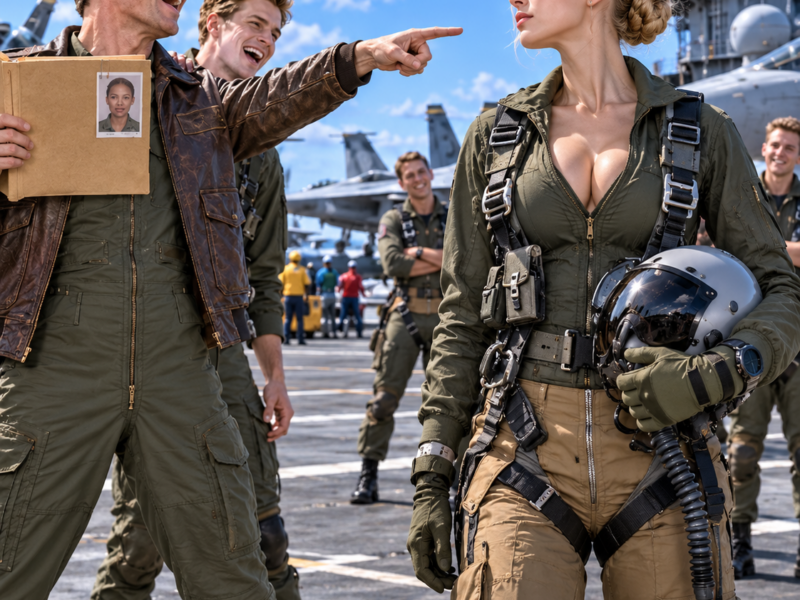
“They read my military record aloud in front of forty-seven people, laughed at the humiliating discharge notation, and told me I was lucky to be allowed anywhere near an aircraft
The missing symbol left a hole in the formation display.
I stared at the screen, listening to the emergency channel fill with overlapping voices.
“Falcon Actual, we just lost Two.”
“Say again, Two. Do you have visual?”
“Negative. Instruments are giving me two different positions.”
Daniel Price leaned over the console. His face had gone pale beneath the fluorescent lights.
“Rebecca, the track didn’t just disappear,” he said. “The system deleted it.”
I looked at him.
“Can you prove that?”
He nodded and began typing.
Across the operations room, Colonel Robert Whitmore was no longer smiling.
“Hayes, get away from that radio,” he ordered. “You are not cleared to direct aircraft.”
I kept my eyes on the display.
“Then clear me.”
“That isn’t how this works.”
“Neither is sending pilots into a navigation failure with a compromised relay.”
Whitmore stepped closer.
“You have no idea what’s happening out there.”
I almost laughed.
Six years ago, eleven people had heard those same words from a man who had been certain he knew better than me.
Eleven people had come home because I ignored him.
I pressed the transmit switch.
“Commander Hayes, this is Rebecca Hayes. I need the aircraft to stop following the automated formation track. Have every pilot switch to the emergency reference I’m sending now.”
A burst of static answered.
Then Commander Hayes came back.
“Falcon Actual, I need you to tell me why.”
“Because the navigation package is feeding your aircraft false positions. If you keep following it, you’re going to converge on coordinates that aren’t yours.”
“Can you prove that?”
“Not yet.”
“Then why should I trust you?”
I looked at the missing symbol.
“Because the last time I waited for proof, eleven people nearly died.”
The channel went quiet.
Whitmore reached for the radio.
I moved it out of his reach.
“Don’t.”
His jaw tightened.
“You’re making a serious mistake.”
“No, Colonel. I’m trying to keep someone else from making the same one.”
Daniel turned his monitor toward me.
“Rebecca. I found something.”
The screen showed a record of the navigation package’s revisions.
One entry had been made after the exercise began.
The authorization field carried a name I recognized.
Not mine.
Not Whitmore’s.
A name that should never have appeared anywhere near this operation.
“Who is that?” Daniel whispered.
I read it twice.
Then I understood why someone had gone to so much trouble to make sure my record was read aloud in front of forty-seven people.
“Get me the original file,” I said.
Whitmore looked over Daniel’s shoulder.
For the first time that morning, he seemed afraid.
“Shut that system down,” he said.
I turned toward him.
“Why?”
He didn’t answer.
And that was when I knew the missing aircraft wasn’t the only thing someone had erased.
Daniel copied the revision history to a separate drive.
His hands moved quickly, but his eyes kept darting toward Whitmore.
“Colonel, if this is what it looks like—”
“Stop talking,” Whitmore said.
The order landed hard enough to silence the room.
Outside, the wind pushed against the hangar doors. Somewhere beyond the walls, engines were still running.
I returned to the radio.
“Commander Hayes, do you copy?”
“Falcon Actual, go ahead.”
“I need you to confirm the last known position of aircraft Two using the pilots’ independent reports, not the formation display.”
A pause.
“Two reports a position west of the assigned corridor. Three says east. They’re not matching.”
“That’s the false track. Tell them to hold their current headings and maintain visual separation. No one follows the automated route.”
“You’re asking me to break the exercise formation.”
“I’m asking you to keep the aircraft from flying into each other.”
Another pause.
Then, quieter, “Understood.”
The channel clicked.
Daniel pulled up a second window.
“There’s a timestamp here,” he said. “The package was modified at 0917. But the authorization certificate says it was approved at 0842.”
“Can you tell who made the change?”
“Not from this screen. The user field is masked.”
“Can you recover it?”
“Maybe. The system logs a local copy before the update is pushed.”
“Find it.”
Whitmore stepped between us and the workstation.
“That’s enough.”
I looked up at him.
“People are still in the air.”
“And you’re compromising a secured operation.”
“Someone already compromised it.”
His expression hardened.
“You don’t know what you’re accusing me of.”
“I haven’t accused you of anything.”
“You’ve been making accusations since you walked into this building.”
I glanced at the forty-seven chairs where my record had been read aloud nine days earlier.
“I’ve been making observations.”
He leaned closer.
“You were brought here to support ground operations. That’s all. You were not invited to reopen an old investigation.”
The words struck closer than I wanted them to.
Because he was right about one thing.
I hadn’t come to Fallon to reopen anything.
I’d come because the Navy needed someone who could read old tactical coordination systems and translate their failures into language maintenance crews could understand.
I wanted a quiet job.
I wanted to stop being the woman people whispered about when they saw the word separation on a personnel file.
I wanted to believe that six years was enough time for a mistake to become a past.
But someone had put the same kind of false navigation package into an exercise.
And someone had made sure my name was in the room before it happened.
“Daniel,” I said, without taking my eyes off Whitmore. “Keep working.”
Whitmore’s hand came down on the desk.
“That’s a direct order.”
Daniel froze.
I saw the choice on his face.
He was twenty-four, barely two years into his first assignment, and he had no reason to risk his career for a woman whose record had just been used as a joke.
I didn’t blame him.
“Daniel,” I said more gently, “you don’t have to do anything you’re not authorized to do.”
He looked at me.
Then he turned back to the screen.
“I can preserve the logs. That’s within my job.”
Whitmore stepped away, but his eyes stayed on the young technician.
“Fine. Preserve them. Don’t open anything.”
Daniel nodded.
The moment the colonel turned, he quietly copied the file.
The first aircraft returned to the emergency channel six minutes later.
“Falcon Actual, this is Three. I have visual on Two. He’s below my left wing, but his instruments still show him several miles away.”
“Keep your eyes on him, not the display,” I replied. “Two, confirm your fuel state.”
“Fuel is good. Navigation is not.”
“Understood. Stay with Three. We’re building a manual picture.”
The words came out steadily.
Inside, I was counting.
Eleven names.
Eleven voices.
Six years ago, the first had been Lieutenant Aaron Mills, who’d called me from a cockpit with a broken navigation picture and a wingman he could no longer locate.
The second had been a young pilot named Claire Donnelly, who had been so frightened she kept apologizing for breathing too loudly over the radio.
The last had been Commander Hayes.
He had been a lieutenant commander then, leading the flight.
He had trusted my voice when the official system told him I was wrong.
And when the operation ended, he had stood beside me while investigators asked why I had issued an unauthorized correction.
He had told them the truth.
It hadn’t mattered.
The report blamed the coordination failure on my judgment. The Navy called my separation administrative. The pilots were instructed not to discuss the incident while the review remained open.
Commander Hayes had been reassigned before the final paperwork was signed.
I hadn’t heard from him since.
“Falcon Actual,” he said now. “I have a question.”
“Go ahead.”
“Do you still have the old reference grid?”
My fingers tightened around the radio.
“I do.”
“Can you use it?”
I looked at the map on the wall.
The old grid had been designed for a different exercise, under different conditions. It wasn’t a magic answer. But it was independent of the navigation package now feeding the formation false information.
“Yes,” I said. “If your pilots can confirm their relative positions, I can build a temporary reference.”
“Then do it.”
Whitmore shook his head.
“You can’t put an obsolete grid into a live operation.”
“It’s better than a corrupted one.”
“You don’t know what that grid was designed for.”
I met his eyes.
“I helped design it.”
His expression changed.
Not surprise.
Recognition.
He had read my record. He knew the training. He knew the incident.
He had simply decided that the administrative notation at the bottom told him everything he needed to know.
“Rebecca,” Daniel said, “I found the original authorization.”
He turned the monitor.
The masked user field had been replaced by a recovered account name.
RWHITMORE.
For a moment, neither of us spoke.
Whitmore looked at the screen.
Then at Daniel.
“That’s not possible.”
Daniel swallowed.
“The account signed the revision.”
“I said that’s not possible.”
“Sir, the certificate is valid.”
Whitmore reached for the keyboard.
I stepped between him and the workstation.
“Don’t touch it.”
He stared at me.
“You have no idea what you’re doing.”
“I know exactly what I’m looking at.”
“You’re looking at a user account. Not a person.”
“Then tell us who used yours.”
He said nothing.
The radio crackled.
“Falcon Actual, this is Commander Hayes. We have another problem. One of the aircraft is receiving a new route.”
I turned away from Whitmore.
“Which aircraft?”
“Six. He’s being directed south of the corridor.”
“Tell Six to reject the route.”
“He says the command is coming through the exercise control channel.”
My stomach tightened.
“Commander, do not let anyone accept a new route until we identify the source.”
“Copy.”
Whitmore moved toward the control desk.
“I’m taking command of this room.”
“No,” I said. “You’re not.”
His face reddened.
“You are a civilian support specialist.”
“And you’re the account on the unauthorized revision.”
Daniel quietly slid the copied drive into his pocket.
Whitmore saw him do it.
“Give me that.”
Daniel stood.
“No, sir.”
The room seemed to shrink around those two words.
Whitmore looked at him as if he couldn’t understand how a junior technician had found the courage to disobey.
Then the overhead speaker clicked.
“Colonel Whitmore, report to the command office immediately.”
The voice belonged to the base operations director.
Whitmore looked toward the ceiling.
For one second, relief crossed his face.
He thought he was being rescued.
“Finally,” he muttered.
He pointed at me.
“Do not let her touch anything.”
Then he walked out.
I didn’t follow him.
The pilots were still waiting.
“Falcon Actual to Six,” I said. “Do you have visual contact with the rest of your flight?”
“Negative. I have a partial visual on Five.”
“Stay with Five. Reject the new route. Confirm your current heading verbally.”
“Route rejected. Holding.”
“Good. Keep talking to me.”
I opened the old reference grid.
The system was simple compared with what the aircraft carried now. It relied on confirmed visual relationships, known landmarks, and reports from pilots rather than a single networked position.
It would take time.
Time was exactly what we didn’t have.
“Daniel, I need the independent relay status.”
“Primary is still down. Secondary is offline.”
“Can we bring the secondary back?”
“Not from here. The maintenance console shows a physical disconnect.”
“Where?”
“North relay station. On the edge of the range.”
I looked at the map.
The station was supposed to have been inspected two days earlier.
The maintenance record showed a completed inspection and a signed verification.
I enlarged the entry.
The technician listed was Daniel Price.
He saw his own name.
“I didn’t sign that.”
“I know.”
“No, Rebecca. I mean I was assigned to the inspection, but I never went. The work order was pulled because they said the station was being replaced.”
“Who closed it?”
He checked.
“Colonel Whitmore’s office.”
I looked toward the door.
The timing was no longer a coincidence.
The relay had been deliberately left unavailable.
The navigation package had been altered.
And the account used to approve the change belonged to the man who had spent nine days making sure nobody in the room considered me credible.
“Daniel, save that too.”
He did.
Then the radio erupted.
“Falcon Actual, Two is losing fuel faster than expected.”
“What’s the problem?”
“His aircraft is showing a systems warning. He says the navigation fault may have affected his fuel management display.”
I felt the room tilt.
“Two, don’t make any changes based on the automated estimate. Read me the independent fuel gauge.”
A few seconds passed.
“Reading now.”
He gave me the number.
It was lower than the digital estimate, but not as low as the warning suggested.
“Understood. We need to get you back first.”
“Copy.”
I looked at the map and calculated the safest return path using the reports from Three and Five.
It wasn’t elegant.
It wasn’t the route the exercise planners had drawn.
But it was a route the pilots could verify with their own eyes.
“Commander Hayes, I can bring Two and Three back along the western boundary. Six and Five will need to remain east until the relay is restored.”
“Can you get all of them home?”
“I can give you a path. They still have to fly it.”
“That’s good enough.”
His voice softened.
“It’s always been good enough when it came from you.”
I didn’t answer.
There were things I had wanted to hear six years ago.
That sentence was one of them.
It was also six years too late.
The base operations director entered the room with two security officers.
Whitmore walked behind them.
His face had changed.
The confidence was gone, replaced by the rigid expression of a man trying to hold a door closed with his shoulder.
“Rebecca Hayes,” the director said. “Step away from the console.”
I did not move.
“Sir, we have six aircraft in the air with a compromised navigation package.”
“I know.”
“Then you know we need to keep this channel open.”
“I also know you are not authorized to issue flight direction.”
“Commander Hayes has requested my assistance.”
“Commander Hayes is not in charge of this base.”
“No. He’s in charge of the flight.”
The director looked at Whitmore.
“Colonel, explain the account discrepancy.”
Whitmore opened his mouth.
Nothing came out.
The director turned back to me.
“Who authorized you to access the old grid?”
“I did.”
“That wasn’t my question.”
“Then ask me again after the pilots are down.”
One of the security officers shifted.
The director studied me for a long moment.
Then he looked at the radio.
“Continue under the flight commander’s authority. No further system changes without my approval.”
It wasn’t trust.
It was a narrow permission granted because there was no safer option.
I accepted it.
“Understood.”
Whitmore leaned toward him.
“You’re making a mistake.”
The director didn’t look at him.
“Then I suppose we’ll have to find out.”
We brought Two and Three back first.
The pilots confirmed each other’s positions every thirty seconds. I read them the reference points and kept the channel clear of unnecessary traffic.
When the first aircraft appeared on the recovery display, the room released a breath.
“Two is on final.”
“Three is behind him.”
A minute later, the first pilot reported wheels down.
Then the second.
I didn’t celebrate.
Four aircraft were still out.
The next problem came from Five.
“Falcon Actual, I have a warning on my communications panel.”
“What does it say?”
“External command authority restored.”
Daniel turned toward me.
“That doesn’t make sense.”
“What does it mean?” I asked.
He scanned the system log.
“It means the aircraft has received a new authorization signal. Someone is trying to regain control of the route.”
“Can they?”
“Not if the pilot rejects it.”
The radio clicked.
“Five, reject the command.”
“Rejected.”
“Confirm.”
“Confirmed.”
A second later, the warning disappeared.
I looked at Daniel.
“Can you trace where it came from?”
He nodded slowly.
“It’s not coming from the exercise control station.”
“Where, then?”
He pointed to a small location marker.
“North relay station.”
The disconnected station.
The one that was supposed to be offline.
Someone had brought it back online long enough to send a command.
“Can you identify the source?”
“I’m trying.”
The director came closer.
“Is that station physically disconnected?”
“It should be,” Daniel said.
“Then how is it transmitting?”
Daniel didn’t answer.
He was staring at the screen.
“There’s a local power draw. Somebody has connected a portable source.”
Whitmore turned toward the door.
The security officers moved before he could.
“Colonel,” one said. “Stay where you are.”
Whitmore’s face went white.
“You can’t detain me over a maintenance record.”
“No one’s detaining you,” the director replied. “We’re asking you not to leave while we determine why your account authorized a route revision and why a disconnected relay is transmitting.”
Whitmore looked at me.
For a moment, I saw the man from the briefing room again: the easy smile, the public humiliation, the certainty that my record made me harmless.
“You don’t understand what this operation is,” he said.
“Then explain it.”
He looked away.
The remaining aircraft returned in pairs.
Five landed first, then Six.
When the last pilot confirmed wheels down, nobody in the room cheered.
The silence was heavier than celebration.
I lowered the radio.
My fingers had begun to ache from gripping it.
Commander Hayes came through one last time.
“Falcon Actual, all aircraft are safe.”
I closed my eyes for a second.
“Copy. Glad you’re home.”
“Rebecca.”
“Go ahead.”
“I owe you an apology.”
I looked at the display, where six aircraft symbols now sat safely on the ground.
“Not over the radio.”
“I understand.”
He paused.
“I’m coming in.”
The channel went quiet.
The first people through the door were not pilots.
They were investigators.
Two officers from the command’s safety and security team entered with a sealed equipment case and a warrant for the north relay station.
The director handed them Daniel’s copied files.
Whitmore was asked to surrender his access badge.
He did it slowly, as if the small plastic card weighed more than it should.
“Colonel,” one investigator said, “we need to ask you about the authorization record.”
Whitmore looked at me again.
“You have no idea what you’ve started.”
I thought of the eleven names in the old report.
“I think I do.”
He was escorted out without another word.
I expected the room to empty after that.
Instead, the pilots began arriving one by one.
Captain Miller came in first.
His flight suit was damp at the collar, and his expression had none of the amusement he’d worn when Whitmore read my record aloud.
He stopped a few feet away.
“I was wrong,” he said.
I waited.
He rubbed the back of his neck.
“I laughed. I didn’t know what the separation notation meant, but I laughed anyway.”
“You knew enough to know it wasn’t funny.”
He nodded.
“Yeah.”
There was no excuse in his voice.
That helped more than a speech would have.
“I’m sorry,” he said.
I looked at him for a moment.
“Next time someone tells you a system is failing, listen before you decide whether you like the person telling you.”
“I will.”
He stepped aside.
Daniel was still at the console, reviewing the saved files.
I touched his shoulder.
“You did good work.”
He shook his head.
“I almost stopped.”
“But you didn’t.”
He looked down at the copied drive.
“My name was on that inspection record. If you hadn’t asked me to check it, I’d have gone home thinking I’d missed something.”
“You didn’t miss it. Someone used your name.”
He swallowed.
“Do you think they were trying to set me up too?”
“I think the investigators need to find out.”
He nodded.
For the first time all morning, he looked his age.
Commander Hayes arrived twenty minutes later.
He was older than I remembered, with more gray at his temples and a thin scar near his jaw. He wore the same quiet expression I remembered from the old operation, the one that made it difficult to tell whether he was angry or simply thinking.
He stopped in front of me.
“Rebecca.”
“Commander.”
His eyes moved to the radio on the desk.
“I heard your voice and knew it was you.”
“I wondered if you would.”
“I should have recognized the name sooner.”
I didn’t answer.
He looked toward the door where Whitmore had been taken.
“Was he the one who read your record?”
“Yes.”
“Why?”
“I’d like to know that too.”
Hayes pulled out a chair but didn’t sit.
“Six years ago, the investigation report said you had issued an unauthorized correction that put the flight outside its assigned corridor.”
“I remember.”
“It also said the correction was based on a personal judgment rather than verified data.”
“I remember that part too.”
He placed a thin folder on the desk.
“I kept a copy of the original flight recordings.”
I stared at it.
“Why?”
“Because the final report didn’t match what I heard in the air.”
My throat tightened.
“Why didn’t you give it to the investigators?”
“I did.”
“And?”
“They told me the recording had been reviewed and that the official transcript was accurate.”
I looked at the folder.
“Was it?”
“No.”
He opened it.
Inside were printed transcripts, time-stamped notes, and a small storage device.
“The original recording shows you warning us about a false position signal before the first navigation discrepancy appeared. The report moved that warning to a later timestamp.”
I read the page.
Then I read it again.
There it was.
My voice.
My warning.
The words I’d been told I had never said.
“They changed the record.”
“Yes.”
“Who?”
“We don’t know yet.”
He sat down at last.
“But we know the same kind of manipulation happened today.”
I touched the edge of the paper.
Six years of trying not to remember the sound of that hearing came back in pieces.
A fluorescent light buzzing overhead.
A lawyer asking whether I had acted beyond my authority.
A senior officer telling me that good intentions did not excuse reckless decisions.
My father’s hand shaking when he signed the paperwork that ended my career.
I had carried the shame because it was easier than carrying the uncertainty.
Now there was a recording.
A real one.
And it had my voice in it.
“Why didn’t you contact me?” I asked.
Hayes lowered his eyes.
“I tried once. Your address was no longer active. I was told you didn’t want to hear from anyone connected to the operation.”
“I didn’t.”
“I thought that meant you wanted to be left alone.”
“I did want that.”
He nodded.
“But I also wanted someone to tell the truth.”
“I know.”
His voice was rough.
“I should have kept pushing.”
I looked at him.
“Maybe. But you didn’t write the report.”
“No. I let the report stand.”
That was harder to forgive.
Not because he was responsible for everything.
Because he had been there.
Because he had known enough to question it.
And because sometimes silence from someone who knows the truth hurts more than a lie from someone who doesn’t.
“I don’t know what to do with this,” I said.
“You don’t have to decide today.”
He slid the folder toward me.
“The investigators will take a copy. You can keep the original recording.”
I didn’t reach for it.
“Whoever changed the report knew exactly what happened in that flight.”
“Yes.”
“And whoever changed today’s package knew my name.”
Hayes nodded.
“That’s why I think the two incidents are connected.”
I looked at the recovered authorization record.
Whitmore’s account had been used.
But that didn’t prove Whitmore had personally made the change.
It proved someone had access to his credentials.
And it proved the maintenance records had been altered.
The question wasn’t just who had done it.
It was why they had chosen this exercise, this day, and this particular room.
I turned to Daniel.
“Can you compare the signature on today’s package with the signature in the old investigation archive?”
He looked at the files.
“Not without access to the original records.”
Hayes pushed another document across the desk.
“Then we’ll get you access.”
I looked at him.
“I’m not part of the investigation.”
“No,” he said. “But you know what to look for.”
I considered the folder.
Then I considered the pilots who had come home.
“I’ll help,” I said. “But I want everything documented. No private meetings. No verbal instructions that disappear later.”
Hayes nodded.
“Agreed.”
The investigation took three weeks.
During that time, I was temporarily reassigned to technical support while the security team examined the relay station, the navigation package, and the old flight records.
The north relay had been powered by a portable unit hidden inside a maintenance cabinet.
A technician from a contracted systems company had installed it the night before the exercise.
He claimed he had been following a work order.
The work order carried Whitmore’s digital approval.
Whitmore denied issuing it.
The contractor’s access badge had been used after hours, but the camera footage from the station showed a person wearing a maintenance jacket and a cap pulled low.
No clear face.
No easy answer.
Then Daniel found the second signature.
It appeared in the old investigation file and in the new navigation package.
The account names were different.
The authorization pattern was not.
The same sequence of approval codes had been used to disguise the person making the changes.
It led to a systems administrator named Peter Lang, who had worked on the original operation and now managed contractor access for the exercise range.
Lang was arrested at his home.
He did not confess immediately.
He asked for a lawyer and said he had only followed instructions.
The investigators found encrypted messages on a company device.
One contained a sentence that made me read it three times.
“Hayes remains the only unresolved variable.”
For a moment, I thought it referred to Commander Hayes.
Then I saw the attached personnel file.
Mine.
Rebecca Hayes.
The record had been opened nine days before the briefing.
Someone had requested my transfer to Fallon months earlier, then made sure my old separation notation appeared in the briefing packet.
The humiliation had not been an accident.
It had been preparation.
They wanted the room to see me as unreliable before the exercise began.
They wanted my warning dismissed.
They wanted me close enough to the operation to recognize the failure, but powerless enough that nobody would listen.
And they had nearly succeeded.
The investigators later traced the original false report to a former program director who had overseen the tactical coordination software six years earlier.
He had retired from active service and joined a private defense contractor.
The altered records had protected his company’s system from scrutiny.
Today’s exercise was meant to demonstrate a new version of that same software.
If the system had failed publicly, the contractor could blame the exercise crew, the maintenance team, or an individual operator.
My old record would have made me the easiest target.
Whitmore’s account had been used because his office had approved the exercise package.
He was suspended pending the investigation.
The evidence showed he had ignored several warnings about the relay inspection and had allowed the briefing packet to include my restricted personnel notation.
It did not yet prove he knew about the deliberate navigation manipulation.
But he was no longer in a position to decide what counted as proof.
When the investigators finally played the original recording from six years earlier, I asked to be alone.
I sat in a small conference room with the lights dimmed and listened through headphones.
My younger voice sounded steadier than I remembered.
“Flight Lead, your position doesn’t match the independent reference. Do not follow the network correction.”
Then the old commander.
“Confirm your source.”
“Visual confirmation from Two and Four. The system is wrong.”
Then static.
Then my warning again, sharper this time.
“Do not accept the next command.”
I closed my eyes.
I had spent six years remembering the moment the flight went wrong.
I had forgotten the moment I tried to stop it.
The recording continued.
Hayes’s younger voice came through.
“Falcon Control, we’re taking Rebecca’s correction.”
I took off the headphones.
For six years, I had believed I was the only one who remembered that moment.
I had been wrong.
The room was quiet.
Outside, a door closed somewhere down the hall.
I sat with my hands flat on the table until the shaking stopped.
The final review did not erase what happened to me.
It could not give back the years I had spent explaining a separation notation to people who had already decided what it meant.
It could not return the job I had lost or the friends who had stopped calling after the investigation.
But the review did correct the official record.
The Navy acknowledged that the original transcript had been altered and that my actions had prevented a more serious loss of life.
My separation remained administrative, but the findings attached to it were amended.
The restriction on my technical work was lifted.
I was offered a position in the aviation safety office.
I didn’t accept immediately.
I went home first.
For the first time in years, I opened the box where I had kept my old flight notes.
The papers smelled faintly of dust and cardboard.
At the bottom was a photograph of the eleven pilots standing beside their aircraft after the operation.
I was in the corner of the frame, younger and thinner, wearing a headset around my neck.
Commander Hayes stood beside me.
Neither of us was smiling.
I turned the photograph over.
Someone had written a date on the back and a short sentence in blue ink.
“Everyone came home.”
I sat on the floor for a long time.
Then I put the photograph on the shelf instead of back in the box.
A week later, I returned to the operations room.
The same forty-seven chairs were arranged in rows.
The same large display covered the front wall.
But the briefing packet on the table was different.
My name appeared on the first page.
Not beneath a list of restrictions.
Not beside an administrative notation.
It was printed under the heading: Technical Review Lead.
Daniel was already there, setting up the equipment.
He looked at the page and smiled.
“Looks better than the old version.”
“It does.”
Captain Miller came in carrying two coffees.
He placed one beside me.
“I didn’t know how you take it,” he said. “So I guessed.”
I looked into the cup.
Black.
He remembered.
“Thanks.”
He took the chair across from me.
“I’ve been thinking about what you said.”
“Which part?”
“About listening before deciding whether you like the person talking.”
I raised an eyebrow.
“That’s a long sentence to remember.”
“I’ve had time.”
He looked down at his hands.
“I don’t expect you to forget what happened.”
“I won’t.”
“I just wanted you to know I won’t do it again.”
I nodded.
That was all I could offer him.
It was enough for now.
Commander Hayes arrived just before the briefing.
He stood near the display while the room settled.
The colonel’s chair at the front remained empty.
Whitmore’s investigation was still underway, and he had been relieved of his duties.
Hayes looked around the room.
“Before we begin, I want to make something clear. The exercise failure was not caused by one technician, one pilot, or one person who spoke up too late. It happened because warnings were ignored, records were trusted without verification, and authority was treated as a substitute for evidence.”
He paused.
“That’s on leadership.”
Nobody moved.
Then he turned toward me.
“Rebecca Hayes will lead today’s technical review. Her findings will be entered into the official record, and any operational recommendation she makes will receive a documented response.”
He didn’t make it sound like a favor.
He made it sound like a responsibility.
I stood.
For a moment, I saw the old briefing again: Whitmore reading my record, Miller laughing, forty-seven people watching me fold my hands and say nothing.
This time, I didn’t fold them.
I walked to the front of the room and connected my drive to the display.
The first slide showed the navigation package’s revision history.
The second showed the relay’s maintenance record.
The third showed the original flight transcript from six years earlier.
I looked at the room.
“Before we discuss the software, we’re going to discuss the difference between a warning and a verified failure,” I said. “Because if we wait until every warning becomes a failure, we have already waited too long.”
No one laughed.
Daniel sat up straighter.
Miller opened his notebook.
Commander Hayes listened without interrupting.
I began.
Later that afternoon, I walked alone to the edge of the flight line.
The sun was low, turning the aircraft shelters gold.
A ground crew member was checking a panel on a parked jet, one hand braced against the metal while the other moved carefully over the inspection list.
Nobody was watching him.
Nobody was applauding.
He was doing the work because someone had to know the aircraft was safe before it ever left the ground.
I understood that kind of work.
I understood what it meant to be overlooked until something went wrong.
My radio crackled.
“Technical Review, this is Operations. We have a question about the secondary relay inspection.”
I lifted it.
“Go ahead.”
A pause.
Then Daniel’s voice came through.
“Just wanted to confirm you’re still on the channel.”
I looked out toward the runway.
“I’m here.”
“Copy that.”
The radio fell quiet.
I kept it in my hand a moment longer.
Six years ago, I had thought coming home meant surviving the flight.
Nine days ago, I had thought it meant getting the pilots safely back to the runway.
Now I understood it could mean something else, too.
It could mean being allowed to tell the truth—and finally having someone listen.
The end.









