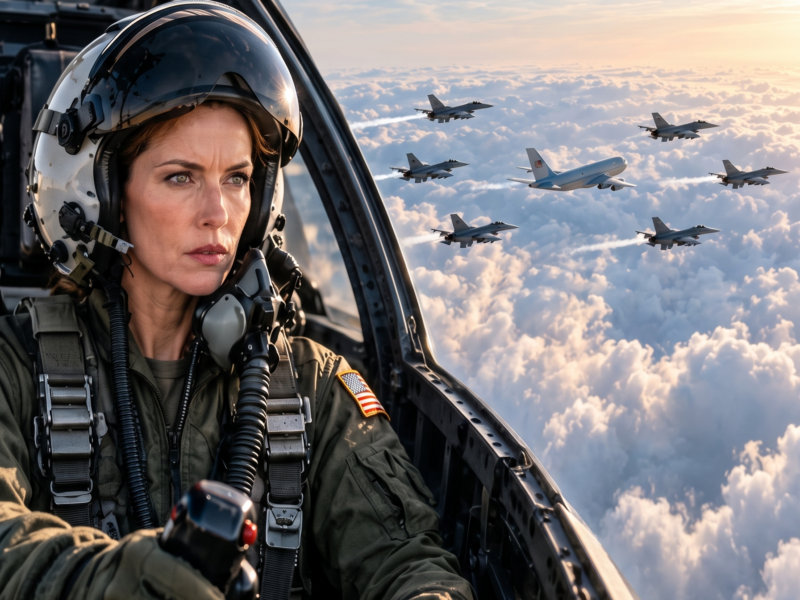
They ordered me to stand down while six enemy fighters surrounded the President’s airliner over the Atlantic
The alarm screamed through the hangar just after sunrise, a harsh, mechanical wail that vibrated in my teeth. I was halfway into my flight suit, the heavy zipper only pulled to my chest, when Commander Miller appeared in the doorway of the locker room. His face was a mask of cold stone.
“You’re grounded,” he said.
I stared at him, my hands freezing on the fabric of my suit. “Why?”
“Because that’s the order.”
Outside the reinforced concrete walls of the hangar, the deep, chest-rattling roar of heavy jet engines began to build. The presidential aircraft, Air Force One, was climbing into the pale morning sky, departing our coastal airbase after a secure overnight summit. I walked past Miller, my boots echoing on the linoleum, and stared at the primary radar console in the corridor.
The screen glowed with a steady green sweep. The massive signature of the President’s modified Boeing 747 was moving steadily eastward over the Atlantic. Then, the radar picture changed violently. Six unidentified fighters appeared out of nowhere, converging on the airliner from above the cloud deck.
Nobody in the command center spoke. The silence was absolute, suffocating.
“Get the nearest squadron airborne,” I said, my voice cutting through the quiet.
My commander shook his head, his arms crossed over his chest. “Stand down.”
I couldn’t believe what I was hearing. “Sir, they’re surrounding the President. Those are bogeys. We have to scramble.”
“I know,” Miller said. His voice was strangely calm. Too calm. There was no panic, no urgency to defend the commander-in-chief.
I looked at the radar screen again, my mind racing. The six aircraft weren’t attacking. They weren’t firing missiles or making strafing runs. They were moving in perfect, synchronized formation around the massive airliner. It looked almost like they were escorting it.
Then I noticed something that made my stomach tighten into a hard knot. One fighter was positioned slightly behind the others, trailing the right wing of the President’s plane at a precise, unnatural angle. Its position was wrong for a standard intercept. But it was perfectly right for something else.
I had seen that exact formation before. Years ago. During a highly classified training exercise that officially never happened, buried deep in the Pentagon’s black-ops archives. It was a forced-abduction tactic, designed to blind a large aircraft’s sensors and hijack its flight path without firing a single shot.
I turned toward my commander, my blood running cold. “Who gave them our flight pattern?”
He didn’t answer. He just stared at me, his eyes devoid of any emotion.
I didn’t wait for his permission. I ran toward the hangar doors, sprinting across the tarmac toward my fueled F-22 Raptor.
“Get back here!” Miller shouted, his voice finally cracking with rage. “That is a direct order, Captain!”
I climbed into the cockpit anyway. The ground crew backed away, confused and terrified, as I slammed the canopy shut. I hit the ignition sequence, my hands moving entirely on muscle memory. The twin engines screamed to life, shaking the airframe. As I lifted off the runway, pushing the throttle to military power, the radio crackled in my helmet.
“Return to base immediately. You are committing treason,” Miller said.
I ignored him, banking hard toward the coast. Ahead, over the dark blue expanse of the ocean, the presidential aircraft was completely surrounded. Through my canopy, I could see the contrails of the six fighters weaving a tight web around the 747.
One of the enemy fighters suddenly moved aggressively closer to the airliner’s cockpit. The massive plane’s altitude changed abruptly, dipping toward the water. Then another fighter blocked its escape route to the north.
I realized exactly what they were doing. They weren’t trying to shoot it down. They were forcing it toward a specific flight corridor. A corridor leading directly over international waters, where radar coverage was virtually nonexistent.
I opened a highly secure, encrypted channel, praying the President’s crew was still monitoring it. “Air Force One, do you copy?”
A calm, tight voice answered through the static. “We copy. Who is this?”
“Don’t follow their route,” I ordered, my grip tightening on the flight stick. “They are trying to hijack your vector.”
There was a pause. “Who are you?”
I looked at the six sleek fighters perfectly boxing in the President. “The pilot who was told to stand down.”
The moment I spoke, one of the enemy aircraft broke its tight formation. It rolled inverted, diving aggressively toward my altitude. My threat receiver shrieked. Missile warning.
I pulled hard on the stick, executing a violent barrel roll. The missile passed mere feet beneath my wing, the heat of its exhaust triggering a proximity alarm. Another fighter moved in, boxing me out from the President’s plane. I pulled the nose up, climbing straight through the thick cloud cover and disappearing from their immediate visual range.
For a few seconds, there was nothing but the gray mist whipping past my canopy. Then I broke through the top of the clouds. I looked down and saw the presidential aircraft turning sharply. The pilot had understood my warning. He was refusing the forced corridor, trying to break the blockade.
The enemy formation fractured, scrambling to contain the massive jet. Then, one of the rogue aircraft suddenly transmitted on an open American military frequency.
“Stop.”
I froze. The voice belonged to Commander Miller.
I checked the identification codes flashing on my secondary monitor. It was impossible. I opened the channel, my breath hitching in my throat. “Sir?”
His voice came again, cold and mechanical. “Come home, Captain. This is bigger than you.”
I rolled my jet, staring down at the fighter currently pressing its wing against Air Force One. Then I noticed something painted beneath its dark gray wings. An American insignia. The muted, low-visibility star and bars of our own Air Force.
My blood ran cold. These weren’t enemy jets from a foreign nation. They were stolen American aircraft. And someone inside our own command had given them permission to fly.
Then the pilot—Miller—transmitted one final message.
“You were never supposed to see this.”
The connection died in a burst of white noise. And on my radar screen, the massive, glowing blip of the President’s aircraft suddenly vanished.
Air Force One had not crashed. I knew the physics of an explosion at that altitude; my sensors would have detected the thermal bloom, the catastrophic dispersal of debris. The aircraft simply ceased to exist electronically. The radar screen was completely dark.
“Electronic Countermeasures,” I whispered to the empty cockpit.
They had triggered a massive, localized EMP or a military-grade jamming field, blinding the Eastern Seaboard’s radar networks and cloaking the entire formation. The President was now a ghost flying over the Atlantic.
My radio was dead, filled with a steady, hissing static. I was entirely alone, flying a rogue asset, hunted by my own commander. I leveled the Raptor just above the cloud deck, my mind racing through the tactical realities. If they were cloaking the aircraft, they had to stay low to avoid satellite visual detection. They were taking the President to a black site.
I closed my eyes for a fraction of a second, forcing myself to remember the details of that classified exercise from years ago. Operation Iron Veil. The objective had been to force a simulated high-value target into a forgotten, decommissioned airstrip. Where was it? My brain sifted through old briefings. The Azores. An abandoned Cold War-era submarine resupply facility built into the side of a remote volcanic island, complete with a runway long enough to accommodate heavy bombers.
It was the only place within their current fuel range where they could land a 747 without the rest of the world watching.
I pushed the stick forward, diving into the cloud cover. I had to get below the radar horizon, skimming the surface of the ocean to avoid being tracked by whatever AWACS aircraft Miller had undoubtedly corrupted to his side.
The descent was brutal. I broke out of the clouds into a violent Atlantic squall. Rain lashed against the canopy like automatic weapons fire. The sky was the color of bruised iron, and the ocean below was a churning nightmare of fifty-foot swells. Flying at three hundred feet in these conditions was suicide, but it was the only way to stay invisible.
The physical toll of flying the F-22 manually through a storm, without the aid of ground control or automated navigation waypoints, was immense. Every gust of wind threatened to slam my jet into the crushing waves. My arms ached from fighting the stick.
Hours passed in a terrifying blur of gray water and driving rain. The fuel gauge ticked downward, a relentless reminder of my shrinking window of survival. If I was wrong about the Azores, I would run out of fuel and die in the freezing Atlantic.
Then, the storm began to break. The thick curtain of rain parted, revealing a jagged, black silhouette rising from the ocean. It was a monolithic rock formation, entirely devoid of lights or civilian structures.
I banked sharply, reducing my airspeed and creeping along the western cliff face of the island. As I rounded a massive volcanic spire, I saw it.
A sprawling, hidden runway carved directly into the basalt rock. Camouflage netting covered heavy anti-air batteries. And sitting at the far end of the tarmac, surrounded by armed mercenaries and military vehicles, was the towering, unmistakable shape of Air Force One.
The six rogue American fighters were parked in a neat row nearby, their canopies open.
My heart hammered against my ribs. I had found them. But I had no backup, no communication with the Pentagon, and only the weapons loaded onto my jet. Firing on the facility from the air was impossible; the risk of hitting the President’s plane was too high. I had to get on the ground.
I scanned the island’s topography. About two miles north of the main facility was a narrow, crumbling stretch of concrete—an old auxiliary strip used for supply planes decades ago. It was overgrown with weeds and littered with debris. It was a pilot’s nightmare.
I didn’t have a choice. I dropped my landing gear, the hydraulic whine sounding too loud in the quiet cockpit. I killed the primary engines, relying on the plane’s momentum to glide silently toward the broken concrete.
The wheels hit the ground with a bone-jarring crunch. The jet violently shuddered, tires screaming as they fought for grip on the moss-slick surface. I deployed the drag chute, fighting the stick with every ounce of my strength to keep the aircraft from veering into the dense jungle bordering the strip.
The Raptor came to a halt just feet away from a rusted perimeter fence. I sat in the cockpit for a moment, my chest heaving, listening to the cooling metal of the airframe tick in the damp air.
I popped the canopy. The humid, salty air of the island rushed in. I grabbed my survival kit, a standard-issue sidearm, and a tactical knife. I was no longer just a pilot. I was the only chance the President of the United States had.
I slid down the nose of the jet and vanished into the dense foliage, moving silently toward the heavily guarded black site. The true battle was just beginning.
The jungle was thick, choking with humidity and the smell of rotting vegetation. I moved carefully, placing each footstep with deliberate precision to avoid snapping twigs or rustling the broad leaves. My flight suit, designed for the sterile cold of high altitude, clung to my skin like a wet shroud.
Through the breaks in the foliage, the massive black site loomed ahead. It was a marvel of hidden engineering. Concrete bunkers were built directly into the volcanic rock, their heavy steel doors painted to match the gray stone. The perimeter was patrolled by men in unmarked tactical gear, carrying suppressed assault rifles. They moved with the cold, professional discipline of elite operators. These weren’t hired thugs; these were our own highly trained soldiers, twisted by Miller into a rogue army.
I crept to the edge of the tree line, crouching behind a rusted, hollowed-out fuselage of a vintage cargo plane. From here, I had a clear view of Air Force One.
The boarding stairs were deployed. A line of heavily armed guards stood at the base. At the top of the stairs, standing in the doorway of the aircraft, was the President. He looked exhausted, his tie loosened, his suit wrinkled, but he stood with an unyielding posture.
Beside him stood Commander Miller.
Miller was pointing toward a massive, fortified hangar at the far end of the tarmac. The hangar doors were open, revealing something that made my blood freeze.
It wasn’t a weapon. Not in the traditional sense. It was a colossal, humming server array, surrounded by heavy cooling units and satellite uplinks. The cables from the array snaked across the concrete, plugging directly into a heavily armored transport vehicle parked near the airliner.
They weren’t trying to force the President to carry a bomb. They were trying to force him to carry a digital payload.
I remembered the intelligence briefings from a year ago. The Pentagon had developed a quantum-encrypted master key—a digital worm designed to infiltrate and completely paralyze the financial and defense grids of any hostile nation on earth. It was called “Project Icarus.” It was considered too dangerous to exist, and Congress had ordered it destroyed. But clearly, Miller had stolen it.
To deploy Icarus, however, required the highest level of authorization. It required the biometric signatures, the voice print, and the launch codes that only the President carried inside the nuclear football. They had hijacked Air Force One to physically hardwire the President’s secure communication node to their server, forcing him to upload the virus into the global network.
I watched as Miller aggressively grabbed the President’s arm, forcing him down the stairs. The Secret Service agents who had survived the hijacking were nowhere to be seen, likely executed or locked away.
I had to move.
I slipped through a tear in the rusted chain-link fence, using the shadows of the parked fuel trucks to cover my approach. My heart pounded a frantic rhythm against my ribs. I drew my sidearm, keeping it low against my leg.
I reached the blind side of the server hangar just as Miller and his guards marched the President inside. The heavy steel doors remained cracked open to allow the thick power cables to pass through. I pressed my back against the cold concrete wall and edged toward the opening.
Inside, the hum of the servers was deafening. Miller shoved the President toward a central console.
“Place your hand on the scanner, Mr. President,” Miller ordered, his voice echoing off the high ceilings. “And speak the authorization phrase.”
“You are committing treason, Miller,” the President said, his voice steady despite the guns pointed at him. “If I unleash Icarus, the global economy will collapse. Millions will starve. It is mass murder.”
“It is a reset,” Miller snapped back, his eyes burning with a fanatical light. “The world is weak. Our enemies grow stronger while politicians debate. With Icarus, we will cripple them all simultaneously. We will rebuild American dominance from the ashes. Now, put your hand on the glass.”
“No,” the President refused, standing his ground.
Miller drew his sidearm and pointed it directly at the President’s head. “I will kill you and use your severed hand if I must. The voice print can be synthesized. It will just take longer. Do it.”
I couldn’t wait any longer. I stepped through the doorway, raising my weapon.
“Drop it, Miller!” I shouted, the command cutting through the hum of the servers.
Every head in the room snapped toward me. Miller’s eyes widened in genuine shock before narrowing into a furious glare.
“Captain,” he said, keeping his gun aimed at the President. “I should have known you wouldn’t follow orders. You always were too arrogant to see the bigger picture.”
Before I could pull the trigger, I felt the cold, hard barrel of an assault rifle press directly against the back of my skull.
“Drop the weapon, pilot,” a rough voice whispered in my ear.
I was surrounded. Two guards stepped from the shadows behind me, stripping the gun from my hand and forcing me to my knees. I stared up at Miller, helpless.
Miller smiled, a cold, empty expression. “You’re just in time, Captain. You get to watch the new world begin.”
The concrete floor dug into my knees as the guard forced my head down, but I kept my eyes locked on Miller. The commander holstered his weapon and turned back to the President, his patience entirely evaporated.
“You see, Mr. President?” Miller said, gesturing toward me. “This is the problem with the old way. Loyalty to a broken system. Captain here risked everything for a set of rules that no longer protect us. Now, the scanner.”
The President looked at me. In his eyes, I didn’t see defeat. I saw calculation. He was waiting for an opening, just as I was.
“If I do this,” the President said slowly, stalling for time, “you won’t just cripple our enemies. You’ll destroy our allies. The fallout will be catastrophic.”
“A necessary amputation,” Miller replied. He grabbed the President’s wrist and violently slammed his palm onto the biometric glass. The console chirped, a green light sweeping over the hand.
Biometric accepted, a synthesized voice announced. Awaiting vocal authorization.
“Speak the phrase,” Miller commanded, drawing his gun again and aiming it at my head. “Or I blow your pilot’s brains across the servers.”
The President swallowed hard, looking at the gun pointed at me. He opened his mouth to speak.
I knew I had one chance. The guard behind me had relaxed slightly, his attention drawn by the drama unfolding at the console. I dropped my center of gravity and drove my elbow backward with every ounce of strength I possessed. The strike connected solidly with the guard’s knee. I heard a sickening crunch, and the man screamed, his rifle firing blindly into the ceiling.
Chaos erupted.
I swept my leg out, knocking the second guard off his feet, and dove for the rifle that had clattered to the floor. Miller spun toward me, firing wildly. Bullets sparked off the concrete inches from my face.
I rolled behind a massive server rack, bringing the rifle up and firing a short, controlled burst. Two of the guards near the door went down. The deafening roar of gunfire filled the enclosed hangar, drowning out the hum of the machines.
“Get to the plane!” I shouted to the President.
The President didn’t hesitate. He ducked under a spray of bullets and sprinted toward the hangar exit. Miller screamed in frustration, torn between securing the digital upload and stopping the President. He chose the President, raising his weapon.
I leaned out from cover and laid down suppressing fire, forcing Miller to dive behind the main console. The heavy server banks shattered under my bullets, sparks showering the room. The upload sequence alarm began to blare, glowing red. The physical connection to Icarus was severed.
I broke from cover, sprinting after the President. We burst out of the hangar doors into the humid island air. The tarmac was in total disarray. Alarms were wailing, and the rogue pilots were sprinting toward their stolen fighters.
“Can you fly that thing?” I yelled to the President, pointing at the massive Boeing 747.
“I’ve logged a few hours in the simulator,” the President replied, his breath ragged. “But the flight crew is locked in the cargo hold!”
“Get them out and get those engines spinning! I’ll hold them off!”
We reached the base of the boarding stairs. I shoved him upward. “Go! Go! Go!”
As the President disappeared into the aircraft, I turned to face the flightline. Three of the rogue fighters were already spooling up their engines, their canopies closing. If they got airborne before Air Force One, they would shoot it down and claim it was a tragic accident. The truth would die with the President.
I looked back at the hangar. Miller was emerging from the smoke, bleeding from a graze on his cheek, a heavy assault rifle in his hands. He was rallying the remaining ground troops.
I needed an aircraft. Fast.
The closest fighter was fifty yards away. Its pilot was halfway up the ladder. I raised my stolen rifle and fired, hitting the metal rungs just inches from his hands. The pilot panicked and dropped to the tarmac, scrambling for cover.
I sprinted across the open concrete, bullets chewing up the ground around my boots. I leaped onto the ladder, scrambling into the cockpit of the stolen F-22. The engine was already primed, the avionics glowing green. I kicked the ladder away and slammed the canopy down.
“Let’s see if you remember how I fly, Miller,” I muttered.
I punched the throttle. The fighter lunged forward, blowing the ground crew off their feet with the exhaust. I didn’t bother taxiing to the runway. I pointed the nose straight down the tarmac, directly toward the three fighters that were lining up for takeoff.
I engaged the M61 Vulcan cannon. The six-barrel rotary gun roared, spitting a stream of depleted uranium rounds across the concrete. I didn’t aim to kill; I aimed to cripple. The rounds shredded the landing gear of the lead fighter. The jet collapsed onto its belly in a shower of sparks and aviation fuel, completely blocking the runway.
The remaining rogue pilots aborted their takeoff, swerving violently to avoid the wreckage.
Behind me, the massive engines of Air Force One began to roar with a deafening, thunderous power. The President had gotten the crew out. The 747 was moving, turning clumsily onto the main runway.
But my radar suddenly pinged. Two more rogue fighters, ones I hadn’t seen, were already airborne. They were circling high above the island, waiting.
“Air Force One, this is Spectre,” I transmitted over the emergency frequency. “You are cleared for takeoff. But hold onto your seats. You’ve got company.”
I pulled back on the stick, rocketing into the sky to meet them.
The G-force slammed me back into the seat as the stolen F-22 shot upward, climbing at a near-vertical angle. Through the canopy, I tracked the two airborne rogue fighters. They were diving like falcons, their targeting radars sweeping the island. They were locking onto the massive, lumbering silhouette of Air Force One as it accelerated down the runway below.
I didn’t have time for a dogfight. I had to become a shield.
I pushed the throttle past the detent, engaging the afterburners. The jet screamed as it broke the sound barrier, the sonic boom echoing over the ocean. I threw my aircraft directly into the path of their dive, intentionally placing myself between the rogue fighters and the President’s plane.
My threat receiver went absolutely berserk. A solid, high-pitched tone indicated a dual missile lock.
“Missiles away,” I whispered to myself, watching the two white smoke trails detach from the enemy jets.
I waited until the absolute last fraction of a second. “Flares!” I punched the countermeasure release and pulled the stick into a brutal, gut-wrenching turn. The sky behind me erupted in bright magnesium flashes. The heat-seeking missiles, confused by the sudden bloom of thermal targets, lost their lock and detonated harmlessly over the ocean.
But the maneuver bled my airspeed. The two rogue fighters shot past me, pulling high-G turns to re-engage.
“Spectre, this is Air Force One,” a voice cracked over the radio. It was the President’s pilot. “We are wheels up. But we have no escort and no countermeasures. We are a sitting duck.”
“Just keep climbing and head west,” I barked. “I’ll keep them off your tail.”
The dogfight was a chaotic, dizzying blur of gray metal and blue ocean. These pilots were my own squadmates. I knew their tactics. I knew they favored aggressive, high-altitude attacks. I dragged them down.
I dove toward the churning waves of the Atlantic, skimming just fifty feet above the water. The two fighters followed, eager for the kill. The heavy salt spray lashed against my canopy.
“Come on, boys,” I muttered. “Show me what Miller taught you.”
The lead fighter opened fire with his cannon, the rounds tearing up the water on my left side. I abruptly chopped my throttle, deploying the speed brakes. My jet rapidly decelerated, essentially slamming on the brakes in mid-air.
The lead rogue fighter overshot me entirely, roaring past my canopy. Before he could react, I slammed the throttle forward, locking my targeting reticle onto his exhaust. I squeezed the trigger. My cannon ripped through his right wing. The jet spiraled out of control, skipping across the ocean surface like a stone before vanishing in a massive plume of white water.
One down. One to go.
But the second pilot was smart. He had anticipated my move and pulled up into a loop, coming down directly behind me. The tone in my helmet returned. He had me dead to rights.
“Spectre, I have tone,” the pilot’s voice came over the open frequency. “Nothing personal.”
Suddenly, the radio erupted with static, followed by a voice that made my heart leap.
“Fox Two.”
A missile streaked down from the cloud cover above, slamming into the tail of the rogue fighter behind me. The explosion violently rocked my aircraft. I watched as the burning debris fell away, the pilot ejecting safely, his parachute blooming over the water.
I looked up. Dropping out of the clouds was a squadron of heavily armed F-35 Lightnings, bearing the loyal insignias of the US Navy.
“Air Force One, this is Strike Leader,” a calm, authoritative voice broadcasted. “We have you on radar. You are safe. We are escorting you home.”
I exhaled, a long, shuddering breath, my grip finally relaxing on the stick. The jamming field had fallen. When I destroyed the server array, I must have knocked out their communications blackout. The military had found us.
I banked my fighter, joining the formation around the President’s plane. Below us, the island black site was already being swarmed by Navy helicopters. Miller’s rogue operation was entirely dismantled. The conspiracy to hijack the world’s digital infrastructure was dead in the water.
Several hours later, I landed my battered, stolen jet at Andrews Air Force Base. The tarmac was heavily secured by loyal military police. As I climbed down the ladder, my legs felt like lead. The exhaustion of the past day crashed down on me like a physical weight.
A black SUV pulled up to the aircraft. The door opened, and the President stepped out. He looked at the scorched metal of my fighter, then walked directly up to me.
He extended his hand. I shook it, my grip still weak.
“You defied a direct order today, Captain,” the President said quietly, the wind whipping across the tarmac.
“Yes, sir. I did.”
“Good,” he said, a faint smile touching his exhausted face. “The world doesn’t need soldiers who only know how to obey. It needs soldiers who know what is right. Miller is in custody. The cleanup will take years, and the public can never know how close we came to the edge.”
He looked at my jet, then back at me. “Your military record will state that you were grounded today due to a mechanical failure. You will not receive a medal. You will not be paraded as a hero.”
I nodded slowly. I understood. The shadow war required shadow heroes.
“But,” the President added, his voice hardening with absolute authority, “if I ever find myself in the sky again, I want you flying off my wing. Am I understood, Spectre?”
I stood a little taller, the fatigue momentarily vanishing. “Perfectly understood, Mr. President.”
I watched him walk away, surrounded by his detail. I turned back to look at the sky, the sun finally beginning to set, casting long, golden shadows across the runway. I was a pilot without a squadron, a hero without a story. But as I looked at the endless blue horizon, I knew I had never felt more ready to fly.
The end.









