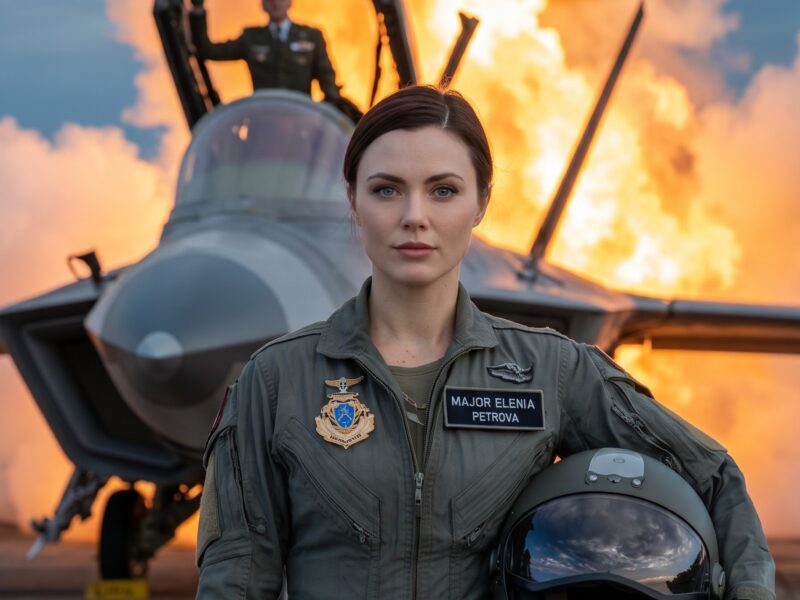
They mocked me when I was ordered to stay away from the flight line at Nellis Air Force Base
The alarm sounded just before sunrise, breaking the stillness of Nellis Air Force Base with a shrill, rhythmic scream. I was carrying a tray of black coffee through the operations building, the harsh scent of caffeine mixing with cold floor wax and ozone. Outside, the Nevada desert was still wrapped in indigo shadows, but inside the command center, every display panel suddenly turned a vivid, alarming shade of red.
“Unidentified aircraft approaching restricted airspace,” a synthetic voice repeated over the loudspeakers. “Sector Four. Altitude forty thousand feet. Speed Mach two point four.”
The room erupted into controlled chaos. Flight leads scrambled for their helmets, staff officers shouted into radio handsets, and Colonel Marcus Vance slammed his heavy palm against the central oak briefing table, shaking the paper maps and ceramic mugs resting on it.
“Get the Raptors airborne now!” Vance barked, his face flushed red under the buzzing fluorescent lights. “I want a two-ship package in the air three minutes ago!”
I stood frozen near the doorway, holding the tray tightly in my hands. I was wearing the plain, insignia-less utility uniform of a civilian contractor—a glorified logistics assistant, hired to organize maintenance logs and restock supply cabinets. To every man and woman in this room, I was just Clara, the quiet woman who kept the coffee hot and stayed clear of the flight line.
Then another voice, breathless and panicked, crackled through the primary comms speaker overhead. “Tower to Ops! All primary and secondary pilots from the 94th are down. Severe gastrointestinal distress and sudden disorientation. We suspect fuel or food contamination from the breakfast mess.”
Colonel Vance froze mid-stride. “What do you mean, down? All of them?”
“Captain Miller collapsed on the tarmac during preflight,” the tower controller replied, panic bleeding through the static. “Lieutenant Ross can’t stand up. One F-22 Raptor is fully fueled, armed, and idling on Runway Two-Seven, but we have no qualified pilot in the cockpit.”
Vance swore under his breath, turning a full circle as he surveyed the room. The second-string pilots were at a tactical symposium in California. The base was effectively defenseless, and the radar tracking screen showed the red blip closing in on the outer perimeter at terrifying speed.
“Who else is cleared for the Block 20 avionics?” Vance demanded, looking at his junior officers. “Is there anyone on this base who can fly a Raptor?”
Silence settled over the command center, heavy and suffocating. No one answered. The F-22 Raptor was a complex, lethal machine, demanding thousands of hours of specialized training. You couldn’t just throw an F-16 pilot into its cockpit and expect them to survive a high-speed intercept.
I slowly lowered the coffee tray onto a nearby filing cabinet, the porcelain clinking quietly against the metal.
“I can,” I said.
My voice wasn’t loud, but in the dead quiet of the room, it cut like a blade.
The colonel turned toward me, his brow furrowing in confusion and rising anger. “You?”
I stepped out from behind the cabinet and met his gaze directly. “I can fly it, sir.”
A few junior officers exchanged amused, disbelieving glances. One of them chuckled under his breath. “Ma’am, this isn’t a flight simulator at a museum,” he muttered. “That’s a hundred-and-fifty-million-dollar air superiority fighter.”
“I know what it is,” I said calmly.
“Then get back to your desk and let us handle this,” Vance snapped, reaching for the base wide-area radio to call for regional support from Luke Air Force Base, hours away.
My fingers tightened into fists at my sides. They had no idea how many years I had spent pretending to be ordinary, fading into the background, wearing ill-fitting clothes, and speaking only when spoken to. They didn’t know that before I took this civilian job at Nellis, I had logged over eight hundred hours in high-G tactical jets under a classified black-budget initiative. They didn’t know I was once the youngest woman ever selected for an experimental F-22 combat evaluation team. And they certainly didn’t know why my military service record had been systematically scrubbed, sealed, and buried under five levels of Department of Defense security clearance.
The warning sirens pitched higher, a double-tone indicating a second vector.
“Target is accelerating,” the radar tech yelled, his fingers flying across his keyboard. “Second bogey detected trailing the first. They’re forty miles out and closing on the Las Vegas suburban corridor!”
Colonel Vance grabbed the edges of the tactical display board, sweating profusely. “Can anyone get that damn Raptor airborne?!”
I stepped right into Vance’s line of sight, blocking his view of the screen. “Give me five minutes. I’ll clear your sky.”
Vance stared at me, searching my face for madness or delusion. But he found neither. Instead, he saw a cold, calculating focus that no civilian could ever fake.
“Who trained you?” he whispered, his voice dropping into a register of genuine suspicion.
I glanced out the reinforced glass window toward the dim runway, where the twin exhaust plumes of the lone F-22 glowed faintly blue against the gray dawn. “Someone who never made it home.”
My father had been Air Force Lieutenant Colonel Thomas “Raven” Mercer. Twelve years ago, his plane crashed in the desert during a routine training exercise. The official board of inquiry ruled it pilot error due to spatial disorientation. But I knew the truth. I had spent my entire youth digging through redacted files, finding hidden discrepancies in telemetry data, discovering a deleted flight log, and tracking down a key maintenance witness who had mysteriously disappeared three days after the crash.
As I turned to run toward the door, the fabric of my high-collared utility shirt snagged on the edge of a map desk, tearing slightly.
Colonel Vance caught sight of what lay beneath: a small, silver pin pinned to the inside collar of my undershirt. It was an unofficial, unregistered unit insignia—a stylized silver raven holding a broken arrow.
Vance’s face drained of color instantly. The air left his lungs in a sharp gasp. “Where did you get that?” he breathed, his voice trembling. “That call sign… that unit was erased from Air Force records after the ’98 incident.”
I didn’t answer him. I was already sprinting through the double doors, out into the biting desert air.
The tarmac smelled of raw jet fuel, hot rubber, and crisp winter wind. The idling Raptor thrummed, its twin Pratt & Whitney engines vibrating through the soles of my boots. I vaulted up the boarding ladder, practically shoving past the bewildered ground crew chief who was trying to tend to the unconscious primary pilot on a stretcher nearby.
“Hey! What are you doing?!” the chief yelled, reaching for my belt.
“Getting this bird in the air!” I shouted over the engine roar.
I dropped into the Kevlar seat. My hands moved across the cold, complex console with automatic, muscular memory. Switches flipped, digital displays flickered to life, and the helmet system synced to my optic nerve. It was like I had never left. The cockpit was an extension of my own body.
Behind me, over the base PA system, someone was screaming, “She’s not authorized! Security forces, intercept!”
Colonel Vance’s voice blasted directly into my helmet headset. “Clara—whoever you are—stand down immediately! That is an order!”
I pulled the canopy down, the heavy acrylic sealing out the sound of the base sirens, leaving only the breathing of my oxygen mask and the low hum of the avionics. I advanced the throttle.
“With respect, Colonel,” I said softly into the mic, “you have thirty seconds before those aircraft reach the city. And I’m the only one who can stop them.”
I released the brakes. The Raptor shot forward, pressing me deep into the ejection seat. The runway blurred, and with a pull of the stick, the jet sliced upward into the morning sky, breaking through the low clouds like a silver spear. For the first time in twelve years, I felt alive. I could breathe again.
I leveled off at thirty thousand feet, flipping the radar to long-range track. The two unidentified targets appeared as sharp green icons on my heads-up display. Their flight paths were strange—not an attack vector, but a structured search pattern. It was deliberate. Almost familiar.
“Unidentified aircraft,” I announced over the emergency channel, my voice steady. “You are in restricted United States airspace. State your identity and intentions immediately.”
No answer. Only crackling atmospheric static filled my ears.
Then, the static smoothed out. A low, gravelly voice echoed through my headset—a voice laced with digitized encryption, yet unmistakably familiar. It was a voice I had listened to on old, smuggled cassette tapes every night before I went to sleep. A voice I hadn’t heard live since I was twelve years old.
“Angel,” the voice said softly. “If you’re hearing this, they finally made you fly again.”
My blood ran cold. The oxygen in my lungs felt like liquid nitrogen.
Ahead of me, five miles out, the lead unknown aircraft suddenly rolled hard to the left, breaking its vector. As its broad wings caught the rising sunlight, my combat optics zoomed in on its tail assembly. Beneath its customized, non-reflective paint, I saw a faded, hand-painted emblem—and a call sign that officially did not exist.
It was my father’s call sign.
Raven One.
My hands froze on the control stick. The horizon tilted slightly as the Raptor drifted off course, but my brain refused to process the instrument readouts.
“Say again, unidentified aircraft,” I whispered, my voice trembling inside the oxygen mask. “Identify yourself!”
“You know who I am, Clara,” the voice came back, rich with static yet undeniably possessing the cadence, the slight southern drawl, and the rhythm of my father. “Look at your sub-band channel four. I’m transmitting the key.”
On my secondary multi-function display, a torrent of raw, encrypted data began to stream in from the lead aircraft. Automatically, my aircraft’s onboard computer, utilizing the old black-project protocols still buried deep in its legacy code, decrypted the signal. A file popped up on the corner of my screen. It was a flight manifest dated November 14th, 2014—the exact day my father was pronounced dead.
Below the manifest were two words written in red text: PROJECT NIGHTFALL: SURVIVED.
“This is a trick,” I spat into the mic, forcing my fingers to re-engage the flight controls. I pulled the Raptor into a sharp right bank, bringing my nose around to lock onto his tail. “My father died in the Tonopah test range. I saw the wreckage. I stood by his empty casket.”
“You stood by a box full of sand and lead, sweetheart,” the voice replied gently. The lead aircraft executed a flawless vector roll, matching my turn with an agility that defied standard aerodynamic limits. Whoever was flying that plane was a master—a phantom who knew the exact performance envelope of my jet. “They had to make you believe I was dead. If you searched for me, they would have ended you too. I had to go into the dark to keep the dark away from you.”
Down on the ground, Colonel Vance’s voice cut through the private frequency, sharp and frantic. “Raptor One! Clara! We are seeing heavy electronic warfare jamming emanating from those targets! Do you have a weapon lock? Terminate those bogeys before they reach the population centers!”
I looked down at my primary target screen. The red reticle was hovering right over the lead jet. My thumb rested on the red weapon-release button on the stick. All I had to do was press it, and an AIM-120 missile would erase the aircraft—and whatever secret it carried—from existence.
“Clara,” Vance’s voice rose to a scream over the comms. “Execute engagement protocols! That’s an order!”
“Don’t do it, Angel,” the radio voice whispered. “Look at the second bogey. The one trailing me.”
I shifted my eyes to the radar screen. The second unidentified aircraft was not flying in formation with the lead plane. It was pursuing it. It was trailing close behind, running dark with no radar emissions, hiding in the radio shadow of the lead jet. And its weapons bays were opening.
“He’s not my wingman, Clara,” my father’s voice warned. “He’s my executioner. They tracked me when I broke radio silence to reach you. If you shoot me down, you leave the country wide open to what’s in his payload.”
“What is he carrying?!” I demanded, switching my radar focus to the second aircraft.
“A weaponized EMP built from the old Nightfall blueprints,” he answered. “If he detonates it over the base, every digital system within two hundred miles goes dark. Nellis, the command centers, the grid—everything. They’re resetting the board, Clara. Erasing everyone who knows about the erased.”
Before I could process the words, a brilliant plume of white smoke erupted from the belly of the second dark aircraft.
“Missile launch! Missile launch!” my radar warning receiver shrieked, filling my cockpit with an urgent, deafening tone.
The missile was not targeted at me. It was locked onto the lead jet—onto my father.
Instinct took over before thought could interfere. I slammed the throttle into full afterburner, the shockwaves rattling my teeth as the F-22 surged forward, slicing through the air at Mach 2.2. I threw the jet into an aggressive dive, putting my aircraft directly between the incoming missile and the lead plane.
“Clara, no!” my father screamed over the radio.
“Deploying flares!” I hit the countermeasure switch. A shower of brilliant, white-hot magnesium flares blazed out behind my aircraft, lighting up the morning sky like a dying star.
The heat-seeking missile bit into the flare cluster, exploding in a massive fireball just three hundred yards off my port wing. The shockwave slammed into my Raptor, throwing the jet into a violent rolling spin. The cockpit alarms blared in a chorus of red lights—hydraulic pressure dropping, right engine compressor stall, primary flight computer malfunction.
Fight the jet. Always fight the jet. My father’s old lessons flashed in my mind. I kicked the rudder pedal hard, shoved the stick forward, and pulled the left throttle back to counter the asymmetric thrust. The Raptor fought me, shuddering violently, but finally snapped out of the spin, leveling off just two thousand feet above the jagged desert floor.
I was panting heavily, sweat stinging my eyes beneath my visor.
“Clara, respond!” Vance was shouting from the control tower. “What was that explosion?! Did you destroy the threat?!”
“Negative,” I gasped, wiping my face with my sleeve. “Threat is active. The second bogey just fired on the lead.”
“What are you talking about?!” Vance demanded. “Who is flying those planes?!”
I looked up through the glass canopy. The second black aircraft was climbing rapidly, setting up for a second attack run—this time, targeting my crippled Raptor. And behind it, circling around to protect my tail, was the mysterious lead jet.
“Colonel,” I said, my voice cold as ice as I re-engaged my manual weapons control. “You knew my father. You were his wingman during Operation Desert Shield. You know why his file was scrubbed.”
There was a long, terrifying pause on the other end of the radio line. On the ground, in the warm, safe command center, Marcus Vance went dead silent.
“Vance…” I whispered. “Answer me.”
“Clara,” Vance’s voice came back, stripped of all authority, reduced to a hollow, frightened whisper. “You don’t know what you’re touching. You need to bail out. Right now. Pull the ejection handle and let that sky clear itself.”
“He’s alive, isn’t he?” I asked, my heart hammering against my ribs. “You buried him alive.”
“He was supposed to stay buried,” Vance whispered. And then, the line went dead.
The communications screen flickered as the base cut my encrypted link. I was alone in the sky with two phantoms—one who claimed to be my father, and another who wanted us both dead.
“Angel, your right engine is bleeding oil,” my father’s voice came through the direct point-to-point sub-band. “He’s coming around for a strafing run with twenty-millimeter cannon fire. Break left, hard!”
I didn’t hesitate. I threw the stick to the left, using vectoring thrust to turn the damaged Raptor on a dime. A stream of armor-piercing tracer rounds tore through the empty air where my jet had been a split second before, burning brilliant orange streaks against the blue sky.
The second black aircraft shot past us, its dark delta-wing design sleek, alien, and completely unbranded. No national markings, no serial numbers. A black-budget shadow.
“Who are they?” I demanded, pulling my throttle back to match my father’s speed as his aircraft swept in beside mine.
Side by side, two impossible ghost ships flew through the cloud bank. Through his clear canopy, I could see the silhouette of the pilot in the other jet. He turned his head toward me, giving a brief, sharp hand signal—the old combat sign for ‘Form up on my wing.’ It was a gesture my father had taught me in a wooden flight simulator he built in our garage when I was ten years old.
“They call themselves the Directorate,” my father answered, his breath rasping through his mask. “A break-away faction within defense intelligence. They’ve been siphoning classified military technology for fifteen years, hiding behind shadow programs like Nightfall. Twelve years ago, I found their off-grid facility in the Nevada mountains. When I tried to report it to the Pentagon, my plane was sabotaged.”
“How did you survive?” I asked, tears finally swelling in my eyes, blurring the HUD indicators. “Why didn’t you come back for me?”
“I ejecting over deep desert,” he said softly. “They captured me. Kept me in an underground black site for eight years, trying to get my flight codes and access keys to the automated strategic network. I escaped four years ago. I’ve been hiding in the shadows, waiting for the right moment to burn their infrastructure to the ground. But today… today they found my safehouse. I had to take the prototype jet and run.”
“And Vance?” I asked, the pieces of the puzzle falling into place with sickening clarity. “What is Vance’s part in this?”
“Marcus Vance was the man who signed off on my death certificate,” my father replied grimly. “He traded my life for his fourth star and command of Nellis. He’s been protecting their logistics pipeline ever since.”
Ahead of us, the dark attacker looped over at the apex of its climb, pulling a high-G split-S maneuver to diving back down on us from above. It was setting up a dive-bombing trajectory, its target not us, but the command facility at Nellis Base below.
“He’s going for the base,” I said, panic rising in my chest. “There are hundreds of innocent airmen down there!”
“He wants to eliminate Vance and wipe the base mainframe before the Department of Defense realizes what’s happening,” my father said. “Clara, your plane is damaged. You can’t take the high-G turn required to intercept him. You have to disengage. Land at the civilian strip in Tonopah.”
“No,” I said, my teeth clenched so tight my jaw ached. “I spent twelve years grieving a ghost, hiding my life, living in dust and shadow. I’m not running away today.”
“Clara—”
“I’m flying on your wing, Raven One,” I interrupted, overriding his protest. “Tell me the maneuver.”
A long pause echoed over the radio, followed by a wet, emotional laugh from the man who had raised me. “All right, kiddo. Just like we practiced in the garage. We execute the Scissors-X. I pull his nose up, you dive from his blind spot, and we force him into the envelope.”
“Copy that,” I said, gripping the stick with white knuckles. “Executing now.”
My father’s jet accelerated straight toward the diving attacker, presenting himself as a broad, easy target. The black jet took the bait, locking its targeting radar onto my father and rolling into a dive to finish him.
“Now, Clara!” my father yelled.
I slammed my left rudder, using the last of my auxiliary hydraulic power to drop the Raptor’s nose into a vertical dive straight toward the sun. The intense gravitational force slammed me back against my seat, black spots dancing at the edges of my vision as the G-meter spiked to 8.5 Gs.
I ignored the pain, ignored the screaming red master warning lights on my panel, and locked my optical crosshairs onto the belly of the black jet.
“Target acquired,” I whispered through gritted teeth. “Fox Two!”
I pressed the button. A short-range Sidewinder missile detached from my internal bay, its rocket motor igniting with a bright flash of white flame.
The Sidewinder missile streaked through the cold air, leaving a spiraling trail of white smoke behind it.
The pilot of the black jet was fast—inhumanly fast. Recognizing the threat at the last possible fraction of a second, he deployed hyper-agile thrust-vectoring, pitching his aircraft’s nose up to force a flat spin. The missile grazed his right wingtip, detonating in a shower of shrapnel that shredded his outer control flap, but failed to destroy the aircraft completely.
The black jet spiraled out of control for a brief second before its computer systems stabilized the spin. But the damage was done. Its attack run on Nellis Base was broken.
“Good hit, Angel!” my father cheered over the radio. “His weapons control is offline! He’s retreating toward the north mountains!”
“I’m on him,” I said, pulling my stick back to level off. But as I did, my damaged right engine let out a loud, metallic screech. Smoke began pouring into the cockpit air vents, thick and acrid.
“Warning. Engine Fire. Right Engine,” the automated system chimed in a calm, artificial voice. “Shut down Right Engine immediately.”
I slammed the right throttle back to fuel cut-off and hit the fire suppression button. The vibration stopped, but my airspeed plummeted instantly. With only one operational engine, my Raptor was losing altitude fast, drifting down toward the rugged, desolate peaks of the Nevada desert.
“Clara, you’re losing thrust!” my father’s voice was laced with panic. “Bail out! Pull the handles!”
“I can still fly it!” I argued, wrestling with the heavy controls as the aircraft leaned hard to the right. “Where is the black jet going?”
“He’s heading for the Nightfall staging ground,” my father said, his own jet dropping down to flank me, matching my slow descent. “An abandoned military bunker complex forty miles north in the desert canyons. If he reaches their underground hangar, they’ll purge all their data servers and disappear forever.”
“Then we end this now,” I said, checking my tactical screen. My single engine was holding steady at seventy percent power, but my fuel reserves were critically low. “Colonel Vance is probably sending security teams to secure the base records right now. We have to capture their raw data before they wipe it.”
Below us, the terrain shifted from flat desert floor to deep, treacherous red-rock canyons. Nestled in a deep valley between two massive cliffs lay a series of concrete reinforced bunkers, disguised to look like abandoned mining structures.
The damaged black jet was rolling into a low, desperate landing pattern on an old dirt strip cutting through the canyon floor.
“He’s landing,” I reported. “He’s going to initiate the physical data purge.”
“Not if I can help it,” my father said. He suddenly pitched his nose down, diving straight toward the canyon entrance. “I’m going to block the hangar doors with a strafing run. Clara, I need you to land on that dirt strip and secure the central terminal inside Bunker Three.”
“Dad, that’s suicide! They have ground defenses!”
“They won’t be looking at you, sweetheart,” he answered, his voice ringing with a fierce, quiet pride. “They’ll be looking at the ghost they thought they killed twelve years ago. Land the plane. Finish what we started.”
My father’s jet screamed over the canyon floor, firing its internal cannon into the structural pylons of the massive steel hangar doors. The explosions echoed like thunder through the valley, causing tons of rock and twisted steel to collapse over the entrance, trapping the occupants inside and destroying their escape vehicles.
Anti-aircraft fire erupted from concealed emplacements around the rocks, bright red tracer rounds chewing up the sky around my father’s aircraft.
“I’m hit!” he called out, his voice laced with strain. “Left wing fuel cell compromised! I’m putting her down in the scrub brush!”
“Dad!” I screamed.
Through my canopy, I watched his jet pancake into the soft desert sand a mile away from the bunker, skidding across the dirt in a huge cloud of dust before coming to a rest against a rock ridge. The canopy popped open, and a figure scrambled out into the dirt, waving a flare. He was alive.
I brought my crippled Raptor down through the narrow canyon walls, lining up with the rough, unpaved dirt strip. The landing gear slammed into the earth with a violent jolt, bouncing the jet violently before the tires bit into the dirt. I deployed the drag chute and stomped on the brakes, stopping the multi-million-dollar fighter jet just feet before the sheer rock wall at the end of the runway.
I popped the canopy, unbuckled my harness, and grabbed the service pistol from the cockpit survival kit.
The desert air hit my face—hot, dry, and smelling of burnt jet fuel and gunpowder. I jumped down from the wing, my boots hitting the dirt with a thud, and ran toward the entrance of Bunker Three, where smoke was billowing from the shattered blast doors.
The interior of Bunker Three was cold, dark, and filled with the humming resonance of massive, industrial-grade cooling fans. Emergency red lights cast long, sinister shadows across walls made of reinforced poured concrete.
I moved down the corridor with my pistol raised, my heart hammering in my chest like a trapped bird. Every step echoed in the vast, silent facility.
At the end of the hallway, behind a thick pane of bulletproof glass, was the main command hub. Banks of servers stretched to the ceiling, their LED lights blinking rapidly as an automated program began wiping the drives, displaying progress bars on massive overhead monitors: SYSTEM PURGE: 64% COMPLETE.
Standing at the primary terminal was a man in a dark, tailors-made suit, furiously typing override codes into a keyboard. Beside him lay a radio handset connected directly to Nellis Air Force Base.
“I don’t care how you do it, Marcus!” the man in the suit was snarling into the handset. “Send a bomber strike! Level this canyon before the Department of Defense auditors arrive!”
I kicked the reinforced door open, stepping into the terminal room, my pistol locked onto his chest.
“Step away from the console,” I ordered, my voice dead calm.
The man froze. He slowly turned around, his eyes widening in shock as he looked at my sweat-stained face, my torn utility uniform, and the silver raven pin pinned to my shirt.
“You…” he whispered, a hysterical laugh bubbling in his throat. “Mercer’s daughter. The girl who brews coffee at Nellis.”
“Cancel the purge,” I said, thumbing back the hammer on the pistol. “Now.”
“You’re too late, girl,” he sneered, pointing a finger at the screen where the bar clicked to 78%. “In two minutes, twelve years of black-budget records, off-book accounts, and political assassinations will be gone. You have no proof. You have nothing.”
“She doesn’t need proof,” a heavy, rough voice spoke from the doorway behind me.
I turned my head slightly. Standing in the entrance, bleeding from a cut on his forehead and leaning against the metal doorframe, was my father. He looked older than he should have, his hair silvered and his face lined with deep scars, but his eyes were bright, fierce, and undeniable.
The man in the suit went pale. “Mercer… you’re a ghost.”
“Ghosts come back to haunt the guilty,” my father said softly. He stepped into the room, holding up a military-grade hard drive connected to a portable transmitter. “I didn’t come here to stop your purge from your terminal. I came here to mirror it to the Pentagon’s main server.”
The man in the suit looked frantically at the main monitor. The text suddenly changed from SYSTEM PURGE to EXTERNAL DATA TRANSFER: BROADCASTING TO DEPARTMENT OF DEFENSE INSPECTOR GENERAL.
“No!” the man screamed, reaching for a weapon concealed beneath the desk.
BANG.
I fired a single shot into the wall beside his head. The bullet shattered the concrete, plastering his face with dust. He froze, his hand trembling as he slowly raised his arms into the air.
“Game over,” I whispered.
Ten minutes later, the air above the canyon thundered with the heavy, rhythmic chopping of rotor blades. Three Blackhawk helicopters from the military police division descended onto the canyon floor, surrounded by armed tactical teams.
They stormed the bunker, placing the man in the suit in heavy restraints and securing the data servers.
Colonel Marcus Vance stepped off the lead helicopter, flanked by two armed federal marshals. He was no longer wearing his commander’s hat. His shoulders were slumped, his face hollow and broken as he realized his empire of lies had completely collapsed.
He looked at my father, then at me, standing side by side outside the bunker entrance in the bright Nevada sun.
“Tom…” Vance croaked, his voice cracking. “I… I had no choice. They threatened my family.”
My father didn’t answer him with anger. He simply stepped forward, stripped the silver officer wings from Vance’s uniform jacket, and dropped them into the dirt. “You always had a choice, Marcus. You just chose yourself.”
The marshals led Vance away in handcuffs, loading him into the back of the transport helicopter.
As the noise of the rotors faded into the distance, a silence settled over the canyon—a quiet, peaceful silence that I hadn’t felt in twelve long years.
My father turned to look at me. He looked down at the battered, single-engined F-22 sitting proudly on the dirt runway, its titanium skin glinting in the morning light. Then he looked at the torn collar of my shirt, where the silver raven pin sparkled.
“You flew that bird like you were born in the cockpit, Angel,” he said, his voice thick with emotion as he pulled me into a tight, crushing hug. “Your mother would have been so proud of you.”
I wrapped my arms around him, burying my face in his flight jacket, the scent of jet fuel and desert wind wrapping around us like a shield. The weight I had carried for a decade—the grief, the doubt, the isolation—finally lifted from my chest, drifting away into the endless blue sky.
“So, what happens now?” I asked, looking up at him as the rescue team approached with a secondary transport.
My father smiled, a real, bright smile that reached his eyes for the first time in a lifetime.
“Now,” he said, looking up toward the horizon where the sun was fully rising, “we get back into the sky.”
The end.









