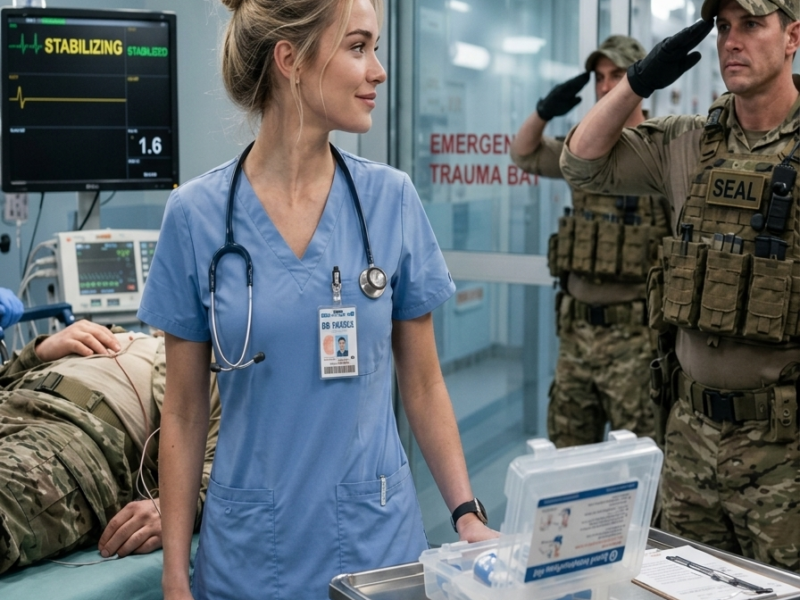
They mocked me in the ER while I stood silently beside a wounded Navy SEAL, until he suddenly pushed himself off the stretcher, saluted me with blood running down his face
The fluorescent lights of Harborview’s emergency room flickered with a relentless, low-pitched buzz that felt like a needle pressed into the back of my brain. It was 3:15 AM on a rainy Tuesday, and the trauma bay was choked with the usual midnight parade of night-shift misery: wet wool, stale coffee, rubbing alcohol, and the coppery tang of fresh blood. Rain lashed against the high frosted windows, reflecting the frantic flashes of red and blue emergency lights from the ambulance bay outside.
I was holding a stainless steel tray loaded with suture kits and sterile scalpel handles, moving carefully around the chaos. My neck hurt. My feet burned through my thin rubber-soled shoes. But I kept my eyes down, my shoulders pulled tight, and my breathing shallow.
“Watch it!”
A heavy elbow slammed into my shoulder as Dr. Marcus Collins brushed past me, his blue scrubs immaculate, his expensive watch catching the light. The metal tray twisted in my grip, slipping through my fingers. The crash was deafening in the crowded corridor—a sharp, violent cascade of stainless steel clattering across the slick linoleum floor, sending wrapped needles and forceps scattering into the puddle beneath an IV pole.
“Of course,” Dr. Collins muttered loud enough for the entire nursing station to hear, shaking his head with a sneer. “She can’t even walk down a hallway without making a mess. Unbelievable.”
A couple of night-shift nurses near the supply cabinet snickered. Nurse Sarah, who had been trying to get Collins’s attention all night, covered her mouth with a manicured hand. “Honestly, Marcus, I don’t even know why HR assigned her to Level 1 Trauma. She looks like a ghost that got lost on the way to the morgue.”
I said nothing. I didn’t even look up to meet their eyes.
I knelt quickly on the cold floor, my hands moving with rapid, mechanical efficiency as I gathered the fallen tools back onto the tray. Silence had been my armor for three long years. I had learned the hard way that when people decide you are weak, quiet, and invisible, you let them believe it. Loud people draw attention. Attention brings questions. And questions bring the kind of light I could not afford to live under.
“Hey, ghost,” Collins called out, kicking a stray roll of medical tape toward my knee. “Clean that up and scrub Trauma Bay Three. We’ve got an incoming transport from the naval station. Try not to drop anything on the patient.”
Before I could stack the last tray, the heavy double doors of the ambulance entrance slammed open with a concussive bang that shook the glass frames. A cold blast of wet midnight air cut through the stifling heat of the ER.
“Trauma team, move!” a paramedic shouted, his voice hoarse from yelling over sirens. “Inbound, severe hemorrhagic shock, blast trauma, and multiple fragment penetrations to the chest and torso!”
Two paramedics burst through the doors, their boots slick with rain and blood, pushing a heavy gurney at a dead sprint. Lying on the blood-soaked vinyl mat was a man who looked like he had been dragged out of the jaws of a war zone. He was wearing the torn, mud-caked remnants of a dark Navy SEAL tactical uniform, his chest rising in shallow, agonizing gasps beneath a high-flow oxygen mask. His face was covered in a mixture of black mud, soot, and bright crimson blood pouring from a jagged laceration near his hairline.
And walking right alongside the moving gurney, refusing to be pulled away by an orderly, was a massive Belgian Malinois. The dog was soaked to the bone, his dark sable coat covered in dried mud. He was limping badly on his rear right leg, his ears pinned flat against his head, his golden-brown eyes locked onto the wounded man with frantic, unbreakable devotion.
“Get that animal out of here!” Collins yelled, stepping into the center of the bay and snapping on a pair of latex gloves. “This is a sterile trauma floor! Orderly, grab that dog!”
“Don’t touch him!” the lead paramedic warned, wiping sweat from his eyes. “That’s a multi-purpose K9. He was on the bird with the patient. He bit two shore patrol officers who tried to separate them at the airfield. He stays, or he tears this room apart.”
I stood up, holding the tray against my chest, my gaze pulling toward the gurney.
“Room three! Move!” I said, my voice cutting through the noise before I even realized I was speaking. It wasn’t my soft, hesitant nursing voice. It was sharp, firm, and layered with an instinct that had lay dormant inside me for months.
Collins glared at me, annoyed by the interruption, but the paramedics didn’t wait for his approval. They wheeled the gurney straight into Trauma Bay Three, the Malinois limping right behind them, his claws clicking rhythmically on the floor.
I stepped up to the head of the bed to secure the wall-mounted suction unit. As I reached past the bed rail, a cold, blood-slick hand suddenly snapped out and clamped down around my wrist.
The grip was like iron, locking my arm in place with military precision.
I froze. My breath caught in my throat.
The soldier lay on the bed, his chest heaving, his face pale from massive blood loss. His dark eyes slowly fluttered open, clouding with pain, but as they focused on my face, the haze of shock seemed to split like fog before a light.
“Wait…” he choked out through the oxygen mask, his voice a gravelly, broken whisper.
“Sir, you need to lie back,” Collins barked, stepping up with a pair of shears to cut away the rest of the tactical vest. “You’ve lost at least two units of blood. Nurse, pull your hand away and get out of the way!”
I tried to pull back, but the soldier’s grip didn’t loosen. He wasn’t hurting me; he was holding on as if I were the only anchor keeping him from drifting into the dark. He stared at my face—at my dark eyes, at the small, pale scar peeking out from the side of my scrub top collar—as if he were staring at a ghost rising out of a fever dream.
Then the Belgian Malinois moved. The dog ignored Collins, ignored the paramedics, and pushed his broad, wet snout directly against my knee. He let out a low, soft whine, leaning his heavy head against my leg, his tail giving a single, exhausted wag against the metal cabinet.
Collins scoffed, tossing his shears onto the side table. “Great. The dog thinks she’s a fire hydrant. Move her out of the way so we can get a central line in!”
The wounded SEAL’s eyes hardened instantly. The coldness in his glare was so sudden, so lethal, that even Collins took half a step back.
With an agonizing groan that sounded like tearing metal, the soldier pushed himself upright on the gurney.
“Sir, lie down!” a paramedic shouted, reaching for his shoulders.
“Don’t touch me!” the SEAL growled, shoving the paramedic’s hands away with his free arm.
Blood was running freely down the side of his neck, dripping from his sleeve onto the white sheets, but he ignored the pain entirely. He swung his boots off the edge of the gurney, his boots hitting the floor with a heavy thud. He stood up. He wobbled for a fraction of a second, his body fighting the massive blood loss, but he locked his knees, straightening his spine into an immovable pillar.
The entire emergency room went dead silent. Doctors, nurses, orderlies, and police officers in the hallway stopped in their tracks, staring into Trauma Bay Three.
The soldier turned his body toward me. Slowly, deliberately, with blood dripping from his fingers and soot covering his brow, he brought his trembling right hand up to his eyebrow.
He saluted me.
A rigid, formal, perfect military salute.
My heart stopped beating in my chest. The tray in my hands felt weightless.
“She saved my team,” the SEAL whispered into the dead quiet of the room. His voice didn’t shake. It carried an absolute, undeniable truth that echoed off the glass walls. “She saved my life.”
The silence in Trauma Bay Three was so absolute you could hear the rain heavy against the roof and the rhythmic, electronic beep of the heart monitor behind the gurney.
Dr. Collins stood frozen with a bag of saline in his hands, his mouth slightly open, his smug expression collapsing into absolute, bewildered confusion. Nurse Sarah lowered her chart, her eyes wide as she looked from the bleeding giant of a man back to me—the quiet, timid girl who had spent the last six months apologizing for existing.
“What… what are you talking about?” Collins stammered, looking at the soldier as if he had lost his mind to neuro-trauma. “She’s a staff float nurse. She’s been here six months. She’s never seen a combat zone in her life.”
The SEAL didn’t look at Collins. His eyes remained locked on mine, his hand slowly dropping back to his side as he fought to maintain his balance. His K9, sensing his handler’s physical limits, shifted closer, wedging his shoulder against the man’s hip to support him.
“Three months ago,” the SEAL rasped, his chest heaving under his torn uniform. “Outpost Bravo… Sector Seven, near the border. We were hit by a vehicle-borne IED followed by mortar fire. The forward surgical facility was leveled.”
I bit the inside of my lip so hard I could taste copper. My hands began to tremble, not with fear, but with the sudden, violent resurgence of memories I had buried beneath layers of fake names and quiet nights.
“I remember,” I whispered softly, my voice barely breaking the stillness.
“We were trapped in the lower triage bunker,” he continued, taking a raspy, painful breath. “The roof collapsed. Concrete dust everywhere. Fires burning through the oxygen lines. The extraction team pulled out the high-value assets and fell back because the secondary magazine was cookin’ off.” He looked around the room at the doctors, his gaze burning with an intense, raw reverence. “Everyone ran. Everyone except one trauma medic. A girl with no armor, no weapon, and a name tag that had been ripped off in the blast.”
I closed my eyes for a fraction of a second, and suddenly I wasn’t in Harborview anymore. I was back in the blinding heat and choking black smoke of Sector Seven. I could feel the heat of the burning diesel, the smell of scorched concrete, and the sound of secondary rounds exploding fifty yards away.
“You were pinned beneath an iron support beam,” I said softly, opening my eyes to meet his. “Your femoral artery was nicked by shrapnel. Your dog was guarding your chest, refusing to let the ceiling collapse on you.”
“You stayed,” the SEAL said, a faint, sad smile touching his soot-stained lips. “You crawled through a eight-inch gap beneath burning timber for twenty minutes. You applied a junctional tourniquet in total darkness while mortar shells were landing on the roof above us. You talked to me… you told me about the rain in Seattle so I wouldn’t lose consciousness.”
“I told you to hold on,” I whispered.
“And I asked your name,” he said, taking a step closer, his K9 stepping with him in perfect sync. “And you wouldn’t give it to me. You just said, ‘Names make it harder when people don’t go home.’ Then the medevac team showed up, shoved me onto a bird, and by the time I woke up at Landstuhl, the outpost was gone. They told me everyone in that bunker who didn’t get out on the first bird was dead.”
He reached out his calloused hand, his fingers gently brushing against the high collar of my scrub top. The dog lowered his nose and nudged the side of my neck, his cold snout brushing against the edge of a thick, jagged scar that ran from the base of my jaw line down beneath my collarbone—a permanent souvenir from a falling steel beam that had nearly taken my head off that night.
“You still have it,” the SEAL said quietly.
“The blast,” I said, my hand instinctively going up to touch the raised scar tissue. “It took a while to heal.”
“You’re the reason five men on Bravo Team are breathing today,” he said, his voice dropping into a deep, gravelly register that seemed to vibrate through the entire room. “I searched every medical manifest in the European Command. They said Nurse Eleanor Vance died in the blast.”
“Eleanor Vance?” Collins echoed, his voice rising in high-pitched shock. He looked at me, his eyes wide. “Wait… Vance? As in Commander Thomas Vance’s daughter? The military surgeon who disappeared during the Fallujah audits?”
I turned my head toward Collins, my expression cold, flat, and completely devoid of the timid submission I had displayed for months. “My name is Maya,” I said firmly. “Eleanor Vance died in that bunker.”
“Why?” the SEAL asked, his brow furrowing as he looked at me with deep concern. “Why hide? You were recommended for the Distinguished Civilian Service Cross. The SEAL community was looking for you. Why are you working night shifts in a public hospital letting these people talk to you like you’re trash?”
I looked down at the floor, the heavy weight of my past pressing against my chest. “Because the explosion at Sector Seven wasn’t an accident,” I said, my voice dropping so low the doctors had to lean in to hear. “The mortar didn’t hit the medical bay by chance. It was targeted. Someone inside the perimeter cleared the security grid right before the strike.”
The SEAL went dead silent. The air in the room instantly grew ten degrees colder. His eyes narrowed to razor-sharp slits, his military training taking over instantly. “A breach?”
“I saw who turned off the automated point-defense system,” I whispered, holding his gaze. “I saw his face right before the primary charge detonated. I barely escaped with my life, and I knew if anyone found out I survived, they would come back to finish the job. So I took a dead nurse’s file, changed my identity, and buried myself in the busiest, most chaotic public hospital I could find.”
Dr. Collins took a step back, suddenly looking very small and very out of his depth. “Maya… if this is true… you should have gone to the federal authorities… you should have—”
Before Collins could finish his sentence, the Belgian Malinois suddenly went completely rigid.
The dog didn’t whine anymore. His tail froze. His dark ears pinned back flat against his skull, his teeth uncovering in a silent, terrifying snarl as he turned his head slowly toward the main hallway of the emergency room.
A low, continuous vibration began deep in the K9’s chest—a sound that signaled pure, lethal intent.
The SEAL felt his dog’s tension instantly. His body shifted from injured patient to hunter in less than a second. His hand dropped to his hip out of habit, searching for a sidearm that wasn’t there. “Ranger… what is it?”
Down the long, dimly lit corridor of the hospital, past the triage desk where patients were waiting, a man was walking slowly away from us. He was wearing a dark blue hospital maintenance uniform, carrying a heavy tool bag, his face obscured by a low baseball cap.
He stopped near the main electrical junction panel at the end of the hall. He didn’t look like an employee. He was moving with a smooth, silent precision that didn’t belong to a facility worker.
The man slowly turned his head back toward Trauma Bay Three. For half a second, beneath the bright fluorescent lights, his eyes met mine.
A chill ran down my spine so cold it paralyzed my breath.
It was him.
The same square jaw. The same cold, dead gray eyes. The same tactical scar cutting through his left eyebrow. The man who had entered the control booth at Sector Seven three months ago, moments before the sky rained fire.
“It’s him,” I breathed, my voice trembling with sudden, overwhelming terror. “He’s here.”
The SEAL didn’t ask questions. He didn’t demand proof. The moment the word left my lips, his combat instincts overrode three units of blood loss, a torn rotator cuff, and a room full of stunned medical staff.
“Ranger! Track!” the SEAL roared.
The Belgian Malinois didn’t hesitate. Despite his severe limp, the dog erupted into motion, his claws tearing into the linoleum as he launched himself across Trauma Bay Three, barreling through the double doors into the main hallway like an arrow fired from a bow.
The man in the maintenance uniform turned instantly. Seeing two hundred pounds of trained military war dog sprinting straight toward him, he didn’t panic. He reached into his heavy canvas tool bag, pulled a dark, suppressed sidearm from beneath a wrench set, and aimed it directly at the approaching K9.
“Down!” I screamed, lunging out of the trauma bay into the hall.
The SEAL was right behind me. He shoved Dr. Collins out of the way with enough force to send the doctor sprawling across a rolling supply cart. He reached out, grabbed the metallic frame of an empty transport gurney, and slammed his weight into it, launching the heavy steel cart down the hallway like a battering ram.
THWIP. THWIP.
Two muffled gunshots echoed through the corridor. The suppressed rounds slammed into the metal frame of the rolling gurney with sharp, metallic thuds, throwing sparks into the air.
The gurney crashed into the maintenance worker just as he fired a third shot. The impact knocked the man off balance, sending his weapon skidding across the wet floor toward the waiting room area.
Screams erupted throughout the ER. Patients in the waiting room scattered, throwing themselves behind chairs and plastic dividers as security alarms began to wail overhead, a high-pitched, pulsing beacon echoing through the building.
“Lock the exits!” the SEAL roared, reaching into his pocket and pulling out his military radio, pressing the emergency override toggle. “Base Command, this is Commander Cole! We have a hard breach at Harborview ER! Hostile active shooter on deck, execute containment protocol Alpha!”
The maintenance worker scrambled back to his feet with terrifying speed. Realizing his primary weapon was gone and the entire facility was locking down, he didn’t try to retrieve his gun. He grabbed a heavy fire extinguisher from the wall bracket, slammed it violently against the glass of the emergency exit door, and kicked the shattered frame open, disappearing into the torrential rain of the dark alley outside.
Ranger leaped through the broken glass right behind him, his dark body vanishing into the night.
“Ranger, negative! Hold!” Commander Cole yelled, but the dog was already gone, driven by his training to pin the target.
Cole stumbled, his knees buckling as his blood pressure plunged. He caught himself against the wall, leaving a long streak of blood across the white paint. His face was gray, sweat pouring down his forehead.
“Sir, you’re hemorrhaging!” I cried, running to his side and catching him beneath his shoulders before he hit the ground. “You need to get back on the gurney right now! If your heart rate stays this high, you will go into cardiac arrest in two minutes!”
Cole looked at me, his vision clearly fading at the edges, but his hand gripped my forearm with desperate strength. “Maya… he didn’t track you here by accident,” he rasped, his breath coming in ragged hitches. “The facility at Sector Seven… it wasn’t just an outpost. It was the data hub for Operation Blackwing. He’s not here to kill a witness… he’s here to destroy the backup drives stored in Harborview’s subterranean server room.”
I stared at him in shock. “Harborview? Why would military servers be here?”
“Harborview is a Level 1 trauma hub for the Pacific Fleet,” Cole said, coughing blood onto his lip. “The basement houses the regional dark-site medical database. Everything… every operational casualty, every covert surgical record, every name of every operative treated off the books… it’s all down there. If he wipes those servers, every crime committed by his network gets erased forever.”
Dr. Collins was crawling out from behind the supply cart, his hands shaking violently, his face white as a sheet. “I… I called the police,” he stammered, looking at Cole with pure terror. “The SWAT team is ten minutes out.”
“Ten minutes is nine minutes too late,” Cole spat, looking at Collins with utter disgust. He turned his eyes back to me, his gaze softening slightly despite the intense pain racking his body. “Maya… I can’t run. My body is done. But you know that floor plan. You know where the subterranean medical archives are.”
“I can’t fight him, Commander,” I said, my voice trembling as the reality of the situation crashed over me. “I’m a nurse. I hold bandages. I don’t carry weapons.”
Cole reached down to his right ankle, unstrapping a heavy, custom-molded tactical sheath hidden inside his combat boot. He pulled out a black, non-reflective combat knife with a reinforced grip and pressed the handle firmly into my palm.
“You crawled through twenty yards of burning concrete to save my life when my own unit left me for dead,” Cole said, his eyes locking onto mine with absolute, unwavering faith. “You aren’t just a nurse, Maya Vance. You’re a survivor. Don’t let him take what’s left of your life.”
Down the alley outside, the sharp, frantic barking of the Belgian Malinois echoed through the rain, followed by the muffled sound of a second gunshot.
Cole’s face went deadly pale. “Ranger…” he breathed.
Without thinking, without hesitating, the fear that had kept me trapped in the shadows for three years evaporated, replaced by a cold, burning fire. I squeezed the hilt of the combat knife, tucked it into the pocket of my scrubs, and grabbed a heavy steel laryngoscope handle from the nearest tray.
“Stay with him!” I shouted at Collins, pointing a finger at his face with enough authority to make him flinch. “If he dies while I’m gone, I will come back and finish you myself!”
I didn’t wait for a response. I turned on my heel and ran straight down the dark, echoing hallway toward the basement stairwell door, stepping out into the shadows where the monster from my past was waiting.
The basement stairwell of Harborview Hospital smelled of damp concrete, old copper pipes, and ozone. The emergency lighting had kicked on, casting long, eerie yellow shadows against the cinderblock walls as I descended the steps two at a time, my rubber soles making no sound against the concrete.
Every step felt like a descent into my worst nightmare. Three years of hiding, three years of changing my address every six months, three years of jumping every time a car backfired—it all compressed down into the cold steel hilt of the knife tucked inside my scrubs.
At the bottom of the fourth flight of stairs, the heavy steel security door leading to the subterranean server floor was standing slightly ajar. The magnetic lock had been bypassed, its digital keypad melted by a thermite charge.
I slipped through the gap, stepping into a dimly lit, narrow corridor lined with thick bundle cables running along the ceiling. The air down here was freezing, chilled by massive industrial air conditioning units designed to keep the server racks from overheating.
Ten feet down the hall, I found Ranger.
The Belgian Malinois was lying on his side near an overturned supply crate, breathing heavily. Blood was pooling on the floor beneath his shoulder, where a bullet had grazed his flank. But the dog was still alive. His golden eyes tracked me as I knelt beside him, his tail giving a weak, valiant thump against the floor.
“Shh… good boy,” I whispered, pulling my scrub top collar down and tearing a strip of sterile gauze from my pocket, pressing it firmly against his wound to stop the bleeding. “Stay down. You did your job.”
Ranger let out a soft whine, his nose nudging my wrist as if warning me to go no further.
I stood up, holding the heavy laryngoscope in my left hand and the combat knife in my right, stepping quietly down the dark corridor toward the main server vault at the end of the hall.
The door to the vault was wide open.
Inside, row after row of tall, black server racks hummed with high-frequency fans, their blue and green LED lights flashing in the gloom. Standing in front of the central terminal was the man in the maintenance uniform.
He had removed his cap, revealing a short-cropped military haircut. He had a small ruggedized laptop plugged directly into the hospital’s main mainframe, his fingers moving rapidly across the keyboard as a progress bar on the screen ticked upward:
OVERWRITING SECTOR 7 ARCHIVES: 68% COMPLETE
He was so focused on destroying the evidence of his treason that he didn’t hear me approach.
“It took me three years to stop having nightmares about your face,” I said, my voice steady, echoing clearly off the metal server racks.
The man froze. His fingers stopped above the keyboard.
Slowly, deliberately, he turned his head around. When he saw me standing in the doorway—covered in dirt, holding a combat knife, with the scar on my neck fully exposed under the blue LED lights—a slow, terrifying smile spread across his face.
“Nurse Vance,” he said, his voice smooth, devoid of any accent or emotion. “Well, well. They told me you burned to death in the bunker. I must admit, I was disappointed when I didn’t find your body in the rubble. I hate leaving loose ends.”
“Who paid you?” I demanded, taking a slow step into the room, keeping my knees bent, my balance centered. “Who ordered the strike on Sector Seven?”
“Does it matter?” he asked, chuckling softly as he took a step away from the terminal, his hand drifting toward his belt. “In our world, Maya, people with money pay for secrets to disappear. Your father was getting too close to the truth about the off-grid military funding. You were just collateral damage.”
He suddenly pulled a long, serrated tactical blade from his belt with a lightning-fast motion, stepping toward me with the effortless grace of a trained assassin.
“The best part about tonight,” he whispered, his gray eyes cold as ice, “is that I get to fix my mistake.”
He lunged.
The attack was blindingly fast—a vertical thrust aimed straight at my throat.
Three years ago, I would have frozen. Three years ago, I was just a doctor’s daughter who spent her days in clean operating rooms. But three years of running, three years of living on the edge of survival, had changed me.
I dropped low, dodging his blade by inches as the steel scraped against the metal server rack behind me. I swung the heavy steel laryngoscope handle with all the strength in my shoulders, slamming it directly into his kneecap.
CRACK.
The man let out a sharp grunt of pain as his knee buckled, his balance breaking for half a second.
Before he could recover, I lunged forward, driving the hilt of Commander Cole’s knife directly into his jaw. The blow sent him staggering backward into the central server rack, knocking his laptop to the floor, the screen shattering against the concrete.
He snarled like a wild animal, wiping blood from his mouth, his eyes burning with pure, murderous rage. He lunged at me again, pinning me against the wall, his heavy forearm pressing against my throat, cutting off my oxygen.
“You’re just a nurse,” he hissed into my face, his blade pressing against my ribs, tearing through my scrubs. “You’re nothing.”
My vision began to blur at the edges. The room started to spin. My lungs burned for air.
“Names make it harder when people don’t go home.”
My own words echoed in my mind from that burning bunker three months ago.
I didn’t try to pull his arm off my throat. Instead, I used both hands to grab his tactical blade wrist, twisting it outward with a emergency-field wrist lock I had seen SEAL medics use a hundred times.
With a final, desperate scream, I drove my heel down onto his broken knee with all my weight.
He screamed as his knee completely dislocated, his grip on my throat loosening. As he fell forward, I spun around him, driving the hilt of the knife into the back of his neck with everything I had left.
He hit the floor like a sack of stones, his forehead slamming against the concrete base of the server rack, knocking him completely unconscious.
I collapsed against the wall, sliding down to the floor, gasping desperately for air, my heart hammering against my chest so hard I thought it would burst.
The vault fell silent, save for the hum of the servers and the sound of my ragged breathing.
On the floor beside the unconscious assassin, his shattered laptop flickered once, the digital screen flashing a final red system message before shutting off forever:
OPERATION ABORTED. DATA SECURED.
The morning sun was just beginning to cut through the heavy gray storm clouds over Seattle when the main entrance of Harborview Hospital was finally cleared by federal authorities.
The street outside was lined with dozens of emergency vehicles—black SUVs with dark tinted windows, police cruisers with flashing lights, and military transports bearing the insignia of the Naval Criminal Investigative Service.
I was sitting on the rear bumper of an open ambulance, a heavy blue wool blanket wrapped around my shoulders. A young paramedic was gently applying a bandage to the small cut on my ribs, while Ranger lay on the dry pavement beside my feet, his shoulder neatly stitched and bandaged, his head resting comfortably against my boot.
The assassin had been hauled out ten minutes ago in heavy steel handcuffs, flanked by four federal agents, heading straight to a dark-site brig. Operation Blackwing was officially over.
A shadow fell over the pavement in front of me.
I looked up.
Commander Cole was standing there. He was dressed in a clean set of Navy working uniforms provided by the escort team, his arm suspended in a tight black sling, his face still pale from surgery but his posture completely restored. Beside him stood the Regional Director of NCIS, holding a thick leather folder.
Cole looked down at me, his dark eyes filled with a deep, quiet respect that no medal or promotion could ever match.
“The servers are secure,” Cole said softly, his voice clear in the morning air. “The data you saved down there… it didn’t just expose the man who attacked Sector Seven. It uncovered a network that spans three military commands. Your father’s name has been completely cleared.”
I let out a long, slow breath, feeling a weight that I had carried for three long years finally slide off my chest, evaporating into the cold morning air.
“What about you, Commander?” I asked, looking at his bandaged shoulder.
“I’ll survive,” he said with a faint, rare smile. “Thanks to you. Twice now.”
Dr. Collins and Nurse Sarah were standing near the glass doors of the ER, watching us from a distance. Collins looked small, humbled, and completely shaken, staring at me as if he were looking at someone from another planet. He didn’t come over. He didn’t try to apologize. He simply turned and walked back inside, completely stripped of his arrogant pride.
The Director of NCIS stepped forward, opening his leather folder and pulling out a silver pen. “Miss Vance… or Nurse Maya, whichever you prefer… your security clearance has been fully restored by order of the Department of the Navy. Your record as a civilian trauma medic is officially immaculate. You can have any position, in any hospital, anywhere in the world.”
I looked at the folder, then at the bright sunrise reflecting off the glass towers of downtown Seattle.
I looked down at Ranger, who raised his head and let out a soft, happy huff, licking my bandaged hand.
“I think I’m done running,” I said quietly, looking back up at Commander Cole. “I think I’d like to stay right here.”
Cole looked at me, his smile broadening, his dark eyes shining with something warm and steady. “Harborview is going to need a new head of trauma nursing after the report I just filed on Collins. I hear the shift lead position is open.”
“I think I can handle Dr. Collins,” I said, a genuine smile breaking across my face for the first time in years.
“I know you can,” Cole replied, extending his left hand toward me. “Welcome back to the living, Maya.”
I took his hand, stepping off the ambulance bumper into the warm morning light, leaving the shadows of the past behind me forever.
The end.









