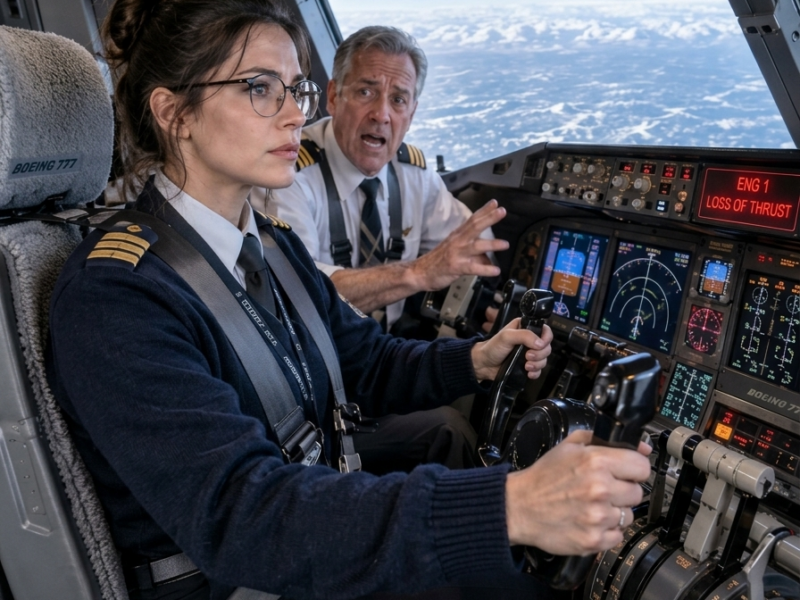
They mocked me for being a quiet flight attendant on a stormy flight out of Denver, until both engines died over the Rockies and the captain turned pale
The crew room at Denver International Airport always smelled of stale coffee, industrial floor wax, and ozone swept in from the tarmac. Outside, bruised purple thunderheads stacked over the Front Range like iron battlements. Lightning flickered within the belly of the clouds, illuminating the jagged peaks that rose fifty miles to the west. It was early evening, but the sky had turned the color of cold lead.
“Hey, Jane Doe. Make sure you don’t faint up there when we hit the chops,” Greg chuckled, adjusting the gold stripes on his blue uniform blazer. He was the senior purser for Flight 418, an aging Airbus A320 bound for Seattle. He had been flying with the airline for twenty-two years, and he made sure every junior hire knew it within five minutes of meeting him.
I looked up from my pre-flight safety checklist and offered a faint, practiced nod. “Yes, Mr. Miller. Bags are stowed, emergency equipment is verified.”
“Don’t give me that robotic nonsense,” he sneered, leaning against the briefing table with an arm crossed over his belly. “Look at you. You barely speak above a whisper. You walk like you’re trying not to leave footprints. The gate agents said you didn’t even push back when that passenger in 3B shoved his rollaboard into your shin. If you’re that timid, honey, you picked the wrong profession. Mountain weather isn’t for mousy little girls.”
Beside him, two junior attendants snickered into their paper cups. I simply folded my manifest, slipped my pen into the breast pocket of my navy vest, and kept my eyes fixed on the laminate table.
They knew me as Elena Vance: quiet, unremarkable, perpetually cooperative. The flight attendant who took the red-eyes nobody wanted, who never complained about delayed layovers in freezing regional airports, who ate her meals alone in the galley behind drawn curtains. They saw a woman in her late twenties with pulled-back brown hair and posture so rigid they assumed it was anxiety.
None of them knew that before I was Elena Vance, I had been Captain Elena “Viper” Cross of the 335th Fighter Squadron.
They didn’t know that my spine stayed straight not out of nervousness, but because three lumbar vertebrae had been fused with titanium pins after an ejection seat punched me into the freezing air above the Black Sea at six hundred knots. They didn’t know that the scar tracing the curve of my collarbone wasn’t from a kitchen mishap, but from the canopy frame of an F-15E Strike Eagle disintegrating under supersonic drag.
Eight years ago, I had been the youngest woman ever qualified for advanced tactical strike missions in my wing. I had logged twelve hundred hours in machines that generated thirty thousand pounds of raw thrust and turned G-forces into broken capillaries. I had lived in a world of high-aspect dogfights, terrain-following radar, and split-second decisions made at Mach 1.8.
Until the night over the Georgian border.
It was an unacknowledged black-box operation. We were flying a two-ship strike package into disputed airspace when our flight systems suffered catastrophic electronic interference—not enemy jamming, but internal corruption traced directly back to a subcontractor’s compromised datalink firmware. My commanding officer and flight lead, Major Nathan Ward, had his flight controls lock completely. His aircraft plunged into the snow-choked cliffs of the Caucasus. My weapons systems officer ejected, but his chute failed to deploy cleanly in the inverted spin. I was the only one who hit the ground alive, hanging from a pine branch with cracked ribs and frozen limbs.
The subsequent investigation was buried under three layers of state secrecy. The incident was officially logged as a spatial disorientation training fatality over neutral waters. No trial. No accountability. The contractor who supplied the corrupted navigation modules walked away clean with a hundred-million-dollar pension, while Nathan’s widow was handed a folded flag and a non-disclosure agreement.
I resigned my commission seventy-two hours later. I burned my flight suits, packed a single duffel bag, legally changed my surname, and took the quietest job I could find that still kept me in the air. As a flight attendant, I wasn’t responsible for the aircraft. I didn’t hold anyone’s life in the palm of my hand. I poured diet sodas, collected plastic cups, and hid behind an invisible mask of subservience.
“Boarding in five, quiet one,” Greg barked, snapping his fingers in front of my face. “Try to smile. You look like you’re attending a funeral.”
“Understood,” I murmured.
We walked down the jet bridge into the chill cabin of the A320. The air was already heavy with humidity and tension. The passengers filed in with damp jackets and sour expressions, their tempers frayed by two hours of weather delays. I stood at the mid-cabin aisle, greeting each passenger with mechanical courtesy, checking boarding passes, and directing overhead bin space.
Row 12. Row 13. Row 14.
I stepped back to let a tall, broad-shouldered man into Row 15, seat C. He was wearing a dark charcoal wool coat, buttoned high against the neck despite the warm cabin air, and dark-rimmed glasses that partially obscured his heavy brow. His silver-streaked hair was cut in a severe military taper. When his hand brushed the overhead locker, I noticed the missing nail on his left index finger and the tiny anchor tattoo faded into the web between his thumb and forefinger.
My breath caught in my throat. My vision tunneled for a fraction of a second.
Marcus Vance. Not a relative, despite the alias I had chosen years ago—he was the former civilian systems director for the tactical datalink division at Blackwood Aerospace. The man who had signed off on the fatal firmware update that doomed Nathan’s jet. The man who had disappeared into the private intelligence consulting sector before the congressional committee could subpoena him.
He didn’t glance at me. To him, I was an anonymous uniform handing out napkins. He slid into his seat, pulled a leather portfolio from his briefcase, and stared straight ahead into the seatback in front of him.
He’s on this plane, my mind screamed, the blood pounding in my ears. Why is he flying commercial out of Denver in the middle of a thunderstorm?
Before my racing thoughts could settle, the forward cabin door thumped shut with a heavy, pressurized hiss. The flight attendants took their jumpseats. The cabin lights dimmed to a low amber hum as the twin CFM56 turbofan engines spooled up, their high-pitched whine vibrating through the floorboards.
We taxied through sheeting rain. Outside, wind shear warnings flashed across the airport’s automated weather boards. When the pilot pushed the throttles forward on Runway 34R, the aircraft surged through the wet slush with an uneasy shudder. We lifted off, the gear retracting with a dull mechanical clunk, and immediately the plane was swallowed whole by the pitch-black maw of the storm.
For the first ten minutes, the ascent was a brutal, bucking climb. The aircraft dropped ten feet, twenty feet at a time in sudden violent pockets of downdrafts. In the cabin, several passengers gasped, their fingers digging white-knuckled into armrests. Through the small oval windows, purple branches of lightning crackled along the wing surfaces, illuminating the flexing aluminum skin.
We cleared twenty-two thousand feet, passing over the jagged teeth of the Continental Divide. The cloud layer here was thick with supercooled water droplets and violent mountain-wave turbulence.
Then came the flash.
It wasn’t a standard lightning strike. It was a blinding, deafening arc of static discharge that slammed directly into the aircraft’s nosecone, rolling backward across the fuselage like an electric wave. The cabin lights died instantly, plunging two hundred passengers into pitch-black terror. The emergency floor path lights flickered to life in a dim, sickly green.
A split second later, a horrific mechanical shudder rattled the airframe.
Engine Number One—the port turbine—let out a violent, coughing boom. Flames belched through the intake, visible as a strobing orange flash against the cloud cover outside the left windows. The jet yawed violently to the left. Overhead bins flew open, luggage tumbled into the aisle, and passengers began to scream in genuine, unbridled hysteria.
“Compressor stall!” I muttered under my breath, my hands gripping the jumpseat harness automatically.
Then came the true horror.
Two seconds later, a dull, hollow groan echoed through the right wing. Engine Number Two didn’t surge. It didn’t cough. The master turbine shaft simply severed under thermal shock and severe rotational stress. With a sickening whine of dying bearings, the right engine windmilled to a dead stop.
The vibration ceased entirely.
The horrific, screaming roar of two commercial jet engines vanished, replaced by an unnatural, terrifying quiet. The only sound left was the hollow hiss of freezing mountain air rushing over the dead metal skin of the fuselage, and the shrieks of passengers realizing that we were no longer climbing.
We were falling.
The plane wallowed like a ship hitting a reef. Without thrust, the nose pitched down, the aerodynamic drag pulling us relentlessly toward the granite ridges hidden below the storm clouds. The cabin altitude warning chime began to sound—three rhythmic dings followed by the automated voice repeating: Caution. Terrain. Caution. Terrain.
“What’s happening? Oh God, what’s happening?!” a mother in Row 10 screamed, clutching her toddler to her chest as oxygen masks dropped from the ceiling with a clattering cascade of plastic panels.
Greg was frozen in the forward galley jumpseat. His face had turned the color of damp parchment. His fingers were locked around his safety harness with such force that his knuckles were stark white. He was hyperventilating, his jaw trembling, his eyes wide and vacant with paralyzed terror.
“Greg! Release the harness!” I barked.
He didn’t move. He didn’t even hear me. The arrogance that had puffed his chest ten minutes ago had completely dissolved, leaving behind a hollow shell of pure panic.
I didn’t wait. I slapped my own harness buckle, broke out of the jumpseat, and grabbed the galley handrail to brace against the plane’s descending pitch. The aircraft was dropping at roughly two thousand feet per minute. At this descent rate, over the highest terrain in North America, we had less than six minutes before the belly of the plane struck a mountainside.
The flight deck door was locked, but the emergency chime sounded twice from inside. Suddenly, the deadbolt clicked open, and the door swung outward.
First Officer Kevin Brooks stumbled into the doorway, his uniform tie undone, his forehead bleeding from where he had slammed into the overhead panel during the violent yaw. He looked barely thirty, completely out of his depth.
“Captain needs help!” he gasped, his voice cracking into a sob. “He’s… he’s having chest pains! I can’t get the APU started! Both engines flamed out! We have no electrical, no hydraulics on System A!”
I didn’t ask for permission. I stepped past him into the flight deck, pulling the heavy cockpit door shut behind me to block out the screaming cabin.
The scene inside was pure chaos.
The flight deck was lit only by the faint glow of the standby flight displays running on emergency battery power. Master warning lights strobed red and amber across the glare shield. Warning klaxons were blaring over each other in an overwhelming cacophony: Dual Engine Failure. Generator 1 Off. Generator 2 Off. Ram Air Turbine Deployed.
In the left seat, Captain Robert Vance—no relation to Marcus, a veteran airline captain with thirty years of clean civilian service—was slumped back against his headrest, his left hand clutching his chest, his breathing ragged and shallow. Sweat soaked his grey hair. His face was ash-grey, his lips tinged with blue.
“Can’t… can’t hold her,” the captain wheezed, his right hand shaking violently on the side-stick controller. “Dual flameout… unrecoverable… mountain clearance… we’re too low…”
Brooks collapsed onto the observer jumpseat behind him, sobbing openly. “The Ram Air Turbine popped, but the bus didn’t transfer! The flight management computers are dead! We don’t have glide calculations! We’re going into the peaks, Robert! We’re dead!”
I looked at the primary flight display.
Airspeed: 210 knots and decaying. Altitude: 18,400 feet. Mountain peaks below us rose to 14,200 feet. We had roughly four thousand feet of clearance, losing thirty-five feet every single second. The aircraft was drifting in a descending spiral through zero-visibility cloud.
My heart didn’t race. The shaking in my hands vanished completely.
A cold, familiar clarity washed over my mind like an injection of pure liquid oxygen. The fear, the past eight years of pretending to be weak, the comfortable numbness of obscurity—all of it burned away in an instant. The cockpit smelled of scorched wiring, ozone, and impending death. I had lived in this environment for years.
I reached down, grasped Captain Vance’s trembling fingers, and lifted his hand gently from the side-stick controller.
“Captain,” I said, my voice dropping into the low, calm, authoritative frequency of a strike lead on an emergency vector. “Look at me.”
His rheumy, pain-filled eyes turned toward me, struggling to focus through his agony. “What… who are you?”
“I know how to land this aircraft,” I whispered.
He blinked, confusion warring with the terror in his eyes. “You’re… you’re the galley girl…”
“I’m an aviator, Robert. Unbuckle and slide out, or stay in the seat and let me take the controls. Choose now. We have four minutes.”
He looked at my eyes. Whatever he saw there—the utter absence of hesitation, the predatory focus that civilian crews never develop—made his jaw slacken. He groaned, reached down with his right hand, unhitched his four-point harness, and allowed the weeping first officer to drag him backward into the jumpseat space.
I slipped into the left captain’s seat.
I adjusted the rudder pedals until the balls of my feet rested firmly on the steel toe brakes. I pulled the five-point harness tight across my hips and chest, clicking the buckle into place. The familiar weight of the shoulder straps against my collarbone bone graft sent a jolt of tactile memory through my nerves.
“What are you doing?!” Brooks yelled from behind me, wiping blood and tears from his eyes. “You can’t fly this! This is a multi-ton commercial jet! It’s not a simulator!”
“Shut up and run the dual-engine restart checklist,” I ordered without looking back. My tone was like a whip cracked against stone. “Check cross-bleed valve open. Verify fuel pumps on emergency DC bus. Now!”
Brooks froze, shocked into silence by the commanding whip in my voice. He scrambled for the laminated emergency quick-reference handbook.
I took hold of the side-stick with my left hand and reached for the manual trim wheel with my right.
The Airbus A320 was in alternate flight control law. With both primary generators offline, the sophisticated computer protections that prevented civilian pilots from stalling or rolling the aircraft were completely dead. The fly-by-wire system was operating in raw, direct mode. It was no longer a computer that flew itself.
It was a seventy-ton glider.
And an airplane doesn’t need an engine to fly. It needs airspeed, discipline, and gravity.
I pushed the side-stick forward.
“What are you doing?!” Brooks shrieked as the aircraft pitched downward, the nose pointing steeper into the black void. “We’re losing altitude faster!”
“We’re maintaining best glide speed, you idiot,” I snarled. “Green dot speed is 215 knots. If we bleed below two hundred, the wings stall, the airflow separates, and we pancake into the ridge like a lead sinker. We trade altitude for airspeed. Airspeed gives us control.”
The artificial horizon leveled out. The aircraft stabilized in a steep, steady, unpowered glide. The shuddering in the airframe smoothed into a clean, aerodynamic slipstream.
“APU start failed!” Brooks called out, his hands trembling over the overhead switches. “Battery voltage is dropping! Igniters are clicking, but both engine cores are seized! Core lock on both turbines! There is no restart, Elena! There is no restart!”
“Understood,” I said calmly. “We dead-stick it.”
“Where?! Denver is forty miles behind us behind a fifteen-thousand-foot wall! Aspen is in a box canyon we can’t clear! We are in the middle of the Rockies with zero visibility!”
I stared at the backup mechanical compass and the standby altitude indicator. I didn’t need the flight computers to tell me where we were. During my years at Peterson Air Force Base in Colorado Springs, I had flown tactical mountain low-level sorties through these exact valleys until every ridgeline was burned into my retinas.
“We’re eight miles north of the Eagle County corridor,” I said, my voice dead and level. “We’re not going to Denver. And we’re not going to Aspen.”
“Then where?”
“Camp Hale,” I said. “Pando Valley.”
Brooks stared at me as if I had spoken in ancient Sumerian. “What? Camp Hale is a decommissioned World War II infantry training ground! There’s no active airport there!”
“There’s an emergency auxiliary military strip built into the valley floor during the Cold War,” I answered, rolling the side-stick fifteen degrees to the left. The aircraft banked smoothly through the clouds. “Runway length: four thousand two hundred feet. Concrete and compacted gravel. Unlit. Unmonitored.”
“Four thousand feet?!” Brooks choked. “An A320 needs six thousand feet on dry pavement with full reverse thrust! We have no reversers! We have no anti-skid on backup hydraulics!”
“Then we’d better not miss our touchdown point,” I said.
The aircraft broke through the bottom of the cloud deck at eleven thousand feet.
Suddenly, the world exploded into terrifying, jagged reality.
The clouds peeled away like torn paper, revealing a world of black granite and blinding white snow. We were flying beneath the ceiling of the storm, trapped inside a narrow mountain valley. Sheer rock walls, dusted with fresh powder and dark clusters of pine, rose two thousand feet above our wingtips on both sides.
Behind the closed cockpit door, the scream of two hundred passengers intensified into a sustained, collective wail of utter doom. They could look out the cabin windows and see trees close enough to count the branches.
“Terrain! Pull up! Whoop, whoop! Pull up!” the mechanical ground-proximity system screamed.
“Override the GPWS warning,” I snapped. “Pull the breaker behind your right shoulder. It’s giving false alerts based on standard glide slopes.”
Brooks fumbled frantically with the circuit breaker panel until the electronic voice fell silent. The only sound remaining was the dull roar of the wind over the cockpit windshield and the heavy, rattling breaths of Captain Vance on the floor behind us.
“Wind is 280 at twenty-two knots, gusting thirty-five,” I observed, watching the drift of snow along the canyon floor. “Crosswind component is going to push us toward the eastern cliff face. Brooks, get on the cabin intercom.”
“What… what do I tell them?” he stammered.
“Tell them to brace for impact. Head down, arms over knees. Tell them if they stand up before we come to a full stop, their spines will break. Say it once, say it clearly, and then get into your seat and cinch your five-point harness until you can’t breathe.”
Brooks grabbed the intercom handset with shaking fingers, his voice trembling across the cabin speakers. Even through the soundproof bulkhead, I heard the sudden drop in the cabin’s noise—the shrill screams giving way to the dreadful, suffocating silence of human beings preparing to die.
I focused entirely on the valley floor ahead.
The Pando Valley was a natural trough carved by ancient glaciers, but it twisted like an uncoiling snake. To make the landing strip, we had to clear a narrow rock saddle known as the Devil’s Gate.
“Altitude eight thousand five hundred,” I murmured. “Speed 205 knots.”
The aircraft was descending toward the saddle. Two granite pillars rose directly in our path, the gap between them barely wider than the eighty-foot wingspan of the Airbus.
“We can’t fit through there!” Captain Vance wheezed from the floor, his eyes wide with horror as he leaned his head against the center console. “Elena, pull up! Trade the speed for altitude! We can clear the ridge and belly-flop into the trees!”
“If we stall into the timber, the fuel tanks in the wing roots will rupture and incinerate everyone aboard,” I said without shifting my gaze. “We fly the gap.”
I applied left rudder and eased the side-stick to the right, executing a brutal, uncoordinated slip. The fuselage turned sideways into the oncoming wind, the side of the aircraft acting as an enormous airbrake. The rate of descent spiked to three thousand feet per minute. The right wingtip carved through the upper boughs of a five-hundred-year-old pine, sending a shower of pulverized needles and bark across the right cockpit glass.
Marcus Vance’s face flashed in my mind for a split second.
He’s sitting back there, I thought. The man who covered up Nathan’s death. The man who destroyed my life. If I miss this gap by two feet, he dies. But so do two hundred innocent people.
“Hold on!” I shouted.
The aircraft shot through the granite needle. The stone walls passed so close on either side that the reflected sound of our own wind-roar boomed back through the aluminum hull like an artillery shell.
We cleared the gap. The valley opened up before us.
There it was.
Half-covered in drifts of fresh snow, cracked with age and overgrown with weeds along the margins, the abandoned military runway stretched across the frozen meadow. It looked like a postage stamp dropped in a field of white.
Four thousand two hundred feet of crumbling concrete.
At the end of the runway was not a gentle overrun zone. At the far end of the strip was a sheer wall of solid granite where the mountain rose vertically into the storm. If we didn’t stop, the aircraft would impact the rock wall at over eighty miles per hour.
“Gear down,” I commanded.
Brooks hesitated, his hand hovering over the red emergency landing gear extension handle. “If I drop the gear now, the drag will kill our glide! We’ll fall short of the threshold!”
“Drop the gear!” I roared, turning my head to glare at him with eyes that had seen dogfights over hostile borders. “Gravity extension! Pull the handle three times!”
Terrified into submission, Brooks grabbed the red handle and yanked it up, down, and up again.
Under the cabin floor, the mechanical uplocks released. Three sets of massive landing gear fell under their own weight, swinging down into the slipstream with a series of heavy, bone-jarring thuds. The green gear-down indicator lights flickered on the standby panel.
The aerodynamic drag hit us like an invisible wall. The airspeed instantly began to decay: 190 knots… 170 knots… 150 knots.
“Flaps to configuration three,” I said. “Use the manual hydraulic accumulator.”
Brooks pumped the auxiliary lever. The trailing-edge flaps ground down into position, groaning under the pressure of the oncoming air. The aircraft ballooned slightly, then settled into a steep, stabilized approach.
We were five hundred feet above the snow. Three hundred feet. One hundred feet.
The runway threshold rushed toward the windshield. The wind was howling from the right, trying to push our tail into a fatal ground-loop. I crossed the controls, kicking opposite rudder while banking the wing slightly into the wind, aligning the fuselage with the center of the cracked runway.
“Fifty feet,” Brooks cried out, reading the radar altimeter. “Forty… thirty… twenty…”
I did not pull back hard. In a dead-stick landing with a heavy transport category aircraft, pulling back too much creates an aerodynamic stall that causes the plane to drop out of the air and shatter its landing gear struts.
I eased the stick back two inches. Just enough to break the descent.
The main wheels slammed into the snow-covered runway.
The impact was violent enough to knock the breath from my lungs.
The shock absorbers bottomed out with a deafening metallic screech. The tires hit the patch of compacted snow and ice, instantly hydroplaning before biting down onto the frozen, pitted concrete below. The aircraft bounced ten feet into the freezing air, shuddering violently as the wings flexed like drawn bows.
“Keep the nose down!” Brooks screamed, grabbing the glare shield.
I didn’t let the aircraft float. I shoved the side-stick forward, forcing the nosewheel down onto the runway with a brutal thud that sent a shockwave vibrating through the rudder pedals directly into my fused spine. A spike of white-hot agony flared across my lower back, but I clamped my teeth together until the copper taste of blood filled my mouth.
“Maximum manual braking!” I yelled.
I stood on the toe brakes with all the strength left in my legs.
Because the main hydraulic systems were dead, the brakes were running purely on the emergency accumulator bottle. We had six, perhaps seven applications of pressure before the nitrogen charge depleted and the brakes went entirely soft.
There were no thrust reversers. There were no automated lift-dumpers.
The aircraft was hurtling down the frozen strip at one hundred and thirty miles per hour, sliding sideways on patches of black ice. Through the cockpit glass, the granite wall at the far end of the runway was expanding with terrifying speed. Two thousand feet remaining. Fifteen hundred feet.
“We’re not stopping!” Brooks screamed, covering his face with his forearms. “We’re going to hit the mountain!”
“Brakes… release… pump!” I shouted to myself, modulating the pedal pressure manually to simulate the missing anti-skid computer.
The tires shrieked, smoking as rubber burned against frozen rock despite the freezing slush. Bits of shredded tread battered the underside of the fuselage with the sound of machine-gun fire. The aircraft lurched, threatening to spin out of control to the left. I danced on the rudder pedals, fighting the drift with aggressive, precise corrections, using the weathercock effect of the vertical tail fin to keep us aligned with the centerline.
One thousand feet.
The granite wall loomed above us like a skyscraper. I could see the individual crevices in the dark rock, the jagged ledges heavy with overhanging cornices of blue glacial ice.
“Hold on!” I screamed into the open cockpit.
Eight hundred feet. Speed: seventy knots.
Five hundred feet. Speed: forty-five knots.
The brake accumulator pressure gauge dropped into the yellow band, then the red. The pedal resistance went completely soft beneath my combat boots. The hydraulic pressure was gone.
We were still rolling at thirty knots, straight toward the rock face.
I didn’t close my eyes. I reached down with both hands, grabbed the emergency parking brake handle on the center pedestal, and hauled it upward with a slow, deliberate, agonizing pull. If I pulled it too fast, the rear brakes would lock solid, the tires would blow, and the plane would flip onto its back.
The mechanical brake pads clamped down on the glowing carbon discs.
A horrific, high-pitched scream of tearing metal tore through the floorboards. The smell of scorched brake linings and burning rubber flooded the cabin air vents. The aircraft bucked forward violently, the nose strut compressing until the nosecone hovered barely three feet above the ground.
And then, with a final, shuddering groan of stressed metal…
The aircraft stopped.
Silence.
Absolute, unbroken, suffocating silence.
The engines were dead. The warning klaxons had finally fallen quiet as the batteries died. The only sound in the cockpit was the heavy, ragged gasping of three people who had walked into the jaws of death and somehow slipped back out.
Outside the cockpit windshield, less than fifteen feet from the nosecone, the vertical granite wall rose into the falling snow like a monument of black iron.
Brooks slowly lowered his arms from his face. He stared at the stone wall, then looked at the instruments, then slowly turned his head to look at me. His mouth opened, but no sound came out.
Behind us, Captain Vance let out a long, trembling breath that ended in a quiet sob.
In the cabin beyond the locked door, the silence held for five seconds. Nobody moved. Nobody breathed. Then, a single child began to cry. A moment later, the entire cabin erupted into an overwhelming roar of tears, gasping prayers, and the frantic clicking of seatbelt buckles.
“We’re alive,” Brooks whispered, his voice trembling so violently he could barely articulate the syllables. “We’re… we’re on the ground. We didn’t crash.”
“Shut down the battery master,” I said, my voice completely steady despite the trembling in my knees. “Evacuate the passengers through the right-side overwing exits and forward slide. The left engine took ground debris during the rollout; verify no residual fire before deploying slides.”
I unbuckled my five-point harness, clicked the release, and stood up on legs that felt like hollow lead pipes. My spine screamed with dull, throbbing pain, but I stood tall. The rigid posture was back.
Captain Vance looked up at me from the jumpseat, his hand still resting over his heart, but the color slowly returning to his cheeks. “Who are you?” he breathed, tears cutting clean lines through the soot and sweat on his aged face. “In forty years of flying… I have never seen anyone handle an aircraft like that. That wasn’t commercial training. That wasn’t standard procedure. Who the hell are you?”
I reached into my pocket, pulled out my clip-on airline identification badge—Elena Vance, Cabin Crew—and tossed it onto the center console.
“Nobody, Captain,” I said quietly. “Just a flight attendant who remembers how to fly.”
I turned the heavy deadbolt on the flight deck door and pushed it open.
When I stepped into the forward galley, the passengers in the front rows fell silent. Greg was standing near the forward boarding door, his uniform disheveled, leaning against the bulkheads with eyes full of shame and disbelief.
“Elena…” he stammered, his voice cracking. “What did you… how did…”
I walked past him without a word, grabbed the emergency door handle, rotated it upward, and deployed the pneumatic evacuation slide into the snow.
“Evacuate,” I announced clearly down the aisle. “Leave your personal items. Women, children, and elderly first. Form a line and move to the clearing fifty yards off the right wing. Move now.”
The passengers moved in an orderly, stunned daze. As they passed me, several reached out to touch my arm, their faces wet with tears, murmuring broken words of gratitude. I guided them down the slide into the knee-deep alpine snow, my eyes constantly scanning the crowd.
Then came Row 15.
Marcus Vance stepped into the galley. He held his leather portfolio tightly under his left arm. His coat was buttoned to the chin. His face was pale, his eyes sharp and analytical, darting around the cabin with the cold paranoia of a hunted wolf.
He stopped directly in front of me.
He adjusted his glasses, looking at my face. For the first time, he really saw me. His eyes drifted to the scar on my collarbone, visible where my uniform collar had torn during the violent landing, then traveled up to my eyes.
The color drained from his face until he looked like a corpse.
“You,” he whispered.
“Captain Cross,” Marcus Vance muttered, his voice dropping into a register that only I could hear above the sound of crying passengers sliding into the snow. “You’re supposed to be dead. The Air Force reported you perished in a private transport accident in Nevada six years ago.”
“They reported what was convenient, Marcus,” I said, my voice as cold as the wind howling through the open cabin door. “Just like they reported Nathan’s fatal flight was a spatial disorientation accident.”
His jaw tightened. His hand gripped the leather portfolio so tightly that the seams of his wool gloves strained. “You don’t know what happened that night. You were just a pilot following a flight path. There were geopolitics involved. Alignments that went beyond the lives of two aviators.”
“Nathan had two daughters,” I said, stepping forward until we were inches apart. “His youngest was three months old when you sold that batch of faulty processors to the defense logistics board to protect your quarterly stock valuation.”
“I did what I had to do to survive,” he hissed, his eyes darting toward the open door, measuring the distance to the snow. “And you have no authority here, Captain. You’re a rogue officer hiding under an assumed name. You can’t touch me.”
Before I could answer, the deep, rhythmic, bone-shaking thump of heavy rotor blades cut through the mountain wind.
The sound wasn’t the light, high-pitched hum of a civilian rescue helicopter. It was the low, visceral thudding of twin turboshaft engines driving an oversized four-bladed main rotor. A Sikorsky UH-60 Black Hawk burst through the low cloud deck over the southern ridge of the valley.
The helicopter was entirely black, stripped of all national insignia and military markings, save for a low-visibility tactical serial number stenciled in charcoal along the tail boom. It banked hard over the clearing, its massive rotor wash kicking up a blinding blizzard of fresh alpine snow that swept across the fuselage of our downed A320.
“Rescue?” Greg called out from the bottom of the slide, shielding his eyes from the freezing spray. “They found us already?!”
“That’s not search and rescue,” Brooks muttered, leaning out the cockpit emergency window. “There’s no hoist. Look at the hardpoints on the stub wings.”
The Black Hawk didn’t deploy medical personnel. It flared sharply fifty yards from the nose of our aircraft, settling onto the snow with mechanical precision. Even before the wheels touched the frozen turf, the sliding cabin door opened.
Four men in unmarked winter combat gear, carrying suppressed carbines held at low-ready, leaped into the knee-deep powder and established an immediate security perimeter around the clearing.
Then, a fifth man stepped out of the cabin.
He didn’t wear a helmet. He wore a heavy green fleece jacket with the subdued rank insignia of an Air Force colonel on the tab, a dark watch cap pulled low over his forehead, and aviator glasses despite the dim mountain light. He walked through the snow with the steady, measured gait of an infantry veteran.
Colonel David Vance. Nathan’s former wing commander, and the officer who had signed my resignation papers eight years ago with tears in his eyes.
The cockpit tactical radio in our downed A320, still connected to the auxiliary battery circuit, suddenly crackled to life. The open military guard frequency hissed with clear, uncompressed digital static.
The voice of the Black Hawk’s pilot broke through the speaker, amplified into the flight deck and forward galley by the emergency relay system.
“Flight 418 flight deck, this is Shadow Six on tactical frequency. We have your ELT beacon.”
A pause, followed by a sentence that made the hair on the back of my neck stand on end.
“Tell Captain Cross we’ve been tracking her tail since she left Denver airspace. And tell her… we’re finally here for the man who murdered Nathan Ward.”
Marcus Vance went completely rigid.
The leather portfolio slipped from his fingers, landing with a soft thud on the wet carpet of the galley floor. The zipper broke open, spilling dozens of classified defense audit documents, encrypted flash drives, and offshore banking ledgers across my shoes.
“No,” Marcus breathed, backing away toward the center aisle of the cabin. “No, no, no. They weren’t supposed to know I was on this flight. I booked under an alias. The manifest was scrubbed!”
“You didn’t book through a civilian portal, Marcus,” I said, stepping between him and the rear of the cabin. “You used a private secure network that Nathan’s old squadron has been monitoring for forty-eight months. They knew you were running for the Canadian border. They were tracking this flight before the storm even hit.”
“Elena, listen to me,” he pleaded, his voice cracking with desperate, unadorned panic. He reached into his coat pocket, his fingers frantically searching for something. “There’s money. Millions in untraceable bearer bonds in Zurich. I can split it with you. We can walk into the timber before they secure the perimeter! You know what will happen to me if I go to Leavenworth! They’ll put me in a hole and throw away the key!”
“That’s the point,” I said.
He lunged for the emergency exit door, trying to push past me.
For eight years, I had held my head down. For eight years, I had poured drinks, smiled politely at insults, and allowed arrogant men to treat me like an invisible ghost.
The muscle memory of ten years of military survival and close-quarters hand-to-hand training took over in a fraction of a millisecond.
I didn’t step back. I stepped inside his reach.
My left hand slapped his wrist, redirecting his forward momentum, while the heel of my right palm drove straight up into his chin with the force of an uncoiling steel spring. The impact snapped his head back. Before he could recover his footing, I hooked my boot behind his ankle, twisted his shoulder, and drove him face-down onto the galley floor with a heavy, breath-stealing thud.
I drove my knee into the small of his back, pinned his left arm behind his shoulder blades, and forced his face into the damp carpet.
“Stay down,” I whispered into his ear. “Or I’ll break the other wrist.”
The forward door darkened as Colonel David Vance stepped onto the threshold, his boots covered in snow, a sidearm holstered securely at his tactical belt. Behind him, two armed operators took positions at the bottom of the slide, cutting off any possibility of escape.
The colonel looked down at Marcus Vance pinned beneath my knee, then slowly raised his eyes to meet mine.
A faint, sad smile crossed his weathered face.
“Hell of a landing, Viper,” he said softly.
“The brakes were shot, Colonel,” I replied, breathing evenly, not letting an inch of pressure off Marcus’s neck. “We used every foot of the strip.”
“I saw the approach from the ridge,” the colonel said, stepping into the galley and looking through the cracked windshield toward the sheer granite wall fifteen feet from the nosecone. “There isn’t another pilot in North America who could have slipped an airliner through the Devil’s Gate on an unpowered glide and stopped it on four thousand feet of ice. Not one.”
“Captain Robert Vance did the heavy lifting before his heart gave out,” I said, nodding toward the cockpit where the paramedics were already entering to assist the captain. “The aircraft is secure. The passengers are clear.”
Colonel Vance motioned to his operators. Two large men in tactical gear stepped forward, dragged Marcus Vance to his feet, slapped heavy steel zip-ties around his wrists, and hauled him out the door into the freezing wind. Marcus didn’t scream anymore. He walked with his head down, completely broken, knowing that the ghost he had helped create had finally dragged him into the light.
The colonel knelt down, picked up the scattered classified documents from the floor, and slid them back into the leather portfolio. He handed the case to one of his aides, then turned back to me.
“Your mother thinks you’re working a desk job in Dallas, Elena,” he said gently. “Nathan’s widow still asks about you every Christmas. You’ve been hiding in the shadows for eight years because you thought you failed him.”
“I did fail him,” I whispered, the titanium pins in my spine aching with the cold that drifted through the open door. “I came home. He didn’t.”
“He died because of sabotage, Captain. You saved two hundred people today because you refused to let go of what he taught you.” The colonel reached into his heavy fleece jacket and pulled out a small, velvet-lined wooden box. He pressed it into my gloved hand.
“What is this?” I asked.
“Your flight wings,” he said. “The Chief of Staff signed your full reinstatement order this morning. The black-box file on the Caucasus mission has been declassified by executive directive. Nathan’s family is receiving the Congressional Medal of Honor at the White House on Friday. And they won’t stand on that stage without his wingman beside them.”
I held the box in my hands. The polished mahogany was smooth and cold, but beneath the lid lay the silver wings that had defined every breath I took before the world went dark.
I looked back through the aircraft cabin.
The empty seats, the dangling oxygen masks, the scattered luggage—the fragile, chaotic human world that I had spent eight years serving from a distance. Outside in the deep snow, two hundred passengers were huddled under emergency blankets, alive, breathing the crisp mountain air, looking back at the scarred metal bird that had carried them through the storm.
Greg was standing near the wing, staring up through the cabin door at me with wide, humbled eyes, realizing finally who had been walking among them all along.
I turned back to Colonel Vance.
For the first time in eight years, I let my shoulders drop the invisible weight they had been carrying. I pulled off my flight attendant scarf, let it flutter down onto the floor, and stood tall before my former commanding officer.
I raised my right hand to my eyebrow and snapped a crisp, razor-sharp military salute.
“Captain Elena Cross,” I said, my voice steady, clear, and unyielding. “Reporting for duty, sir.”
The storm clouds above the valley began to tear apart, letting through the first golden shafts of late afternoon sun across the snow-capped peaks of the Continental Divide. My quiet war was over. The silence was finally broken. And for the first time since the night the sky burned over the Caucasus, I was ready to fly again.
The end.









