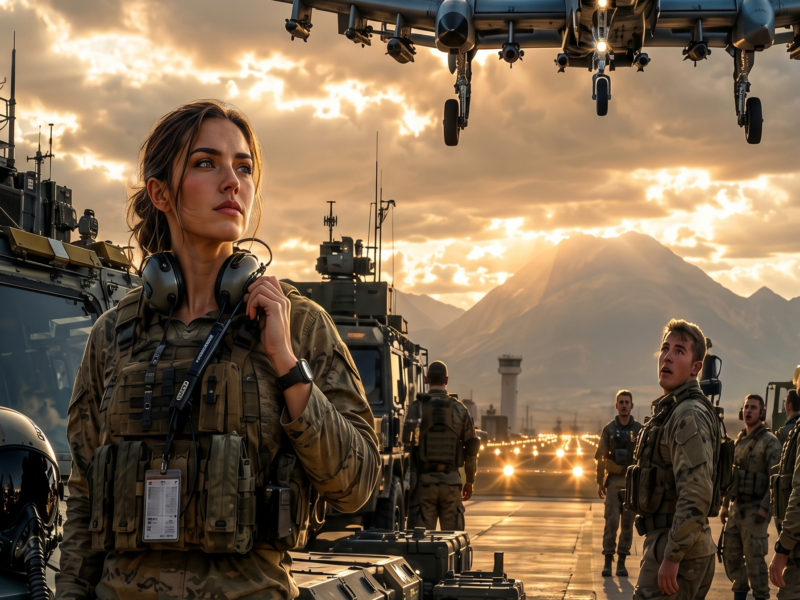
They mocked me as “just logistics” when I climbed into the A-10 cockpit during a desperate convoy rescue
The smell of JP-8 jet fuel and hot tarmac was a permanent fixture at Forward Operating Base Shank, nestled deep in the arid, dust-choked mountains of eastern Afghanistan. At 06:00, the sun had barely crested the jagged peaks, casting long, sharp shadows across the concrete revetments where three A-10C Thunderbolts sat under dusty camouflage netting.
I stood by the fuel truck with a metal clipboard resting against my thigh, verifying the density meters for the morning transport run. My uniform bore no combat patches, no pilot wings, and no tactical designations—just the standard logistics insignia of a supply coordinator. To the two hundred men and women stationed at Shank, I was simply Captain Evelyn Reed: the quiet woman who made sure the ammunition arrived on time, the fuel tanks stayed full, and the supply manifests matched the inventory.
“Hey, Logistics,” Lieutenant Miller called out, leaning against the ladder of an A-10 as he pulled on his flight gloves. “Make sure those three-hundred-gallon external tanks are topped off before noon. We’ve got a routine patrol along Route Viper.”
I didn’t raise my eyes from the paper. “Tanks were flushed and filled at zero-four-hundred, Lieutenant. Your tire pressures are set for high-altitude landing, and your secondary hydraulic fluid was topped off twenty minutes ago.”
Miller blinked, taken aback by the precision of my response, before chuckling softly to his wingman. “Look at that. Our supply girl knows her way around a maintenance sheet. Maybe we should teach her how to ground-guide a jet next.”
His wingman snickered. “Careful, Miller. She might drop her clipboard.”
I said nothing. I checked the final box on the manifest, capped my pen, and walked toward the tactical operations center (TOC). I had spent three months at FOB Shank enduring the casual condescension of young pilots who saw my logistics uniform as a sign of administrative irrelevance. They saw a thirty-eight-year-old woman with graying hair tucked behind her ears and dark circles under her eyes. They didn’t ask what I had done before I transferred to supply distribution. They didn’t ask why my personnel jacket was sealed under a Class-4 security clearance.
Inside the TOC, the air was cold, thick with the smell of stale coffee, tobacco, and the low, continuous hum of server racks. Large tactical displays mapped the rugged terrain of the valley, glowing with blue and red unit icons.
Major Harrison, the squadron commander, stood over the central map table, his eyes fixed on a glowing red corridor labeled Sector Bravo-Ninth.
“Report,” Harrison barked without looking up as I stepped into the room to deliver the morning fuel logs.
“All primary fuel bladders are at maximum capacity, Major,” I said, setting the clipboard on the corner of his desk. “The supply convoy from Bagram is twenty minutes away from entering the mouth of the Shabar Pass.”
Harrison grunted, adjusting his glasses. “Good. That convoy is carrying our winter ordnance. Make sure the unloading crew is ready the moment they hit the gate.”
“Yes, sir.”
I turned to leave, but before my hand touched the door handle, the primary comms speaker on the wall burst into a storm of violent static, followed by the rapid, panicked voice of a convoy commander over an open frequency.
“MAYDAY! MAYDAY! This is Victor-Six! We are taking heavy rocket-propelled grenade and small-arms fire in the Shabar Pass! Lead vehicle is disabled! I repeat, lead vehicle is burning!”
The TOC erupted into motion. Intelligence officers lunged for their headsets; satellite imagery feeds zoomed in on the Shabar Pass. Red icons multiplied across the valley map like a spreading virus.
“Get me a visual!” Harrison ordered, leaning over the table.
“Sir, the convoy is trapped in a narrow throat at kilometer twelve!” an intelligence lieutenant shouted. “High cliffs on both sides! Enemy forces have blocked the front and rear with IED detonations! They have forty personnel pinned against the rock face!”
“Where is our air cover?” Harrison demanded.
“Viper Squadron is currently engaged sixty miles south near the border, sir!” the radio operator called out, his face pale. “They’re bingo on fuel and out of heavy ordnance! They can’t divert!”
“What about Bagram?”
“Weather cell over Bagram has grounded all rotary craft! They’re locked in by heavy cloud cover for at least two hours!”
Harrison slammed his fist onto the map table, cracking the glass overlay. “Forty men… they’re sitting ducks in that ditch! We need a platform with a heavy gun to clear those ridgelines! We need an A-10!”
The room fell into a suffocating silence. Every pilot attached to the station was currently airborne with Viper Squadron or stuck at Bagram. The chairs at the flight control desks were empty.
I stood by the door, my eyes fixed on the satellite display showing the burning trucks in the narrow stone trench of the Shabar Pass. My pulse, usually slow and measured, began a steady, familiar rhythm. The ghost I had spent twelve years trying to bury began to stir behind my eyes.
“There’s one ready,” I said quietly.
Harrison snapped his head toward me, his brow furrowed in anger and stress. “What did you say?”
“A-10C, Tail Number 408,” I said, taking two steps toward the table, my voice dropping into a flat, absolute cadence. “It was rearmed this morning with eleven hundred rounds of thirty-millimeter armor-piercing incendiary, two AGM-65 Maverick missiles, and four rocket pods. Fuel tanks are full. It’s sitting in Bay Three.”
Harrison stared at me as if I had spoken in a foreign language. He shook his head dismissively. “That aircraft is sitting there because we don’t have a stick to fly it, Captain. Stay with logistics. Pilots fly.”
“You don’t have anyone else, Major,” I said, stepping closer until I was standing directly across the table from him. “In twelve minutes, those insurgents will move down from the high ground and wipe out forty soldiers. In fifteen minutes, you will be writing forty letters to families.”
Harrison’s eyes narrowed into slits. “Have you ever flown combat, Captain Reed?”
I looked him dead in the eye. “Yes.”
The TOC went completely still. The frantic clatter of keyboards stopped. Harrison searched my face, looking for hesitation, fear, or bluff. He found none. He looked at the satellite screen, where a second vehicle on the map turned red, signifying a catastrophic hit.
“Get her a flight suit,” Harrison ordered softly, never taking his eyes off me. “If you scratch my airplane, Reed, I’ll court-martial what’s left of you.”
Ten minutes later, I was standing on the ladder of A-10C Tail Number 408. The familiar smell of hydraulic fluid, ozone, and metal flooded my senses as I swung myself into the narrow titanium bathtub cockpit. My hands didn’t tremble. My fingers moved across the switch banks with a terrifying, mechanical fluid memory that twelve years of desk duty had failed to erase.
Fuel pumps—ON. APU—ENGAGED. Left engine spooling—20%, 40%, 60%. Right engine—IGNITION.
The twin General Electric TF34 engines behind the canopy howled to life, their high-pitched whine shaking the airframe. The digital heads-up display (HUD) flickered green against the glass, projecting speed, altitude, and artificial horizon lines across my field of vision.
I pulled the heavy helmet down over my head, snapping the oxygen mask over my face. The world outside contracted into the clear, sharp boundaries of a combat mission.
“Shank Tower, Tail Number 408 requesting immediate emergency departure, runway zero-four,” I said through the mask.
“Tail Number 408, cleared for immediate takeoff,” the tower controller replied, his voice laced with disbelief. “Good hunting… whoever you are.”
I slammed the throttles forward. The heavy twin-engine attack jet surged down the concrete strip, its thirty-millimeter GAU-8 Avenger cannon protruding from the nose like a black, iron snout. At one hundred and forty knots, I pulled back on the stick.
The earth dropped away. The mountains rose up to meet me. The quiet logistics officer was gone, and the phantom had returned to the sky.
The sky over the Shabar Pass was a churning tapestry of slate-gray clouds and dark, rising columns of black smoke. At nine thousand feet, the A-10 cut through the turbulent mountain air like a iron anvil thrown through a storm.
The moment I crossed the ridge line marking the entrance to Sector Bravo-Ninth, the primary tactical frequency exploded with frantic, screaming voices over a background of heavy, continuous machine-gun fire and mortar detonations.
“Victor-Six to anyone listening! We have lost the third vehicle! RPG fire from the eastern ridge! We are taking direct mortar hits on the middle platoon! We cannot hold this ditch!”
I flipped the master arm switch on the left console to ON. A green confirmation light illuminated on the HUD: GUN READY. MAVERICK ARMED.
I adjusted my throttle, banking the heavy jet ninety degrees to the left, diving through the cloud deck toward the narrow, jagged trench of the pass below.
“Victor-Six, this is Raven One,” I broadcasted over the open tactical link. My voice was smooth, measured, and entirely free of the tension vibrating through the network. “I am inbound on your position, zero-three-zero, altitude seven thousand. Mark your friendly front line with green smoke.”
A sharp silence fell over the radio, lasting two seconds, before the convoy commander’s voice broke through, filled with shock.
“Raven One?! Who the hell is Raven One?! We were told there was no air support!”
“You have air support now, Victor-Six,” I replied, rolling the A-10 out of its bank and aligning the nose with the dark gap of the canyon floor. “Pop green smoke on the road and give me your target coordinates.”
“Green smoke is out! Target is the eastern ridge! They have three heavy machine-gun nests and a mortar crew dug into the stone structures above us! They’re chewing us to pieces!”
Through the drift of gray rain and black diesel smoke, I saw the canyon floor. It was a nightmare of tactical isolation. The supply trucks were jammed together on a single-lane dirt road, flanked by a two-hundred-foot vertical cliff on the left and a roaring, rocky river on the right. Bright red streams of armor-piercing tracer rounds were pouring down from the high stone ruins on the eastern ridge, walking straight across the canvas roofs of the transport trucks.
Soldiers were crouched behind the wheels, firing wildly upward with M4 rifles, their small-caliber rounds bouncing uselessly off the rock faces above them.
I pulled the throttle back to ninety percent, lowering the nose into a thirty-degree dive directly toward the eastern ridge. The green reticle of the thirty-millimeter cannon on my HUD swept across the stone ruins, locking onto the heat signatures of the enemy machine-gun emplacements.
Eight thousand feet distance. Six thousand feet. Four thousand feet.
My thumb rested on the red trigger mounted on the front of the control stick.
“Victor-Six, heads down,” I said softly into the mask. “Clearing the ridge.”
I squeezed the trigger.
The GAU-8 Avenger cannon built into the belly of the aircraft didn’t sound like a gun. It sounded like the fabric of the sky being violently ripped in half—a deep, terrifying, mechanical BRRRRRRRRRRRRRRRRRRRRRRRRRRRRRRRRRRRRRT that vibrated through my boots, through my spine, and through the very titanium frame of the cockpit.
Eleven hundred rounds of thirty-millimeter depleted uranium and high-explosive incendiary shells poured out of the seven rotating barrels at a rate of seventy rounds per second.
The eastern ridge erupted in a continuous, hundred-yard line of orange fire, pulverized stone, and disintegrating rock. The enemy machine-gun positions, built from stone blocks and timber, were instantly vaporized, reduced to clouds of fine gray dust and flying debris.
I pulled back hard on the stick, the G-meter climbing to 4.5 as the A-10 roared back up into the clouds, the wake of its engines scattering the smoke across the canyon floor.
For four seconds, the tactical frequency was dead quiet.
Then, a wild, screaming cheer erupted from the soldiers on the ground.
“HOLY MOTHER OF GOD!” a voice screamed over the radio. “Did you see that?! The whole ridge just vanished! Whoever you are, Raven One, keep coming! Keep coming!”
“Target destroyed, Victor-Six,” I radioed, executing a sharp wing-over maneuver at eleven thousand feet to stay within the narrow canyon corridor. “Checking secondary targets.”
“Raven One, this is Harrison in the TOC,” the squadron commander’s voice broke through the channel. He was listening to the live telemetry feed back at Shank. “That was a high-risk dive angle, Reed! You cleared the ridge by less than two hundred feet!”
“The angle was correct for the wind gradient in the pass, Major,” I answered coldly, my eyes scanning the tactical display. “I am setting up for a second pass on the mortar position.”
“Raven One!” the convoy commander shouted, his voice tight with renewed panic. “We have a fresh enemy squad advancing along the riverbed behind us! They have satchel charges! They’re moving toward Truck Four—it has twenty wounded soldiers inside!”
I looked down through the canopy glass. Near a half-destroyed concrete bridge spanning the river, a team of twelve enemy fighters was moving rapidly through the boulders, using the riverbanks for cover, heading straight for the rear of the stalled convoy.
The angle was terrible. The riverbed ran parallel to the truck line; if I missed by ten meters, my thirty-millimeter rounds would tear through the very soldiers I was trying to save.
“Raven One, you can’t hit those rocks without catching our trucks in the blast zone!” Harrison warned over the radio. “Pull up and use a Maverick!”
“A Maverick missile’s blast radius is too large,” I replied, my hands adjusting the trim tabs with absolute precision. “I’m using the gun.”
“Reed! That’s too tight! You’ll hit our own men!”
“Trust me, Major,” I whispered.
I rolled the A-10 inverted, pulled the nose down through the horizon, and dove straight toward the narrow concrete bridge.
The world flipped upside down as I pulled the A-10 through the split-S maneuver, plunging back into the narrow gorge at four hundred knots.
The wind howled against the canopy as the sheer rock walls of the pass closed in on both sides of my wings. My wingspan was fifty-seven feet; the canyon at this point was barely ninety feet wide. One gust of crosswind, one micro-burst off the mountain peaks, and my wingtip would clip the rock, turning the fourteen-ton jet into a tumbling fireball.
“Raven One, you are below the safe altitude ceiling!” the ground-collision warning system in my headset chimed in a synthetic, rhythmic voice: “ALTITUDE. ALTITUDE. PULL UP.”
I reached down with my left hand and flipped the terrain warning system override switch to OFF. The synthetic voice went quiet, leaving only the sound of my own steady breathing inside the oxygen mask.
“Victor-Six, mark the rear truck with a strobe or red flare,” I commanded, adjusting the rudder pedals to counter the strong downdraft spilling off the west wall.
A red signal flare ignited on the roof of Truck Four, throwing bright crimson smoke into the gray rain.
The enemy squad was twenty meters from the rear bumper of the truck, throwing hand grenades over the rocks. The soldiers inside were firing blindly through the rear canvas flaps.
I aligned the crosshairs of the HUD with the line of boulders five meters behind the red smoke. I didn’t use the automated target tracker; I calculated the wind drift manually in my head, offsetting the reticle two feet to the left to account for the three-knot crosswind whistling off the river.
“Holding…” I muttered to myself. “Holding…”
Three hundred feet above the water. Two hundred feet.
BRRRRRRRRRRRRRRRRRRRRRRRRRRRRRRRRRRRRRT.
A one-second burst. Forty rounds of heavy explosive steel slammed into the line of boulders behind Truck Four.
The force of the thirty-millimeter impacts turned the granite rocks into lethal shrapnel, obliterating the advancing enemy squad instantly without a single round touching the truck’s canvas cover. The concussive wave blew the red smoke away, leaving the riverbed clear and empty.
I pulled the stick back with both hands, my thigh muscles tightening as the G-forces compressed my body into the seat. The A-10’s nose pitched up violently, clearing the concrete bridge abutment by less than fifteen feet. The belly of the aircraft scraped through the branches of a pine tree growing out of the cliff face, showering the wing root with green needles before soaring back out into the open sky above the pass.
“Clear! The rear is clear!” the convoy commander screamed over the radio, his voice cracking with pure emotion. “She didn’t hit a single piece of our brass! Every shot was on the stone! Every single shot!”
“Raven One, status,” I said, leveling off at eight thousand feet to check my engine instruments. Hydraulic pressure was stable; oil temperature was green; fuel state was three thousand pounds.
“Victor-Six,” I broadcasted. “The ridgeline and riverbed are clear of active threats. Can your vehicles move?”
“Negative, Raven One!” Victor-Six replied. “The lead vehicle is a five-ton cargo truck with its front axle blown off! It’s wedged sideways across the narrowest point of the road! We can’t push past it without an armored winch, and we don’t have one!”
I looked down at the map display. Behind the stalled convoy, three miles up the northern slope of the pass, two black dots were moving rapidly down the dirt switchbacks—two heavy, flatbed technical trucks mounted with twin twenty-three-millimeter anti-aircraft cannons.
“Victor-Six, you have two heavy technicals descending the northern road to reinforce the ambushing unit,” I said. “They will be on your position in five minutes.”
“We’re trapped,” the convoy commander said, the adrenaline draining from his voice, replaced by cold exhaustion. “We can’t clear the road in five minutes. Raven One… you need to bingo on fuel and get out of here before those anti-aircraft guns set up on the high ground. You’ve done enough.”
I looked at my fuel gauge. Two thousand eight hundred pounds. Enough to make three more passes and return to Shank on fumes.
I looked down at the burning truck blocking the road. It was a standard five-ton steel-framed transport, completely engulfed in flames, its heavy front bumper jammed deep into the soft earth of the drainage ditch.
A crazy, impossible idea—an idea born from twelve years of studying airframe physics and structural weight distribution—formed in my mind.
“Victor-Six, tell your soldiers to clear the area fifty meters around that lead truck,” I ordered.
“What?” Victor-Six asked, confused. “Raven One, what are you going to do?”
“I’m going to clear your road,” I said.
I banked the A-10 three miles out over the valley floor, turning back toward the mouth of the pass. I switched my armament panel from the gun to the hardpoint station holding a single AGM-65 Maverick air-to-ground missile—a heavy, television-guided weapon carrying a one-hundred-and-twenty-pound shaped-charge warhead.
“Raven One, this is Harrison!” the TOC commander shouted through the channel. “What are you planning?! A Maverick missile will disintegrate that truck, but the blast radius will tear the road apart! You’ll create a crater they can’t drive over!”
“Not if I hit the front axle from a ninety-degree flank angle, Major,” I answered smoothly. “I’m not aiming for the truck. I’m aiming for the dirt beneath the front bumper. The shaped-charge kinetic wave will lift the front frame and throw the burning chassis sideways into the river, leaving the dirt roadway intact.”
There was a pause on the line.
“That shot requires a millimeter-precise impact point at three hundred miles per hour in a crosswind,” Harrison said softly. “I’ve only seen one pilot in my career execute a kinetic displacement strike like that. She died twelve years ago over Iraq.”
My hands tightened around the control stick. My visor reflected the green light of the HUD.
“She didn’t die, Major,” I whispered softly, keeping the intercom button unpressed. “She just went to work in supply.”
The nose of the A-10 pointed straight down at the burning wreck blocking the narrow dirt road.
The camera lens in the tip of the AGM-65 Maverick missile sent a grainy black-and-white image directly to the small cathode-ray screen on the right side of my instrument panel. I used the tiny control hat on the flight stick to move the crosshairs across the video feed, locking the crosshairs not onto the center of the burning truck, but onto a three-foot patch of dark mud directly beneath its left front tire.
“Target acquired,” I said into the mask.
“Raven One, you are inside the minimum safe arming distance!” the automated system warned.
“Override,” I muttered, flipping the secondary safety latch with my thumb.
“Victor-Six, heads down!” I shouted.
I pressed the red missile launch button.
With a loud, metallic CLACK followed by a roaring hiss of rocket propellant, the heavy Maverick missile detached from the rail under my right wing. The white trail of smoke streaked down into the canyon floor, accelerating to Mach 1.2 in less than a second.
I kept the A-10 in a hard bank, watching over my left shoulder as the missile hit the mud precisely three inches below the truck’s front axle.
A sudden, sharp flash of white heat and high-pressure kinetic gas erupted beneath the vehicle.
The shaped warhead didn’t detonate in a massive upward fireball; instead, it directed ninety percent of its explosive energy sideways into the earth, lifting the heavy fifteen-ton frame of the burning five-ton truck into the air like a toy. The vehicle flipped cleanly sideways, cleared the low rock wall of the road, and slammed upside down into the rushing waters of the river below, disappearing into the white foam.
The road was completely open.
“THE ROAD IS CLEAR!” the convoy commander screamed over the radio, his voice echoing through the TOC speakers back at Shank. “THE ROAD IS OPEN! MOVE THE TRUCKS! MOVE! MOVE! MOVE!”
The long line of military supply transports ignited their engines, their heavy diesel motors roaring as the lead vehicle accelerated past the scorch mark on the road where the wreck had been two seconds prior.
“One truck through!” Victor-Six radioed, his voice filled with frantic excitement. “Two trucks! Three trucks!”
Behind them, high on the northern switchback road, the two black enemy technical trucks rounded the final bend, their twin twenty-three-millimeter anti-aircraft cannons swiveling toward the fleeing convoy.
“Raven One, those technicals are in firing position!” Victor-Six shouted. “They’re targeting our rear!”
“Not today,” I said softly.
I pulled the A-10 back around, using the last six hundred rounds of my thirty-millimeter ammunition. I didn’t execute a long dive; I made a flat, high-speed strafing run parallel to the mountain wall, firing a sweeping arc of incendiary rounds across the upper dirt road.
The two technical vehicles were caught mid-turn. The thirty-millimeter rounds slammed through their unarmored engine blocks and fuel tanks, triggering a double explosion that tore the vehicles apart and triggered a minor rockslide that completely blocked the northern switchback road.
I pulled up out of the canyon for the final time, soaring high above the clouds as the sun broke through the gray overcast, illuminating the entire valley floor in golden light.
Below me, the convoy of forty soldiers accelerated out of the mouth of the Shabar Pass, clearing the danger zone and entering the wide, open security perimeter of the main highway leading back to FOB Shank.
“All forty soldiers are clear of the pass,” Victor-Six broadcasted over the open frequency, his voice thick with tears. “We are in the open. I repeat… all personnel survived. Raven One… whoever you are… you saved forty lives today. God bless you.”
I took a deep, slow breath inside my mask, feeling the cold air fill my lungs. The adrenaline that had sustained me for thirty minutes began to fade, leaving a deep, quiet ache in my shoulders and hands.
“Copy, Victor-Six,” I said softly. “Glad to help. Raven One is RTB.”
“Raven One, this is Harrison,” the squadron commander’s voice came through, completely changed—stripped of authority, filled with an awe that bordered on total silence. “Shank Tower has cleared you for priority landing on runway zero-four. The entire station is watching your approach, Captain.”
“Copy, Major,” I replied, pulling the throttle back to set up my glide path. “Have the refueling truck ready. And tell Logistics… I’ll be ten minutes late for my afternoon shift.”
The landing at FOB Shank was smooth and silent.
The heavy A-10 touched down on the concrete runway, its tires smoking briefly before the nose gear settled onto the centerline. I taxied the battered, smoke-stained aircraft into Bay Three, where two fuel trucks and a team of ground mechanics were waiting, standing in absolute silence along the revetment walls.
I shut down the twin engines. The high-pitched whine died away, leaving only the sound of hot metal ticking in the cool desert wind.
I unbuckled my harness, removed my helmet, and let my graying hair fall down around my shoulders. I wiped a streak of dark soot and sweat from my forehead, taking off my flight gloves.
When I climbed down the yellow boarding ladder, Major Harrison was standing at the base of the aircraft. Beside him stood the two young pilots, Miller and his wingman, who had mocked me three hours earlier by the fuel truck.
Miller wouldn’t look me in the eye; he stood at rigid attention, his face flushed red with shame, his hands locked tightly behind his back.
Harrison stared at me for several long seconds, looking at my quiet face, my plain logistics uniform, and the grease-stained flight suit hanging over my arm.
“Where did you learn to fly like that, Reed?” Harrison asked, his voice low and serious. “That wasn’t standard tactical flight doctrine. That was master-level combat maneuvering. You handled that Thunderbolt like you built it yourself.”
I tucked my helmet under my arm and looked toward the nose of the A-10, where the seven barrels of the thirty-millimeter cannon were still radiating heat.
“I learned a long time ago, Major,” I said quietly. “Before I transferred to logistics.”
Harrison frowned, confusion written across his weathered face. “Your service record says you were a logistics coordinator at Ramstein for five years before coming here. It says you had no prior combat flight hours.”
“Records can be edited, sir,” I replied. “When someone wants to disappear from the flight line, the Air Force is very accommodating.”
“Why would anyone want to disappear after flying like that?” Harrison asked.
I looked down at my boots, the memory of a dark sky over Al-Anbar twelve years ago flashing behind my eyes—the sound of an anti-aircraft missile impact, the loss of my wingman, and the six months I spent in a sterile hospital room recovering from severe burns before deciding I could never bear the weight of sending young men into fire again.
“Because,” I said softly, “I made a promise to myself twelve years ago that I would never take another stick in my hands. I thought if I stayed with the supply trucks, I could stop feeling responsible for who lives and who dies.”
Harrison was about to speak, but the crunch of heavy boots on gravel interrupted him.
An intelligence lieutenant came sprinting across the tarmac from the TOC, holding a thick, red-stamped manila folder in his hands. He was out of breath, his face pale as paper.
“Sir!” the lieutenant gasped, stopping beside Harrison and handing him the folder. “We just received an encrypted file override from Air Force Personnel Command in Washington! The moment Captain Reed’s transponder code went active over the Shabar Pass, the main mainframe flagged her flight telemetry!”
Harrison took the file. “Flagged it for what?”
“For master file extraction, sir,” the lieutenant whispered, looking at me with wide, terrified eyes. “Her personnel file wasn’t sealed for security reasons, Major. It was sealed under the Ghost Protocol.”
Harrison opened the heavy paper folder.
Inside was a single, high-resolution color photograph taken twelve years earlier. In the photo, a twenty-six-year-old woman with sharp, fierce eyes and no gray hair stood confidently on the ladder of the very same A-10C Thunderbolt—Tail Number 408—wearing a flight suit covered in elite combat patches, including the Distinguished Flying Cross with Valor.
Beneath the photograph was a stamped, official military casualty report from the Iraq conflict, bearing three bold, underlined words across the summary line:
PILOT PRESUMED DEAD.
Harrison stared at the photograph, then raised his eyes slowly to look at my face. His hands were trembling slightly as he held the paper.
“Major Evelyn ‘Raven’ Vance…” Harrison read the name off the top of the official document, his voice barely audible above the wind. “The lead instructor for the A-10 Weapons School at Nellis. You held the all-time accuracy record for thirty-millimeter gun runs in Air Force history.”
The two young pilots beside him gasped, Miller’s head snapping up in utter shock.
“They said you went down over the desert in 2014,” Harrison stammered, looking at the document, then back at me. “They named a building after you at the Academy. They said no pilot survived that crash.”
“I survived,” I said quietly, taking the clipboard from the equipment rack where I had left it that morning. “My aircraft didn’t. And after that day, I realized I didn’t want to be a legend anymore. I just wanted to be useful.”
I clicked my pen and looked at the fuel truck parked nearby.
“Major,” I said, my voice returning to the flat, professional tone of a supply coordinator. “Tail Number 408 needs eleven hundred rounds of thirty-millimeter ammunition, two Maverick replacement rails, and three thousand gallons of JP-8 before seventeen-hundred hours. Do I have your authorization to process the work order?”
Harrison stared at me for three seconds. Then, slowly, he brought his hand up to his brow, rendering the sharpest, most respectful salute I had seen in twenty years of military service.
Behind him, Miller and his wingman instantly snapped into crisp, rigid salutes, their eyes filled with absolute reverence.
“Authorization granted… Colonel,” Harrison said softly, using the rank listed at the bottom of the sealed file. “And… thank you for saving my soldiers.”
I returned the salute smoothly, holding it for a second, before lowering my hand.
“Just doing my job, Major,” I said, turning back toward the supply shed. “Logistics keeps the Air Force flying.”
The end.









