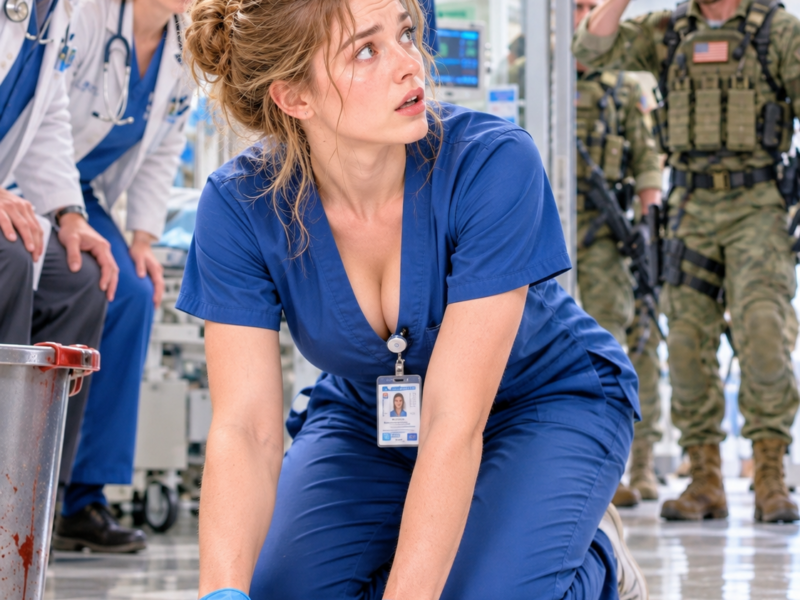
“They made me scrub dried blood off the emergency room floor while the senior doctors laughed at my nursing-school uniform
Commander Harris reached for the envelope, but I pulled it against my chest.
“Nobody touches this except me.”
He studied my face, then nodded.
“Understood.”
Behind him, the emergency department had become strangely quiet.
The message remained on every monitor.
SPECTRE — DO NOT ALLOW HER TO LEAVE THE BUILDING.
A patient in the waiting area was staring at the screen.
One of the nurses had stepped away from the medication cart.
Dr. Collins looked as if someone had just pulled the floor out from beneath him.
“Turn those screens off,” he demanded.
Nobody moved.
“Did you hear me? Turn them off!”
Commander Harris raised one hand.
“Nobody touches the computer systems until our technical team arrives.”
Collins turned toward him.
“You have no authority to give orders inside my hospital.”
Harris finally looked directly at him.
“Doctor, someone just used your hospital’s internal network to issue a threat against a civilian employee. You can argue about authority later.”
He turned to me.
“Emily, we need to get you somewhere secure.”
I shook my head.
“I’m not going anywhere until I read this.”
“That’s your decision.”
I looked down at Marcus’s handwriting.
Three years.
Three years of believing I had lost him.
Three years of waking up at night remembering the sound of the helicopter and the radio going silent.
And now his letter was in my hands.
I broke the seal.
Inside was a folded sheet of paper and a small photograph.
The photograph showed Marcus standing beside me in Afghanistan.
We were both covered in dust.
He was smiling at something outside the frame.
I remembered that day.
It had been the last afternoon we spent together before the mission.
On the back, he had written:
“Some promises survive longer than people.”
My vision blurred.
I unfolded the letter.
Emily,
If you’re reading this, Harris finally found you.
I know you probably hate me.
I know you think I left you behind, and I know you blame yourself for what happened at the extraction point.
You need to stop doing that.
You did what you were supposed to do.
I didn’t come back because I made a choice.
But there’s something I never told you.
The mission wasn’t compromised by the enemy.
Someone gave them our location.
I found out who.
I also found out why they wanted you gone.
Do not trust anyone who tells you the mission was classified because of operational security.
The truth is buried in the medical evacuation records.
Find the original casualty log from October 14.
Look for the name that doesn’t belong.
And Emily, whatever happens, don’t let them use the medical files to make you disappear a second time.
Marcus.
I read the last sentence twice.
Then I looked up.
Commander Harris was watching me.
“What’s the original casualty log?”
He exchanged a glance with the older SEAL standing beside him.
“That’s what we’ve been trying to recover.”
“Why?”
“Because the official record says Marcus Reed died during that mission.”
I looked down at the photograph.
“He didn’t.”
Harris took a breath.
“No, ma’am. We no longer believe he did.”
The room seemed to tilt.
I gripped the counter.
“You’re telling me Marcus is alive?”
“I’m telling you we have evidence that he survived the extraction. We don’t know where he is now.”
I stared at him.
“Why didn’t anyone tell me?”
Harris looked genuinely uncomfortable.
“Because three years ago, the report we received stated that he had been captured and later died in enemy custody.”
“Then why do you think he’s alive?”
He pointed toward the photograph.
“That letter was delivered to our command office four days ago. The postmark came from a naval facility in Virginia. It was addressed to me personally, with instructions to find you.”
“Who delivered it?”
“We’re still investigating.”
I looked at the young SEAL who had spoken earlier.
He was struggling to hold himself together.
“What’s your name?” I asked.
“Petty Officer First Class Tyler Bennett.”
“Did you know Marcus?”
His jaw tightened.
“He carried me out of a building after I was wounded. I wouldn’t be here without him.”
I looked at the photograph again.
“Then why does everyone keep talking about him like he’s dead?”
Tyler lowered his eyes.
“Because that’s what they wanted us to believe.”
Before I could ask more, a loud crash came from the corridor.
One of the nurses screamed.
Harris immediately moved in front of me.
“Everyone stay where you are!”
Two SEALs moved toward the emergency entrance.
Another pulled the black equipment case closer.
I recognized the sound that followed.
The emergency doors had been locked.
Someone had activated the hospital’s security lockdown.
A message appeared on the main reception screen.
FACILITY SECURITY ALERT.
ALL PERSONNEL REMAIN IN ASSIGNED AREAS.
Then the lights flickered.
Not completely off.
Just enough to make the hallway disappear for a second.
I remembered another night.
Another darkness.
Another moment when someone had decided that my presence was inconvenient.
“Commander,” I whispered.
He turned.
“What?”
“Someone is trying to isolate us.”
He nodded.
“That’s what I think.”
Then Dr. Collins spoke from behind us.
“Emily, give me the letter.”
I turned.
He was standing near the medication cabinet.
His hands were shaking.
“Why?”
“Because it’s military property.”
I almost laughed.
“Three minutes ago, you told these men they had no authority in your hospital.”
“That’s different.”
“How?”
His eyes moved toward the envelope.
“You don’t understand what you’re involved in.”
I stepped back.
“Then explain it.”
Collins glanced toward the security cameras.
For the first time, I noticed that he wasn’t looking at the SEALs.
He was looking at the camera above the nurses’ station.
“Emily,” he said quietly, “you need to stop asking questions.”
Commander Harris moved closer.
“Doctor, take your hands out of your pockets.”
Collins froze.
Then a voice came through the hospital’s overhead speakers.
“Emily Parker. This is your final warning.”
I recognized the voice.
Not the exact person.
The tone.
The calm, rehearsed authority.
It sounded like the kind of person who expected everyone else to obey without question.
“Return the military correspondence to hospital administration and report to the security office.”
Harris looked toward the ceiling speaker.
“Identify yourself.”
Silence.
Then the voice returned.
“Commander Harris, your presence here is unauthorized. Leave the facility immediately.”
Harris’s expression hardened.
“Whoever you are, you have about thirty seconds to explain why you’re threatening a civilian nurse.”
No answer came.
Instead, the monitors went dark again.
Tyler moved beside me.
“Ma’am, we need to go.”
I looked at the patients.
A little girl was crying in her mother’s arms.
An elderly man was trying to stand.
A nurse was attempting to calm a woman who had begun hyperventilating.
I couldn’t leave them.
“There’s an emergency generator,” I said.
Harris nodded.
“We know.”
“No, you don’t understand. The backup system controls the ventilation and emergency equipment in the critical-care rooms. If someone shuts it down completely, patients could be in danger.”
Harris looked at his team.
“Two of you stay with the civilians. The rest of us move toward the control room.”
Collins stepped forward.
“I’ll take you.”
Harris shook his head.
“You stay here.”
“I know this building better than you.”
“That’s exactly why you’re staying.”
Collins looked at me.
For a second, I saw something resembling desperation.
Then he turned and walked toward the staff corridor.
Harris watched him go.
“Tyler, stay with Emily.”
The commander and two other SEALs moved down the hallway.
I remained beside the nurses’ station.
The envelope was damp from my hands.
I unfolded the letter again.
Find the original casualty log from October 14.
Look for the name that doesn’t belong.
My mind went back to the night of the mission.
The helicopter.
The radio.
The blood on my gloves.
And the casualty report I had been asked to sign.
I remembered one detail that had never made sense.
There had been six people listed as casualties.
But only five bodies had been recovered.
I had questioned the discrepancy.
A superior officer told me the sixth person had been evacuated separately.
I believed him.
Until now.
“Tyler,” I said.
He turned.
“What?”
“How many people were officially listed as casualties that night?”
He frowned.
“Six.”
“How many bodies were recovered?”
His expression changed.
“Five.”
I nodded slowly.
“That’s what I remembered.”
He looked at me.
“Why?”
“Because the missing person was Marcus.”
Tyler shook his head.
“His death certificate says he died in enemy custody.”
“Then why was he listed as evacuated?”
He didn’t answer.
I reached into my pocket and took out my phone.
I still had an old photograph from that mission.
Not the one Marcus had sent me.
A picture of the casualty board.
I had taken it because I wanted to remember the names of the people we had lost.
I opened the image.
There were six names.
Five had red marks beside them.
One had a handwritten note.
M. REED — TRANSFERRED.
I stared at the screen.
Transferred.
Not deceased.
Not missing.
Transferred.
My fingers went cold.
“Tyler, look at this.”
He leaned closer.
His eyes widened.
“That’s not the official casualty notation.”
“What does it mean?”
“Someone moved him.”
“Where?”
He shook his head.
“I don’t know.”
A door slammed at the end of the corridor.
Then we heard running footsteps.
A hospital security officer appeared, holding a radio.
“Commander Harris?”
“He’s in the control room,” Tyler answered.
The officer looked directly at me.
“Miss Parker, I need you to come with me.”
Tyler stepped between us.
“She’s not going anywhere.”
The officer raised his identification badge.
“Hospital security. I’m under orders from the administrator.”
I looked at the badge.
The photograph was blurry.
The name underneath was partially covered by his thumb.
“What’s your name?” I asked.
He hesitated.
“Officer Daniels.”
“Which administrator?”
“Dr. Collins.”
I glanced at Tyler.
He understood immediately.
“Move away from her.”
The officer reached inside his jacket.
Tyler moved faster.
He caught the man’s wrist and forced his arm against the wall.
A small black device fell onto the floor.
It wasn’t a weapon.
It was a portable data drive.
Tyler picked it up.
“What is this?”
The officer struggled.
“I don’t know!”
Tyler looked at me.
“Ma’am, stay back.”
The hospital security officer was restrained until two more staff members arrived.
I stared at the data drive.
A small white label had been attached to it.
OCT 14 — ORIGINAL.
By the time Commander Harris returned, the hospital’s backup power had been restored.
The monitors were working again.
The patients were safe.
But Dr. Collins was gone.
Harris looked at the data drive in Tyler’s hand.
“Where did you get that?”
I explained what had happened.
He took the drive carefully.
“Did anyone access it?”
“No.”
He nodded.
“Good.”
He called one of his men over and asked him to secure it.
Then he turned toward me.
“Emily, there’s something I need to tell you.”
I was tired of people saying that sentence.
“Please don’t tell me another secret about Marcus.”
Harris lowered his voice.
“I knew Marcus before the mission.”
I waited.
“He was one of the best operators I’ve ever worked with. But he wasn’t just a member of the team that night.”
“What do you mean?”
“He had discovered that our casualty records were being altered.”
I looked at the photograph in my phone.
“Because of the missing sixth body?”
“Because of more than that. Several injured personnel had been recorded as transferred to military hospitals that never received them. Their medical records were being used to justify payments for treatments and equipment that had never been provided.”
I remembered the illegal supply records in the letter.
The strange transfer notation.
The missing casualty.
“Someone was stealing money through the medical evacuation system.”
“Yes.”
“And Marcus found out.”
Harris nodded.
“He copied the records before the mission. He intended to bring them back.”
“Who knew?”
“Only a few people.”
I thought about Dr. Collins.
“Was Collins involved?”
Harris looked toward the empty corridor.
“We’re beginning to believe he was.”
“Beginning?”
“We need evidence.”
I folded my arms.
“Then open the drive.”
Harris shook his head.
“Not on the hospital network.”
He took the evidence to a secure room that the SEALs had arranged with military investigators.
I followed.
Tyler stayed close to me.
Inside, one of the SEALs connected the drive to an isolated laptop.
A password prompt appeared.
Harris looked at me.
“Does that mean anything to you?”
I studied the screen.
There was a small phrase beneath the password field.
THE FIRST PROMISE.
I remembered the old training warehouse.
Marcus and I had stood outside it during our first week together.
He had given me a battered notebook.
“Write down the names of everyone you treat,” he had said.
“Why?”
“Because people disappear from reports when nobody remembers to look for them.”
Then he had made me promise that if anything happened to him, I would never let his name become just another line on a casualty sheet.
I typed the phrase.
The password was accepted.
The drive opened.
There were dozens of files.
Medical evacuation records.
Payment authorizations.
Shipment manifests.
Photographs.
And one video file.
The filename was simple.
EMILY.
My hands began to shake.
Harris looked at me.
“Do you want us to play it?”
I nodded.
The video began.
The image was dark.
Then a familiar face appeared.
Marcus.
His hair was longer.
There was a scar above his left eyebrow.
But he was alive.
He looked directly into the camera.
“Emily.”
I covered my mouth.
For several seconds, I couldn’t breathe properly.
Marcus gave a tired smile.
“If you’re watching this, I guess I owe you an explanation.”
He glanced away.
Then returned his eyes to the camera.
“I didn’t die on October 14.”
A tear rolled down my cheek.
“I was transferred before the extraction. The men who arranged the ambush wanted the medical records, not the bodies. They needed someone to carry the evidence, and they knew I had it.”
He paused.
“I couldn’t contact you because I didn’t know who was listening. Every message I sent was intercepted.”
He leaned closer.
“There’s something else. I didn’t choose to leave you behind. I was told you were already dead.”
I stared at the screen.
“What?”
Marcus continued.
“They showed me a casualty report with your name on it. They said you had been killed during the evacuation.”
My knees weakened.
For three years, I had believed Marcus was dead.
He had believed the same about me.
Neither of us had known the truth.
The video continued.
“Emily, the person who signed the transfer order was someone you trusted. Someone who knew both of us.”
A document appeared on the screen.
It showed the original transfer authorization.
At the bottom was a signature.
Richard Collins.
I stared at it.
The chief physician at St. Mary’s.
The man who had made me scrub floors.
The man who had tried to take Marcus’s letter.
The man who had ordered hospital security to isolate me.
Tyler whispered something under his breath.
Harris leaned closer to the screen.
“There’s more.”
The video continued.
“Collins wasn’t the one who planned everything. He was following instructions from someone higher up. Someone who had access to our deployment records and the medical evacuation system.”
Marcus looked directly into the camera.
“Emily, I need you to find the original casualty log. Not the copy. The real one.”
He paused.
“Because the person who signed my transfer order is the same person who signed yours.”
The video ended.
Nobody spoke.
I looked at Commander Harris.
“Where is the original casualty log?”
He stared at the transfer authorization.
“We don’t know.”
Then one of the SEALs behind him spoke.
“Commander, there’s a new message.”
He had received an encrypted notification.
Harris opened it.
His expression changed immediately.
“What is it?” I asked.
He turned the screen toward me.
A photograph showed an old military storage facility.
Beneath it was a message.
SPECTRE KNOWS THE TRUTH NOW.
BRING HER TO THE ORIGINAL SITE.
ALONE.
The storage facility was located outside Norfolk, less than twenty miles from St. Mary’s.
It had once been used for military medical supplies.
Now it was officially listed as abandoned.
Commander Harris refused to let me go alone.
I refused to stay behind.
We argued for almost ten minutes before he finally agreed that I could accompany the team, provided I remained with him.
Tyler sat beside me in the vehicle.
He kept checking his equipment.
“You don’t have to come,” I told him.
He looked at me.
“Marcus carried me out of a building when I couldn’t walk.”
He tightened the strap on his vest.
“I’ve spent three years wishing I could do something for him.”
I looked out the window.
“Then help me find him.”
The facility appeared beyond a line of trees.
Its windows were covered with metal panels.
A faded sign hung above the entrance.
MILITARY MEDICAL LOGISTICS.
Harris raised his hand.
The team stopped.
Two SEALs moved toward the entrance while the others secured the surrounding area.
I followed Harris inside.
The smell hit me first.
Dust.
Old paper.
Mold.
And a faint chemical odor.
There were rows of metal shelving.
Most were empty.
But one cabinet at the far end had a new lock.
Harris nodded toward it.
Tyler opened the lock using a small tool.
Inside were several folders.
I recognized the old military classification labels.
One folder had my name.
Another had Marcus’s.
A third was marked OCTOBER 14.
I pulled it out.
The original casualty log was inside.
My name appeared on the second page.
Emily Parker — transferred to civilian medical rehabilitation.
I stared.
I had never been transferred to civilian medical rehabilitation.
I had been sent home after the mission, placed on medical leave, and eventually discharged.
Someone had created a false record.
Marcus’s name appeared directly beneath mine.
Marcus Reed — transferred to secure medical custody.
Both entries carried the same authorization number.
And both were signed by the same person.
I turned the page.
There was a name I recognized immediately.
Rear Admiral William Prescott.
He had been the senior officer responsible for our medical operations.
He had attended Marcus’s memorial service.
He had shaken my hand afterward.
He had told me how sorry he was.
I remembered his exact words.
“Some sacrifices are necessary, Emily. You must learn to move forward.”
I felt sick.
“He knew,” I whispered.
Harris examined the document.
“Prescott authorized both transfers.”
“Where is he now?”
“Retired. He left active service two years ago.”
“Then we need to find him.”
A voice came from behind us.
“You’re not going to find him by looking through old paperwork.”
We turned.
Dr. Collins stood in the doorway.
He was holding a small pistol.
Tyler moved toward me.
Harris raised his weapon.
“Put it down, Doctor.”
Collins looked exhausted.
His white shirt was wrinkled, and there was sweat along his forehead.
“Don’t make this worse.”
Harris kept his weapon trained on him.
“You’ve already made it worse.”
Collins glanced at the folder in my hands.
“Emily, I tried to warn you.”
“You tried to silence me.”
“I was trying to keep you alive.”
I stared at him.
“You made me clean floors while you knew my name was on a false casualty report.”
His face tightened.
“I didn’t know what they had done to you.”
“You’re lying.”
He lowered the pistol slightly.
“Prescott told me you were dead.”
I felt my jaw tighten.
“Then why did you recognize me?”
“Because I knew your file. When I saw you at the hospital, I realized the transfer had failed.”
“Failed?”
He nodded.
“Prescott had arranged for both you and Marcus to disappear after the mission. Marcus was moved to a secure location. You were supposed to be sent to a rehabilitation facility under a different identity.”
I looked at the document.
“Why?”
“Because you had both seen the original medical records.”
“Then why was I allowed to leave the military?”
“Because someone intervened.”
“Who?”
Collins looked away.
“Major Daniel Foster.”
I searched my memory.
A medical officer.
He had been present during the mission.
He had helped me evacuate the wounded.
I remembered him arguing with Prescott about the casualty count.
“Foster saved me?”
“He changed your transfer destination. He sent you home instead of the facility Prescott had selected.”
I felt tears gather in my eyes.
“Why didn’t he tell me?”
“Because he was being watched.”
Harris stepped forward.
“Where is Prescott?”
Collins hesitated.
Then he looked toward the far end of the warehouse.
“He’s here.”
A second door opened.
An older man walked into the room.
He wore a dark civilian jacket.
His silver hair was neatly combed.
I recognized him immediately.
Rear Admiral William Prescott.
The same man who had stood beside Marcus’s memorial photograph.
The same man who had once told me that my survival was a blessing.
He looked at the folder in my hands.
Then he smiled faintly.
“Emily Parker.”
I couldn’t speak.
He glanced toward Commander Harris.
“James. I thought you would have learned by now that some matters are better left alone.”
Harris didn’t lower his weapon.
“Sir, step away from the door.”
Prescott ignored him.
He looked at me.
“You were always a difficult young woman.”
I stared at him.
“You told me Marcus was dead.”
“Marcus was supposed to disappear.”
“Was he alive?”
Prescott paused.
Then he nodded.
“Yes.”
My throat tightened.
“Where is he?”
“Safe.”
“Where?”
Prescott looked toward the folder.
“Give me the records, Emily.”
“No.”
His expression hardened.
“You have no idea how much damage those documents could cause.”
“They show that you falsified casualty reports.”
“They show that I protected an operation that saved lives.”
“You stole medical supplies.”
“Resources were redirected. That was necessary.”
“People died.”
He didn’t answer.
I stepped closer.
“People who needed those supplies died.”
Prescott looked at me with something close to pity.
“You were young. You believed every life could be saved if everyone simply did their job. That isn’t how the world works.”
I thought of Marcus.
Of Tyler.
Of the five bodies recovered from the mission.
Of the families who had been told their loved ones were dead or missing.
“Maybe not,” I said. “But you don’t get to decide that some people are worth erasing.”
Prescott’s eyes narrowed.
For a moment, nobody moved.
Then he reached inside his jacket.
Harris shouted.
“Don’t!”
Prescott pulled out a small remote control.
A red indicator light flashed.
One of the SEALs moved toward the equipment room.
“Commander, there’s a signal coming from the storage section!”
Prescott smiled.
“You should have stayed away.”
I looked around.
I noticed a stack of old medical containers near the wall.
Several were marked with warning labels.
The chemical smell was stronger now.
He wasn’t threatening to destroy the records.
He was threatening to destroy the entire facility.
Harris moved toward him.
Prescott raised the remote.
“One more step.”
I looked at the folder.
Then at the old storage cabinets.
And I remembered something from my training.
The facility had an emergency isolation system.
I had seen the layout on the wall near the entrance.
If activated, it would close the internal fire doors and disconnect the storage section from the main building.
I glanced at Tyler.
He followed my eyes.
He understood.
While Harris kept Prescott distracted, Tyler moved toward the wall panel.
Prescott noticed.
“Stop him!”
Collins suddenly stepped forward.
He grabbed Prescott’s arm.
The remote fell.
It hit the floor and slid beneath a shelf.
Harris rushed forward and restrained Prescott.
The SEALs secured the room.
Tyler reached the control panel and activated the isolation system.
Heavy metal doors began closing.
The building shook as the ventilation system shut down.
For several seconds, I could hear nothing but the sound of the doors locking.
Then Harris looked at me.
“Emily, are you okay?”
I nodded.
But my eyes were on Collins.
He was sitting against the wall, his hands raised.
He had finally stopped pretending.
“Why did you help him?” I asked.
Collins looked at Prescott.
“Because I was afraid.”
“Of what?”
“Of losing everything.”
I stared at him.
“People lost their lives.”
He lowered his head.
“I know.”
The admission was small.
It didn’t make anything better.
But it was the first honest answer I had heard from him.
Prescott was arrested that afternoon.
The original casualty log, the medical transfer records, and the recovered financial documents became the foundation of a federal investigation.
Dr. Collins was also arrested.
He eventually pleaded guilty to falsifying records and obstructing the investigation.
His cooperation helped investigators identify several additional people involved in the scheme.
But the most important discovery came from a file buried inside the medical records folder.
It contained a location.
A private rehabilitation center in North Carolina.
The name of the patient was listed as John Miller.
The admission date was three years earlier.
And the emergency contact information contained a familiar name.
Emily Parker.
I stared at the screen.
My hands were shaking again.
Harris stood beside me.
“We believe that’s where Marcus was held.”
“Why would he list me as his emergency contact?”
“Because he never stopped believing you were alive.”
I looked at him.
“Can we go?”
Harris nodded.
“We leave in twenty minutes.”
The rehabilitation center was quiet.
It stood among tall pine trees outside Asheville, surrounded by a low stone wall and carefully maintained gardens.
There were no military vehicles outside.
No security guards in uniform.
Just an ordinary building with white windows and a small fountain near the entrance.
A nurse at reception checked the name Harris provided.
Then she looked toward me.
“Are you Emily Parker?”
I nodded.
She smiled gently.
“He’s been asking about you.”
My knees nearly gave way.
I followed her down a long corridor.
Every step felt slower than the last.
At the end of the hallway was a room with the door slightly open.
I could hear a television playing quietly.
Then a familiar voice said something.
“Turn that thing down.”
I stopped.
It was Marcus.
Older.
Rougher.
But unmistakably him.
The nurse knocked.
“Mr. Miller, you have a visitor.”
A man sitting beside the window turned.
His hair was shorter than I remembered.
A long scar crossed his left eyebrow.
His right leg was supported by a brace.
But his eyes were the same.
He stared at me.
For a moment, neither of us moved.
Then he whispered my name.
“Emily?”
I couldn’t make my legs work.
He slowly stood.
“You’re alive.”
I covered my mouth.
“So are you.”
He took one step.
Then another.
I crossed the remaining distance and wrapped my arms around him.
He was thinner than I remembered.
His shoulders felt fragile beneath my hands.
But he was real.
I buried my face against his chest and began to cry.
He held me tightly.
“I’m sorry,” he whispered.
I shook my head.
“Don’t.”
“I tried to get back.”
“I know.”
“I thought you were dead.”
“I thought the same about you.”
He pulled away just enough to look at my face.
For a moment, he smiled.
Then his eyes filled.
“Three years.”
I nodded.
“Three years.”
He touched my cheek as if he needed to make sure I wasn’t another memory.
“I looked for you.”
“I was right here.”
“I know that now.”
We sat beside the window for almost an hour.
Marcus told me what had happened after the mission.
Prescott had arranged his transfer under a false medical identity.
He had been taken to a secure facility and kept under observation while investigators were told he had died in enemy custody.
When he tried to contact anyone, his messages were intercepted.
His injuries were serious.
He had lost much of the strength in his right leg.
The rehabilitation center had been part of a later agreement that allowed him limited freedom while investigators quietly worked to identify the people responsible.
He had sent the letter only after learning that Prescott’s influence was weakening.
“Why didn’t you come sooner?” I asked.
He looked down at his hands.
“I was afraid they’d use you to find me.”
I reached for his hand.
“They already did.”
He gave a sad smile.
“I know.”
I studied his face.
“Why did you choose the name Spectre in the letter?”
He laughed softly.
“Because it was the only name I knew that nobody could mistake.”
“Nobody called me that at the hospital.”
“That’s probably a good thing.”
I smiled.
Then I remembered the photograph.
The one he had sent with the letter.
I took it from my bag.
“You kept this?”
He nodded.
“I had a copy.”
“Why?”
“Because you were the person who stayed when everyone else wanted to leave.”
I looked at the photograph.
We were both young.
Both tired.
Both convinced that the worst thing that could happen to us was losing someone during a mission.
We hadn’t understood that sometimes the worst part came afterward.
I didn’t return to St. Mary’s.
Not because I was ashamed of being a nursing student.
Not because I wanted revenge on Dr. Collins.
But because I finally understood that I had been trying to build a new life in a place where people had already decided what I was worth.
My clinical supervisor had apologized.
The hospital administration had offered to review my rotation and reinstate my original training schedule.
I declined.
Instead, I completed my nursing education at another medical center in Virginia.
The transition wasn’t easy.
Some nights, I woke up hearing the old radio transmissions.
Some mornings, I struggled to enter a treatment room without remembering the mission.
But slowly, the past became something I could carry without allowing it to decide every part of my future.
Marcus continued rehabilitation.
His recovery was uneven.
Some days he could walk with a cane.
Other days, the pain forced him back into a wheelchair.
He hated asking for help.
I reminded him that he had spent years helping everyone else.
Eventually, he learned to let people help him.
Tyler visited whenever his assignments brought him near Virginia.
He always brought terrible coffee.
Marcus claimed it tasted like something scraped from the bottom of a ship.
Tyler insisted it was a Navy tradition.
I never asked which one was telling the truth.
Several months later, I graduated from nursing school.
Marcus sat in the second row.
He wore a dark suit and leaned on his cane.
When my name was called, I looked toward him.
He was already standing.
His hands were shaking as he applauded.
After the ceremony, he handed me a small box.
Inside was a silver medical pin.
I recognized it immediately.
It had belonged to the medical team we had served with three years earlier.
“Where did you find this?”
Marcus smiled.
“Recovered from my personal effects.”
I turned it over.
On the back, someone had engraved a single word.
SPECTRE.
I looked at him.
“I thought we were done with that name.”
“We are,” he said.
“Then why give it to me?”
He took my hand.
“Because you don’t have to be that person anymore. But you don’t have to pretend she never existed either.”
I closed my fingers around the pin.
For years, I had believed leaving the military meant abandoning the people I had served beside.
I had thought becoming a nurse meant starting over from nothing.
But standing there, in my graduation gown, I finally understood that I hadn’t abandoned that part of myself.
I had simply found another way to do the same work.
A year later, I accepted a position at a veterans’ rehabilitation hospital.
My first patient was a young Navy corpsman recovering from a serious leg injury.
He was angry, impatient, and convinced that his life was over because he might never return to active duty.
I recognized that look.
I pulled a chair beside his bed.
“What’s your name?”
“Jackson.”
“All right, Jackson. I’m Emily.”
He looked away.
“I don’t want another doctor telling me everything will be fine.”
“Good. I’m not going to tell you that.”
He turned toward me.
I placed his medical chart on the table.
“I’ll tell you what we know. I’ll tell you what we don’t know. And we’ll figure out the next step together.”
He studied me for a moment.
Then he nodded.
As I walked toward the door, he called after me.
“Hey, Nurse Parker?”
I turned.
“Are you going to come back tomorrow?”
I smiled.
“Yes. I will.”
That evening, Marcus and I sat on the porch of our small house overlooking the water.
The sunset stretched across the harbor, turning the boats into dark silhouettes.
He was still using his cane.
I was still learning how to sleep through the night.
Neither of us had returned to the lives we once imagined.
But we were there.
Together.
Marcus reached for my hand.
“Do you ever miss it?”
I knew what he meant.
The missions.
The people.
The feeling that every second mattered.
“Sometimes,” I admitted.
“Me too.”
He looked toward the water.
“Do you think they’ll ever stop calling you Spectre?”
I laughed.
“Probably not.”
He smiled.
“Does it bother you?”
I considered the question.
Then I looked at the silver pin resting on the table beside us.
“No. Not anymore.”
For three years, I had thought the name Spectre belonged to a woman who had disappeared.
A woman who had failed to bring someone home.
A woman who had been forgotten by the people she had served.
But I had been wrong.
Spectre wasn’t the person who vanished that night.
She was the person who survived it, kept the truth alive, and eventually learned that she deserved a life beyond the battlefield.
I leaned my head against Marcus’s shoulder.
The harbor lights began to flicker in the distance.
For the first time in three years, when the darkness came, I wasn’t afraid of what it might hide.
The end.









