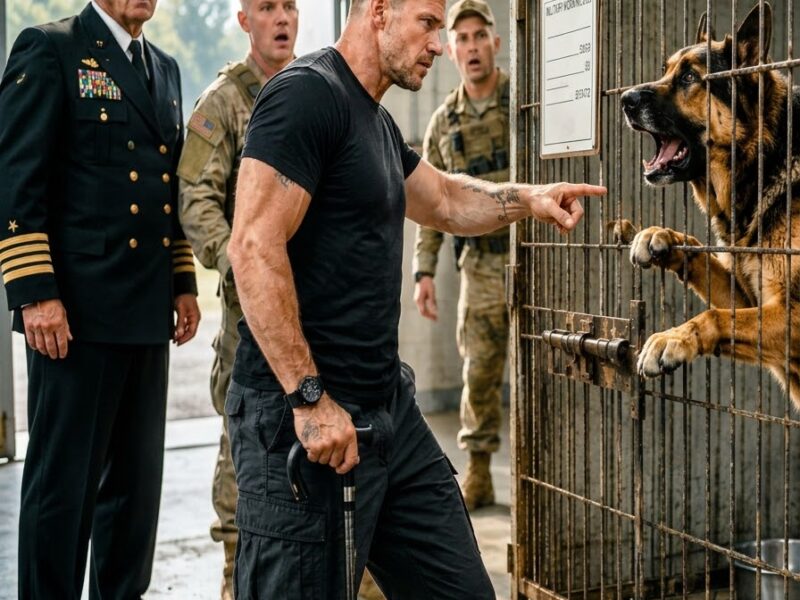
They locked my retired K9 inside a rusted cage behind a Navy base kennel, laughing when I begged them to let him out
The coastal fog hung thick over Naval Base San Diego, carrying the bitter stench of diesel exhaust, brackish bay water, and old copper. It was past midnight. The perimeter floodlights flared overhead, but behind the main kennel block, in a narrow access corridor choked with overgrown weeds and discarded wooden pallets, a single security light flickered wildly before dying out completely.
In the gloom stood a padlocked cage. Its iron bars were thick with rust, the wire mesh bowed outward as if something heavy had repeatedly slammed against it.
Inside, lying motionless on the cold, damp concrete floor, was Rex.
His silver muzzle rested against his scarred front paws. He was fourteen years old—a Belgian Malinois whose coat had faded from rich mahogany to a dull, ash-gray. Deep white scars crisscrossed his chest and neck, silent remnants of shrapnel from two separate deployments in the Helmand Province. His breathing came in shallow, ragged hitches.
Fourteen years ago, he was a ninety-pound war dog who could clear a compound in seconds. Tonight, his back legs trembled just from the effort of keeping his hips aligned.
A young Navy Petty Officer leaned casually against the chain-link fence, a ring of brass keys dangling carelessly from his index finger. He took a drag from a cigarette, the orange ember casting sharp shadows across his smirking face.
“You’re wasting your time, Captain,” the handler said, blowing a cloud of gray smoke into the damp night air. “He’s government property pending decommission. Retirement doesn’t mean special treatment. You know how the machine works.”
I stood three feet from him, my shoulders squared, my hands hanging loose at my sides. Every nerve in my body was screaming. I had worn the uniform for twelve years. I had led combat teams into places that didn’t exist on official maps. I knew the regulations, the bureaucracy, and the cold indifference of military logistics. But seeing Rex locked in a filthy cage behind a supply shed bypassed every shred of discipline I possessed.
“Open the cage,” I said. My voice was low, flat, and stripped of all emotion.
The handler chuckled, tapping the ash onto the toe of his combat boot. “Orders came straight from Base Command, sir. Dog was flagged as a bio-hazard and a security risk. Orders are orders.”
I turned my back on the handler and stepped directly up to the rusted bars.
“Rex,” I whispered.
The old dog’s ears twitched. Slowly, painfully, he lifted his head from the concrete. His dark brown eyes, cloudy with cataracts but burning with a fierce, unmistakable intelligence, locked onto mine. His tail lifted off the floor, giving a single, heavy thud against the concrete before dropping back down.
That tiny, exhausted movement nearly tore me apart.
After my final deployment six months ago, the Navy had officially retired Rex. They had signed the discharge papers, presented me with his ceremonial harness, and promised him a quiet, peaceful life on my small farm in Oregon. He was supposed to spend his final years sleeping on a rug by the fireplace, free from the roar of rotors and the smell of cordite.
Then, three weeks ago, I woke up to an empty house. The front gate was unlatched. A unmarked black van had been spotted down the road. Rex was gone.
For twenty-one days, I called every contact I had left in the Pentagon, every former handler in Special Warfare, every contact in Naval Logistics. I was met with a wall of total silence. Official records showed Rex had been euthanized due to age-related organ failure two days after his abduction.
It was a lie. Someone had forged his death certificate, smuggled him back onto Naval Base San Diego under a classified manifest, and locked him in a cage beneath a broken security light.
“He doesn’t belong to the Navy anymore,” I said, turning back to the handler. “He’s mine.”
“Not on paper, Captain,” the handler replied, his smirk widening as he jingled the keys. “On paper, he’s a line item waiting for disposal. Now I suggest you head back to the main gate before I call Security Forces for trespassing.”
I took one step toward him. The air between us instantly turned electric.
“Captain Morgan!”
A sharp, authoritative voice cut through the fog. Heavy footsteps crunched over the gravel as a tall man in a crisp working uniform stepped into the dim light of the alley. He wore the silver oak leaves of a Commander on his collar, his chest covered in rows of ribbons, his face carved into a stern, unforgiving mask.
Commander Mason Hayes. He was the executive officer of the base’s logistics division—and a man who had served as my brother’s immediate supervisor six years ago.
“Captain Morgan,” Hayes said, stopping five feet away, his arms folded across his chest. “You are out of uniform, out of bounds, and currently violating a restricted perimeter. You need to leave. Now.”
I didn’t step back. “That’s my dog, Commander. I have the signed adoption papers from the Secretary of the Navy.”
“Those papers were voided under National Security Directive 4,” Hayes said coldly. “That animal is no longer your property, Morgan. He belongs to the Department of the Navy.”
“He’s fourteen years old!” I shouted, my voice echoing off the concrete walls of the kennel. “He can barely stand! What national security threat could a dying dog possibly pose?!”
“That is classified,” Hayes snapped. “Now walk away before I have the MPs escort you off this installation in handcuffs.”
My hands curled into tight fists. My jaw clenched so hard my teeth hurt. I looked past Hayes at the handler, then back at the cage.
Rex suddenly lifted his head off the floor. His body went rigid.
He wasn’t looking at me. He wasn’t looking at Hayes or the handler. He was staring past us, his eyes fixed on the far end of the adjoining kennel block—a dark, windowless storage bay used for holding surplus training equipment.
His ears pinned back against his skull. A low, rhythmic tremor started in his chest, vibrating through his ribcage.
I knew that posture. I had seen it in an abandoned compound in Ramadi; I had seen it in a mountain pass in Kunar. It was his alert stance.
I followed his gaze down the concrete walkway. Nothing moved in the fog. The only sound was the distant hum of a generator and the lap of water against the pier.
Then I saw it.
Mounted beneath the bottom rail of the neighboring kennel box, obscured by a clump of dead weeds and a pile of rusted metal pipe, was a small, rectangular junction box. It looked like a standard electrical housing, except for one thing:
Deep inside the dark recess of the box, a tiny, high-frequency red LED light was blinking at three-second intervals.
My stomach dropped like a stone into a well.
Rex had spent nine years as a Multi-Purpose Canine attached to Naval Special Warfare Development Group. He had logged over two hundred combat missions. He was trained for tracking, assault, and—above all else—high-grade explosive detection.
And right now, every line of his trembling body was pointed directly at that metal box.
“Everyone back,” I ordered, my voice dropping to an icy whisper.
The young handler snorted. “Seriously? Captain, you can’t just—”
I spun on him, grabbing the front of his tactical vest, slamming him back against the chain-link fence with enough force to rattle the entire enclosure. The keys flew from his hand, splashing into a mud puddle.
“Shut your mouth and look at the dog!” I snarled into his face.
The handler blinked, his arrogance instantly vanishing as he looked at Rex. The old dog was no longer shaking from weakness. He was locked in a rock-solid point, his body rigid, his eyes fixed on the red light blinking in the dark.
Commander Hayes stared at Rex, then looked down at the metal box hidden beneath the kennel rail. The blood slowly drained from the officer’s face.
“Hayes,” I said, releasing the handler. “Clear the block. Back. Now.”
Hayes didn’t argue. He pulled his radio from his belt, his hand shaking slightly as he keyed the microphone. “All stations, this is Hayes. Code Red at the rear kennel block. Evacuate all personnel within two hundred yards. Get EOD down here immediately! I repeat, Code Red!”
The next twenty minutes moved in a blur of sirens, flashing red lights, and the heavy thud of combat boots against wet gravel.
Security Forces cordoned off the entire eastern perimeter of the base. Heavy tactical trucks blocked the access roads, their headlights cutting through the thick fog. A four-man Explosive Ordnance Disposal (EOD) team clad in massive, armored blast suits rolled up in a heavy response vehicle, deploying a track-mounted remote surveillance robot into the narrow alleyway.
Hayes and I stood eighty yards back behind the engine block of a tactical truck. The young handler was sitting on the bumper of an ambulance nearby, his face pale, his hands shaking so badly he couldn’t light his cigarette.
The chief of the EOD team stepped back from the control console, pulling off his heavy helmet. His face was drenched in sweat despite the freezing fog.
“What is it, Chief?” Hayes demanded, stepping forward.
“It’s not an IED, Commander,” the EOD Chief said quietly, wiping his brow with the back of his sleeve. “At least, not a conventional one.”
“Meaning what?” I asked.
The Chief pulled up a high-resolution thermal image on his tablet and handed it to me. “The box contains a military-grade encryption hub wired into a short-range radio relay. But strapped to the back of the receiver is two pounds of stabilized C-4 explosive connected to a cell-receiver and a micro-barometric detonator.”
I stared at the screen. “It’s a secondary trap.”
“Exactly,” the Chief nodded. “If someone tried to tamper with the wireless hub, or if the radio frequency was interrupted, the charge would detonate, destroying the hub, the kennel, and everything within fifty feet. It was designed to erase data, not just kill people.”
“Who put a military tracking hub inside a naval kennel?” Hayes asked, his voice tight.
“It wasn’t tracking the kennel,” the Chief replied, looking directly at me. “The signal was zeroed in on a micro-transponder buried inside the subcutaneous ID chip of that old dog in the cage.”
My breath caught in my throat.
Someone hadn’t just stolen Rex to put him in a cage. They had used him as a living beacon. They had brought him to this specific location because his internal ID chip was linked to an encrypted data pipeline—a pipeline that was actively transmitting data through the hidden box.
“Render it safe,” Hayes ordered grimly.
“We already bypassed the detonator with a signal jammer and clipped the firing lead,” the Chief said. “The charge is cold. But Commander… you need to see what was wired into the back of that casing.”
The Chief walked back to the EOD truck and returned carrying a small, clear plastic evidence bag. Inside was a scorched, rectangular circuit board stamped with a military serial number and a faded stencil: PROPERTY OF US NAVAL SPECIAL WARFARE – OPERATION BLACKWOOD.
Hayes stared at the stencil. His jaw twitched, a muscle working furiously beneath his skin.
“Operation Blackwood,” I whispered, the words tasting like ash in my mouth. “That was my brother’s deployment.”
Six years ago, my older brother, Lieutenant Daniel Morgan, had led a five-man SEAL element into the mountains along the Afghan-Pakistan border. The official report stated that their position was overrun by enemy insurgents, resulting in the loss of all five team members and their support team. Their bodies were recovered, but their mission logs, gear, and hard drives were reported destroyed by enemy fire.
Rex had been the lead K9 on that exact mission. He was the only survivor dragged out of that burning valley by a secondary recovery team.
The entire base went deathly quiet. The distant hum of the harbor seemed to fade into the fog.
I pushed past the EOD team and walked straight back into the alley toward the rusted cage.
“Morgan, wait!” Hayes called out, running after me.
Rex was still lying in the cage, but his head was up. His tail gave two heavy, deliberate thuds against the floor as I approached.
I knelt in the dirt in front of the door, reaching through the rusty bars to place my hand gently against his scarred, gray muzzle. He leaned into my palm, letting out a long, shuddering sigh.
“He didn’t bring us here to die, Hayes,” I said softly without looking back. “He brought us here because he was waiting for someone to find what was buried under this floor.”
Hayes stopped behind me, looking down at the dog. “Captain… you don’t know what you’re digging into.”
“Look at him!” I snapped, turning my head. “He’s been holding this secret for six years! He’s been carrying it in his skin while your command tried to put him down!”
Hayes looked at the dog. For the first time, the cold, rigid mask of the Commander cracked. He looked tired, old, and deeply shaken. He reached into his pocket, pulled out a heavy master key ring he had taken from the handler, and stepped forward.
“Rex,” Hayes whispered, his voice trembling slightly.
The old dog slowly stood up. His hind legs wobbled, his joints cracking in the cold air, but he kept his footing. He walked right up to the door of the cage and stopped, his nose resting against the heavy steel padlock.
Hayes hesitated for a second, then inserted the key into the lock and turned it.
The latch clicked open with a heavy metallic snap.
The rusty iron door swung open with a harsh, groaning screech.
Rex didn’t rush out. He didn’t bark or leap. He stepped deliberately out of the cage, his paws clicking softly against the damp concrete. He paused for a moment, pressing his side against my leg as if reassuring himself that I was truly there, then turned his head toward the back of the kennel corridor.
He began to walk. It was a slow, agonizing pace—his left hind leg dragged slightly, a permanent gift from an AK-47 round he had taken in 2018—but his head was held high, his ears forward.
I walked beside him, my hand resting gently on his shoulder harness. Hayes followed two paces behind, his hand resting on the holster of his sidearm.
Rex led us past six empty kennel runs, past the mound of discarded equipment, until he reached a rusted, double-door steel storage locker bolted to the brick foundation of the main building. The locker was covered in layers of flaking green paint, secured by a heavy brass Combination Lock 9 or 10.
Rex stopped directly in front of the left door. He sat down heavily on his hips, raised his right paw, and gave the lower steel panel a single, firm scratch.
Scritch.
He looked up at me, his brown eyes clear and steady.
“He marked it,” I said, my heart hammering against my ribs. “That’s his final alert signal.”
Hayes stepped forward, staring at the brass combination lock. “This locker hasn’t been opened in years. It’s supposed to hold old maintenance records and spare cleaning chemicals.”
“Look at the lock, Commander,” I said, pointing to the dial.
The brass surface was completely free of dust. The tumblers were freshly oiled. Someone had been accessing this locker recently—and regularly.
“Do you have the combination?” I asked Hayes.
“No,” Hayes replied, his brow furrowed. “This block was managed by the Special Warfare Logistics Detachment until it was decommissioned three years ago. Only the detachment quartermaster had the codes.”
I looked down at the lock, then reached out and turned the dial.
I set the first number to 0-7. The month of my brother’s birth.
I set the second number to 1-2. The day.
I set the third number to 0-4. The date of his death.
CLICK.
The heavy brass shackle released.
Hayes gasped, taking an instinctive step back. “How did you know that?”
“Because Daniel set this lock,” I said, my fingers trembling as I pulled the shackle free and dropped it into the gravel. “He wasn’t just a SEAL, Hayes. He was a master technician. If he left something behind, he left it where only two things could find it: his dog, or his brother.”
I grabbed the handle of the rusted locker door and pulled.
The hinges screamed in protest as the heavy steel door swung open.
The locker was mostly empty. A few cobwebs hung from the upper shelves, and two empty plastic jerrycans sat on the bottom rack. But sitting dead center on the middle shelf was a small, dusty wooden box bound in copper wire.
Lying on top of the box was a faded, four-by-six photograph protected inside a clear plastic sleeve.
I reached out with a shaking hand and picked up the photograph.
It showed five men standing in front of an MH-47 Chinook helicopter on a dusty airfield in Afghanistan. They were wearing desert camouflage, heavily armed, smiling at the camera. In the middle of the group stood my brother, Daniel, his arm thrown over the shoulders of a tall, broad-shouldered sergeant. Standing at their feet, wearing a tactical assault vest, was a young, sleek Belgian Malinois—Rex.
I recognized four of the men. They were the members of Daniel’s squad who had officially perished in the valley of Kunar.
But I stared at the fifth man—the broad-shouldered sergeant standing next to my brother.
His face had been deliberately scratched out with a combat knife, leaving a jagged, white hole in the paper where his features should have been.
I turned the photograph over. Written on the back in my brother’s sharp, precise handwriting were six words:
Rex remembers who betrayed us.
09/19/2020 – Operation Blackwood was a setup from inside.
The air rushed out of my lungs. My knees felt weak. I held the photograph out to Hayes, my voice choked with sudden, overwhelming rage.
“A setup,” I whispered. “They didn’t die in an ambush. They were murdered.”
Hayes took the photograph, his eyes scanning the handwriting. His hand shook so violently the plastic sleeve rattled. “My God… Daniel found the leak before they took his team out.”
“What was in this box, Hayes?” I demanded, pointing to the wooden case on the shelf.
“I don’t know,” Hayes stammered, pulling a small silver key from his pocket. “I swear to you, Morgan, I didn’t know about any of this! I was told Daniel’s team was lost to enemy mortar fire!”
“Open it,” I said.
Hayes inserted the key into the small brass latch of the wooden box and turned it. The lid popped open.
Inside, resting on a bed of yellowed foam, was a single, heavy-duty military hard drive wrapped in lead shielding, alongside an old, blood-stained leather logbook.
Before either of us could reach for the drive, Rex suddenly let out a deep, chest-rattling growl that echoed through the narrow alley.
He spun his body around, his front paws planted wide, his teeth bared as he faced the frosted glass door at the entrance of the kennel corridor.
A shadow had just moved behind the glass.
The shadow stood motionless on the other side of the frosted glass door, outlined by the yellow glare of the perimeter floodlights outside.
Rex didn’t bark. The deep, guttural growl vibrating from his chest was a weapon in itself—a sound of pure, unadulterated hatred that I had never heard him make in fourteen years. Every hair along his spine stood on end. His cloudy eyes were locked onto the glass with lethal focus.
“Hayes,” I whispered, reaching slowly toward the holster on his belt. “Give me your sidearm.”
Hayes didn’t argue. He unclasped his holster, pulled his SIG Sauer P226, and placed it smoothly into my palm. I racked the slide, chambering a 9mm round with a sharp, metallic clack.
“Who’s out there?” Hayes shouted toward the door, his voice echoing off the concrete walls. “This is a restricted area! State your name and command!”
Silence.
The shadow didn’t move. The wind howled through the gaps in the corrugated roof, driving sheets of icy fog through the alleyway.
Then, a low, rasping voice echoed through the keyhole of the frosted door—a voice that sounded like grinding stones, dry and devoid of warmth.
“Good boy, Rex,” the voice whispered. “You always did have a nose for the buried trash.”
Rex froze.
A physical shockwave seemed to pass through the old dog’s body. His ears flattened hard against his skull, his lips pulling back over his yellowed teeth in a violent, silent snarl. He took one step forward, his weight shifted onto his strong front shoulders, completely ignoring the weakness in his hind legs.
I knew that voice.
It was a voice I had heard in audio recordings from my brother’s squad comms six years ago. It was a voice that had delivered the eulogy at a closed-casket memorial service at Naval Amphibious Base Coronado.
It belonged to Master Chief Vance—the senior K9 handler assigned to Operation Blackwood. The man whose name was carved into the granite memorial wall in Virginia. The man everyone believed had been blown to pieces alongside my brother six years ago.
“Vance?” Hayes gasped, his face turning the color of chalk. “That’s impossible… Vance died in the valley!”
“Vance didn’t die,” I said, my eye locked over the rear sight of the P226, aligned directly with the center of the frosted door. “He was the fifth man in the photograph. The one who scratched out his own face.”
The frosted glass door slowly creaked open.
A man stepped into the narrow hallway. He wore a dark, unbranded tactical jacket and a black baseball cap pulled low over his eyes. His left cheek was covered in deep, knotty burn scars that pulled the corner of his mouth up into a permanent, grotesque sneer. In his gloved right hand, he held a heavy, suppressed pistol pointed straight at my chest.
“Put the gun down, Captain,” Vance said, his voice flat and calm. “You’re out of your depth. You were always just the little brother who stayed home while Daniel did the real work.”
“You sold them out,” I said, my finger tightening against the trigger of the SIG Sauer. “You traded your own team to a foreign syndicate for a payout and a fake death.”
Vance smiled—a cold, horrifying sight across his scarred face. “Do you have any idea how much intelligence data from a Special Warfare team fetches on the open market, Morgan? Fifty million dollars. Enough to buy a new life, a new identity, and a paradise halfway across the globe. All I had to do was leave a tracking beacon in their command tent before the strike hit.”
He looked down at Rex, his eyes narrowing.
“The only mistake I made was leaving that damn dog behind,” Vance continued, his voice darkening. “I thought the blast took him out. But six months ago, I found out the military had recovered him. And worse… that Daniel had used the dog’s internal ID chip as an encrypted storage key to hide the master ledger before he died.”
“That’s why you had him stolen from my farm,” I realized, the horrifying puzzle finally locking into place. “You couldn’t access the encrypted server files without bringing Rex’s ID chip within fifty feet of the local relay node.”
“He was just a tool, Captain,” Vance said, stepping closer, his suppressed weapon never wavering. “A living hard drive. I brought him here to extract the final encryption key, wipe the server, and leave a nice little C-4 present to erase every trace of this kennel. You weren’t supposed to be here tonight.”
“He’s not a tool,” I snarled. “He’s a SEAL.”
“He’s an old, broken mutt who can barely stand!” Vance spat, raising his weapon to line up a shot directly with my forehead. “And now he’s going to watch you die, just like he watched your brother.”
“Hayes! Get down!” I yelled.
Before Vance could squeeze the trigger, before I could fire my sidearm, a streak of gray fur exploded past my legs.
Rex didn’t hesitate. He didn’t wobble. He didn’t act like a fourteen-year-old dog with failing hips and cloudy eyes.
Driven by nine years of combat training and an unbreakable bond forged in fire, the old war dog launched his ninety-pound body through the air with explosive, terrifying velocity.
Rex’s jaws locked onto Vance’s right forearm with horrific, crushing force before the man could fire a single round.
CRACK!
The sound of shattering bone echoed through the corridor as Vance screamed in agony, his suppressed pistol flying from his grip and clattering across the wet concrete. The momentum of Rex’s assault slammed the massive handler against the brick wall, the back of his head cracking hard against the masonry.
“Get off me, you damn beast!” Vance roared, driving his left fist wildly into Rex’s ribs.
Thump! Thump!
Heavy, brutal blows slammed into the old dog’s body, but Rex didn’t let go. His jaws clamped tighter, his eyes burning with an ancient, unstoppable rage, dragging the traitorous handler down toward the floor. He was fighting for his brother, for his squad, for every man Vance had betrayed six years ago.
“Morgan! Take the shot!” Hayes screamed, scrambling across the gravel toward the locker.
I stepped forward, raising the SIG Sauer P226 with both hands, tracking Vance’s head as he wrestled frantically with the dog on the floor.
“Rex! Out!” I commanded in a voice of pure iron.
It was the release command. The single word that every Navy K9 was trained to obey instantly, no matter how intense the fight.
Rex opened his jaws and instantly disengaged, rolling smoothly to the side, positioning his body as a barrier between Vance and me.
Vance gasped for air, his right arm mangled and useless, his left hand reaching desperately into his tactical jacket for a backup weapon.
“Don’t do it, Vance,” I said, my crosshairs centered precisely between his eyes.
Vance froze. He looked up at the muzzle of my gun, then at Hayes, who was holding the heavy hard drive and the logbook, and finally at Rex, who stood beside me, his chest heaving, his mouth dripping with blood, his head held high.
Vance’s hand slowly slid out of his jacket, empty. He collapsed back against the brick wall, a hollow, defeated laugh escaping his lips.
“It’s over, Vance,” Hayes said, his voice cold and steady as he held up his tactical radio. “Security teams are already closing in on this block. Federal marshals are being dispatched. You’re going to spend the rest of your life in a maximum-security brig at Leavenworth.”
Heavy sirens began to wail across the base as tactical vehicles rounded the corner, their high beams washing over the corridor, illuminating the scene in blinding white light.
Armed Security Forces personnel poured into the alley, their rifles raised, screaming orders. Hayes stepped forward, flashing his credential badge, and took command of the scene, directing the MPs to secure Vance in heavy steel wrist restraints.
As they dragged the bleeding, disgraced former handler toward an armored transport vehicle, Vance looked back at us one last time.
He didn’t look at me. He didn’t look at Hayes. He looked down at the old Belgian Malinois standing in the center of the corridor.
Rex didn’t growl. He didn’t bark. He simply watched the traitor be carried away into the dark, his mission finally complete.
An hour later, the rain had stopped. The eastern horizon over San Diego Bay was turning a faint, pale blue as the first rays of dawn broke through the dissipating coastal fog.
The kennel block was filled with federal agents, naval investigators, and senior officers from Special Warfare Command. The wooden box, the hard drive, and the blood-stained logbook had been secured into federal evidence crates—documents that would finally clear my brother’s team, expose a massive international corruption network, and bring justice to five fallen heroes.
I sat on the tailgate of my pickup truck parked near the main gate.
Rex sat beside me, his head resting heavily in my lap. I had wrapped a warm, dry wool blanket around his shoulders, and an EOD medic had already cleaned and bandaged his minor scratches.
Commander Hayes walked up to the truck, carrying a thick leather binder under his arm. He looked tired, but the stern, rigid mask he had worn for years was gone.
He stopped in front of us, pulled a document from the binder, and handed it to me.
It was a new, official military discharge certificate—stamped with the seal of the Department of Defense, signed by the Chief of Naval Operations.
“What’s this?” I asked, looking up.
“That’s Rex’s official, permanent discharge,” Hayes said quietly. “Full medical retirement with full honors. His service record has been updated to reflect his action on Operation Blackwood and tonight’s recovery operation. He’s officially awarded the Navy and Marine Corps Medal for extraordinary heroism.”
I ran my fingers over the gold-embossed seal on the parchment.
“He’s coming home with me, Hayes,” I said. “For good this time.”
“Nobody is ever going to touch him again, Captain,” Hayes replied, stepping forward and offering me his hand. “That’s a personal promise from me to you. And… I’m sorry. For everything.”
I shook his hand firmly. “Thank you, Commander.”
Hayes looked down at Rex, taking a slow step back, bringing his hand up to his brow in a crisp, formal military salute.
Rex lifted his head from my lap. He didn’t stand—his old legs had given everything they had tonight—but he held his head high, his cloudy brown eyes reflecting the golden light of the rising sun.
“Let’s go home, buddy,” I whispered, pulling the wool blanket tighter around his chest.
Rex let out a long, contented sigh, closed his eyes, and rested his head against my leg as I turned the key in the ignition and drove away from the base, heading north toward the mountains, toward the quiet farm, toward the peaceful life he had earned a hundred times over.









